
A complete issue · 20 pages · 1897
Life — January 7, 1897
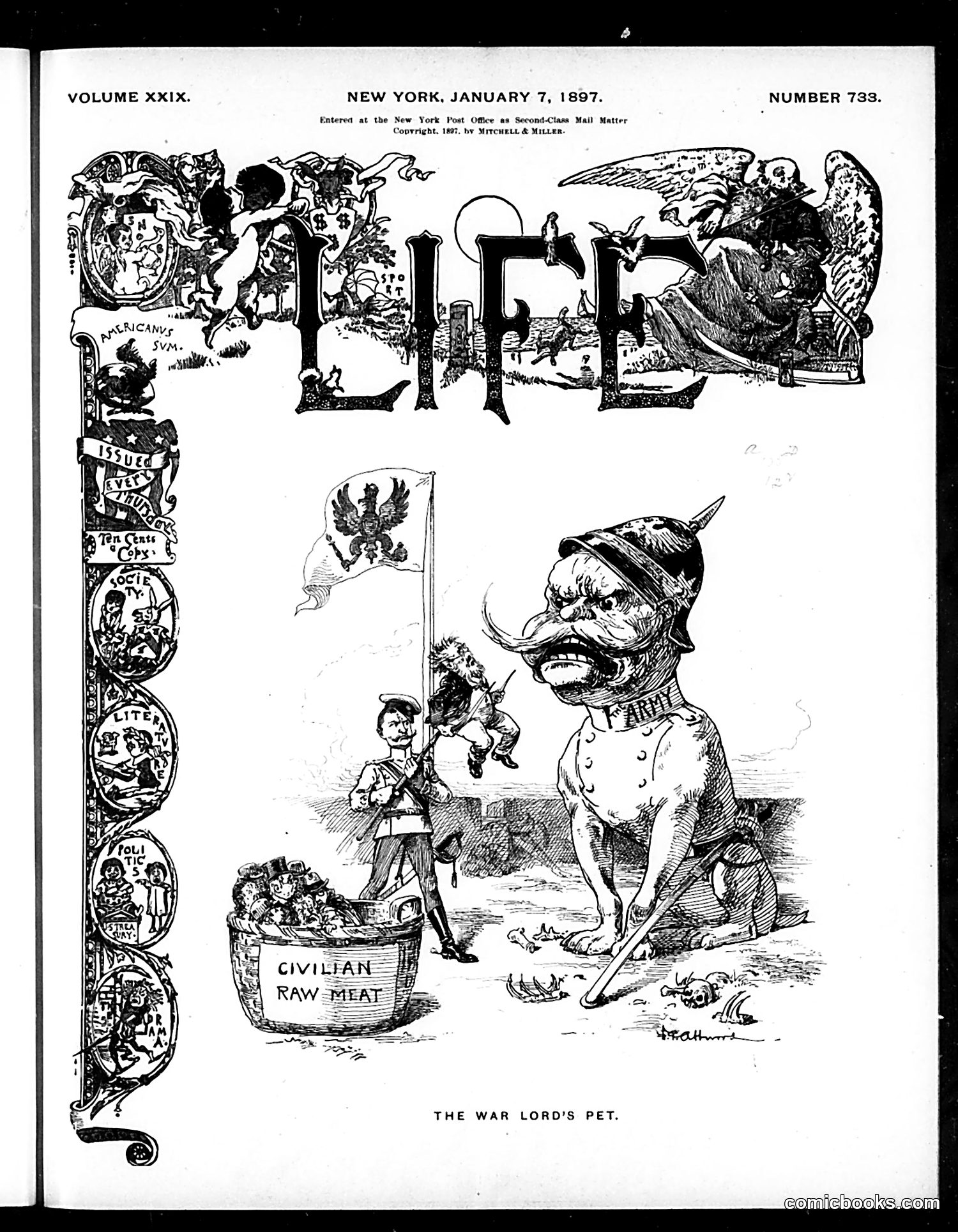
This political cartoon satirizes German militarism and Kaiser Wilhelm II (the caricatured figure with the spiked Prussian helmet and exaggerated mustache). The cartoon depicts the Kaiser as a brutish, aggressive "pet" controlled by military interests. The basket labeled "CIVILIAN RAW MEAT" suggests that civilians are being consumed or sacrificed to feed militaristic ambitions. The small soldier figure holding the German imperial flag appears to be managing or restraining this military beast. The satire critiques how German civilian society was subordinated to military power and the Kaiser's imperial agenda during this period of rising European tensions preceding World War I.
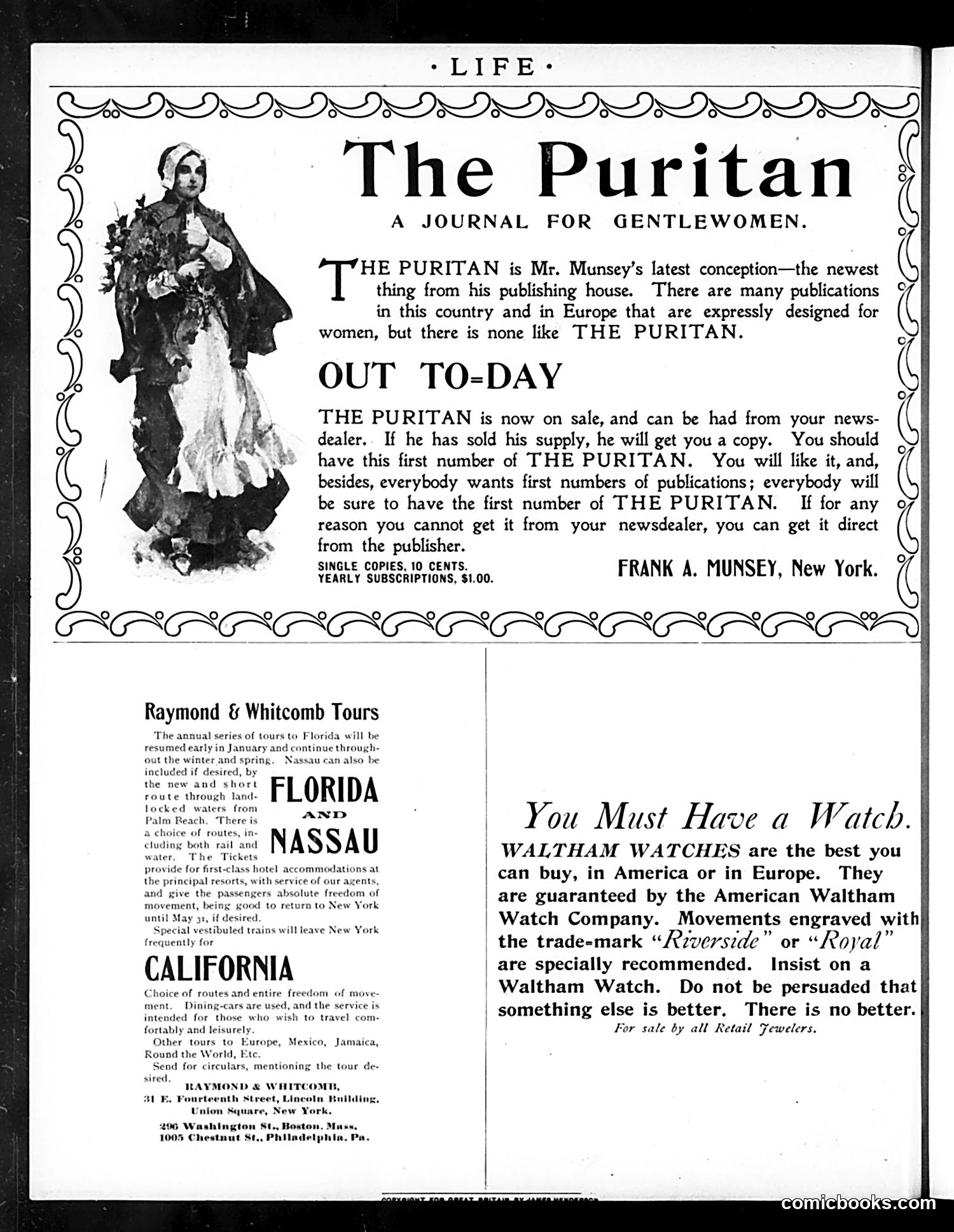
This page is primarily **advertising content**, not satire or political commentary. The main advertisement promotes *The Puritan*, a new magazine for women published by Frank A. Munsey. The illustration shows a woman in Victorian-era dress (long skirts, decorative cloak) and represents the magazine's target audience of "gentlewomen." The ad emphasizes this is Munsey's "latest conception" and encourages readers to purchase the first issue from newsdealers. The page also contains ads for Raymond & Whitcomb Tours (travel packages to Florida, California, and Europe) and Waltham Watches, typical period advertisements. There is **no discernible political satire or cartoon** on this page—it's a straightforward commercial publication showcasing consumer products and services for wealthy readers.
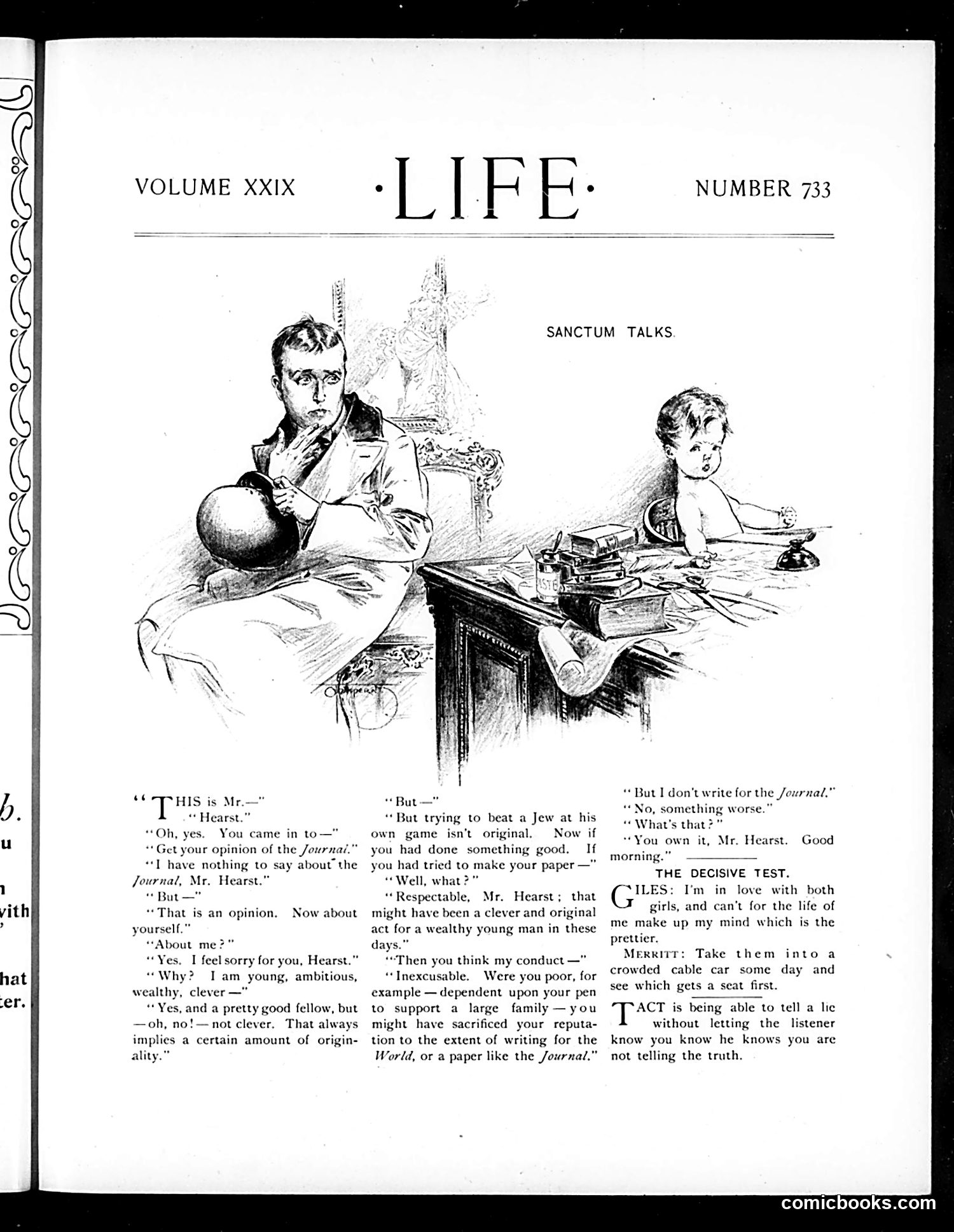
This satirical piece critiques journalism ethics, specifically targeting writers who compromise their principles for publication. The illustration shows a man (identified as "Mr. Hearst," likely referencing William Randolph Hearst, the powerful newspaper magnate) speaking with a young, ambitious writer. The dialogue reveals the satire's point: the established editor pressures the writer to produce sensational content rather than original, thoughtful work. When the writer protests that he doesn't write for "the Journal," Hearst dismisses this, suggesting even respectable publications compromise integrity. The final section, "The Decisive Test," sarcastically suggests that the ability to lie convincingly without the listener detecting dishonesty is a useful skill—mocking how journalism had become about manipulation rather than truth-telling.
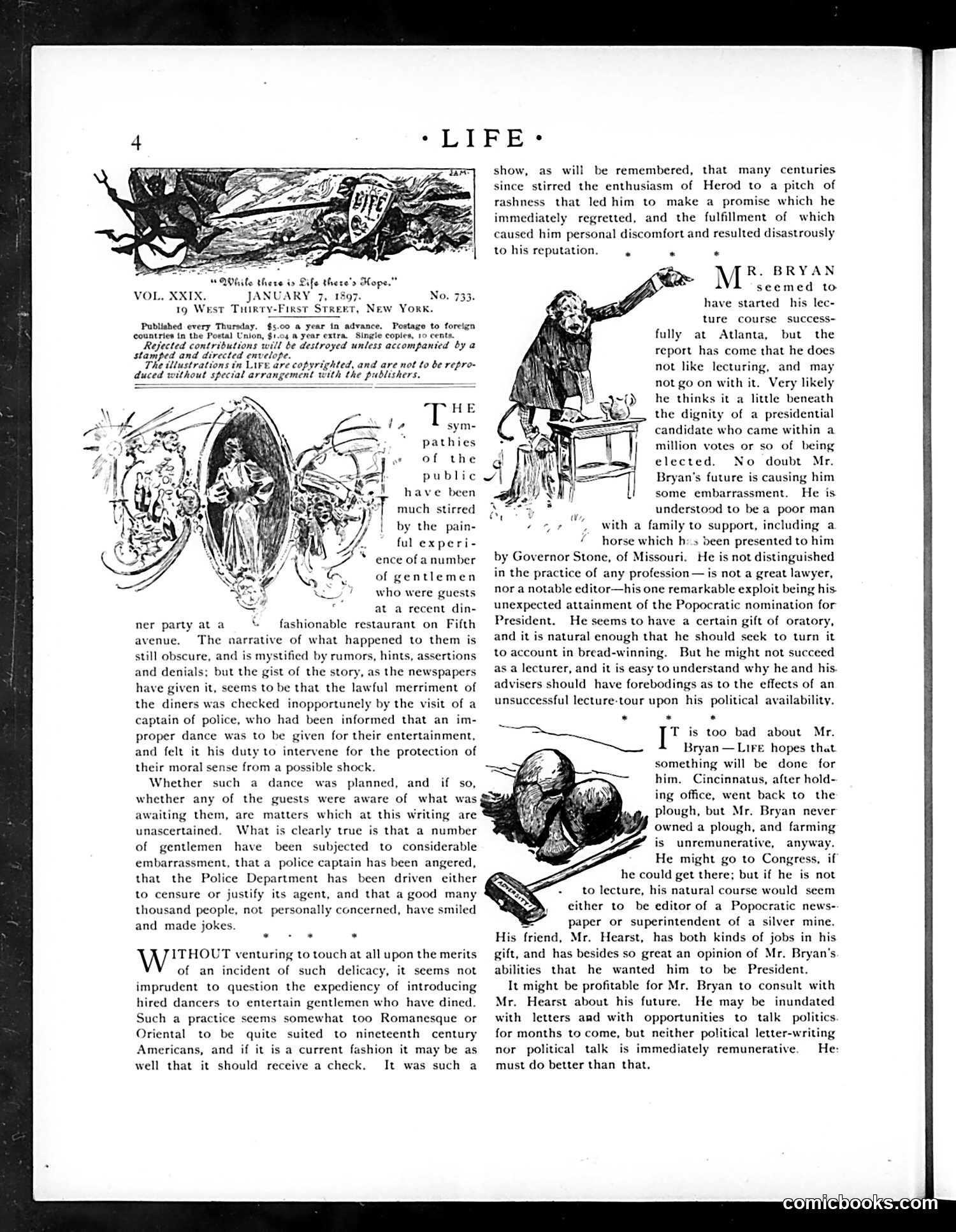
This page critiques **William Jennings Bryan**, the populist politician and three-time presidential candidate. The text discusses Bryan's failed lecture tour, suggesting he lacks the oratorical gifts needed for success on the platform despite his political prominence. The illustrations mock Bryan's career prospects. One cartoon shows him as an entertainer or performer—suggesting his political ambitions are theatrical rather than serious. Another depicts him struggling with manual labor, implying his future lies in farming or working-class work rather than high office. The satire targets Bryan's perceived unsuitability for leadership, his failed business ventures, and his reliance on others' support. The piece suggests his political future looks bleak despite his prior prominence in American politics.
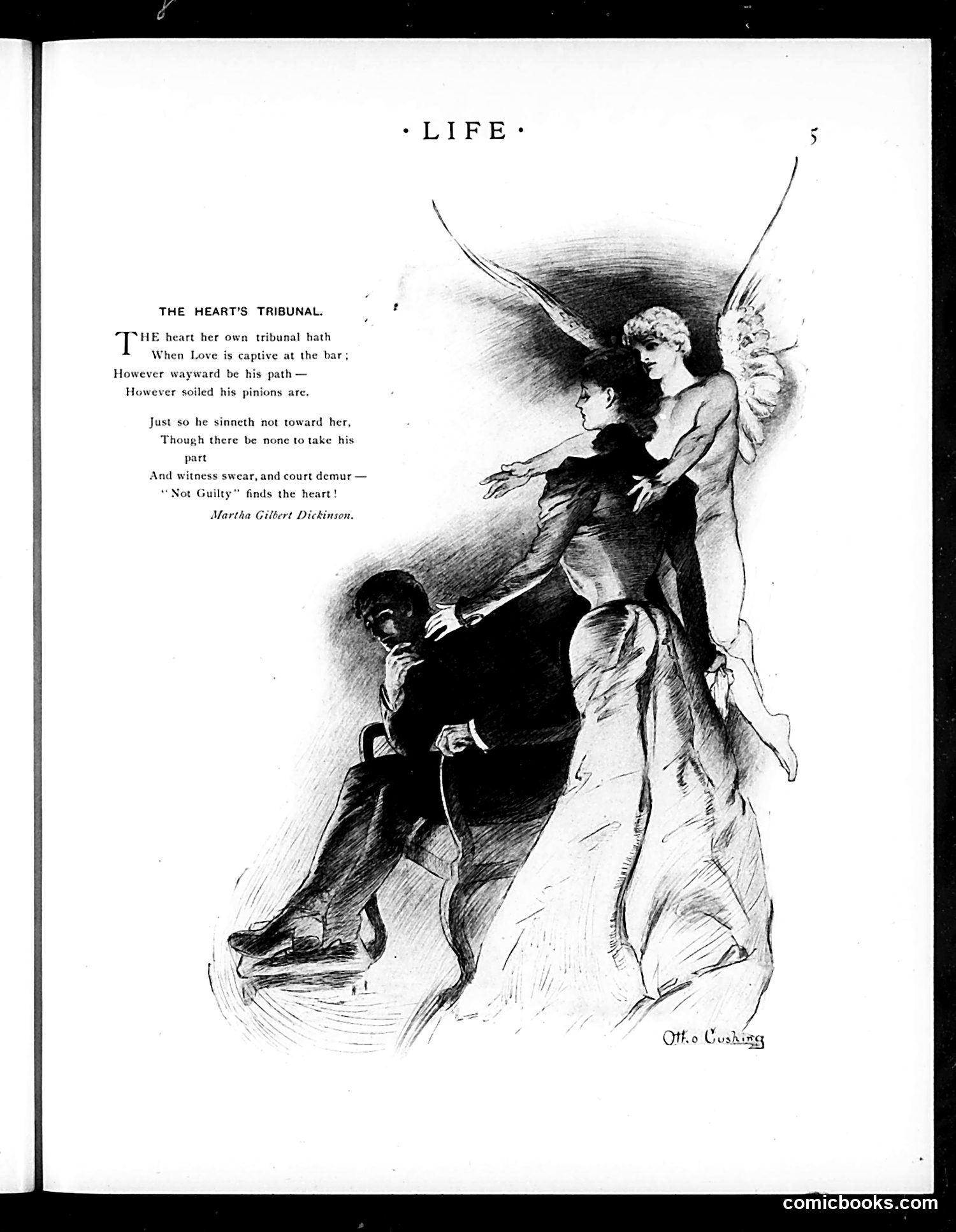
This page from *Life* magazine presents a poem by Martha Dickinson (likely related to Emily Dickinson) titled "The Heart's Tribunal," illustrated by Otto Cushing. The illustration depicts three figures: a man in dark clothing at the bottom left, appearing to climb or struggle upward; two figures above (a woman and what appears to be an angelic or allegorical female figure with wings) positioned higher, suggesting judgment or moral authority. The poem's theme concerns love, conscience, and moral judgment—the "heart's tribunal" determining guilt or innocence in matters of the heart. The visual composition uses vertical hierarchy to reinforce this: the struggling man below faces judgment from elevated feminine figures representing love and morality above. This reflects Victorian-era sentimentality about women as moral arbiters of romantic conduct.
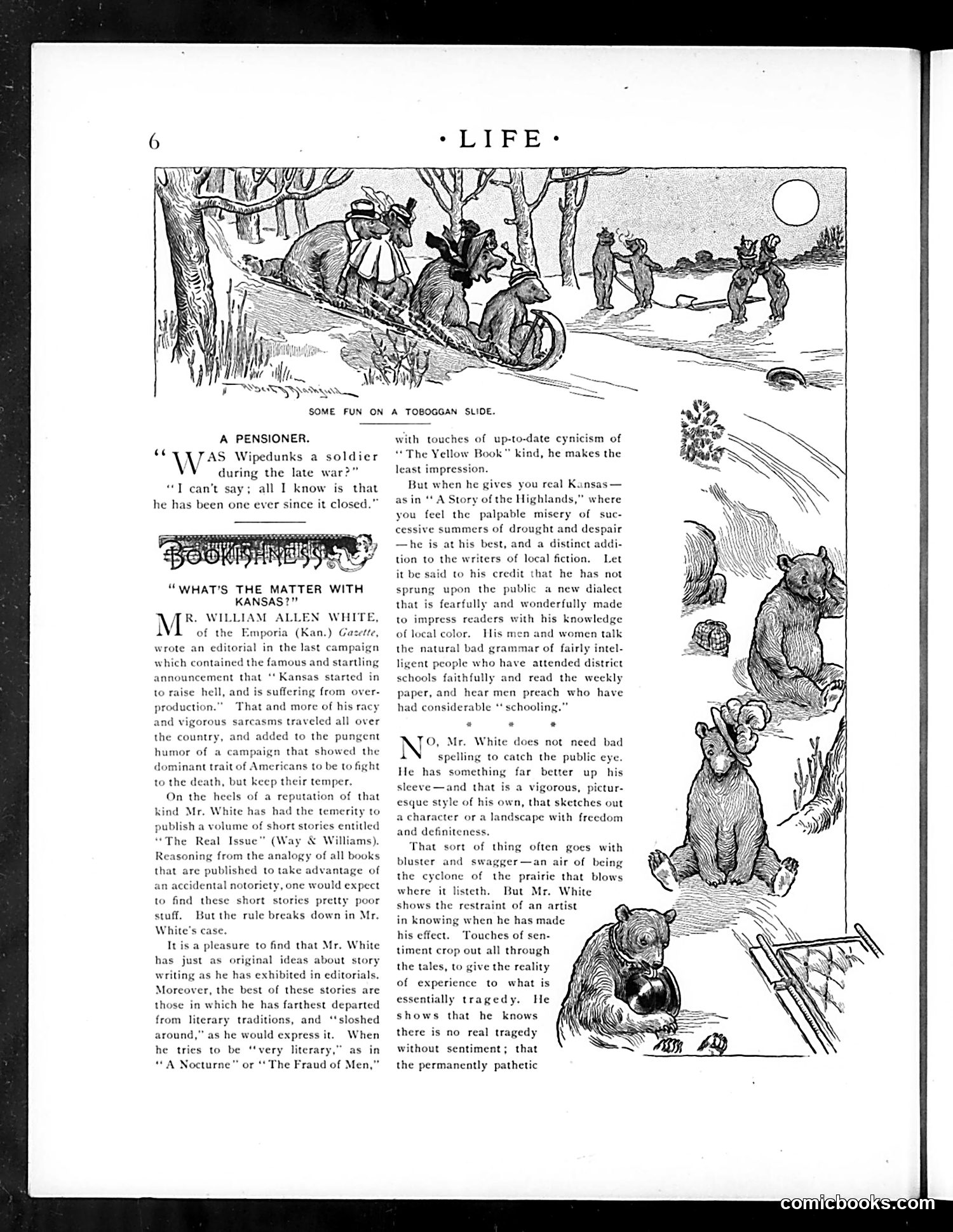
**Main Content:** This page reviews Kansas author Marshall Allen White's short stories. The text praises White's realistic depiction of Kansas life and his restrained, sophisticated writing style—avoiding melodrama while capturing authentic tragedy and human experience. **Top Illustration:** "Some Fun on a Toboggian Slide" depicts bears sledding, a lighthearted scene unrelated to the article below. **Right Illustration:** A series of sketches showing bears in various poses, likely accompanying a humorous sidebar or separate piece (not clearly connected to White's review). **Satire/Context:** The page demonstrates *Life*'s dual function: literary criticism alongside humor and whimsy. The contrast between serious literary analysis and playful animal illustrations reflects the magazine's satirical, eclectic approach to American culture circa early 1900s.
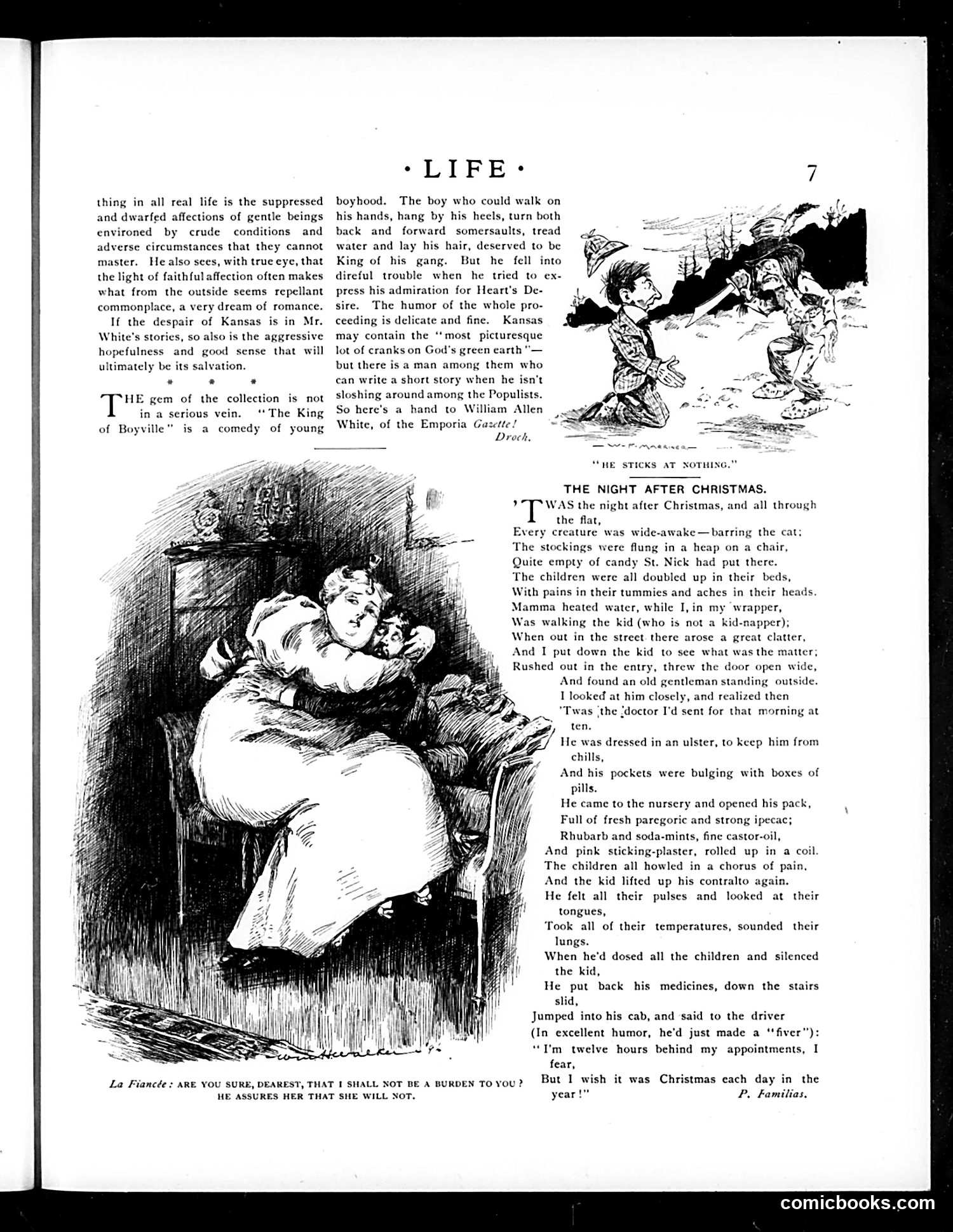
This page contains two distinct pieces: 1. **"The King of Boyville"** - A brief editorial discussing Mr. White's Kansas stories, praising them as comedic yet ultimately redemptive tales of boyhood hardship. 2. **"The Night After Christmas"** - A humorous poem by P. Familias about a doctor's chaotic Christmas visit to treat sick children. The accompanying sketch shows a woman holding a feverish child. The satirical point targets the romanticization of poverty and hardship in popular literature. While praising White's ability to find romance in crude Kansas conditions, the editor notes this works only when the author himself isn't "sloshing around among the Populists"—a jab at political involvement tainting literary merit. The Christmas poem mocks the contrast between holiday sentiment and harsh medical reality.
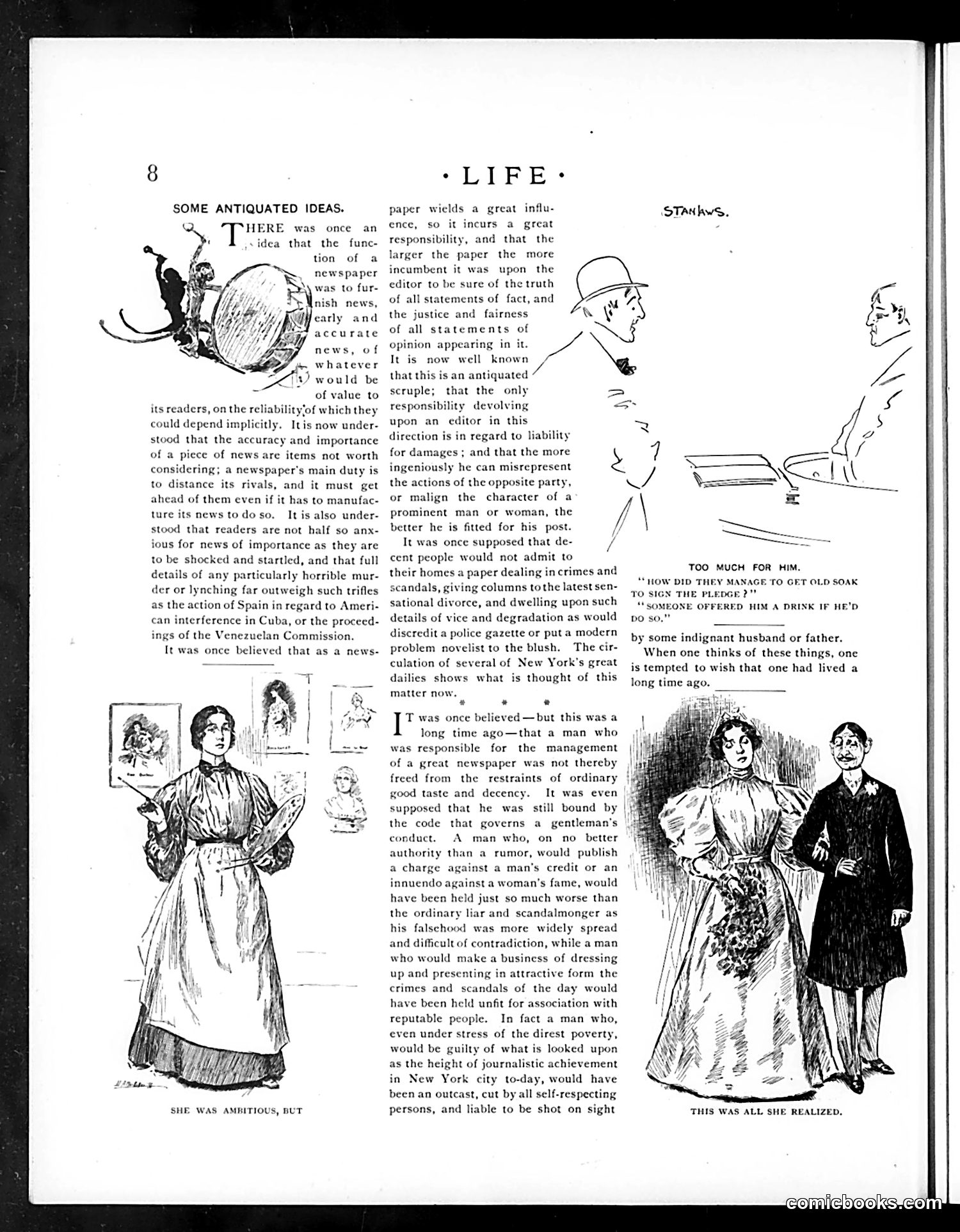
This page satirizes outdated journalistic ethics through text and illustrations. The article argues that old newspaper standards—like editors ensuring factual accuracy and refusing to publish unsubstantiated gossip about prominent citizens—are now considered quaint. The cartoons illustrate this decline: "She Was Ambitious, But" shows a woman surrounded by sketches of society scandals, suggesting she built a journalism career on sensationalism. "This Was All She Realized" depicts her with an indignant man, implying the social ruin that follows from irresponsible reporting. The satire critiques modern New York newspapers for treating scandal-mongering as legitimate journalism, arguing that responsible editors would once have refused such content as degrading to both the profession and their readers.
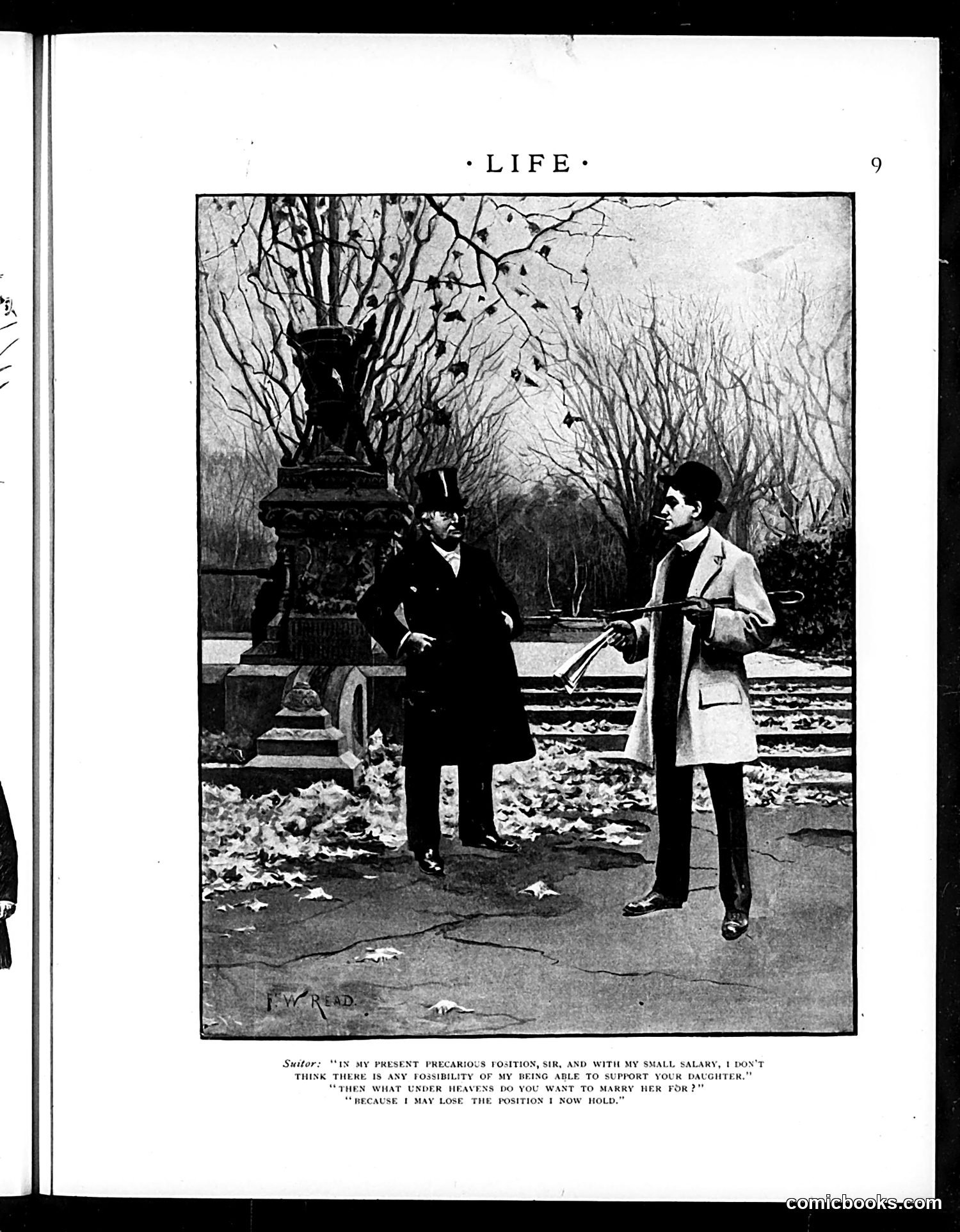
This is a satirical cartoon from *Life* magazine showing two men in a park setting. The caption presents a dialogue where one man (left) tells another (right) that despite his "present precarious position" and "small salary," he cannot support the other man's daughter, and asks how the man can afford to support her himself, concluding "because I have lost the position I now hold?" The satire appears to target economic anxiety during a period of financial instability (likely early 20th century). The joke hinges on the absurdity: a man without secure employment is questioning how someone else manages to support dependents while facing job insecurity. It's social commentary on the precarious economic circumstances facing working men and the impossible expectations placed on them regarding family support and marriage prospects during uncertain times.
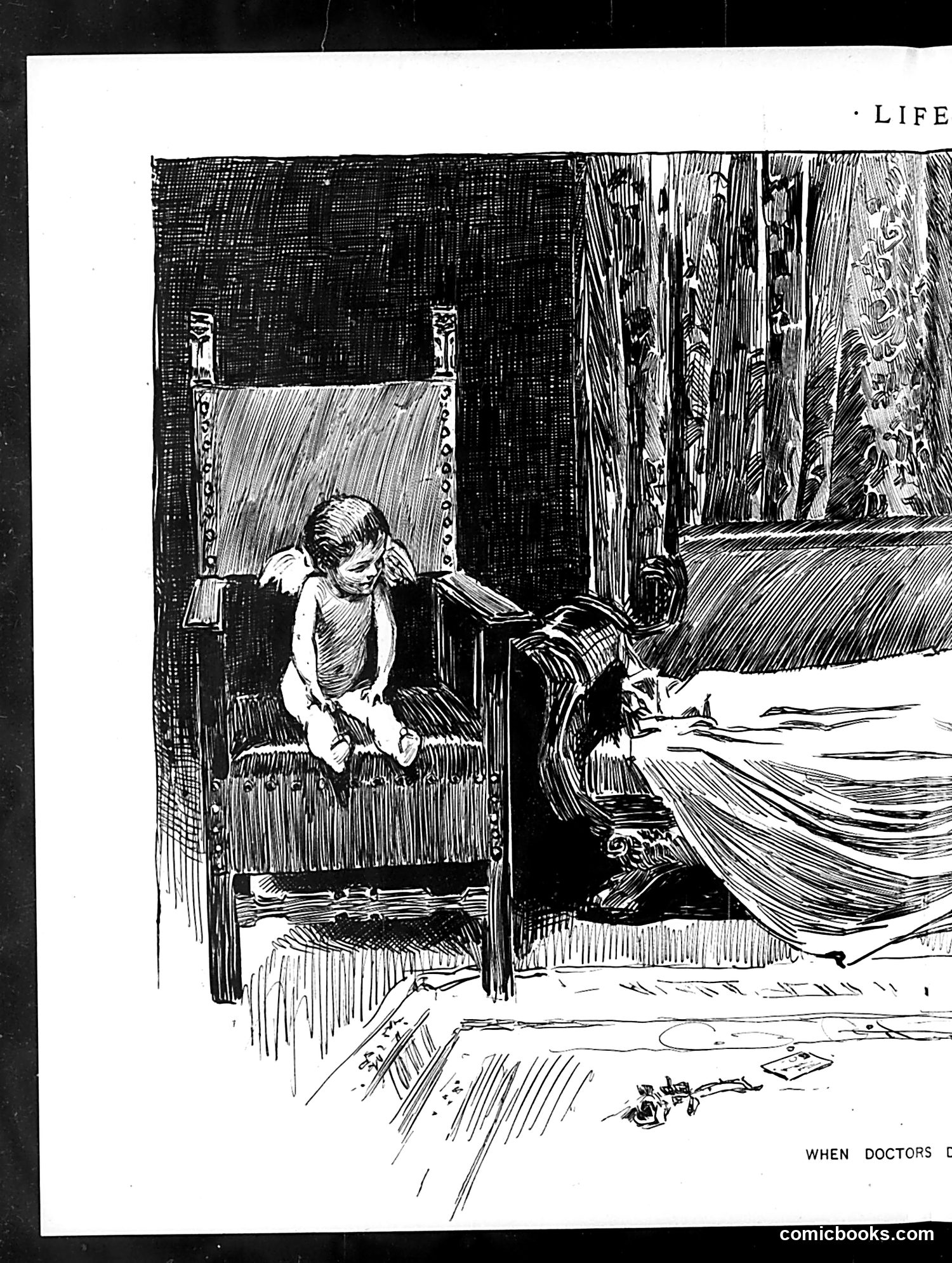
This is a black and white illustration showing a domestic scene. A shirtless young child sits on a chair while an adult (likely a mother or caregiver) tends to them on a bed nearby. The room contains period furniture and clothing scattered on the floor. The visible text fragment reads "WHEN DOCTORS D[...]" (cut off), suggesting this is part of a larger caption about medical advice or doctors' recommendations. Without the complete caption or full context from the Life magazine page, the exact satirical point is unclear. It likely comments on contemporary parenting practices, medical advice, or domestic life in the early 20th century. The illustration style and setup suggest it's making a humorous observation about childhood care or health practices of that era, but the specific target of satire cannot be determined from the visible portion alone.
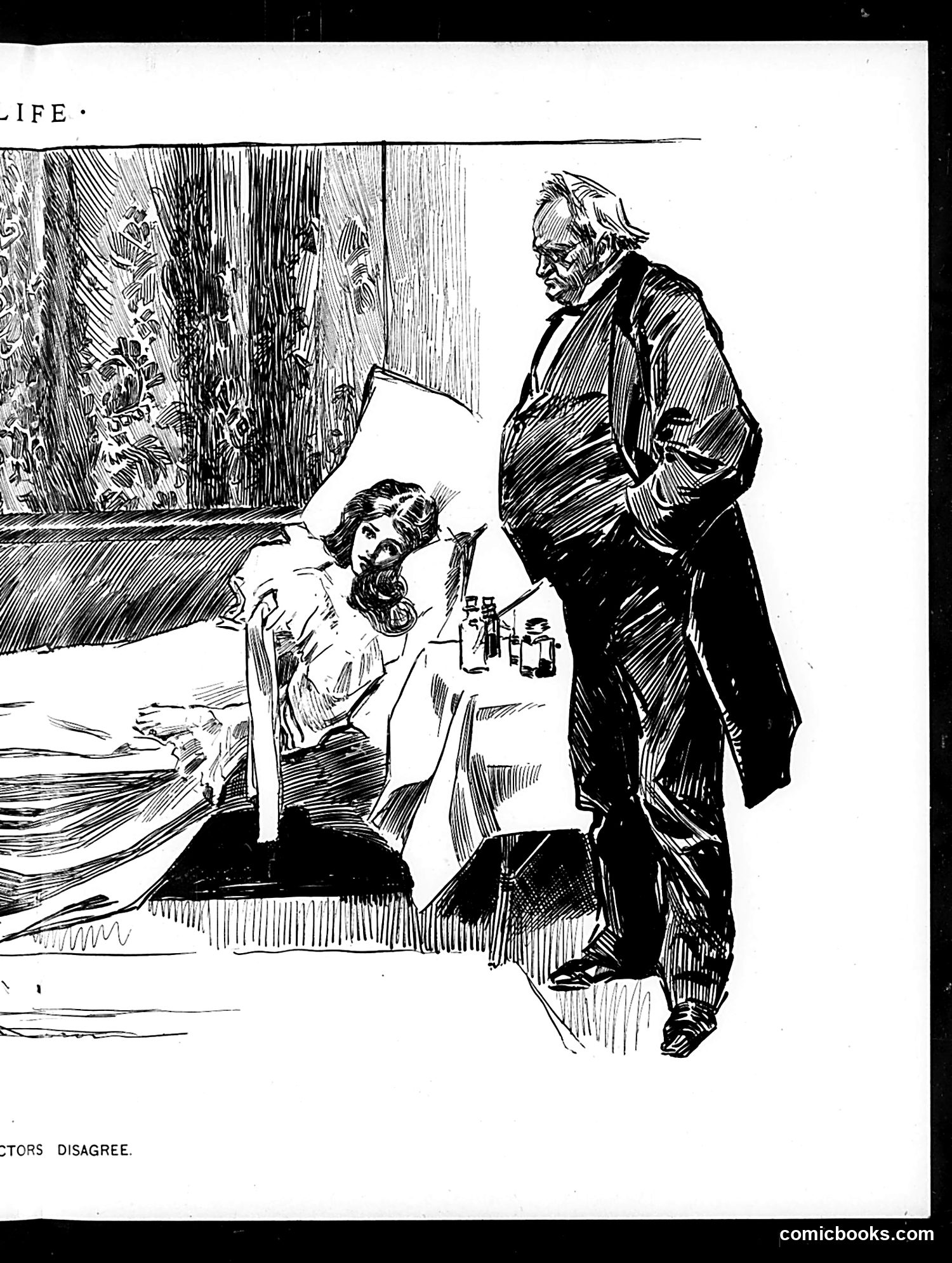
This appears to be a satirical medical scene from early 20th-century Life magazine. The visible text fragment "CTORS DISAGREE" (likely "DOCTORS DISAGREE") suggests the cartoon critiques disagreement among physicians or medical professionals. The image shows a bearded, elderly male figure (possibly representing an established medical authority or doctor) observing a younger person sitting at what appears to be a desk with bottles or medical supplies. The composition suggests commentary on conflicting medical opinions or practices of the era. Without the complete caption or date, the specific medical controversy being satirized remains unclear, though the contrast between the two figures implies generational or professional disagreement within medicine—a common satire target in Life's early decades.
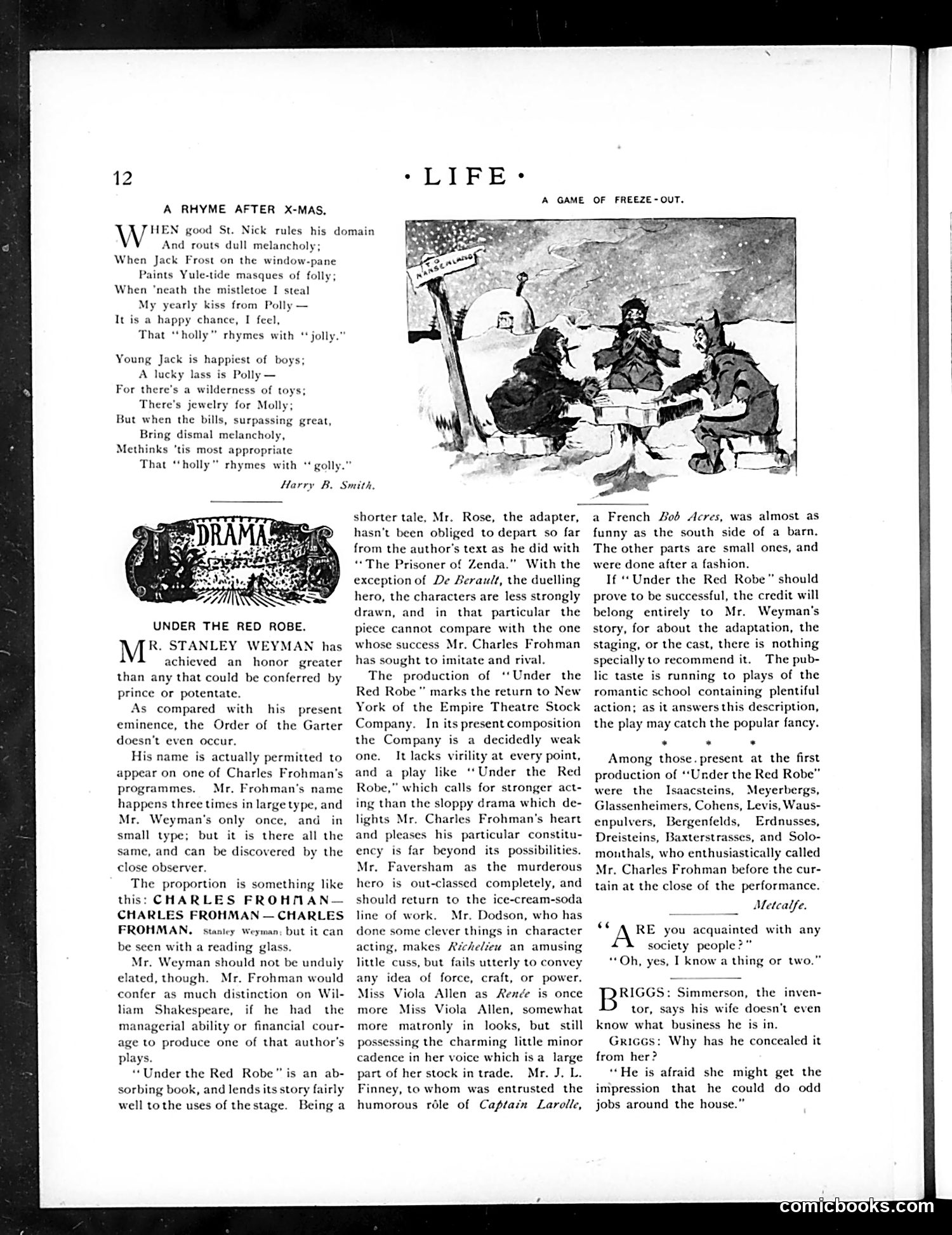
This page contains theatrical reviews and a holiday poem, not political cartoons. The main content critiques the stage production of "Under the Red Rose," adapted from Stanley Weyman's novel by producer Charles Frohman. The satire targets **Charles Frohman's outsized ego**: the reviewer sarcastically notes that Weyman's name appears on Frohman's programs—but only once in small type, while Frohman's name appears three times in large type. The joke is that Frohman takes credit for everything, treating himself as more important than the actual author. The review is scathing about the Empire Theatre Stock Company's performance, calling actors like Faversham "out-classed" and suggesting he should "return to the ice-cream-soda line of work." Only Weyman's original story receives praise. The opening poem humorously contrasts Christmas joy ("holly" rhyming with "jolly") with post-holiday financial stress ("holly" rhyming with "golly").
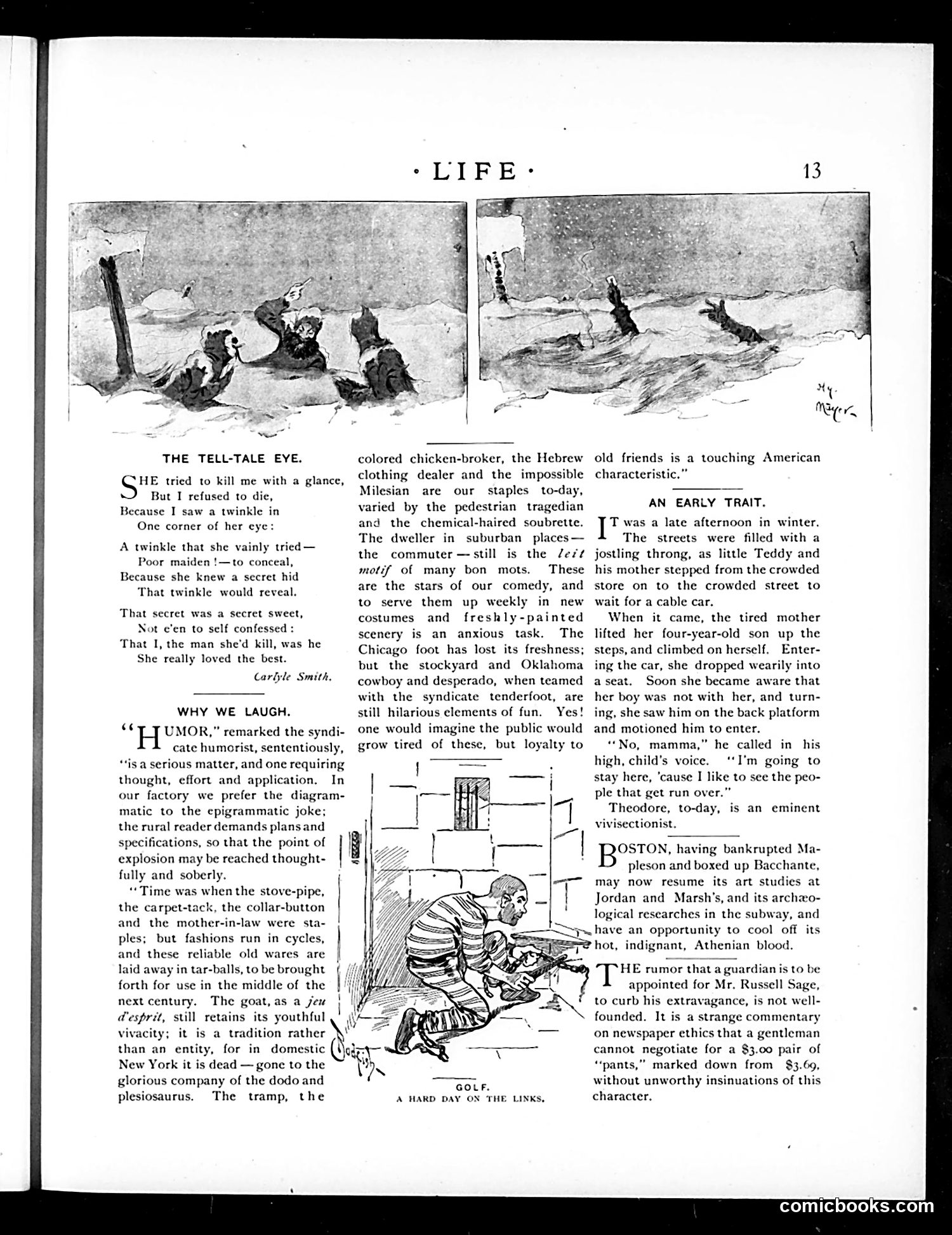
This page contains multiple satirical pieces typical of early 20th-century *Life* magazine humor: **"The Tell-Tale Eye"** is a sentimental poem about a woman whose concealed affection is revealed by her eye's twinkle—conventional romantic verse. **"Why We Laugh"** critiques syndicate humor factories, explaining their formulaic approach. It identifies stock comic characters: "the colored chicken-broker, the Hebrew clothing dealer and the impossible Milesian" (Irish person)—ethnic stereotypes standard to period humor. The passage celebrates the "commuter" and "Oklahoma cowboy" as currently popular comedic subjects, reflecting contemporary American preoccupations. **"An Early Trait"** tells an anecdote about a young boy ("Teddy") who displays morbid curiosity watching pedestrians on streetcar tracks, with the punchline that he became a "vivisectionist"—a dark joke equating anatomical dissection with his childhood fascination. **"Golf: A Hard Day on the Links"** accompanies an illustration of a golfer. The remaining brief items satirize Boston's cultural pretensions, Russell Sage's finances, and newspaper gossip—typical society-page mockery.
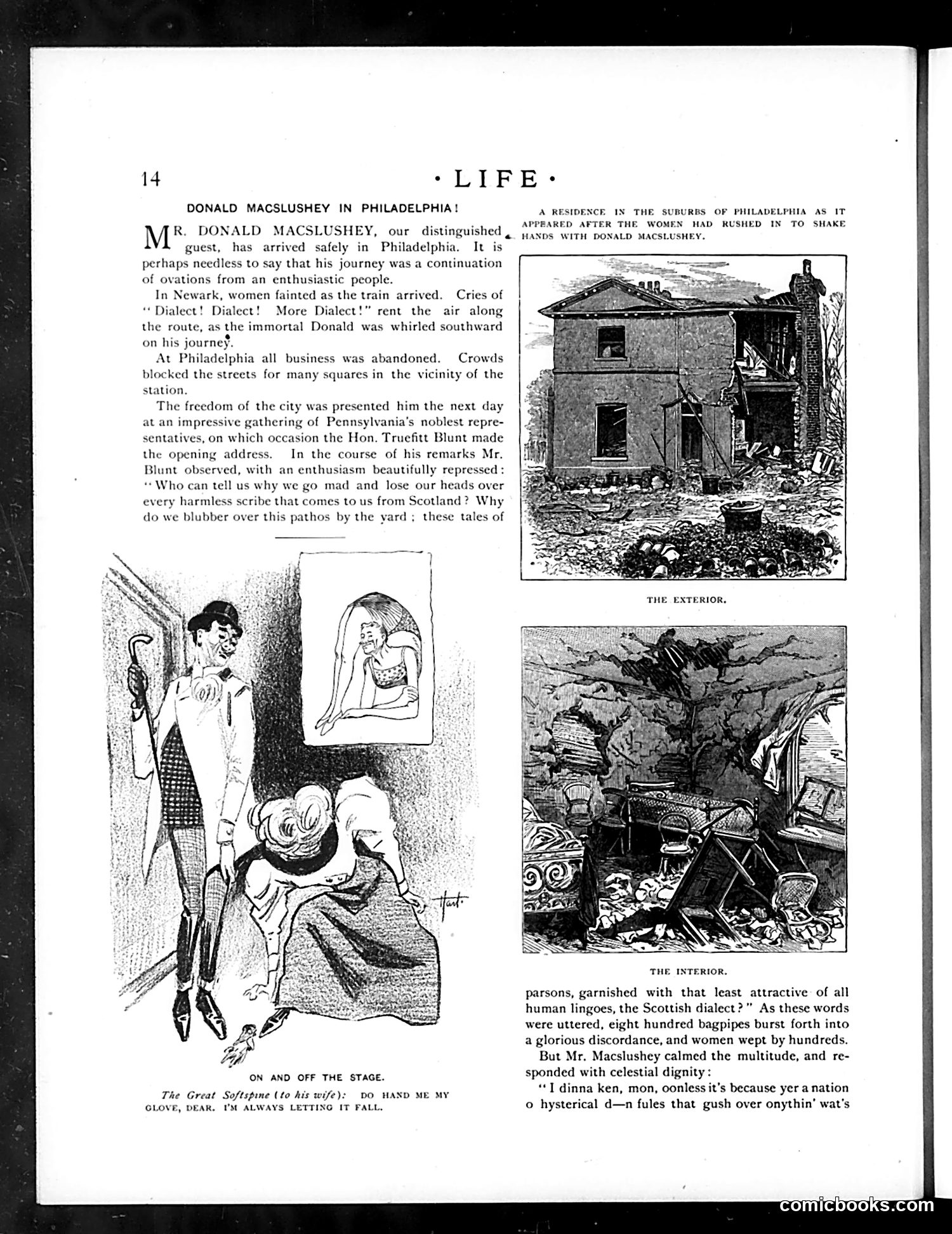
This satirizes the hysterical American reception of Scottish writer **Donald MacSlushey** (likely a fictional parody of a real celebrated Scottish author). The joke mocks Americans' overwrought enthusiasm for Scottish dialect literature and romanticism. The cartoon shows: 1. **The exaggerated fandom**: Women fainting, crowds blocking streets, business halted—absurd idol-worship behavior. 2. **The "dialect" obsession**: Characters repeatedly cry "Dialect! Dialect!" mocking Americans' fascination with Scottish vernacular writing. 3. **The satirical irony**: When asked why Americans go "mad" over Scottish pathos, MacSlushey responds (in heavy dialect) that they're "hysterical" fools who gush over anything Scottish—the author himself embodying the very affectation being criticized. 4. **The "On and Off Stage" cartoon** shows theatrical melodrama—likely contrasting pretentious stage sentimentality with reality. The two destroyed houses illustrate the physical chaos caused by frenzied female admirers. The satire targets both sentimental Scottishness and American cultural gullibility.
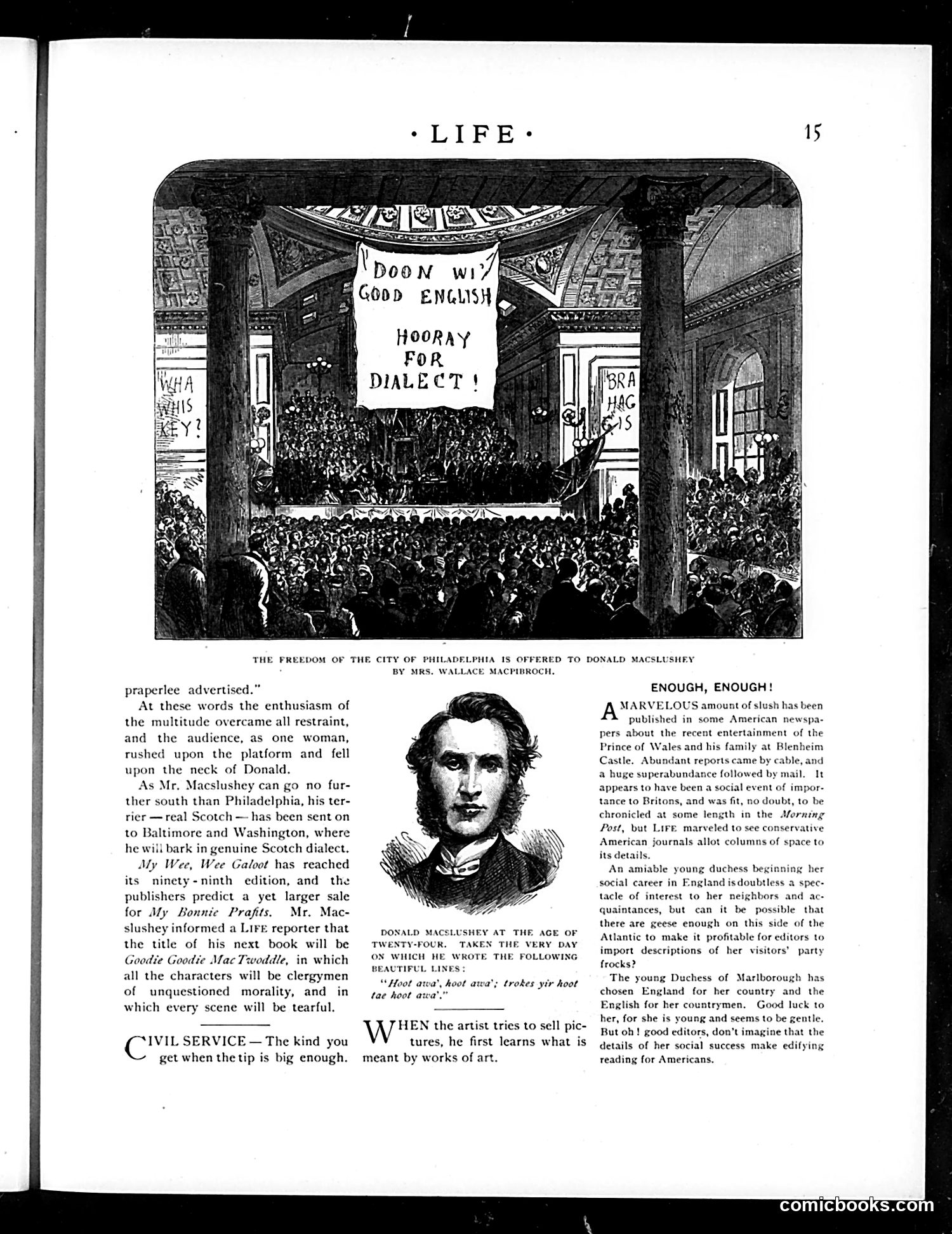
This page satirizes Scottish dialect literature and American press excess. The top illustration shows a Philadelphia crowd enthusiastically greeting "Donald Macslushey," a fictional Scottish author whose works feature heavy dialect writing ("Hoot awa'"). Life mocks both Macslushey's commercial success with his ninety-ninth edition book *My Wee, Wee Galoot* and his planned tearful novel *Goodie Goodie Mac Twoddle*. The cartoon ridicules the craze for sentimental Scottish literature in America. The caption's irony—his terrier being "sent on to Baltimore and Washington, where he will bark in genuine Scotch dialect"—suggests the absurdity of this trend. The editorial below critiques American newspapers for excessive coverage of British society events (the Prince of Wales's visit to Blenheim Castle). Life argues editors waste space on trivial "party frocks" rather than substantive content, questioning why Americans should care about a young duchess's social calendar. Both pieces target American cultural snobbery and journalistic sensationalism.
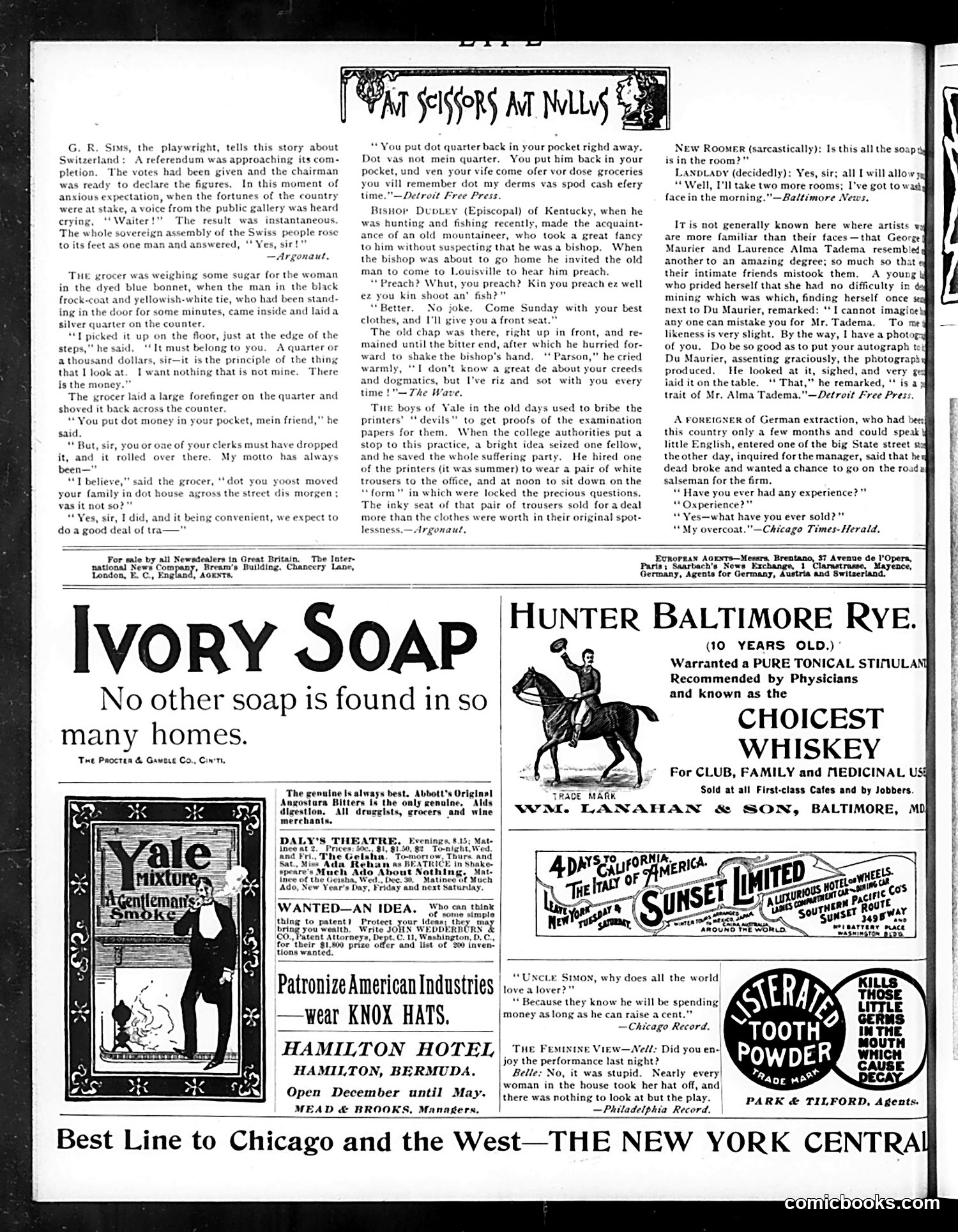
This page contains **three humorous anecdotes** rather than political cartoons: 1. **Swiss Democracy Joke**: A public assembly voting on a referendum is interrupted by someone shouting "Waiter!"—the entire Swiss people immediately respond "Yes, sir," mocking Swiss deference to service hierarchy over civic duty. 2. **The Honest Grocer**: A man returns a found quarter to a grocer, insisting on principle. The grocer recognizes him as a new neighbor and shrewdly refuses it, knowing the man will soon owe him money for groceries on credit—exposing the man's false morality. 3. **Bishop's Sermon**: A mountaineer invites a bishop to preach after hunting together, expecting performance quality equal to his fishing skills. The bishop's subsequent sermon impresses the old man not through theology but personal connection. These are gentle social satires about hypocrisy, presumption, and misplaced values—typical of *Life* magazine's satirical humor. The page is primarily **advertisements** (Ivory Soap, Knox Hats, Hunter Baltimore Rye whiskey).
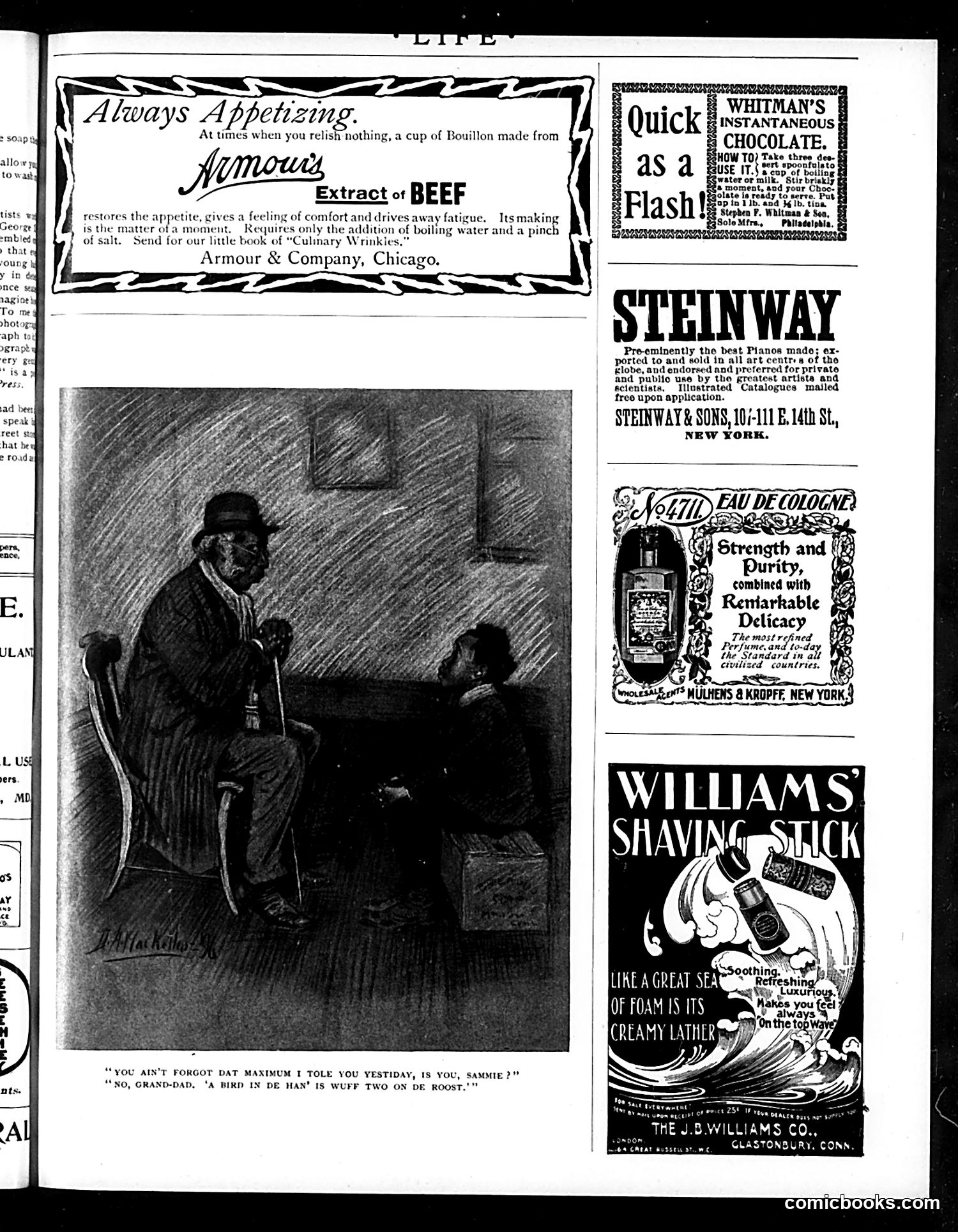
This page is primarily **advertisements** with one cartoon illustration. The central image shows a conversation between an elderly Black man and a young child, using dialect speech. The caption reads: "You ain't forgot dat maximum I tole you yesterday, is you, Sammie?" / "No, grand-dad, 'a bird in de han' is wuff two on de roost.'" This depicts a **stereotypical scene of a grandfather teaching a child folk wisdom**—specifically the proverb "a bird in the hand is worth two in the bush." The cartoon uses exaggerated dialect typical of early 20th-century racial caricature to present this as humor. The surrounding content is commercial: ads for Armour beef extract, Whitman's chocolate, Steinway pianos, Norell eau de cologne, and Williams shaving stick. This was standard Life magazine format, mixing satirical content with period advertising. **Context a modern reader misses:** The dialect and visual caricature reflect deeply racist stereotyping common to the era, presented as family warmth rather than satire.
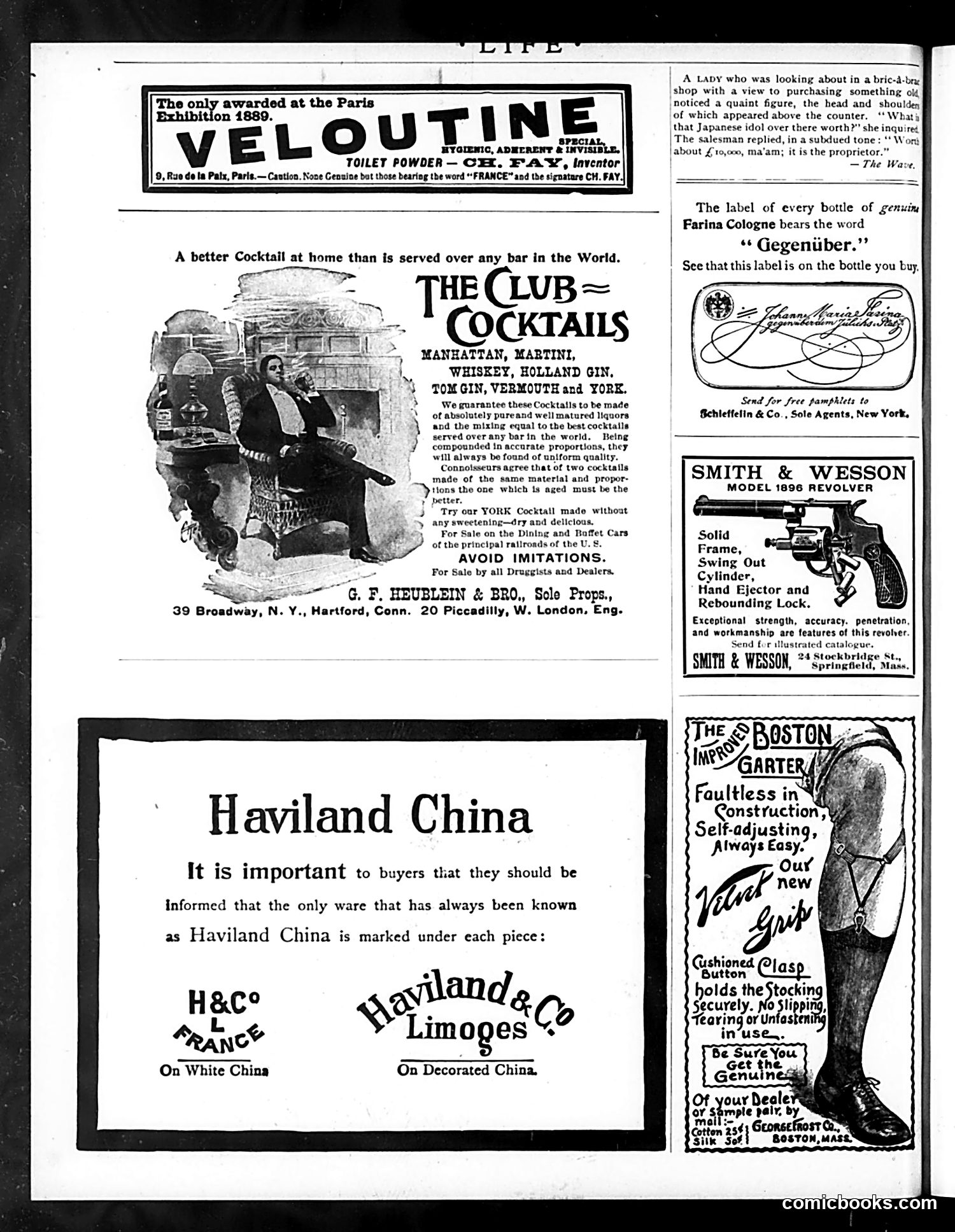
This is primarily a **advertisements page** from Life magazine (likely early 1900s based on product styles). It contains no political cartoons, though it includes one brief **satirical anecdote** at top right: A woman in an antique shop asks about a "Japanese idol" above the counter, worth £10,000. The salesman replies it's "the proprietor"—a joke mocking wealthy shop owners as exotic or pretentious figures themselves. This is gentle class humor, not political satire. The page features period advertisements for luxury goods: Veloutin toilet powder (Paris-made, awarded at 1889 Exhibition), cocktail recipes (marketed as superior to bar drinks), Haviland China (French porcelain), Smith & Wesson revolvers, Farina Cologne, and Boston garters. The ads emphasize **authenticity and quality**—warnings against imitations, maker marks, and branded labels—reflecting consumer anxieties about counterfeit goods in an era of increasing mass production and international commerce.
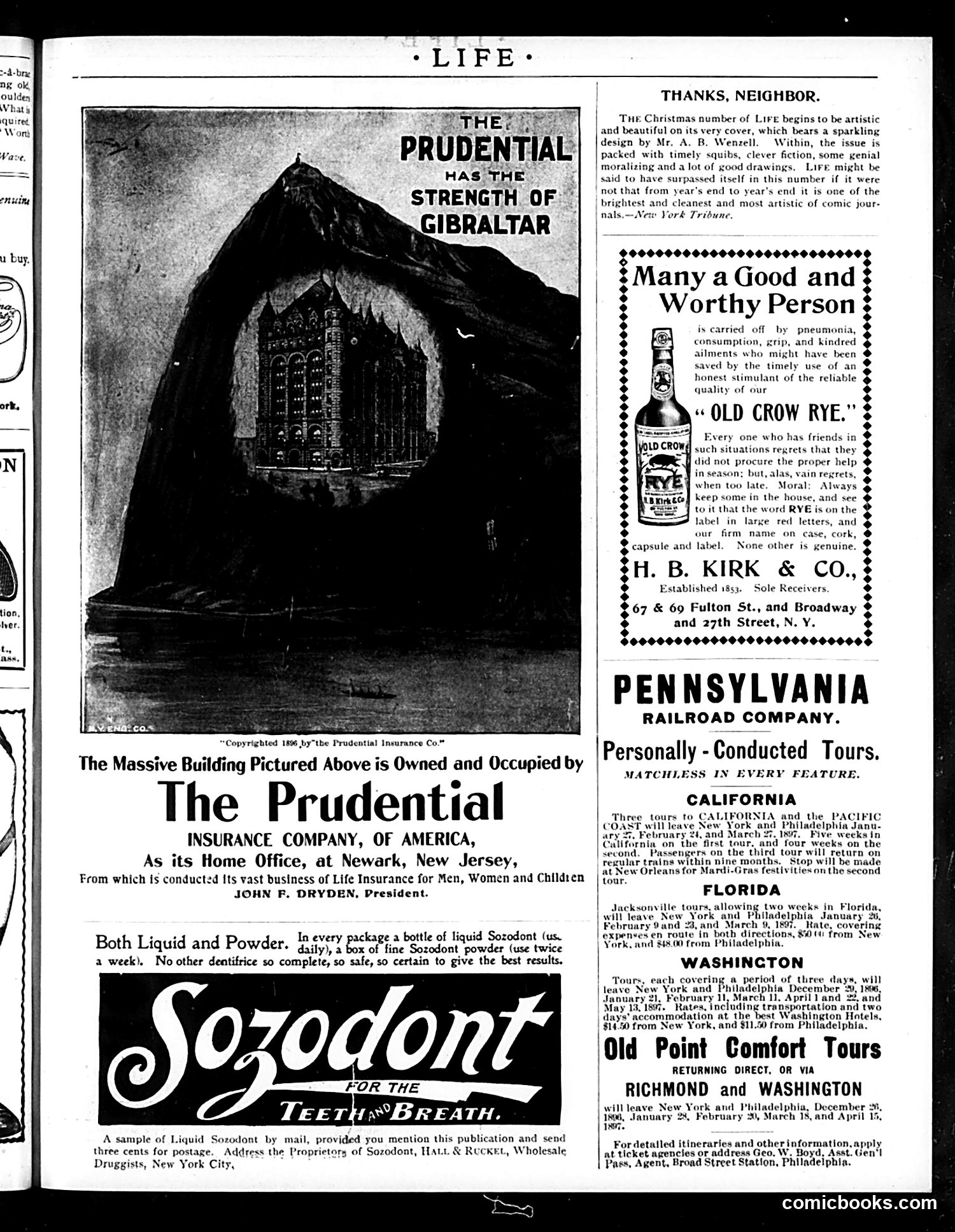
This page is primarily **advertising**, not satire or commentary. It features: **Main Content:** A large advertisement for the Prudential Insurance Company, headquartered in Newark, New Jersey under President John F. Dryden. The image shows their impressive office building (framed dramatically like Gibraltar), emphasizing corporate stability and strength—a key selling point for life insurance companies in this era. **Surrounding Ads:** - Sozodont toothpaste (liquid and powder) - Old Crow Rye whiskey, marketed as a medicinal stimulant for pneumonia and consumption - Pennsylvania Railroad tourist excursions to California, Florida, and Washington D.C. **Context:** This reflects 1896 America: life insurance was a relatively new financial product; patent medicines and alcohol were widely advertised as health remedies; and railroad tourism was booming for the wealthy. The page shows no political satire—it's a straightforward commercial magazine issue.
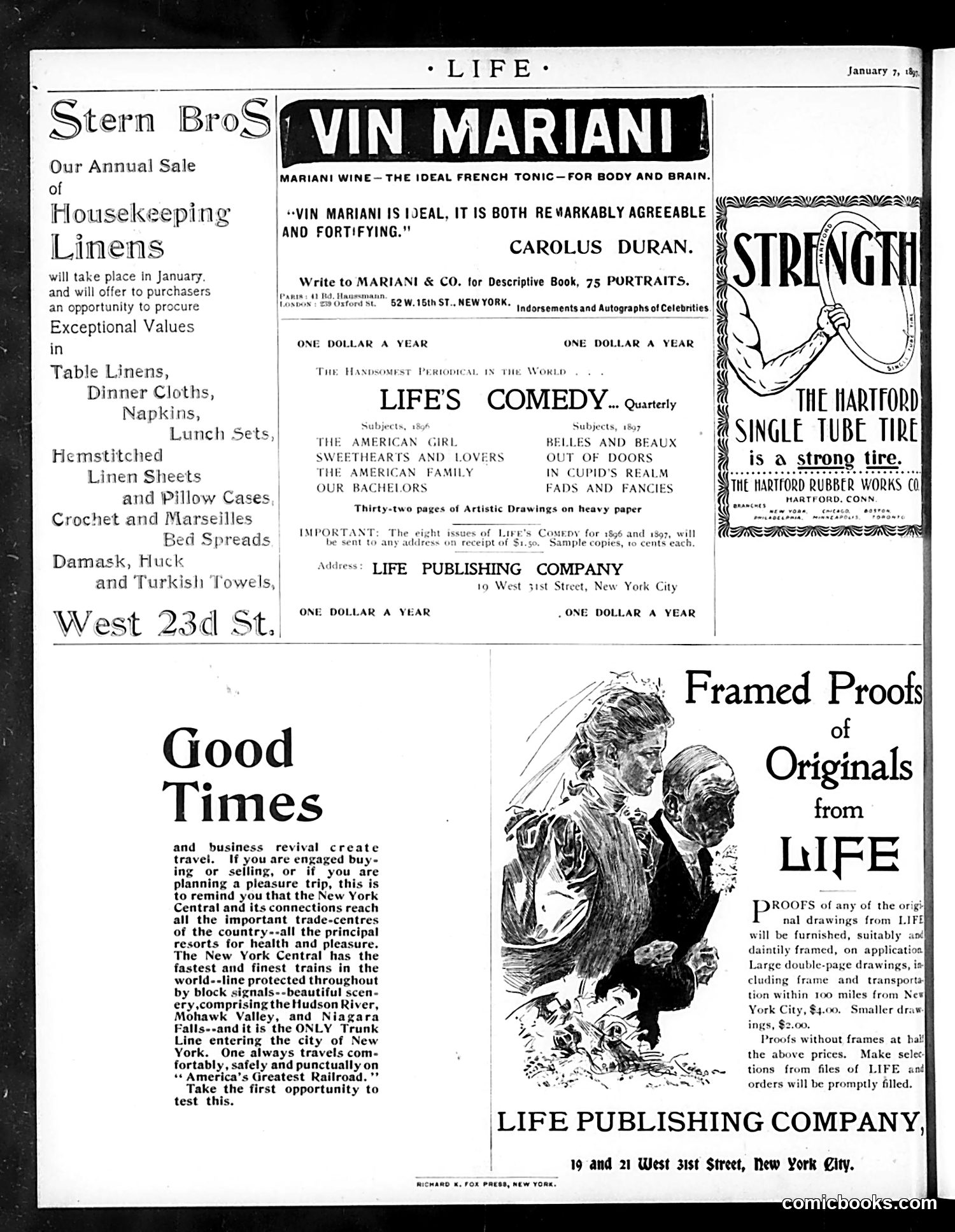
This is primarily an **advertising page** rather than a satirical cartoon page. The content consists of commercial advertisements for various products and services typical of the 1890s: **Key advertisements include:** - **Vin Mariani**: A French wine tonic marketed as beneficial for "body and brain," endorsed by the painter Carolus Duran. These patent medicines were common in this era and often contained cocaine or other drugs. - **Stern Bros.**: A department store advertising their annual linen sale. - **Hartford Single Tube Tire**: Promoting bicycle tires (bicycles were extremely popular in the 1890s). - **Life Publishing Company**: Promoting their own publications, including "Life's Comedy" quarterly and framed proofs of original artwork. - **New York Central Railroad**: Advertising rail travel, emphasizing speed and safety. **No political satire is evident** on this page—it's a straightforward commercial publication showcasing consumer goods and services of the Gilded Age period.