
Life, 1897-01-07 · page 8 of 20
Life — January 7, 1897 — page 8: what you’re looking at
What you’re looking at
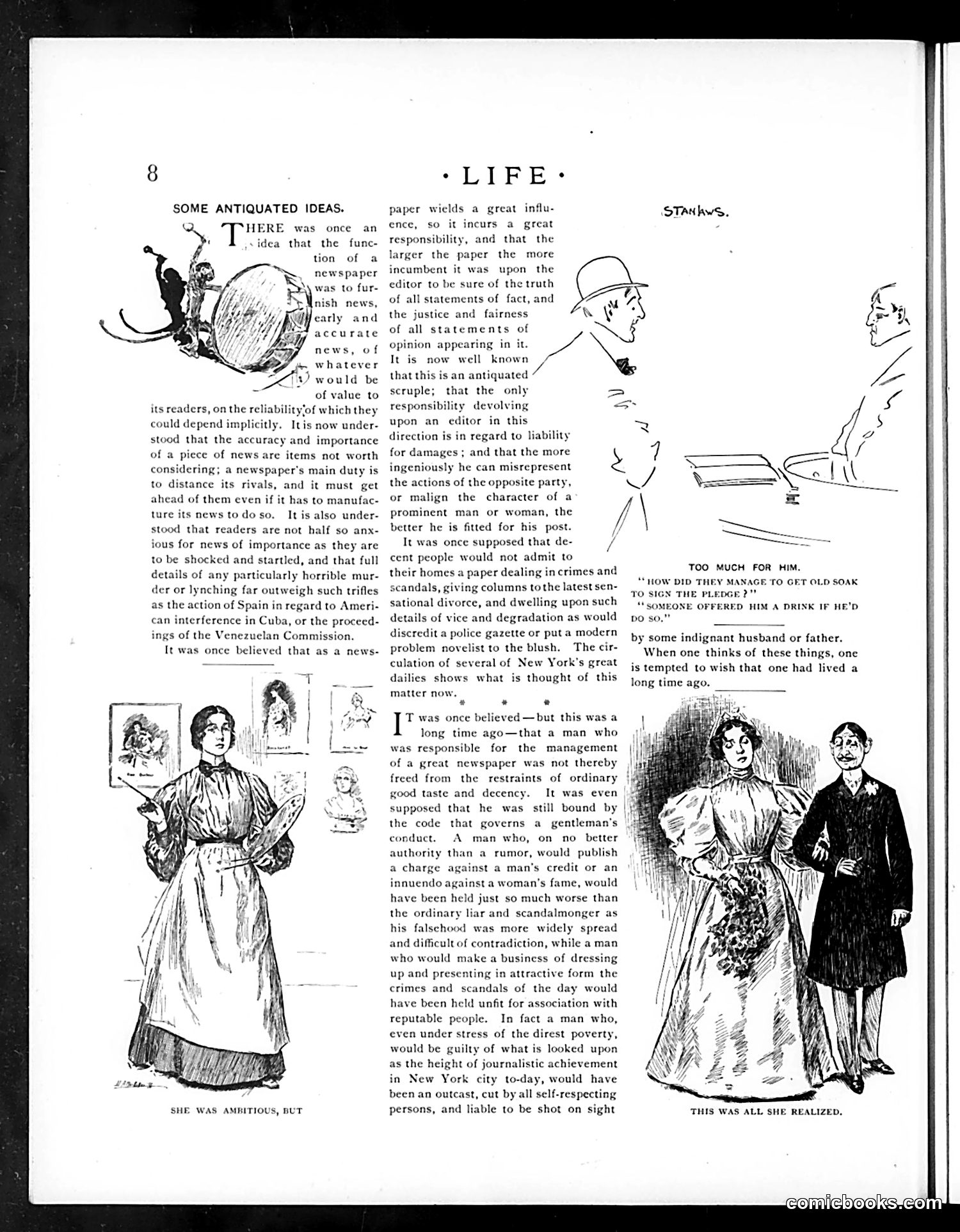
This page satirizes outdated journalistic ethics through text and illustrations. The article argues that old newspaper standards—like editors ensuring factual accuracy and refusing to publish unsubstantiated gossip about prominent citizens—are now considered quaint. The cartoons illustrate this decline: "She Was Ambitious, But" shows a woman surrounded by sketches of society scandals, suggesting she built a journalism career on sensationalism. "This Was All She Realized" depicts her with an indignant man, implying the social ruin that follows from irresponsible reporting. The satire critiques modern New York newspapers for treating scandal-mongering as legitimate journalism, arguing that responsible editors would once have refused such content as degrading to both the profession and their readers.
📄 Transcribed text from this page (OCR, searchable)
Machine-transcribed from the original scan — historical spelling and the odd misread are preserved.
SOME ANTIQUATED IDEAS. HERE was idea that once the func- tion of a newspaper Si) was to fur- accurate of whatever would be of value to its readers, on the reliability‘of which they could depend implicitly. Itis now under- stood that the accuracy and importance of a piece of news are items not worth considering; a newspaper's main duty is to distance its rivals, and it must get head of them even if it has to manufac- ture its news todo so. Itis also under- stood that readers are not half so anx- ious for news of importance as they are to be shocked and startled, and that full details of any ticularly horrible mur- der or lynching far outweigh such trifles as the action of Spain in regard to Ameri- can interference in Cuba, or the proceed- ings of the Venezuelan Commission. It was once believed that as a ne an news, SHE WAS AMBITIOUS, BUT *LIFE: paper wields a great influ- ence, so it incurs a great responsibility, and that the the upon larger the paper incumbent it was more the editor to be sure of the truth of all statements of fact, and the justice and fairness & ra of all statements of opinion appearing in it. It is now well known that this is an antiquated scruple; that the only responsibility devolving upon an editor in this direction is in regard to liability for damages ; and that the more ingeniously he can misrepresent the actions of the opposite party, or malign the character of a prominent man or woman, the better he is fitted for his post. It was once supposed that de- cent people would not admit to their homes a paper dealing in crimes and scandals, giving columns tothe latest sen- sational divorce, and dwelling upon such details of vice and degradation as would discredit a police gazette or put a modern problem novelist to the blush. The cir- culation of eral of New York's great dailies shows what is thought of this matter now, * * * T was once believed —but this was a long time ago—that a man who for the of a great newspaper was not thereby freed from the restraints of ordinary good taste and decency. It was even supposed that he was. still bound by the code that governs a gentleman's conduct. A on no better authority than a rumor, would publish a charge against a man’s credit or an innuendo against a woman's fame, would have been held just so much worse than liar and scandalmonger as his falsehood was more widely spread and difficult of contradiction, while a man who would make a business of dressing up and presenting in attractive form the crimes and scandals of the day would have been held unfit for association with reputable people. In fact a man who, even under stress of the direst poverty, would be guilty of what is looked upon as the height of journalistic achievement in New York city to-day, would have been an outcast, cut by all self-respecting persons, and liable to be shot on sight was responsible management man who, the ordinary TOO MUCH FOR HIM. HOW DID THEY MANAGE TO GET OLD SOAK TO SIGN THE PLEDGE 2?" “SOMEONE OFFERED HIM A DRINK IF HE'D bo so, by some indignant husband or father. When one thinks of these things, one is tempted to wish that one had lived a long time ago. THIS WAS ALL SHE REALIZED,