
Life, 1897-01-07 · page 13 of 20
Life — January 7, 1897 — page 13: what you’re looking at
What you’re looking at
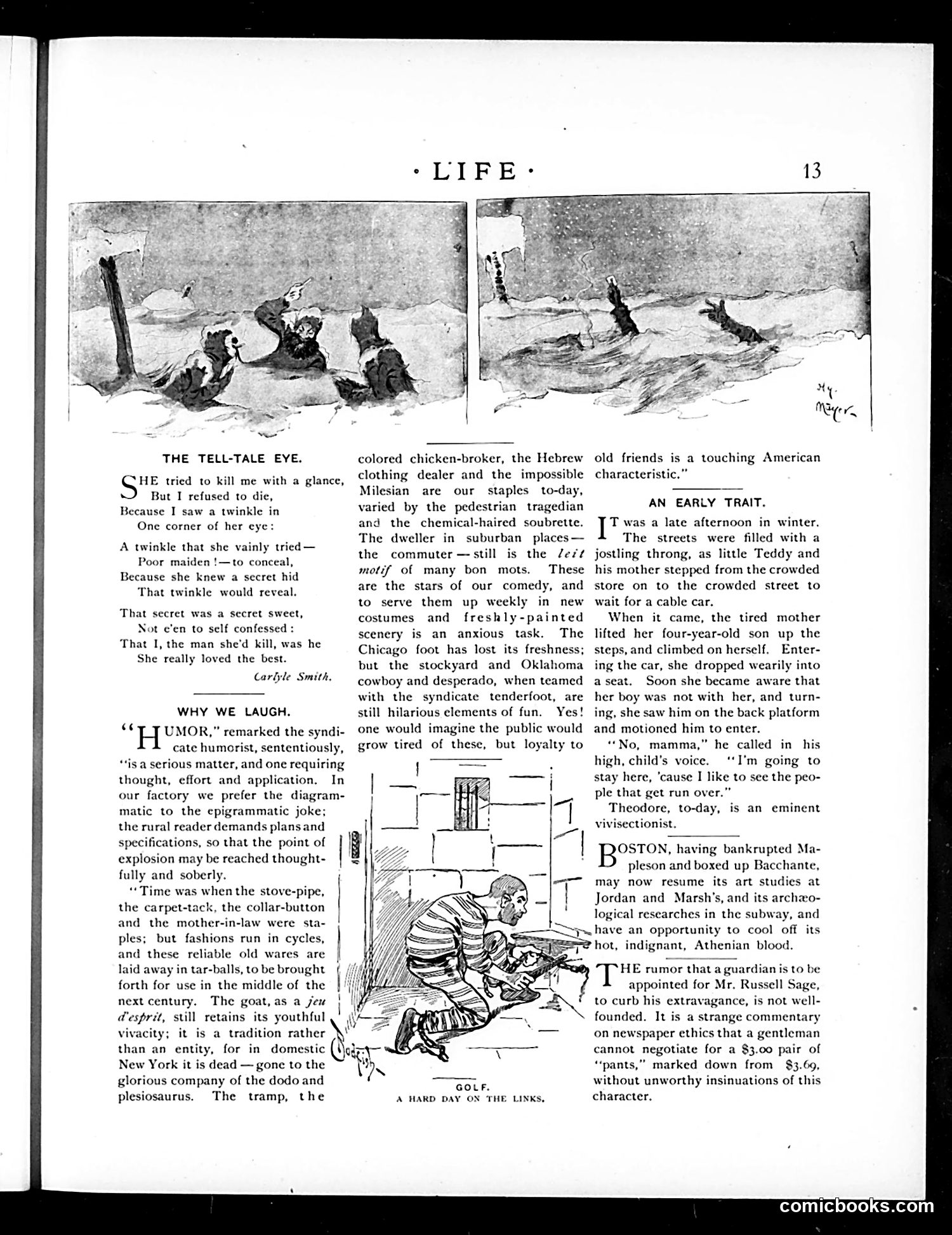
This page contains multiple satirical pieces typical of early 20th-century *Life* magazine humor: **"The Tell-Tale Eye"** is a sentimental poem about a woman whose concealed affection is revealed by her eye's twinkle—conventional romantic verse. **"Why We Laugh"** critiques syndicate humor factories, explaining their formulaic approach. It identifies stock comic characters: "the colored chicken-broker, the Hebrew clothing dealer and the impossible Milesian" (Irish person)—ethnic stereotypes standard to period humor. The passage celebrates the "commuter" and "Oklahoma cowboy" as currently popular comedic subjects, reflecting contemporary American preoccupations. **"An Early Trait"** tells an anecdote about a young boy ("Teddy") who displays morbid curiosity watching pedestrians on streetcar tracks, with the punchline that he became a "vivisectionist"—a dark joke equating anatomical dissection with his childhood fascination. **"Golf: A Hard Day on the Links"** accompanies an illustration of a golfer. The remaining brief items satirize Boston's cultural pretensions, Russell Sage's finances, and newspaper gossip—typical society-page mockery.
📄 Transcribed text from this page (OCR, searchable)
Machine-transcribed from the original scan — historical spelling and the odd misread are preserved.
THE TELL-TALE EYE. SHE tried to kill me with a glance, But I refused to die, Because I saw a twinkle in One corner of her eye: A twinkle that she vainly tried — Poor maiden !—to conceal, Because she knew a secret hid That twinkle would reveal. That secret was a secret sweet, Not e’en to self confessed : That I, the man she'd kill, was he She really loved the best. Carbyle Smith, WHY WE LAUGH. oe UMOR,” remarked the syndi- cate humorist, sententiously, serious matter, and one requiring thought, effort and application, In our factory we prefer the diagram- matic to the epigrammatic joke; the rural reader demands plans and specifications, so that the point of explosion may be reached thought- fully and soberly. “Time was when the s' the carpet-tack, the collar-button and the mother-in-law were sta- ples; but fashions run in cycles, and these reliable old wares are laid away in tar-balls, to be brought forth for use in the middle of the next century. The goat, as a jew esprit, still retains its youthful vivacity; it is a tradition rather than an entity, for in domestic New York it is dead — gonc to the glorious company of the dodo and plesiosaurus. The tramp, the colored chicken-broker, the Hebrew clothing dealer and the impossible Milesian are our staples to-day, varied by the pedestrian tragedian and the chemical-haired soubrette. The dweller in suburban places — the commuter —still is the Je¢¢ motif of many bon mots. These are the stars of our comedy, and to serve them up weekly in new costumes and freshly-painted scenery is an anxious tas The Chicago foot has lost its freshness: but the stockyard and Oklahoma cowboy and desperado, when teamed with the syndicate tenderfoot, are still hilarious elements of fun. Yes! one would imagine the public would grow tired of these, but loyalty to 1 1 GOLF. A HARD DAY ON THE LINKS, a touching American characteristic.” AN EARLY TRAIT. T was a late afternoon in winter. The streets were filled with a jostling throng, as little Teddy and his mother stepped from the crowded store on to the crowded street to wait for a cable car. When it came, the tired mother lifted her four-year-old son up the steps, and climbed on herself. Enter- ing the car, she dropped wearily into aseat. Soon she became aware that her boy was not with her, and turn- ing, she saw him on the back platform and motioned him to enter. “‘No, mamma,” he called in high, child's voice. ‘‘I'm going to stay here, ‘cause I like to see the peo- ple that get run over.” Theodore, to-day, is an eminent vivisectionist. his OSTON, having bankrupted Ma- pleson and boxed up Bacchante, may now resume its art studies at Jordan and Marsh's, and its archwo- logical researches in the subway, and have an opportunity to cool off its hot, indignant, Athenian blood. HE rumor that a guardian is to be appointed for Mr. Russell Sage, to curb his extravagance, is not well- founded. It is a strange commentary on newspaper ethics that a gentleman cannot negotiate for a $3.00 pair of “pants,” marked down from $3.69, without unworthy insinuations of this character, comicbooks.com