
Life, 1897-01-07 · page 4 of 20
Life — January 7, 1897 — page 4: what you’re looking at
What you’re looking at
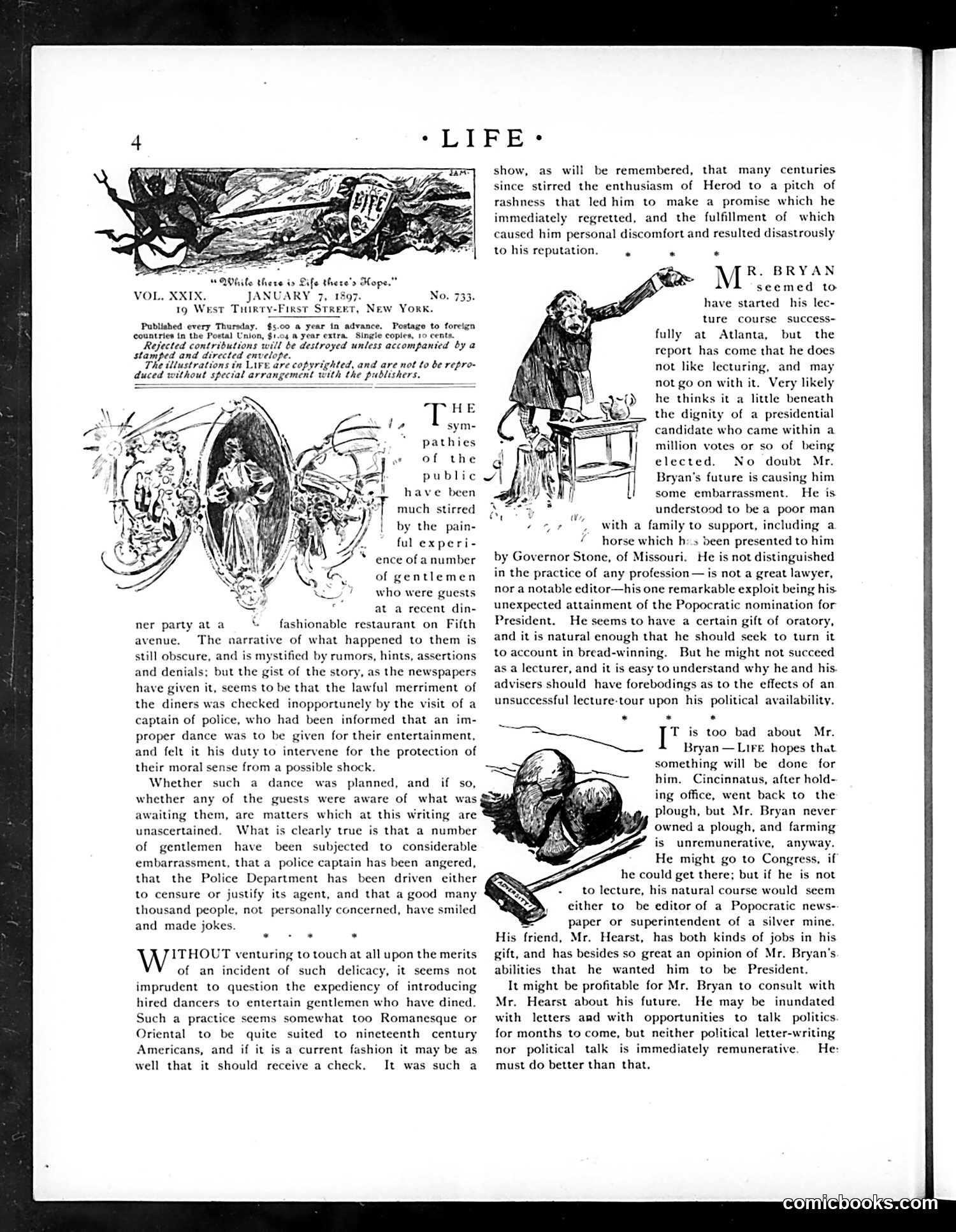
This page critiques **William Jennings Bryan**, the populist politician and three-time presidential candidate. The text discusses Bryan's failed lecture tour, suggesting he lacks the oratorical gifts needed for success on the platform despite his political prominence. The illustrations mock Bryan's career prospects. One cartoon shows him as an entertainer or performer—suggesting his political ambitions are theatrical rather than serious. Another depicts him struggling with manual labor, implying his future lies in farming or working-class work rather than high office. The satire targets Bryan's perceived unsuitability for leadership, his failed business ventures, and his reliance on others' support. The piece suggests his political future looks bleak despite his prior prominence in American politics.
📄 Transcribed text from this page (OCR, searchable)
Machine-transcribed from the original scan — historical spelling and the odd misread are preserved.
* LIFE: No, New York. VOL. XXIX. 19 West Tuirt JANUARY v-First STRE! 733. Published every Thursday. $5.00 a year in advance, Postage to foreign countries in the Postal Union, $1.04 a year extra. Single coples, 10 cents. Rejected contributions will be destroyed unless accompanied by a stamped and directed envelope. The illustrations in LAF are copyrighted, and are not to be repro- without special arrangement with the publisher pathies of the public | by the pain- ful experi- ence of anumber of gentlemen who were guests at a recent din- ner party at a % fashionable restaurant on Fifth avenue. The narrative of what happened to them is still obscure, and is mystified by rumors, hints, assertions and denials; but the gist of the story the newspapers have given it, seems to be that the lawful merriment of the diners was checked inopportunely by the visit of a captain of police, who had been informed that an im- proper dance was to be given for their entertainment, and felt it his duty to intervene for the protection of their moral sense from a possible shock. Whether such a dance was planned, and if so, whether any of the guests were aware of what was awaiting them, are matters which at this writing are unascertained. What is clearly true is that a number of gentlemen have been subjected to considerable embarrassment, that a police captain has been angered, that the Police Department has been driven either to censure or justify its agent, and that a good many thousand people, not personally concerned, have smiled and made jokes. ITHOUT venturing to touch at all upon the merits of an incident of such delicacy, it seems not imprudent to question the expediency of introducing hired dancers to entertain gentlemen who have dined. Such a practice seems somewhat too Romanesque or Oriental to be quite suited to nineteenth century Americans, and if it is a current fashion it may be as well that it should receive a check. It was such a show, as will be remembered, that many centuries since stirred the enthusiasm of Herod to a pitch of rashness that led him to make a promise which he immediately regretted, and the fulfillment of which caused him personal discomfort and resulted disastrously to his reputation, Ps * TR. BRYAN M seemed to have started his lec- ture course success- fully at Atlanta, but the report has come that he does not like lecturing, and may not go on with it. Very likely he thinks it a little beneath the dignity of a presidential candidate who came within a million votes or so of being elected. No doubt Mr. Bryan's future is causing him some embarrassment. He is understood to be a poor man with a family to support, including a horse which hss deen presented to him by Governor Stone, of Missouri. He is not distinguished in the practice of any profession — is not a great lawye: nor a notable editor—his one remarkable exploit being his. unexpected attainment of the Popocratic nomination for President. He seems to have a certain gift of oratory, and it is natural enough that he should seck to turn it to account in bread-winning. But he might not succeed as a lecturer, and it is easy to understand why he and his. advisers should have forebodings as to the effects of an unsuccessful lecture-tour upon his political availability. is too bad about Mr. * . Bryan —Lire hopes that ss 5 something will be done for -—~— him. Cincinnatus, after hold- ing office, went back to the plough, but Mr. Bryan never owned a plough, and farming is unremunerative, anyway. He might go to Congress, if he could get there; but if he is not to lecture, his natural course would seem either to be editor of a Popocratic news- paper or superintendent of a silver mine. His friend, Mr. Hearst, has both kinds of jobs in his gift, and has besides so great an opinion of Mr. Bryan's abilities that he wanted him to be President. It might be profitable for Mr. Bryan to consult with Mr. Hearst about his future. He may be inundated with letters and with opportunities to talk politics: for months to come, but neither political letter-writing nor political talk is immediately remunerative. He: must do better than that. *