
Life, 1897-01-07 · page 6 of 20
Life — January 7, 1897 — page 6: what you’re looking at
What you’re looking at
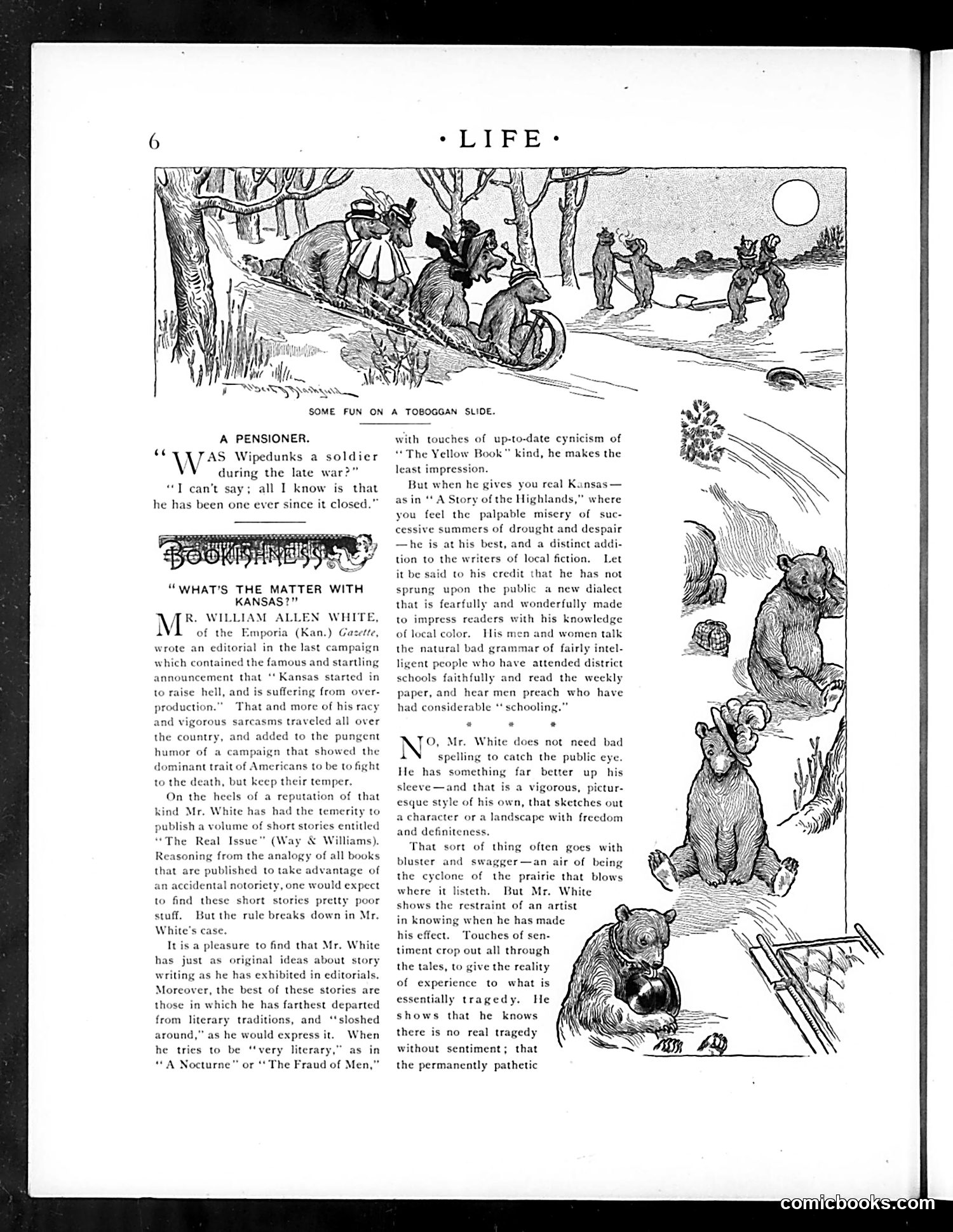
**Main Content:** This page reviews Kansas author Marshall Allen White's short stories. The text praises White's realistic depiction of Kansas life and his restrained, sophisticated writing style—avoiding melodrama while capturing authentic tragedy and human experience. **Top Illustration:** "Some Fun on a Toboggian Slide" depicts bears sledding, a lighthearted scene unrelated to the article below. **Right Illustration:** A series of sketches showing bears in various poses, likely accompanying a humorous sidebar or separate piece (not clearly connected to White's review). **Satire/Context:** The page demonstrates *Life*'s dual function: literary criticism alongside humor and whimsy. The contrast between serious literary analysis and playful animal illustrations reflects the magazine's satirical, eclectic approach to American culture circa early 1900s.
📄 Transcribed text from this page (OCR, searchable)
Machine-transcribed from the original scan — historical spelling and the odd misread are preserved.
Tl Mh 7 STP AQSL| SOME FUN ON A TOBOGGAN SLIDE. A PENSIONER. Wipedunks a soldier during the late war?” “T can’t say; all I know is that he has been one ever since it closed.” “WHAT'S THE MATTER WITH KANSAS?” M* WILLIAM ALLEN WHIT i of the Emporia (Kan.) Gazette, wrote an editorial in the last camp ign which contained the famous and startling announcement that ‘‘ Kansas started in to raise hell, and is suffering from over- production.” That and more of his racy and vigorous s; ms traveled all over the country, and added to the pungent humor of a campaign that showed the dominant trait of Americans to be to fight to the death, but keep their temper. On the heels of a reputation of that kind Mr. White has had the temerity to publish a volume of short stories entitled “The Real Issue” (Way & Williams). Reasoning from the analogy of all books that are published to take advanta| an accidental notoriety, one would expect to find the: stuff, Whit It is a pleasure to find that Mr. White has tas original ideas about story writing as he has exhibited in editorials. Moreover, the best of these stories those in which he has farthest de from literary traditions, and ‘sloshed around,” as he would expr When he tries to be ‘very literary,” as in “A Nocturne” or ‘* The Fraud of Men,” short stories pretty poor But the rule breaks down in Mr. 's case. s it. with touches of up-to-date cynicism of “The Yellow Book” kind, he makes the least impress But when he g as in ‘+ A Story of the Highlands,” where you feel the palpable misery of suc- cessive summers of drought and despair —he is at his bes stinct addi- tion to the writers of local fiction, Let it be said to his credit that he has not a new dialect ion. you real Kansas — and a d sprung upon the public that is fearfully and wonderfully made readers with his knowledge His men and women talk r of fairly intel- ligent people who have attended district to impr of lc the natural bad gramm color. schools faithfully and read the weckly paper, and hear men preach who have had considerable * schooling.” * * * NOME White docs not need ad AN ‘spelling to catch the public eye. He has something far better up his and that is a vigorous, pictur- esque style of his own, that sketches out a character or a landscape with freedom and definiteness. sleeve That sort of thing often goes with bluster and er—an air of being the cyclone of the prairie that blows where it listeth. But Mr. White shows the restraint of an artist in knowing when he has made his effect. Touches of sen- timent crop out all through swag the tales, to give the reality what is He he knows of experience to essentially tragedy. shows that there is no real tragedy without sentiment; that the permanently pathetic