
Life, 1897-01-07 · page 12 of 20
Life — January 7, 1897 — page 12: what you’re looking at
What you’re looking at
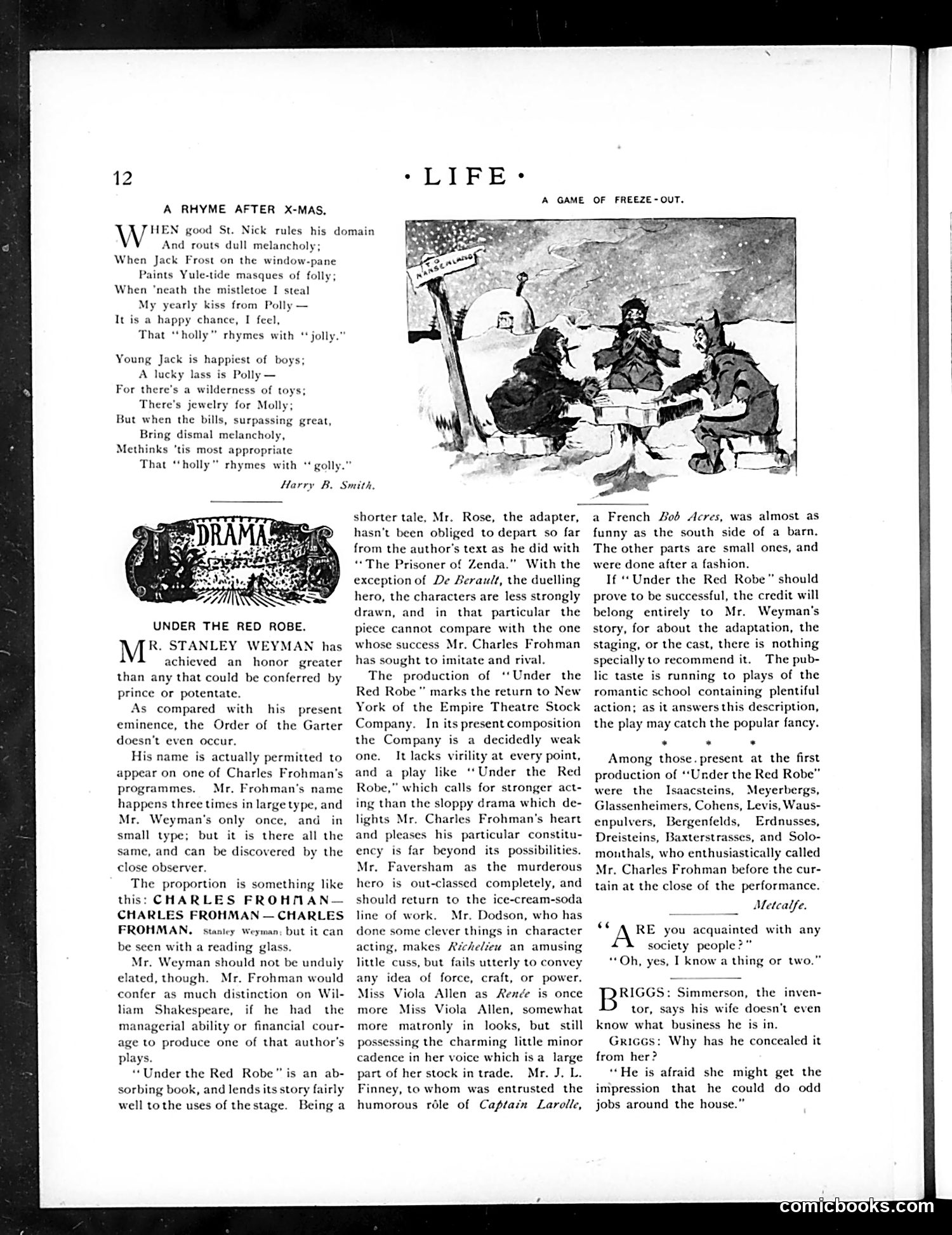
This page contains theatrical reviews and a holiday poem, not political cartoons. The main content critiques the stage production of "Under the Red Rose," adapted from Stanley Weyman's novel by producer Charles Frohman. The satire targets **Charles Frohman's outsized ego**: the reviewer sarcastically notes that Weyman's name appears on Frohman's programs—but only once in small type, while Frohman's name appears three times in large type. The joke is that Frohman takes credit for everything, treating himself as more important than the actual author. The review is scathing about the Empire Theatre Stock Company's performance, calling actors like Faversham "out-classed" and suggesting he should "return to the ice-cream-soda line of work." Only Weyman's original story receives praise. The opening poem humorously contrasts Christmas joy ("holly" rhyming with "jolly") with post-holiday financial stress ("holly" rhyming with "golly").
📄 Transcribed text from this page (OCR, searchable)
Machine-transcribed from the original scan — historical spelling and the odd misread are preserved.
12 A RHYME AFTER X-MAS, V HEN good St. Nick rules his domain And routs dull melancholy; When Jack Frost on the window-pane Paints Yule-tide masques of folly; When ‘neath the mistletoe I steal My yearly kiss from Polly — is a happy chance, I feel, That “holly” rhymes with “jolly.” Young Jack is happiest of boys; A lucky lass is Polly — For there's a wilderness of t¢ There's jewelry for Molly But when the bills, surpassing great, Bring dismal melanchol Methinks ‘tis most appropriate That “holly” rhymes with “golly.” Harry B. Smith, UNDER THE RED ROBE, R. STANLEY WEYMAN has achieved an honor greater than any that could be conferred by prince or potentate, As compared with his present eminence, the Order of the Garter doesn’t even occur. His name is actually permitted to appear on one of Charles Frohman’s programmes. Mr. Frohman’s name happens three times in large type, and Mr. Weyman’'s only once, and in small type; but it is there all the same, and can be discovered by the close observer. The proportion is something like this: CHARLES FROHMAN— CHARLES FROHMAN — CHARLES FROHMAN, | stanicy Weyman; but it can be seen with a reading glass. Mr. Weyman should not be unduly elated, though. Mr, Frohman would confer much distinction on Wil- liam S speare, if he had the managerial ability or financial cour- age to produce one of that author's Under the Red Robe” is an ab- sorbing book, and lends its story fairly well tothe uses of thestage. Being a shorter tale, Mr. Rose, the adapter, hasn't been obliged to depart so far from the author's text as he did with “The Prisoner of Zenda.” With the exception of De Berault, the duelling hero, the characters are less strongly drawn, and in that particular the piece cannot compare with the one whose success Mr. Charles Frohman has sought to imitate and rival. The production of ‘‘Under the Red Robe" marks the return to New York of the Empire Theatre Stock Company. In its present composition the Company is a decidedly weak one. It lacks virility at every point, and a play like ‘Under the Red Robe,” which calls for stronger act- ing than the sloppy drama which de- lights Mr. Charles Frohman’s heart and pleases his particular constitu- ency is far beyond its possibilities. Mr. Faversham as the murderous hero is out-classed completely, and should return to the ice-cream-soda line of work. Mr. Dodson, who has done some clever things in character acting, n Richelieu an amusing little cuss, but fails utterly to conv any idea of force, craft, or power. Miss Viola Allen as Renée is once more Miss Viola Allen, somewhat more matronly in looks, but still possessing the charming little minor cadence in her voice which is a large part of her stock in trade. Mr. J. L. Finney, to whom was entrusted the humorous roéle of Captain Larolle, FREEZE - OUT. a French Bod Acres, was almost as funny as the south side of a barn, The other parts are small ones, and were done after a fashion. If Under the Red Robe” should prove to be successful, the credit will belong entirely to Mr. Weyman's story, for about the adaptation, the staging, or the cast, there is nothing specially to recommend it. The pub- lic taste is running to plays of the romantic school containing plentiful action; as it answers this description, the play may catch the popular fancy. . . . Among those. present at the first production of ‘‘Under the Red Robe” were the Isaacstcins, Meyerbergs, Glassenheimers, Cohens, Levis, Waus- enpulvers, Bergenfeld: Erdnusses, Dreisteins, Baxterstrasses, and Solo- monthals, who enthu: Mr. Charles Frohman before the cur- tain at the close of the performance. Metcalfe. RE you acquainted with any society peopl “Oh, yes, I know a thing or two.” RIGGS: Simmerson, the inven- s his wife doesn't even know what business he is in. GriGi Why has he concealed it from her? ‘He is afraid she might get the impression that he could do odd jobs around the house.”