
A complete issue · 34 pages · 1896
Life — December 5, 1896
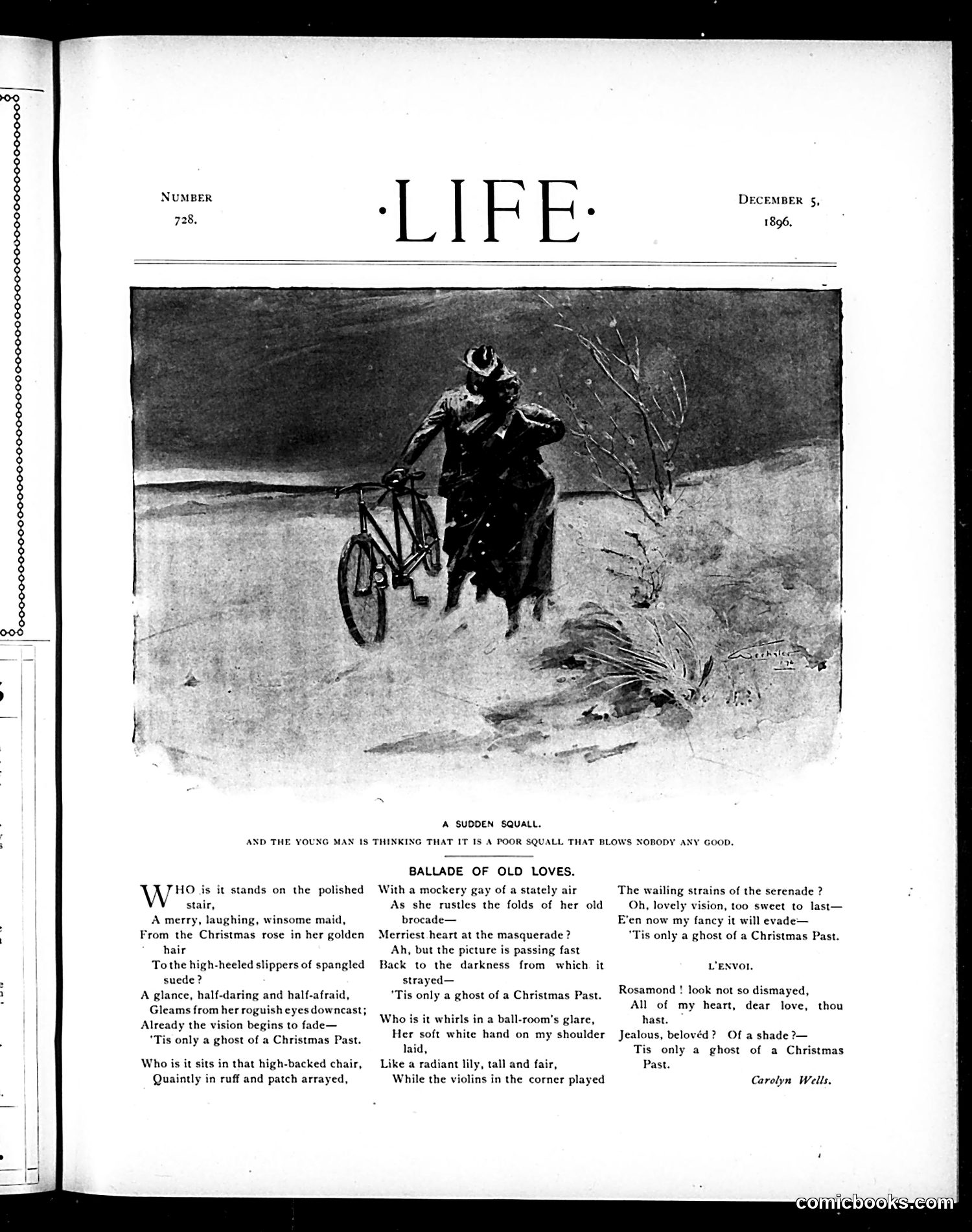
The page features an illustration titled "A SUDDEN SQUALL" with accompanying text explaining that "the young man is thinking that it is a poor squall that blows nobody any good." The image shows a figure in winter clothing struggling with a bicycle in snowy conditions, with bare winter vegetation visible. Below is a poem titled "BALLADE OF OLD LOVES" by Carolyn Wells, expressing nostalgic themes about past romance and Christmas memories. The satirical point appears to be about finding unexpected benefit in difficult circumstances—the "squall" (snowstorm) forcing the young man and woman together creates an opportunity. The poem's melancholic tone about lost love and "only a ghost of a Christmas Past" complements this romantic scenario, suggesting that even hardship can bring silver linings in matters of the heart.
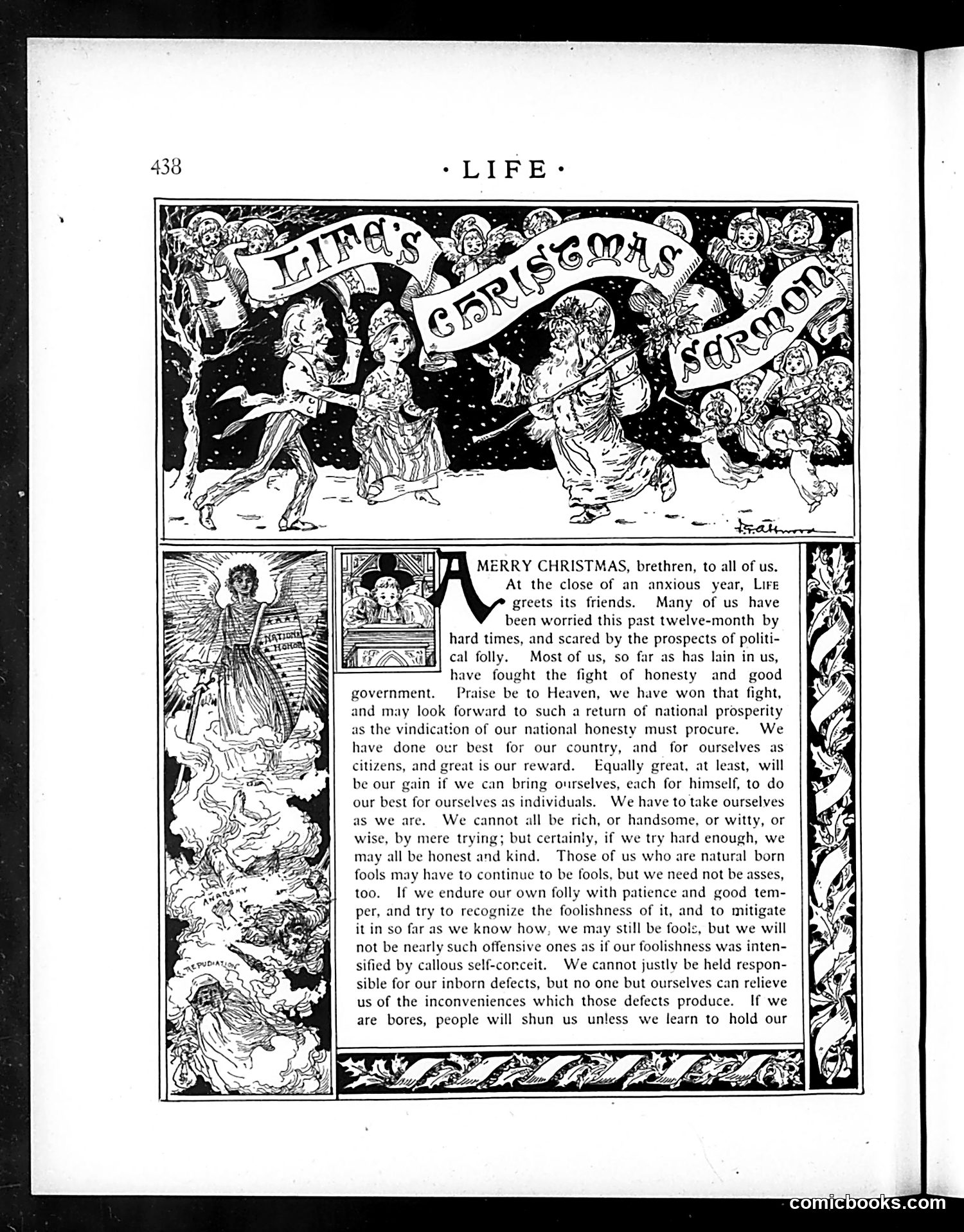
This is a Christmas editorial message, not a political cartoon. The page shows "Life's Christmas Sermon" with allegorical imagery (angels and religious figures in the left panels). The text addresses post-WWI America, referencing "an anxious year" with "worried" citizens and "scared by the prospects of political folly." It advocates for national honesty and prosperity through individual virtue rather than government action. The sermon's core message: citizens must improve themselves morally and intellectually to strengthen the nation. It warns against both natural fools and "callous self-conceit," arguing that recognizing one's own foolishness is necessary to avoid becoming insufferable to others. The piece reflects post-war anxiety and Progressive-era faith in individual self-improvement as a solution to social problems.
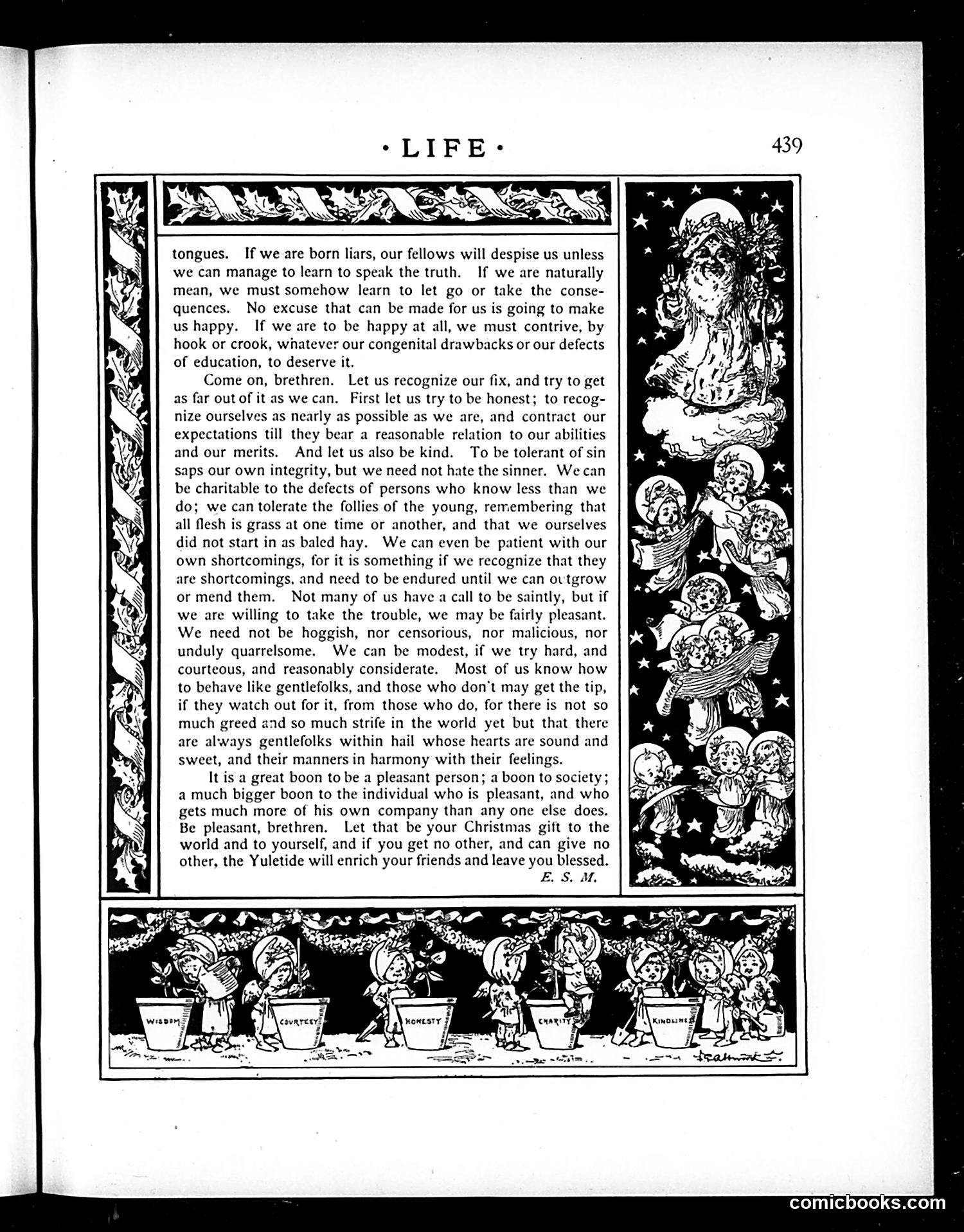
The page presents a moral essay (signed E.S.M.) advocating for personal virtue and kindness as Christmas gifts to the world. The text emphasizes honesty, self-awareness, charity toward others' shortcomings, and pleasant social behavior. The accompanying illustrations support this message: the right panel shows a religious/angelic Christmas scene with cherubs and stars, reinforcing spiritual virtue. The bottom panel depicts small figures planting virtues in pots labeled "Wisdom," "Courtesy," "Honesty," "Charity," and "Kindness"—a literal visualization of cultivating moral character. This is primarily *social commentary* rather than political satire, reflecting early 20th-century Life magazine's role promoting genteel middle-class values during the holiday season.
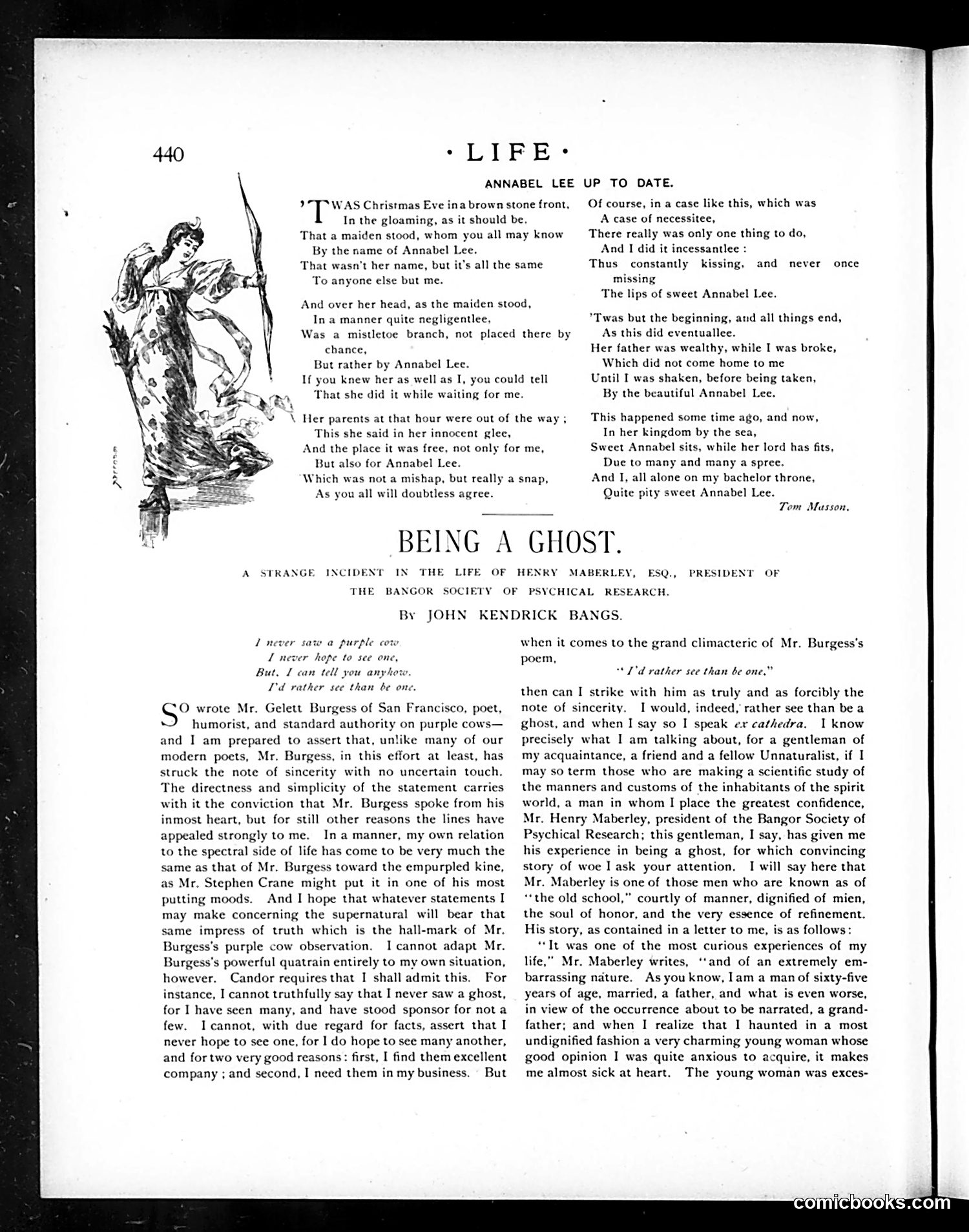
This page contains two distinct pieces: **"Annabel Lee Up to Date"** (top): A poem riffing on Edgar Allan Poe's famous "Annabel Lee," updated with contemporary social commentary. The illustration shows a woman in classical dress. The satire appears to mock modern romance and marriage prospects—replacing Poe's tragic, idealized love with mundane reality about wealth disparities and social expectations. **"Being a Ghost"** (main article): John Kendrick Bangs writes about Henry Maberley, president of the Bangor Society of Psychical Research, who claims to have been a ghost. The piece satirizes spiritualism and the ghost-hunting craze popular in late-19th/early-20th-century society, presenting Maberley's account of haunting a young woman as both humorous and morally awkward—mocking both spiritualism and gentlemanly pretensions.
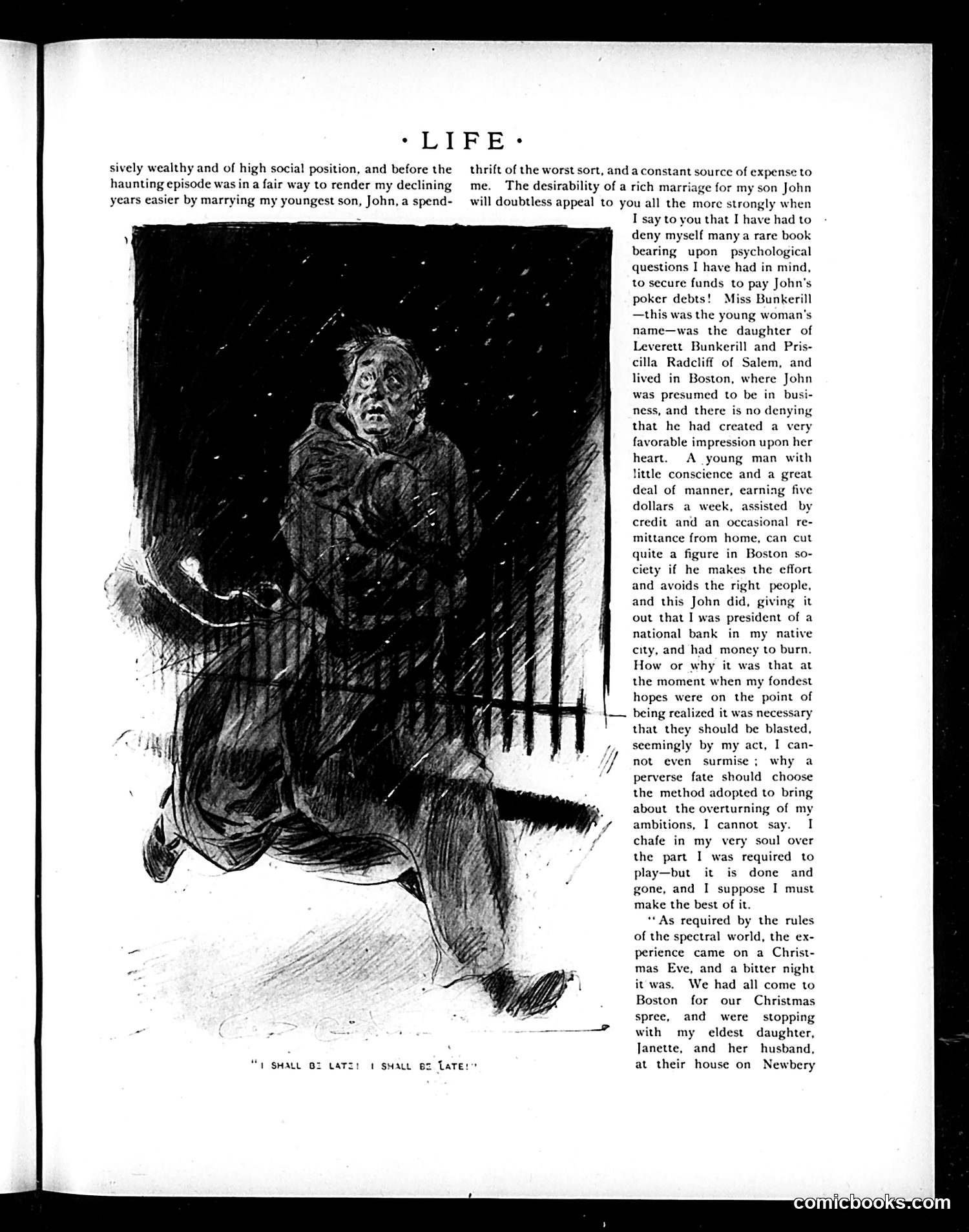
This page from *Life* magazine contains a narrative essay about the author's financial disappointments, particularly regarding his son John's failed marriage prospects. The accompanying illustration depicts a disheveled, distressed man in what appears to be a state of emotional anguish—likely representing the narrator himself—with the caption "I SHALL BE LATE! I SHALL BE LATE!" The satire targets the author's anxieties about social status and wealth. The narrative reveals he sought a wealthy marriage for his son to solve financial problems, only to have those hopes "blasted." The cartoon illustrates the comedic desperation of a man caught between maintaining appearances while facing economic ruin—a relatable concern for *Life*'s educated, middle-class readership during what appears to be the Gilded Age or early 20th century.
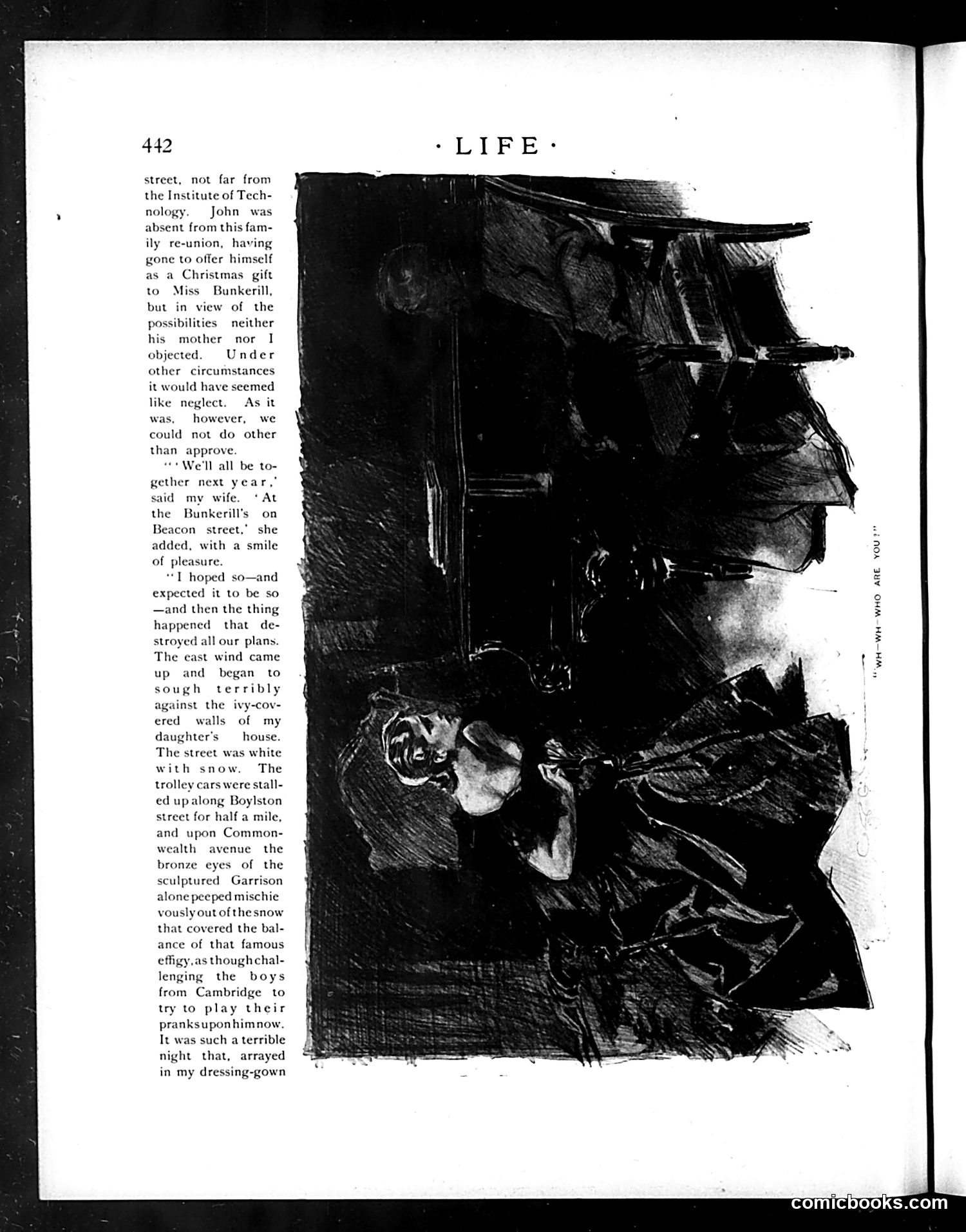
This page contains a sketch illustration accompanying personal narrative text, not a political cartoon. The sketch appears to be a portrait study rendered in dark ink, showing a profile view of a face with distinctive features. The accompanying text is a reminiscence about family gatherings, mentioning the Institute of Technology, Christmas gifts, and Miss Bunkerill. The narrator describes planning a reunion "at the Bunkerill's on Beacon street" and recounts a winter storm that disrupted plans—"The east wind came up and began to sough terribly against the ivy-covered walls." The illustration serves as decorative accompaniment to this domestic narrative rather than functioning as satirical commentary. Without additional context identifying the specific person depicted, I cannot determine if this is a portrait of a named individual or a generic illustrative figure.
This page contains no cartoon or illustration—it's purely text from a serialized short story titled "LIFE" (page 443). The narrative describes a narrator's snowy evening adventures, including ringing a doorbell at a house and encountering characters named Miss Bunkerill and Jonks. This appears to be fiction rather than satire or political commentary. The text mentions "the state-house" and references to "Maine," but these are plot elements within a domestic story, not political commentary. There are no identifiable caricatures, political figures, or satirical targets visible. This is simply a literature page from the magazine, not a political or social satire piece.
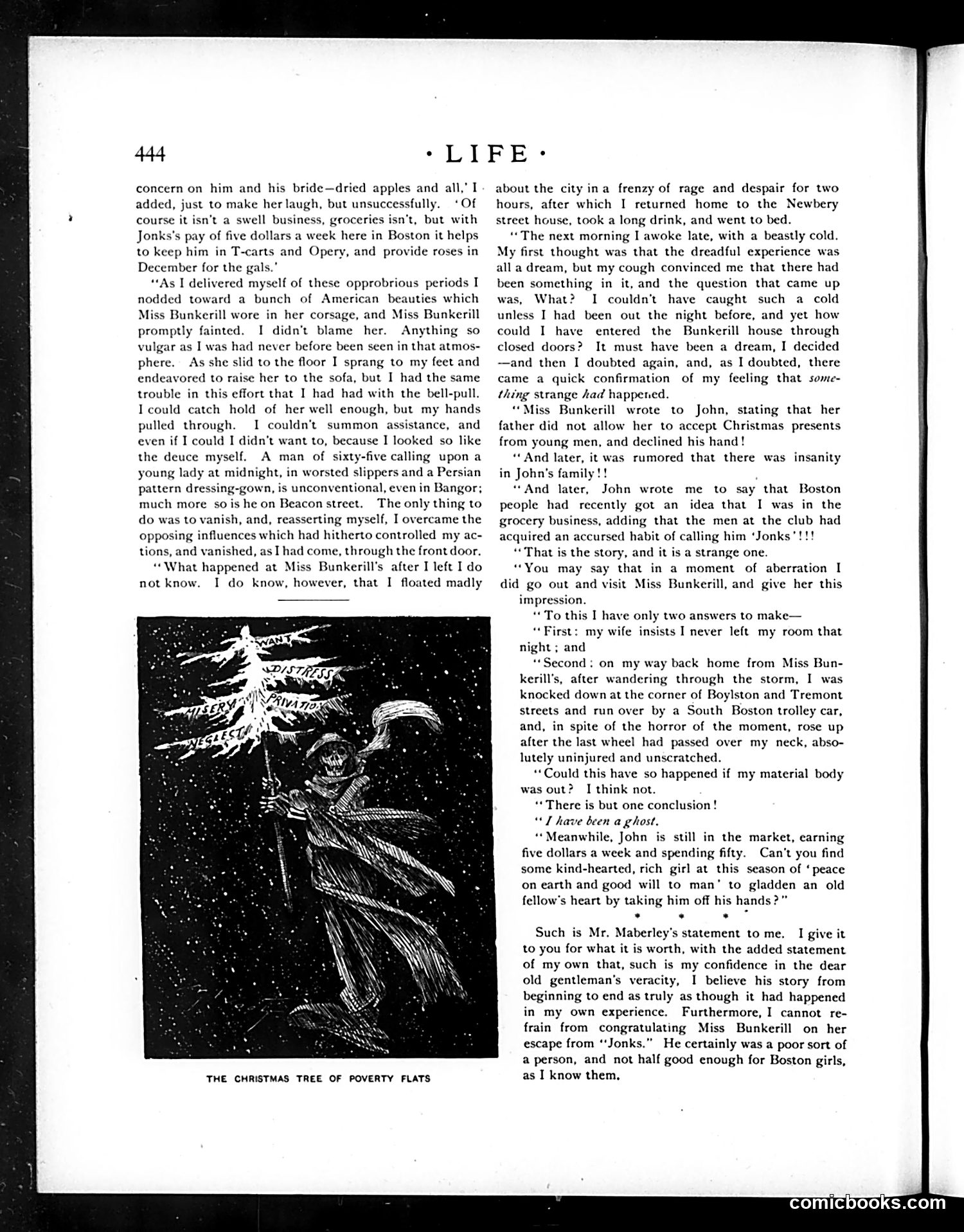
This illustration depicts a personified Christmas tree as an emaciated, skeletal figure—a visual metaphor for poverty during the holiday season. The image critiques the contrast between Christmas's promise of abundance and the harsh reality facing poor urban residents, particularly in Boston's "Poverty Flats" (a working-class neighborhood). The accompanying text discusses a man named Maberley's account of visiting Miss Bunkerill, a young woman living in difficult circumstances. The narrative emphasizes class struggle and suggests Christmas brings false hope rather than genuine relief to the impoverished. The satirical point: while wealthy Americans celebrate with traditional abundance, poor families face starvation and desperation—rendering Christmas a cruel irony rather than a season of genuine "peace on earth and good will."
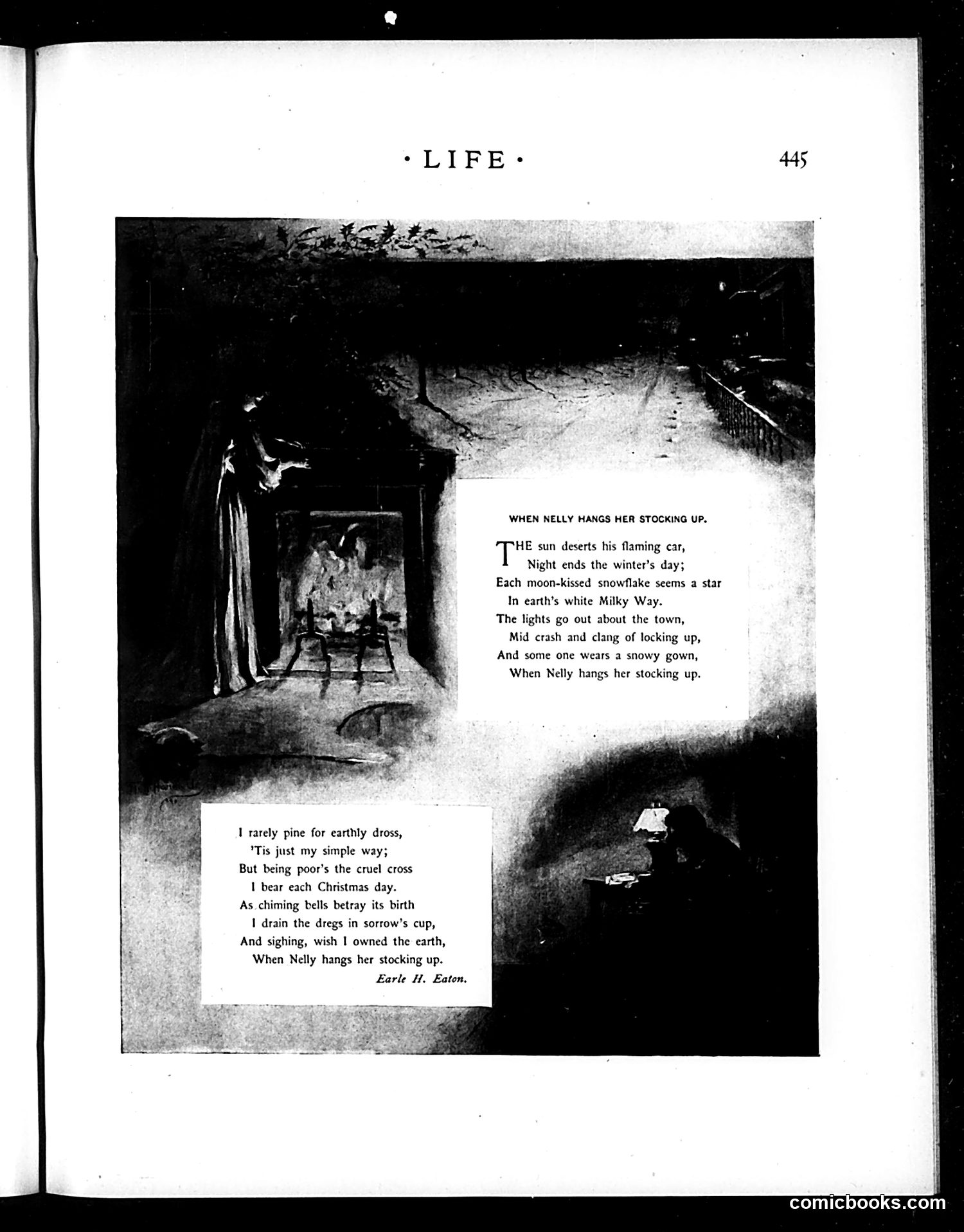
This page presents two poems about Christmas from the perspective of poverty. The first poem, attributed to Earle H. Eaton, reflects on the hardships of the poor during the holiday season—"being poor's the cruel cross / I bear each Christmas day." The accompanying image shows a humble interior with a fireplace, evoking a modest home. The second poem, untitled, uses more whimsical language about winter and holiday imagery (snowflakes, stocking-hanging) to frame similar themes of economic struggle. Together, these pieces appear to be *Life* magazine's social commentary on wealth inequality and the bittersweet reality of Christmas for working-class Americans, contrasting festive tradition with material deprivation.
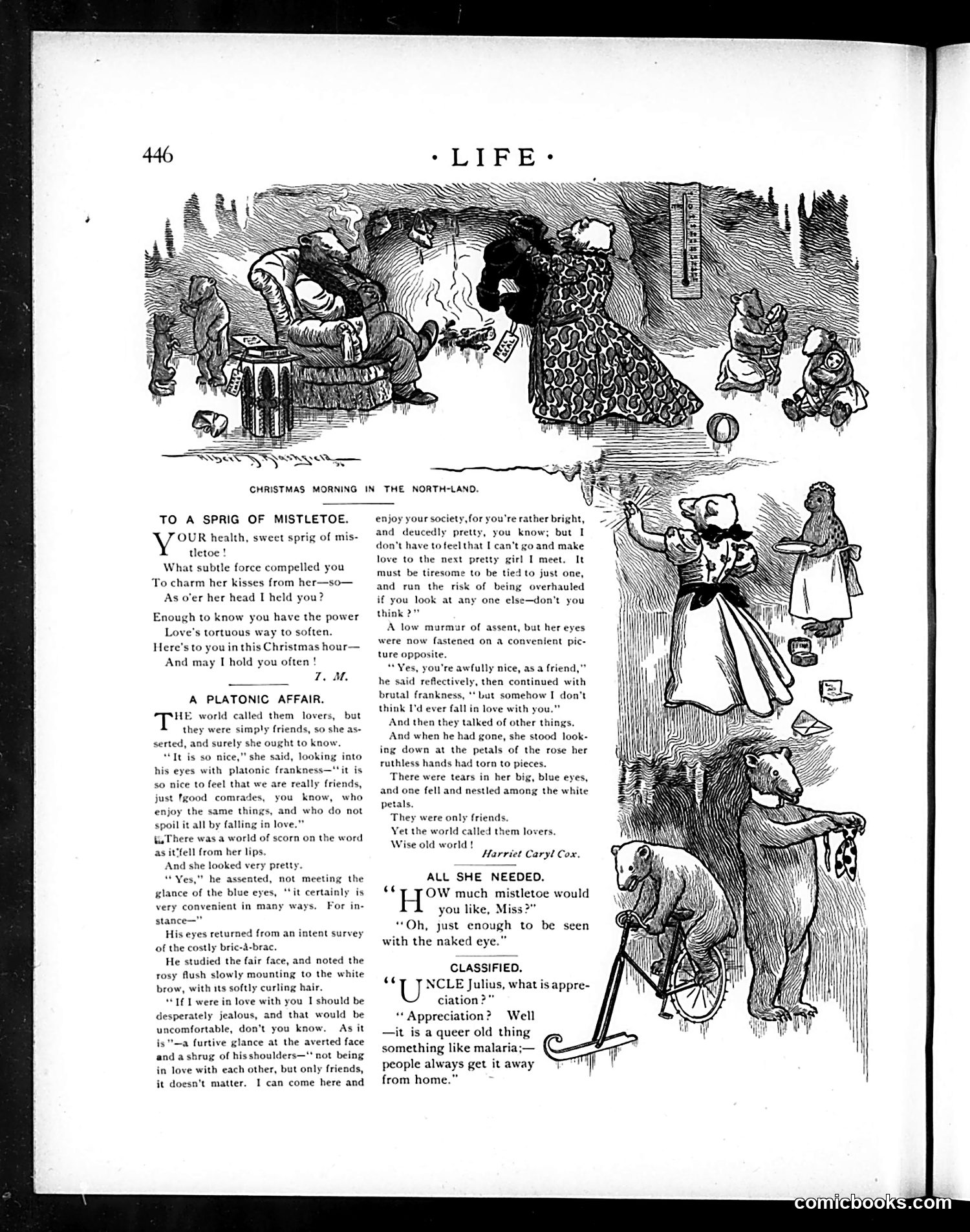
This page contains three separate pieces of satirical content: 1. **"Christmas Morning in the North-Land"** (top illustration): A winter holiday scene with figures gathered around what appears to be a hearth or fire, depicting domestic Christmas celebration. 2. **"To a Sprig of Mistletoe"** (left column): A poem by T.M. addressing the tradition of kissing under mistletoe, humorously exploring romantic dynamics and the social awkwardness of the custom. 3. **"A Platonic Affair"** (center): A story by Harriet Caryl Cox about two people who claim to be "just friends" while clearly experiencing romantic tension—satirizing the social pretense around opposite-sex friendships in this era. 4. **"All She Needed," "Classified"** (right side): Brief humorous vignettes with accompanying illustrations mocking dating customs and social conventions. The overall theme concerns courtship, romance, and the social rituals surrounding them.
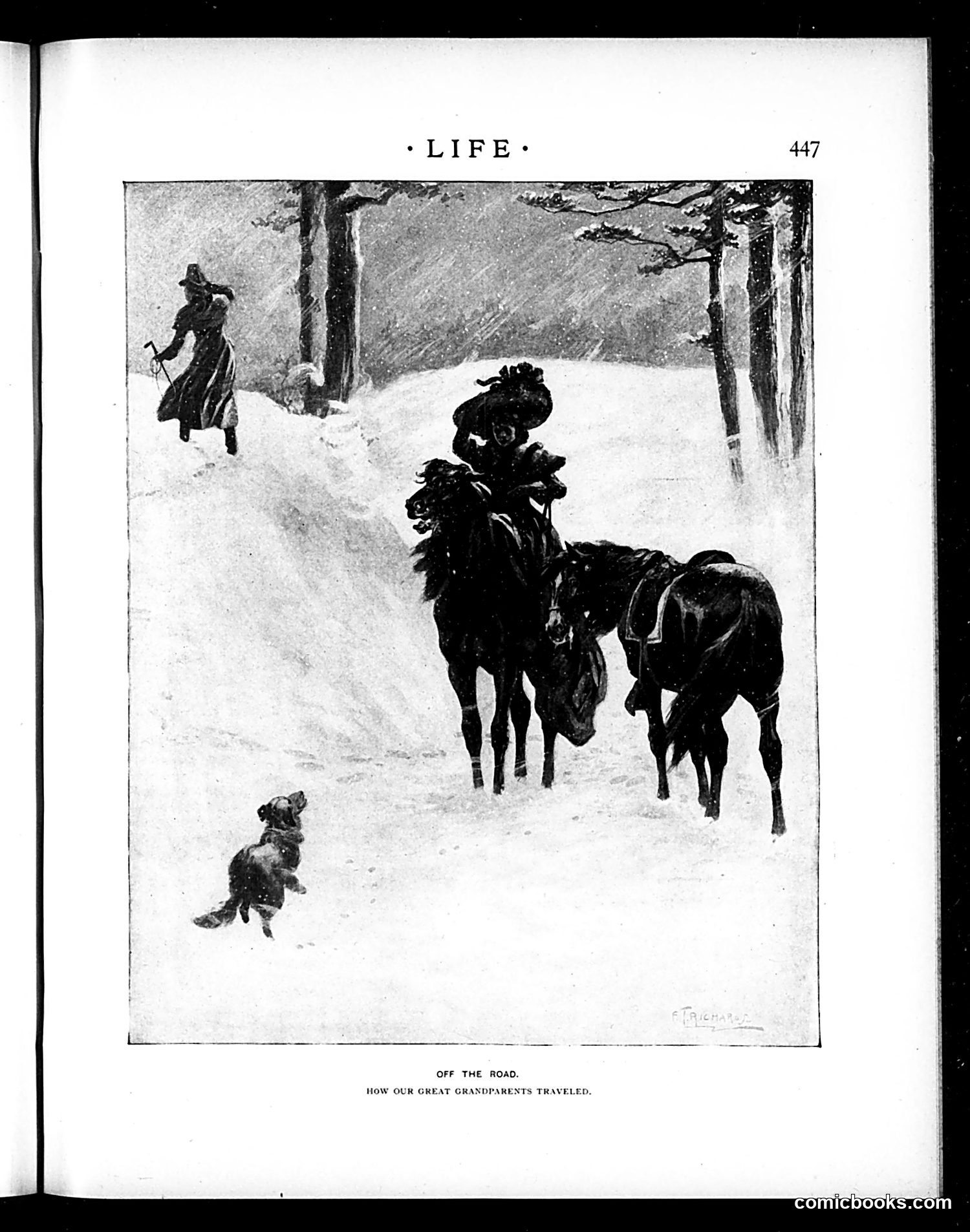
This illustration, titled "Off the Road: How Our Great Grandparents Traveled," depicts a snowy winter scene with horses and riders navigating through a forested landscape. The satire appears to contrast modern (early 20th century) transportation with historical travel methods. The image shows elegantly dressed figures on horseback in severe winter conditions, with a small dog struggling through the snow in the foreground. The contrast between the dignified riders and the struggling animal suggests commentary on the hardships of pre-modern travel—likely meant to humorously highlight how uncomfortable and difficult journeys were for previous generations, implicitly celebrating contemporary improvements in transportation (automobiles, trains) that made travel safer and more convenient.
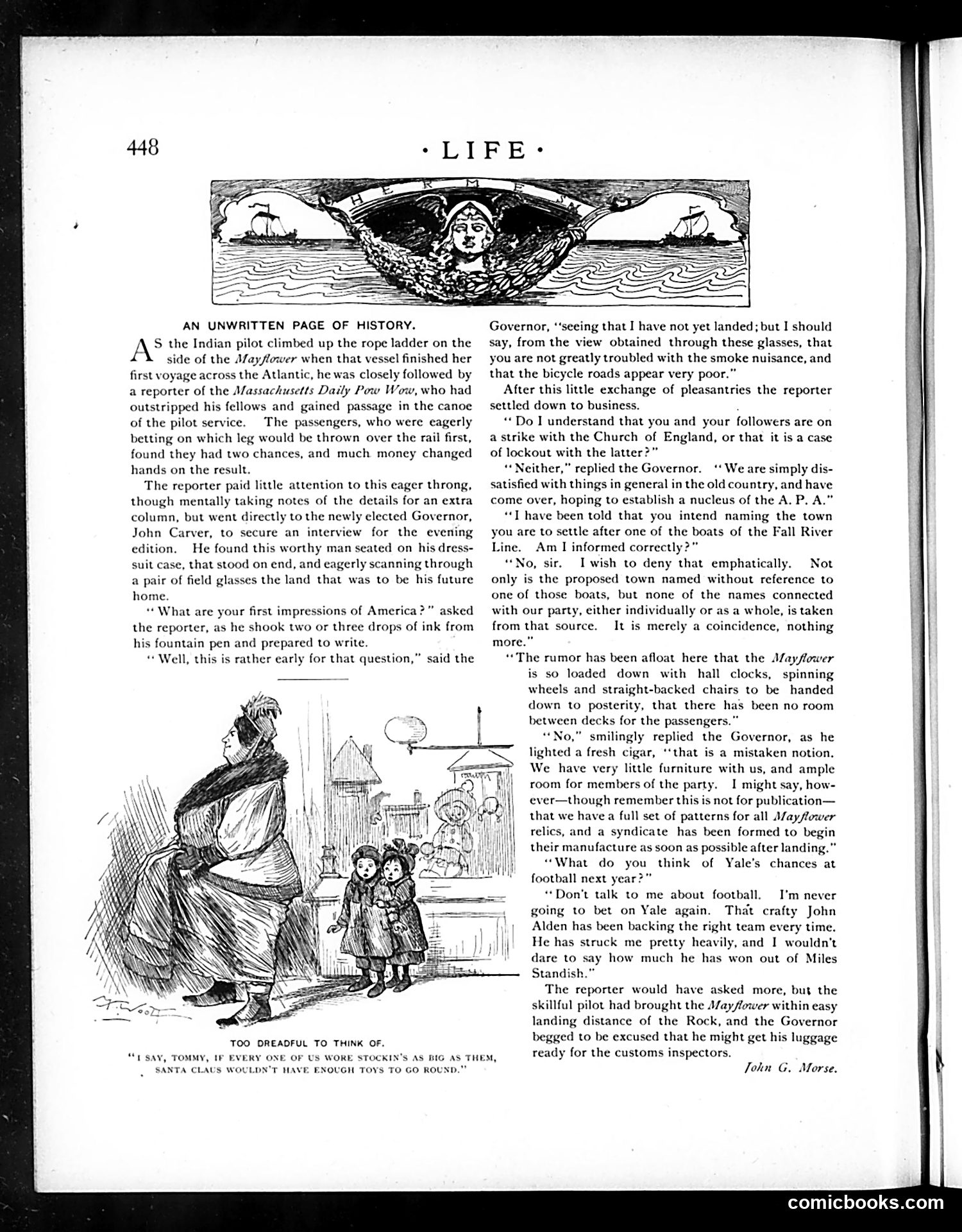
This is a satirical piece titled "An Unwritten Page of History," imagining a newspaper reporter interviewing Governor John Carver as the Mayflower arrives at Plymouth. The humor derives from anachronistic absurdities: **The Satire:** The Pilgrims are depicted discussing modern 1890s concerns—bicycle roads, smoke nuisance, Yale football betting, Mayflower "relics" being manufactured for profit, and the A.P.A. (American Protective Association). Governor Carver uses a fountain pen and field glasses; there's casual mention of customs inspectors and the Fall River Line steamboats. **The Point:** By transplanting late-19th-century American commercialism, journalism, and social anxieties onto the 1620 landing, the piece mocks both contemporary American culture and romanticized historical narratives. The reporter's eager sensationalism and focus on gossip satirizes yellow journalism of the era. **The Bottom Illustration:** A separate joke about Santa's stockings references consumer excess during the emerging Christmas commercialization period. The author is John G. Morse.
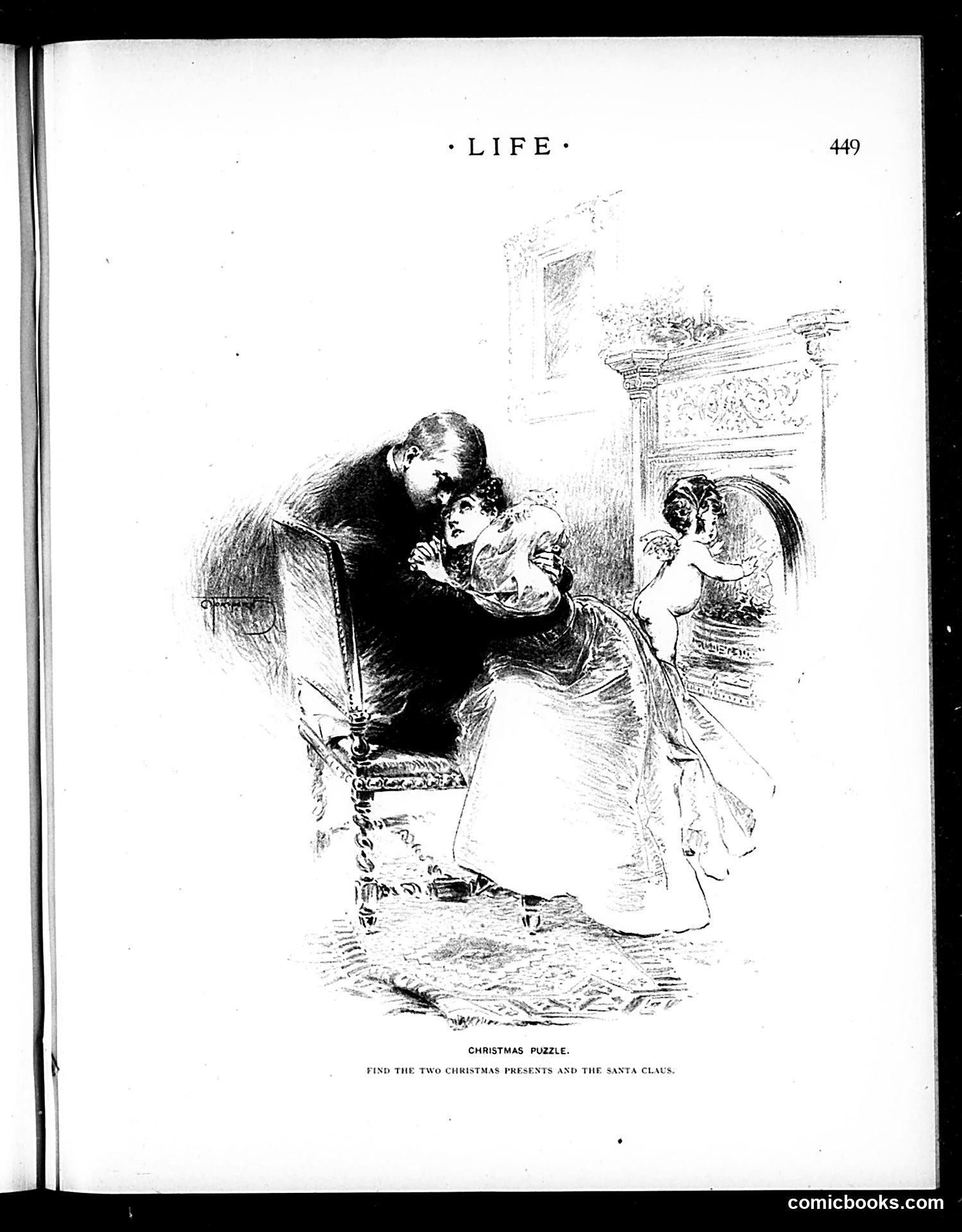
This page contains a visual puzzle rather than political satire. The sketch depicts a domestic Christmas scene: a man in formal dress bending toward a woman in an elegant gown, with a cherub figure visible in the background near a fireplace mantel. The puzzle challenges readers to locate three hidden elements: two Christmas presents and Santa Claus within the illustration. This type of "find the hidden objects" puzzle was popular entertainment in early 20th-century magazines. The image appears to satirize romantic holiday moments—the intimate pose between the elegantly-dressed couple suggests the "presents" and "Santa" may be coded references to romantic elements rather than literal objects, playing on period conventions of tasteful innuendo in family publications.
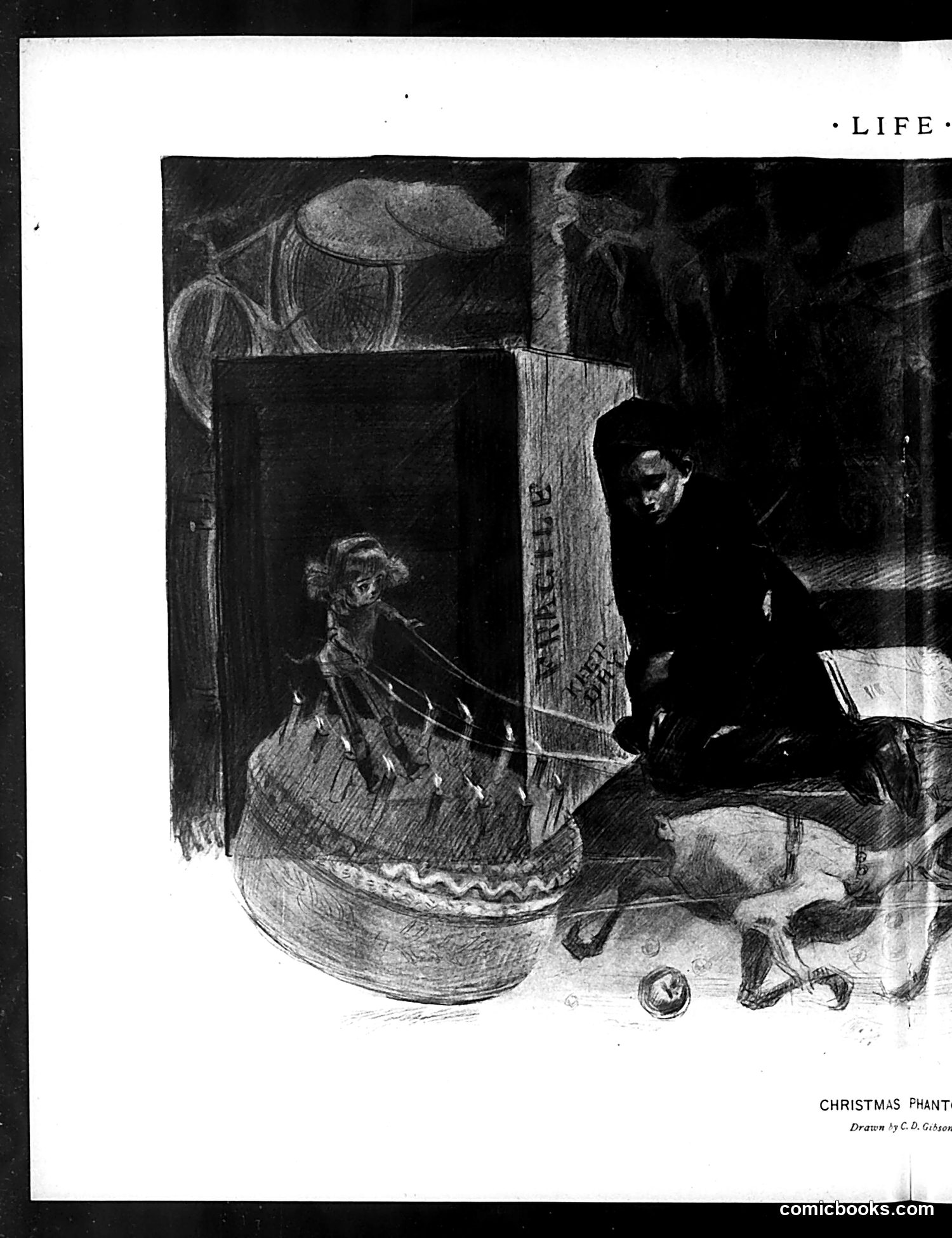
This C.D. Gibson drawing depicts a Christmas-themed scene with satirical intent. A well-dressed man in a top hat appears to be a well-to-do gentleman, possibly representing wealth or the establishment. He observes a young child in ragged clothing looking at toys or gifts through what appears to be a window or barrier—a visual metaphor for economic inequality during the holiday season. The title "Christmas Phantom" likely suggests the fleeting, ghostly nature of Christmas joy for the poor, or critiques how wealthy society ignores the plight of impoverished children during celebrations. Gibson's drawing style emphasizes the contrast between the gentleman's comfort and the child's deprivation, making a social commentary on class disparity typical of early 20th-century American satirical magazines.
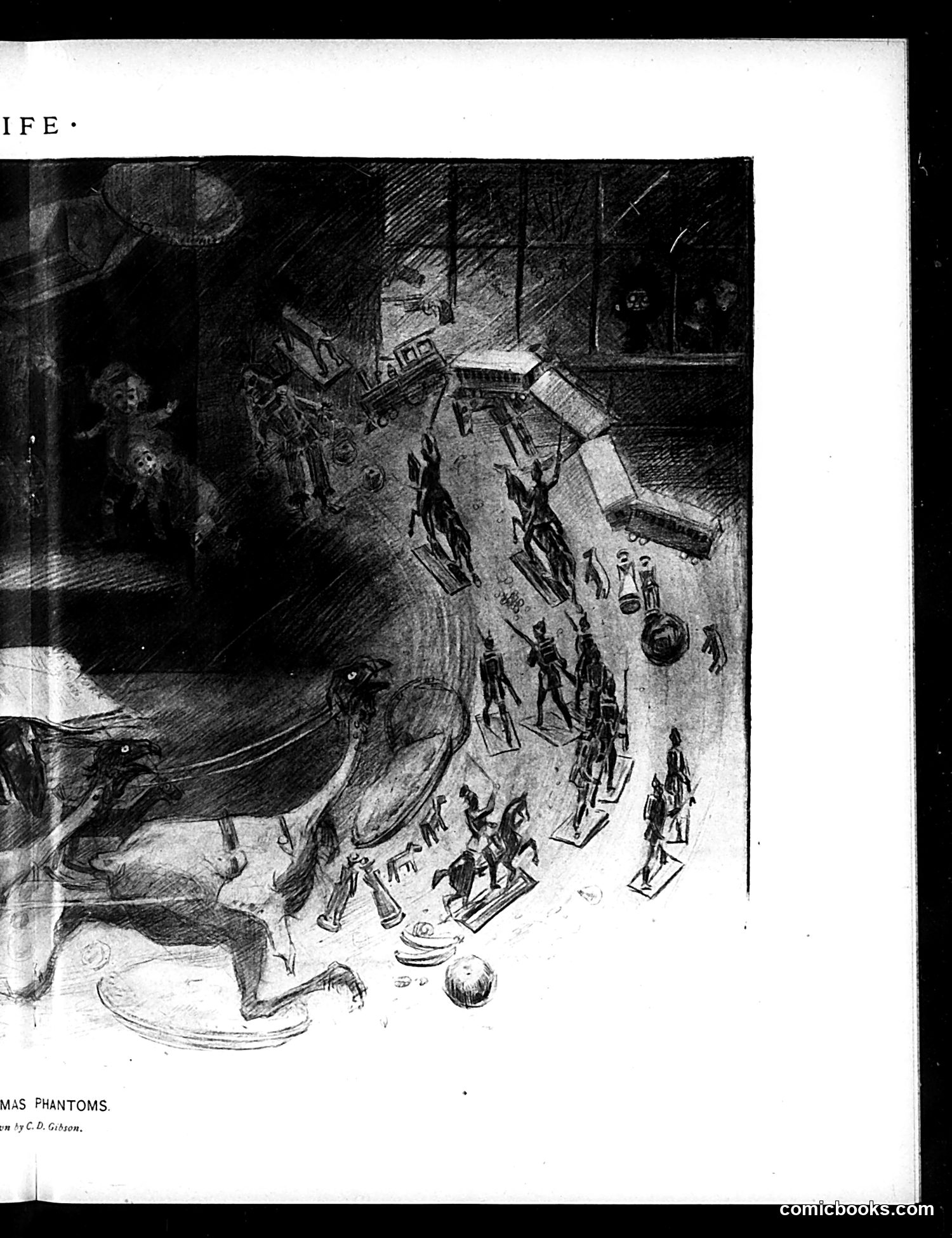
This appears to be a satirical cartoon titled "Christmas Phantoms" illustrated by C.D. Gibson. The image depicts a large, imposing figure (likely representing greed, poverty, or another societal ill) looming over a group of small, struggling figures in what appears to be an urban setting. The contrast in scale emphasizes the overwhelming power or influence of whatever this phantom represents. Gibson's style and Life magazine's satirical nature suggest this critiques social or economic conditions affecting ordinary people during the holiday season. The "phantom" concept likely references Dickens's Christmas Carol, though without additional context or clearer details, the specific social issue being targeted—whether labor conditions, economic inequality, homelessness, or another concern—cannot be definitively determined from the image alone.
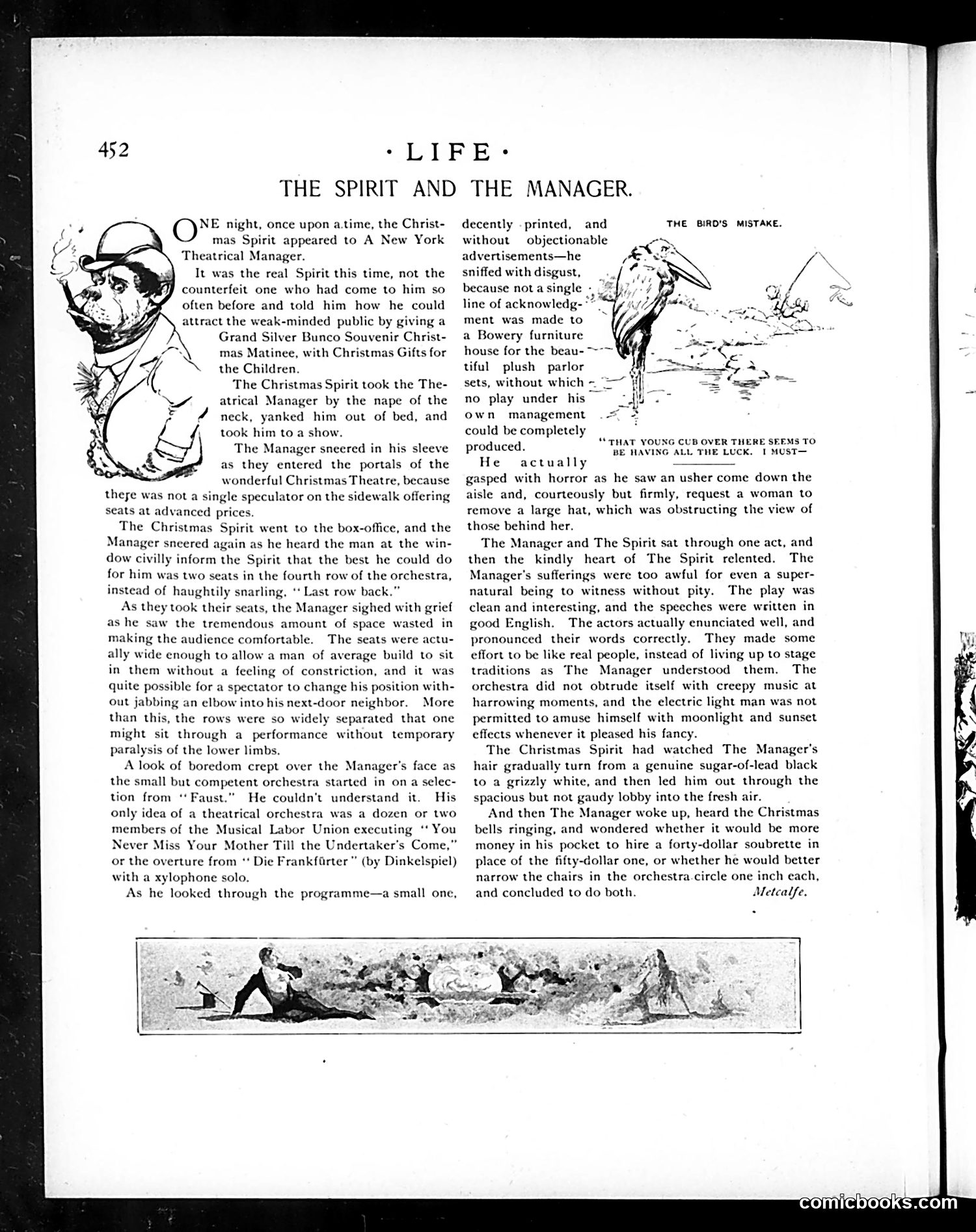
This story satirizes corrupt theatrical management practices of early 20th-century New York. The "Christmas Spirit" visits a cynical Broadway manager who has made his fortune through exploitation: cramped seating, aggressive advertising, planted shills hawking tickets, and cheap theatrical productions that prioritize profit over quality. The spirit shows him an idealized theater with spacious seats, honest box-office staff, no advertisements, competent orchestras playing serious music, and actors who perform naturally rather than "living up to stage traditions." The manager is horrified—he sees none of his profit-maximizing schemes. Upon waking, he contemplates whether he could afford to replace cheap performers with better talent, suggesting his sole motivation remains money. The satire mocks theater managers' systematic dishonesty and contempt for audience comfort, presenting their exploitation as so normalized that basic decency appears fantastical.
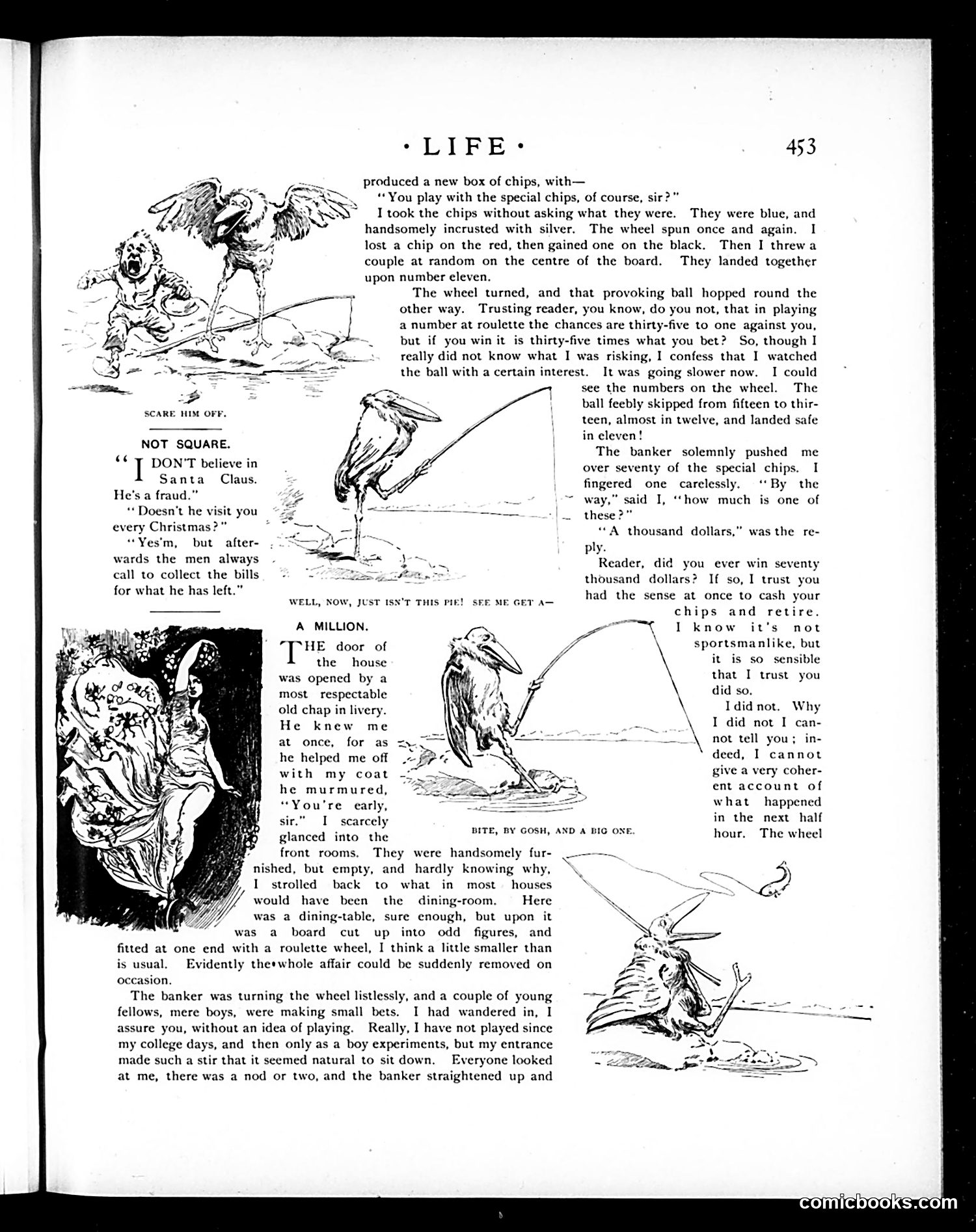
This story-with-illustrations depicts a gentleman's accidental roulette win at an illegal gambling house (disguised as a private residence). The narrator wins 70,000 dollars on his first bet—odds of 35-to-1—then admits he never actually cashed in or explained what happened next. The satire targets multiple concerns: the prevalence of underground gambling operations in wealthy homes, the moral weakness of gentlemen who stumble into vice "without an idea of playing," and the fantasy of sudden wealth that corrupts judgment. The inserted dialogue about Santa Claus ("the men always call to collect the bills") reinforces the theme that easy money and indulgence lead to ruin. The crude illustrations of the protagonist's increasingly desperate gambling postures mock his loss of dignity and self-control. The piece warns readers that gentleman's "luck" is illusory—a cautionary tale about fin-de-siècle moral hazards.
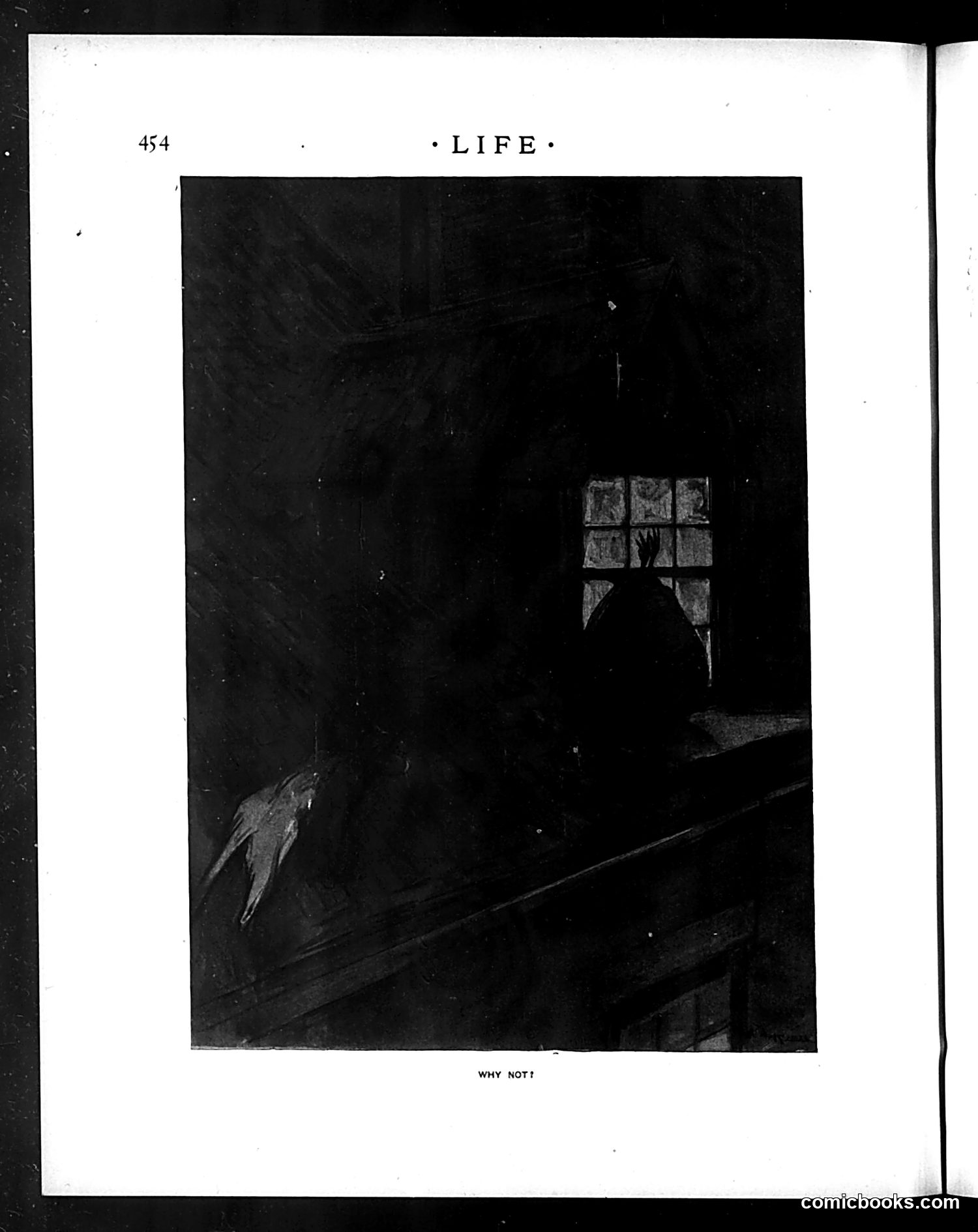
This appears to be a satirical illustration from *Life* magazine showing a dark, shadowy interior scene. A window with panes is visible in the background, and what looks like a dead bird or fowl lies in the foreground on what may be a wooden surface or ledge. The caption "WHY NOT?" suggests ironic commentary, though the specific target is unclear from the image alone. The stark, somewhat grotesque imagery—the dead animal, the darkness, the austere setting—indicates social or political criticism, likely about deprivation, neglect, or hypocrisy. Without additional context about the publication date or surrounding articles, I cannot identify the precise contemporary reference this cartoon addresses.
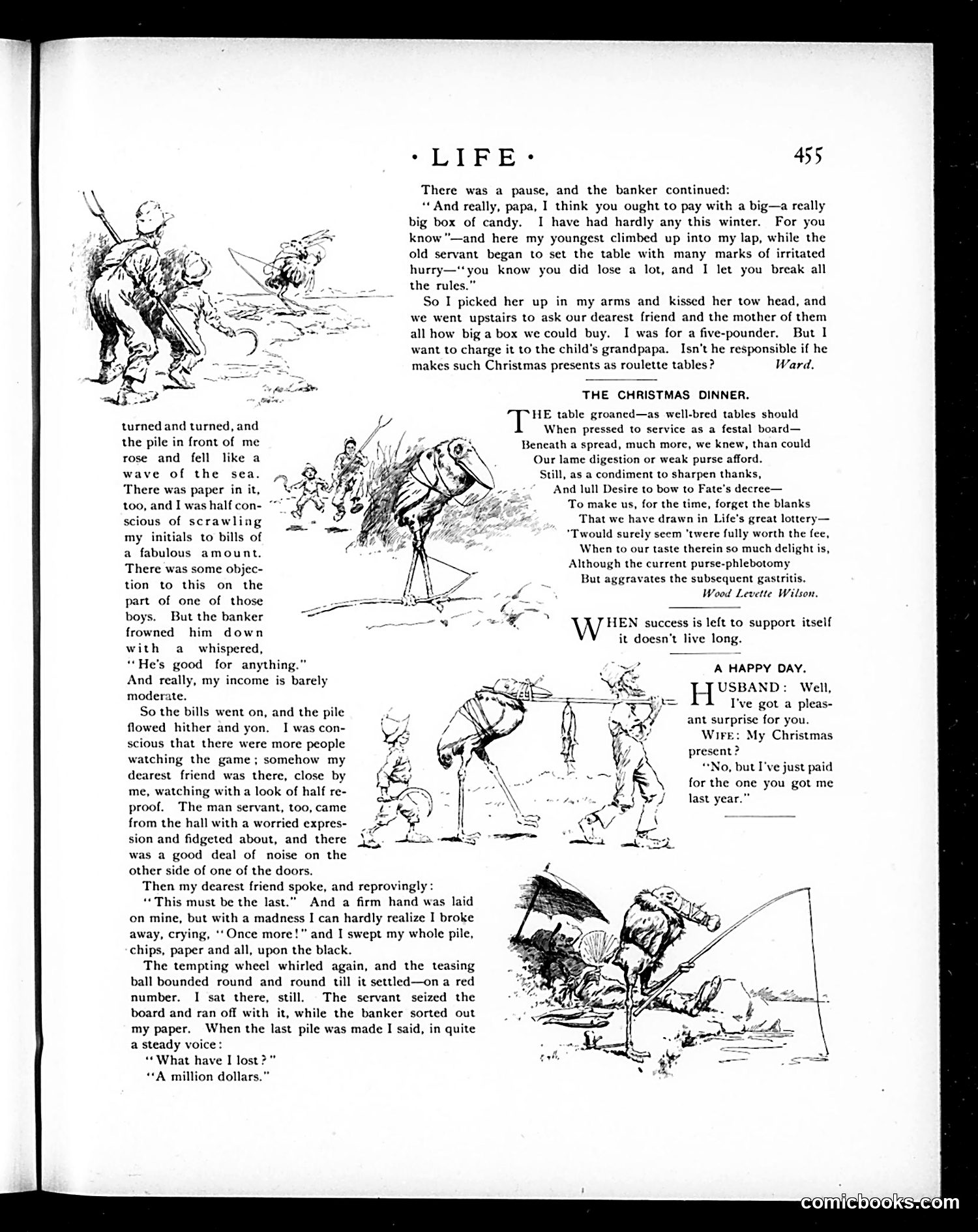
This page contains satirical commentary on **gambling, Christmas excess, and financial irresponsibility** among the wealthy. The main narrative (left) depicts a man losing a fortune at a roulette table. The banker's whispered assurance—"He's good for anything"—satirizes how credit enables reckless behavior. The dreamer's daughter interrupts the fever dream, asking for candy as her Christmas present, suggesting childhood innocence contrasts sharply with adult vice. The final revelation—he's lost "a million dollars"—underscores the satire: that gambling ruins fortunes. The boxed sections mock **holiday spending**: "The Christmas Dinner" poem sardonically celebrates lavish feasts while acknowledging weak finances and indigestion. "A Happy Day" jokes that husbands can only afford to *pay off* previous Christmas gifts, not buy new ones. The illustrations show fantastical, chaotic scenes emphasizing the unreality and moral disorder of these behaviors. Together, the page critiques wealthy excess during Christmas—gambling, overspending, and financial delusion—as moral and practical failures.
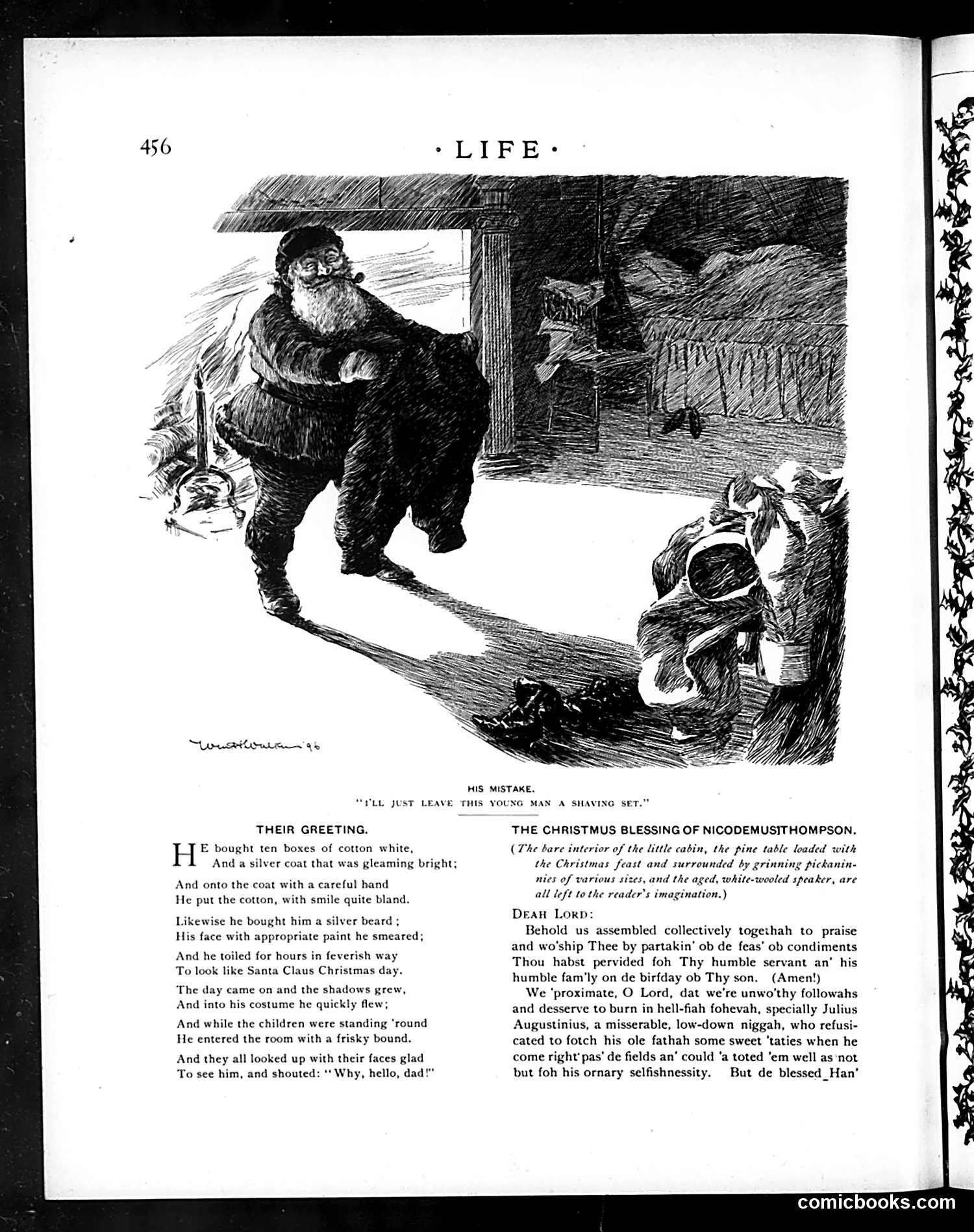
This page contains two separate pieces of satirical content from *Life* magazine: **"Their Greeting"** (top): A sentimental poem about a father preparing an elaborate Santa Claus costume for his children's Christmas morning, only to be greeted with "Why, hello, dad!"—revealing his disguise was transparent. The satire targets overly sentimental Victorian Christmas sentimentality. **"The Christmus Blessing of Nicodemusithompson"** (bottom): A racist dialect piece presented as a religious prayer from an elderly Black man at a family Christmas dinner. The text employs offensive phonetic spelling ("togethah," "foh," "fathah") characteristic of minstrel-show caricature. It mocks both Black religious speech and includes contemptuous references to family members. This reflects *Life*'s editorial stance during the late 19th/early 20th century, when such material was considered humorous by its intended (white) audience. The piece is deeply offensive by modern standards.
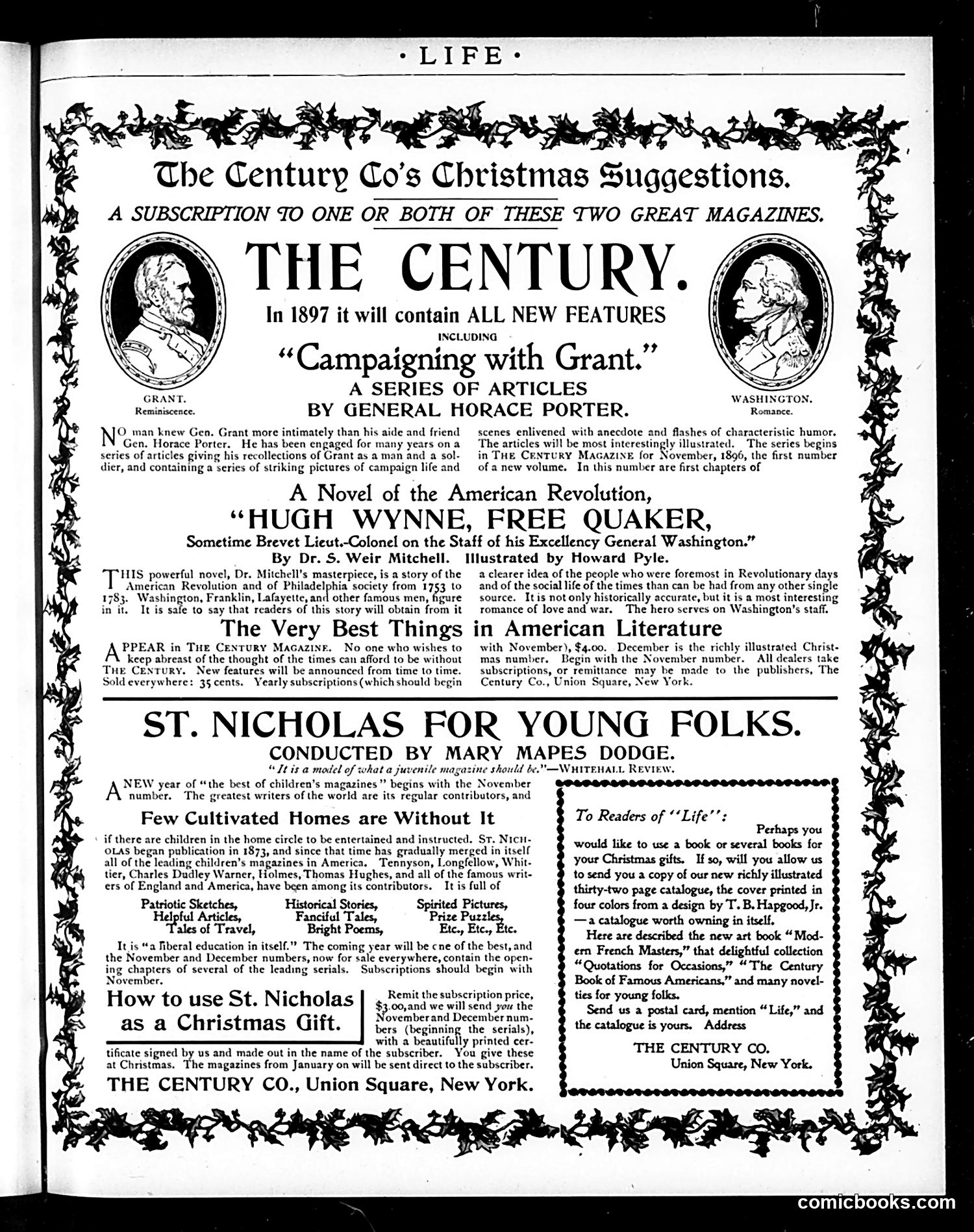
This is primarily a **magazine advertisement page**, not a political cartoon. The Century Company is promoting two magazines for Christmas 1896-1897 subscriptions. **Key content:** - **The Century Magazine** will feature a series called "Campaigning with Grant" by General Horace Porter (Grant's former aide), offering intimate recollections of Civil War leadership - A serialized novel, "Hugh Wynne, Free Quaker" by Dr. S. Weir Mitchell, set during the American Revolution featuring Washington, Franklin, and Lafayette - **St. Nicholas Magazine** for children, edited by Mary Mapes Dodge, featuring America's greatest writers **The appeal to readers:** These are pitched as quality American literature and prestigious magazine subscriptions—suitable gifts for cultured households. The nostalgia for Civil War history and Revolutionary era romanticism reflects late-19th-century American interests in their own founding narratives. There is **no satire or political message**—this is straightforward commercial promotion dressed in elegant typography.
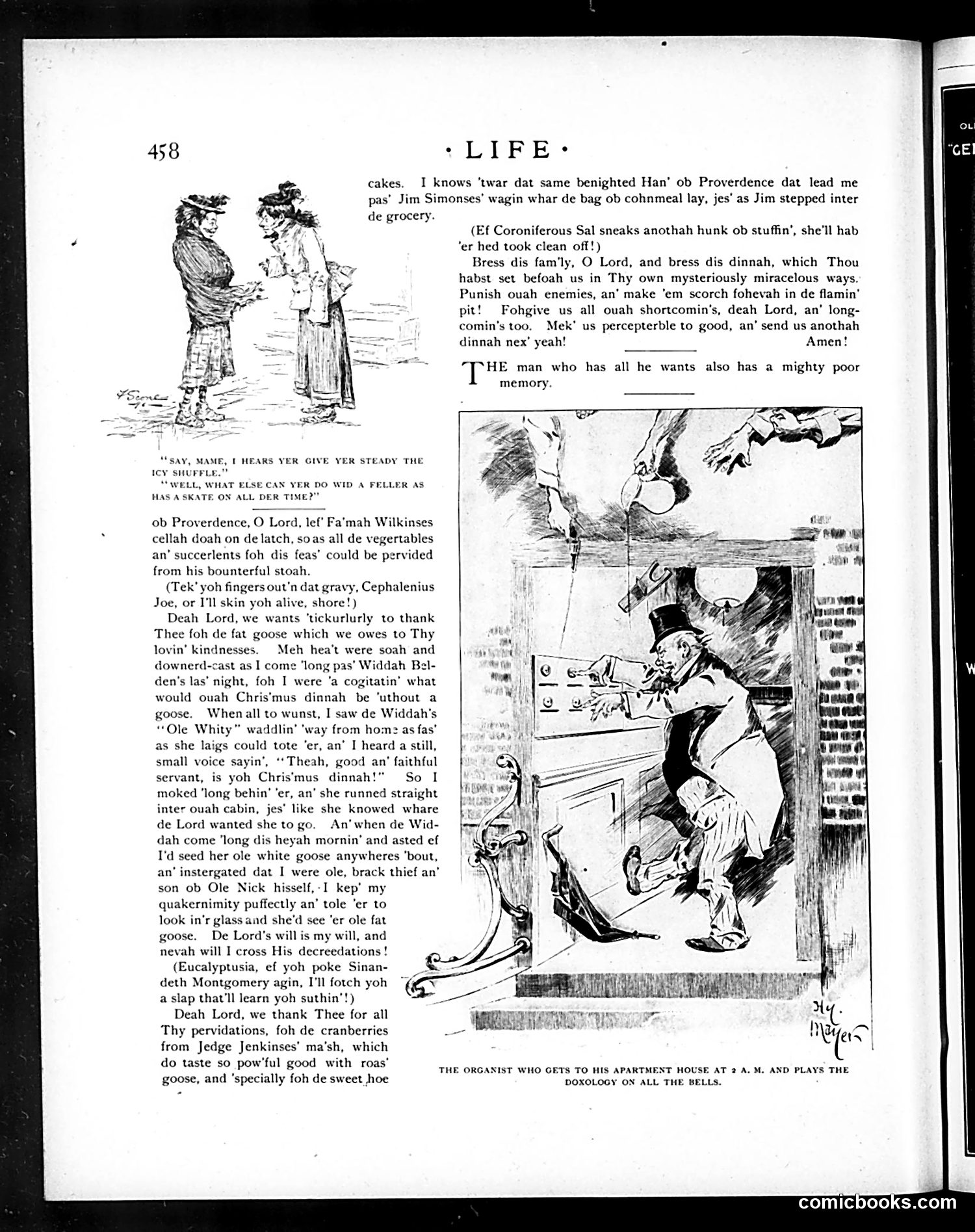
This page contains two distinct satirical pieces using racial stereotypes typical of early 20th-century American humor. **Upper section**: A comic narrative in dialect depicting an African American character's prayer before a stolen Christmas dinner. The "joke" relies on racial caricature—exaggerated dialect spelling and the premise that the character stole a neighbor's goose but claims divine providence. The humor targets both the character's perceived dishonesty and his religious hypocrisy. **Lower section**: A single-panel cartoon captioned "The organist who gets to his apartment house at 2 A.M. and plays the doxology on all the bells." The joke concerns a musician returning home very late and playing hymns loudly on building bells, disturbing neighbors—satirizing either religious zealotry or inconsiderate behavior masquerading as piety. Both pieces employ exaggerated characterization for comedic effect. The racial content would be considered deeply offensive by modern standards, reflecting the publication's era and prevailing attitudes toward African American subjects in popular media.
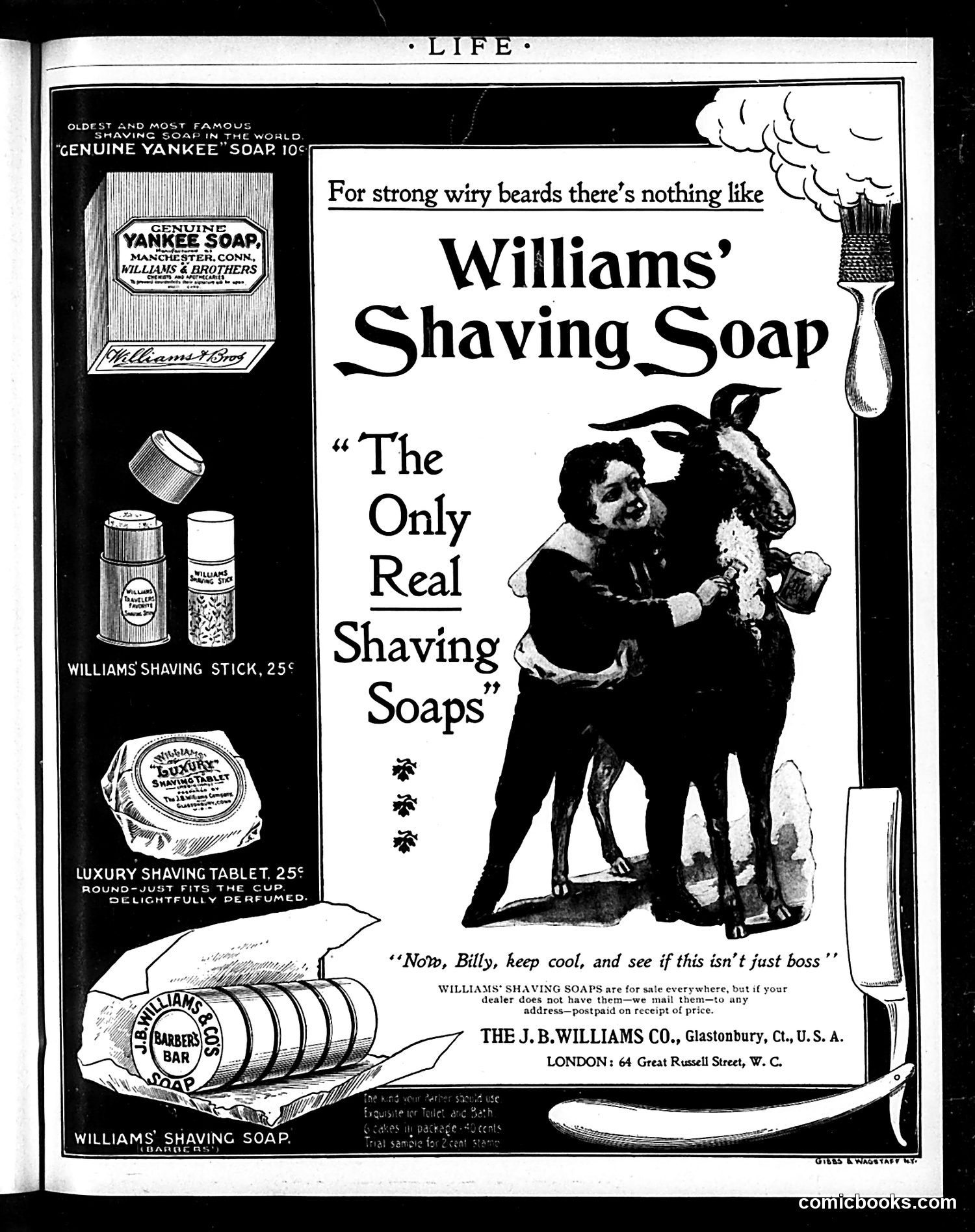
This is primarily an **advertisement**, not political satire. The page promotes Williams' Shaving Soap products through a humorous domestic scene rather than satirizing current events. The illustration shows a man shaving a dog, with the caption "Now, Bitts, keep cool, and see if this isn't just boss"—a lighthearted joke suggesting the soap works so well it's suitable even for animals. The tagline "For strong wiry beards there's nothing like Williams' Shaving Soap" plays on the visual pun. The left sidebar catalogs Williams' product line: Genuine Yankee Soap (10¢), a Shaving Stick (25¢), and a Luxury Shaving Tablet (25¢). The "Barbers' Bar" soap is also shown. This reflects early 20th-century advertising humor—using absurdist scenarios and talking animals to make products memorable. There's no political commentary; it's purely commercial.
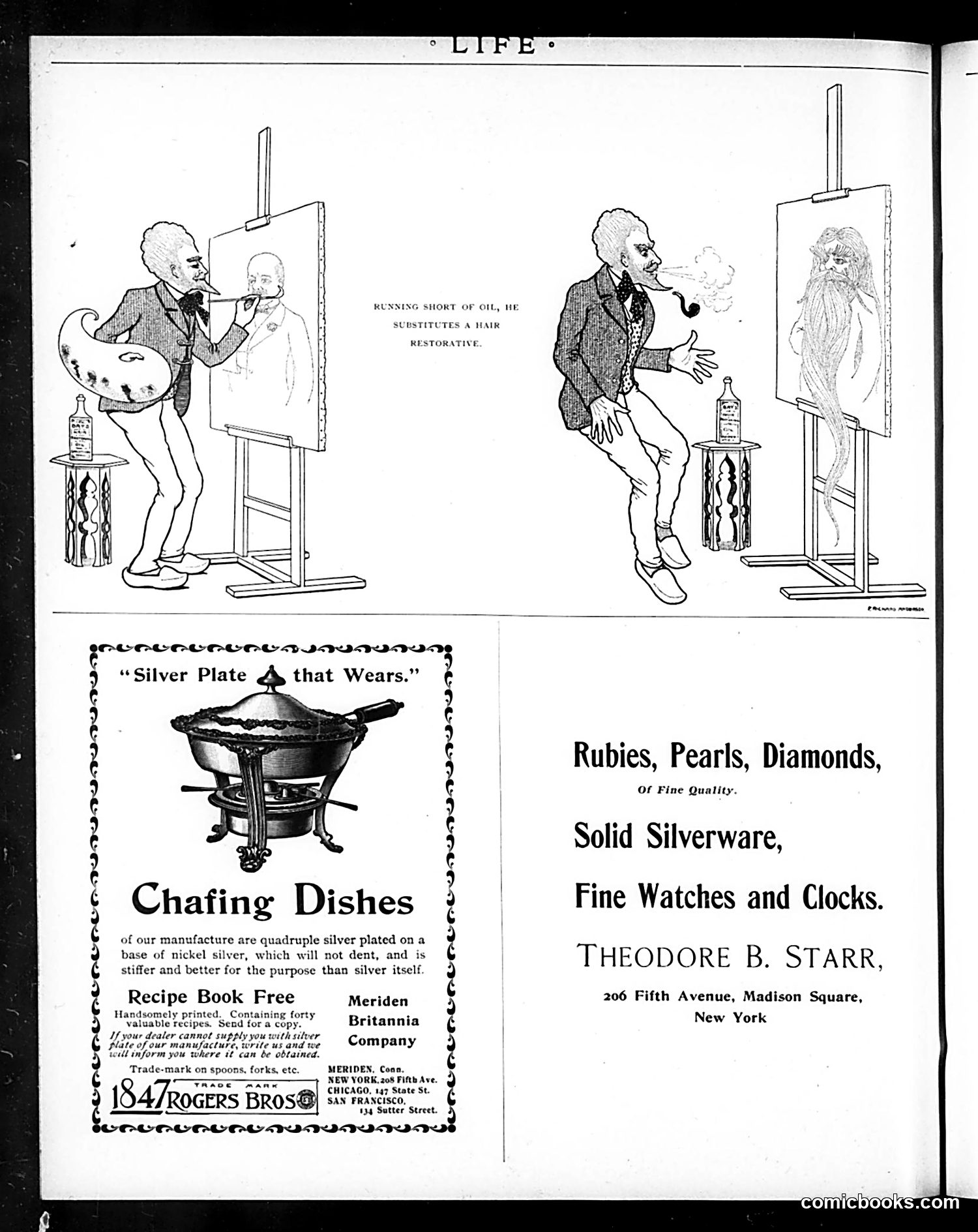
This page contains a satirical cartoon about baldness remedies, paired with period advertisements. **The Cartoon:** The top panels show a man (likely an artist or charlatan) painting portraits. On the left, he has hair oil available; on the right, he's substituted a commercial hair-restorative product for the oil. The caption reads: "Running short of oil, he substitutes a hair restorative." **The Satire:** The joke mocks the interchangeability of hair-restoration products with ordinary oils—suggesting they're essentially the same thing, or that manufacturers cynically substitute cheap oil into expensive "restoratives." It's a jab at patent medicine fraud and snake-oil salesmanship, common targets of satirical magazines in the late 19th/early 20th century. **Context:** This reflects widespread public skepticism about unregulated beauty and health products making exaggerated claims. The humor assumes readers recognize the dubious nature of hair-loss remedies marketed in that era. **Advertisements:** The page also features legitimate luxury goods (silver, watches, diamonds) from established jeweler Theodore B. Starr.
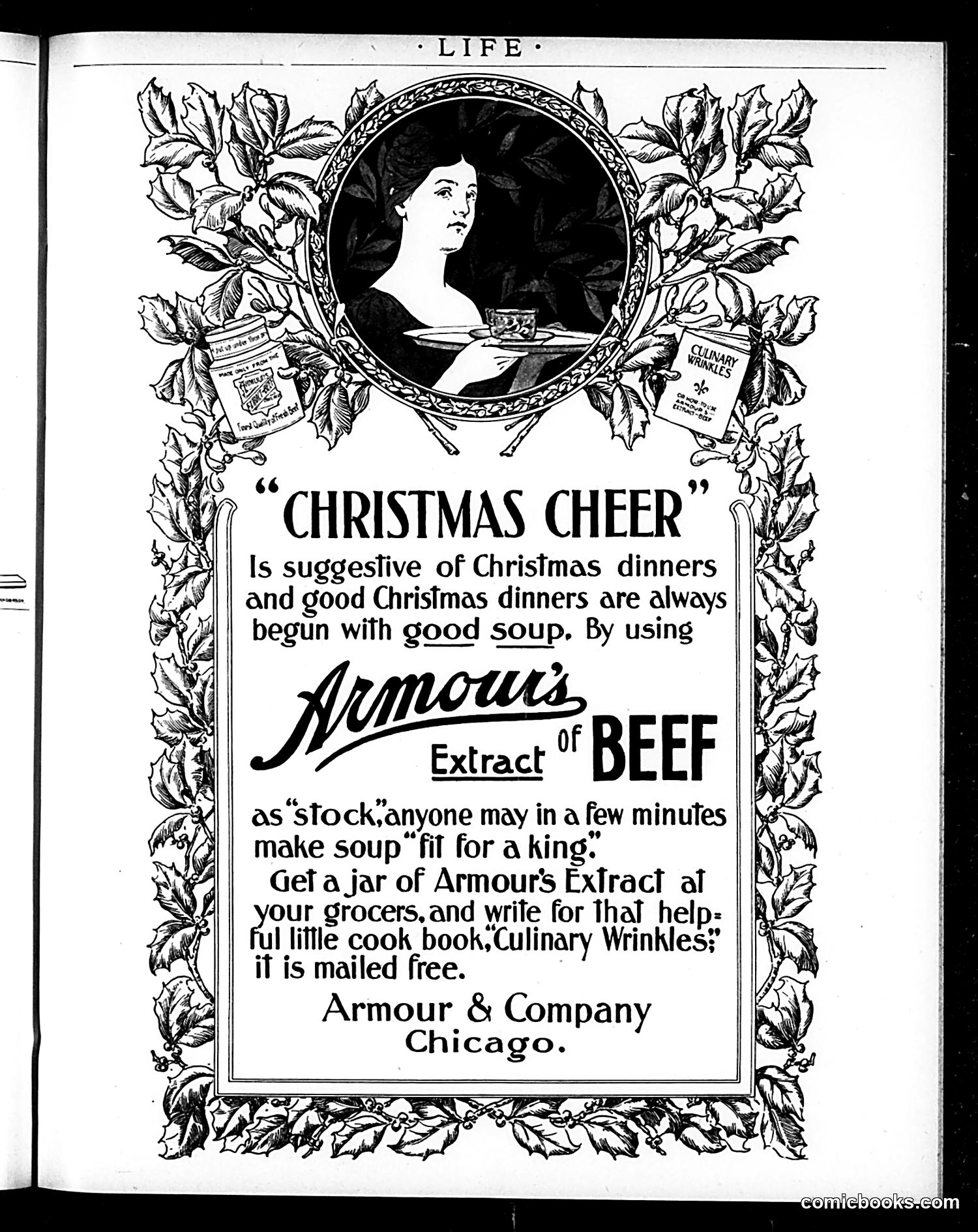
This page is primarily a **product advertisement** for Armour's Extract of Beef, not political satire or a cartoon. It appeared in *Life* magazine during the early 20th century. The decorative illustration shows a woman's portrait in an ornate circular frame surrounded by holly and ivy, invoking Christmas imagery. The ad connects "Christmas Cheer" with Christmas dinners, arguing that good dinners begin with good soup. Armour & Company (a Chicago meat-processing firm) promotes their beef extract as a convenient "stock" for making soup quickly. The copy emphasizes ease—soup "fit for a king" in minutes—and encourages readers to obtain a free cookbook called "Culinary Wrinkles" from grocers. This reflects early 20th-century advertising strategy: using seasonal themes, convenience claims, and free promotional materials to drive consumer purchases of processed food products.
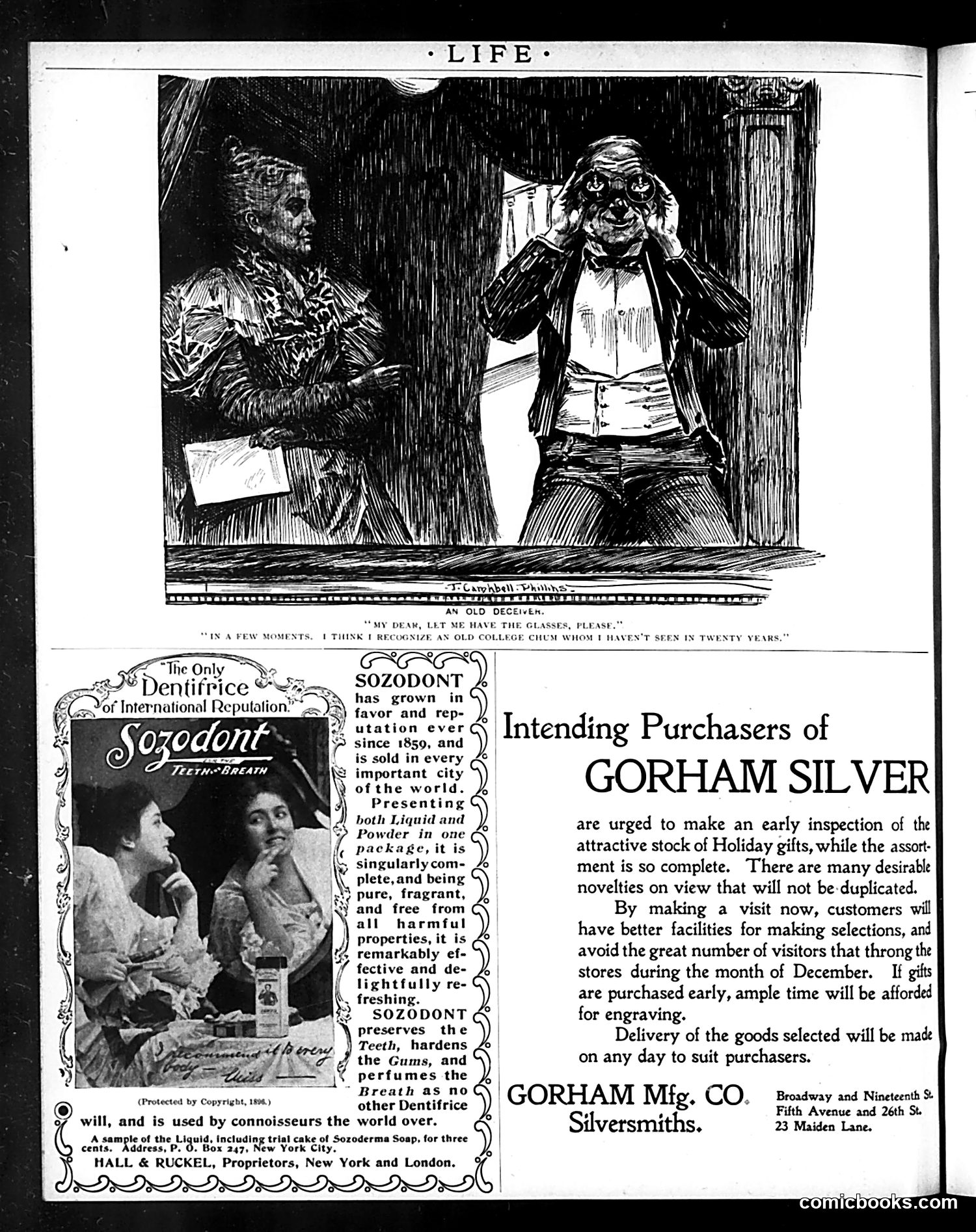
**The Cartoon:** The top illustration depicts two figures at what appears to be a social gathering or theater. One person (left) holds opera glasses while another (right) eagerly requests them, claiming to recognize "an old college chum" after twenty years. The joke plays on a common social awkwardness: the requestor may be using the glasses as a pretext to observe someone more closely, or the humor lies in the absurdity of recognizing someone after such a long absence. The exaggerated facial expressions suggest comedic intent typical of *Life* magazine's satirical style. **The Advertisements:** The page primarily contains period advertisements for Sozodont toothpaste and Gorham Silver goods—typical commercial content for *Life*. These ads are historically noteworthy as examples of late-19th-century marketing but carry no satirical or political message themselves. **Context:** Without additional historical markers visible, the specific occasion or social commentary remains unclear, though the cartoon reflects genteel urban society concerns about etiquette and recognition.
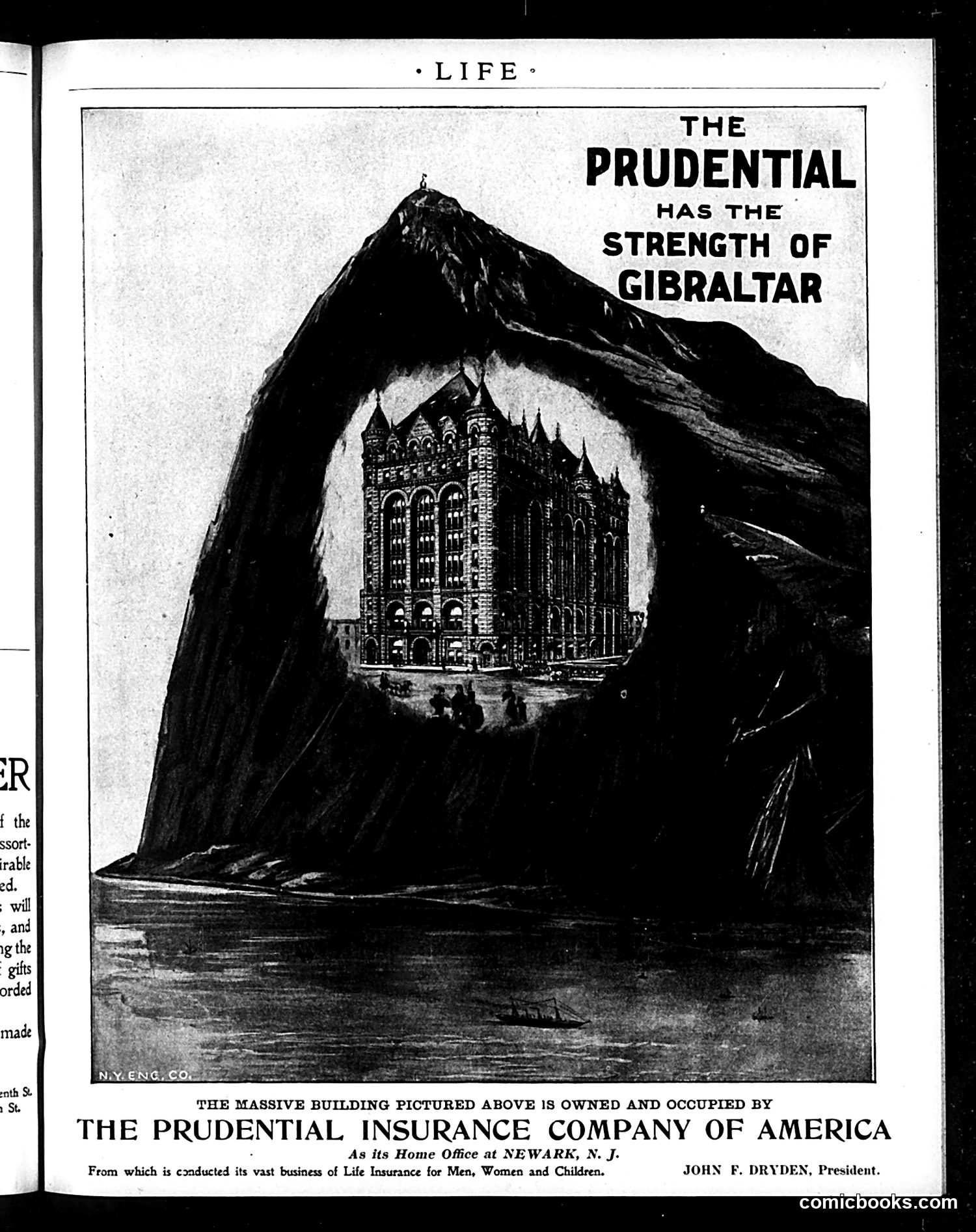
This is a **corporate advertisement**, not satire. The Prudential Insurance Company uses a striking visual metaphor: their Newark office building is framed within the silhouette of the Rock of Gibraltar, a famous natural fortification symbolizing impregnable strength and stability. The advertisement's message is explicit in the headline: "The Prudential has the strength of Gibraltar." By visually combining their architectural achievement with this geological landmark, the company asserts its reliability and permanence to potential life insurance customers. This appeals to early 20th-century anxieties about financial security—convincing people that their life insurance policies are backed by an institution as solid and enduring as an actual mountain. The image exploits the dramatic contrast between the imposing natural formation and human engineering to build confidence in the company's solvency.
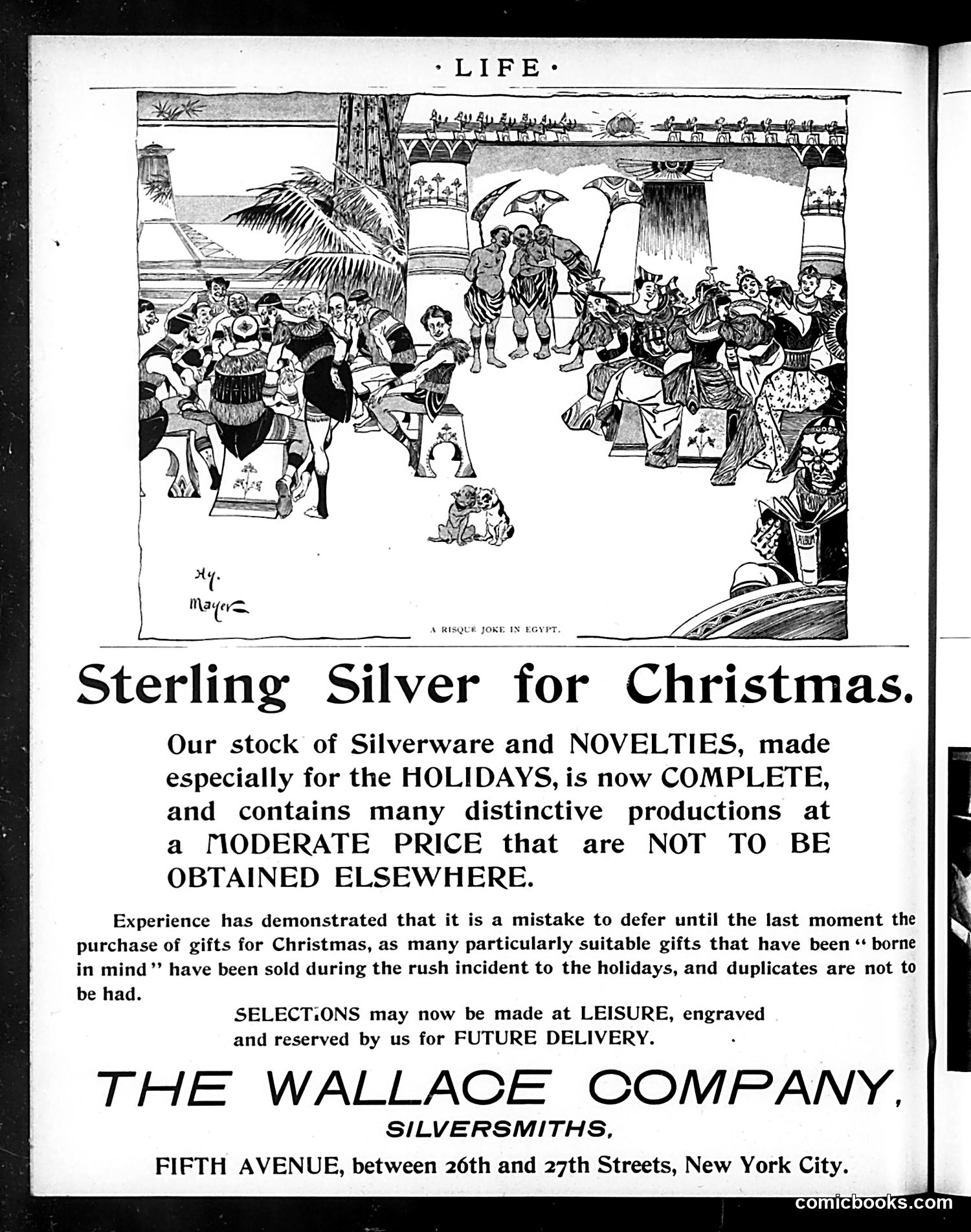
This page is primarily a **sterling silver advertisement** for The Wallace Company, but features a cartoon titled "A Risqué Joke in Egypt" by artist Maye. The cartoon depicts what appears to be **colonial-era Egyptians and Western tourists** in an exotic setting with pyramids and palm trees. The "risqué joke" likely involves **sexual innuendo or impropriety** involving the figures shown—though the exact nature is unclear without additional context. The humor appears to trade on early-20th-century stereotypes about Egypt as a place of exotic scandal. The cartoon serves as light entertainment for *Life* magazine readers, while below it Wallace Company promotes Christmas shopping for silver novelties, warning readers not to delay purchases since popular items sell out during the holiday rush.
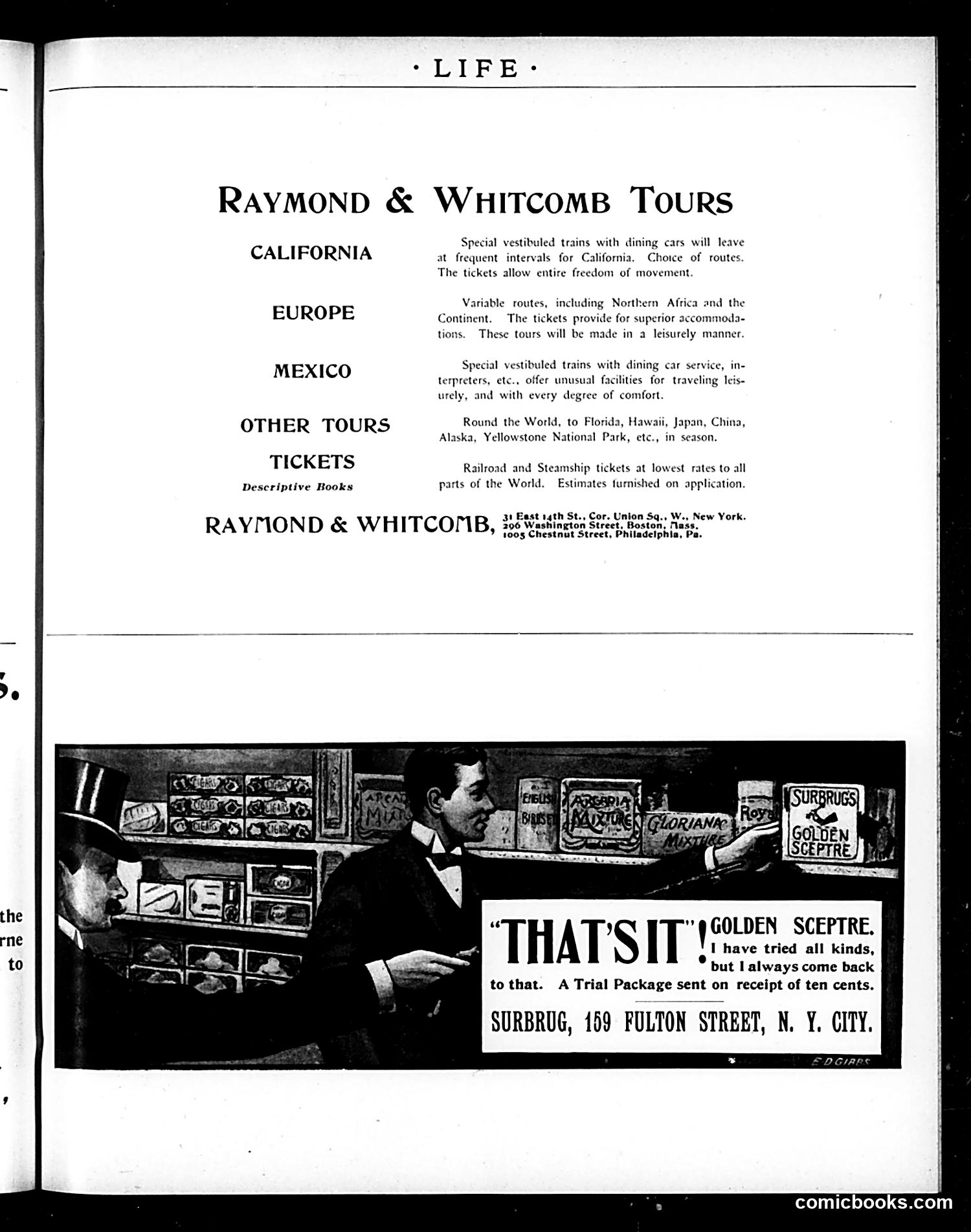
This page contains two distinct advertisements with no political cartoon. **Upper section:** A Raymond & Whitcomb Tours advertisement promoting luxury travel packages to California, Europe, Mexico, and worldwide destinations. The copy emphasizes comfort, dining cars, and leisurely pacing—typical appeals for affluent Gilded Age travelers. **Lower section:** An advertisement for "Golden Sceptre," a product (likely a food or beverage, possibly a condiment or sauce based on the shelf display shown). The image depicts a man in formal attire examining bottles on a store shelf. The testimonial claims superiority over competitors, with a humorous tone suggesting the product is irresistible. A trial package is offered for ten cents. Both advertisements target wealthy or middle-class readers, reflecting early 20th-century consumer culture. There is no satire or political commentary present—this is a standard advertising page from *Life* magazine.
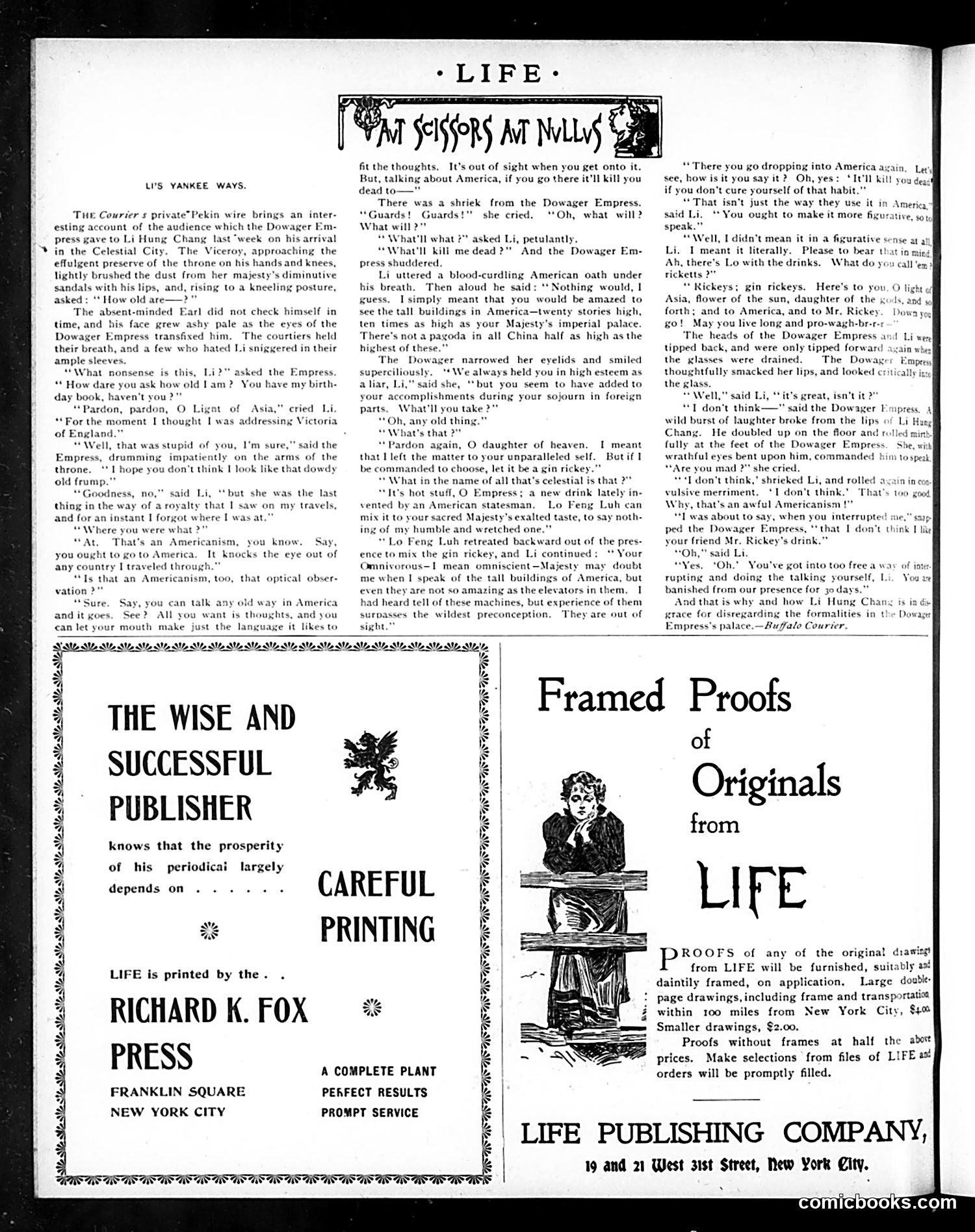
This satirical piece mocks **Li Hung Chang**, the Chinese statesman and diplomat, during or after his travels to America. The humor relies on cultural collision: Li, having recently visited the United States, constantly lapses into American slang and idioms ("it'll kill you dead," "gin rickey," "out of sight") while addressing the **Chinese Dowager Empress**. The satire targets both figures: Li appears foolish for adopting American speech patterns and nearly committing the grave offense of asking the Empress her age (comparing her unfavorably to Queen Victoria). The Empress is portrayed as imperious and suspicious, taking his American expressions literally as threats. The joke hinges on early-1900s American attitudes toward modernization, diplomatic blundering, and the collision between traditional Eastern protocol and brash American informality. Li's obsession with American elevators and tall buildings satirizes contemporary American pride in industrial achievement. The page also contains **advertisements** for Life's printing services and framed proofs, which occupy roughly half the space.
This is a title page from *Life* magazine announcing its editorial vision to readers. The small cherub illustration at the top is the magazine's mascot, representing its irreverent, playful spirit. The text is a prospectus—essentially a promise to subscribers about what to expect in the coming year. *Life* pledges to maintain its established character: "frank, fearless, and judiciously frivolous" satire targeting "fraud and humbug." The magazine commits to high-quality artwork by "first artists" (not cheap reproductions) and contributions from top writers. Notably, *Life* emphasizes its moral purpose: it will wage "warfare against all that is cruel, and unjust, and wrong" through wit. This reveals that despite being primarily humorous and satirical, the magazine positioned itself as having serious social commentary and reformist ambitions—attacking injustice while entertaining readers.
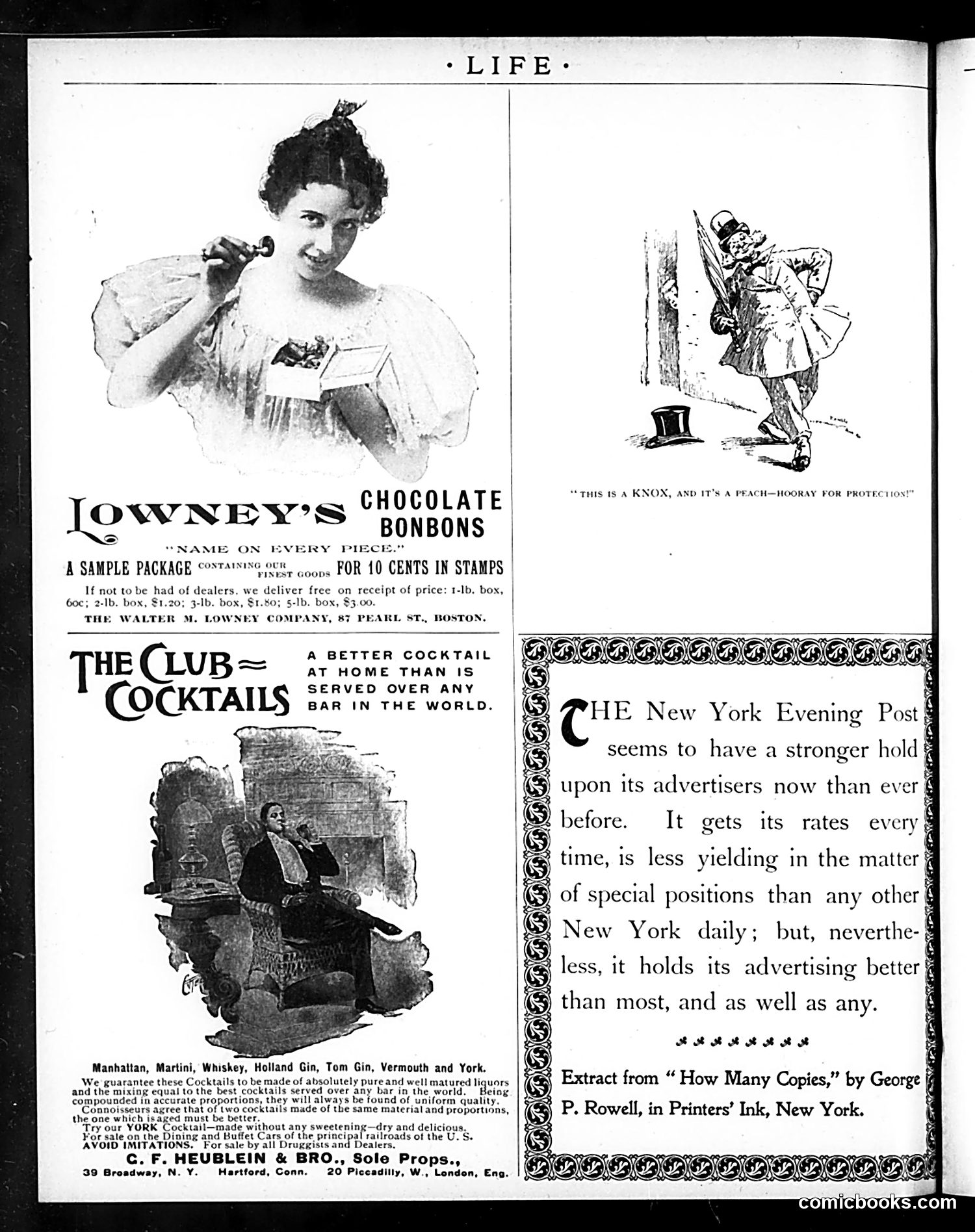
This page consists primarily of **advertisements**, not political satire. However, one small cartoon merits attention: The sketch captioned "THIS IS A KNOX, AND IT'S A PEACH—HOORAY FOR PROTECTION!" depicts a figure admiring a hat. This is a **tariff-protection joke**: "Knox" likely refers to Knox hats (a real American brand). The phrase "hooray for protection" is political wordplay—it simultaneously celebrates both the hat itself and American **protectionist trade policies** that shielded domestic manufacturers like Knox from foreign competition. The wearer's enthusiasm for the protected American product serves as gentle satire of protectionist rhetoric popular in the era. The remaining content—advertisements for Lowney's Chocolate Bonbons, Club Cocktails (by Heublein & Bros.), and a testimonial about the New York Evening Post's advertising strength—are straightforward commercial pitches with no satirical intent.
This is a **Waltham watch advertisement** disguised as editorial content, not a political cartoon. The "satire" is implicit: a Swiss official's 1876 speech praising American Waltham watches is presented as news, lending credibility to an advertisement. The joke for readers would be recognizing this as bald advertising dressed up as a foreign dignitary's endorsement. **Key context:** This represents 19th-century American industrial pride. The Centennial Exhibition (1876) was a showcase for U.S. manufacturing. By publishing a Swiss official's admission that a *randomly selected* Waltham watch outperformed typical Swiss products, the ad argues American manufacturing had surpassed Swiss watchmaking—historically the gold standard. The advertisement weaponizes foreign praise ("taken from the enemy") to suggest American superiority in precision manufacturing, a significant claim at that moment in industrial competition.
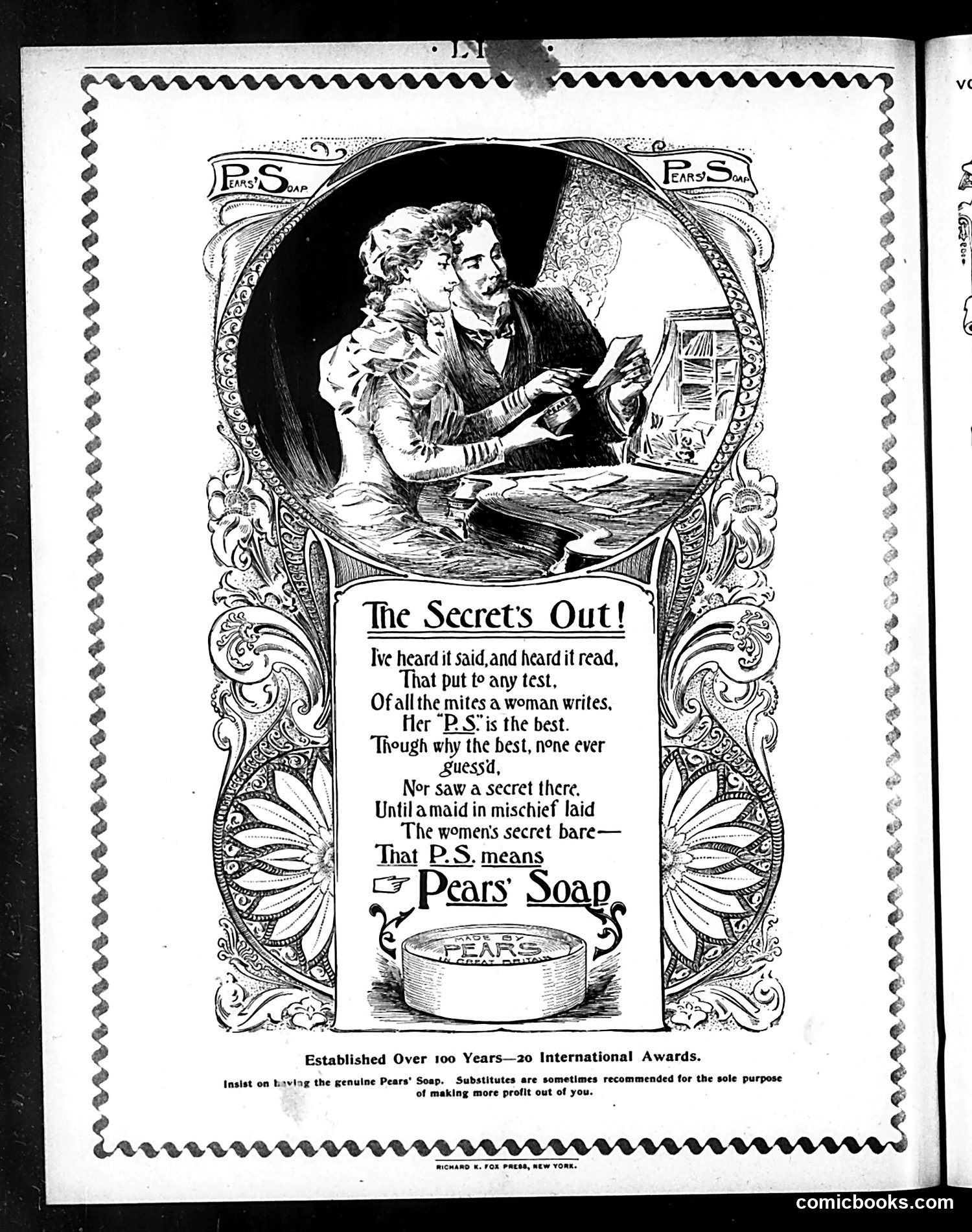
This is primarily a **product advertisement** rather than political satire. It's a Pears' Soap marketing piece that plays on a common phrase of the era. The ad's "secret" is a pun: women's letters famously ended with "P.S." (postscript). The advertisement claims this abbreviation actually stands for "Pears' Soap," suggesting that women's most important written advice concerns this product. The illustration depicts two fashionable figures—a woman and man—examining correspondence, with the woman appearing to share this "secret" discovery. The ornate border and playful verse ("I've heard it said...") create a lighthearted, gossipy tone meant to amuse while promoting the soap brand. The tagline warns against substitutes, emphasizing authenticity and the brand's established reputation (over 100 years, 20 international awards). This reflects early 20th-century concerns about counterfeit products competing with established brands. The humor relies on wordplay rather than social commentary.