
Life, 1896-12-05 · page 19 of 34
Life — December 5, 1896 — page 19: what you’re looking at
What you’re looking at
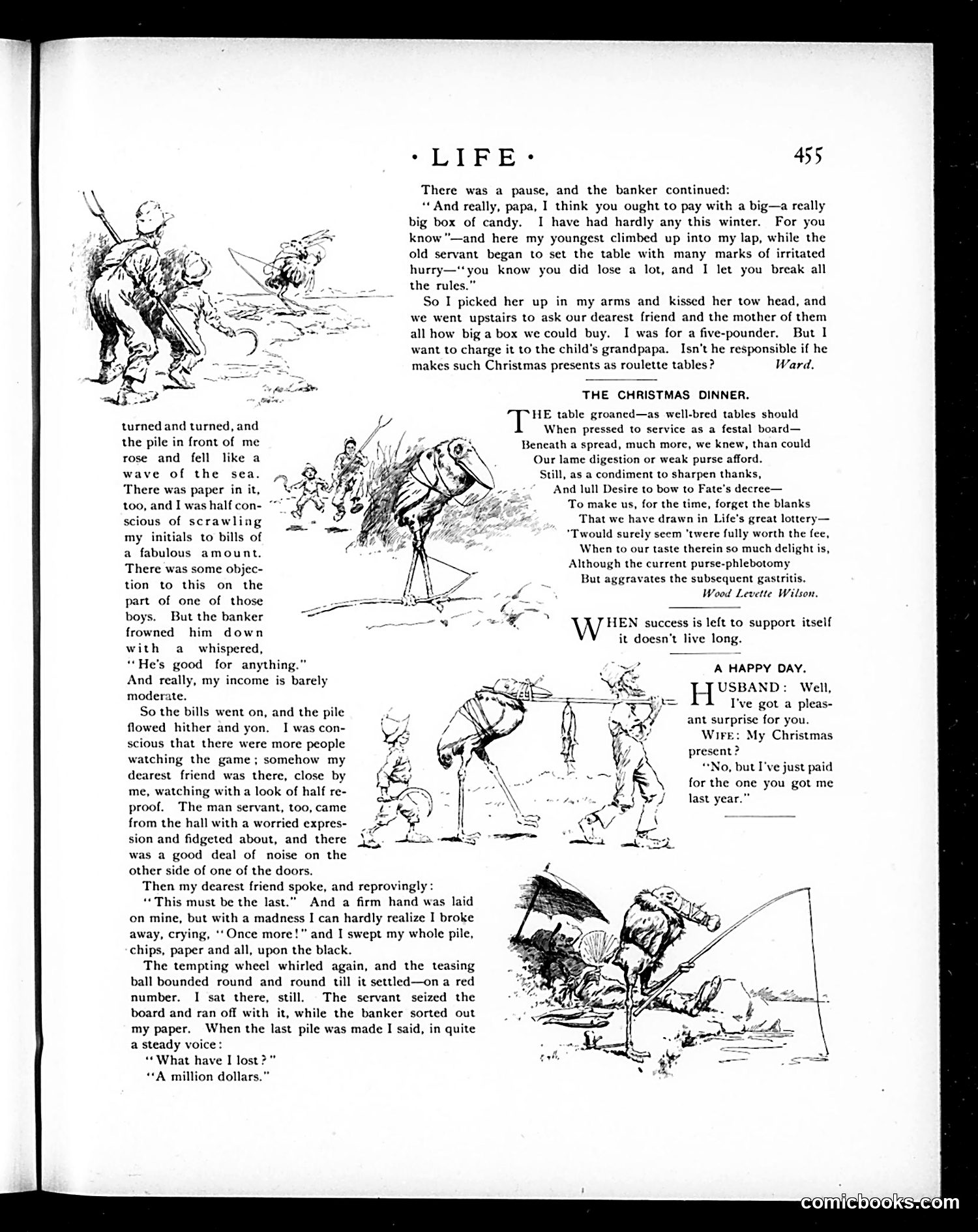
This page contains satirical commentary on **gambling, Christmas excess, and financial irresponsibility** among the wealthy. The main narrative (left) depicts a man losing a fortune at a roulette table. The banker's whispered assurance—"He's good for anything"—satirizes how credit enables reckless behavior. The dreamer's daughter interrupts the fever dream, asking for candy as her Christmas present, suggesting childhood innocence contrasts sharply with adult vice. The final revelation—he's lost "a million dollars"—underscores the satire: that gambling ruins fortunes. The boxed sections mock **holiday spending**: "The Christmas Dinner" poem sardonically celebrates lavish feasts while acknowledging weak finances and indigestion. "A Happy Day" jokes that husbands can only afford to *pay off* previous Christmas gifts, not buy new ones. The illustrations show fantastical, chaotic scenes emphasizing the unreality and moral disorder of these behaviors. Together, the page critiques wealthy excess during Christmas—gambling, overspending, and financial delusion—as moral and practical failures.
📄 Transcribed text from this page (OCR, searchable)
Machine-transcribed from the original scan — historical spelling and the odd misread are preserved.
turned and turned, and the pile in front of me rose and fell like a wave of the sea. There was paper in it, too, and I was half con- “ scious of scrawling my initials to bills of a fabulous amount. There was some objec- tion to this on the part of one of those boys. But the banker frowned him down with a whispered, “He's good for anything.” And really, my income is barely moderate. So the bills went on, and the pile flowed hither and yon. I was con- scious that there were more people watching the game; somehow my dearest friend was there, close by me, watching with a look of half re- proof. The man servant, too, came from the hall with a worried expres- sion and fidgeted about, and there was a good deal of noise on the other side of one of the doors. -*LIFE- 455 There was a pause, and the banker continued: ‘And really, papa, I think you ought to pay with a big—a really big box of candy. I have had hardly any this winter. For you know "—and here my youngest climbed up into my lap, while the old servant began to set the table with many marks of irritated hurry—‘tyou know you did lose a lot, and I let you break all the rules.” So I picked her up in my arms and kissed her tow head, and we went upstairs to ask our dearest friend and the mother of them all how big a box we could buy. I was for a five-pounder. But I want to charge it to the child's grandpapa. Isn't he responsible if he makes such Christmas presents as roulette tables? Ward. THE CHRISTMAS DINNER. HE table groancd—as well-bred tables should When pressed to service as a festal board— Beneath a spread, much more, we knew, than could Our lame digestion or weak purse afford. Still, as a condiment to sharpen thanks, And lull Desire to bow to Fate's decree— To make us, for the time, forget the blanks That we have drawn in Life's great lottery— ‘Twould surely seem "twere fully worth the fee, When to our taste therein so much delight is, Although the current purse-phlebotomy But aggravates the subsequent gastritis, Wood Levette Wilson, HEN success is left to support itself it doesn’t live long. A HAPPY DAY. H USBAND: Well, I've got a pleas- ant surprise for you. Wire: My Christmas present? “No, but I've just paid for the one you got me last year.” Then my dearest friend spoke, and reprovingly : “This must be the last." And a firm hand was laid on mine, but with a madness I can hardly realize I broke away, crying, ‘‘Once more!" and I swept my whole pile, chips, paper and all, upon the black. The tempting wheel whirled again, and the teasing ball bounded round and round till it settled—on a red number. I sat there, still, The servant seized the board and ran off with it, while the banker sorted out my paper. When the last pile was made I said, in quite a steady voice: “*What have I lost?” “A million dollars.”