
Life, 1896-12-05 · page 8 of 34
Life — December 5, 1896 — page 8: what you’re looking at
What you’re looking at
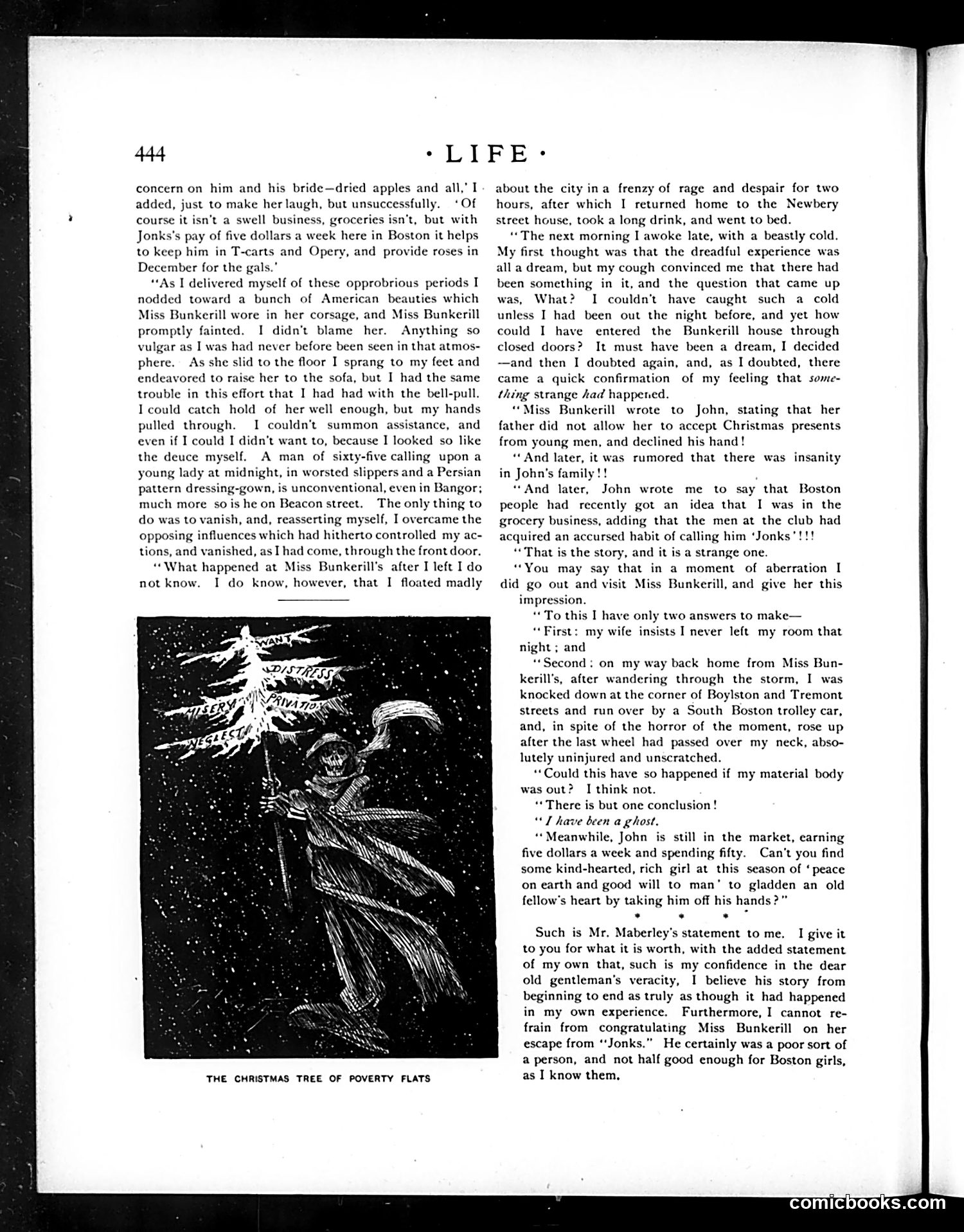
This illustration depicts a personified Christmas tree as an emaciated, skeletal figure—a visual metaphor for poverty during the holiday season. The image critiques the contrast between Christmas's promise of abundance and the harsh reality facing poor urban residents, particularly in Boston's "Poverty Flats" (a working-class neighborhood). The accompanying text discusses a man named Maberley's account of visiting Miss Bunkerill, a young woman living in difficult circumstances. The narrative emphasizes class struggle and suggests Christmas brings false hope rather than genuine relief to the impoverished. The satirical point: while wealthy Americans celebrate with traditional abundance, poor families face starvation and desperation—rendering Christmas a cruel irony rather than a season of genuine "peace on earth and good will."
📄 Transcribed text from this page (OCR, searchable)
Machine-transcribed from the original scan — historical spelling and the odd misread are preserved.
444 concern on him and his bride—dried apples and all,’ I added, just to make her laugh, but unsuccessfully.‘ Of course it isn't a swell business, groceri n't, but with Jonks’s pay of five dollars a week here in Boston it helps to keep him in T-carts and Opery, and provide roses in December for the : “As I delivered myself of these opprobrious periods I nodded toward a bunch of American beauties which Miss Bunkerill wore in her corsage, and Miss Bunkerill promptly fainted. I didn’t blame her. Anything so vulgar as I had never before been seen in that atmos- phere. As she slid to the floor I sprang to my feet and endeavored to raise her to the sofa, but I had the same trouble in this effort that I had had with the bell-pull. I could catch hold of her well enough, but my hands pulled through. 1 couldn’t summon assistance, and even if I could I didn’t want to, because I looked so like the deuce myself. A man of sixty-five calling upon a young lady at midnight, in worsted slippers and a Persian pattern dressing-gown, is unconventional, even in Bangor; much more so is he on Beacon street. The only thing to do was to vanish, and, reasserting myself, I overcame the opposing influences which had hitherto controlled my ac- tions, and vanished, as I had come, through the front door, “‘What happened at Miss Bunkerill's after I left I do I do know, however, that I floated madly not know. THE CHRISTMAS TREE OF POVERTY FLATS *LIFE: about the city ina frenzy of rage and despair for two hours, after which I returned home to the Newbery street house, took a long drink, and went to bed. “The next morning I awoke late, with a beastly cold. My first thought was that the dreadful experience was alla dream, but my cough convinced me that there had been something in it, and the question that came up was, What? 1 couldn't have caught such a cold unless I had been out the night before, and yet how could I have entered the Bunkerill house through closed doors? It must have been a dream, I decided —and then I doubted again, and, as I doubted, there came a quick confirmation of my feeling that some- thing strange had happened. “Miss Bunkerill wrote to John, stating that her father did not allow her to accept Christmas presents from young men, and declined his hand! “And later, it was rumored that there was insanity in John's family !! “And later, John wrote me to say that Boston people had recently got an idea that I was in the grocery business, adding that the men at the club had acquired an accursed habit of calling him ‘Jonks'!!! “That is the story, and it is a strange one. “You may say that in a moment of aberration I did go out and visit Miss Bunkerill, and give her this impression. “To this I have only two answers to make— : my wife insists I never left my room that night; and ‘cond ; on my way back home from Miss Bun- kerill’s, after wandering through the storm, I was knocked down at the corner of Boylston and Tremont streets and run over by a South Boston trolley car, and, in spite of the horror of the moment, rose up after the last wheel had passed over my neck, abso- lutely uninjured and unscratched. “Could this have so happened if my material body was out? I think not. ‘There is but one conclusion! “T have been a ghost. ‘*Meanwhile, John is still in the market, carning five dollars a week and spending fifty. Can't you find some kind-hearted, rich girl at this season of ‘ peace on earth and good will to man’ to gladden an old fellow’s heart by taking him off his hands?” . . . Such is Mr. Maberley’s statement to me. I give it to you for what it is worth, with the added statement of my own that, such is my confidence in the dear old gentleman's veracity, I believe his story from beginning to end as truly as though it had happened in my own experience. Furthermore, I cannot re- frain from congratulating Miss Bunkerill on her escape from ‘‘Jonks.” He certainly was a poor sort of a person, and not half good enough for Boston girls, as I know them, comicbooks.com