
Life, 1896-12-05 · page 3 of 34
Life — December 5, 1896 — page 3: what you’re looking at
What you’re looking at
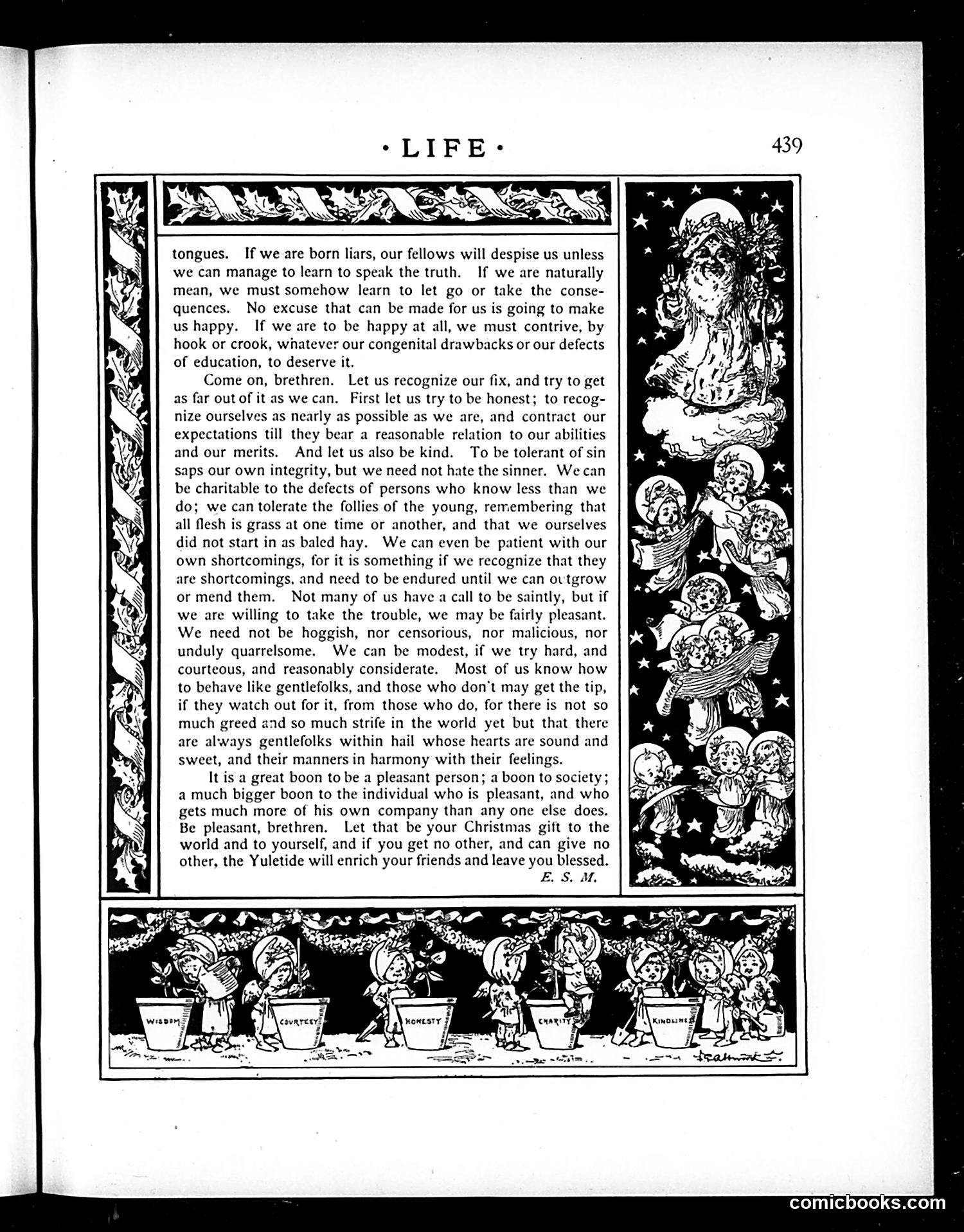
The page presents a moral essay (signed E.S.M.) advocating for personal virtue and kindness as Christmas gifts to the world. The text emphasizes honesty, self-awareness, charity toward others' shortcomings, and pleasant social behavior. The accompanying illustrations support this message: the right panel shows a religious/angelic Christmas scene with cherubs and stars, reinforcing spiritual virtue. The bottom panel depicts small figures planting virtues in pots labeled "Wisdom," "Courtesy," "Honesty," "Charity," and "Kindness"—a literal visualization of cultivating moral character. This is primarily *social commentary* rather than political satire, reflecting early 20th-century Life magazine's role promoting genteel middle-class values during the holiday season.
📄 Transcribed text from this page (OCR, searchable)
Machine-transcribed from the original scan — historical spelling and the odd misread are preserved.
tongues. If we are born liars, our fellows will despise us unless we can manage to learn to speak the truth. If we are naturally mean, we must somehow learn to let go or take the conse- quences. No excuse that can be made for us is going to make us happy. If we are to be happy at all, we must contrive, by hook or crook, whatever our congenital drawbacks or our defects of education, to deserve it. Come on, brethren. Let us recognize our fix, and try to get as far outof it as we can. First let us try to be honest; to recog- nize ourselves as nearly as possible as we are, and contract our expectations till they bear a reasonable relation to our abilities and our merits. And let us also be kind. To be tolerant of sin saps our own integrity, but we need not hate the sinner. We can be charitable to the defects of persons who know less than we do; we can tolerate the follies of the young, remembering that all flesh is grass at one time or another, and that we ourselves did not start in as baled hay. We can even be patient with our own shortcomings, for it is something if we recognize that they are shortcomings, and need to be endured until we can ovtgrow or mend them. Not many of us have a call to be saintly, but if we are willing to take the trouble, we may be fairly pleasant. We need not be hoggish, nor censorious, nor malicious, nor unduly quarrelsome. We can be modest, if we try hard, and courteous, and reasonably considerate. Most of us know how to behave like gentlefolks, and those who don’t may get the tip, if they watch out for it, from those who do, for there is not so much greed and so much strife in the world yet but that there are always gentlefolks within hail whose hearts are sound and sweet, and their manners in harmony with their feelings. It is a great boon to be a pleasant person; a boon to society; a much bigger boon to the individual who is pleasant, and who gets much more of his own company than any one else does. Be pleasant, brethren. Let that be your Christmas gift to the world and to yourself, and if you get no other, and can give no other, the Yuletide will enrich your friends and leave you blessed. comicbooks.com