
A complete issue · 18 pages · 1896
Life — November 19, 1896
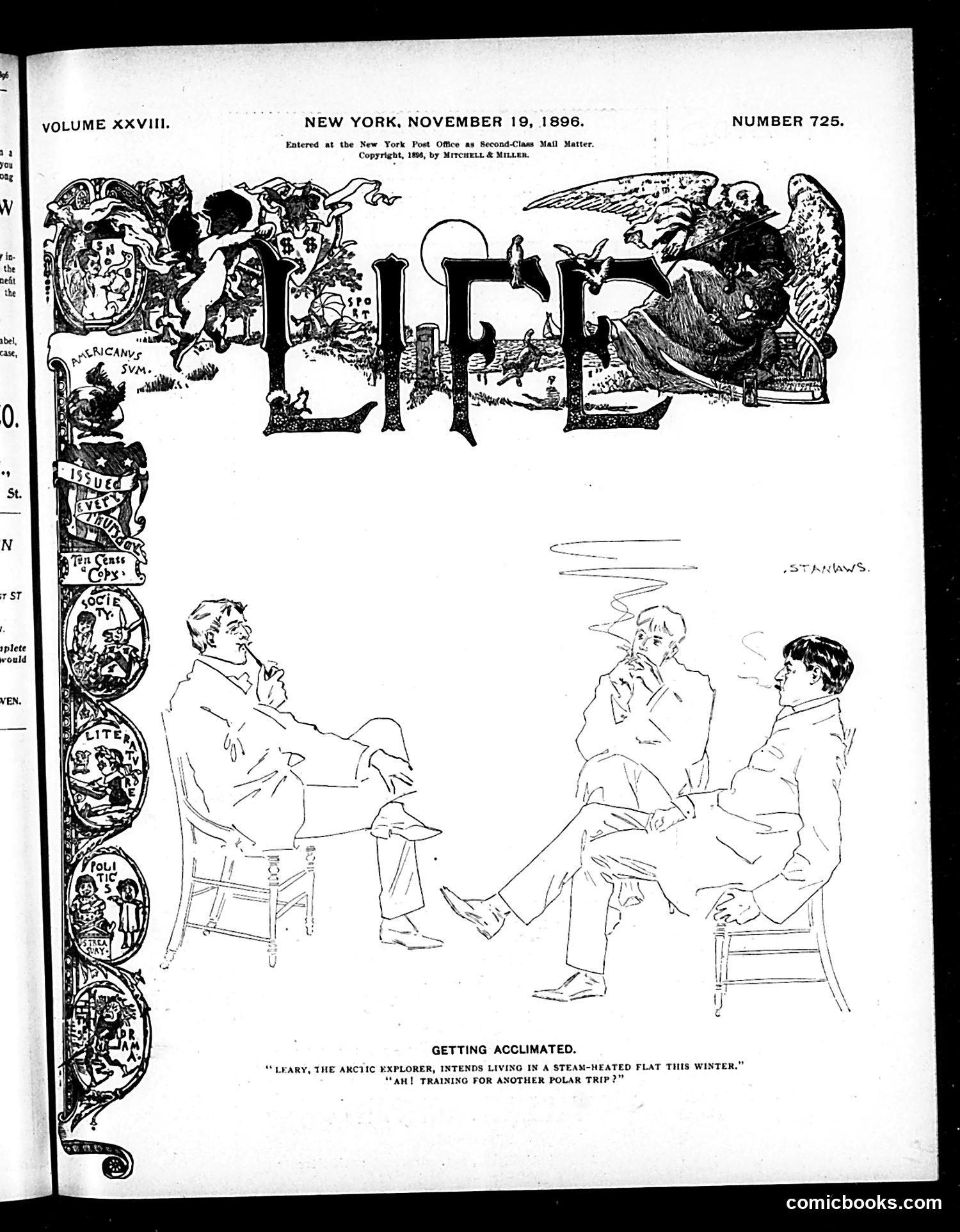
The bottom cartoon, titled "Getting Acclimated," depicts two men in conversation. One says: "Leary, the arctic explorer, intends living in a steam-heated flat this winter" and the other responds "Ah! Training for another polar trip?" The joke satirizes an Arctic explorer (identified as "Leary") who, after enduring extreme cold during polar expeditions, now plans to live in the comfort of a heated apartment for the winter. The other man sarcastically suggests this comfortable arrangement is "training" for future Arctic expeditions—implying the opposite: that comfort is the worst possible preparation for extreme conditions. The humor relies on the absurdity of this contradiction in preparation methods.
This page is **primarily advertising**, not editorial content or cartoons. It contains commercial notices from the early 20th century, including: - Stern Bros' fur department (neck scarves, jackets, capes) - Book advertisements (novels by George Ade, Henry M. Blossom, Arthur Morrison, Lucas Malet) - Arnold Constable & Co.'s winter underwear and hosiery - The Hartford Rubber Works' Victory Crowns tires - Silver & Gold mounted leather goods by The Wallace Company - A notice for Mr. C.D. Gibson's new book "Pictures of People" The only visual element with potential satirical content is the **Victory Crowns tire advertisement** featuring a classical female figure, but it appears to be straightforward product branding rather than political satire. The page reflects early 1900s consumer culture and literary promotion.
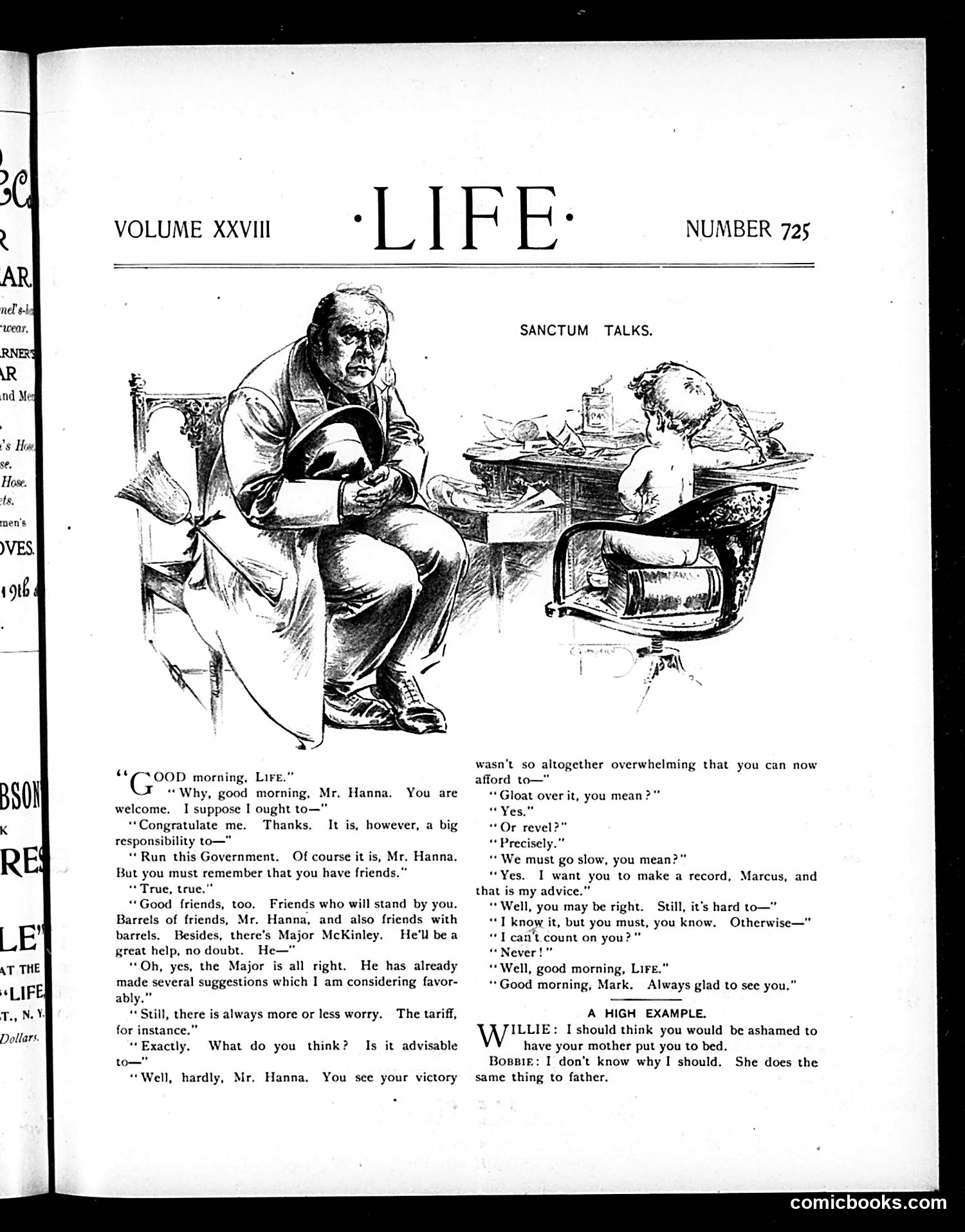
This page from *Life* magazine presents two satirical dialogues titled "Sanctum Talks." The first dialogue, "Good morning, Life," depicts a conversation between Life's editor and "Mr. Hanna" (likely a political figure or public official) regarding governmental responsibility, friends, and tariff concerns. The satire critiques Hanna's political positions and suggests he's celebrating a "victory" despite ongoing worries about tariffs and economic policy. The second piece, "A High Example," mocks parental hypocrisy through a brief exchange between Willie and Bobbie about bedtime—a child observing that mothers enforce rules they don't follow themselves with fathers. The cartoons use caricature and dialogue to lampoon both political incompetence and domestic contradiction, typical of *Life*'s satirical approach during this era.
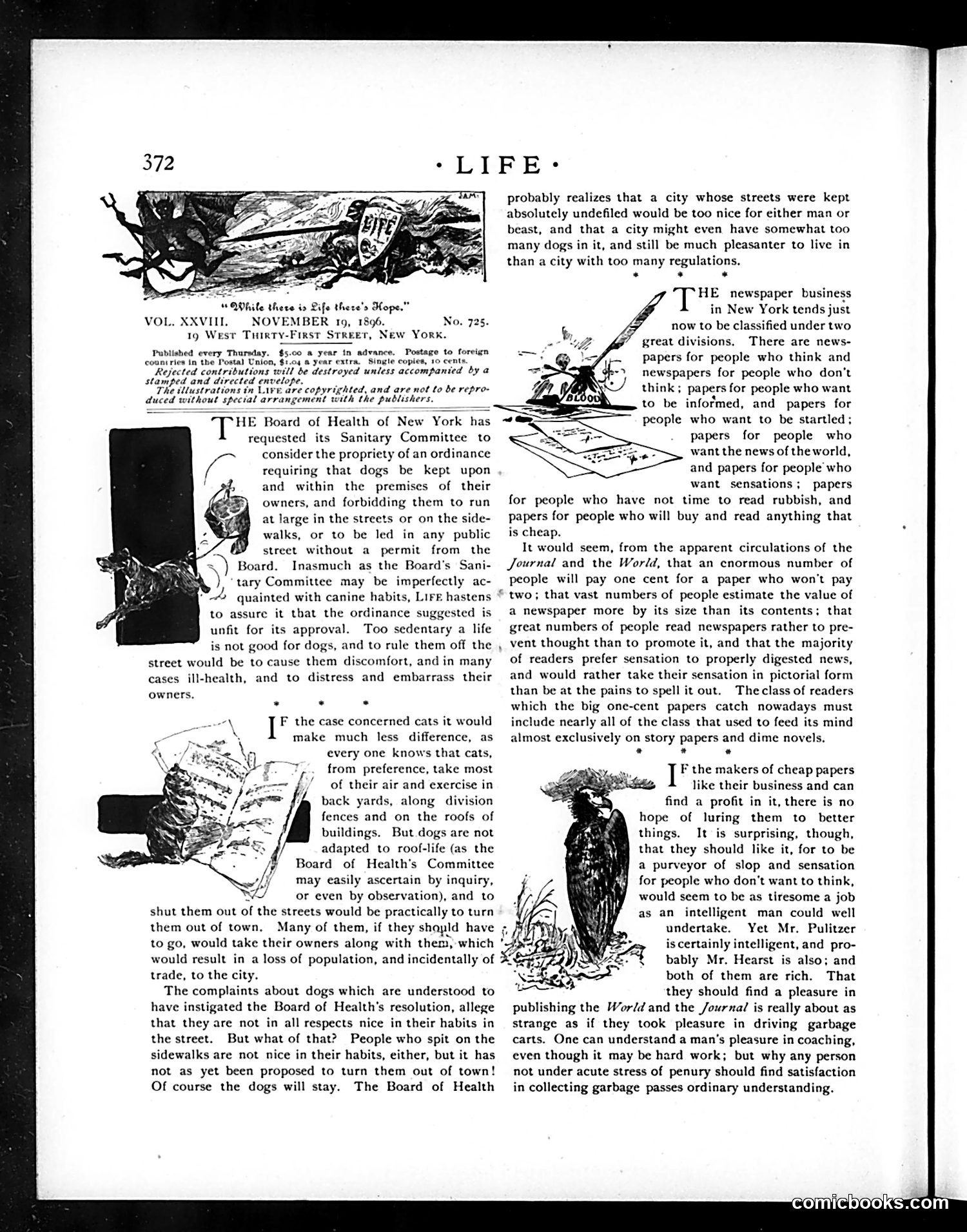
This page satirizes New York City's newspaper industry and regulatory disputes. The main article critiques cheap newspapers that prioritize sensationalism over serious journalism, arguing they cater to readers wanting "sensation" rather than proper "digested news." The accompanying illustrations show dogs—likely metaphors for uncontrolled elements in the city. The text references the Board of Health's recent ordinance regarding stray dogs in New York streets, debating whether dogs should be expelled from the city entirely. The satire suggests that while dog control might seem logical, the real problem—like cheap sensational papers—reveals deeper hypocrisy: society tolerates many unsavory things while scapegoating specific targets. The cartoons emphasize this satirical point about selective regulation and public priorities.
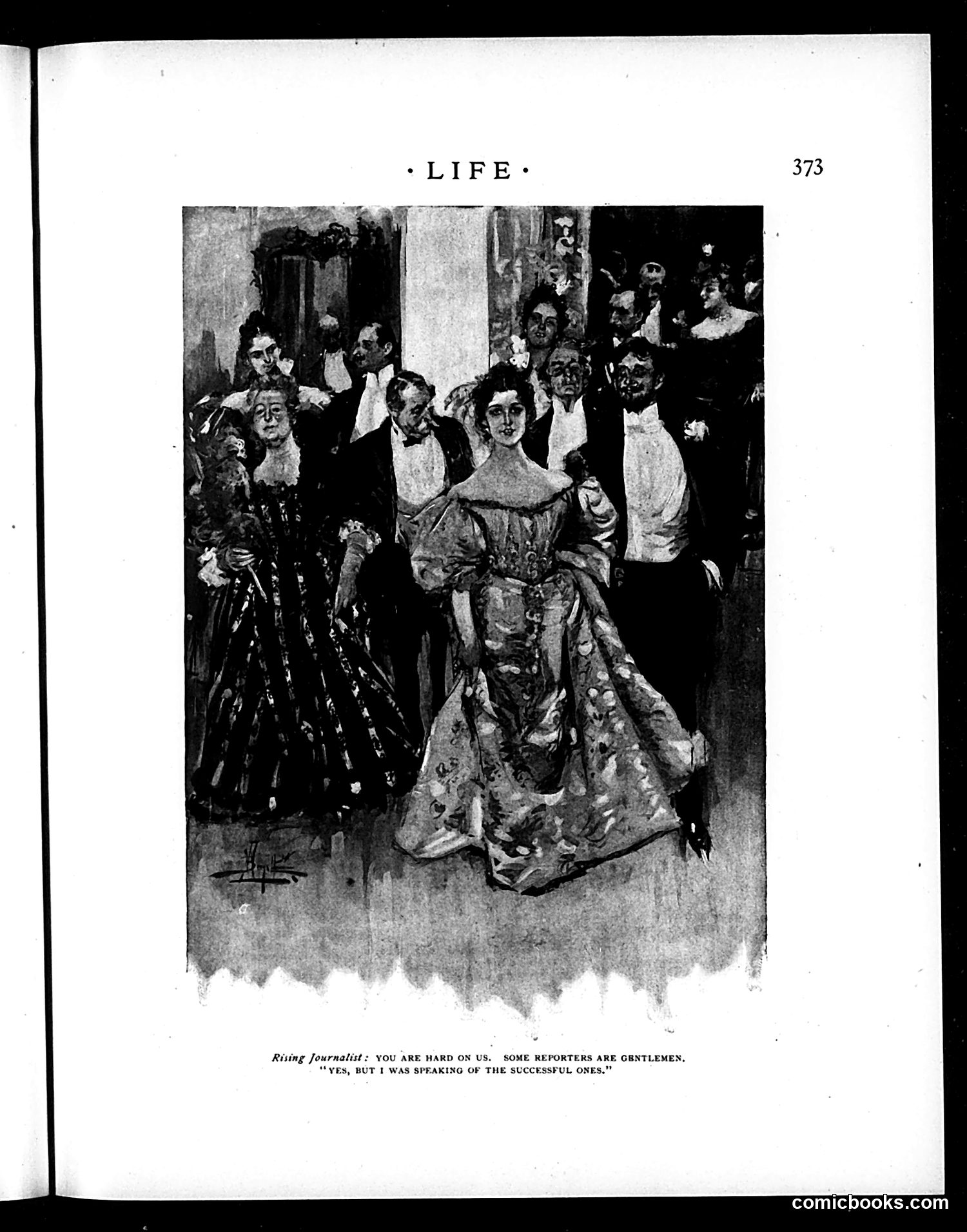
This illustration depicts a social gathering featuring a woman in an ornate, patterned dress as the central figure, surrounded by formally dressed men in tuxedos and women in evening wear. The caption reads: "Rising Journalist: 'YOU ARE HARD ON US. SOME REPORTERS ARE GENTLEMEN.' 'YES, BUT I WAS SPEAKING OF THE SUCCESSFUL ONES.'" The satire critiques the journalism profession, suggesting successful reporters lack gentlemanly qualities—implying they achieve success through aggressive, unethical, or underhanded methods rather than integrity. The formal social setting provides ironic contrast to this cynical commentary about journalistic practices. This reflects early 20th-century tensions between emerging yellow journalism tactics and traditional professional standards.
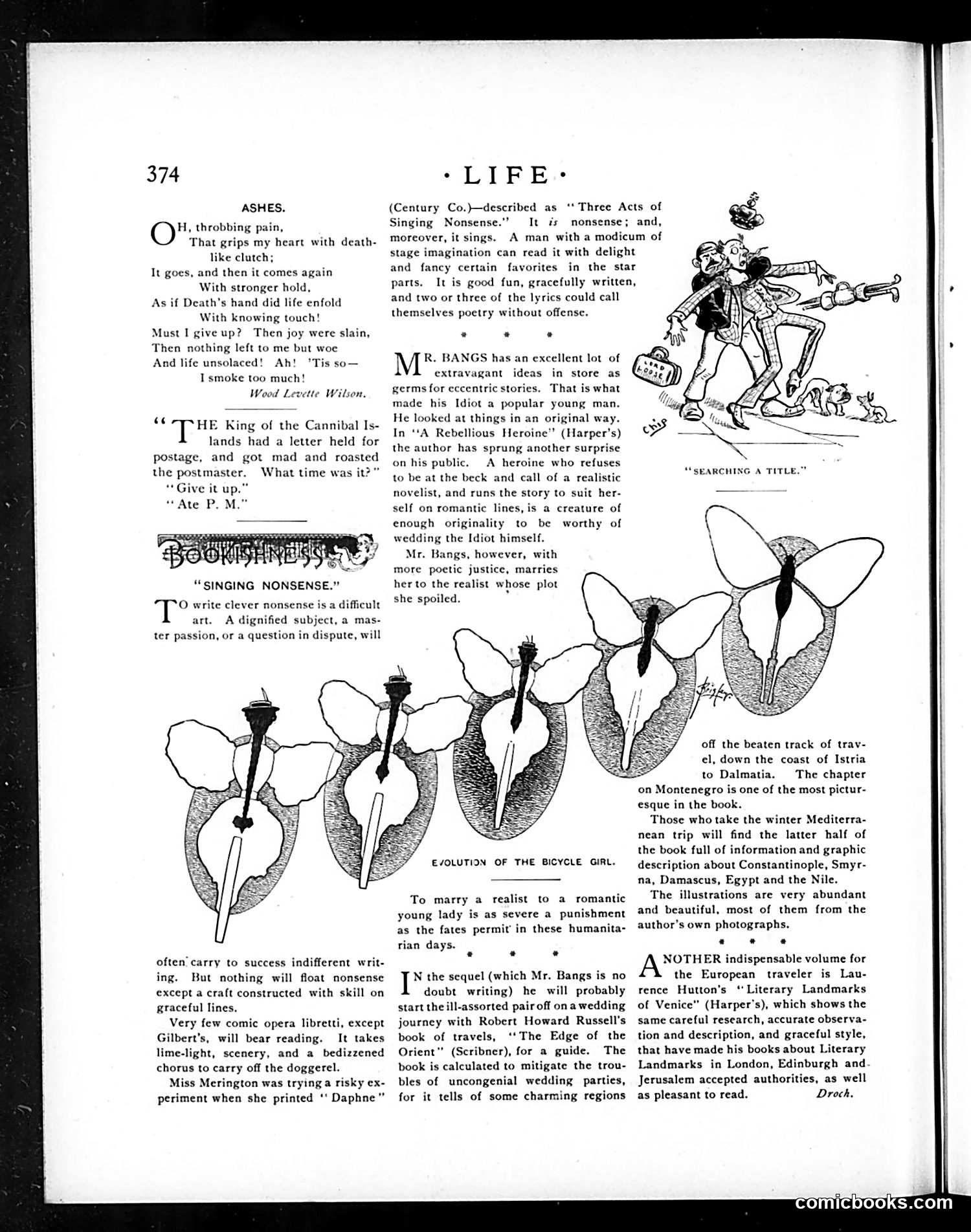
The page contains two distinct cartoons: **"Searching a Title"** (upper right) depicts a disheveled man surrounded by scattered papers and items, illustrating the difficulty writers face finding suitable titles for their work—a relatable creative struggle. **"Evolution of the Bicycle Girl"** (lower left) shows a sequential progression of female figures emerging from or transforming within bicycle seats, visualizing how women's cycling culture evolved. This references the late 19th-century "bicycle craze" when cycling became fashionable for women, challenging Victorian dress norms and symbolizing female independence and mobility. Both cartoons use visual humor to comment on contemporary cultural anxieties: literary creativity and women's changing social roles.
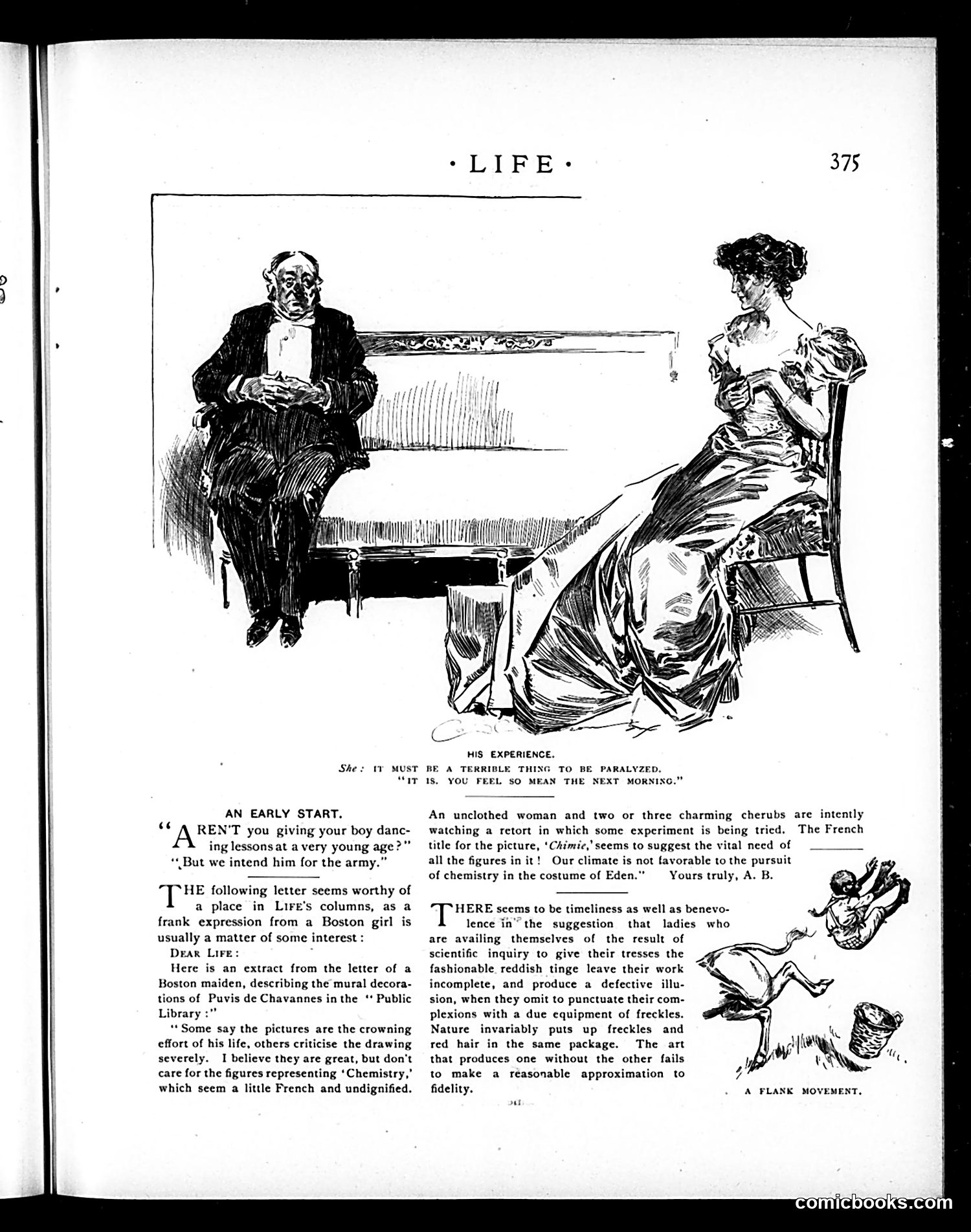
This page contains two distinct sections: **Top Illustration ("His Experience"):** Shows a man and woman in an intimate domestic scene with the caption suggesting she fears feeling unwell the next morning. The dialogue references her concern about physical consequences. **Text Sections:** Two letters to the editor discuss art criticism. One Boston correspondent defends Puvis de Chavannes's mural paintings in the Public Library, praising the "Chemistry" artwork despite some figures appearing "French and undignified." The second letter responds with social satire about women undergoing scientific treatments to artificially redden their hair, mocking both cosmetic vanity and the pretense of scientific authority. The author humorously suggests nature and freckles come together in redheads. The page combines domestic humor with commentary on beauty standards and pseudoscientific cosmetic treatments of the era.
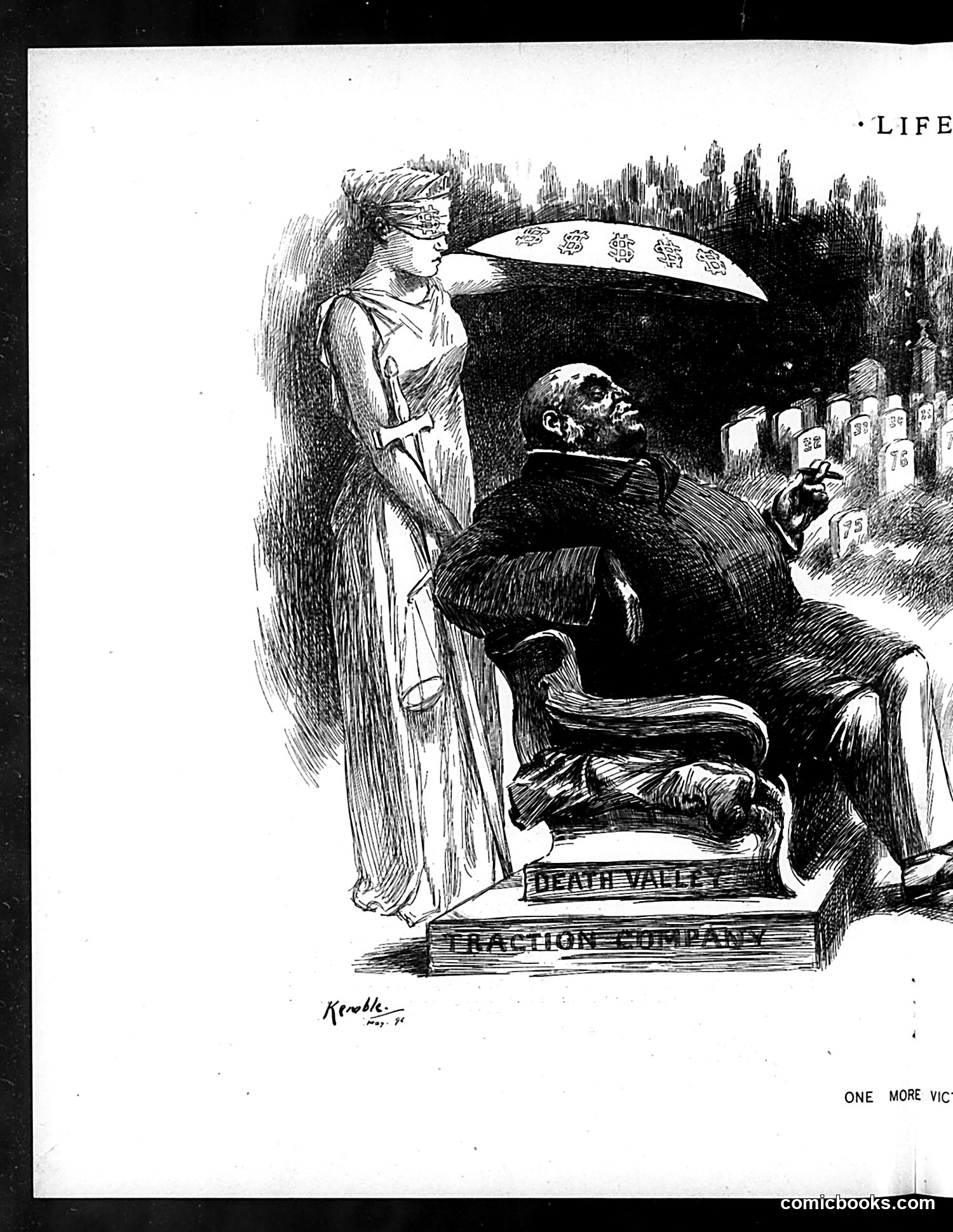
This is a satirical cartoon from *Life* magazine showing a military officer sitting on stacked books labeled "DEATH VALLEY" and "FACTION COMPANY." A woman holding a parasol decorated with dollar signs stands nearby, while a cemetery with headstones appears in the background. The cartoon appears to critique **military leadership during wartime**, suggesting that officers are profiting from or indifferent to soldier deaths. The dollar-sign parasol likely represents **war profiteering**—the financial gain made by military contractors or corrupt officials while soldiers die. The "Death Valley" reference and cemetery reinforce the human cost of war. The signature reads "Kesbie" (likely the cartoonist), and the caption begins "ONE MORE VIC[TORY]"—possibly suggesting that each military "victory" comes at tremendous human cost to ordinary soldiers.
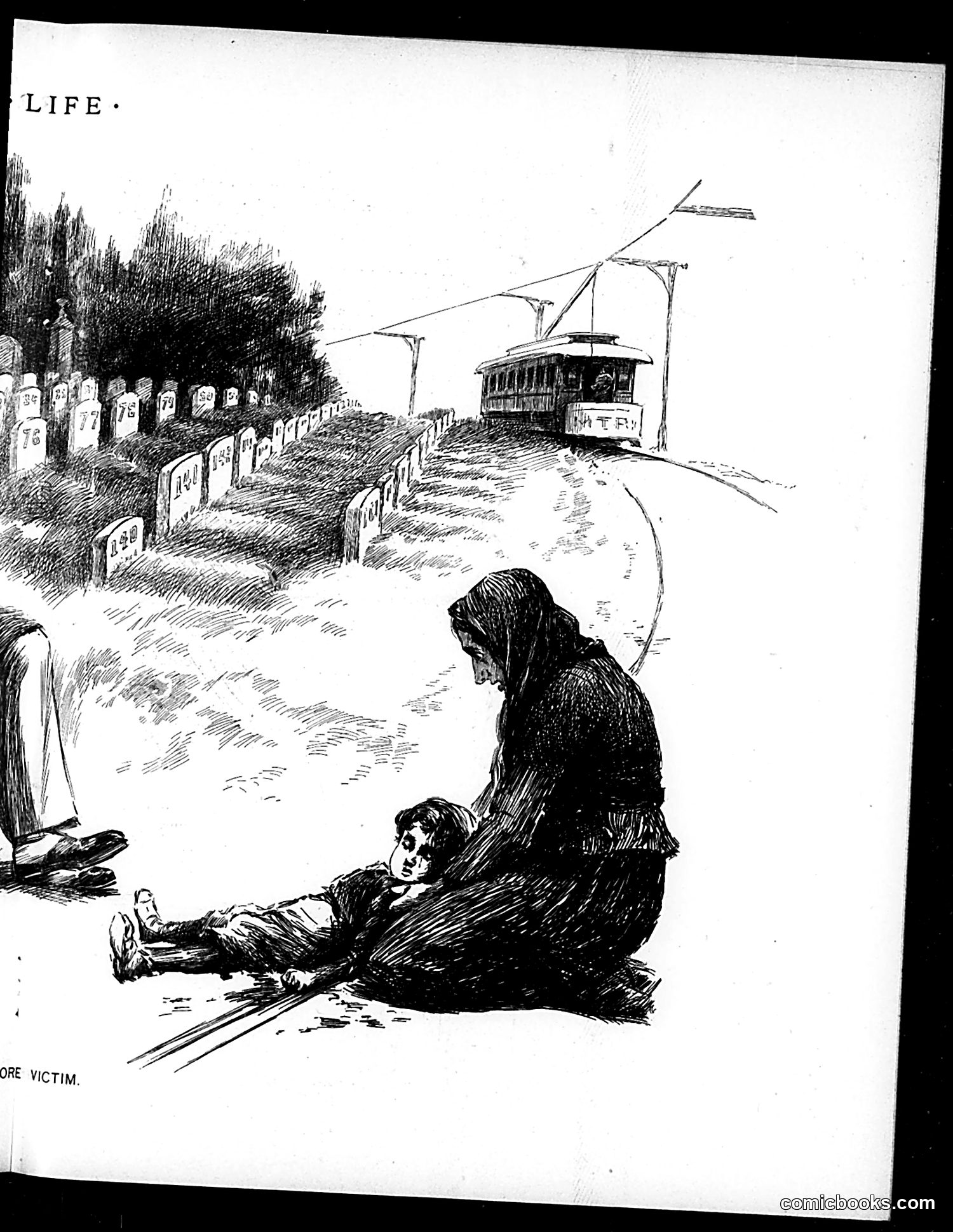
This is a satirical cartoon titled "LIFE" depicting a grim scene at what appears to be a cemetery or graveyard. An adult figure (likely representing Death or a reaper, given the dark robes) holds a small child while sitting on railroad tracks. A trolley or electric streetcar approaches on the tracks in the background, with utility poles visible. The visible text fragment "ORE VICTIM" (likely part of "MORE VICTIM") suggests this is commentary on **streetcar/trolley accidents**, which were a serious public safety concern in early-to-mid 20th century America. The cartoon uses dark satire to critique the danger these vehicles posed to urban populations, particularly children. The composition emphasizes the vulnerability of innocent lives to technological hazards of modern city life.
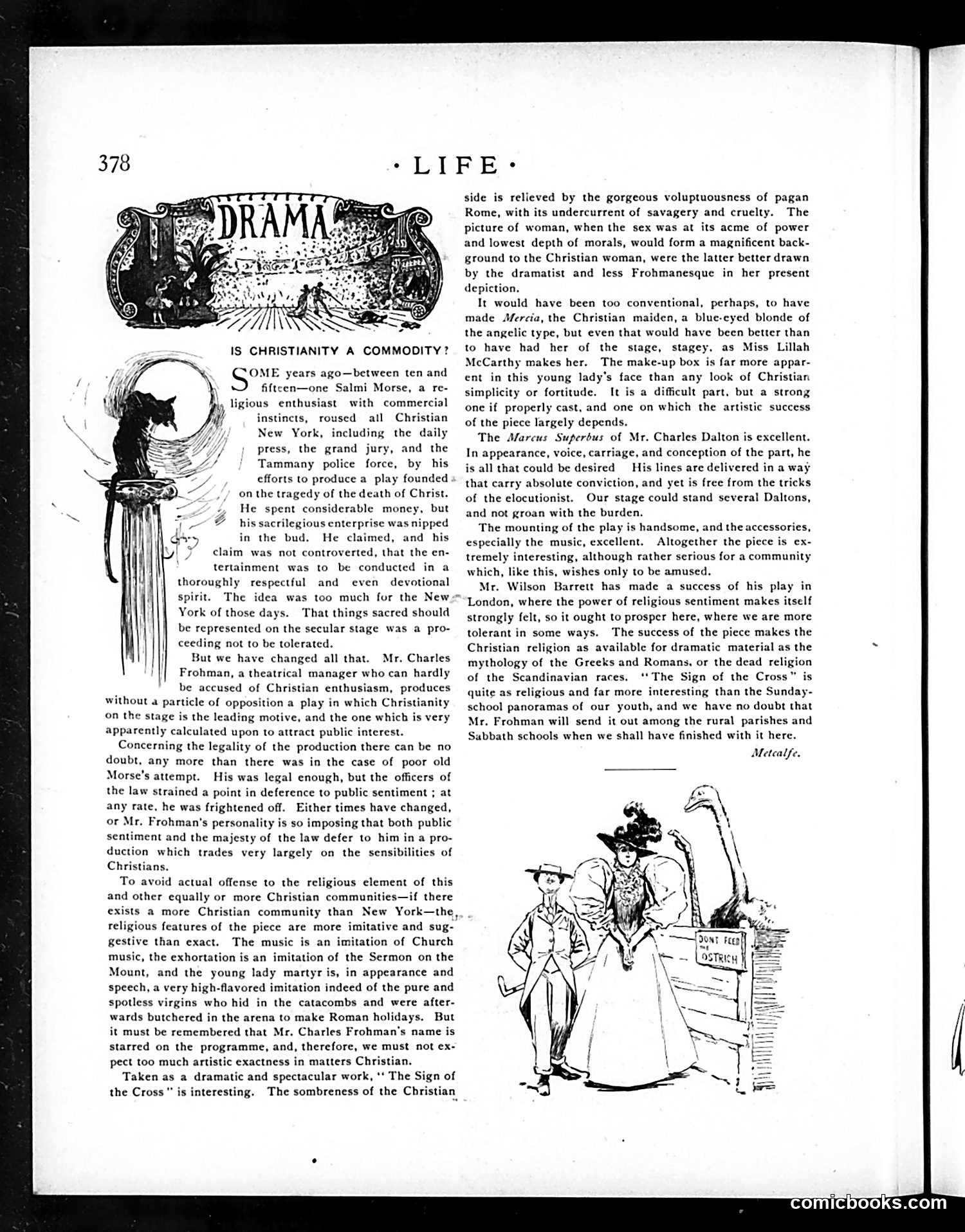
This page critiques the commercialization of Christianity in theater. The article "IS CHRISTIANITY A COMMODITY?" questions a theatrical entrepreneur (likely Charles Frohman, mentioned in the text) who attempted to stage religious plays including "The Sign of the Cross" to attract audiences. The satirical point: The author mocks the contradiction of treating Christian themes as commercial entertainment products rather than devotional material. The text notes that while religious communities objected to such plays, Frohman's prominence allowed the productions to proceed. The illustration shows figures at a gate labeled "DON'T FEED THE OSTRICH," likely satirizing willful blindness to the ethical problems of commodifying faith for profit and public spectacle.
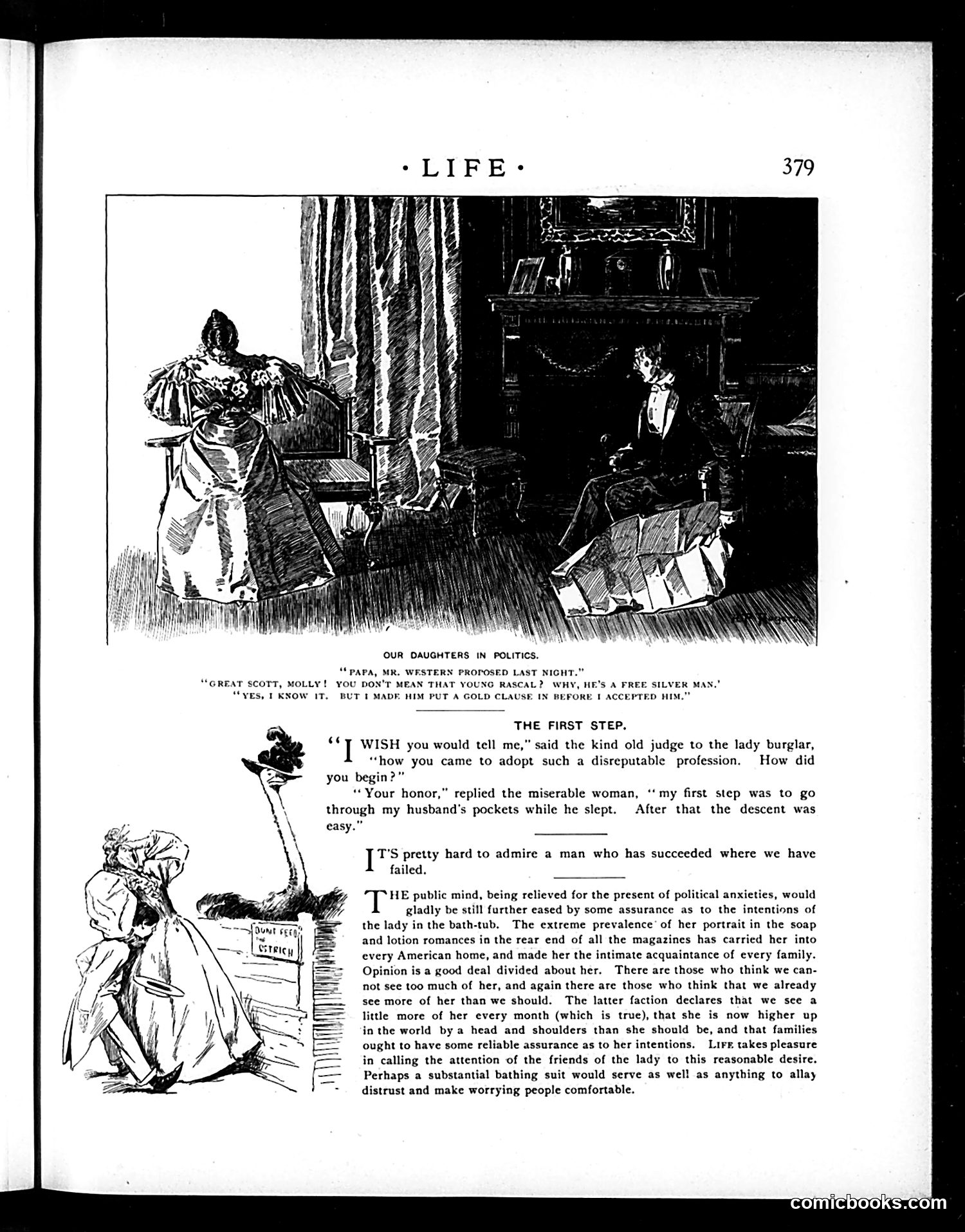
This page satirizes women's involvement in politics and public life. The top cartoon shows a domestic scene where a woman discusses a suitor: a man proposed to her daughter, but he's a "free silver man" (supporter of unlimited silver coinage—a major 1890s political debate). The mother rejected him despite his virtues, prioritizing political ideology over matrimonial suitability. The lower section, titled "The First Step," mocks a "lady burglar" through dark humor: a judge asks how she became a criminal. She replies she started by robbing her sleeping husband's pockets—implying that women entering public/criminal life represents a dangerous moral decline from domestic virtue. The satire criticizes women's political engagement as threatening traditional gender roles.
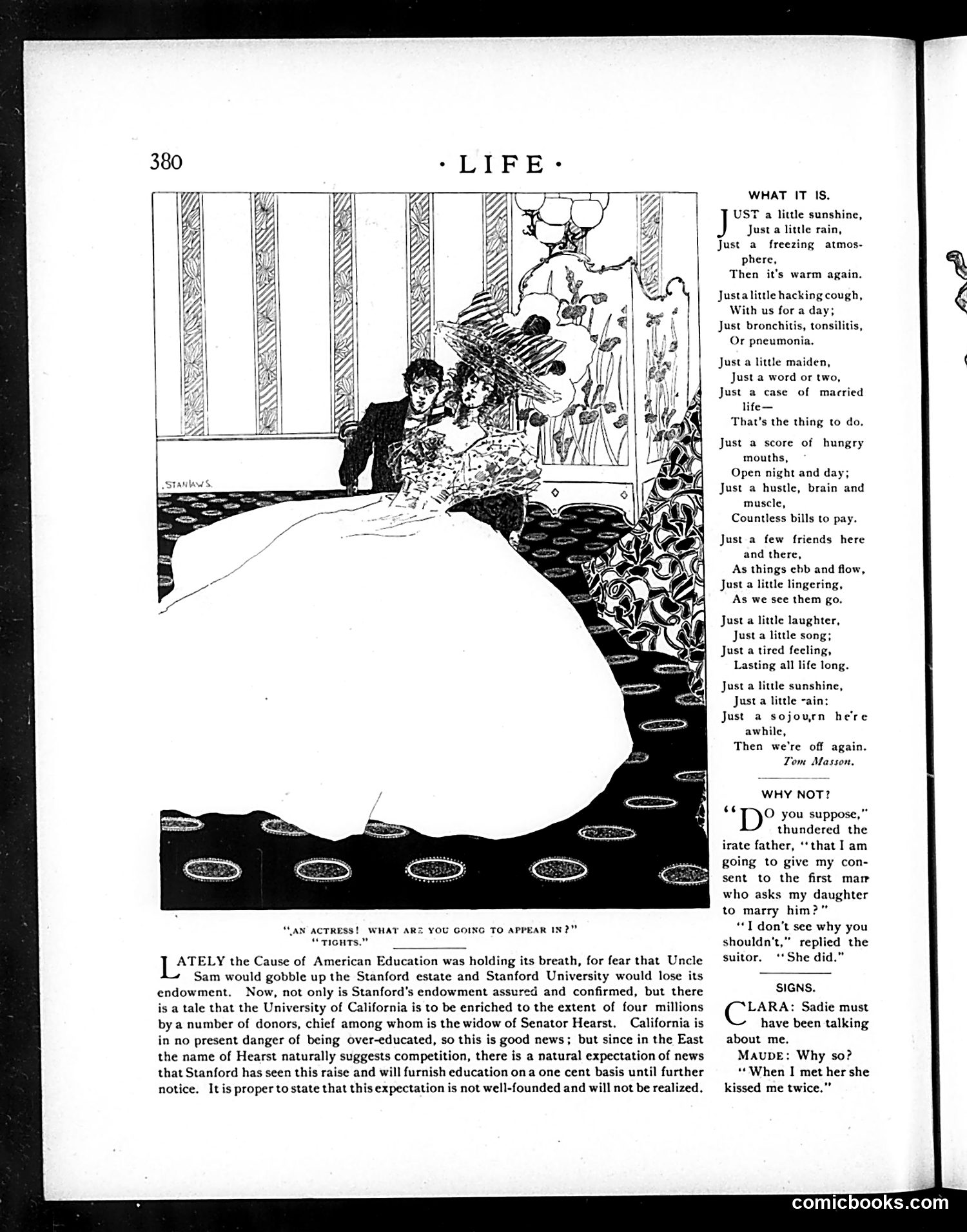
This page contains three distinct pieces of satirical humor typical of early 20th-century Life magazine: **Top illustration:** A romantic scene showing a couple in an elegant bedroom. The accompanying poem "What It Is" by Tom Masson satirizes married life as a series of mundane hardships—illness, financial strain, child-rearing, exhaustion—disguised with poetic language about "sunshine" and "rain." **Middle section:** Two brief joke items. The first references an actress in "tights" (theatrical costume), playing on double meanings. The second is a father-daughter marriage joke about paternal authority and courtship customs. **Bottom article:** Discusses Stanford University's endowment and suggests the University of California will receive millions from donors including Senator Hearst's widow. The satire implies wealthy Californians are engaged in competitive charitable giving, with Stanford expected to respond by offering education on a "one cent basis"—mocking the race to appear generous. **Overall tone:** Cynical humor about marriage, wealth-based education competition, and theatrical propriety—reflecting Edwardian-era social preoccupations.
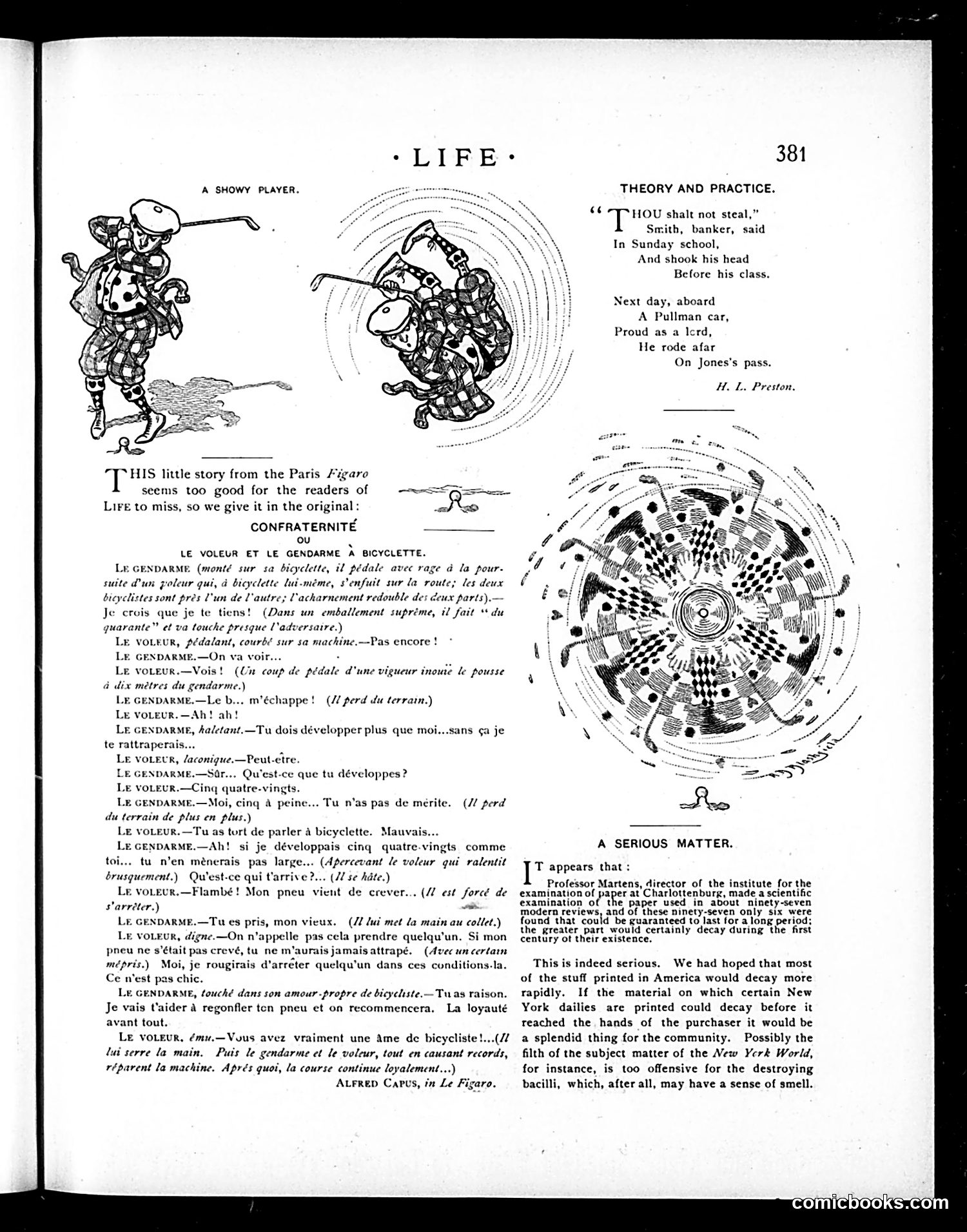
**"The Thief and the Policeman on Bicycles"** (translated from Paris's *Figaro*): This French dialogue-based cartoon mocks honor among criminals. A policeman chases a thief—both on bicycles. They engage in a competitive discussion about gear ratios while racing. When the thief's tire punctures and he's caught, he protests it's dishonorable to arrest someone who's broken down. The policeman, swayed by this twisted logic, helps repair the bicycle so they can race fairly again. The satire targets absurd codes of conduct and how easily principle bends to appeals to vanity. **"Theory and Practice"**: A short poem by H.L. Preston contrasts moral instruction with hypocrisy. A banker (Smith) teaches Sunday school children not to steal, then immediately uses another man's (Jones's) railroad pass fraudulently—demonstrating that the wealthy ignore their own preached morality. **"A Serious Matter"**: Life mocks New York newspapers (particularly the *World*) as so filled with filth that even bacteria refuse to decompose them, sarcastically suggesting this moral degradation is literally indestructible.
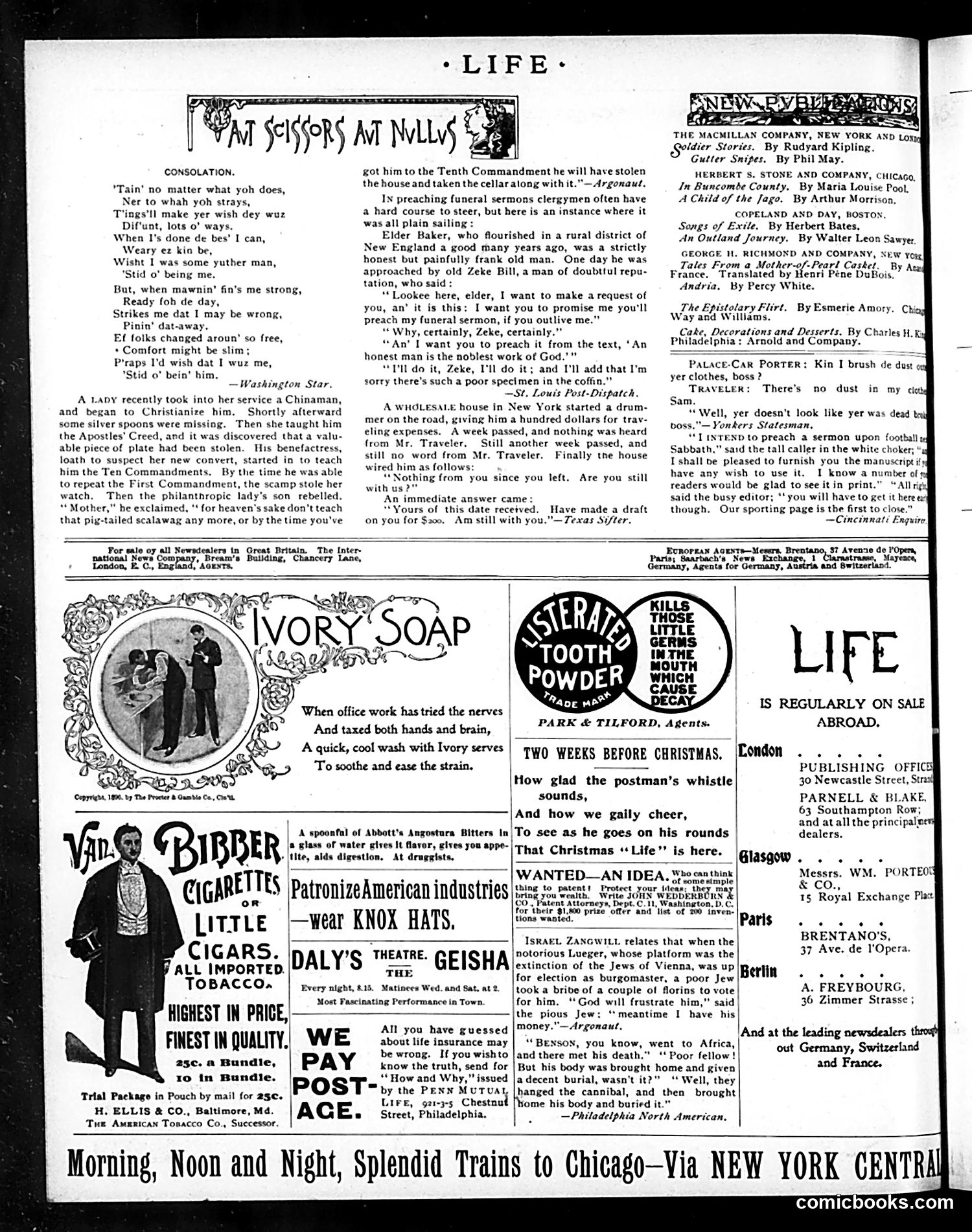
This page contains primarily **humorous anecdotes and advertisements** rather than political satire. The three main jokes use period-specific dialect and social attitudes: 1. **"Consolation"** (poem): A man in apparent poverty reflects philosophically that dissatisfaction is universal—even if he were someone else, he'd likely wish to be himself again. 2. **The Chinaman anecdote**: Satirizes naive Christian charity. A lady teaches her Chinese servant morality lessons, but he steals from her at each stage, culminating in dark humor: teaching him the Ten Commandments will only result in him stealing the house itself. This reflects contemporary xenophobic stereotypes and skepticism about conversion efforts. 3. **Elder Baker's funeral sermon**: A frankly honest preacher agrees to deliver a eulogy for a disreputable man using the text "An honest man is the noblest work of God"—then adds he regrets there's "such a poor specimen in the coffin." Humor derives from the preacher's blunt contradiction. The page is primarily **advertising** (Ivory Soap, Van Bibber Cigars, etc.) with book announcements, suggesting this is a commercial magazine mixing editorial content with revenue-generating ads.
This is primarily an **advertising page** with no political cartoons or satire. The content consists of product advertisements typical of early 20th-century American magazines: **Notable ads include:** - Armour's Beef Extract (soup seasoning) - Whitman's chocolate - Violettes du Czar perfume - Fresh Cut Grain (Anheuser-Busch Malt Nutrine drink) - Knox Hat - Williams Shaving Stick - Field Flowers souvenir booklet (honoring poet Eugene Field) The only potentially satirical element is the **Violettes du Czar perfume ad**, which trades on exotic European mystique—"Czar's Violets" from Paris—appealing to American consumers' attraction to continental sophistication during an era of imperial nostalgia. The **Malt Nutrine ad** emphasizes health benefits typical of patent medicine marketing, claiming the drink provides "vitality and growth in strength" for "all who are weak." Overall, this represents standard commercial advertising rather than editorial satire or political commentary.
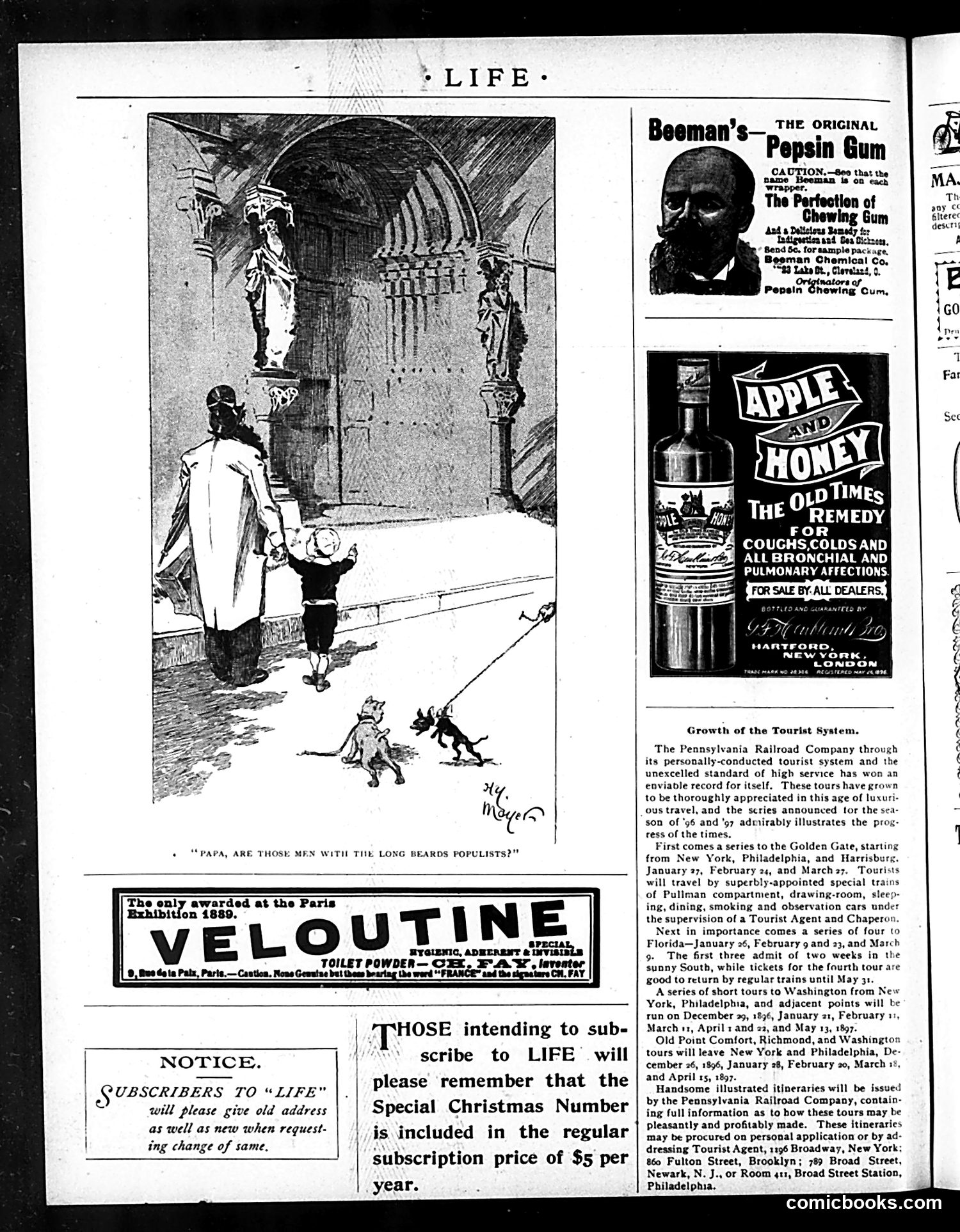
The main cartoon shows a woman and child encountering statues of bearded men in what appears to be a classical architectural setting. The caption—"Papa, are those men with the long beards Populists?"—is satirical political commentary. **Context:** This likely dates to the 1890s when the Populist Party was a significant political force in America, advocating for farmers' and workers' rights. The joke equates Populists with classical statues—suggesting they are relics of the past, immobile, or permanent fixtures rather than a dynamic movement. By having a child ask about them as if they were historical monuments, Life ridicules Populism as outdated or permanently established rather than a living, evolving political force. The remainder of the page contains period advertisements (chewing gum, cough remedy) and an article promoting Pennsylvania Railroad tourist packages—typical magazine content for the era.
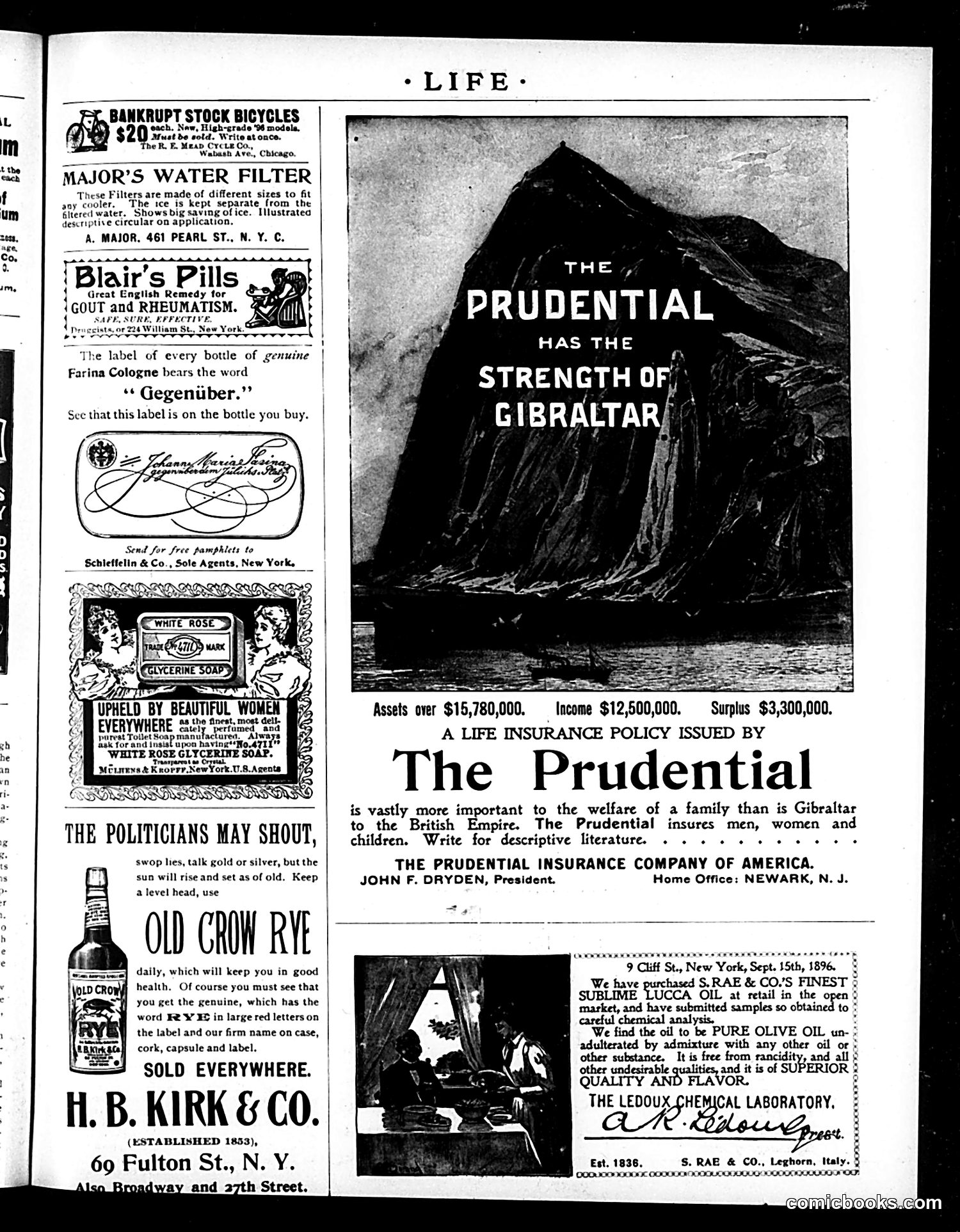
This page is primarily **advertising**, not political satire. It contains multiple product endorsements typical of 1890s publications. The one quasi-political element is an **Old Crow Rye whiskey ad** with the headline "THE POLITICIANS MAY SHOUT," dismissing political debate ("swap lies, talk gold or silver") as noise. The ad suggests voters should ignore partisan conflict and simply maintain composure through whiskey consumption—a cynical, apolitical message reflecting Gilded Age voter fatigue. The dominant content is the **Prudential Insurance advertisement** featuring Gibraltar's dramatic cliffs, comparing the insurance company's financial strength ("Assets over $15,780,000") to the fortress rock's military importance to the British Empire. This uses imperial patriotism to sell life insurance. Other ads promote bicycles, water filters, patent medicines (Blair's Pills for gout), soap, and olive oil—standard commercial content of the era with no satirical intent. The page reflects 1890s consumer culture and advertising tactics rather than political commentary.
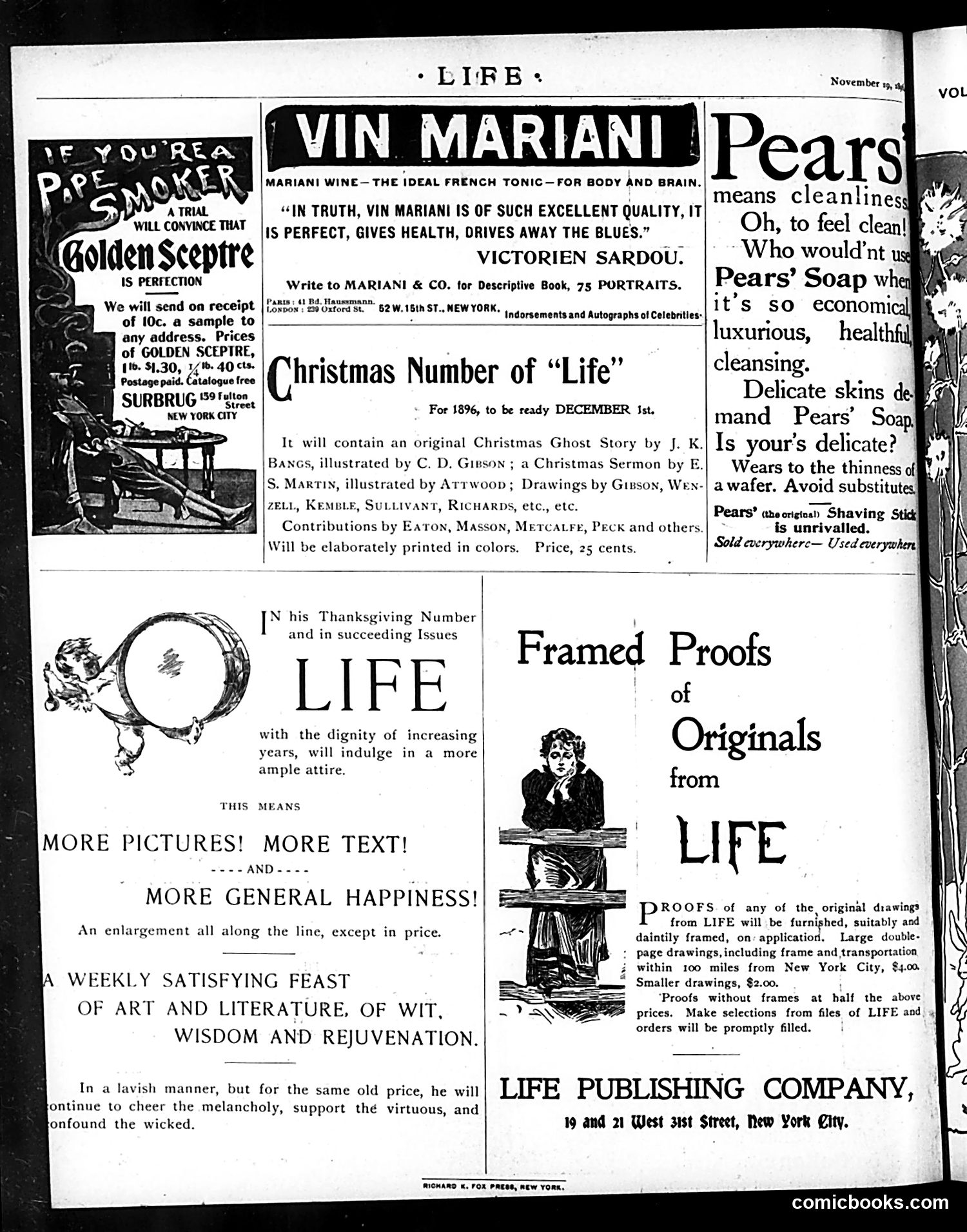
This is primarily an **advertising and promotional page** rather than a satirical cartoon page. The content consists of: **Advertisements:** - **Golden Sceptre** pipe tobacco, marketed to "pipe smokers" as "perfection" - **Vin Mariani** (a French wine tonic), endorsed by playwright Victorien Sardou as a health drink that "drives away the blues" - **Pears' Soap**, emphasizing genteel cleanliness for "delicate skins" **Magazine Promotion:** Life announces its upcoming Christmas issue (1896) featuring ghost stories by J.K. Bangs and contributions from notable illustrators and writers. The magazine promises "more pictures," "more text," and "more general happiness" at the same price—a boast typical of period magazine advertising. **Historical Context:** The advertisements reflect 1890s attitudes: wine tonics were openly promoted as medicinal, tobacco was aspirational, and soap advertising heavily targeted feminine gentility. The endorsements by celebrities (Sardou) were standard promotional tactics.