
Life, 1896-11-19 · page 10 of 18
Life — November 19, 1896 — page 10: what you’re looking at
What you’re looking at
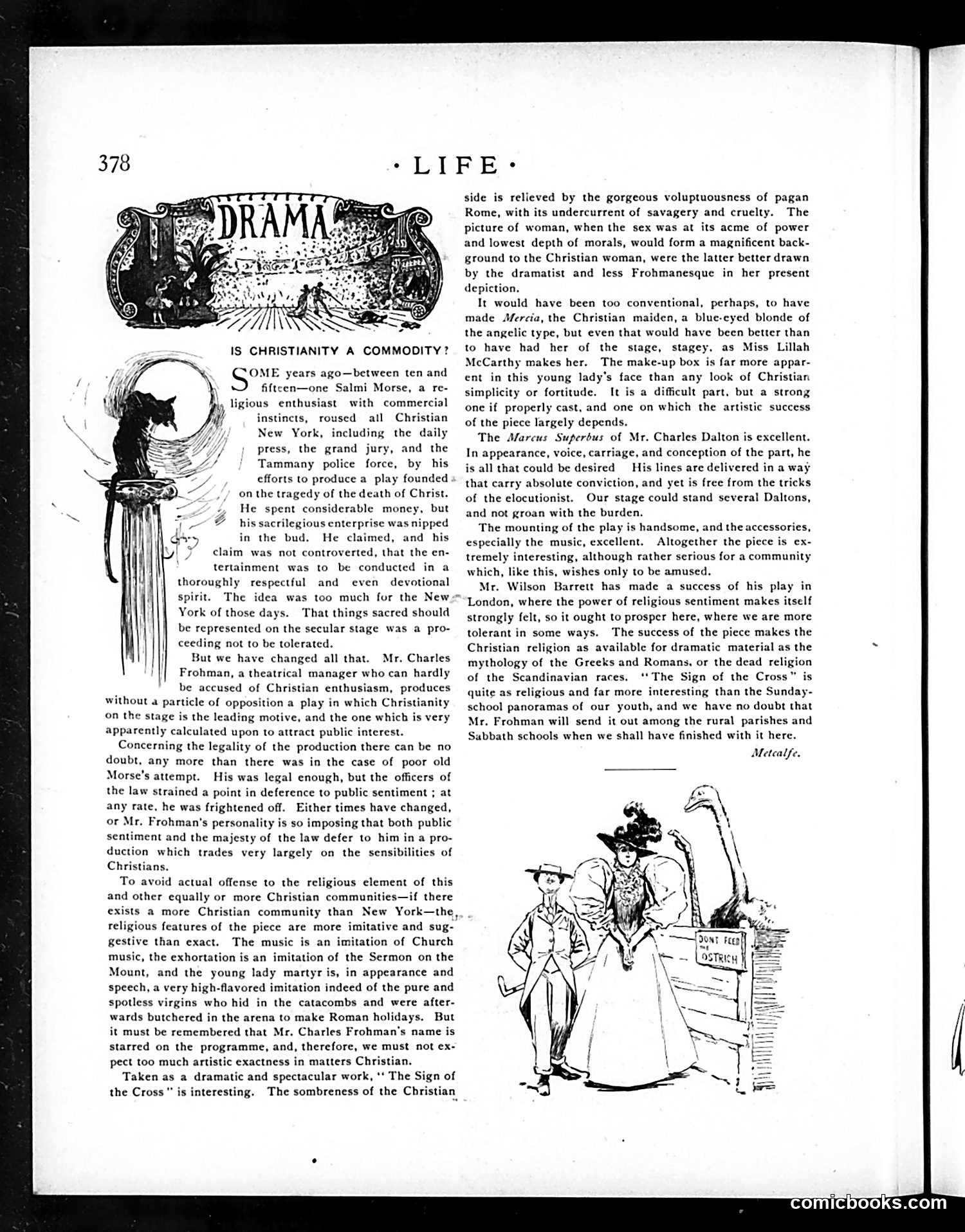
This page critiques the commercialization of Christianity in theater. The article "IS CHRISTIANITY A COMMODITY?" questions a theatrical entrepreneur (likely Charles Frohman, mentioned in the text) who attempted to stage religious plays including "The Sign of the Cross" to attract audiences. The satirical point: The author mocks the contradiction of treating Christian themes as commercial entertainment products rather than devotional material. The text notes that while religious communities objected to such plays, Frohman's prominence allowed the productions to proceed. The illustration shows figures at a gate labeled "DON'T FEED THE OSTRICH," likely satirizing willful blindness to the ethical problems of commodifying faith for profit and public spectacle.
📄 Transcribed text from this page (OCR, searchable)
Machine-transcribed from the original scan — historical spelling and the odd misread are preserved.
“DE DLFE + IS CHRISTIANITY A COMMODITY? OME years ago—between ten and fifteen—one Salmi Morse, a re- ligious enthusiast with commercial instincts, roused all Christian New York, including the daily press, the grand jury, and the Tammany police force, by his efforts to produce a play founded on the tragedy of the death of Christ. He spent considerable money, but his sacrilegious enterprise was nipped in the bud. He claimed, and his claim was not controverted, that the en- tertainment was to be conducted thoroughly respectful and even devotional spirit. The idea York of those days. That things sacred should be represented on the secular stage was a pro- ceeding not to be tolerated. But we have changed all that. Mr. Charles Frohman, a theatrical manager who can hardly be accused of Christian enthusiasm, produces without a particle of opposition a play in which Christianity on the stage is the leading motive, and the one which is very apparently calculated upon to attract public interest. Concerning the legality of the production there can be no doubt, any more than there was in the case of poor old Morse’s attempt. His was legal enough, but the officers of the law strained a point in deference to public sentiment ; at any rate, he was frightened off. Either times have changed, or Mr. Frohman's personality is so imposing that both public sentiment and the majesty of the law defer to him in a pro- duction which trades very largely on the sensibilities of Christians, ina To avoid actual offense to the religious element of this and other equally or more Christian communities—if there exists a more Christian community than New York—the, religious features of the piece are more imitative and sug- gestive than exact, The music is an imitation of Church music, the exhortation is an imitation of the Sermon on the Mount, and the young lady martyr is, in appearance and speech, a very high-flavored imitation indeed of the pure and spotless virgins who hid in the catacombs and were after- wards butchered in the arena to make Roman holidays. But it must be remembered that Mr. Charles Frohman’s name is starred on the programme, and, therefore, we must not ex- pect too much artistic exactness in matters Christian. Taken as a dramatic and spectacular work, ‘‘ The Sign of the Cross" is interesting. The sombreness of the Christian. was too much for the New * side is relieved by the gorgeous voluptuousness of pagan Rome, with its undercurrent of savagery and cruelty. The picture of woman, when the sex was at its acme of power and lowest depth of morals, would form a magnificent back- ground to the Christian woman, were the latter better drawn by the dramatist and less Frohmanesque in her present depiction. It would have been too conventional, perhaps, to have made Mercia, the Christian maiden, a blue-eyed blonde of the angelic type, but even that would have been better than to have had her of the stage, stagey, as Miss Lillah McCarthy makes her. The make-up box is far more appar- ent in this young lady’s face than any look of Christian simplicity or fortitude. It is a difficult part, but a strong one if properly cast, and one on which the artistic success of the piece largely depends. The Marcus Superbus of Mr. Charles Dalton is excellent. In appearance, voice, carriage, and conception of the part, he is all that could be desired His lines are delivered in a way that carry absolute conviction, and yet is free from the tricks of the elocutionist. Our stage could stand several Daltons, and not groan with the burden. The mounting of the play is handsome, and the accessories, especially the music, excellent. Altogether the piece is ex- tremely interesting, although rather serious for a community which, like this, wishes only to be amused. Mr. Wilson Barrett has made a success of his play in London, where the power of religious sentiment makes itself strongly felt, so it ought to prosper here, where we are more tolerant in some ways. The success of the piece makes the Christian religion as available for dramatic material as the mythology of the Greeks and Romans, or the dead reli of the Scandinavian races. ‘‘The Sign of the Cross” quite as religious and far more interesting than the Sunday- school panoramas of our youth, and we have no doubt that Mr. Frohman will send it out among the rural parishes and Sabbath schools when we shall have finished with it here. Metcalfe. comicbooks.com