
Life, 1896-11-19 · page 6 of 18
Life — November 19, 1896 — page 6: what you’re looking at
What you’re looking at
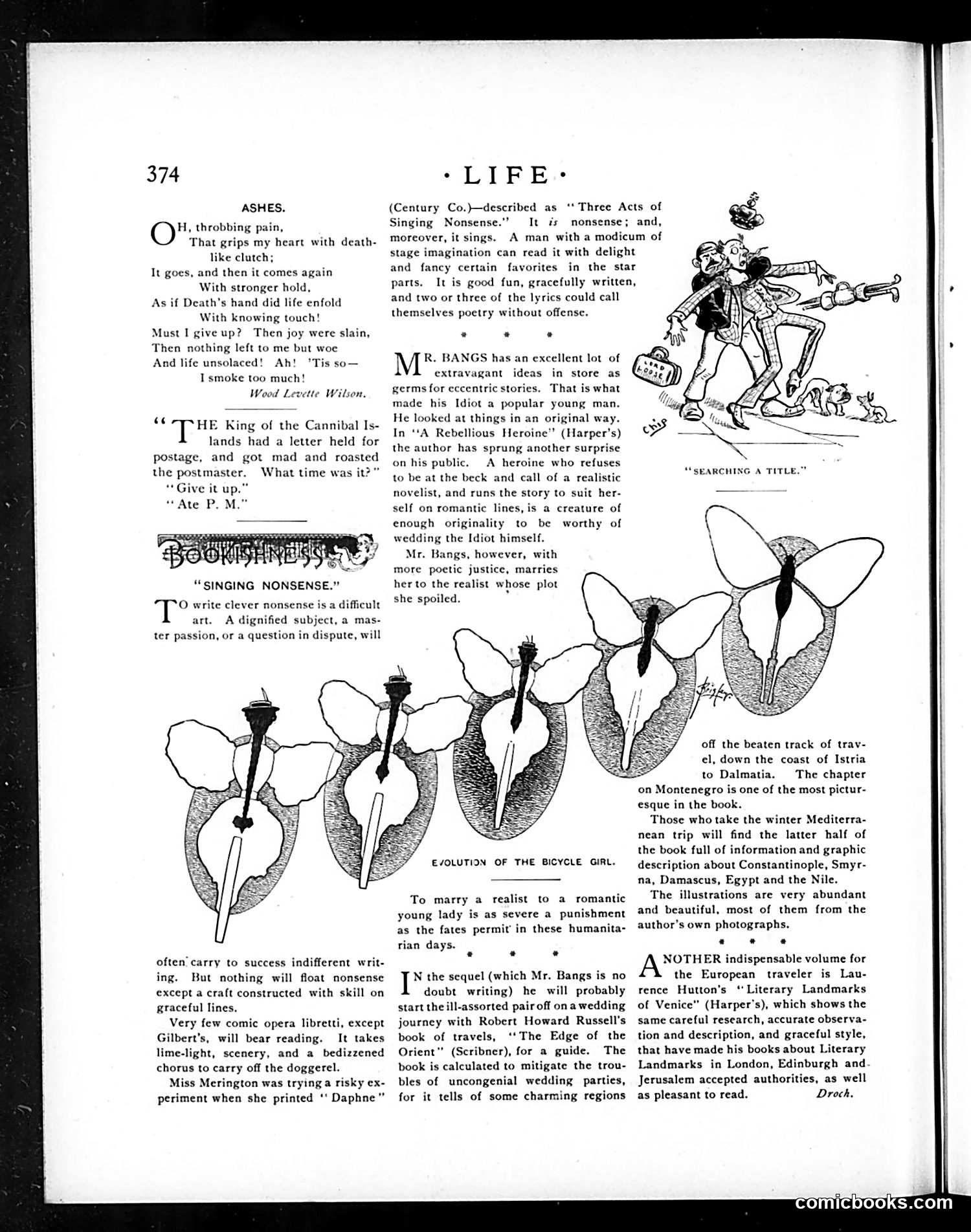
The page contains two distinct cartoons: **"Searching a Title"** (upper right) depicts a disheveled man surrounded by scattered papers and items, illustrating the difficulty writers face finding suitable titles for their work—a relatable creative struggle. **"Evolution of the Bicycle Girl"** (lower left) shows a sequential progression of female figures emerging from or transforming within bicycle seats, visualizing how women's cycling culture evolved. This references the late 19th-century "bicycle craze" when cycling became fashionable for women, challenging Victorian dress norms and symbolizing female independence and mobility. Both cartoons use visual humor to comment on contemporary cultural anxieties: literary creativity and women's changing social roles.
📄 Transcribed text from this page (OCR, searchable)
Machine-transcribed from the original scan — historical spelling and the odd misread are preserved.
374 ASHES. H, throbbing pain, That grips my heart with death- like clutch; It goes, and then it comes again With stronger hold, As if Death’s hand did life enfold With knowing touch! Must I give up? Then joy were slain, Then nothing left to me but woe And life unsolaced! Ah! I smoke too much! Wood Levette Wilson. 'Tis so— “e HE King of the Cannibal Is- lands had a letter held for postage, and got mad and roasted the postmaster. What time was it?” “Give it up.” “SINGING NONSENSE.” O write clever nonsense is a difficult art. A dignified subject, a mas- ter passion, or a question in dispute, will often’ carry to success indifferent writ- ing. But nothing will float nonsense except a craft constructed with skill on graceful lines, Very few comic opera libretti, except Gilbert's, will bear reading. It takes lime-light, scenery, and a bedizzened chorus to carry off the doggerel. Miss Merington was tryinga risky ex- periment when she printed ‘t Daphne” ‘LIFE (Century Co.)}—described as ‘* Three Acts of Singing Nonsense.” It és moreover, it sings. nonsense; and, A man with a modicum of stage imagination can read it with delight and fancy certain favorites parts. and two or three of the lyrics could call themselves poetry without offense. 2 a * R. BANGS has an excellent lot of extravagant in store as germs for eccentric stories. That is what made his Idiot a popular young man. He looked at things in an original way. In ‘A Rebellious Heroine” (Harper's) the author has sprung another surprise on his public. to be ideas A heroine who refuses the beck and call of a realistic novelist, and runs the story to suit her- self on romantic lines, is a creature of enough originality to be worthy of wedding the Idiot himself. Mr. Bangs, however, with more poetic justice, marries her to the realist whose plot she spoiled. , EVOLUTION OF THE BICYCLE GIRL. To marry a realist to a romantic young lady is as severe a punishment as the fates permit in these humanita- rian days. * * N the sequel (which Mr. Bangs is no doubt writing) he will probably start the ill-assorted pair off ona wedding journey with Robert Howard Russell's book of travels, ‘‘The Edge of the Orient” (Scribner), for a guide. The book is calculated to mitigate the trou- bles of uncongenial wedding parties, for it tells of some charming regions in the star It is good fun, gracefully written, off the beaten track of trav- el, down the coast of Istria to Dalmatia. The chapter on Montenegro is one of the most pictur- esque in the book. Those who take the winter Mediterra- nean trip will find the latter half of the book full of information and graphic description about Constantinople, Smyr- na, Damascus, Egypt and the Nile. The illustrations are very abundant and beautiful, most of them from the author’s own photographs. s # @ NOTHER indispensable volume for the European traveler is Lau- rence Hutton’s “Literary Landmarks of Venice” (Harper's), which shows the same careful research, accurate observa- tion and description, and graceful style, that have made his books about Literary Landmarks in London, Edinburgh and Jerusalem accepted authorities, as well as pleasant to read. Droch.