
Life, 1896-11-19 · page 4 of 18
Life — November 19, 1896 — page 4: what you’re looking at
What you’re looking at
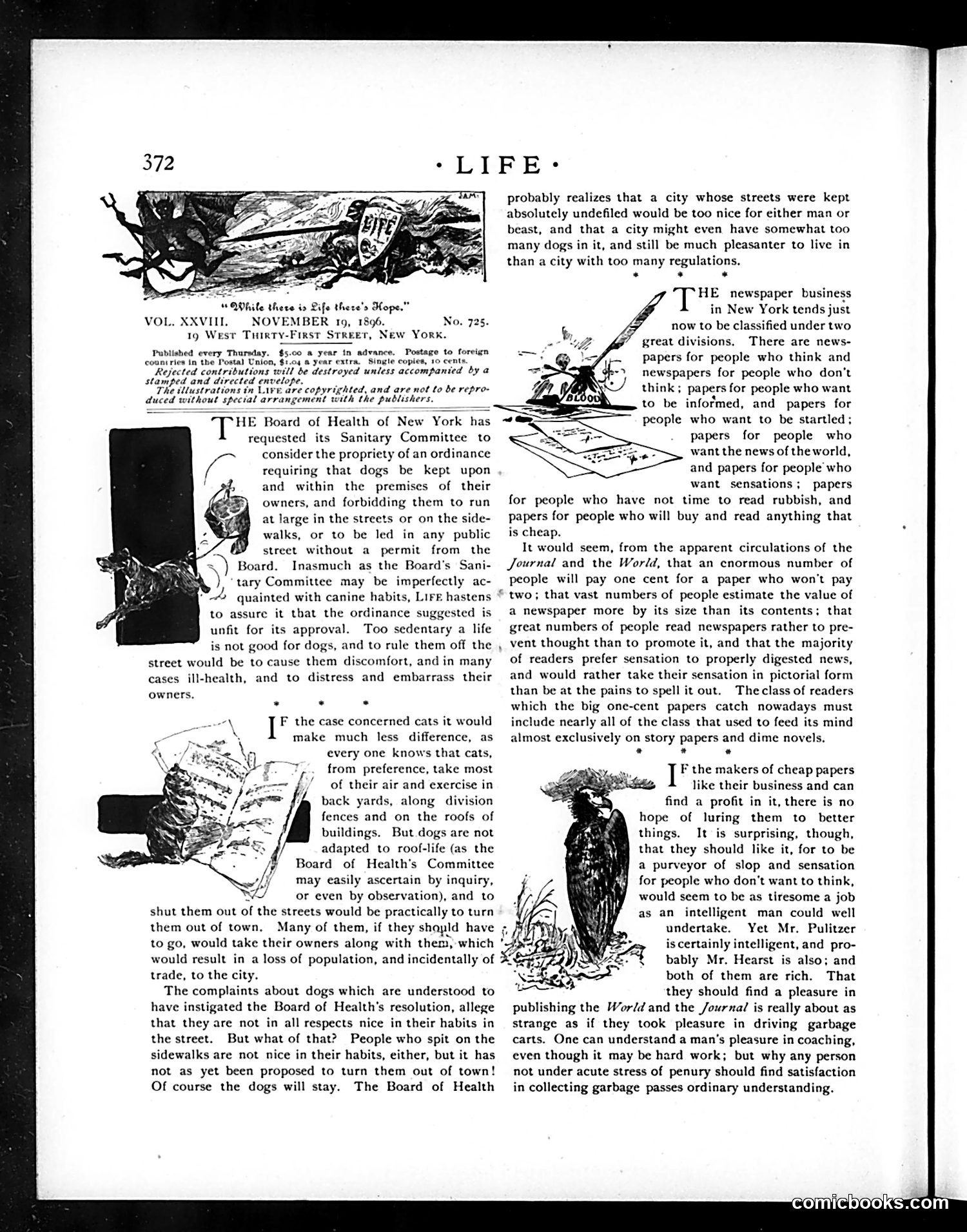
This page satirizes New York City's newspaper industry and regulatory disputes. The main article critiques cheap newspapers that prioritize sensationalism over serious journalism, arguing they cater to readers wanting "sensation" rather than proper "digested news." The accompanying illustrations show dogs—likely metaphors for uncontrolled elements in the city. The text references the Board of Health's recent ordinance regarding stray dogs in New York streets, debating whether dogs should be expelled from the city entirely. The satire suggests that while dog control might seem logical, the real problem—like cheap sensational papers—reveals deeper hypocrisy: society tolerates many unsavory things while scapegoating specific targets. The cartoons emphasize this satirical point about selective regulation and public priorities.
📄 Transcribed text from this page (OCR, searchable)
Machine-transcribed from the original scan — historical spelling and the odd misread are preserved.
“While there is Life there's Hope.” VOL. XXVIII, NOVEMBER 19, 1896. No. 725. 19 West THirt r, New York. Published every Thursday. $5.00 a year in advance. Postage to foreign countries in the Postal Union, $1.04 @ year extra. Single copies, 10 cents. Rejected contributions will be destroyed untess accompanied by a stamped and directed envelope. The illustrations in Live. are copyrighted, and are not to be repro- duced without special arrangement with the publishers. HE Board of Health of New York has requested its Sanitary Committee to consider the propriety of an ordinance requiring that dogs be kept upon and within the premises of their owners, and forbidding them to run at large in the streets or on the side- walks, or to be led in any public street without a permit from the Board. Inasmuch as the Board's Sani- ) ‘tary Committee may be imperfectly ac- "4 quainted with canine habits, LiFe hastens to assure it that the ordinance suggested unfit for its approval. Too sedentary a life is not good for dogs, and to rule them off the , street would be to cause them discomfort, and in many cases ill-health, and to distress and embarrass their owners. F the case concerned cats it would make much less difference, as every one knows that cats, from preference, take most of their air and exercise in back yards, along division fences and on the roofs of buildings. But dogs are not adapted to roof-life (as the Board of Health's Committee ww’) may easily ascertain by inquiry, NZ or even by observation), and to shut them out of the streets would be practically to turn them out of town, Many of them, if they shayld have ¢, would result in a loss of population, and incidentally of trade, to the city. The complaints about dogs which are understood to have instigated the Board of Health's resolution, allege that they are not in all respects nice in their habits in the street. But what of that? People who spit on the sidewalks are not nice in their habits, either, but it has not as yet been proposed to turn them out of town! Of course the dogs will stay. The Board of Health fa to go, would take their owners along with them, which 'y probably realizes that a city whose streets were kept absolutely undefiled would be too nice for either man or beast, and that a city might even have somewhat too many dogs in it, and still be much pleasanter to live in than a city with too many regulations. . . HE newspaper business in New York tends just now to be classified under two great divisions, There are news- papers for people who think and newspapers for people who don’t think; papers for people who want to be informed, and papers for people who want to be startled; papers for people who want the news of theworld, and papers for people who want sensations; papers for people who have not time to read rubbish, and papers for people who will buy and read anything that is cheap. It would seem, from the apparent circulations of the Journal and the World, that an cnormous number of people will pay one cent for a paper who won't pay © two; that vast numbers of people estimate the value of a newspaper more by its size than its contents; that great numbers of people read newspapers rather to pre- vent thought than to promote it, and that the majority of readers prefer sensation to properly digested news, and would rather take their sensation in pictorial form than be at the pains to spell it out. Theclass of readers which the big one-cent papers catch nowadays must include nearly all of the class that used to feed its mind almost exclusively on story papers and dime novels. * * * the makers of cheap papers like their business and can tee I find a profit in it, there is no hope of luring them to_ better things. It is surprising, though, that they should like it, for to be a purveyor of slop and sensation for people who don’t want to think, would seem to be as tiresome a job as an intelligent man could well undertake. Yet Mr. Pulitzer is certainly intelligent, and pro- bably Mr. Hearst is also; and both of them are rich. That they should find a pleasure in publishing the Wor/d and the /ourna/ is really about as strange as if they took pleasure in driving garbage carts. One can understand a man’s pleasure in coaching, even though it may be hard work; but why any person not under acute stress of penury should find satisfaction in collecting garbage passes ordinary understanding.