
A complete issue · 20 pages · 1896
Life — June 11, 1896
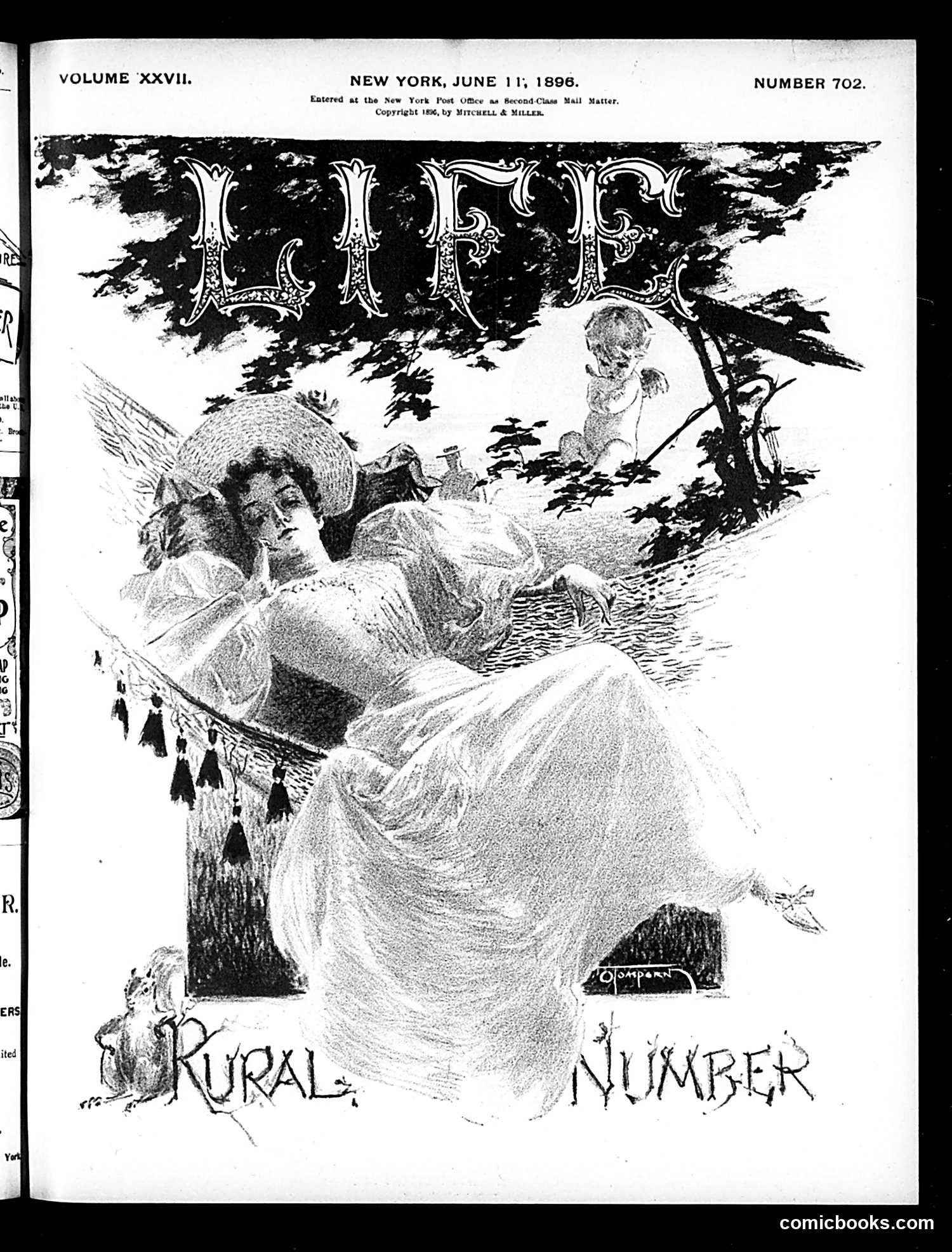
This is the cover of Life magazine from June 11, 1896 (Volume XXVII, Number 702). The illustration depicts a reclining woman in classical dress representing "Life" itself, with a cherub or cupid figure beside her. Small figures appear to be climbing or descending along her flowing garment. The text labels read "RURAL" (lower left) and "NUMBER" (lower right), suggesting this issue focused on rural themes or census data. The ornate "LIFE" masthead and classical artistic style are typical of Life's aesthetic during this period as a satirical weekly commentary on American society, politics, and culture. The specific satirical point of this particular cover—without additional context about 1896 events—remains unclear from the image alone.
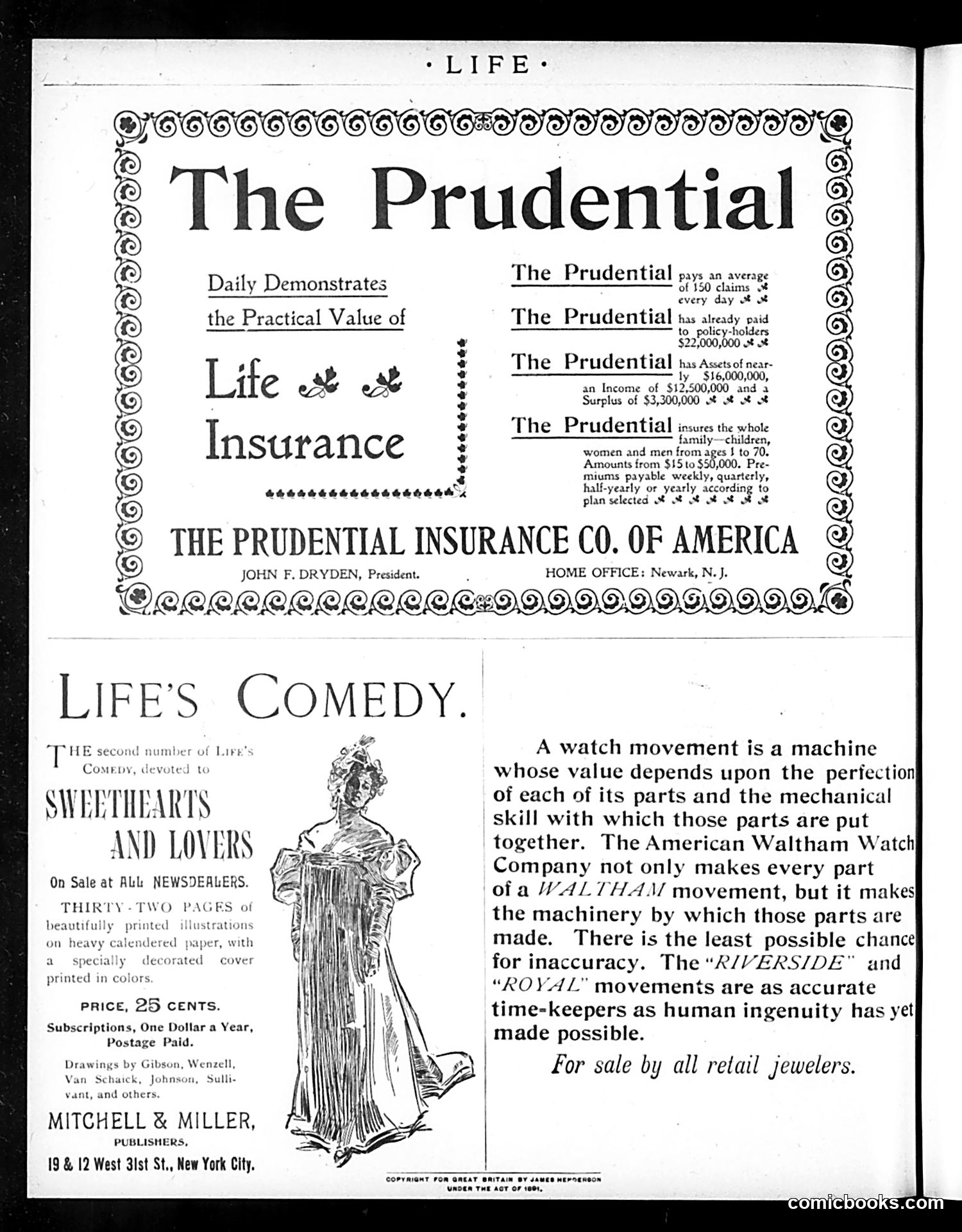
This page contains **advertisements rather than political cartoons or satire**. The top half advertises **The Prudential Insurance Company of America**, emphasizing its financial stability (claims paid, assets, income surplus) and broad coverage from ages 1-70. The bottom half advertises two unrelated products: 1. **Life's Comedy** — the second issue of a humor publication devoted to "sweethearts and lovers," sold for 25 cents, published by Mitchell & Miller in New York. 2. **American Waltham Watch Company** — promoting the precision of their watch movements ("Riverside" and "Royal" models), emphasizing mechanical accuracy and quality manufacturing. There are no political references or satirical commentary visible. The page is purely commercial advertising from what appears to be an early 20th-century publication.
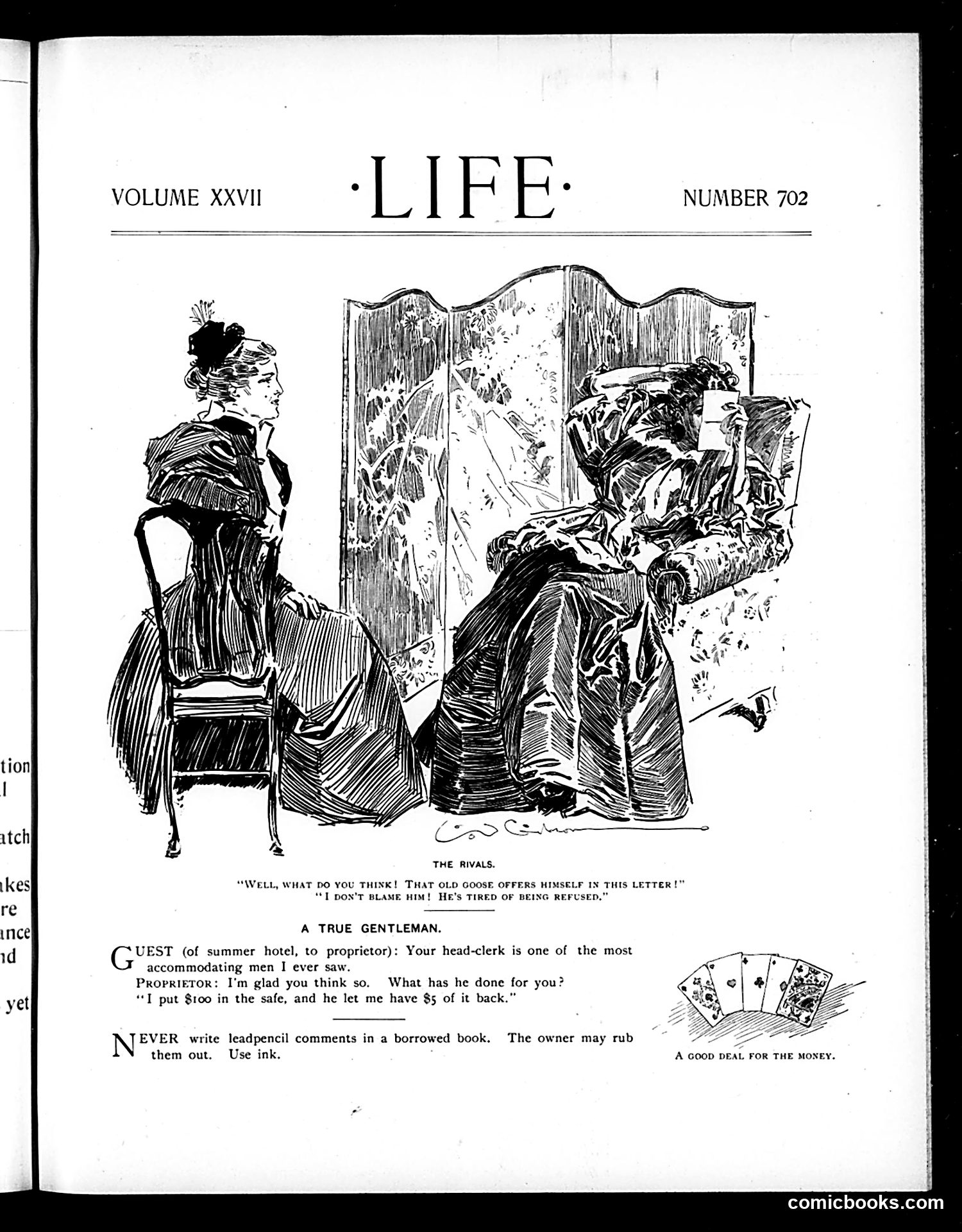
This page contains three separate items from *Life* magazine: **"The Rivals"** (top cartoon): Two elegantly dressed women examine a letter. The dialogue suggests one woman's romantic rival is making advances, with one character expressing weariness at being pursued. The satire targets romantic jealousy and social competition among upper-class women. **"A True Gentleman"** (middle): A hotel proprietor brags that his head-clerk is accommodating—having put $100 in the safe and returned only $5. The guest finds this acceptable. This satirizes loose ethics in service industries and suggests corruption was normalized among hospitality staff. **"A Good Deal for the Money"** (right): Playing cards are displayed. The caption likely jokes about gambling's poor odds. Overall, these pieces target social pretense, infidelity, and petty dishonesty among the leisure class.
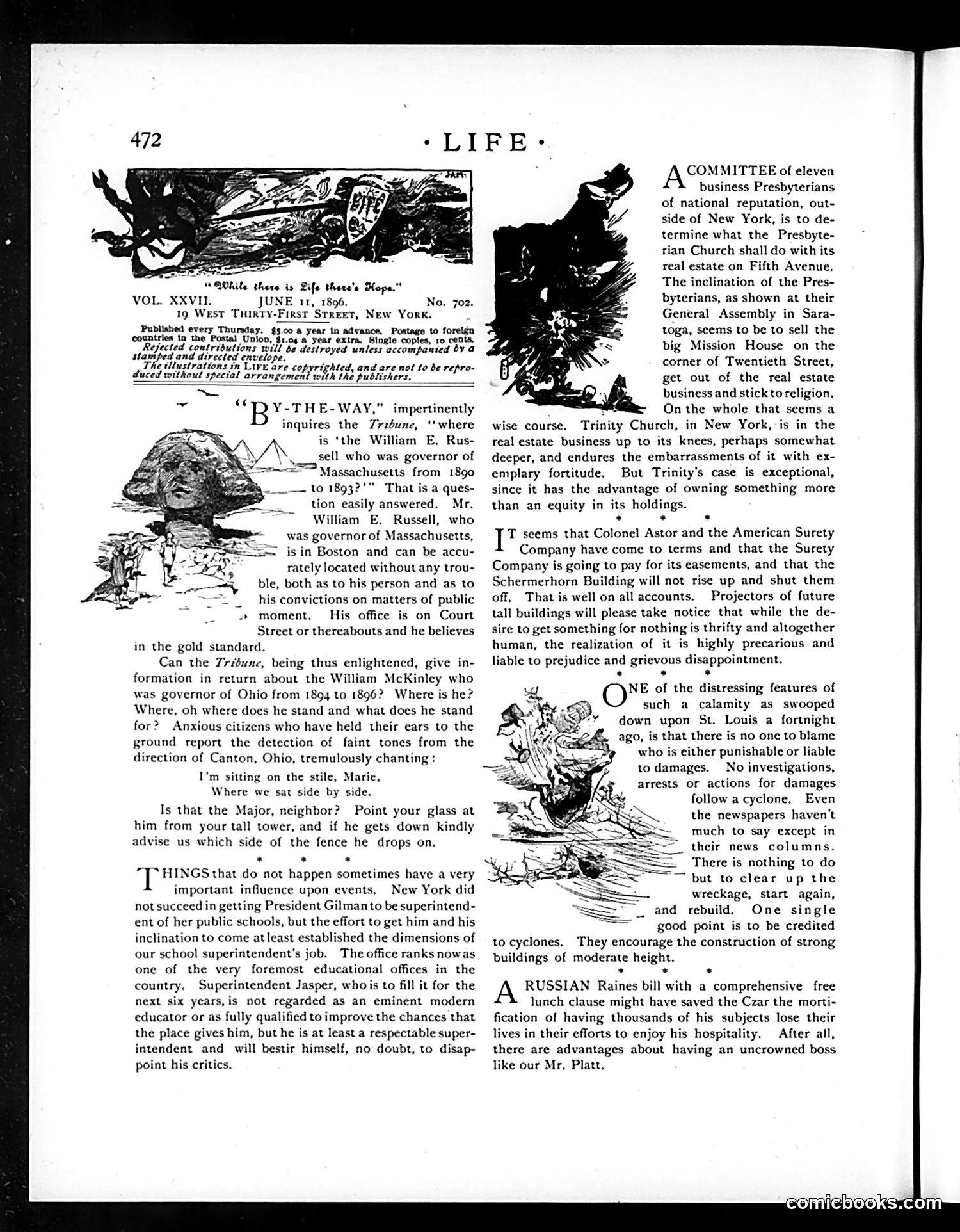
This page contains several satirical commentary pieces rather than a single cartoon. The main topics are: 1. **Presbyterian Church real estate**: Mocking the Presbyterian Church's inclination to sell its Fifth Avenue Mission House and abandon religion for real estate business, contrasting this unfavorably with Trinity Church's more principled approach. 2. **William E. Russell**: A brief query about Russell, former governor of Massachusetts, questioning his current whereabouts and relevance—appearing to mock a once-prominent figure now faded from public notice. 3. **School superintendent appointment**: Criticizing New York's failure to secure President Gilman for superintendent of public schools, settling instead for Jasper, deemed insufficiently qualified despite being respectable. 4. **St. Louis cyclone aftermath**: Commentary on lack of accountability following a destructive cyclone, noting no investigations or damage claims resulted. 5. **Russian Raines bill**: A satirical quip about a Russian free lunch clause potentially saving the Czar from assassination attempts.
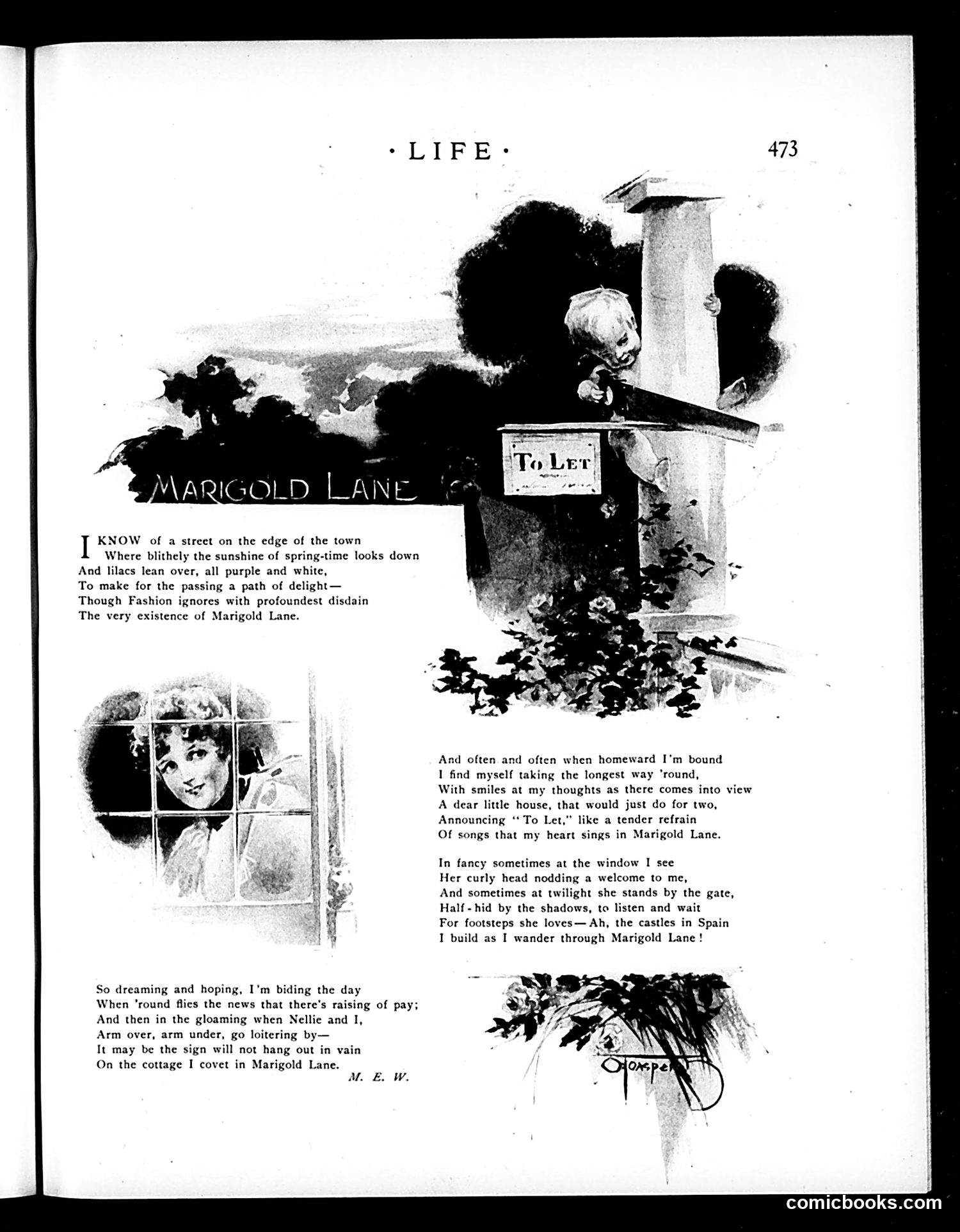
This page from *Life* magazine presents a sentimental poem by M.E.W. about longing for a charming cottage on "Marigold Lane." The poem expresses nostalgia for a beloved location and romantic memories—specifically mentioning a woman named Nellie and fantasies of Spanish castles. The illustrations support this romantic theme: a "To Let" sign on a quaint house with lilacs, a woman's face peering from a cottage window, and floral decorative elements. This appears to be lighthearted domestic sentimentality rather than political satire. The signature "Oompe" indicates the artwork's illustrator. The content reflects early 20th-century *Life* magazine's blend of poetry, illustration, and escapist romanticism for middle-class readers.
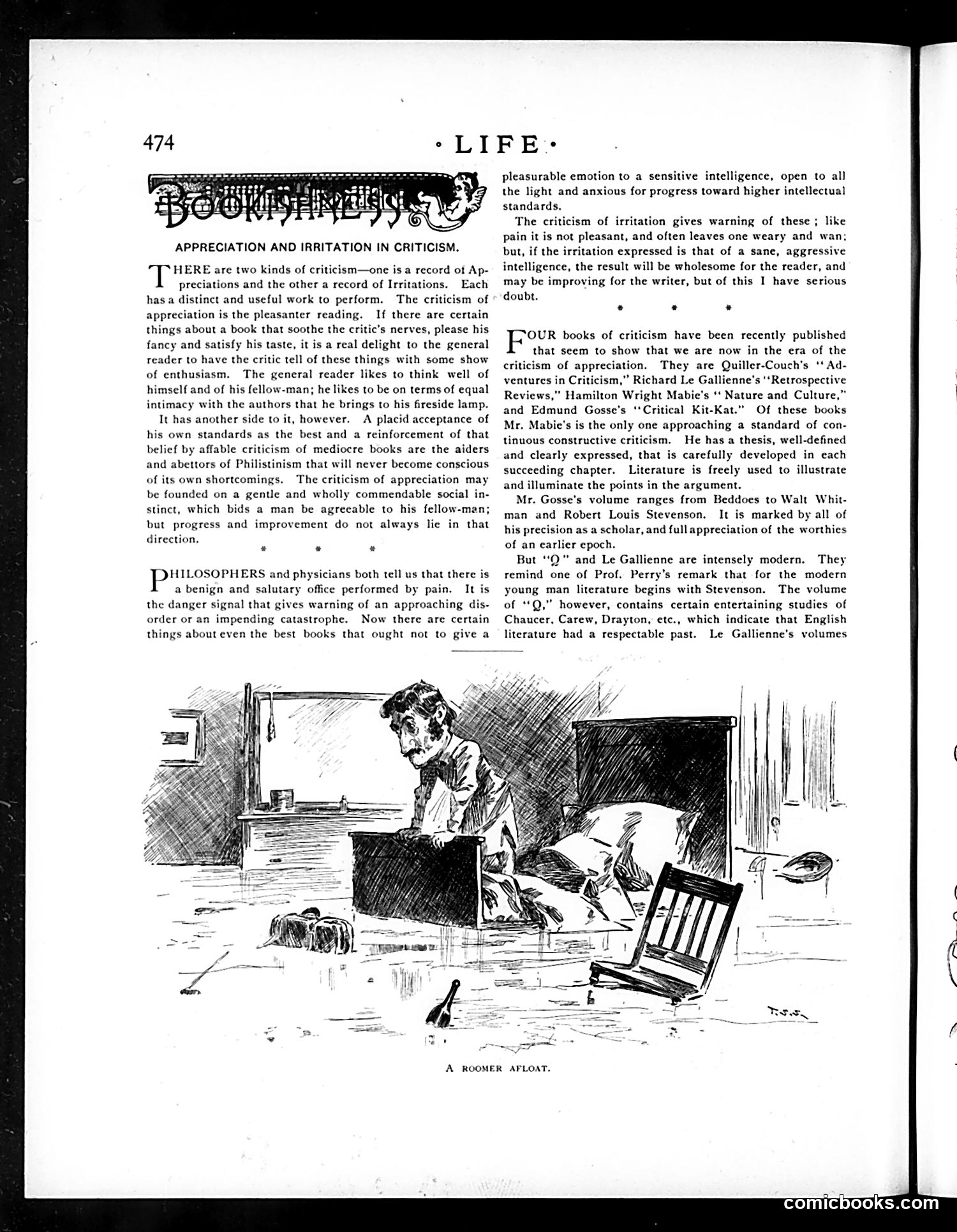
This cartoon depicts a person in a sparse, deteriorating room with minimal furnishings—a bed, chair, and desk—surrounded by water. The title "A Roomer Afloat" is a pun: the figure is literally adrift in floodwaters, but also "afloat" in the sense of being financially unstable, unable to afford better housing. The satire targets urban poverty and poor living conditions in tenement housing. The cramped, shabby room and rising water suggest both literal environmental hazard and metaphorical economic drowning. The figure appears resigned rather than alarmed, implying this dire circumstance is commonplace for working-class renters. This reflects Progressive Era concerns about inadequate housing for low-income workers in American cities, a significant social problem of the early 20th century.
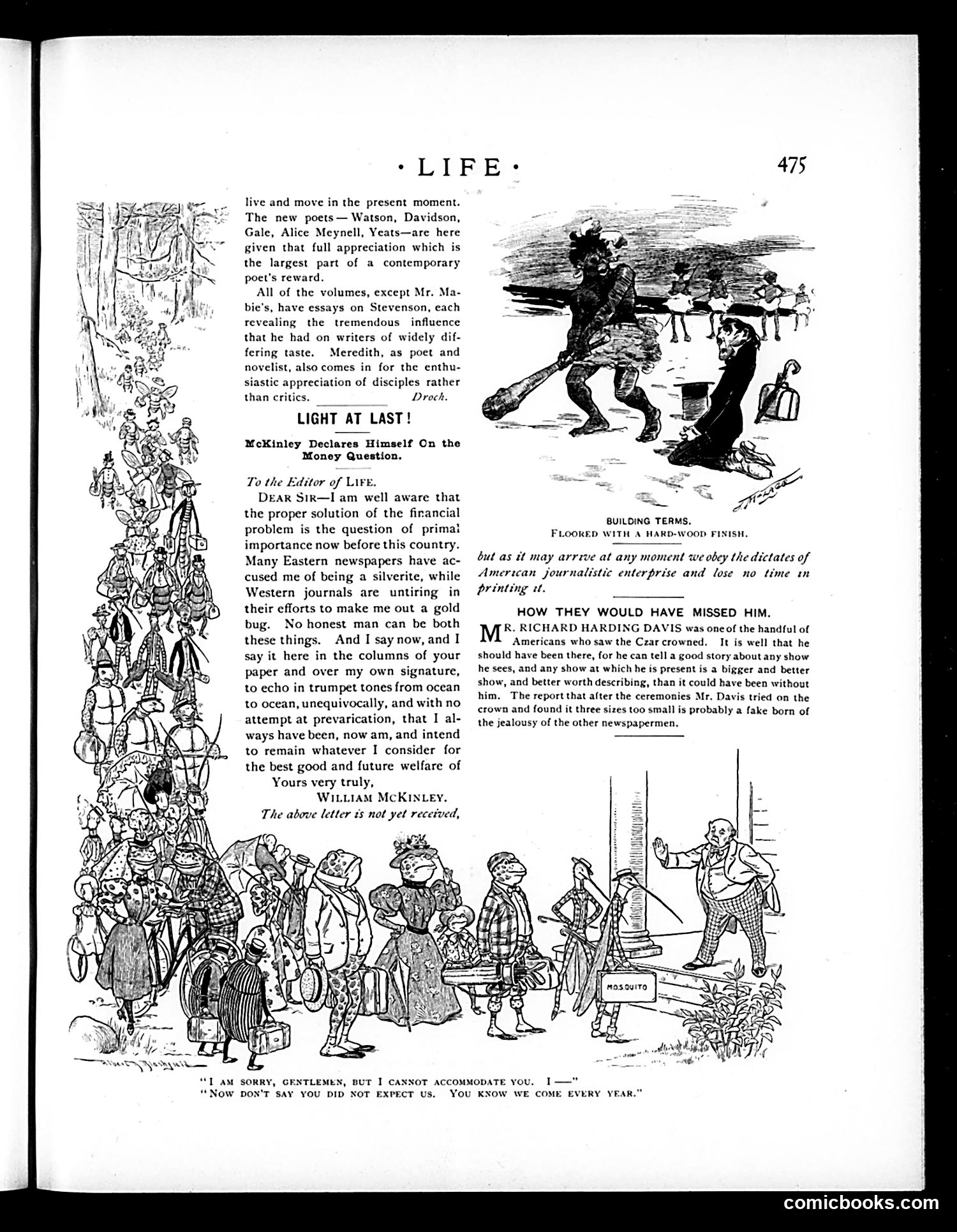
This page from *Life* magazine satirizes President **William McKinley** addressing the financial crisis through a letter to the editor. The top cartoon depicts McKinley as a figure juggling money and construction materials, suggesting he's struggling to balance economic policy. The letter itself is a mock-serious piece where McKinley apparently claims to have solved America's monetary problems—a reference to the contentious "money question" (gold standard vs. free silver debate) that dominated 1890s politics. The bottom cartoon shows a large crowd of people arriving at what appears to be McKinley's residence, with dialogue suggesting they come "every year" expecting hospitality he cannot provide—satirizing broken campaign promises or unfulfilled expectations regarding economic relief.
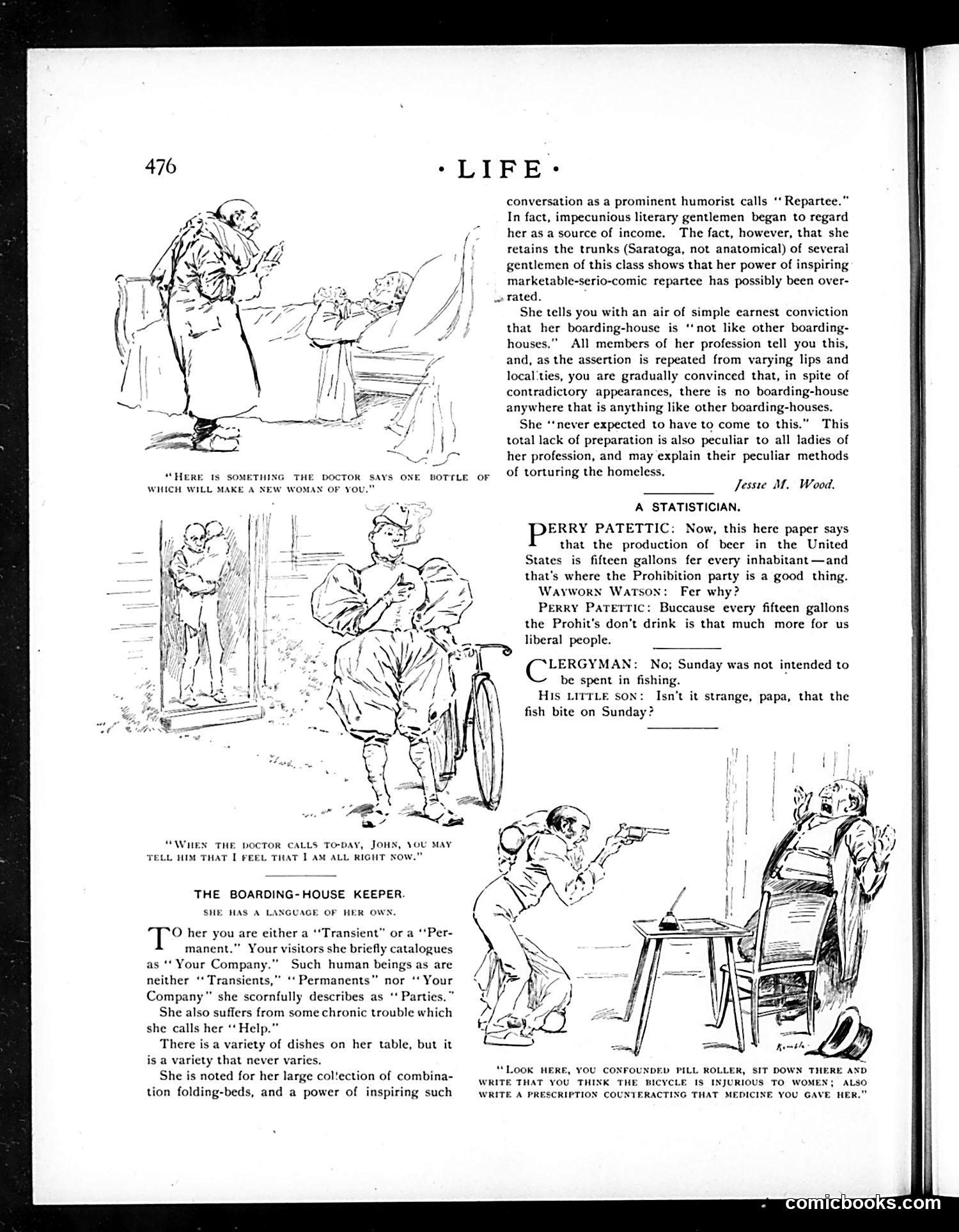
This page contains three separate humorous sketches satirizing early 20th-century American social types: **"The Boarding-House Keeper"** mocks a specific social figure—a woman who runs a boarding house and nicknames her residents as "Transients," "Permanents," or "Your Company." The text describes her combination folding-beds and her tendency to inspire comparisons to her own disorganized household. **"A Statistician"** presents a brief dialogue between Perry Patetic and Wayborn Watson debating beer consumption statistics during Prohibition, satirizing both statistical arguments and the era's alcohol ban. **"Clergyman"** depicts a priest confused about why fish bite on Sundays. The sketches use exaggerated character types and absurdist logic typical of Life's humor—targeting landlords, pedantic debaters, and clergy through everyday domestic situations.
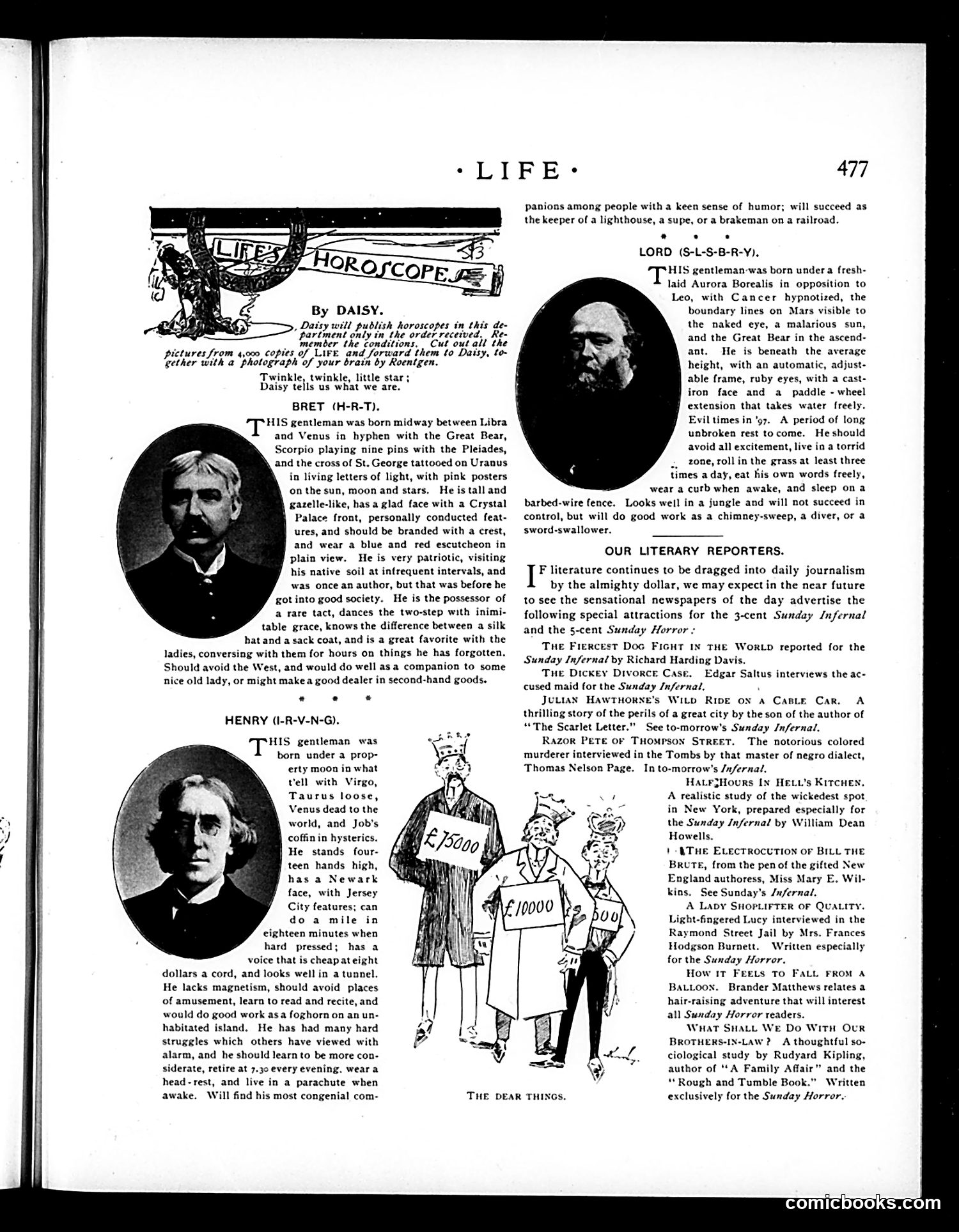
This page contains character sketches and biographical descriptions rather than political cartoons. The visible entries describe fictional or real individuals: **"Lord"** describes a gentleman born under Aurora Borealis, with detailed physical characteristics (ruby eyes, cast-iron face). The satirical description suggests an absurdly constructed or artificial person. **"Bret"** portrays a man born between Libra and Venus, characterized as tall, gazelle-like, and possessing refined tastes—capable of distinguishing between silk and sack cloth. **"Henry"** describes someone born under Virgo with intellectual pretensions but lacking magnetism; he's portrayed as someone who would fail in positions requiring genuine presence. The cartoon showing figures labeled with monetary amounts (£5000, £1000, £500) appears to satirize wealth distribution or financial hierarchies, though the specific context remains unclear without additional page context.
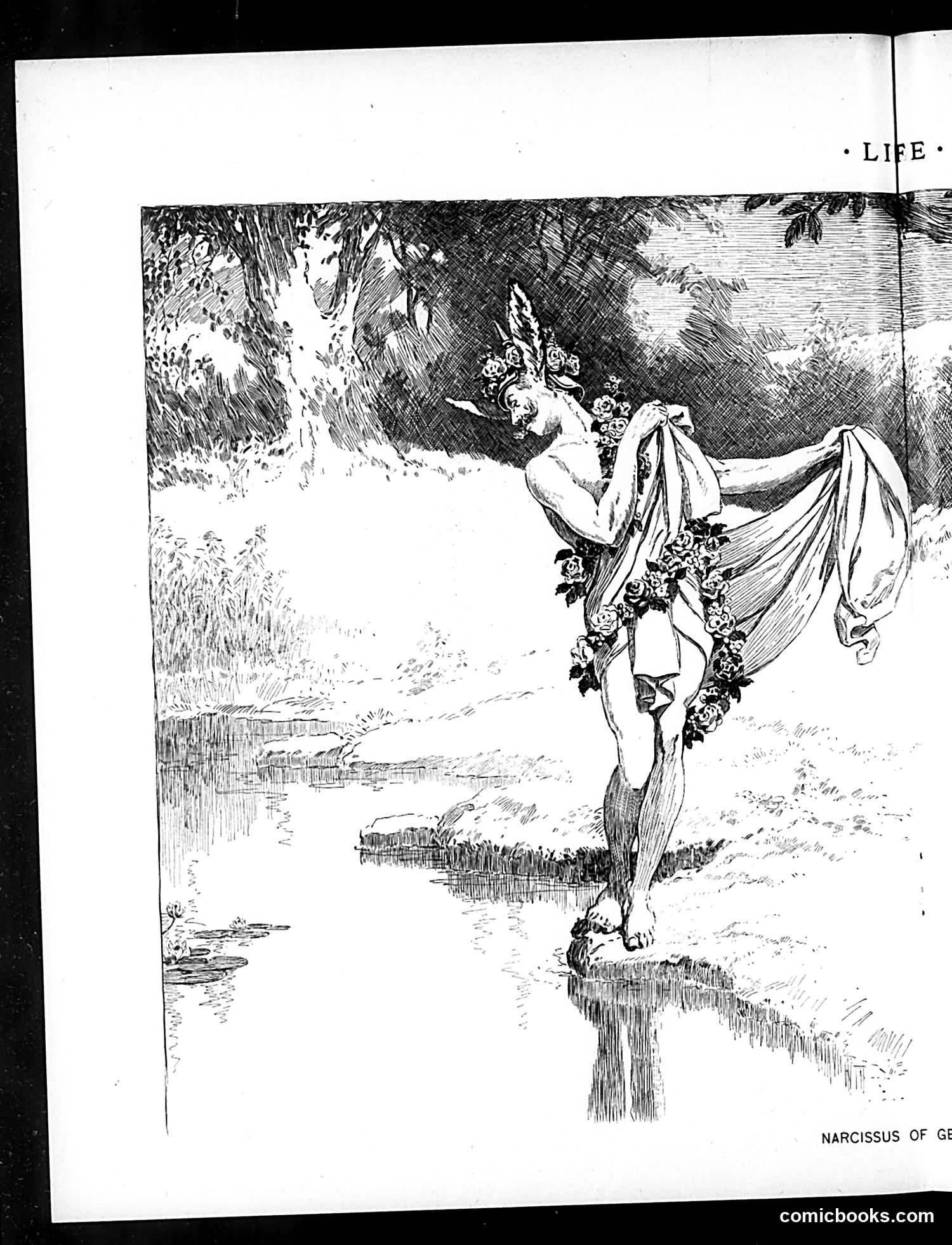
This illustration depicts a classical mythological figure—likely referencing the Greek myth of Narcissus, who fell in love with his own reflection. The title's reference to Georgia suggests a political figure from that state, though the specific identity is unclear from the visible text. The figure is elaborately dressed in flowing fabric and decorative garlands, standing by water in a contemplative pose. The satire appears to mock someone's vanity or self-absorption, using the Narcissus myth as commentary on a Georgia politician's alleged preoccupation with self-promotion or excessive pride. Without the full OCR text or publication date, the precise target remains uncertain, but the classical allusion serves Life magazine's typical purpose: satirizing political figures through literary and mythological comparison.
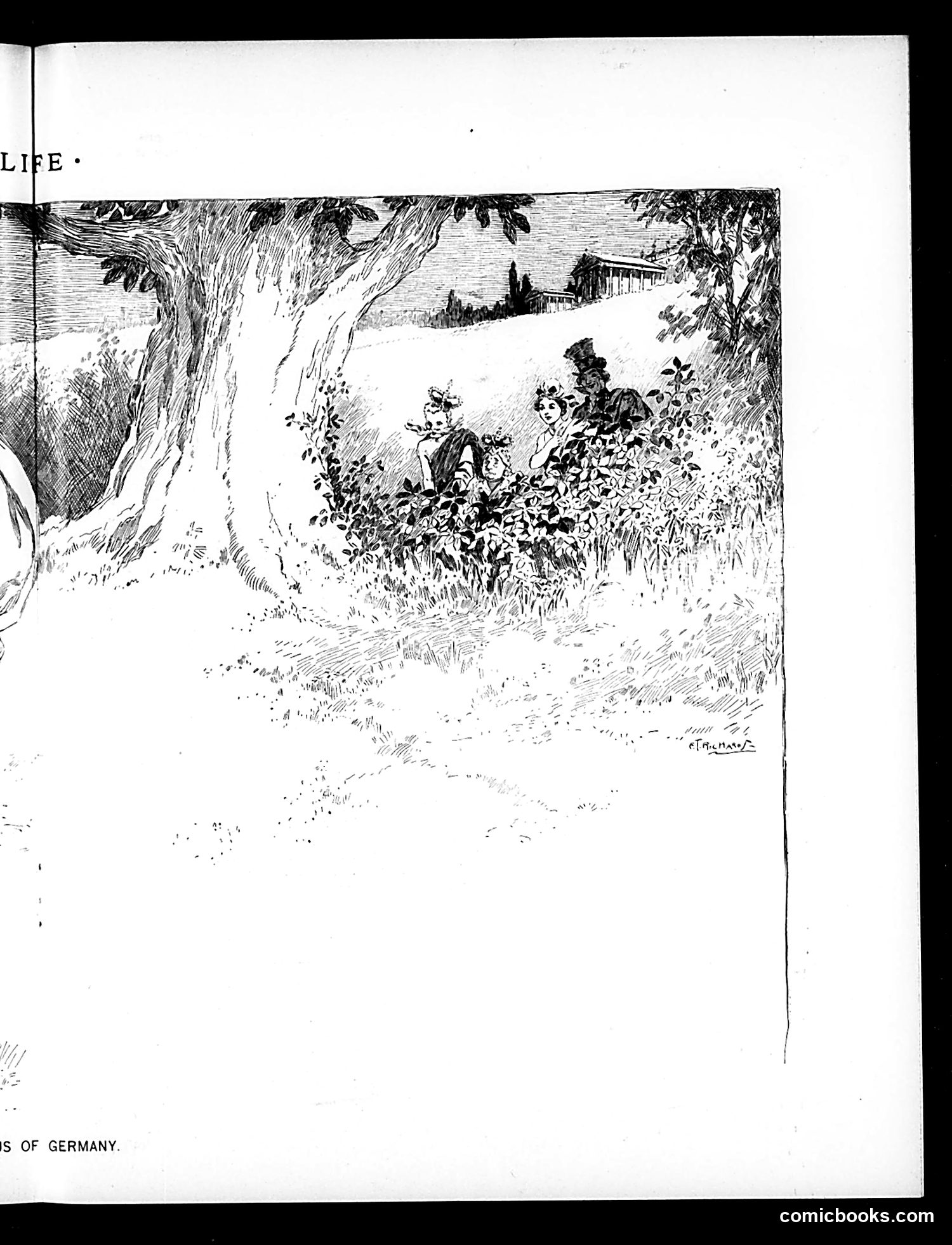
This is an illustration from *Life* magazine showing a pastoral German landscape scene. The image depicts figures in period clothing (appearing to be 19th century) gathering among flowering plants and vegetation, with a large tree on the left and a hillside settlement visible in the background. The page header reads "LIFE" and the footer text references "S OF GERMANY," suggesting this illustration relates to German themes or customs. However, without the complete OCR text or additional context visible on this page, I cannot definitively identify which specific satirical point is being made, who the figures represent, or what social/political commentary the cartoon intends. The image appears to be a straightforward scenic illustration rather than overtly political satire, though the *Life* magazine context suggests some commentary may be present.
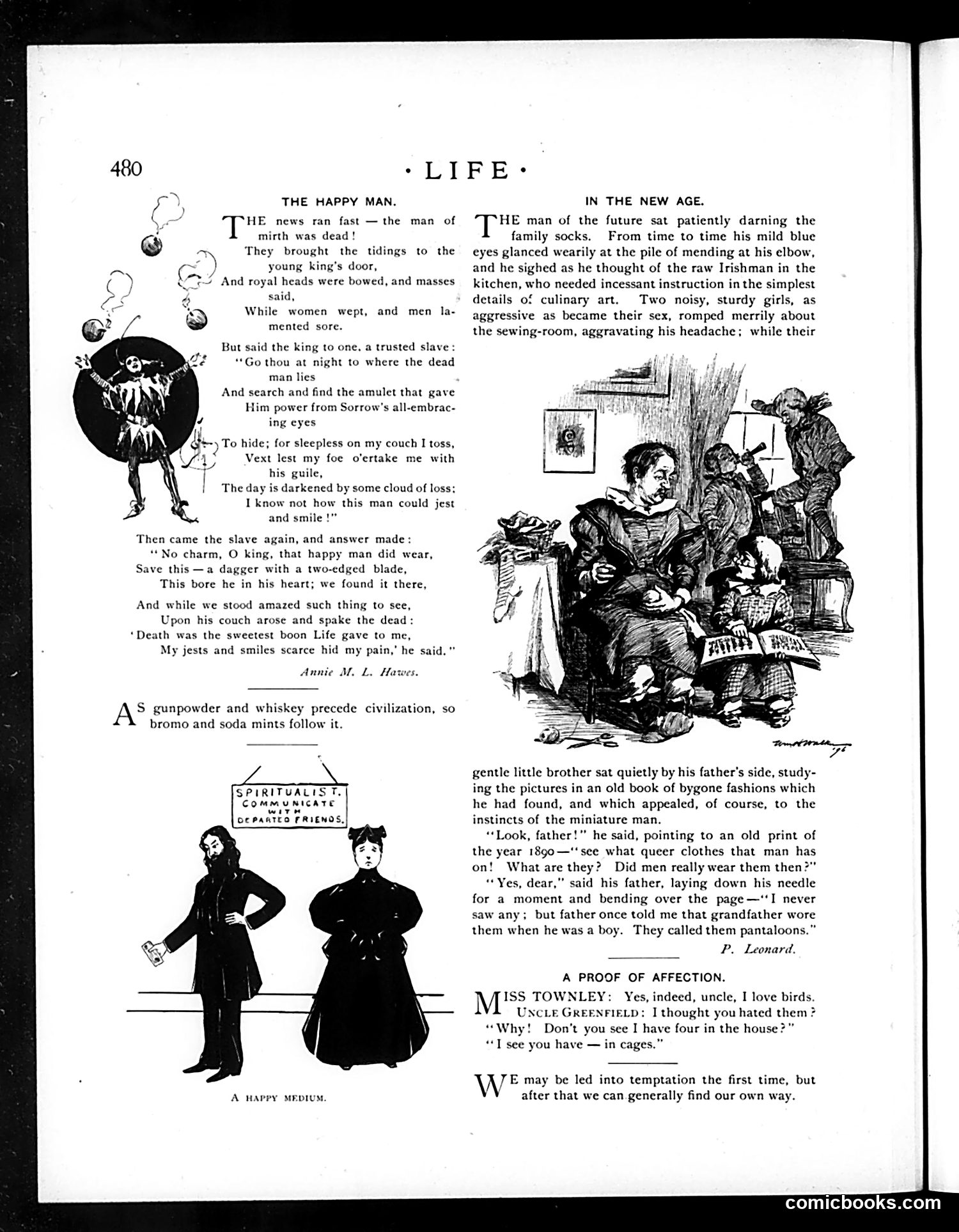
This page contains three satirical pieces reflecting late 19th/early 20th-century social commentary: **"The Happy Man"** (poem): A moral fable where a king seeks the secret to a jester's happiness despite sorrow. The reveal—the jester carried a dagger and ultimately found death preferable to life—is dark satire on suffering and the facade of cheerfulness. **"In the New Age"**: Satirizes shifting gender roles. The "man of the future" does domestic work (darning socks, managing servants) while his daughters are aggressive and assertive. His sensitive son prefers old fashion books—inverting traditional masculinity. This mocks anxieties about women's emerging independence and changing social norms. **"A Happy Medium"**: Visual pun on spiritualism. Two figures labeled "spiritualist" and "communicate with departed friends" represent the contemporary spiritualist movement's popularity. **"A Proof of Affection"**: A mild joke: the uncle assumes the niece hates birds because she keeps them caged—a reversal of expected logic about pet ownership. The page reflects fin-de-siècle tensions about modernity, gender, and social change.
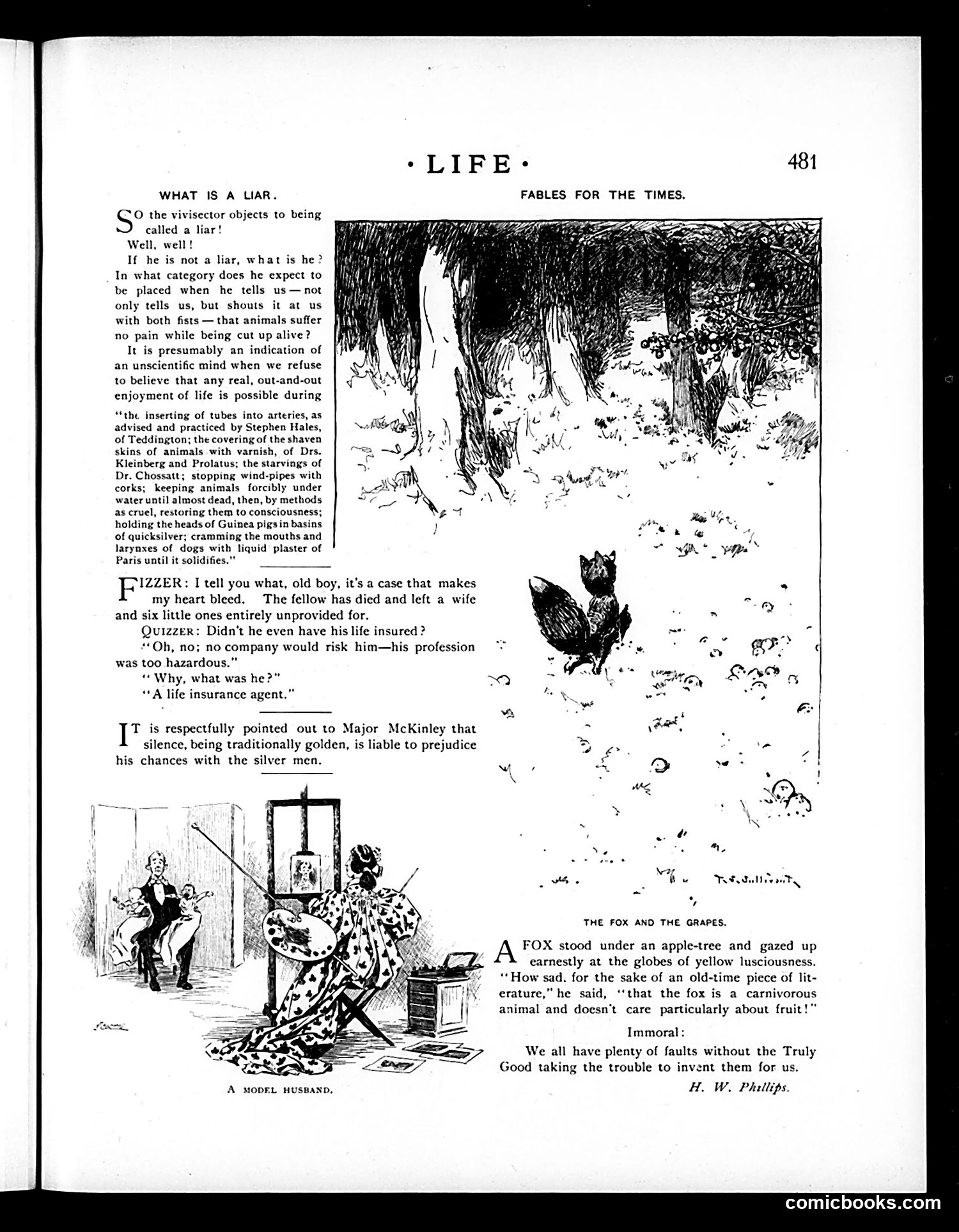
This page contains three distinct satirical pieces: **"What Is a Liar?"** attacks vivisection (animal testing). The satire mocks scientists who claim animals feel no pain during cruel experiments while listing gruesome procedures (cutting arteries, varnishing skin, drowning, poisoning). The hypocrisy is the point: if animals suffer no pain, why are the experiments so brutal? **"A Model Husband"** (cartoon, lower left) appears to satirize marital dynamics, showing a woman controlling/dominating a passive man. **"The Fox and the Grapes"** modernizes Aesop's fable to criticize moral righteousness. Rather than condemning the fox for rationalization, it attacks people who "invent faults" for others to critique—implying moralizers are the real problem. A separate item mocks President McKinley, suggesting silence on currency policy (the "silver men" debate) would help his political standing. The page's overarching theme: exposing hypocrisy in authority figures and self-righteous moralizers.
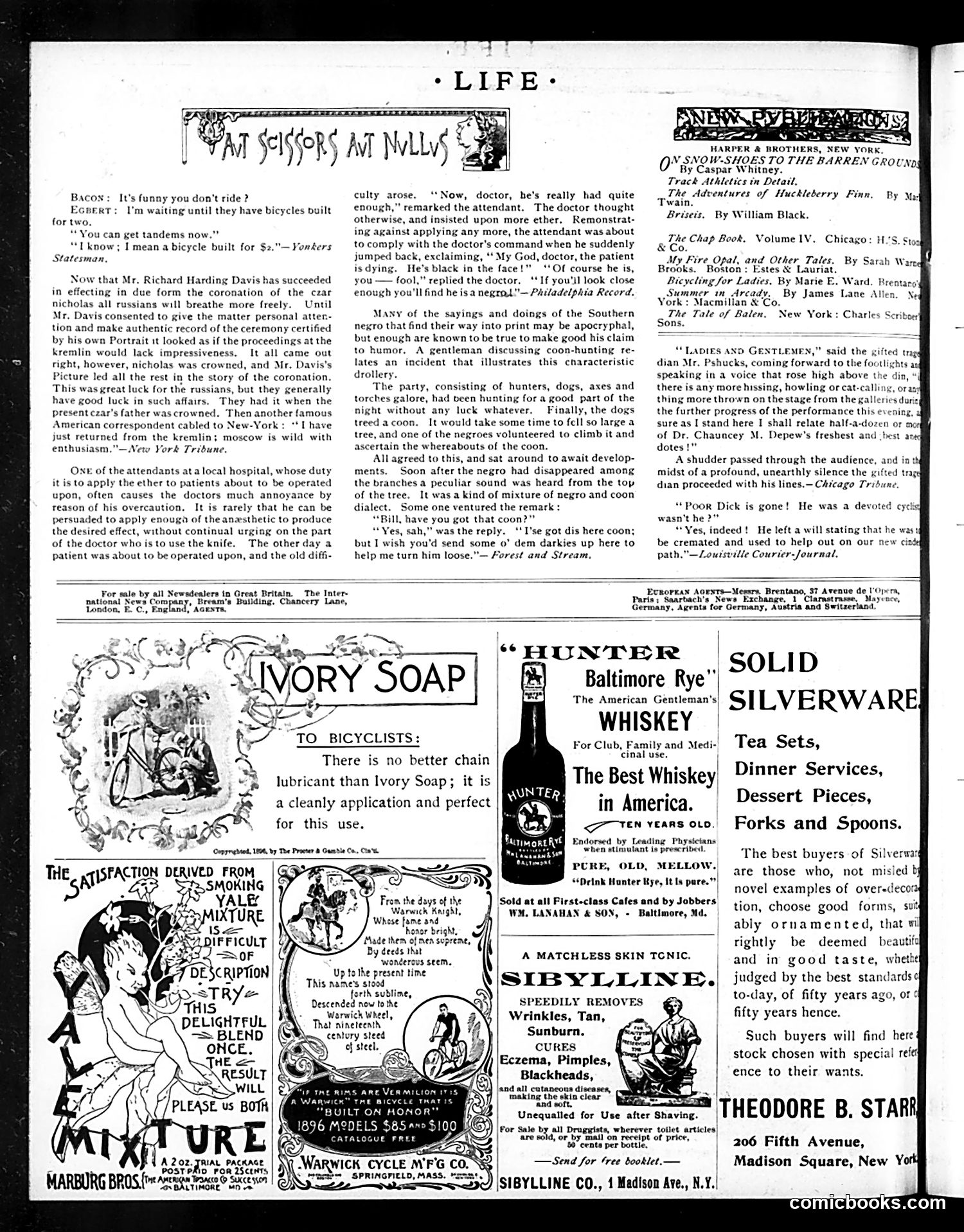
This page contains several brief satirical anecdotes typical of *Life* magazine's humor, plus advertisements. The main pieces mock: 1. **"Bicycles built for $2"**: A joke about cheap bicycles and tandem pricing—refers to the 1890s bicycle craze when prices varied wildly. 2. **Richard Harding Davis's ego**: Davis was a famous war correspondent who covered the Russian czar's coronation. The satire mocks American journalists' self-importance, suggesting Davis's mere presence made the event legitimate. 3. **Racist "coon-hunting" anecdote**: Uses a dehumanizing slur standard in period publications. The "humor" relies on minstrel-show stereotypes about Black dialect and behavior. 4. **Medical incompetence**: A doctor ignores an anesthetist's warnings, nearly killing a patient—commentary on doctor arrogance. 5. **Theater disruption threat**: References a theatrical heckler (possibly Chauncey Depew, a politician known for long speeches). The advertisements emphasize bicycles, soap, whiskey, and silverware—products marketed to affluent readers. The page reflects *Life*'s target audience: educated, moneyed, and comfortable with casual racism.
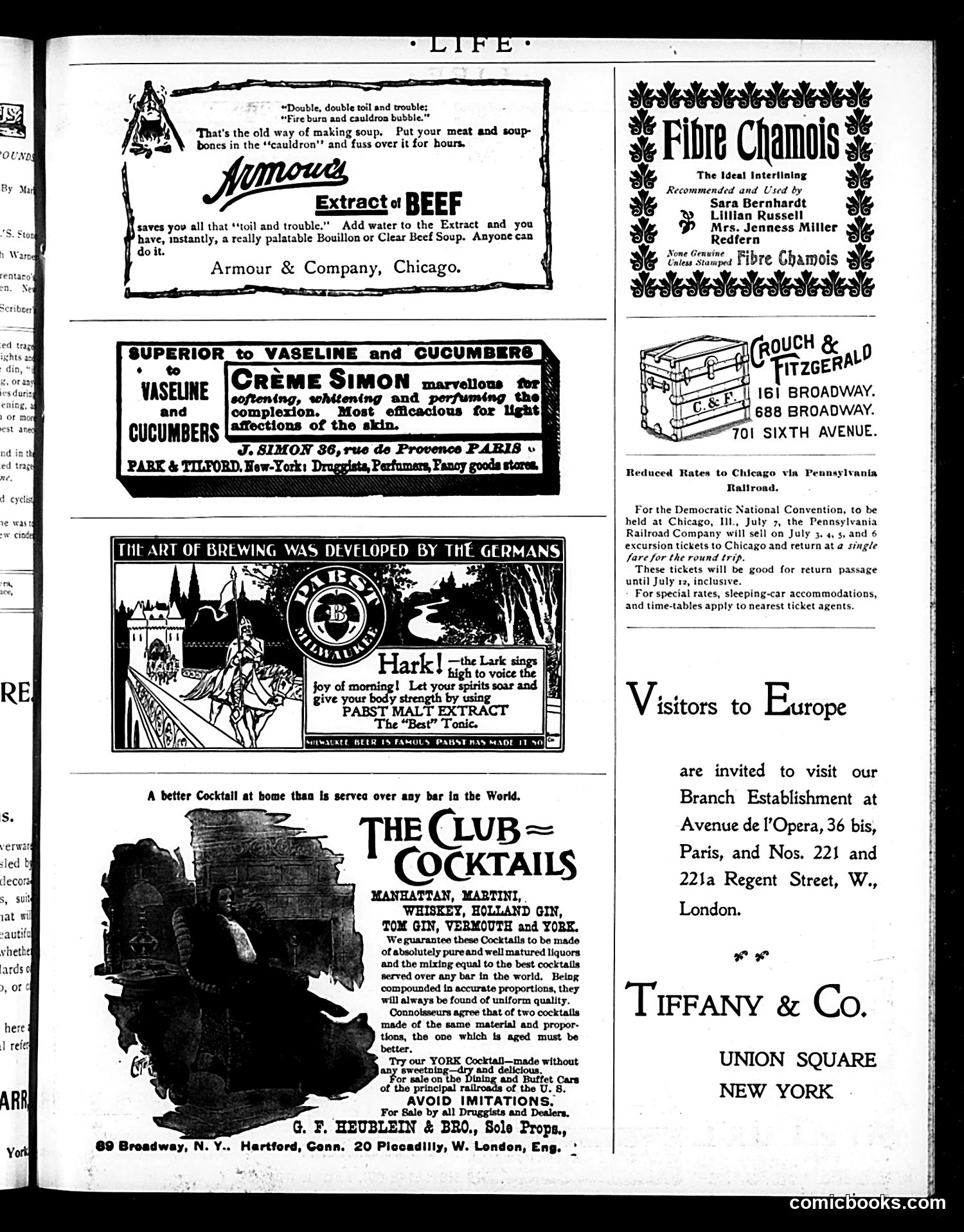
This page is primarily **advertising**, not political satire. It contains product advertisements typical of early 20th-century American magazines: **Key Advertisements:** - **Armour's Beef Extract**: Uses a Macbeth reference ("Double, double toil and trouble") to mock old-fashioned soup-making, positioning their instant extract as modern convenience - **Fibre Chamois**: Endorsed by celebrities (Sara Bernhardt, Lillian Russell) as a beauty product for skin softening - **Crème Simon**: Another skincare product claiming superiority to competitors - **Pabst Malt Extract**: Features German brewing heritage imagery with a singing lark - **The Club Cocktails**: Emphasizes quality ingredients and professional mixing - **Tiffany & Co.**: Luxury goods retailer advertising European locations - **Pennsylvania Railroad**: Promoting discounted excursion fares to the Democratic National Convention in Chicago The page reflects **consumer culture and product standardization** of the era, with heavy emphasis on convenience, celebrity endorsement, and imported sophistication. No political cartoon or satire is present.
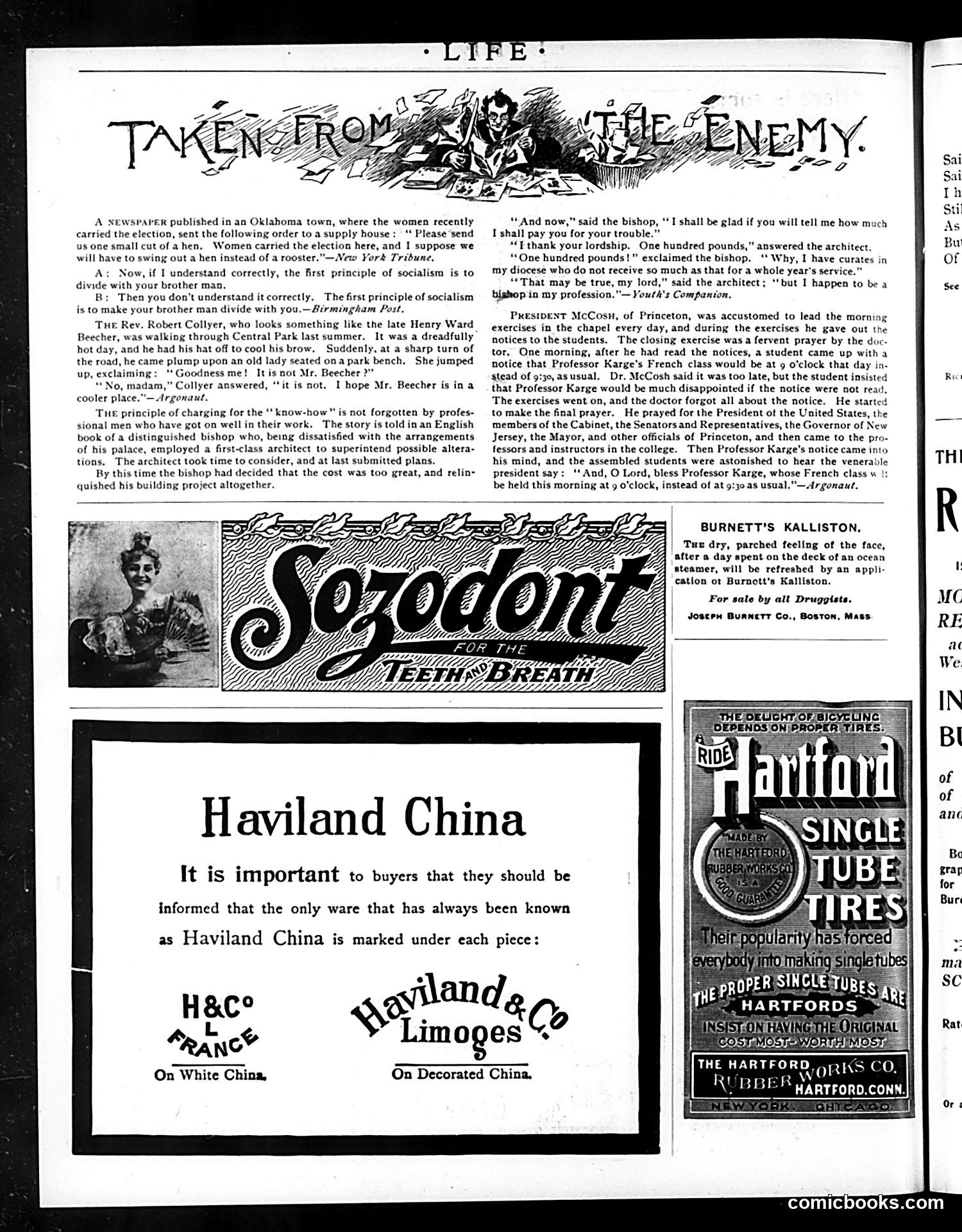
This page contains several humorous anecdotes satirizing early 20th-century American life, plus advertisements. The title piece jokes about women's suffrage: an Oklahoma newspaper orders a hen instead of a rooster because women "carried the election," suggesting women voting represents an emasculation of society—a common anti-suffrage trope. Other jokes mock socialism (dividing resources), clerical pretension (comparing a reverend to famous preacher Henry Ward Beecher), and professional fees (an architect charges a bishop for "know-how" despite appearing to do nothing). The final anecdote ridicules Princeton's President McCosh, whose formal morning prayers become absurdly bureaucratic when he accidentally prays for Professor Karge's French class schedule change—mocking institutional pomposity. The advertisements (Sozodont toothpaste, Haviland China, Hartford bicycle tires) are period product placements typical of Life's revenue model. Overall, the page reflects genteel satirical humor targeting social pretension, women's rights anxieties, and institutional folly.
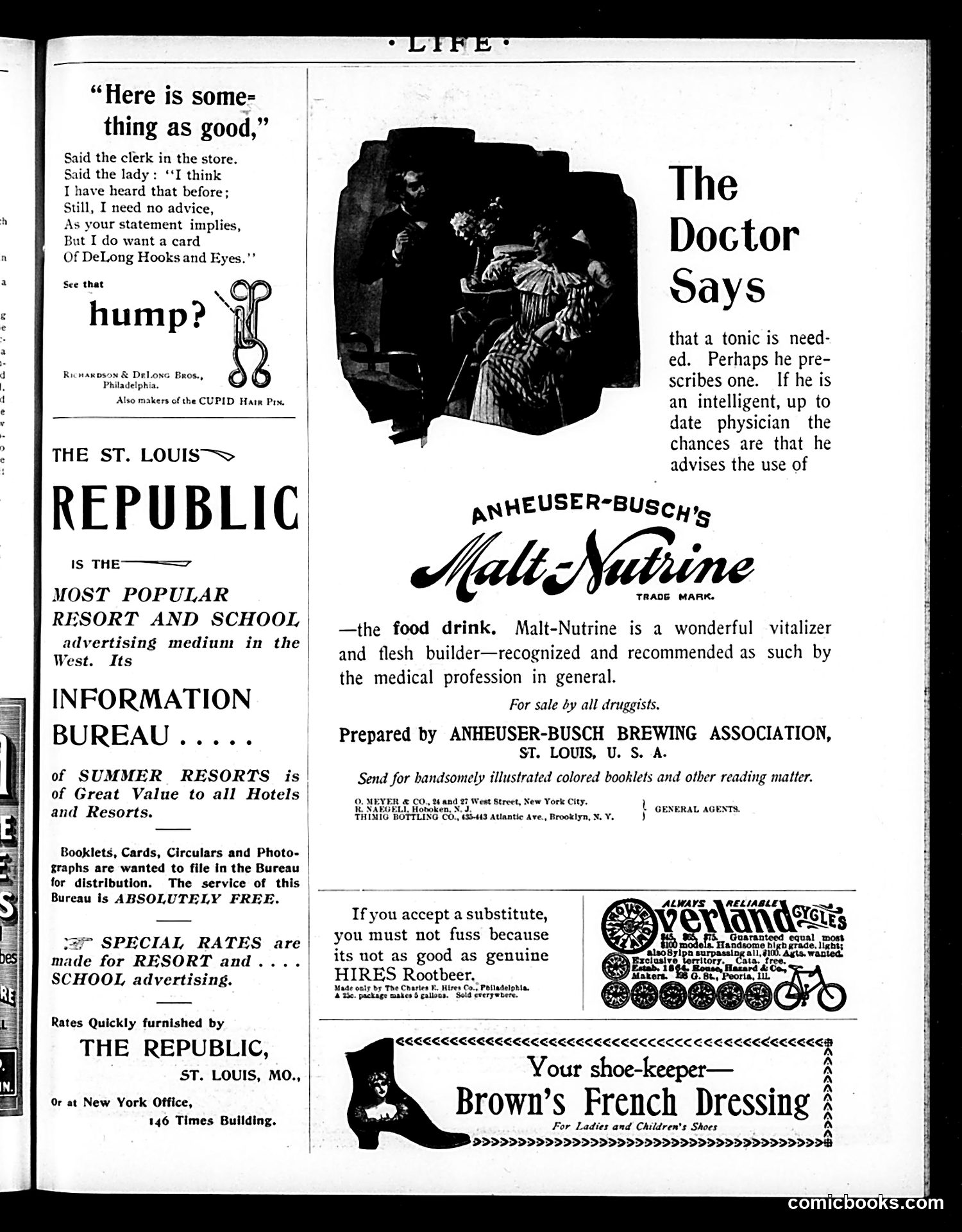
This page is primarily **advertising**, not political satire. It contains several vintage product ads from the early 1900s: **Main content:** - A small dialogue joke about a store clerk offering a substitute product, which leads into an ad for **DeLong Hooks and Eyes** (fasteners), mocking the sales tactic of passing off substitutes as equally good. - A large ad for **Anheuser-Busch's Malt-Nutrine**, a "food drink" marketed as a medicinal tonic endorsed by doctors—a common claim for patent medicines of this era. - Ads for **Hires Rootbeer** and **Brown's French Dressing** (shoe polish). **Historical context:** These ads reflect the period when beer and sugar-water tonics were marketed as health products with vague medical endorsements. The joke about substitutes reflects consumer wariness of inferior imitations—a real concern in an era before strict product regulation. The page also includes a notice for the *St. Louis Republic* newspaper's advertising services.
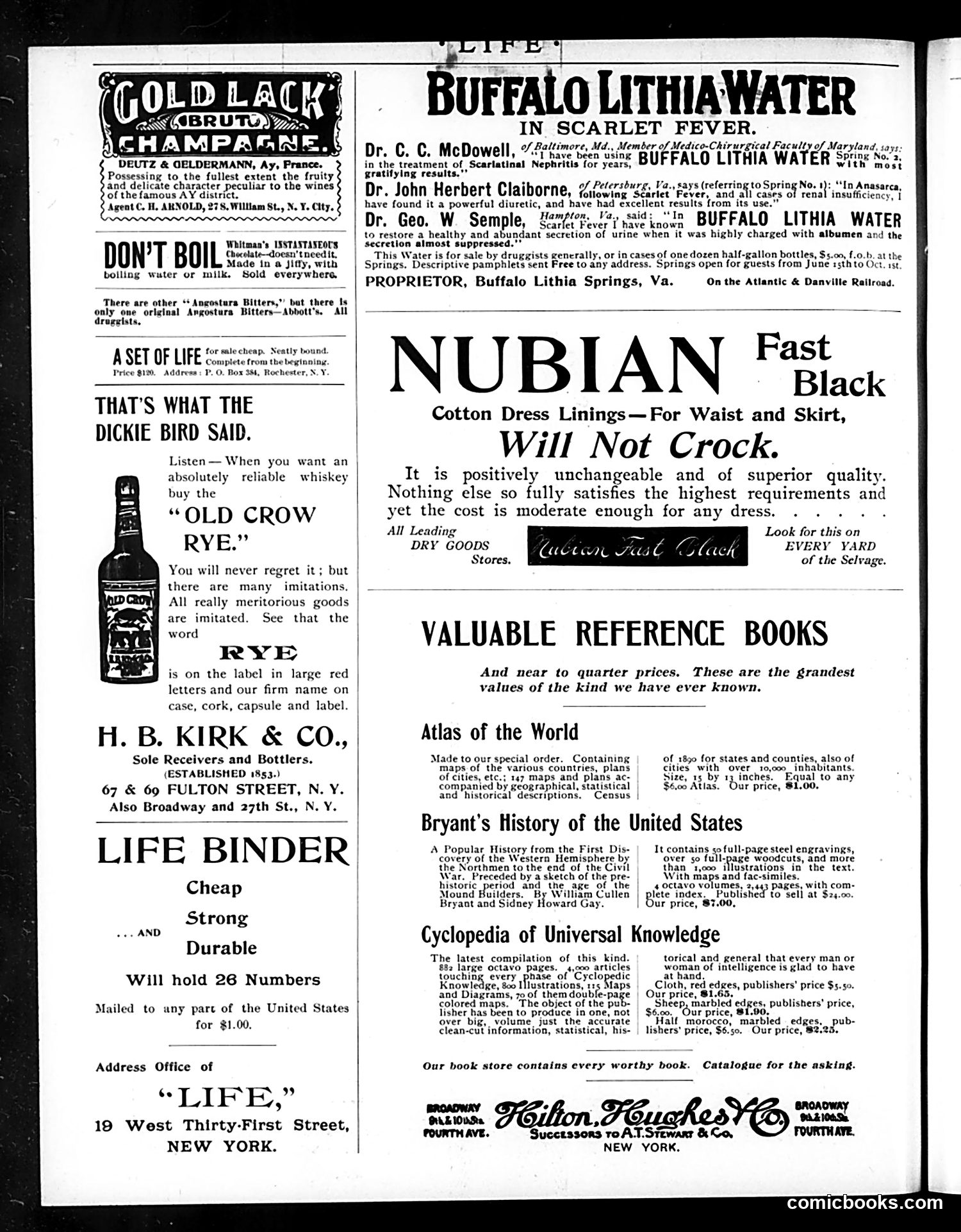
This is primarily an **advertising page** from Life magazine, not a political cartoon. The content consists entirely of commercial advertisements for various products and services typical of the late 19th century. The ads promote: - **Alcoholic beverages** (champagne, whiskey) - **Patent medicines** (Buffalo Lithia Water, advertised as treatment for scarlet fever with doctor testimonials) - **Household products** (chocolate, fabric linings) - **Reference books** (atlases, histories) - **Magazine subscriptions** (Life's own binder service) **For modern readers:** The most striking element is the **medical advertising**—Buffalo Lithia Water claims therapeutic benefits with physician endorsements, reflecting an era before FDA regulation when such health claims were unvetted and often dubious. The "patent medicine" era commonly made exaggerated curative promises. The page reflects consumer culture of the Gilded Age and demonstrates how magazines financed themselves through dense advertising rather than subscription fees alone.
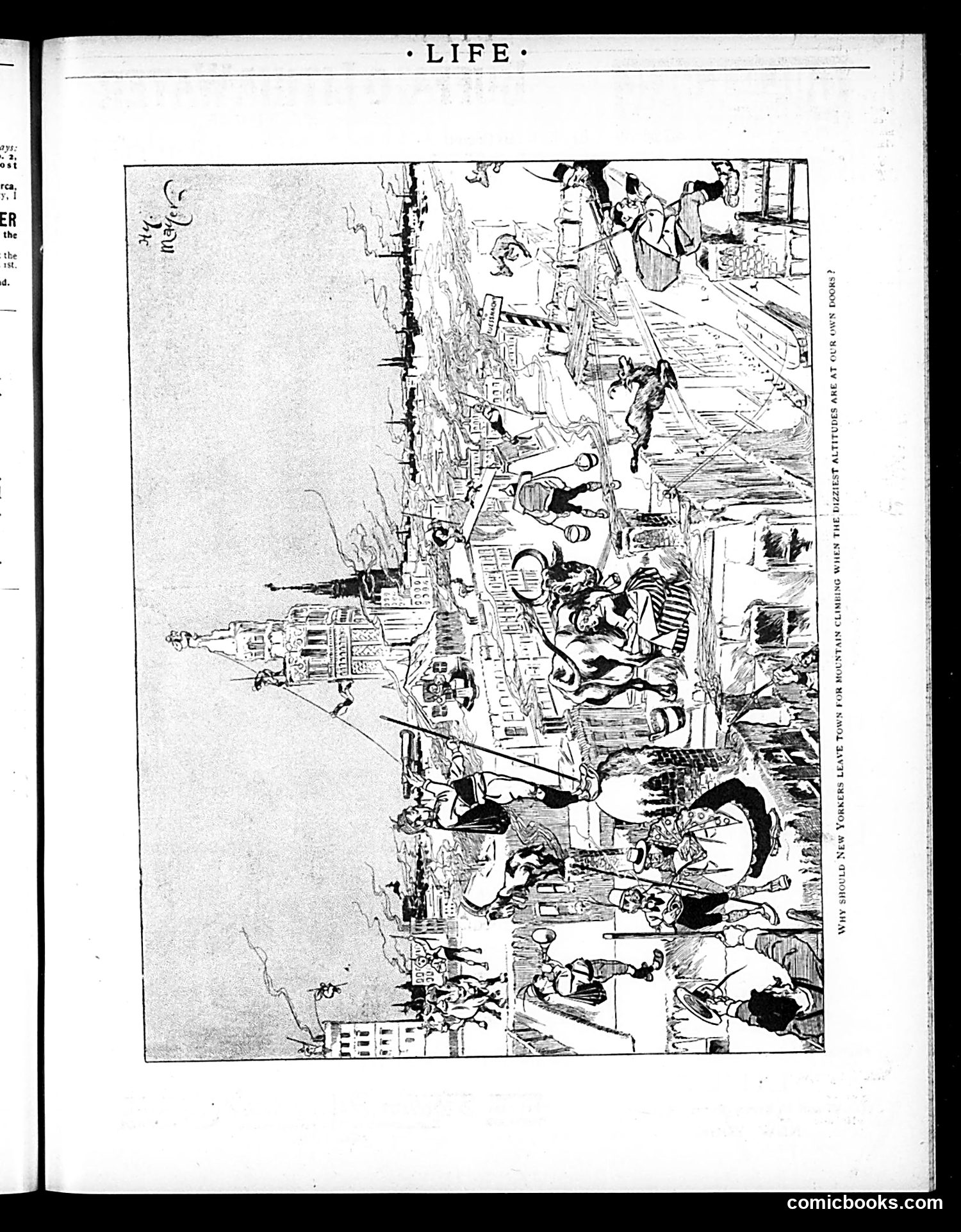
This page appears to be a single large cartoon, rotated 90 degrees, depicting a crowded urban street scene—likely New York City based on the OCR text reference to "New Yorkers." The caption's joke critiques New Yorkers who travel to mountains for climbing while ignoring the "dizziest altitudes" available in their own city. The cartoon illustrates this by showing a chaotic, vertically-packed street scene with people stacked and crammed at multiple levels—suggesting skyscrapers and urban density create their own vertiginous heights and chaos. The satire mocks both the impracticality of seeking mountain adventures when living in a visually disorienting urban environment, and implicitly the frenetic, overcrowded nature of city life itself. The dense, cluttered composition reinforces the joke visually.
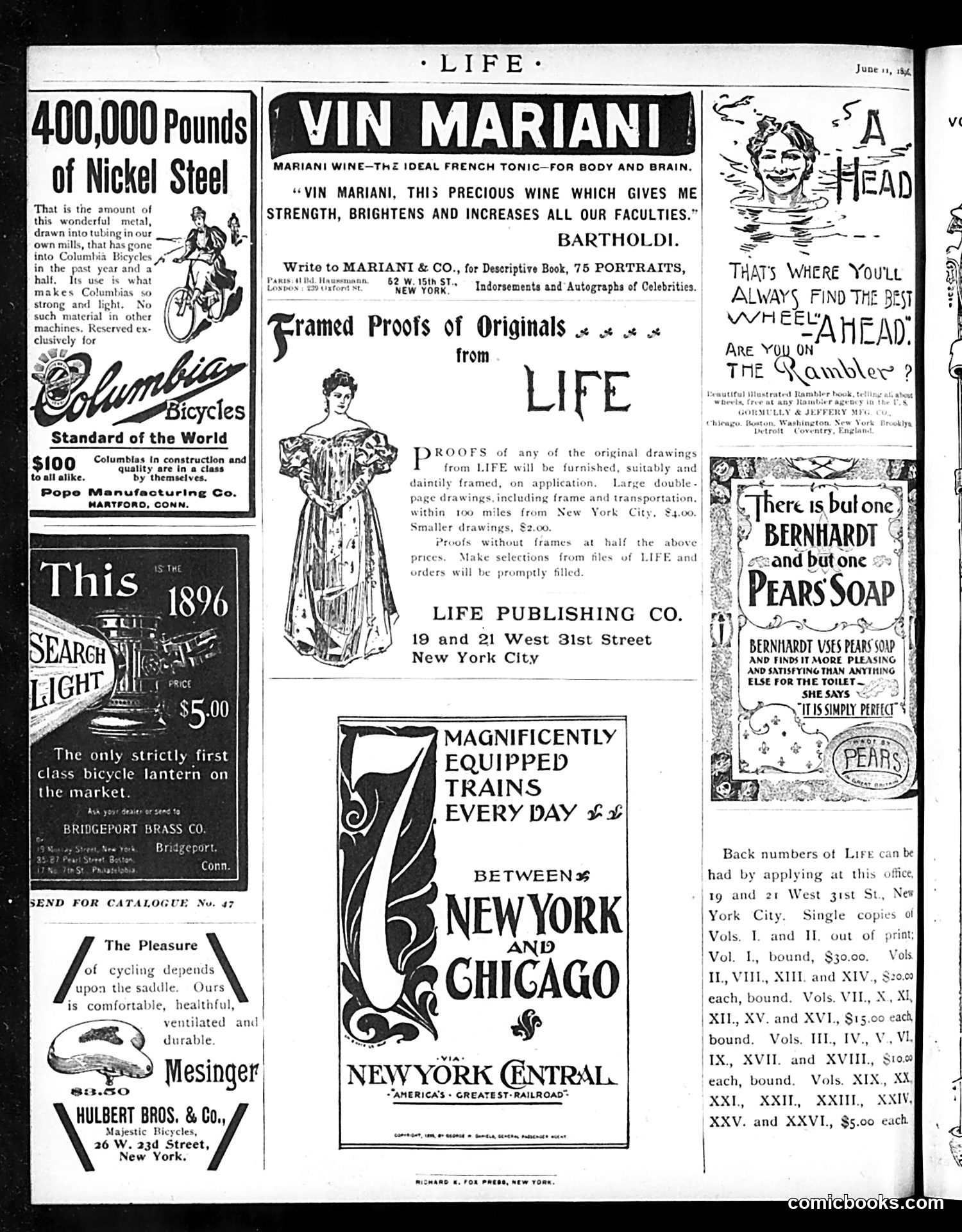
This is primarily an **advertising page** with minimal editorial content. The notable satirical element is the **Vin Mariani wine advertisement** featuring a testimonial attributed to Bartholdi (sculptor of the Statue of Liberty). The joke appears to be using a respected American cultural figure to endorse a French tonic wine—likely satirizing celebrity endorsements and the pseudo-scientific health claims common to patent medicines of the era. The page otherwise contains typical 1890s advertisements: bicycles (Columbia, Mesinger saddles), a railroad advertisement (New York Central), Pears Soap (featuring actress Sarah Bernhardt), and a bicycle lantern. These ads reflect the bicycle boom of the 1890s and emerging celebrity endorsement marketing. The Life Publishing Company uses the page to advertise back issues and framed artwork proofs from the magazine itself, suggesting this was standard self-promotion practice for periodicals.