
Life, 1896-06-11 · page 6 of 20
Life — June 11, 1896 — page 6: what you’re looking at
What you’re looking at
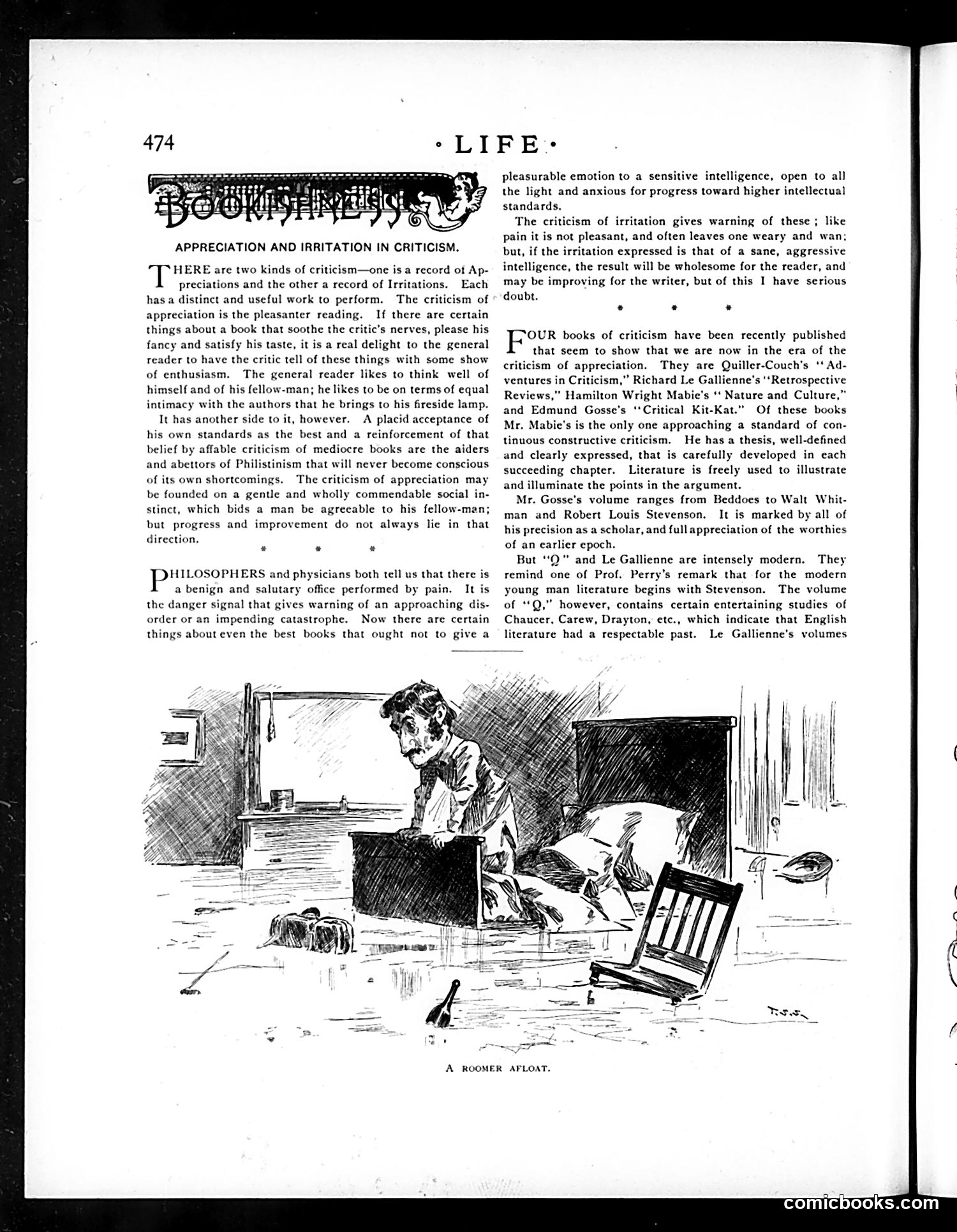
This cartoon depicts a person in a sparse, deteriorating room with minimal furnishings—a bed, chair, and desk—surrounded by water. The title "A Roomer Afloat" is a pun: the figure is literally adrift in floodwaters, but also "afloat" in the sense of being financially unstable, unable to afford better housing. The satire targets urban poverty and poor living conditions in tenement housing. The cramped, shabby room and rising water suggest both literal environmental hazard and metaphorical economic drowning. The figure appears resigned rather than alarmed, implying this dire circumstance is commonplace for working-class renters. This reflects Progressive Era concerns about inadequate housing for low-income workers in American cities, a significant social problem of the early 20th century.
📄 Transcribed text from this page (OCR, searchable)
Machine-transcribed from the original scan — historical spelling and the odd misread are preserved.
LIFE: APPRECIATION AND IRRITATION IN CRITICISM, HERE are two kinds of criticism—one is a record of Ap- preciations and the other a record of Irritations. Each has a distinct and useful work to perform. The criticism of appreciation is the pleasanter reading. If there are certain things about a book that soothe the critic’s nerves, please his fancy and satisfy his taste, it is a real delight to the general reader to have the critic tell of these things with some show of enthusiasm. The general reader likes to think well of himself and of his fellow-man; he likes to be on terms of equal intimacy with the authors that he brings to his fireside lamp. It has another side to it, however. A placid acceptance of his own standards as the best and a reinforcement of that belief by affable criticism of mediocre books are the aiders and abettors of Philistinism that will never become conscious of its own shortcomings. The criticism of appreciation may be founded on a gentle and wholly commendable social in- stinct, which bids a man be agreeable to his fellow-man; but progress and improvement do not always lie in that direction, * . * PitLosoPHERs and physicians both tell us that there is a benign and salutary office performed by pain. It is the danger signal that gives warning of an approaching dis- order or an impending catastrophe. Now there are certain things about even the best books that ought not to give a pleasurable emotion to a sensitive intelligence, open to all the light and anxious for progress toward higher intellectual standards, The criticism of irritation gives warning of these ; like pain it is not pleasant, and often leaves one weary and wan; but, if the irritation expressed is that of a sane, aggressive intelligence, the result will be wholesome for the reader, and may be improving for the writer, but of this I have serious doubt. OUR books of criticism have been recently published that seem to show that we are now in the era of the criticism of appreciation. They are Quiller-Couch’s ‘* Ad- ventures in Criticism,” Richard Le Gallienne's ‘‘Retrospective Reviews," Hamilton Wright Mabie's ‘t Nature and Culture,” and Edmund Gosse’s ‘‘Critical Kit-Kat.” Of these books Mr. Mabie's is the only one approaching a standard of con- tinuous constructive criticism. He has a thesis, well-defined and clearly expressed, that is carefully developed in each succeeding chapter. Literature is freely used to illustrate and illuminate the points in the argument. Mr. Gosse's volume ranges from Beddoes to Walt Whit- man and Robert Louis Stevenson. It is marked by all of his precision as a scholar, and full appreciation of the worthies of an carlier epoch. But “Q” and Le Gallienne are intensely modern. They remind one of Prof. Perry’s remark that for the modern young man literature begins with Stevenson. The volume of '*Q," however, contains certain entertaining studies of Chaucer, Carew, Drayton, etc., which indicate that English literature had a respectable past. Le Gallienne’s volumes A ROOMER AFLOAT. comicbooks.com