
Life, 1896-06-11 · page 12 of 20
Life — June 11, 1896 — page 12: what you’re looking at
What you’re looking at
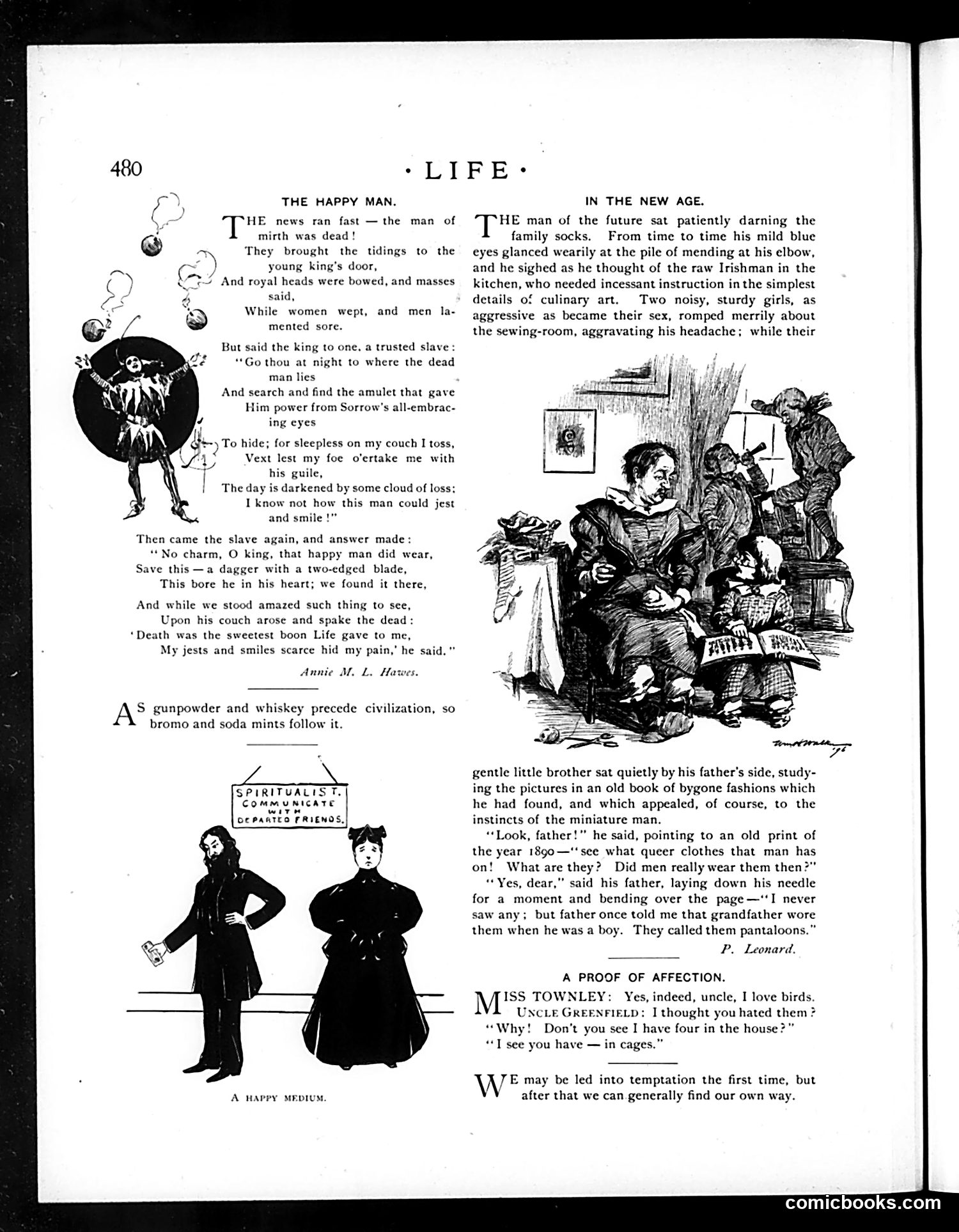
This page contains three satirical pieces reflecting late 19th/early 20th-century social commentary: **"The Happy Man"** (poem): A moral fable where a king seeks the secret to a jester's happiness despite sorrow. The reveal—the jester carried a dagger and ultimately found death preferable to life—is dark satire on suffering and the facade of cheerfulness. **"In the New Age"**: Satirizes shifting gender roles. The "man of the future" does domestic work (darning socks, managing servants) while his daughters are aggressive and assertive. His sensitive son prefers old fashion books—inverting traditional masculinity. This mocks anxieties about women's emerging independence and changing social norms. **"A Happy Medium"**: Visual pun on spiritualism. Two figures labeled "spiritualist" and "communicate with departed friends" represent the contemporary spiritualist movement's popularity. **"A Proof of Affection"**: A mild joke: the uncle assumes the niece hates birds because she keeps them caged—a reversal of expected logic about pet ownership. The page reflects fin-de-siècle tensions about modernity, gender, and social change.
📄 Transcribed text from this page (OCR, searchable)
Machine-transcribed from the original scan — historical spelling and the odd misread are preserved.
480 & THE HAPPY MAN. HE news ran fast —the man of mirth was dead ! a) They brought the tidings to Cc) young king's door, <7 And royal heads were bowed, and masses j said, While mented sore. the Fed PS) women wept, and men la- But said the king to one, a trusted slave: “Go thou at night to where the dead man lies And search and find the amulet that gave Him power from Sorrow’s all-embrac- ing eyes To hide; for sleepless on my couch I toss, Vext lest my foe o'ertake me with his guile, The day is darkened by some cloud of loss; I know not how this man could jest and smile !" Then came the slave again, and answer made “No charm, O king, that happy man did wear, Save this —a dagger with a two-edged blade, This bore he in his heart; we found it there, And while we stood amazed such thing to see, Upon his couch arose and spake the dead: *Death was the sweetest boon Life gave to me, My jests and smiles scarce hid my pain,’ he said.” Annie M. L. Hawes. S gunpowder and whiskey precede civilization, so bromo and soda mints follow it. SPIRITUALIST, COMMUNICATE wire Oc PARTEO FRIENO A HAPPY MEDIUM *LIFE: IN THE NEW AGE. THe man of the future sat patiently darning the family socks. From time to time his mild blue eyes glanced wearily at the pile of mending at his elbow, and he sighed as he thought of the raw Irishman in the kitchen, who needed incessant instruction in the simplest details of culinary art. Two noisy, sturdy girls, as aggressive as became their sex, romped merrily about the sewing-room, aggravating his headache; while their gentle little brother sat quietly by his father's side, study- ing the pictures in an old book of bygone fashions which he had found, and which appealed, of course, to the instincts of the miniature man. “Look, father!” he said, pointing to an old print of the year 1890—‘"‘see what queer clothes that man has on! Whatare they? Did men really wear them then?” “Yes, dear,” said his father, laying down his needle for a moment and bending over the page—‘‘I never saw any; but father once told me that grandfather wore them when he was a boy. They called them pantaloons.” P. Leonard. A PROOF OF AFFECTION. ISS TOWNLEY: Yes, indeed, uncle, I love birds. I UNCLE GREENFIELD: I thought you hated them ? “Why! Don't you see I have four in the house?” “T see you have — in cage: WE may be led into temptation the first time, but y after that we can generally find our own way. comicbooks.com