
Life, 1896-06-11 · page 4 of 20
Life — June 11, 1896 — page 4: what you’re looking at
What you’re looking at
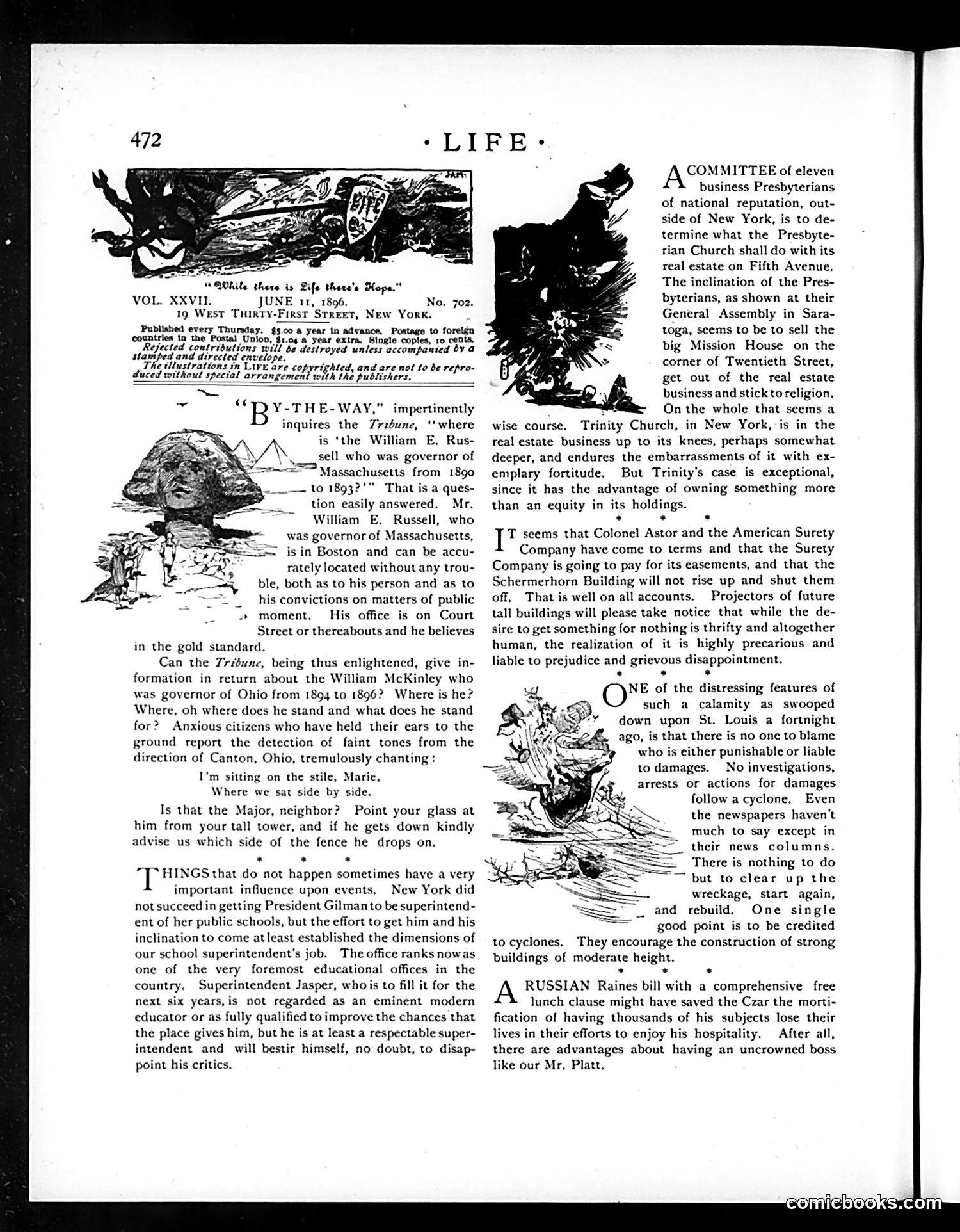
This page contains several satirical commentary pieces rather than a single cartoon. The main topics are: 1. **Presbyterian Church real estate**: Mocking the Presbyterian Church's inclination to sell its Fifth Avenue Mission House and abandon religion for real estate business, contrasting this unfavorably with Trinity Church's more principled approach. 2. **William E. Russell**: A brief query about Russell, former governor of Massachusetts, questioning his current whereabouts and relevance—appearing to mock a once-prominent figure now faded from public notice. 3. **School superintendent appointment**: Criticizing New York's failure to secure President Gilman for superintendent of public schools, settling instead for Jasper, deemed insufficiently qualified despite being respectable. 4. **St. Louis cyclone aftermath**: Commentary on lack of accountability following a destructive cyclone, noting no investigations or damage claims resulted. 5. **Russian Raines bill**: A satirical quip about a Russian free lunch clause potentially saving the Czar from assassination attempts.
📄 Transcribed text from this page (OCR, searchable)
Machine-transcribed from the original scan — historical spelling and the odd misread are preserved.
“While there is Life there's Hope.” VOL. XXVII. JUNE 11, 1896, No. 702. 19 West Tuirty-First Street, New York. Published every Thursday. $5.00 @ year in advance, Postage to forelén countries in the Postal Union, $1.04 « year extra. Single copies, 10 cents. Rejected contributions will be destroyed unless accompanied bY & stamped and directed envelope. The illustrations in Live are copyrighted, and are not to be repro- duced without special arrangement with the publishers. -THE-WAY,” impertinently inquires the 7rzdune, ‘where is ‘the William E, Rus- sell who was governor of Massachusetts from 1890 _—— to 1893?'" That is a ques- tion easily answered, Mr. William E, Russell, who was governor of Massachusetts, ~ isin Boston and can be accu- rately located without any trou- ble, both as to his person and as to his convictions on matters of public -» moment. His office is on Court Street or thereabouts and he believes in the gold standard. Can the 7rsbune, being thus enlightened, give in- formation in return about the William McKinley who was governor of Ohio from 1894 to 1896? Where is he? Where, oh where does he stand and what does he stand for? Anxious citizens who have held their ears to the ground report the detection of faint tones from the direction of Canton, Ohio, tremulously chanting : I'm sitting on the stile, Marie, Where we sat side by side. Point your glass at Is that the Major, neighbor? him from your tall tower, and if he gets down kindly advise us which side of the fence he drops on, * . . HINGS that do not happen sometimes have a very important influence upon events. New York did not succeed in getting President Gilman to be superintend- ent of her public schools, but the effort to get him and his inclination to come atleast established the dimensions of our school superintendent's job. The office ranks nowas one of the very foremost educational offices in the country. Superintendent Jasper, whois to fill it for the next six years, is not regarded as an eminent modern educator or as fully qualified to improve the chances that the place gives him, but he is at least a respectable super- intendent and will bestir himself, no doubt, to disap- point his critics. COMMITTEE of eleven business Presbyterians of national reputation, out- side of New York, is to de- termine what the Presbyte- tian Church shall do with its real estate on Fifth Avenue. The inclination of the Pres- byterians, as shown at their General Assembly in Sara- toga, seems to be to sell the big Mission House on the corner of Twentieth Street, get out of the real estate business and stick to religion. On the whole that scems a wise course. Trinity Church, in New York, is in the real estate business up to its knees, perhaps somewhat deeper, and endures the embarrassments of it with ex- emplary fortitude. But Trinity's case is exceptional, since it has the advantage of owning something more than an equity in its holdings. . . . T seems that Colonel Astor and the American Surety Company have come to terms and that the Surety Company is going to pay for its easements, and that the Schermerhorn Building will not rise up and shut them off. That is well on all accounts. Projectors of future tall buildings will please take notice that while the de- sire to get something for nothing is thrifty and altogether human, the realization of it is highly precarious and liable to prejudice and grievous disappointment, . . . NE of the distressing features of such a calamity as swooped down upon St. Louis a fortnight ago, is that there is no one to blame who is either punishable or liable to damages. No investigations, arrests or actions for damages follow a cyclone. Even the newspapers haven't much to say except in their news columns. There is nothing to do ™~ but to clear up the wreckage, start again, and rebuild. One single good point is to be credited to cyclones, They encourage the construction of strong buildings of moderate height. . . . RUSSIAN Raines bill with a comprehensive free lunch clause might have saved the Czar the morti- fication of having thousands of his subjects lose their lives in their efforts to enjoy his hospitality. After all, there are advantages about having an uncrowned boss like our Mr. Platt.