
A complete issue · 28 pages · 1896
Life — May 28, 1896
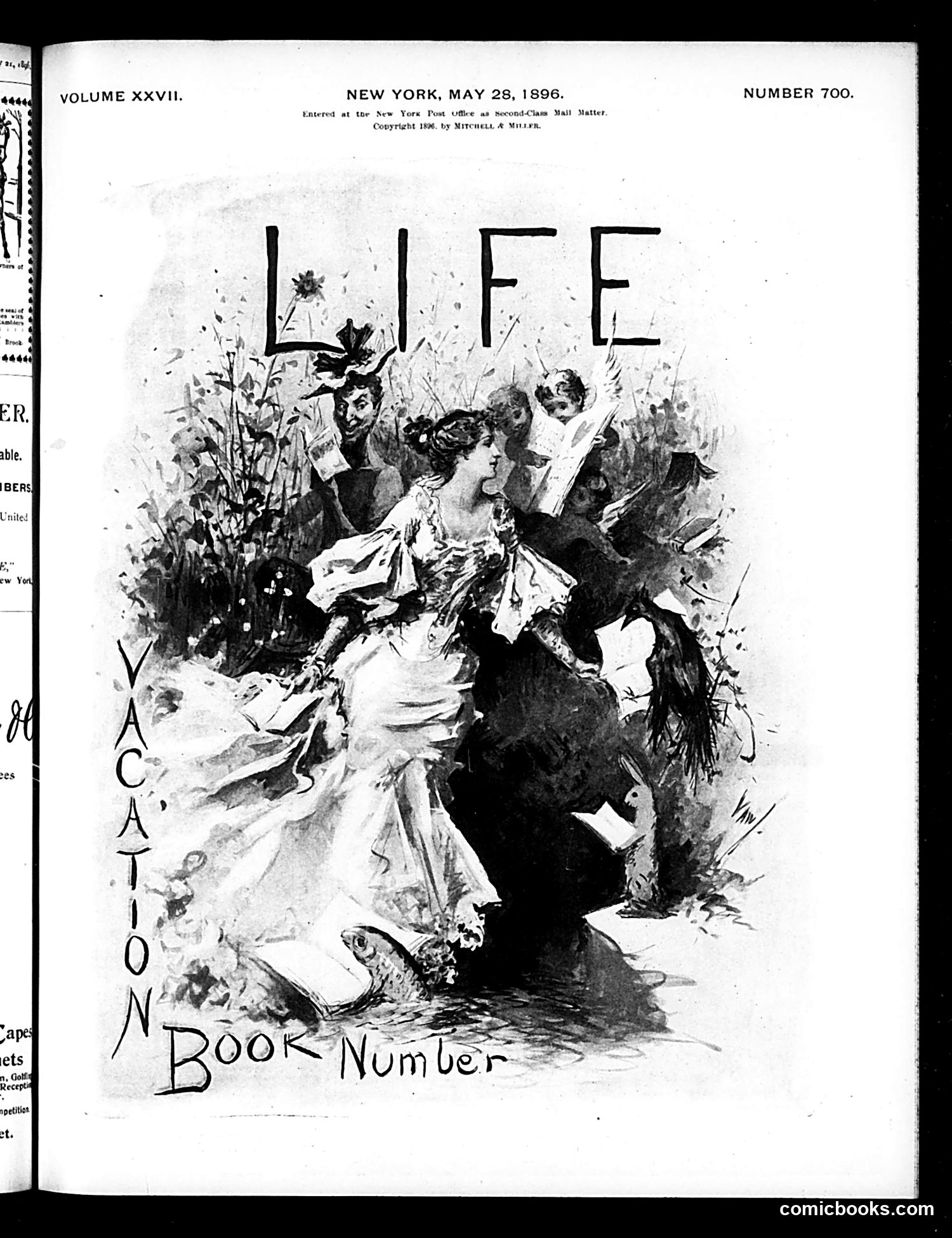
This is a cover for Life magazine's "Vacation Book Number" issue. The illustration shows a woman in late 19th-century dress surrounded by figures in a natural setting with flowers and foliage. The artistic style is typical of the 1890s—romantic and decorative. Without additional context or OCR text visible in the image itself, I cannot definitively identify the specific figures or satirical point being made. The composition suggests themes of leisure, nature, and romance popular in the 1890s, but the exact social or political commentary—if any—remains unclear from the image alone. The page appears primarily designed as an attractive cover rather than containing overt political satire.
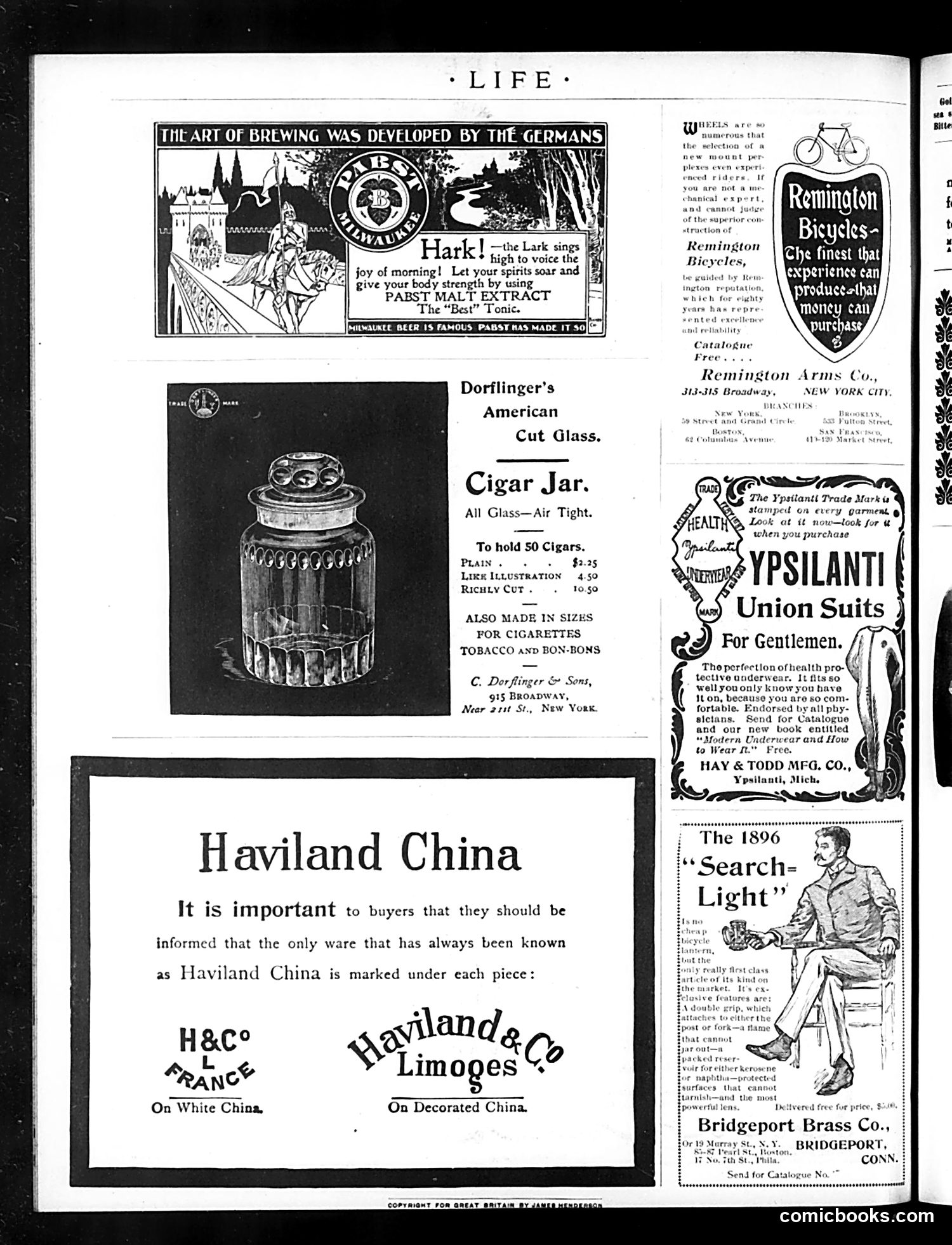
This page is primarily **advertising**, not political satire. The top advertisement promotes Pabst Malt Extract as a tonic, using a medieval German setting with the slogan "Hark! the Lark sings high to voice the joy of morning." It plays on the "art of brewing was developed by the Germans" to market the product as healthful. Below are ads for Dorflinger's cut glass cigar jars, Remington bicycles, Ypsilanti Union Suits (underwear), a "Search-Light" lamp, and Haviland China. The page contains **no political cartoons or satire**—it's a straightforward commercial page typical of Life magazine's advertising revenue model in this era. The content reflects late-19th-century consumer products and marketing approaches.
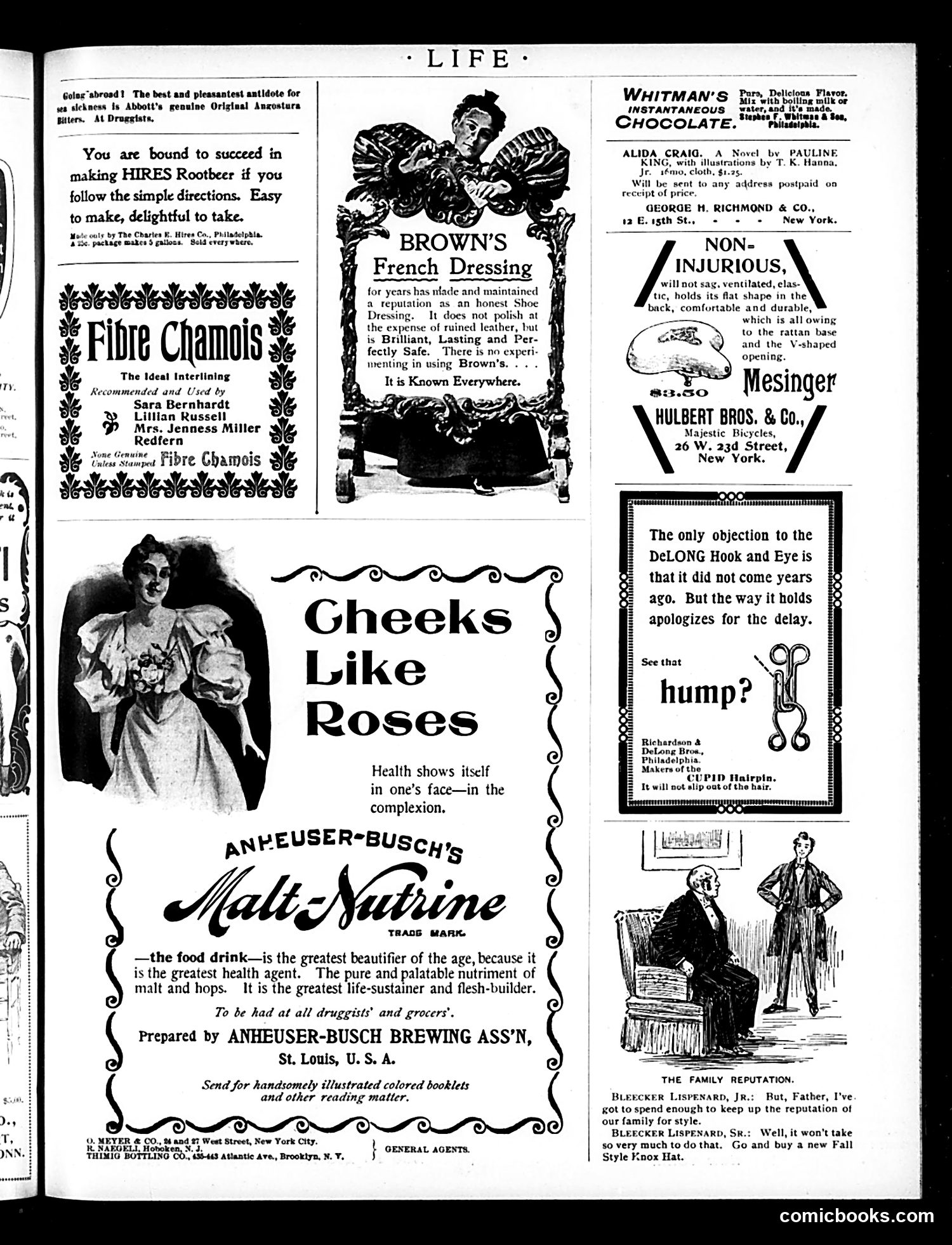
This page is primarily **advertising**, not political satire. It contains product ads for: - **Brown's French Dressing** (shoe polish) - **Fibre Chamois** (interlining fabric) - **Anheuser-Busch's Malt Nutrine** (a malt beverage marketed as a health drink) - **Messinger** bicycles - **DeLong Hook and Eye** fasteners - **Richardson & DeLong** hairpins The only narrative content is a small comic at bottom right titled "The Family Reputation," showing a domestic scene where a father objects to his son's hat choice for maintaining family style. These ads reflect early 1900s consumer products and marketing claims typical of *Life* magazine's commercial content during this era.
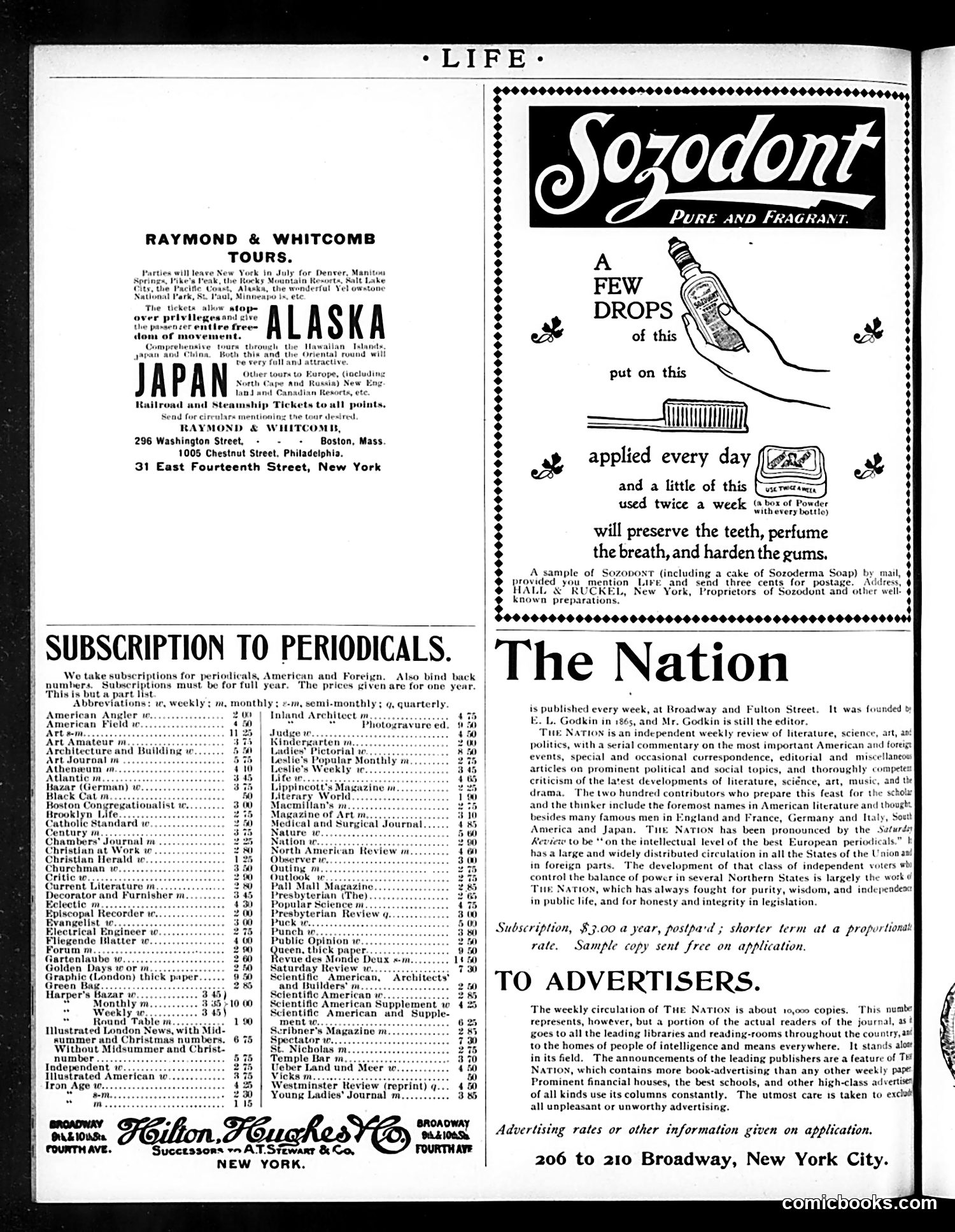
This page contains primarily **advertisements and business listings** rather than political satire. The left side advertises Raymond & Whitcomb Tours (offering trips to Alaska and Japan) and lists subscription rates for various periodicals. The right side features a Sozodont toothpaste advertisement promising to "preserve the teeth, perfume the breath, and harden the gums" with daily application. The bottom right contains an informational article about *The Nation* magazine, describing it as an independent weekly review of literature, science, and politics founded by E.L. Godkin. There are **no political cartoons visible** on this page. The satirical magazine *Life* here serves primarily as a vehicle for late-19th/early-20th-century advertisements and publishing notices, typical of periodicals from this era.
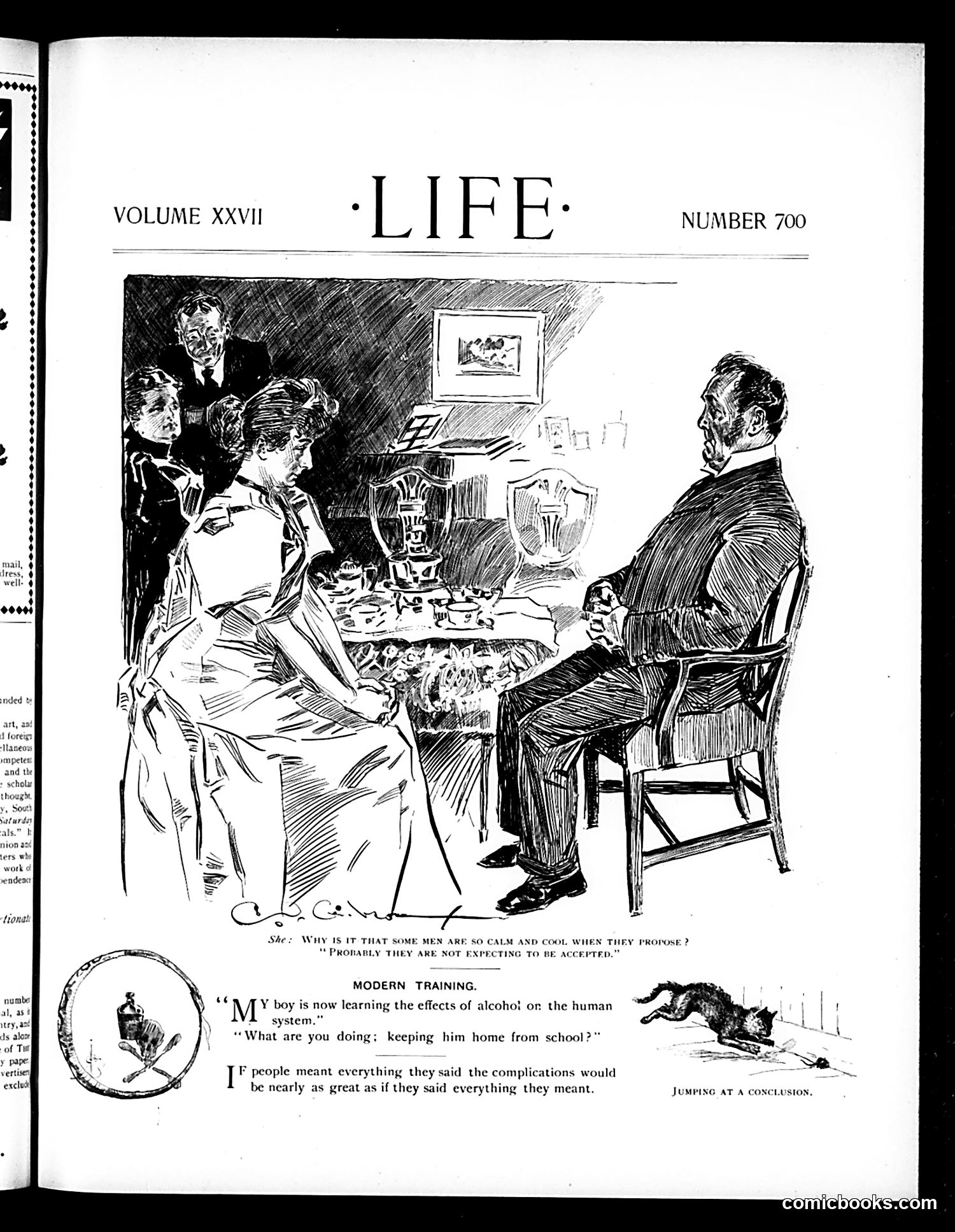
This page contains social satire about courtship and parental expectations. The main cartoon depicts a marriage proposal scene where a man sits across from a woman at a table, while her parents stand behind her. The caption jokes that some men are "so calm and cool" when proposing because they "are not expecting to be accepted"—satirizing men's anxiety about rejection and their defensive pessimism. The "Modern Training" section below mocks contemporary parenting, suggesting a boy is learning about alcohol's effects by being kept home from school. The final line comments on the gap between what people say and what they mean, a general observation about human dishonesty in communication. The page uses humor to critique masculine insecurity, parental methods, and social hypocrisy.
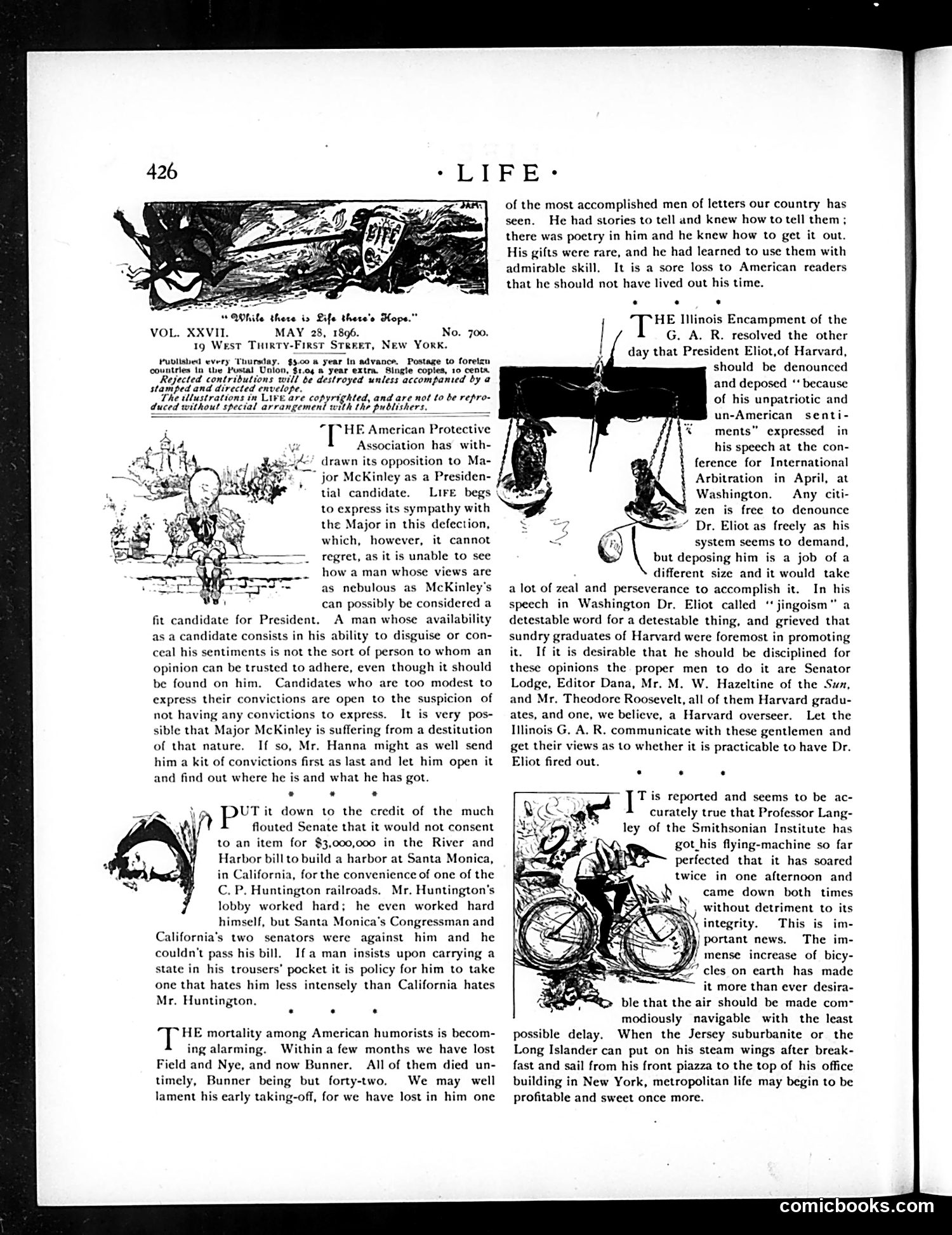
This page contains three distinct editorial commentary sections with accompanying satirical illustrations. The first discusses **Major McKinley as a Presidential candidate**, questioning whether someone with such "nebulous" views could be trusted in office. The cartoon shows a figure being examined, suggesting scrutiny of the candidate's positions. The second addresses the **American Protective Association's opposition to McKinley**, noting the difficulty in denouncing Harvard President Eliot for his "un-American sentiments" at an International Arbitration conference, while arguing Eliot's removal would require significant effort. The third briefly mentions a **$3,000,000 appropriation for Santa Monica harbor**, attributed to C.P. Huntington's railroad lobbying influence over California's senators. The final section discusses **increased bicycle usage** and air navigation developments, presented as social progress worth noting.
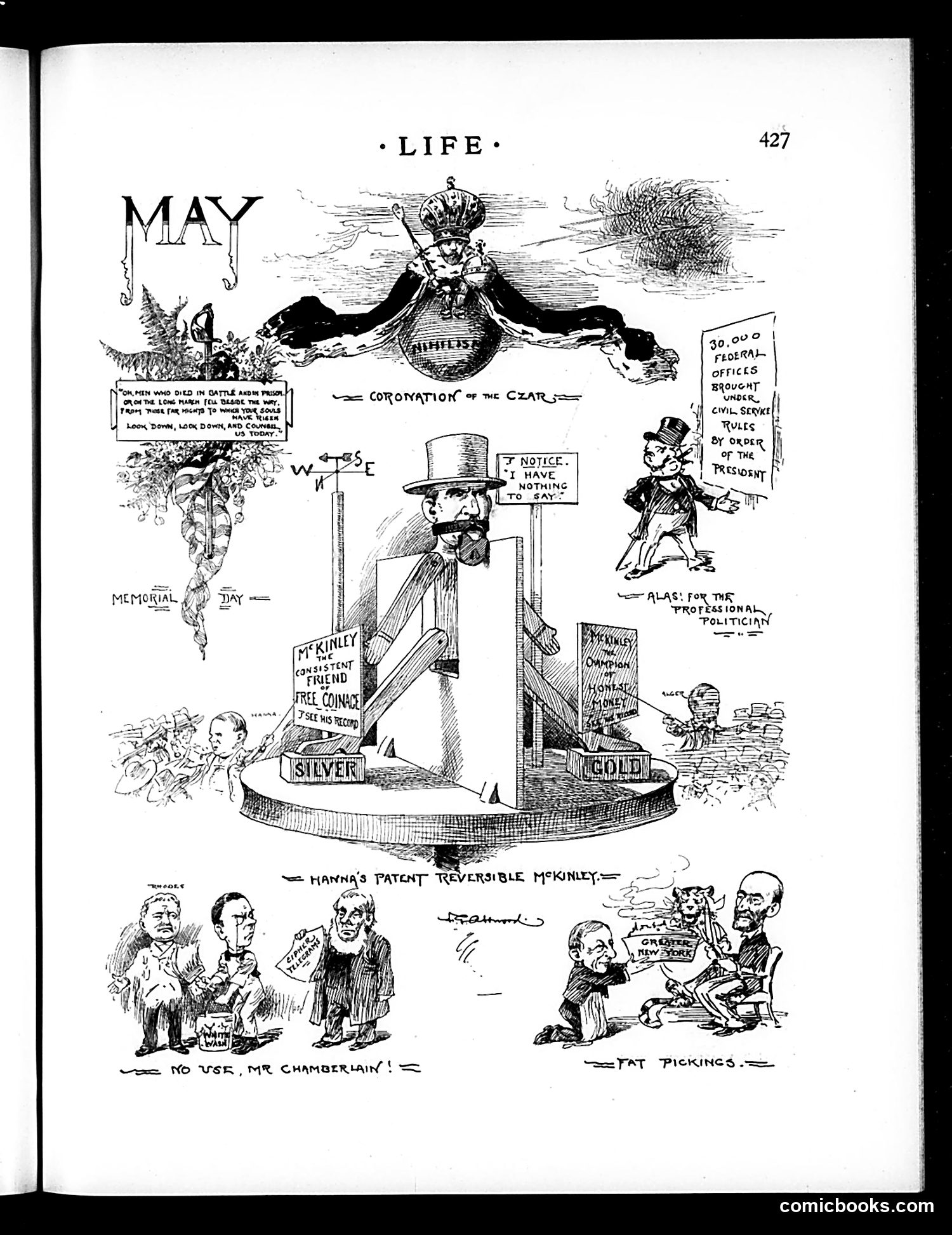
This page presents several political cartoons satirizing President McKinley and contemporary politics. The central image, "Coronation of the Czar," depicts McKinley with imperial regalia, mocking accusations that he governed like an autocrat rather than a democratic leader—likely referencing his expansionist foreign policy and executive overreach. "Hanna's Patent Reversible McKinley" shows McKinley as a mechanical device controlled by Mark Hanna, his political boss, suggesting the President lacked independent will. Other panels mock McKinley's handling of federal appointments ("30,000 Federal Offices"), monetary policy ("Silver"), and political opportunism ("Fat Pickings"). The bottom section, "No Use, Mr. Chamberlain," appears to reference British Colonial Secretary Joseph Chamberlain, connecting McKinley's imperialism to British colonialism.
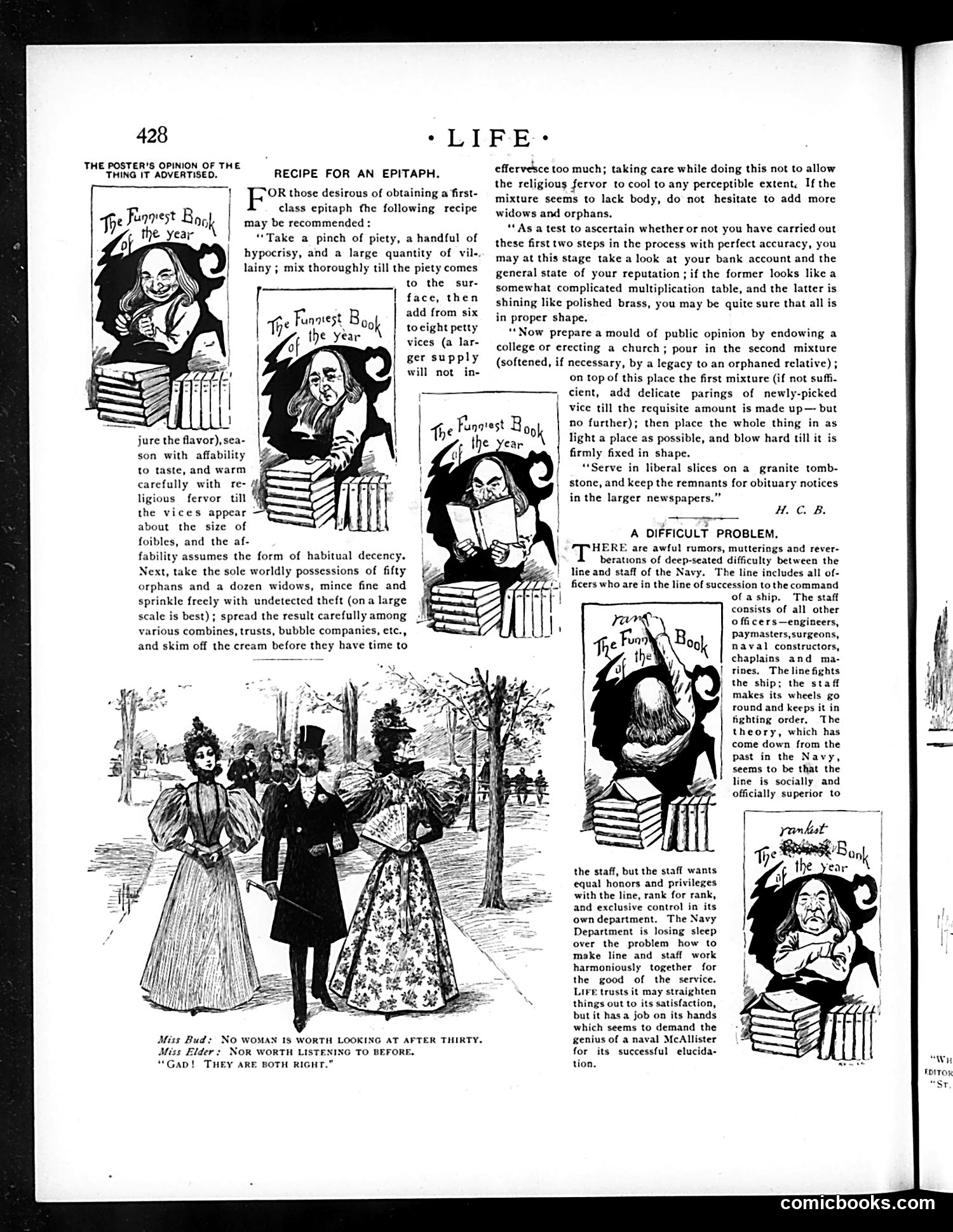
This page contains multiple elements: **Left side:** A satirical "Recipe for an Epitaph" advertises "The Funniest Book of the Year" through humorous instructions on creating church epitaphs. The joke targets funeral monument inscriptions—advising readers to mix hypocrisy, villainy, and false piety in equal measure. **Center illustration:** Three fashionably dressed women converse, with the caption "No woman is worth looking after thirty" / "Nor worth listening to before" / "God! They are both right!" This mocks contemporary attitudes about women's age and value. **Right side:** "A Difficult Problem" discusses tensions between naval line officers and staff officers over hierarchy and authority—internal Navy department politics about who controls operations. It's administrative satire rather than political commentary. The page blends advertisement, gender satire, and institutional humor typical of Life's early approach.
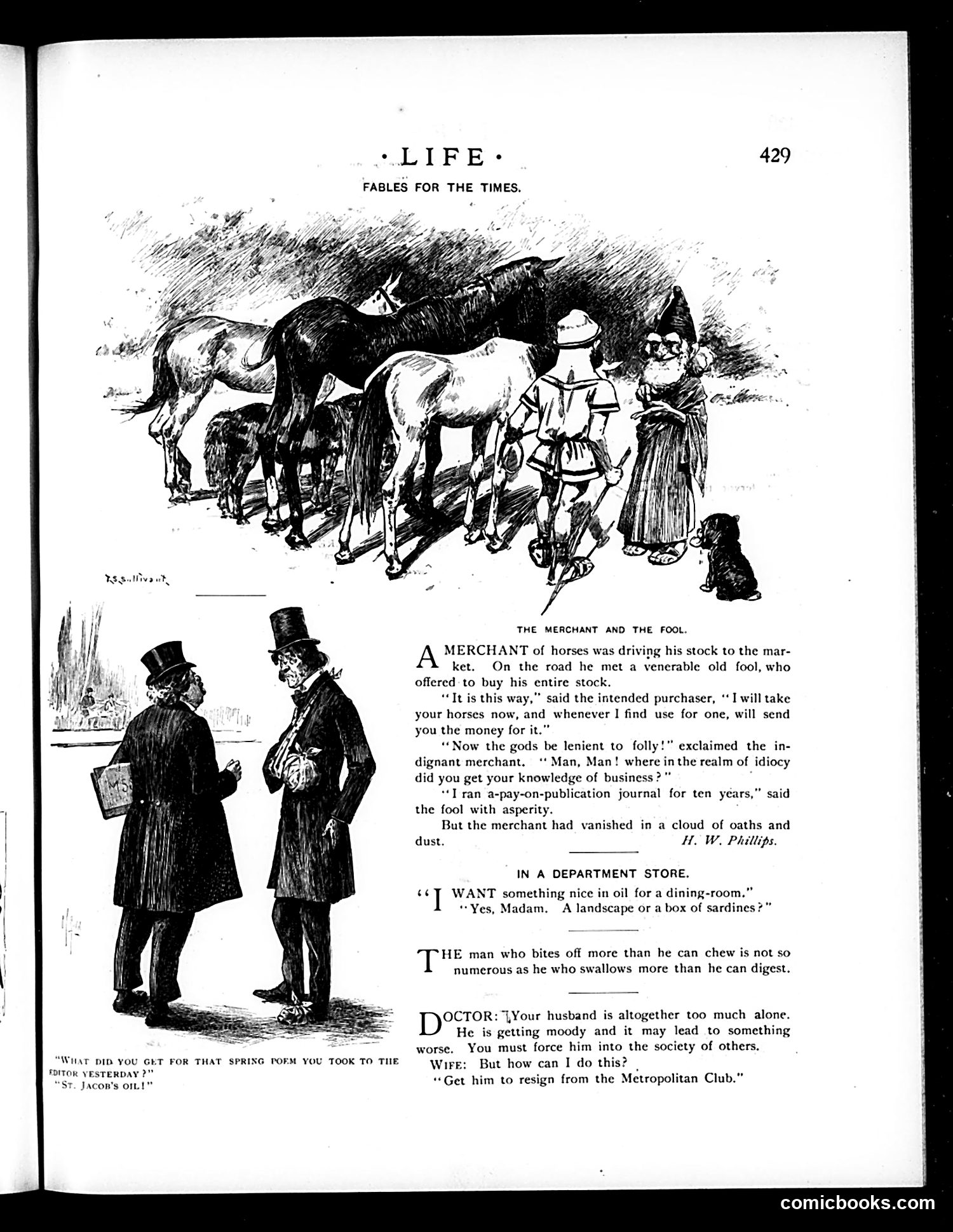
This page presents three satirical pieces targeting contemporary society: **"The Merchant and the Fool"** (top illustration): A horse merchant meets a self-proclaimed fool on the road. The fool claims ten years' experience in "pay-on-publication journalism"—apparently believing this constitutes business expertise. The merchant's exasperated reaction ("where in the realm of idiocy did you get your knowledge?") mocks the fool's misplaced confidence. The satire targets incompetent publishers or journalists of the era. **Lower cartoons and brief quips** mock various social pretensions: a department store customer's vapid taste, overconsumption, and marital advice suggesting the Metropolitan Club as a cure for domestic isolation. The overall theme: exposing foolishness hiding behind modern institutions and fashionable pursuits. The style is typical early-20th-century American satirical humor.
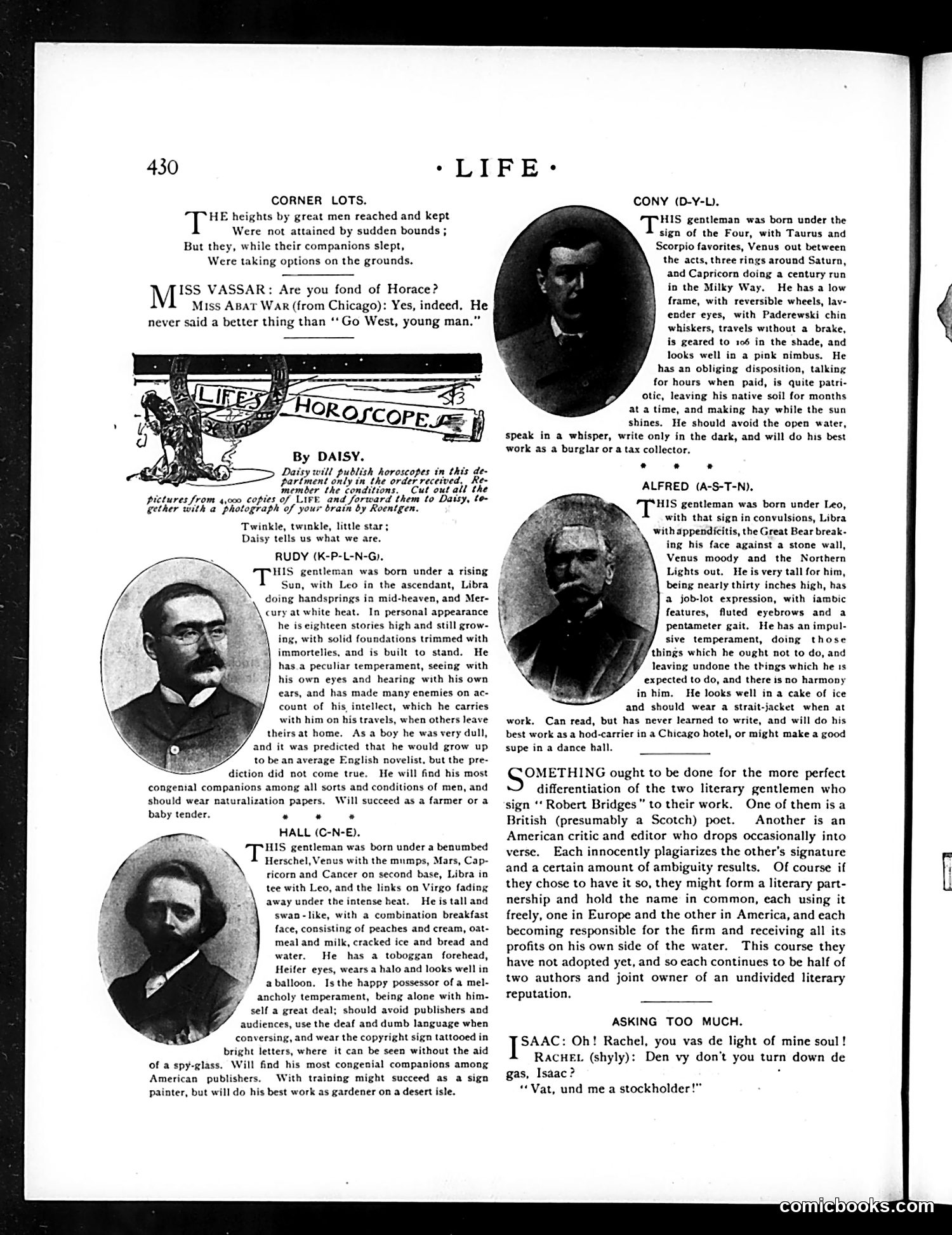
This page contains astrological character sketches ("Life's Horoscope") featuring portraits of four gentlemen identified by initials: Rudy, Hall, Cony, and Alfred. Each receives a satirical personality reading based on their birth zodiac signs. The humor derives from matching astrological stereotypes to physical appearance and presumed personality traits. For example, Hall (Libra) is described as tall with a "tobogggan forehead," suited only for work as a "sign painter" or "gardener on a desert isle." The bottom section discusses two writers named "Robert Bridges"—one British, one American—who share the same name, creating professional confusion and ambiguity over literary ownership and profits. A final comedic dialogue about a "stockholder" ends the page.
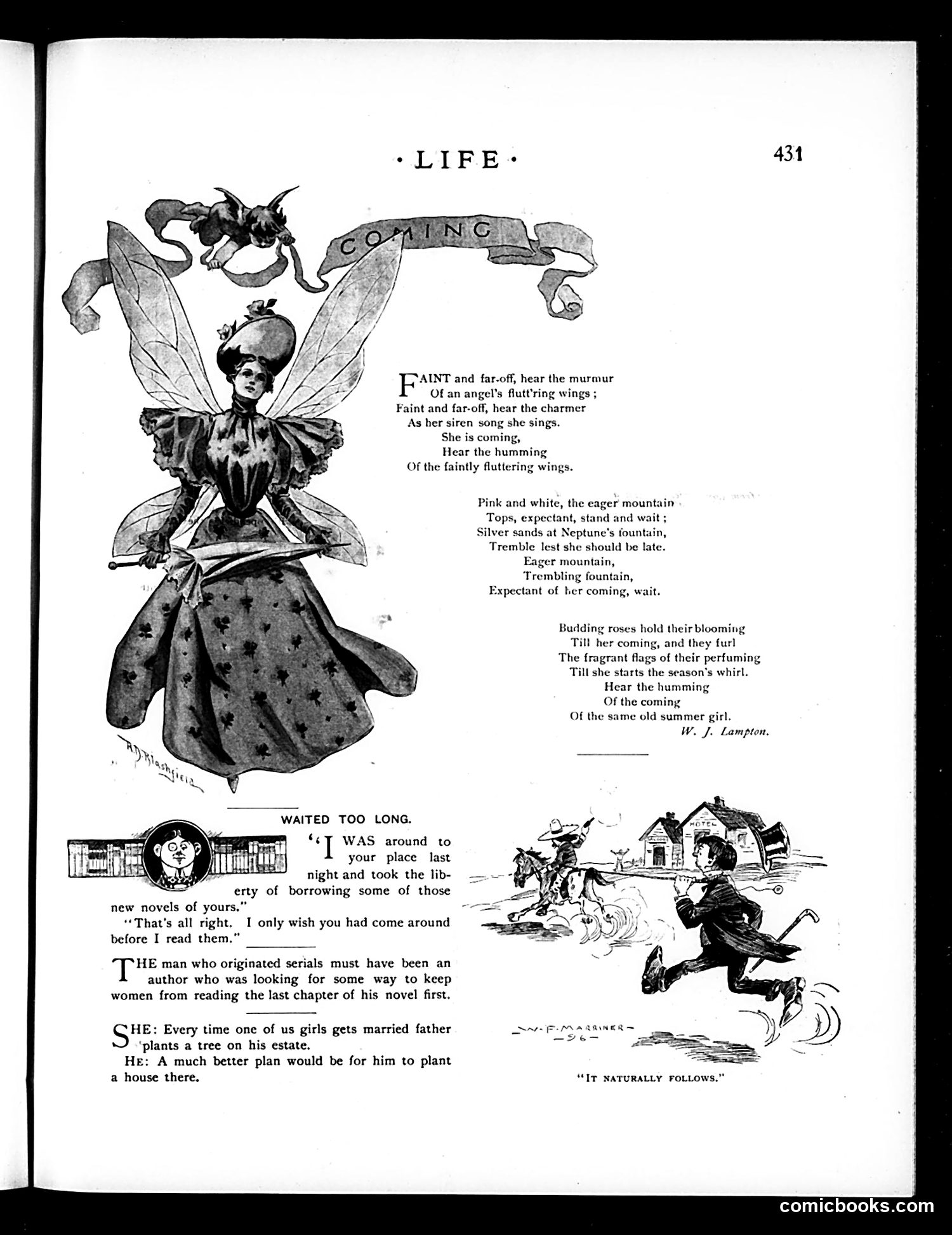
This page contains a poem titled "Coming" by W.J. Lampton celebrating the arrival of spring—personified as a fairy-winged woman emerging from nature. The illustration shows this romanticized seasonal figure. Below are two separate humor pieces: **"Waited Too Long"** depicts a domestic scene where a woman borrowed her friend's novels but delayed returning them. The joke plays on social etiquette around borrowed items. **The final joke** contrasts gender perspectives on marriage customs: when a woman mentions fathers plant trees upon each daughter's marriage, the man suggests planting a *house* instead—implying wives need homes more than decorative trees, a practical critique of romantic sentimentality. The page represents typical early-20th-century Life magazine humor: light satire on social conventions, domesticity, and courtship customs.
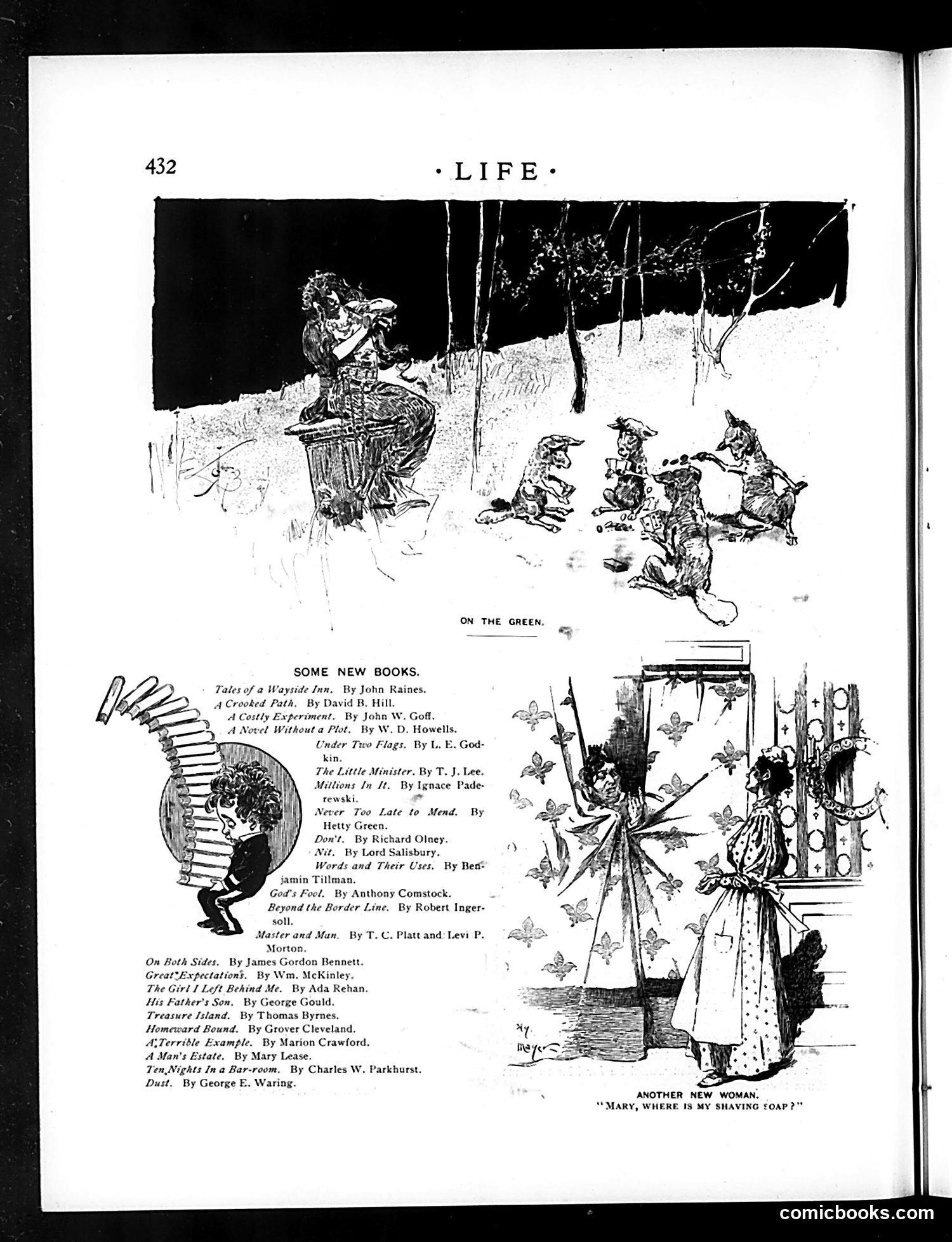
This page combines two distinct satirical elements: **"On the Green"** (top illustration): Shows a woman playing golf while men caddy for her—satirizing the "New Woman" of the 1890s who was claiming traditionally male activities and social spaces. **"Some New Books"** (center): A mock book list where titles are paired with contemporary political and social figures as "authors." Examples include "A Crooked Path" by David B. Hill (a politician) and "Don't" by Richard Olney (Secretary of State), turning their names into ironic commentary on their reputations or policies. **"Another New Woman"** (bottom): A husband asking his wife where his shaving soap is—a domestic role-reversal joke mocking anxieties about women's independence and changing gender roles during this era. The page satirizes 1890s social upheaval, particularly feminist activism and the emergence of the "New Woman" who challenged traditional gender norms, while also using prominent politicians' names for contemporary political satire.
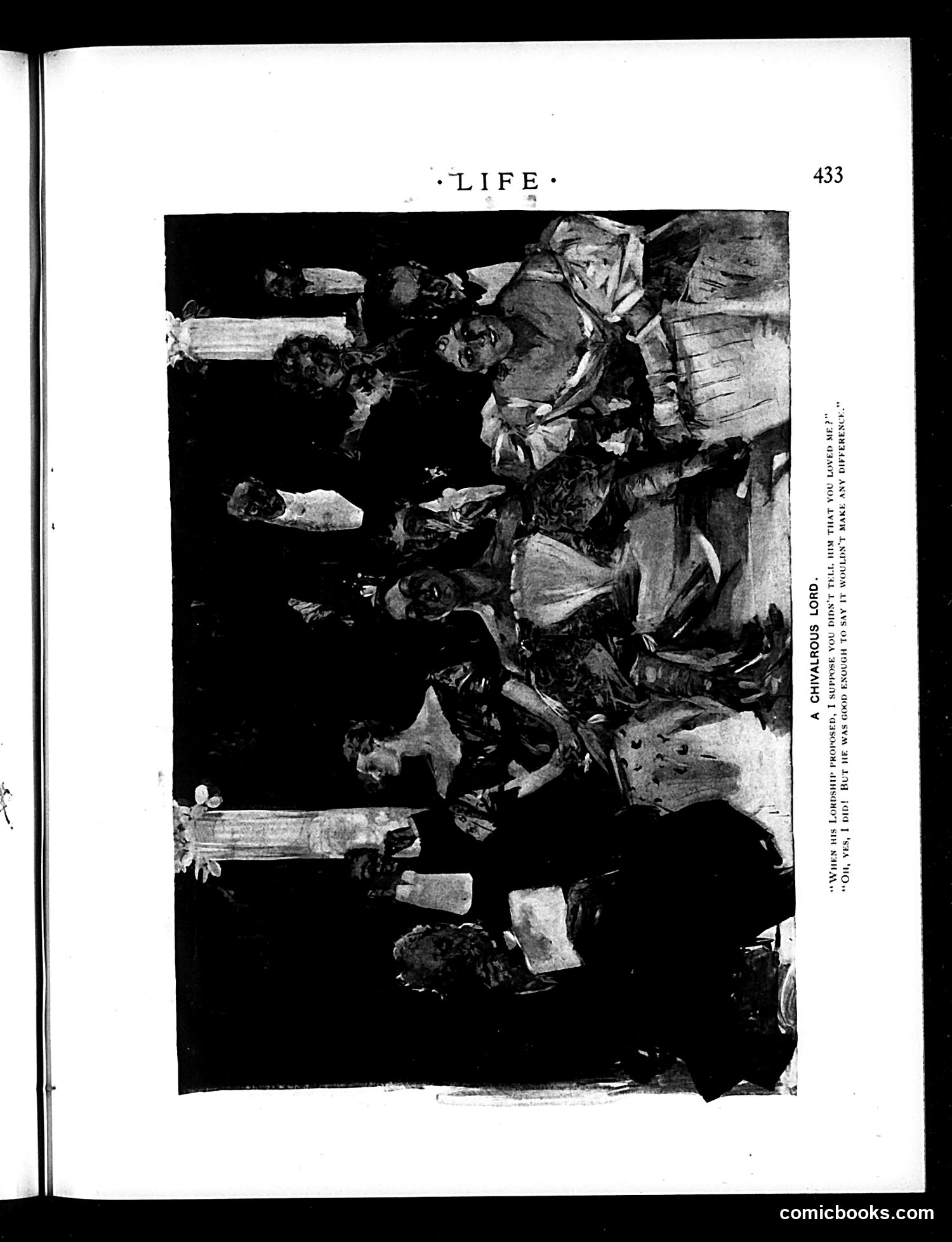
I cannot reliably read the OCR text on this page due to apparent errors or corruption in the transcription. The image itself is a black and white photograph that appears to show multiple figures in period dress arranged in a theatrical or staged scene, but the image quality and orientation make it difficult to identify specific individuals or determine the exact satirical point. Without being able to read the accompanying caption or text clearly, I cannot confidently explain what political or social references this content makes or who the caricatured figures represent. To provide accurate historical context as you've requested, I would need clearer text identifying the subject matter.
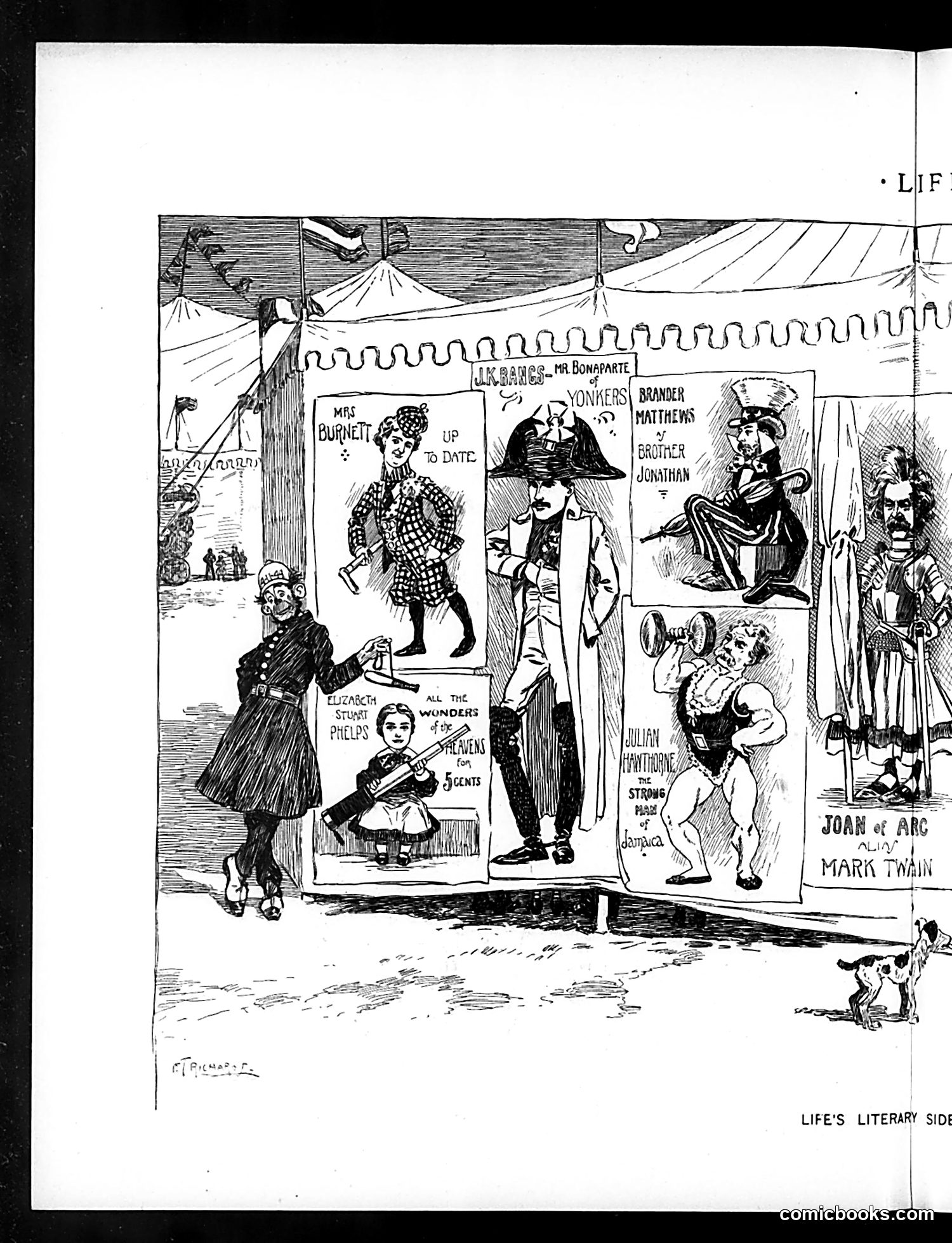
This is a satirical illustration of a carnival or circus tent displaying literary figures as attractions. The central figure appears to be a barker promoting various "acts," with posters advertising: - Mrs. Burnett ("Up to Date") - Elizabeth Stuart Phelps - Characters from what appears to be Napoleon-related works ("Yonkers," "Branden Matthews," "Brother Jonathan") - Julian Hawthorne - Joan of Arc (attributed to Mark Twain) The satire mocks contemporary American literature and authors by treating them as sideshow spectacles—suggesting popular literary works of the period were sensationalist entertainment rather than serious art. The carnival setting trivializes these literary figures, equating them with circus curiosities for mass consumption. This reflects late 19th-century cultural debates about literary merit versus popular appeal.
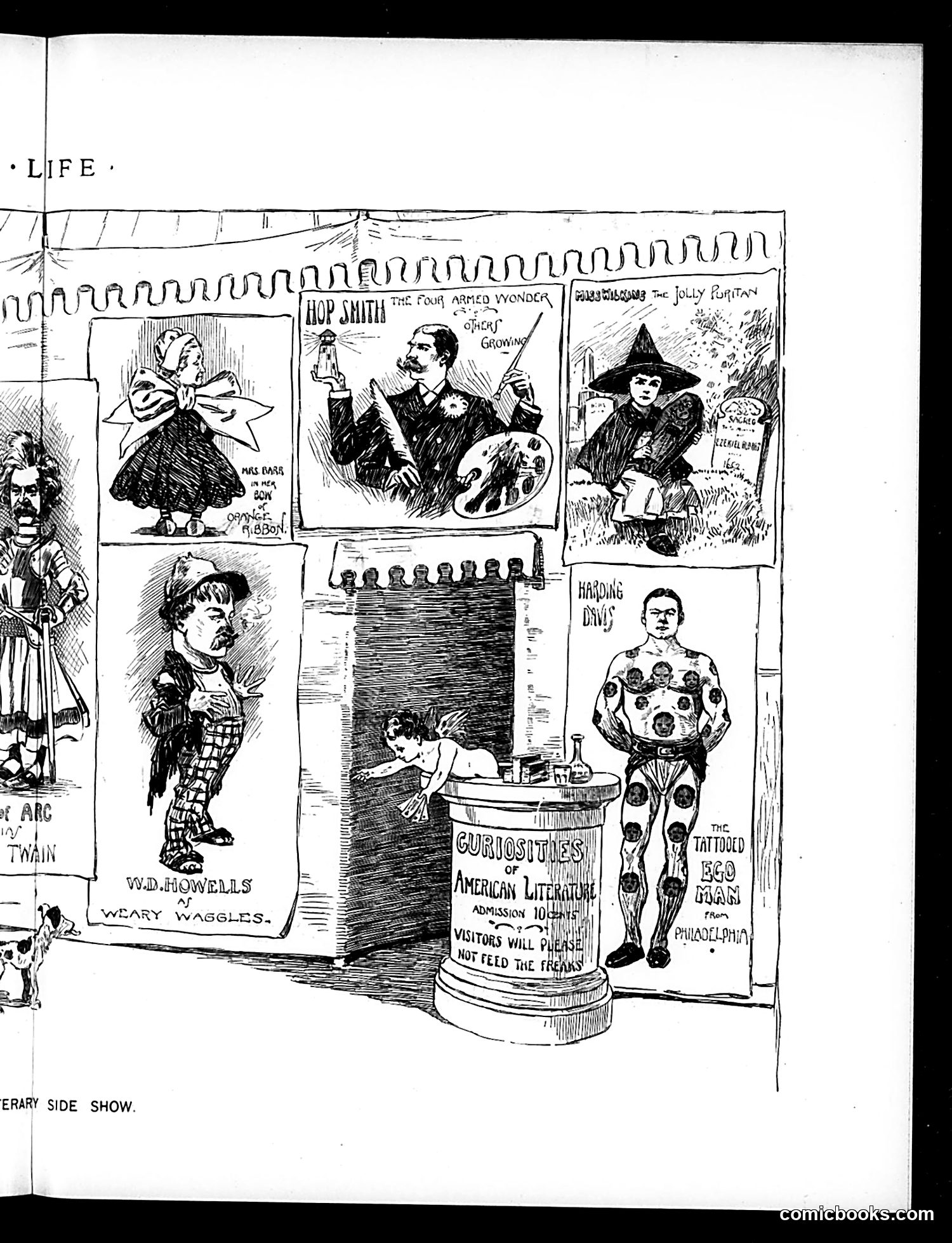
This Life magazine page satirizes turn-of-the-century American literary culture as a carnival freak show. The central barrel labeled "Curiosities of American Literature" contains a figure, with a sign warning visitors not to feed the "freaks." The surrounding panels mock prominent figures: W.D. Howells appears in period dress labeled "Weary Waggles"; other panels reference "Hop Smith" (unclear if real person or invented name), "The Jolly Puritan," and "The Tattooed Ego" from Philadelphia. The satire equates serious American literature with circus attractions—suggesting contemporary writers and literary trends were viewed as oddities or spectacles rather than serious art. The carnival framing mocks both the pretentiousness of literary circles and public fascination with literary personalities as entertainment.
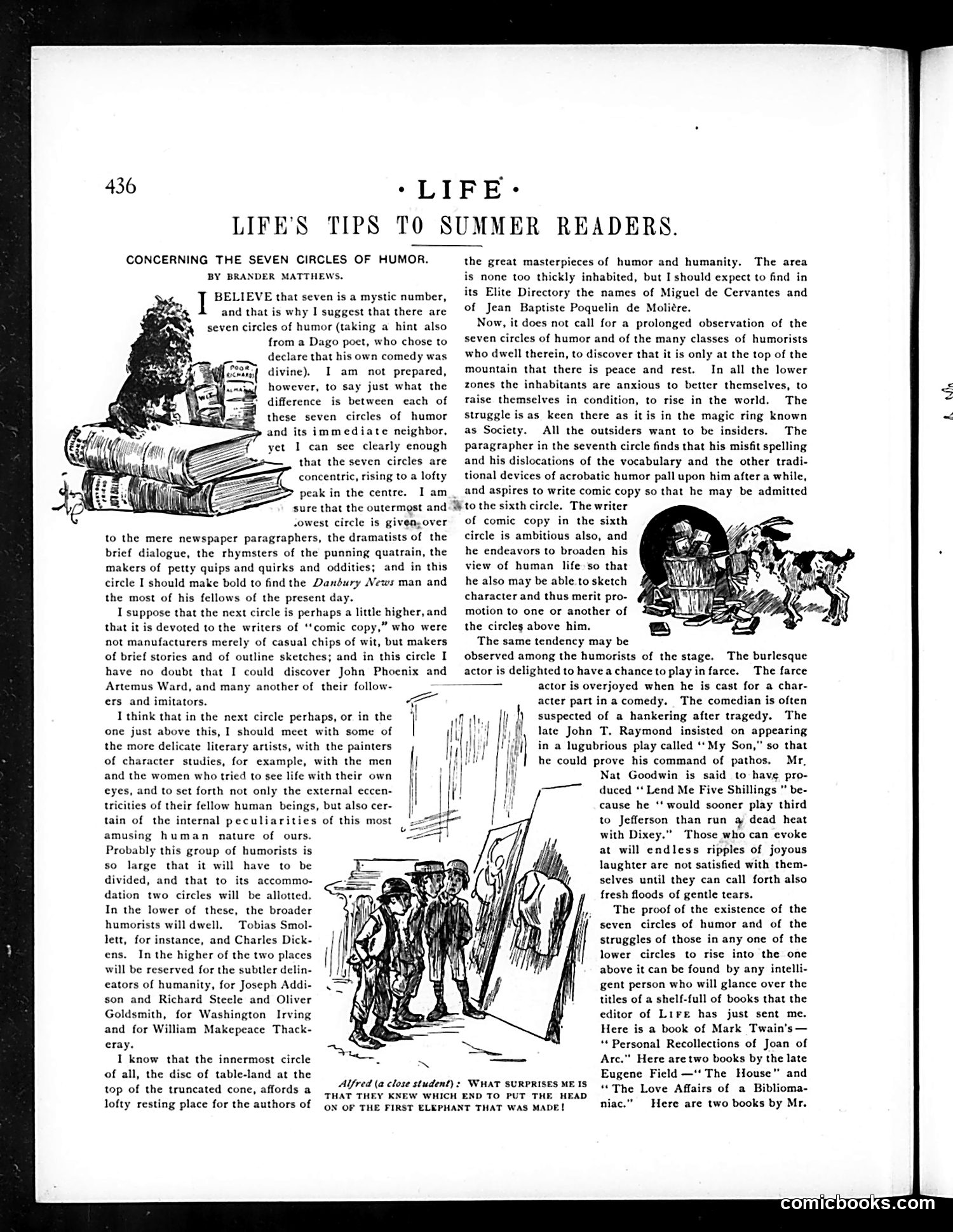
This page from *Life* magazine presents Brander Matthews's essay "Life's Tips to Summer Readers: Concerning the Seven Circles of Humor," which uses a hierarchical framework (borrowed from Dante's *Divine Comedy*) to classify American humor writers by sophistication. Matthews argues humor ranges from lowest (newspaper paragraphers and pun-makers) to highest (Cervantes and Molière). The cartoons illustrate this stratification: one shows a figure buried in books representing lower-tier humor writers; another depicts working-class figures struggling upward, symbolizing humorists' ambition to ascend the hierarchy. The small cartoon captioned with "Alfred" jokes about elephants—likely representing "low" humor—the kind of absurdist gag characteristic of the bottom circles Matthews critiques. The piece reflects 19th-century literary criticism valuing character-driven, subtle wit (Addison, Goldsmith) over crude wordplay or slapstick, while acknowledging the commercial energy of popular humor writers.
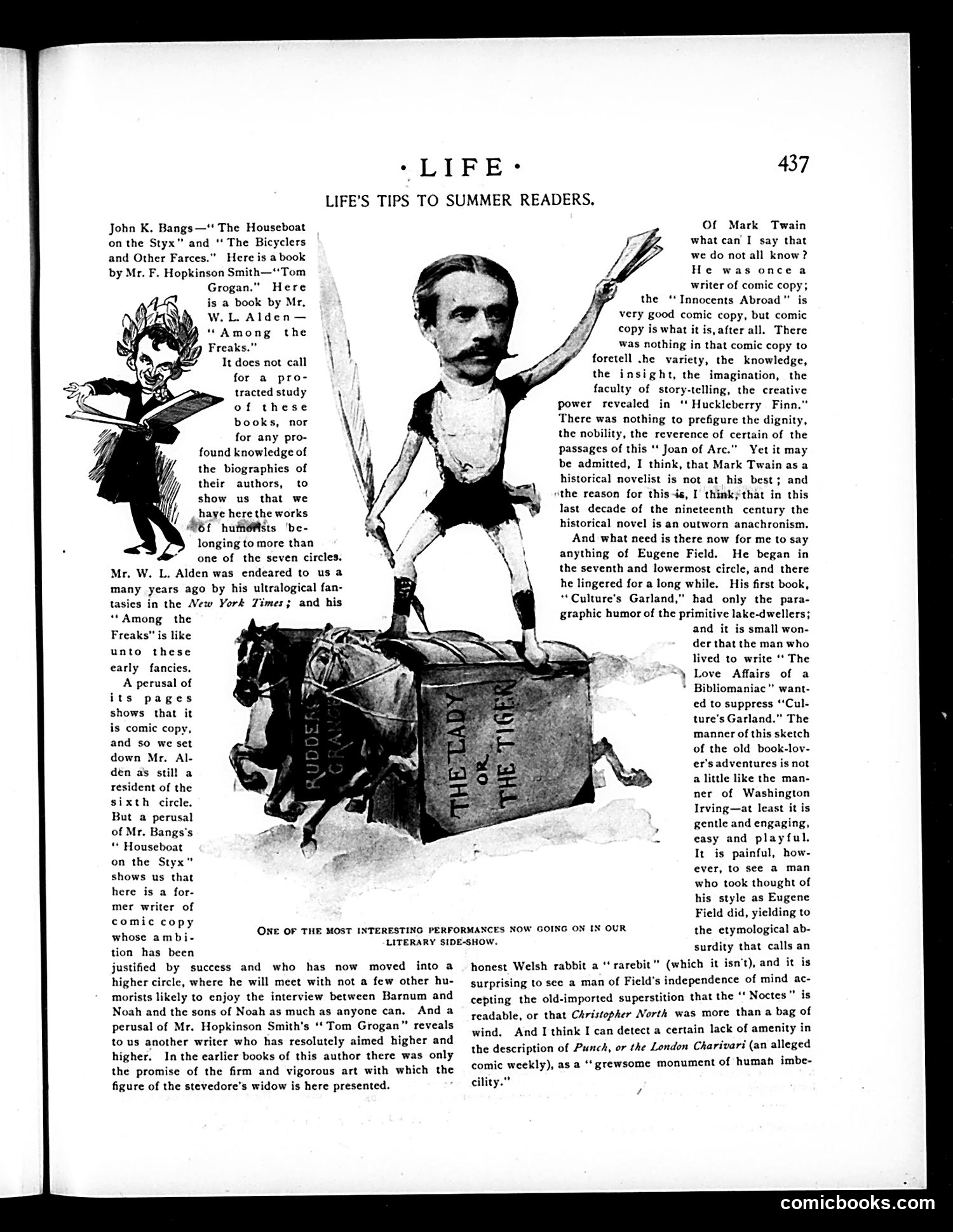
This page reviews four American humorists, ranking them by literary ambition using Dante's circles of Hell as metaphor. The central cartoon depicts a caricatured figure standing triumphantly on a book labeled "Huckleberry Finn," illustrating the discussion of how writers progressed from "comic copy" to serious literature. The critic argues that John K. Bangs, F. Hopkinson Smith, and Eugene Field elevated themselves from mere comic writers to serious authors. Mark Twain receives particular praise for *Huckleberry Finn* and *Joan of Arc*, though his historical novels are deemed dated. The satire critiques Field's inconsistencies: despite his careful prose style, he accepted linguistic errors (Welsh rabbit vs. "rarebit") and endorsed dubious British publications. The overall point celebrates American humorists who transcended light comedy for greater artistic achievement, reflecting late-19th-century anxieties about literature's respectability.
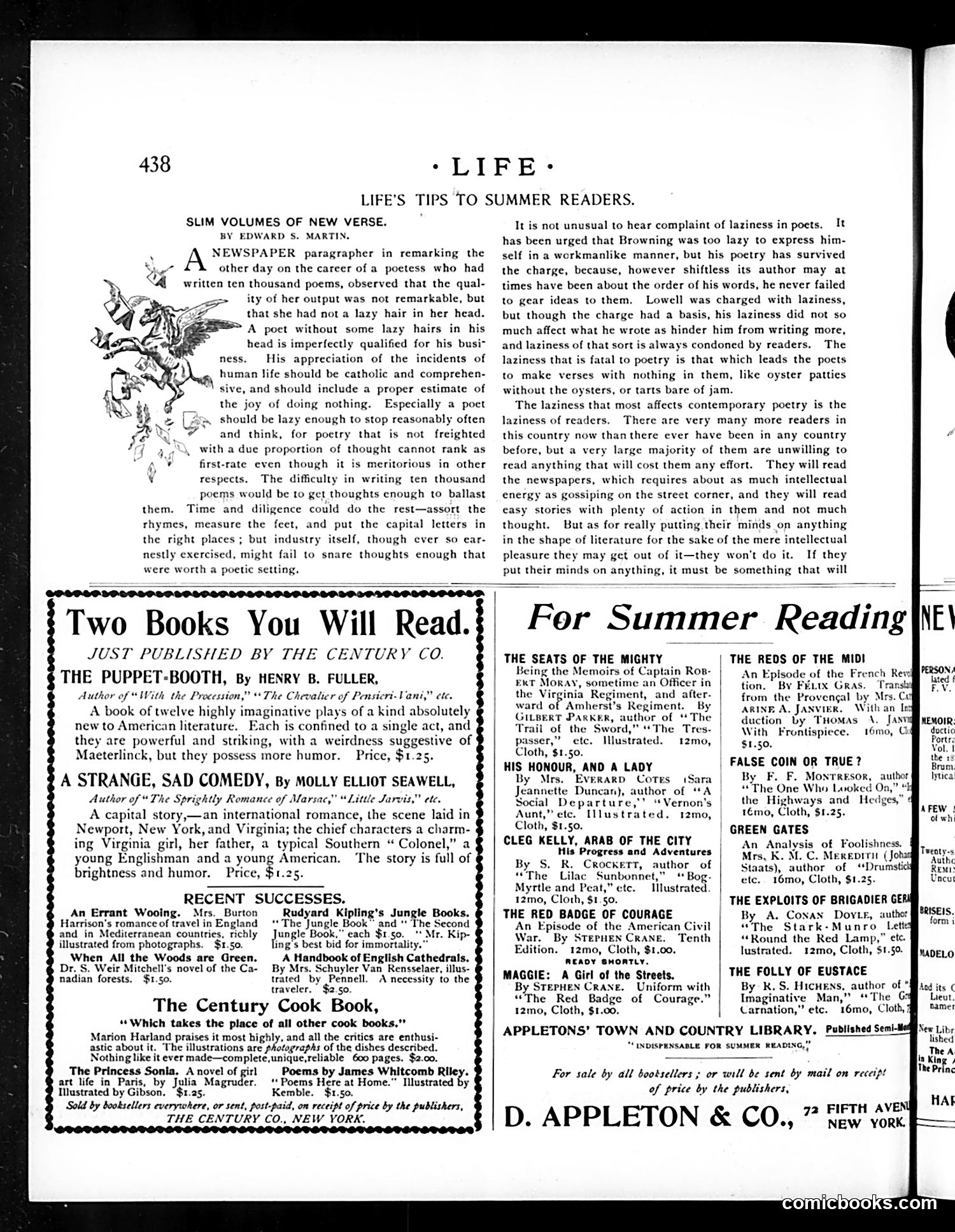
This page is primarily a literary essay and book advertising spread, not a political cartoon. The illustration—a decorative winged figure in the upper left—is ornamental, not satirical commentary. The main content is Edward S. Martin's essay "Slim Volumes of New Verse," which critiques contemporary poetry. Martin argues that poets need intellectual substance, not just technical skill. He defends "lazy" poets like Browning and Lowell whose thoughtfulness compensates for stylistic looseness, while condemning poets who write empty verses—comparing them to "oyster patties without the oysters." Notably, Martin also criticizes modern *readers* as intellectually lazy, preferring newspapers and action stories to literature requiring mental effort. This reflects early 1900s anxiety about mass literacy and declining serious reading habits amid growing popular entertainment. The page includes advertisements for new books from Century Company and Appleton & Company, typical of Life magazine's mixed editorial-advertising format.
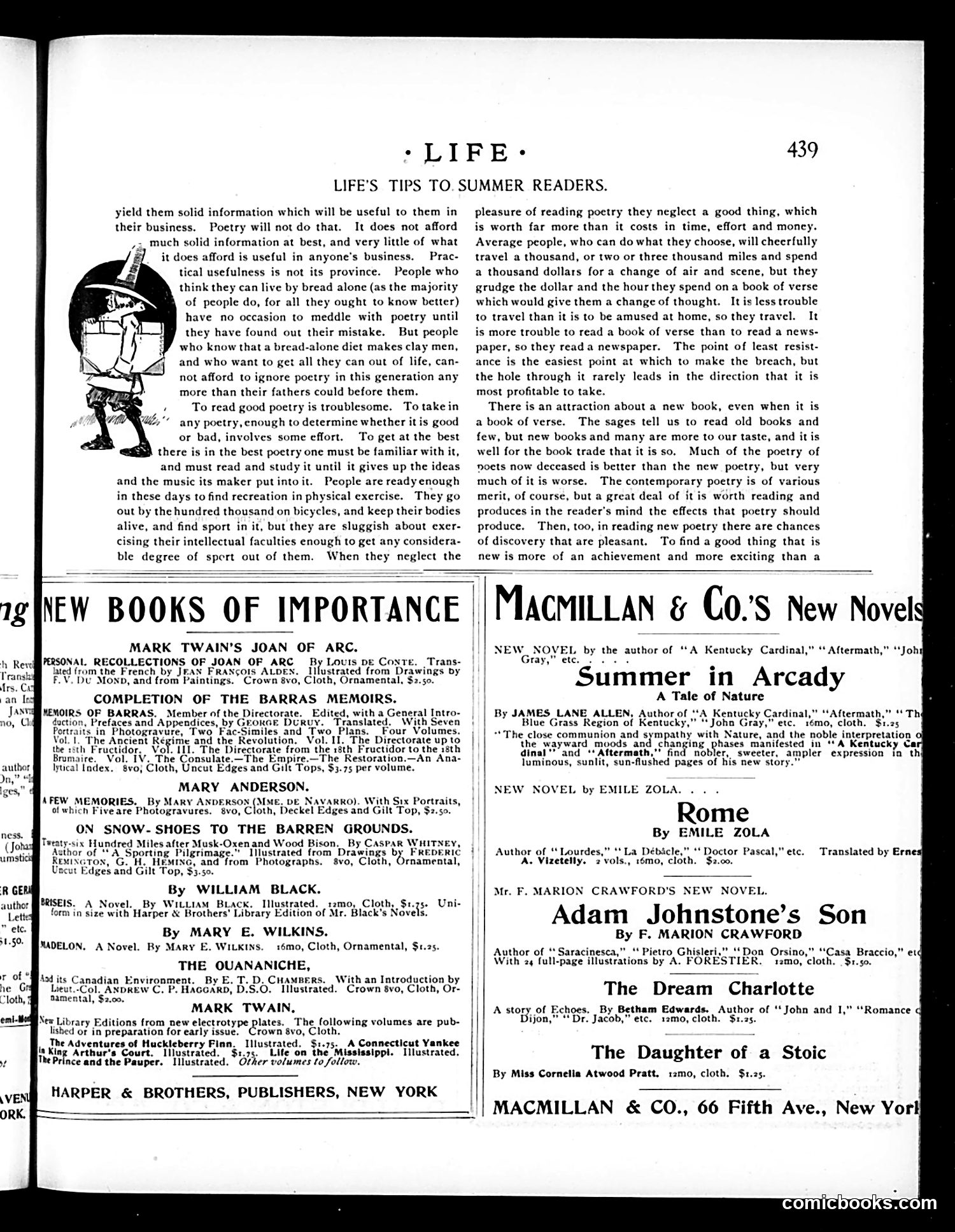
This page is primarily **advertising for new books and literary discussion**, not political satire. The main content is an essay titled "Life's Tips to Summer Readers" advocating that ordinary people read poetry despite its intellectual difficulty. The essay argues that poetry, unlike practical information, enriches life by exercising the mind—comparing this mental exercise to the physical exercise people willingly undertake (cycling). **The cartoon** (visible on the left) appears to show a cyclist or person engaged in physical activity, illustrating the essay's contrast between people's eagerness for physical recreation versus their reluctance to expend mental effort on poetry. The page concludes with **publisher advertisements** for new books, including Mark Twain's *Joan of Arc*, memoirs of French Revolution figures, and novels by various authors. This was standard for *Life* magazine—mixing editorial content with advertising.
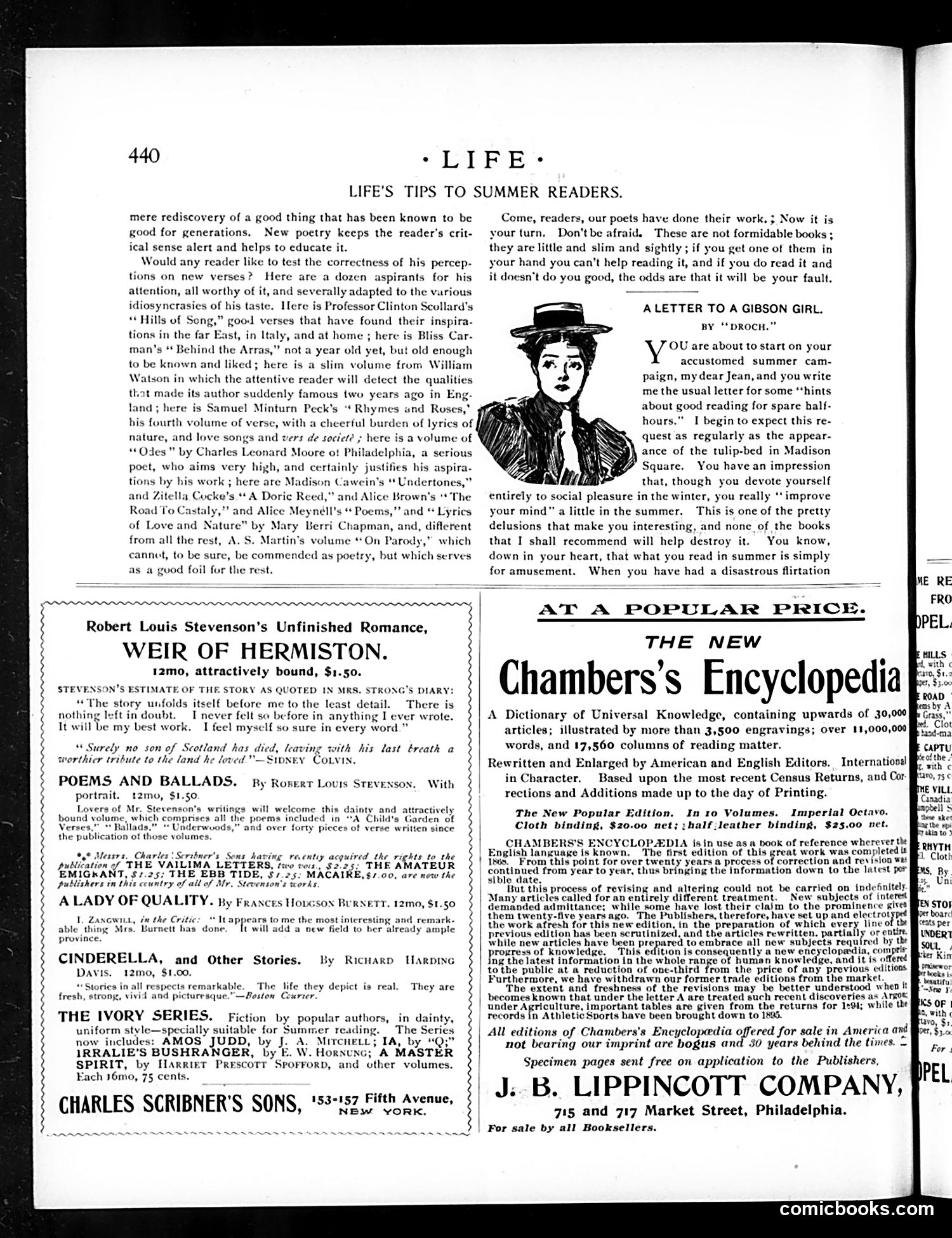
This page is primarily **advertising and book recommendations**, not political satire. The content consists of: 1. **"Life's Tips to Summer Readers"** — editorial advice recommending poetry collections by contemporary authors (Clinton Scollard, Bliss Carman, William Watson, etc.) for summer reading. 2. **Book advertisements** from Charles Scribner's Sons, promoting: - Robert Louis Stevenson's *Weir of Hermiston* (unfinished romance) - Stevenson's *Poems and Ballads* - Frances Hodgson Burnett's *A Lady of Quality* - Richard Harding Davis's *Cinderella and Other Stories* - Various volumes in the "Ivory Series" 3. **Chambers's Encyclopedia advertisement** — promoting a comprehensive reference work with 30,000 articles and 3,500 engravings. The **single illustration** shows a fashionable young woman's portrait (labeled "A Letter to a Gibson Girl"), representing the popular "Gibson Girl" aesthetic of the era. The page reflects **Gilded Age literary culture** and publishing practices—encouraging leisured summer reading while advertising quality books and reference materials.
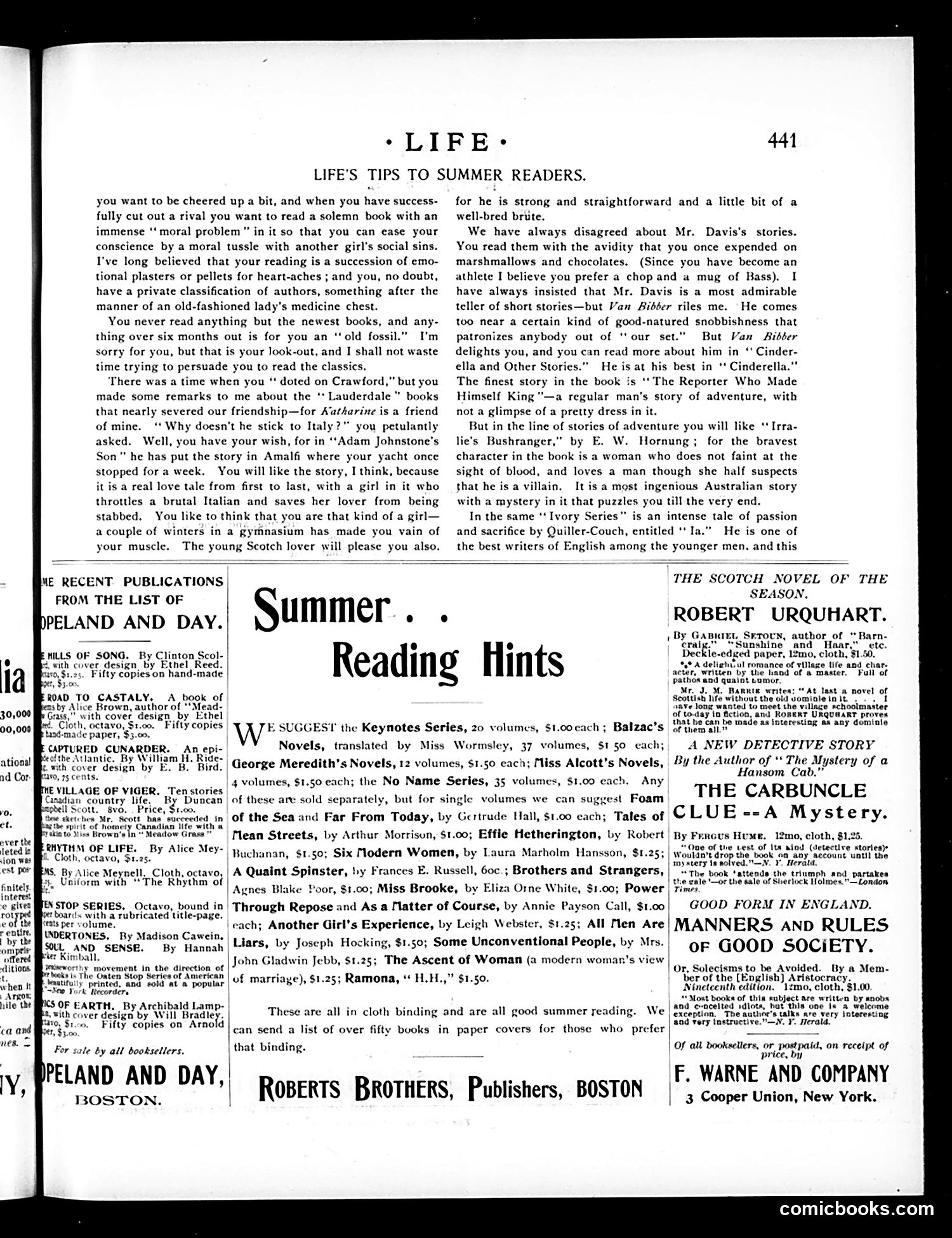
This page is primarily **literary advertising and book recommendations**, not political satire. It contains a column titled "Life's Tips to Summer Readers" offering reading suggestions. The main content is a personal essay advising readers on summer reading choices. It discusses various novels and authors, including works by Richard Harding Davis and E.W. Hornung. The author humorously critiques readers' literary tastes—particularly their tendency to chase fashionable "new" books while dismissing classics, and their preference for escapist romance over serious literature. The lower half features book advertisements from **Roberts Brothers Publishers** (Boston) and **F. Warner and Company** (New York), promoting titles in various series: the Keynotes Series, Balzac's Novels, Miss Alcott's Novels, and the "No Name Series." **No significant political satire or caricatures appear on this page.** It's a straightforward literary advice column combined with period publishing advertisements.
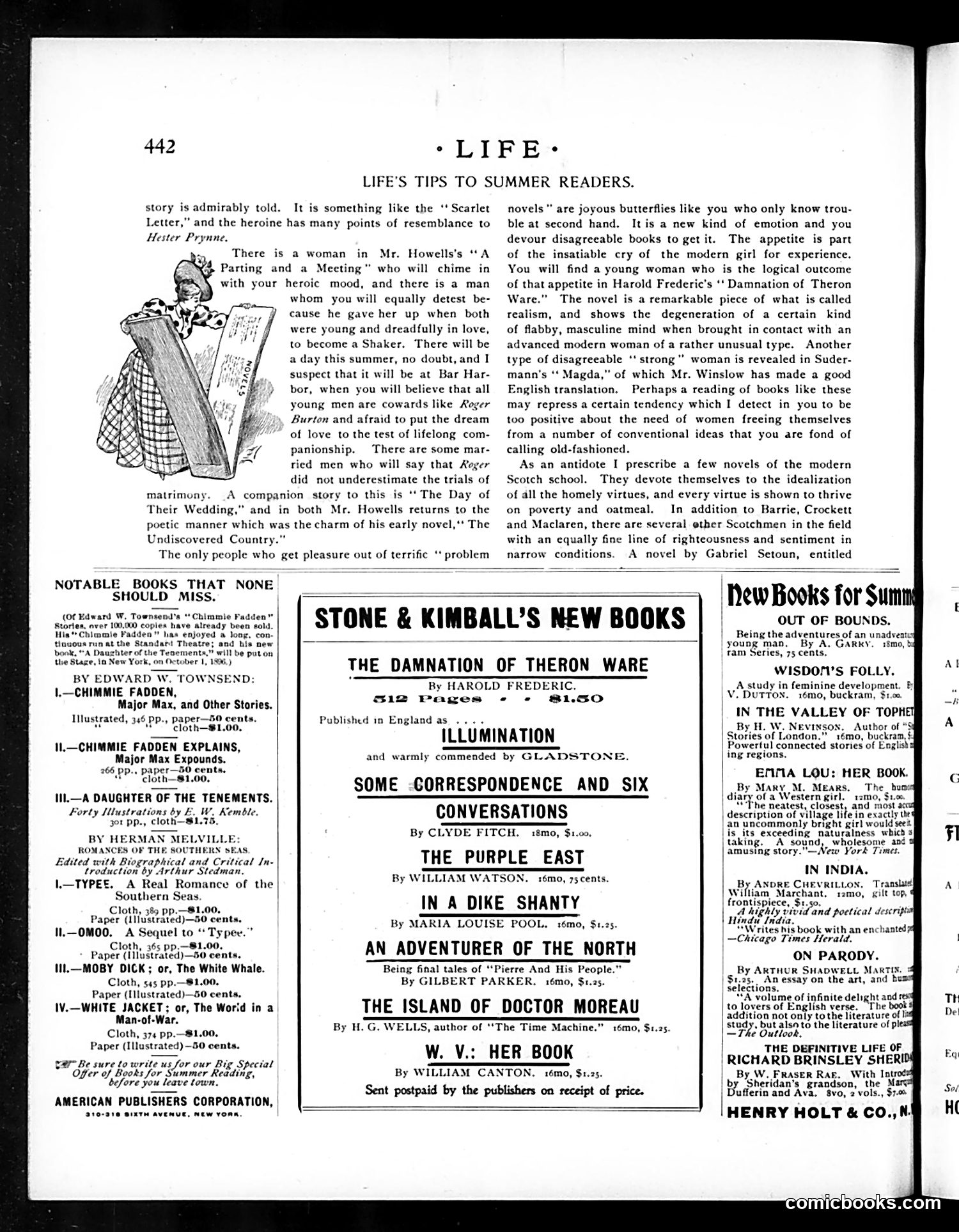
This page contains **book recommendations and advertisements**, not political cartoons. The small illustration shows a woman reading—a visual aid for the "Summer Readers" advice column. The editorial content critiques **popular fiction for young women**, particularly their appetite for "disagreeable" novels dealing with modern social problems. The author warns against books portraying women as aggressively "strong" or overly critical of traditional conventions, citing Harold Frederic's *Damnation of Theron Ware* and Sudermann's *Magda* as examples of works depicting female characters the author views as dangerously progressive. As an antidote, the writer prescribes Scottish novels celebrating "homely virtues" tied to "poverty and oatmeal"—implying conservative, morally uplifting literature as a counterweight to realist "problem novels." The bulk of the page advertises new books from Stone & Kimball publishers and reprints of Herman Melville's works, reflecting late-Victorian publishing trends.
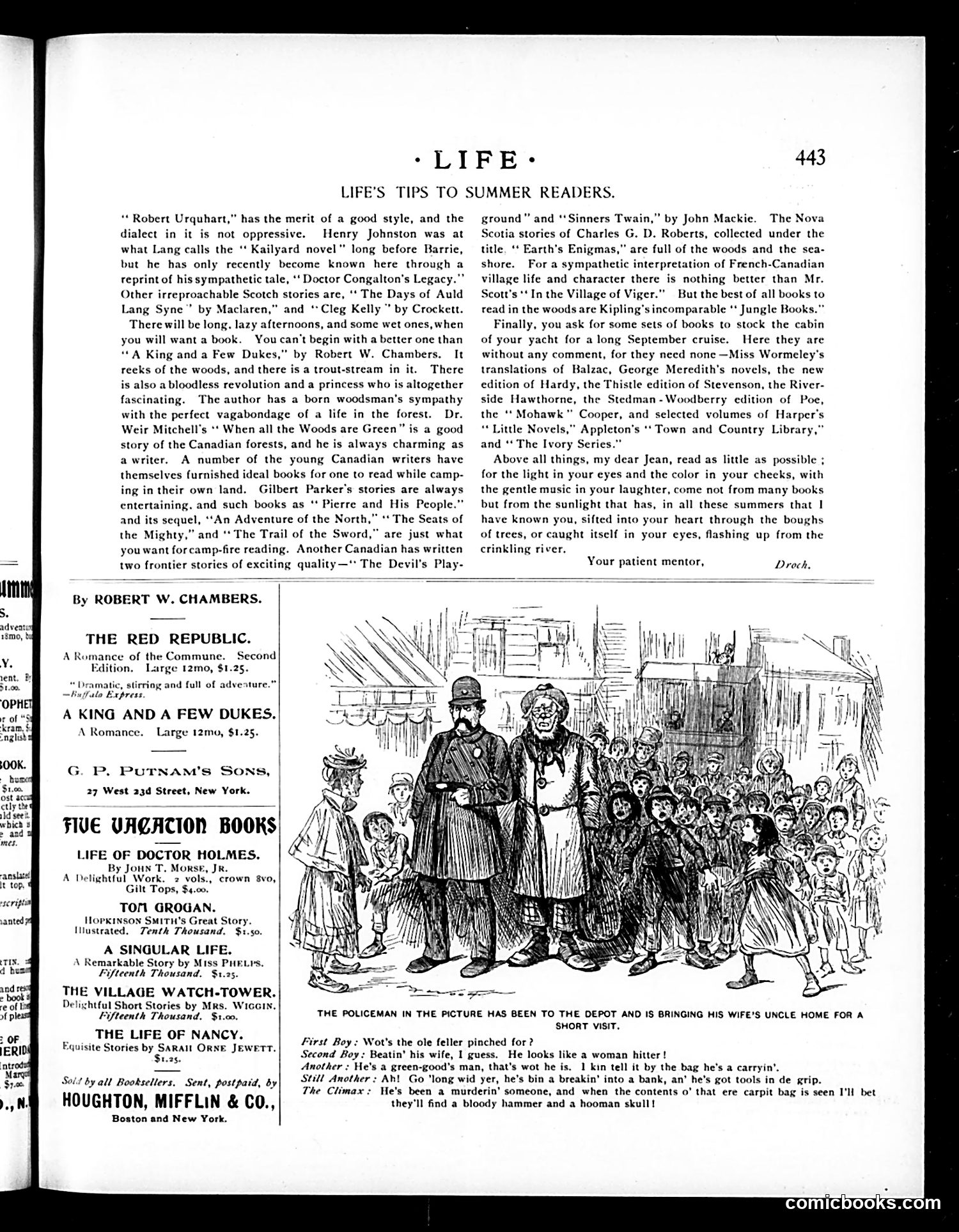
This page is primarily **book advertisements and literary recommendations** for summer reading. The main illustration depicts a policeman escorting what appears to be a rough, working-class man and woman through a street crowded with poor urban residents—likely depicting a scene of law enforcement or social welfare in a tenement district. The caption and dialogue below suggest a humorous, sympathetic view of urban poverty: the boys speculate about the man's background ("looks like a woman hitter"), while the final comment implies the man is a burglar being brought to justice with his wife's belongings. The joke appears to rest on the **contrast between the policeman's official duty and the apparent domesticity of the situation**—treating serious crime or poverty with gentle humor typical of Life magazine's satirical approach to American social issues of the period.
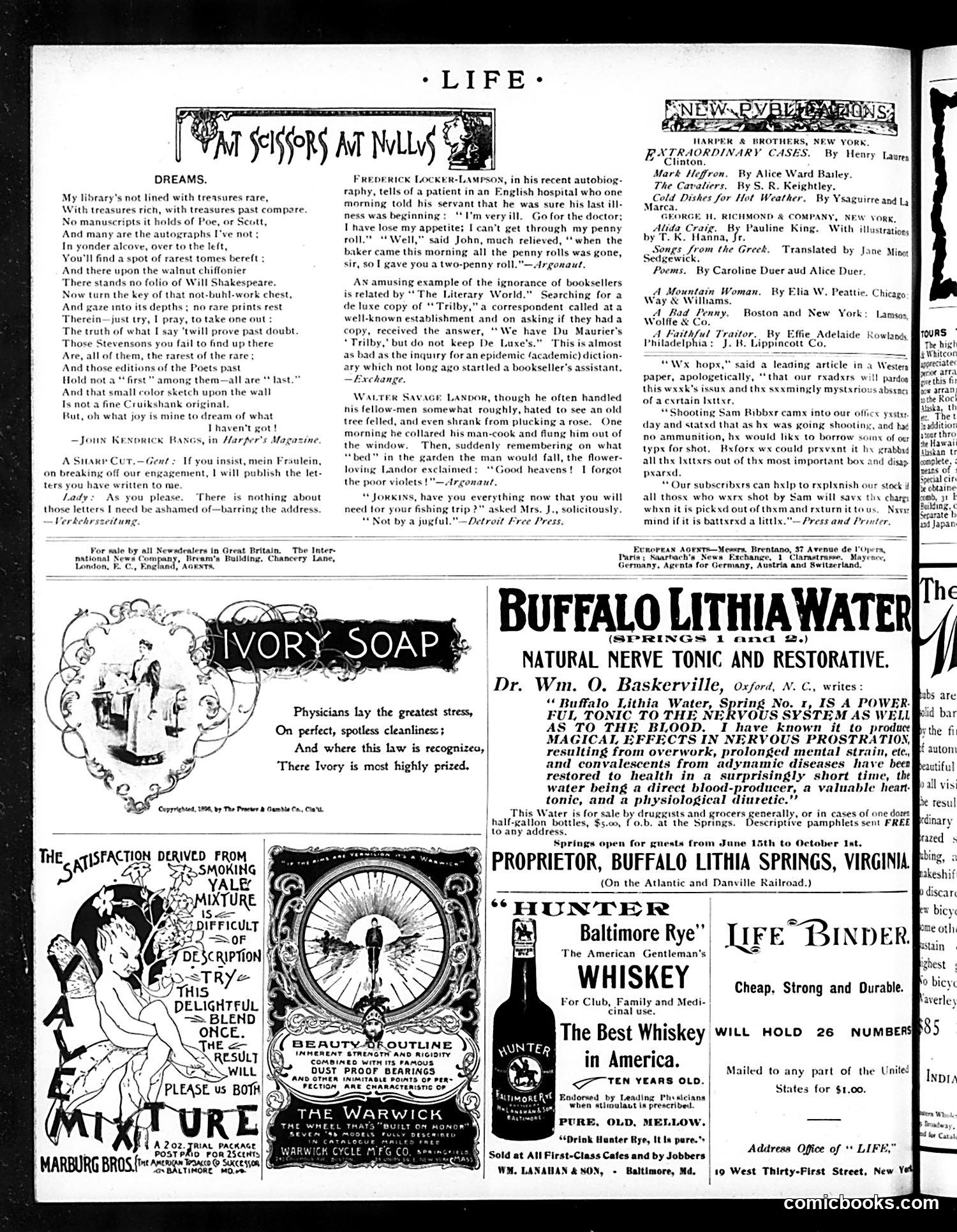
This page is primarily **literary and humorous content**, not political satire. The main feature is a poem titled "Dreams" by John Kendrick Bangs, celebrating the joy of *wanting* rare books rather than owning them—a gentle satire on bibliophilia and collector's snobbery. The page includes three anecdotes about literary figures and book-related mishaps: 1. **Frederick Locker-Lampson's hospital patient** who loses appetite for penny rolls 2. **A bookseller's ignorance** of "Trilby" by Du Maurier, confusing the title with publisher information 3. **Walter Savage Landor's** eccentric behavior—violently ejecting his cook but then regretting he'd fall on delicate flowers The surrounding advertisements (Ivory Soap, Buffalo Lithia Water, Hunter Whiskey) are period typical. This is primarily a **literary magazine page**, not political commentary—it appeals to educated, book-collecting readers through witty observations about reading culture and eccentric literary personalities.
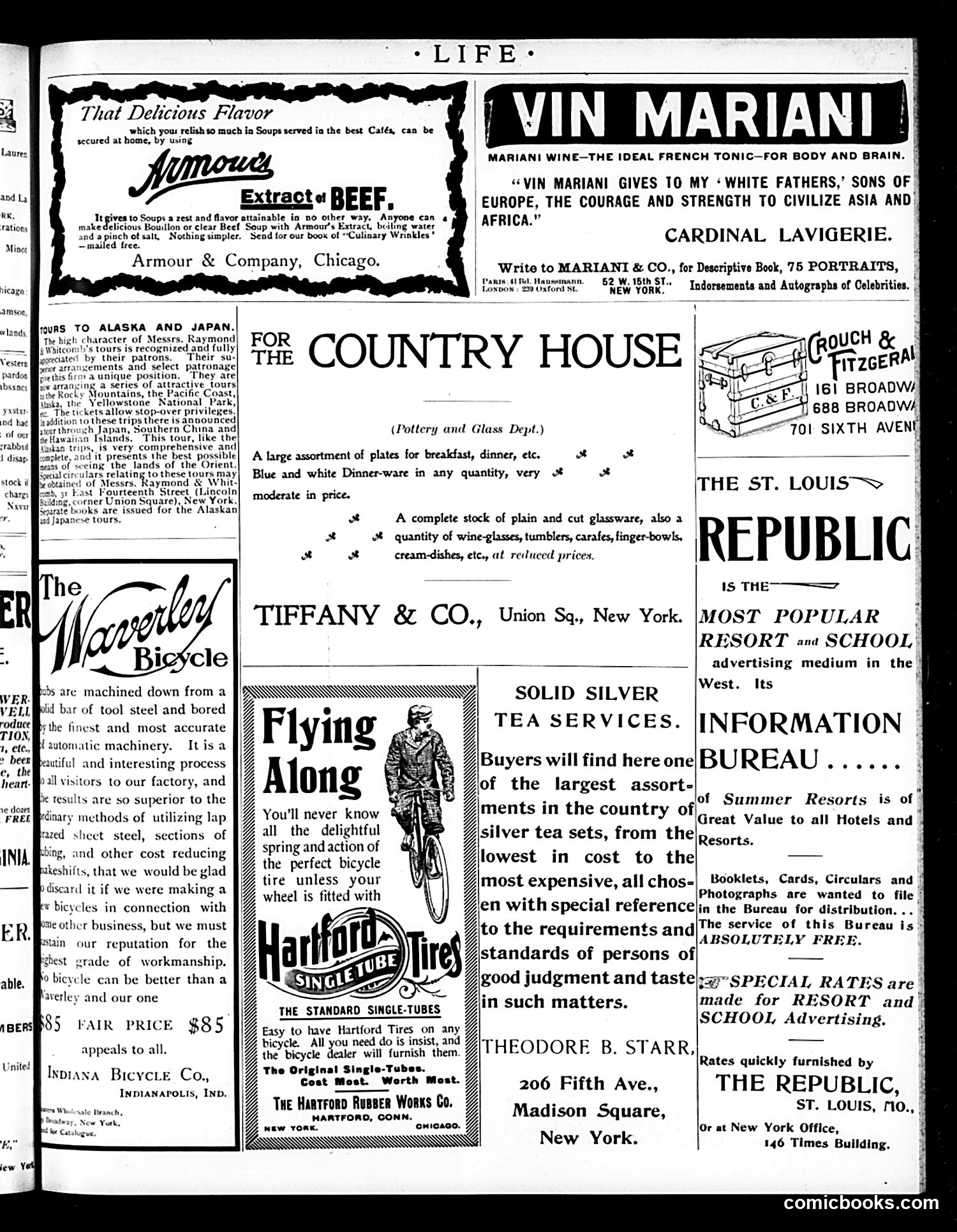
This is primarily an **advertising page** with no political cartoons or satirical content requiring historical context. The page contains various period advertisements (circa early 1900s) for consumer goods: beef extract, bicycles, wine, dinnerware, tea services, and resort advertising. One notable advertisement is for **Vin Mariani wine**, which includes a quote attributed to "Cardinal Lavigerie" claiming the wine gives "white fathers" and "sons of Europe" the "courage and strength to civilize Asia and Africa." This reflects the **colonial-era attitudes** of the period—the advertisement explicitly promotes European imperial expansion as a civilizing mission, a common justification for colonialism at the time. The endorsement by a cardinal lends religious authority to this worldview. By modern standards, this language is overtly racist and imperialist, but it represents mainstream commercial messaging of that era. The page itself contains no satire or humor—Life was simply publishing straightforward period advertisements reflecting contemporary values and commercial interests.
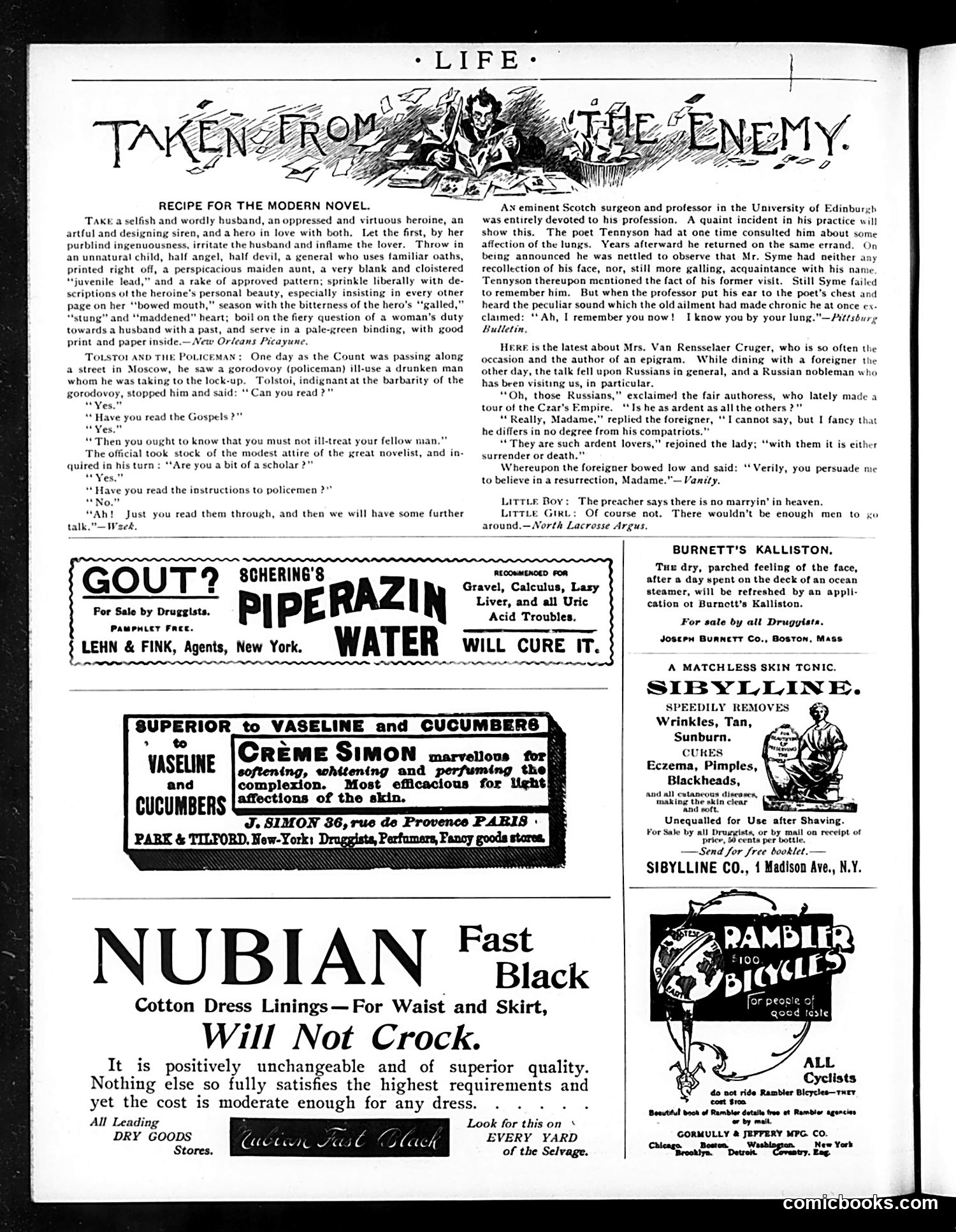
This page from *Life* magazine consists primarily of **humorous anecdotes and advertisements** rather than political cartoons. The main satirical content is "Recipe for the Modern Novel"—a tongue-in-cheek formula mocking popular Victorian and contemporary fiction. It parodies the formulaic melodrama of novels: predictable plots involving virtuous heroines, seductive rivals, tormented heroes, and overwrought emotional language ("galled," "maddened" hearts). The satire targets both the clichéd storytelling and the sentimental, overwrought prose style of period literature. Additional jokes include: - An anecdote about Tolstoy challenging a Moscow policeman's brutality—satirizing the clash between intellectual idealism and practical bureaucracy - A surgeon's failure to remember poet Tennyson by face, only by his distinctive lung sounds—poking fun at professional tunnel vision - A light joke about Russian ardor that puns on resurrection theology The page is dominated by period advertisements for patent medicines and consumer goods, typical of *Life*'s revenue model. No specific political figures or events are referenced.
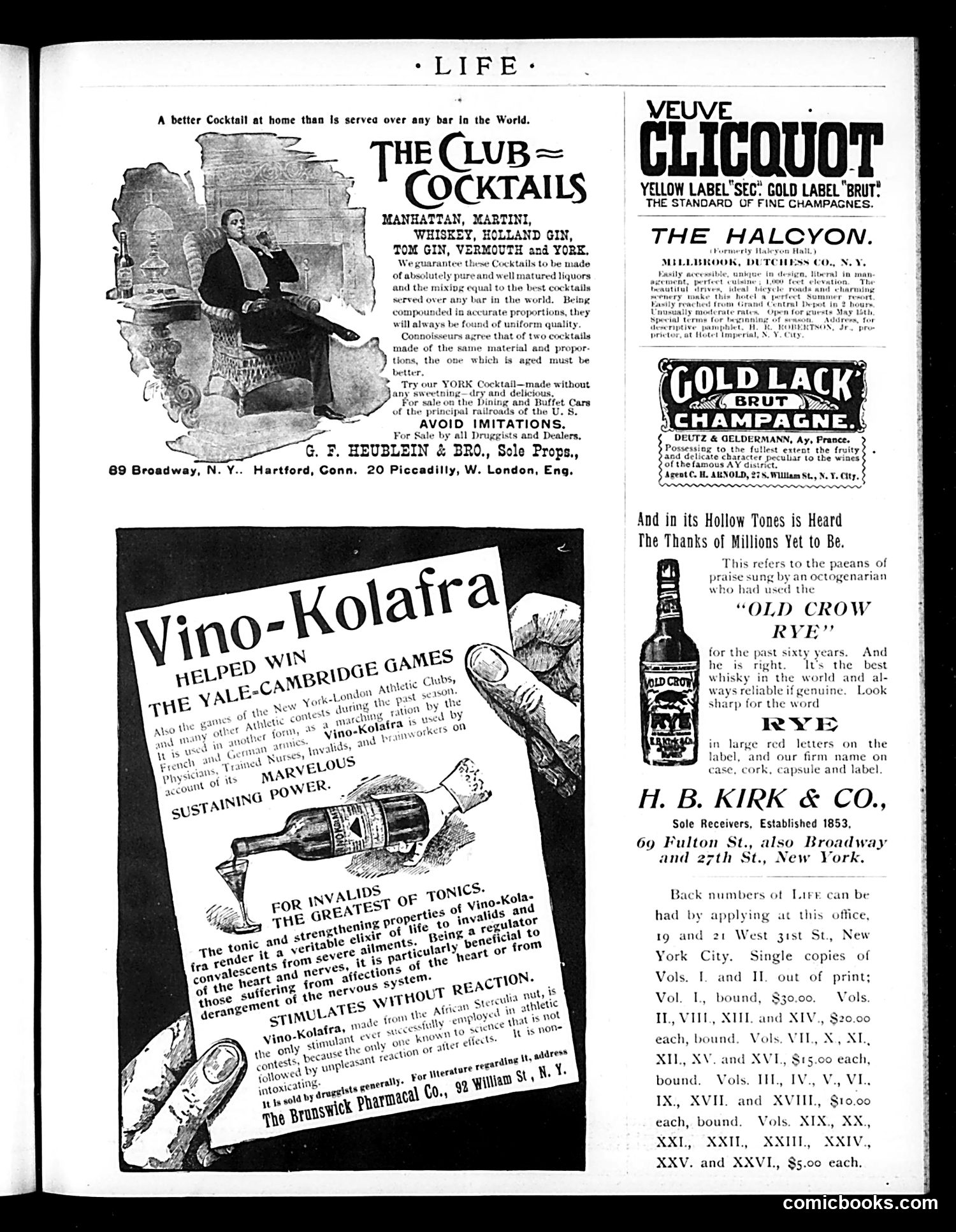
This page is primarily **advertising**, not political satire. It contains five liquor and beverage advertisements typical of early 20th-century magazines: 1. **"The Club Cocktails"** – promoting home cocktail kits (Manhattan, Martini, etc.) as superior to bar drinks, emphasizing quality control and uniformity. 2. **"Vino-Kolafira"** – a tonic wine claiming to have helped the Yale athletic teams win Cambridge Games, marketed as beneficial for invalids with "sustaining power" for heart/nerve conditions (typical patent-medicine claims of the era). 3. **Veuve Clicquot Champagne** – French champagne advertisement. 4. **"Cold Lack Brut" Champagne** – another champagne brand. 5. **"Old Crow Rye"** – whiskey advertisement featuring an octogenarian testimonial about 60 years of use. The page also includes subscription information for back issues of *Life* magazine itself. There is **no political cartoon or satire** present—this is a commercial advertising section.
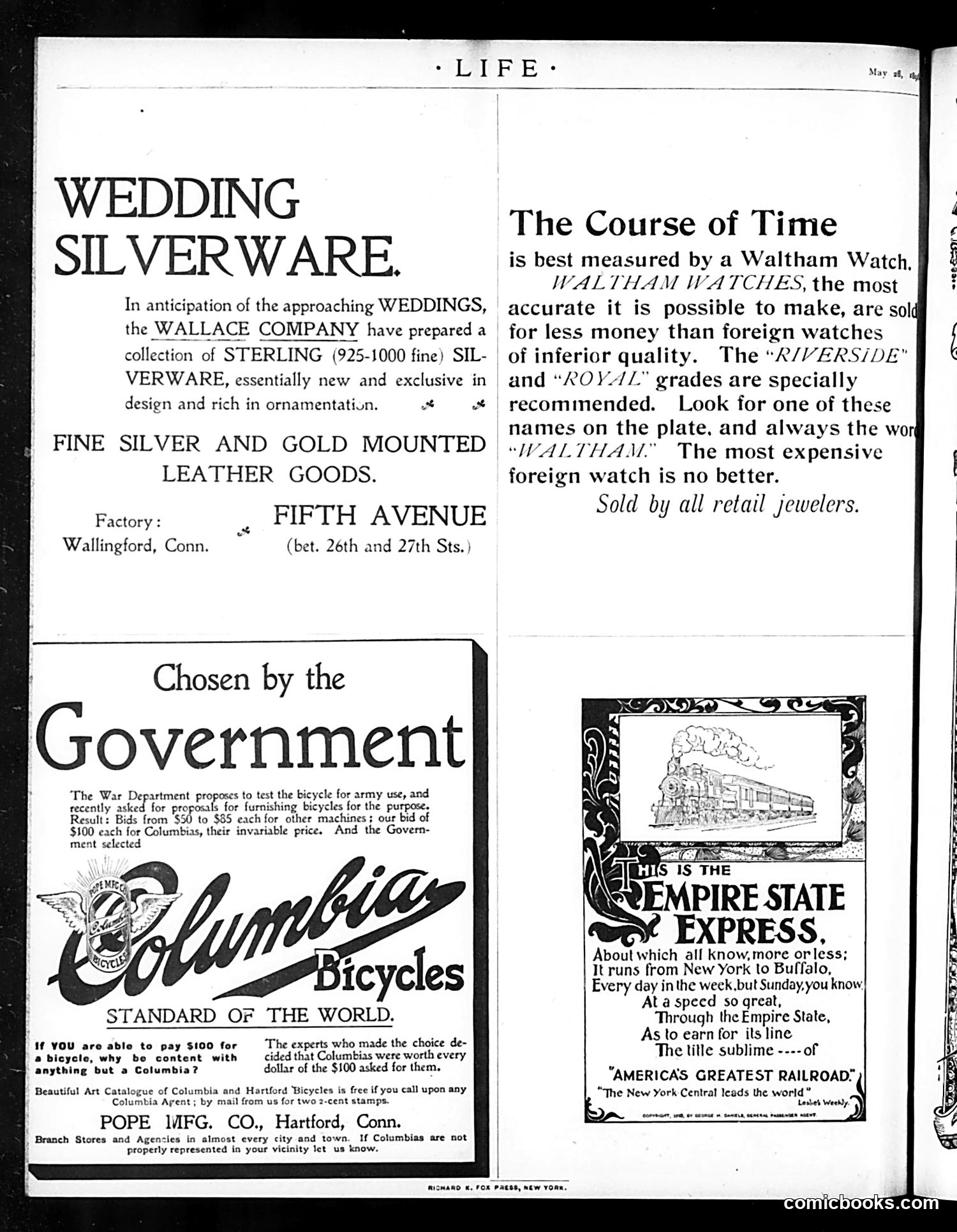
This is primarily a **commercial advertising page**, not political satire. It contains four separate product advertisements from circa 1900s America: 1. **Wallace Company silverware**: Wedding gift promotion for sterling silver goods from their Connecticut factory. 2. **Waltham Watches**: Claims American-made watches are superior value to foreign imports, particularly "Riverside" and "Royal" grades. 3. **Columbia Bicycles**: The satire here is commercial, not political. The ad humorously claims the U.S. War Department chose Columbia bicycles ($100 each) over cheaper competitors ($50-85), suggesting quality justifies premium pricing. The copy sarcastically asks why anyone would buy inferior bikes if they can afford Columbia. 4. **Empire State Express/New York Central Railroad**: Poetic advertisement for the famous passenger train line, emphasizing speed and prestige. The page reflects **turn-of-century American manufacturing pride**—promoting domestic products as superior to foreign competitors. There is no political cartoon or social satire present; these are straightforward advertisements appealing to consumer values of quality and national pride.