
Life, 1896-05-28 · page 16 of 28
Life — May 28, 1896 — page 16: what you’re looking at
What you’re looking at
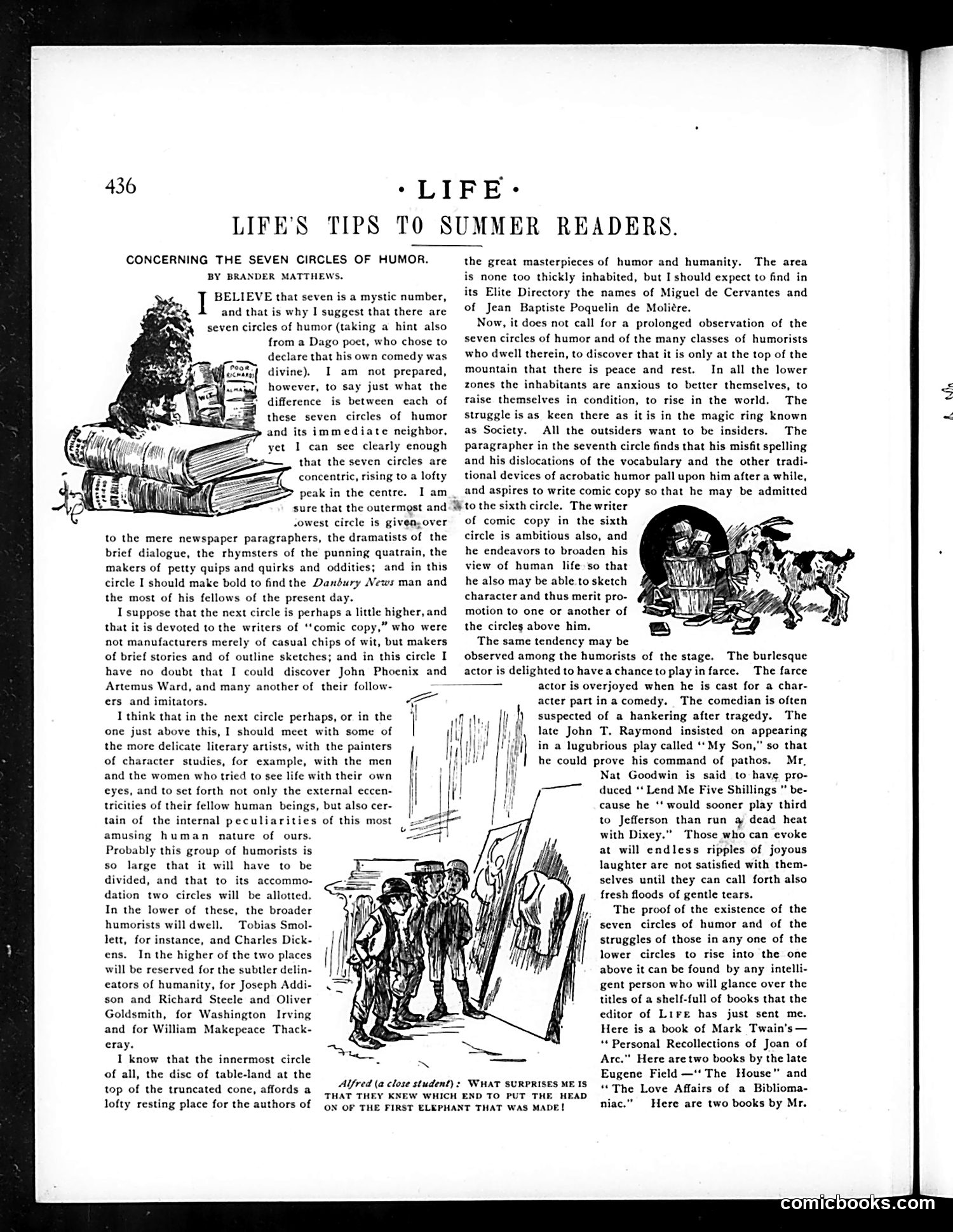
This page from *Life* magazine presents Brander Matthews's essay "Life's Tips to Summer Readers: Concerning the Seven Circles of Humor," which uses a hierarchical framework (borrowed from Dante's *Divine Comedy*) to classify American humor writers by sophistication. Matthews argues humor ranges from lowest (newspaper paragraphers and pun-makers) to highest (Cervantes and Molière). The cartoons illustrate this stratification: one shows a figure buried in books representing lower-tier humor writers; another depicts working-class figures struggling upward, symbolizing humorists' ambition to ascend the hierarchy. The small cartoon captioned with "Alfred" jokes about elephants—likely representing "low" humor—the kind of absurdist gag characteristic of the bottom circles Matthews critiques. The piece reflects 19th-century literary criticism valuing character-driven, subtle wit (Addison, Goldsmith) over crude wordplay or slapstick, while acknowledging the commercial energy of popular humor writers.
📄 Transcribed text from this page (OCR, searchable)
Machine-transcribed from the original scan — historical spelling and the odd misread are preserved.
436 *LIFE- LIFE’S TIPS TO SUMMER READERS. CONCERNING THE SEVEN CIRCLES OF HUMOR. BY BRANDER MATTHEWS. BELIEVE that seven is a mystic number, and that is why I suggest that there are seven circles of humor (taking a hint also from a Dago poet, who chose to declare that his own comedy was divine). I am not prepared, however, to say just what the difference is between each of these seven circles of humor and its immediate neighbor, yet I can see clearly enough that the seven circles are concentric, rising to a lofty peak in the centre. I am sure that the outermost and .owest circle is given,over to the mere newspaper paragraphers, the dramatists of the brief dialogue, the rhymsters of the punning quatrain, the makers of petty quips and quirks and oddities; and in this circle I should make bold to find the Dandury News man and the most of his fellows of the present day. I suppose that the next circle is perhaps a little higher, and that it is devoted to the writers of ‘comic copy,” who were not manufacturers merely of casual chips of wit, but makers of brief stories and of outline sketches; and in this circle I have no doubt that I could discover John Phoenix and Artemus Ward, and many another of their follow- ers and imitators. I think that in the next circle perhaps, or in the one just above th I should meet with some of the more delicate literary artists, with the painters of character studies, for example, with the men and the women who tried to see life with their own eyes, and to set forth not only the external eccen- tricities of their fellow human beings, but also cer- tain of the internal peculiarities of this most amusing human nature of ours. Probably this group of humorists is so large that it will have to be divided, and that to its accommo- dation two circles will be allotted. In the lower of these, the broader humorists will dwell. Tobias Smol- lett, for instance, and Charles Dick- ens. In the higher of the two places will be reserved for the subtler delin- eators of humanity, for Joseph Addi- son and Richard Steele and Oliver Goldsmith, for Washington Irving and for William Makepeace Thack- eray. I know that the innermost circle of all, the disc of table-land at the top of the truncated cone, affords a lofty resting place for the authors of Alfred (a close student): WHAT SURPRISES ME IS THAT THEY KNEW WHICH END TO PUT THE HEAD ON OF THE FIRST ELEPHANT THAT WAS MADE! the great masterpieces of humor and humanity. The area is none too thickly inhabited, but I should expect to find in its Elite Directory the names of Miguel de Cervantes and of Jean Baptiste Poquelin de Moliére. Now, it does not call for a prolonged observation of the seven circles of humor and of the many classes of humorists who dwell therein, to discover that it is only at the top of the mountain that there is peace and rest. In all the lower zones the inhabitants are anxious to better themselves, to taise themselves in condition, to rise in the world. The struggle is as keen there as it is in the magic ring known as Society. All the outsiders want to be insiders. The paragrapher in the seventh circle finds that his misfit spelling and his dislocations of the vocabulary and the other tradi- tional devices of acrobatic humor pall upon him after a while, and aspires to write comic copy so that he may be admitted Wro the sixth circle. The writer of comic copy in the sixth circle is ambitious also, and he endeavors to broaden his view of human life so that he also may be able to sketch character and thus merit pro- motion to one or another of the circles above him. The same tendency may be observed among the humorists of the stage. The burlesque actor is delighted to have achance to play in farce. The farce - actor is overjoyed when he is cast for a char- acter part ina comedy. The comedian is often suspected of a hankering after tragedy. The late John T. Raymond insisted on appearing in a lugubrious play called * My Son,” so that he could prove his command of pathos. Mr, Nat Goodwin is said to have pro- duced ‘* Lend Me Five Shillings " be- cause he ‘would sooner play third to Jefferson than run dead heat with Dixey.” Those who can evoke at will endless ripples of joyous laughter are not satisfied with them- selves until they can call forth also fresh floods of gentle tears. The proof of the existence of the seven circles of humor and of the struggles of those in any one of the lower circles to rise into the one above it can be found by any intelli- gent person who will glance over the titles of a shelf-full of books that the editor of Lire has just sent me. Here is a book of Mark Twain's — “Personal Recollections of Joan of Arc." Here are two books by the late Eugene Field —‘‘ The House" and “The Love Affairs of a Biblioma- niac.” Here are two books by Mr. —