
Life, 1896-05-28 · page 6 of 28
Life — May 28, 1896 — page 6: what you’re looking at
What you’re looking at
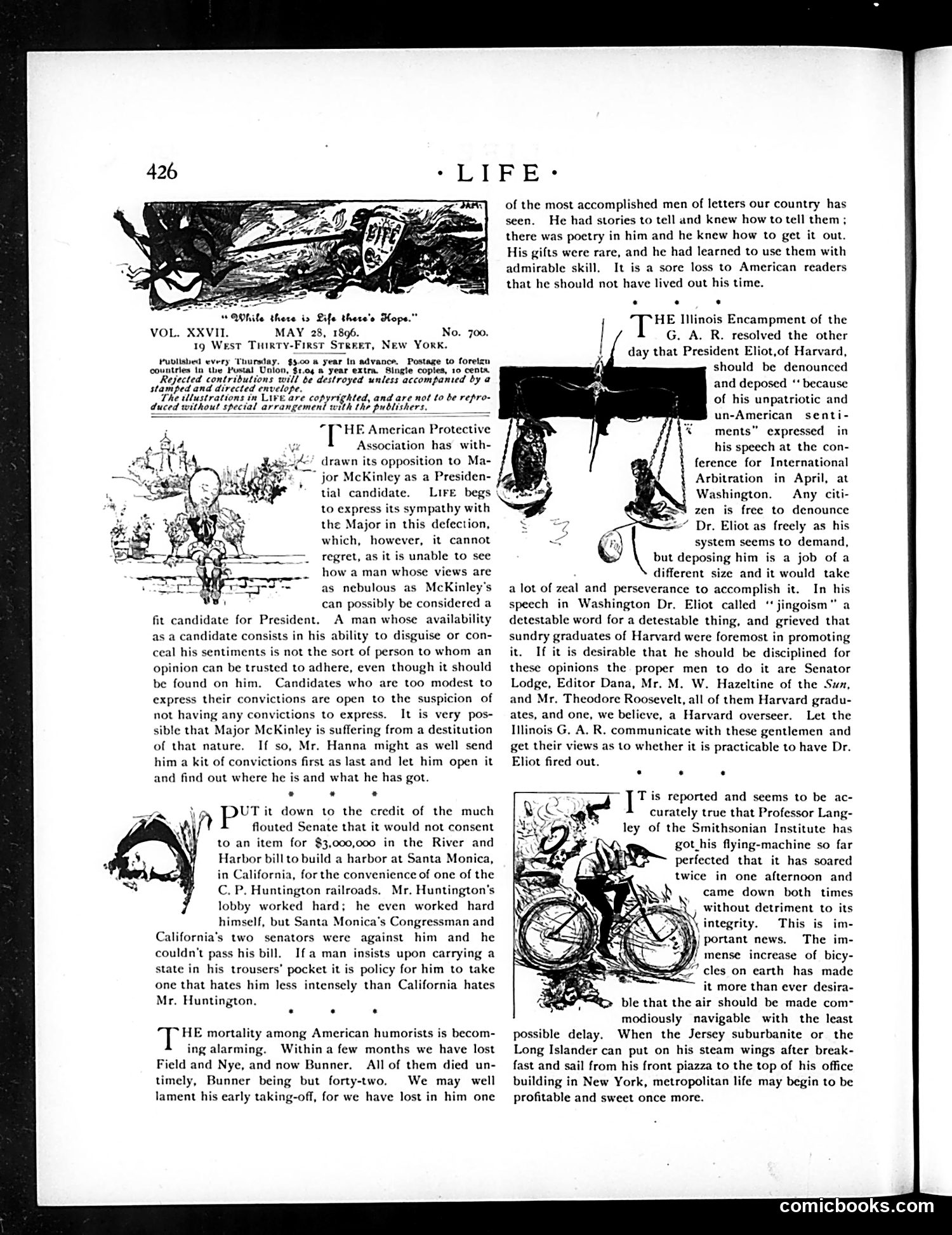
This page contains three distinct editorial commentary sections with accompanying satirical illustrations. The first discusses **Major McKinley as a Presidential candidate**, questioning whether someone with such "nebulous" views could be trusted in office. The cartoon shows a figure being examined, suggesting scrutiny of the candidate's positions. The second addresses the **American Protective Association's opposition to McKinley**, noting the difficulty in denouncing Harvard President Eliot for his "un-American sentiments" at an International Arbitration conference, while arguing Eliot's removal would require significant effort. The third briefly mentions a **$3,000,000 appropriation for Santa Monica harbor**, attributed to C.P. Huntington's railroad lobbying influence over California's senators. The final section discusses **increased bicycle usage** and air navigation developments, presented as social progress worth noting.
📄 Transcribed text from this page (OCR, searchable)
Machine-transcribed from the original scan — historical spelling and the odd misread are preserved.
* LIFE there's Hope.” VOL. XXVII. MAY 28, 1896. No. 700, 1g West Turty-First Steret, New York. Published every Thursday. $3.00 4 year In advance, Postage to foreizu countries In the Pustal Union, $1.04 a year extra. Single coples, 10 cents. Rejected contributions will stamped and directed envelope. The tllustrations in Live are copyrighted, and are not to be repro- duced without special arrangement with the publishers. be destroyed unless accompanted by a “T° HE American Protective Association has with- drawn its opposition to Ma- jor McKinley as a Presiden- tial candidate. Lire begs to express its sympathy with the Major in this defection, which, however, it cannot regret, itis unable to see how a man whose views are as nebulous as McKinley's can possibly be considered a fit candidate for President. A man whose availability as a candidate consists in his ability to disguise or con- ceal his sentiments is not the sort of person to whom an opinion can be trusted to adhere, even though it should be found on him. Candidates who are too modest to express their convictions are open to the suspicion of not having any convictions to express. It is very pos- sible that Major McKinley is suffering from a destitution of that nature. If so, Mr. Hanna might as well send him a kit of convictions first as last and let him open it and find out where he is and what he has got. . * . UT it down to the credit of the much flouted Senate that it would not consent to an item for $3,000,000 in the River and Harbor bill to build a harbor at Santa Monica, in California, for the convenience of one of the C. P. Huntington railroads. Mr. Huntington's lobby worked hard; he even worked hard himself, but Santa Monica’s Congressman and California's two senators were against him and he couldn't pass his bill. Ifa man insists upon carrying a state in his trousers’ pocket it is policy for him to take one that hates him less intensely than California hates Mr. Huntington, . . . T HE mortality among American humorists is becom- ing alarming. Within a few months we have lost Field and Nye, and now Bunner, All of them died un- timely, Bunner being but forty-two. We may well lament his early taking-off, for we have lost in him one of the most accomplished men of letters our country has seen. He had stories to tell and knew how to tell them ; there was poetry in him and he knew how to get it out. His gifts were rare, and he had learned to use them with admirable skill. It is a sore loss to American readers that he should not have lived out his time. . . . HE Illinois Encampment of the G. A. R. resolved the other day that President Eliot,of Harvard, should be denounced and deposed ‘‘ because of his unpatriotic and un-American senti- ments” expressed in his speech at the con- ference for International Arbitration in April, at Washington. Any citi- zen is free to denounce = Dr. Eliot as freely as his system seems to demand, but deposing him is a job of a different size and it would take a lot of zeal and perseverance to accomplish it. In his speech in Washington Dr. Eliot called ‘ jingoism” a detestable word for a detestable thing, and grieved that sundry graduates of Harvard were foremost in promoting it. If it is desirable that he should be disciplined for these opinions the proper men to do it are Senator Lodge, Editor Dana, Mr. M. W. Hazeltine of the Sun, and Mr. Theodore Roosevelt, all of them Harvard gradu- ates, and one, we believe, a Harvard overseer. Let the Illinois G. A. R. communicate with these gentlemen and get their views as to whether it is practicable to have Dr. Eliot fired out. . ry ie is reported and seems to be ac- curately true that Professor Lang- ley of the Smithsonian Institute has got_his flying-machine so far perfected that it has soared twice in one afternoon and came down both times without detriment to its a\\ integrity. This is im- fa) Portant news. The im- Hf’ mense increase of bicy- * cles on earth has made it more than ever desira- &> ble that the air should be made com- modiously navigable with the least possible delay. When the Jersey suburbanite or the Long Islander can put on his steam wings after break- fast and sail from his front piazza to the top of his office building in New York, metropolitan life may begin to be profitable and sweet once more. comicbooks.com