
Life, 1896-05-28 · page 17 of 28
Life — May 28, 1896 — page 17: what you’re looking at
What you’re looking at
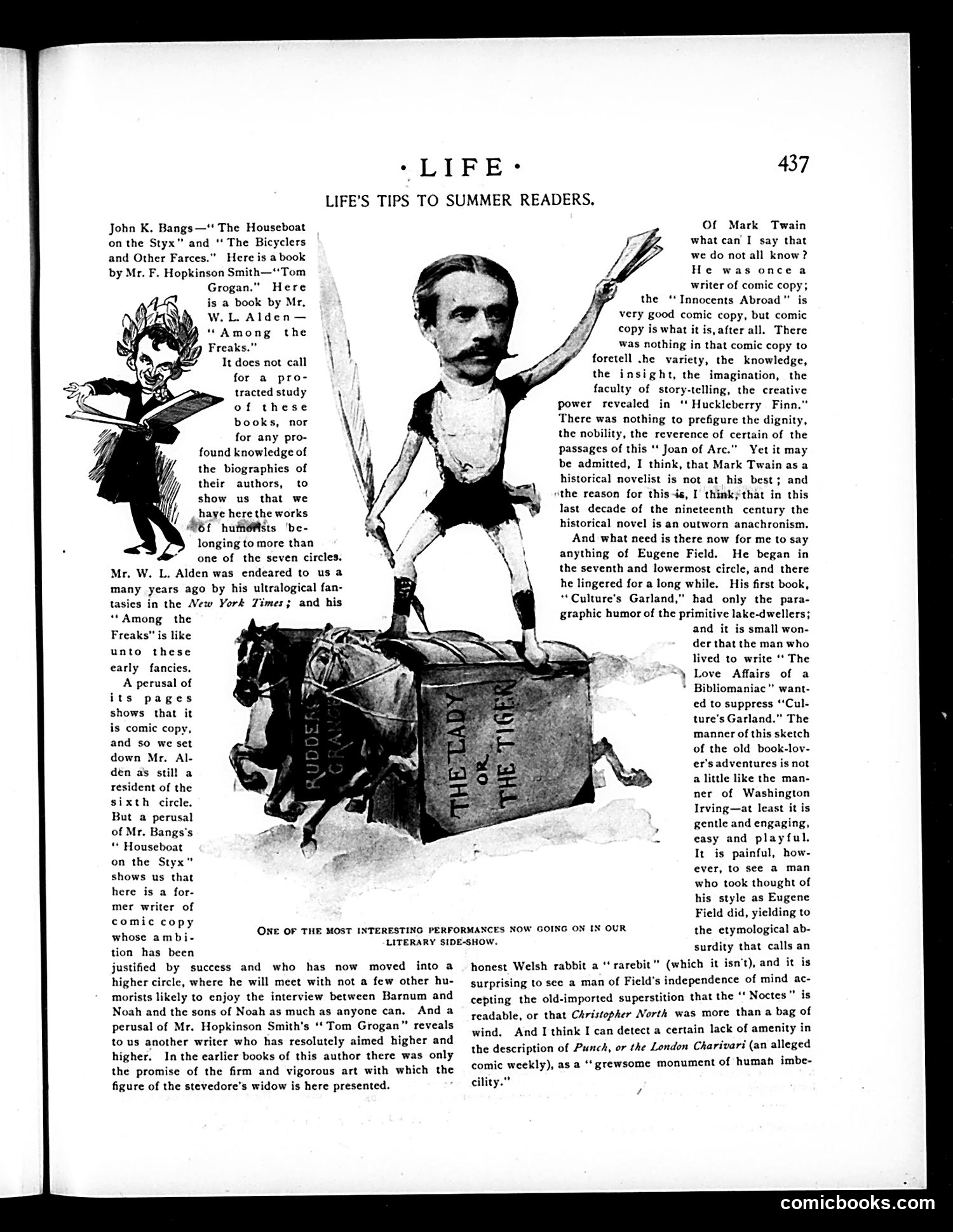
This page reviews four American humorists, ranking them by literary ambition using Dante's circles of Hell as metaphor. The central cartoon depicts a caricatured figure standing triumphantly on a book labeled "Huckleberry Finn," illustrating the discussion of how writers progressed from "comic copy" to serious literature. The critic argues that John K. Bangs, F. Hopkinson Smith, and Eugene Field elevated themselves from mere comic writers to serious authors. Mark Twain receives particular praise for *Huckleberry Finn* and *Joan of Arc*, though his historical novels are deemed dated. The satire critiques Field's inconsistencies: despite his careful prose style, he accepted linguistic errors (Welsh rabbit vs. "rarebit") and endorsed dubious British publications. The overall point celebrates American humorists who transcended light comedy for greater artistic achievement, reflecting late-19th-century anxieties about literature's respectability.
📄 Transcribed text from this page (OCR, searchable)
Machine-transcribed from the original scan — historical spelling and the odd misread are preserved.
- LIFE: 437 LIFE’S TIPS TO SUMMER READERS. John K. Bangs—‘‘ The Houseboat on the Styx" and ‘The Bicyclers and Other Farces.” Here is a book by Mr. F. Hopkinson Smith—“'Tom Grogan." Here is a book by Mr, W.L. Alden — “Among the Freaks.” It does not call for a pro- tracted study of these books, nor for any pro- found knowledge of the biographies of their authors, to show us that we haye here the works MSE humeists ‘be- longing to more than one of the seven circles. Mr. W. L. Alden was endeared to us a many years ago by his ultralogical fan- tasies in the New York Times; and his *“*Among the Freaks” is like unto these early fancies. A perusal of its pages shows that it is comic copy, and so we set down Mr. Al- den as still a resident of the sixth circle, But a perusal of Mr. Bangs’s “* Houseboat on the Styx” shows us that here is a for- mer writer of comic copy whose ambi- tion has been justified by success and who has now moved into a higher circle, where he will meet with not a few other hu- morists likely to enjoy the interview between Barnum and Noah and the sons of Noah as much as anyone can. And a perusal of Mr. Hopkinson Smith's ‘Tom Grogan” reveals to us another writer who has resolutely aimed higher and higher. In the earlier books of this author there was only the promise of the firm and vigorous art with which the figure of the stevedore’s widow is here presented. ONE OF THE MOST INTERESTING PERFORMANCES NOW GOING ON IN OUR LITERARY SIDE-SHOW. Of Mark Twain what can I say that we do not all know? He was once a writer of comic copy; the ‘Innocents Abroad" is very good comic copy, but comic copy is what it is, after all. There was nothing in that comic copy to foretell .he variety, the knowledge, the insight, the imagination, the faculty of story-telling, the creative power revealed in ‘Huckleberry Finn.” ‘There was nothing to prefigure the dignity, the nobility, the reverence of certain of the Passages of this ‘* Joan of Arc.” Yet it may be admitted, I think, that Mark Twain as a historical novelist is not at his best; and the reason for this-is, I think, that in this last decade of the nineteenth century the historical novel is an outworn anachronism. And what need is there now for me to say anything of Eugene Field. He began in the seventh and lowermost circle, and there he lingered for a long while. His first book, ““Culture's Garland,” had only the para- graphic humor of the primitive lake-dwellers; and it is small won- der that the man who lived to write ‘‘ The Love Affairs of a Bibliomaniac" want- ed to suppress “Cul- ture's Garland.” The manner of this sketch of the old book-lov- er's adventures is not a little like the man- ner of Washington Irving—at least it is gentle and engaging, easy and playful. It is painful, how- ever, to see a man who took thought of his style as Eugene Field did, yielding to the etymological ab- surdity that calls an honest Welsh rabbit a‘ rarebit” (which it isn’t), and it is surprising to sce a man of Field's independence of mind ac- cepting the old-imported superstition that the “ Noctes" is readable, or that Christopher North was more than a bag of wind, And I think I can detect a certain lack of amenity in the description of Punch, or the London Charivari (an alleged comic weekly), as a ‘‘grewsome monument of human imbe- comicbooks.com