
A complete issue · 20 pages · 1896
Life — February 13, 1896
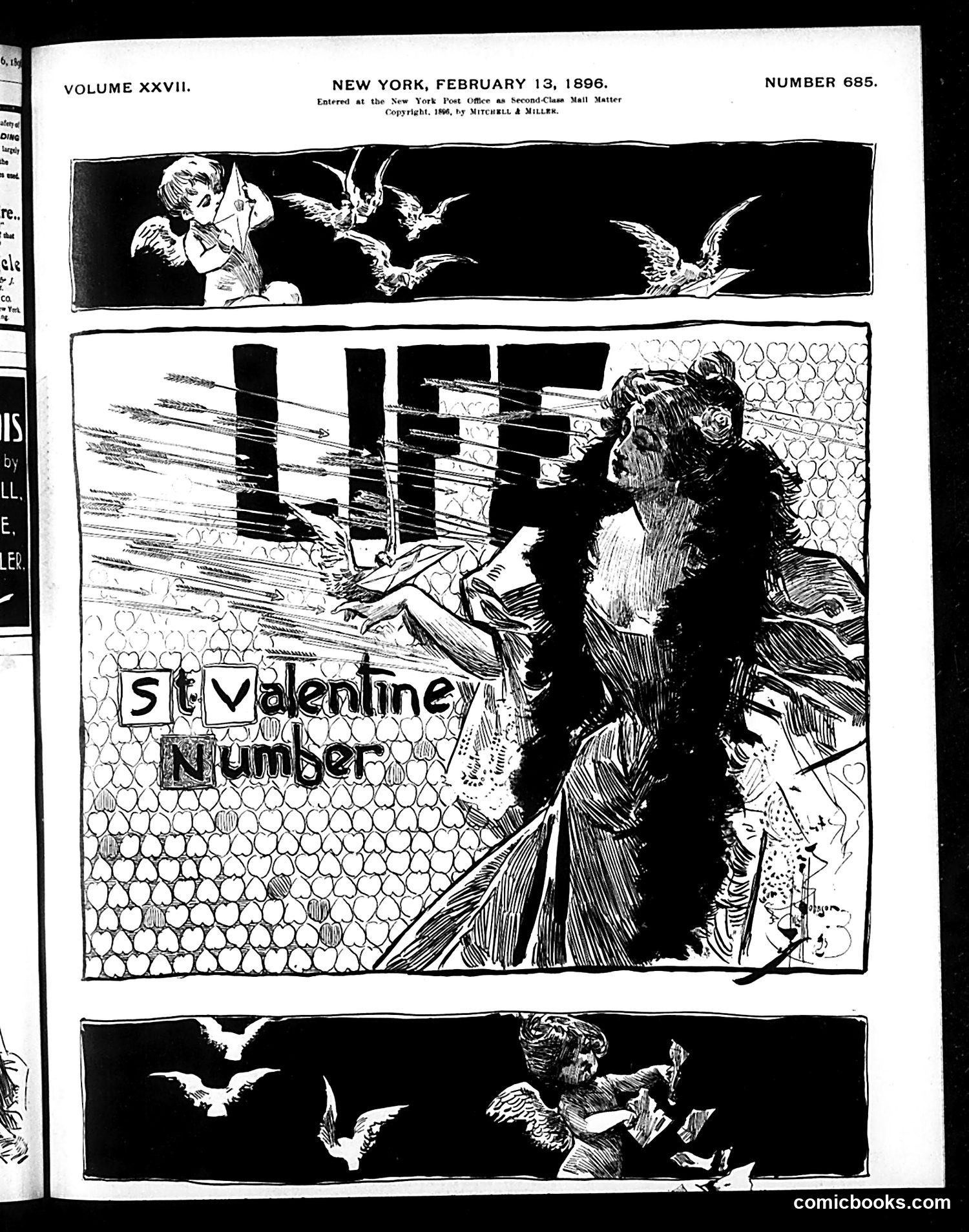
This is the cover of Life's Valentine's Day special issue. The central image shows a woman in Victorian dress amid romantic imagery—Cupids at top, hearts filling the background, and what appears to be a man's silhouette at right. The title "St Valentine Number" explicitly labels the content's theme. The satirical point likely plays on romantic expectations versus reality. The arrows and dynamic composition suggest chaos rather than smooth romance. This was a common Life magazine approach: using holiday themes to gently mock Victorian courtship conventions, gender relations, and sentimental excess. The dramatic, somewhat chaotic rendering undercuts the sweetness typically associated with Valentine's Day content, suggesting ironic commentary on romance and love.
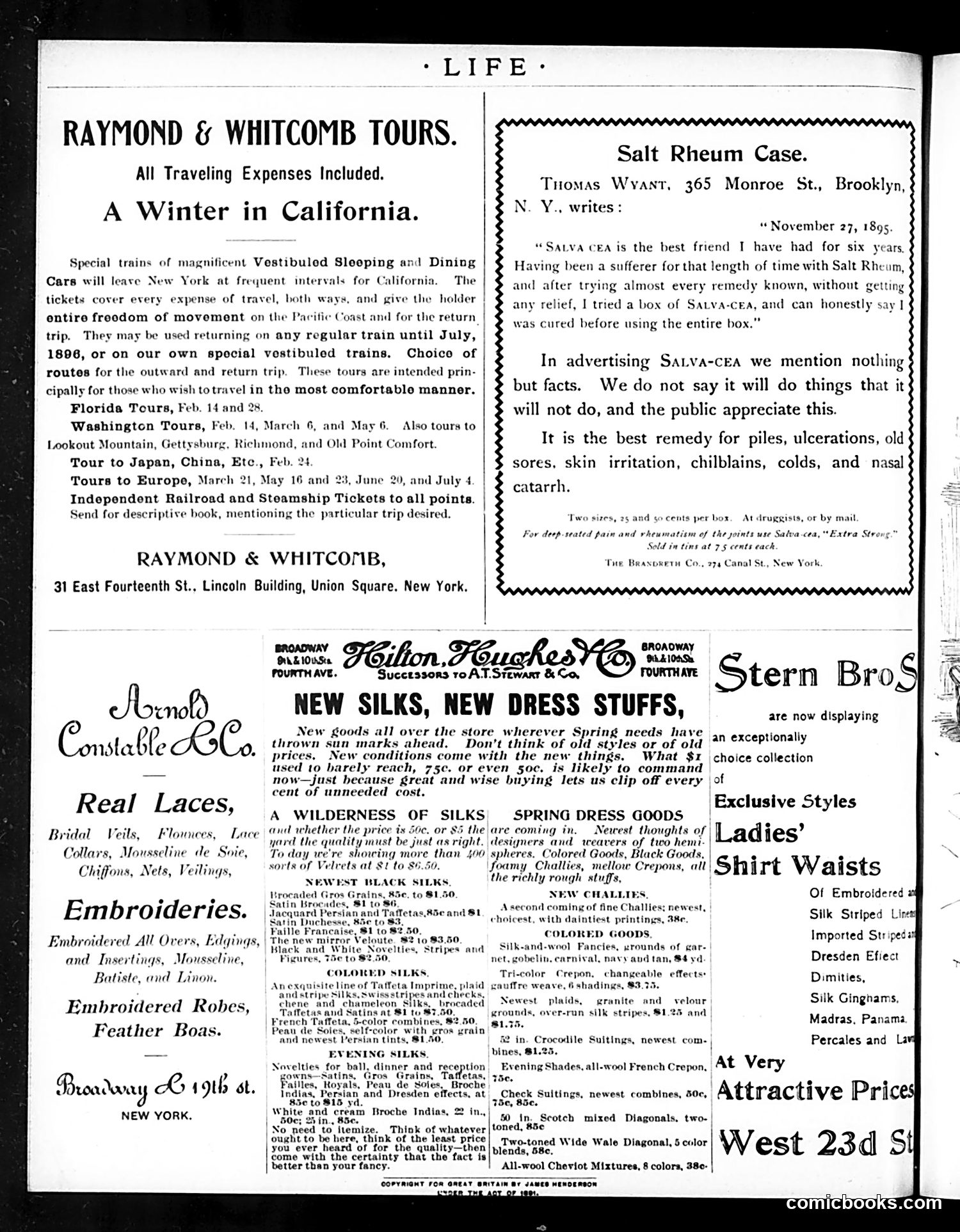
This page contains **no political cartoons or satirical illustrations**. Instead, it is primarily **advertising content** from what appears to be a late 19th-century issue of Life magazine (dated November 1895 based on the Salt Rheum Case testimonial). The page features: - Travel advertisements (Raymond & Whitcomb Tours) - A product testimonial for "Salva-cea," a patent medicine claiming to cure salt rheum, piles, and various skin conditions - Department store advertisements for silks, dress goods, laces, and ladies' clothing from retailers like Arnold Constable & Co., Stern Bros., and Houlton Houckes The content is purely commercial with no satirical or political commentary evident.
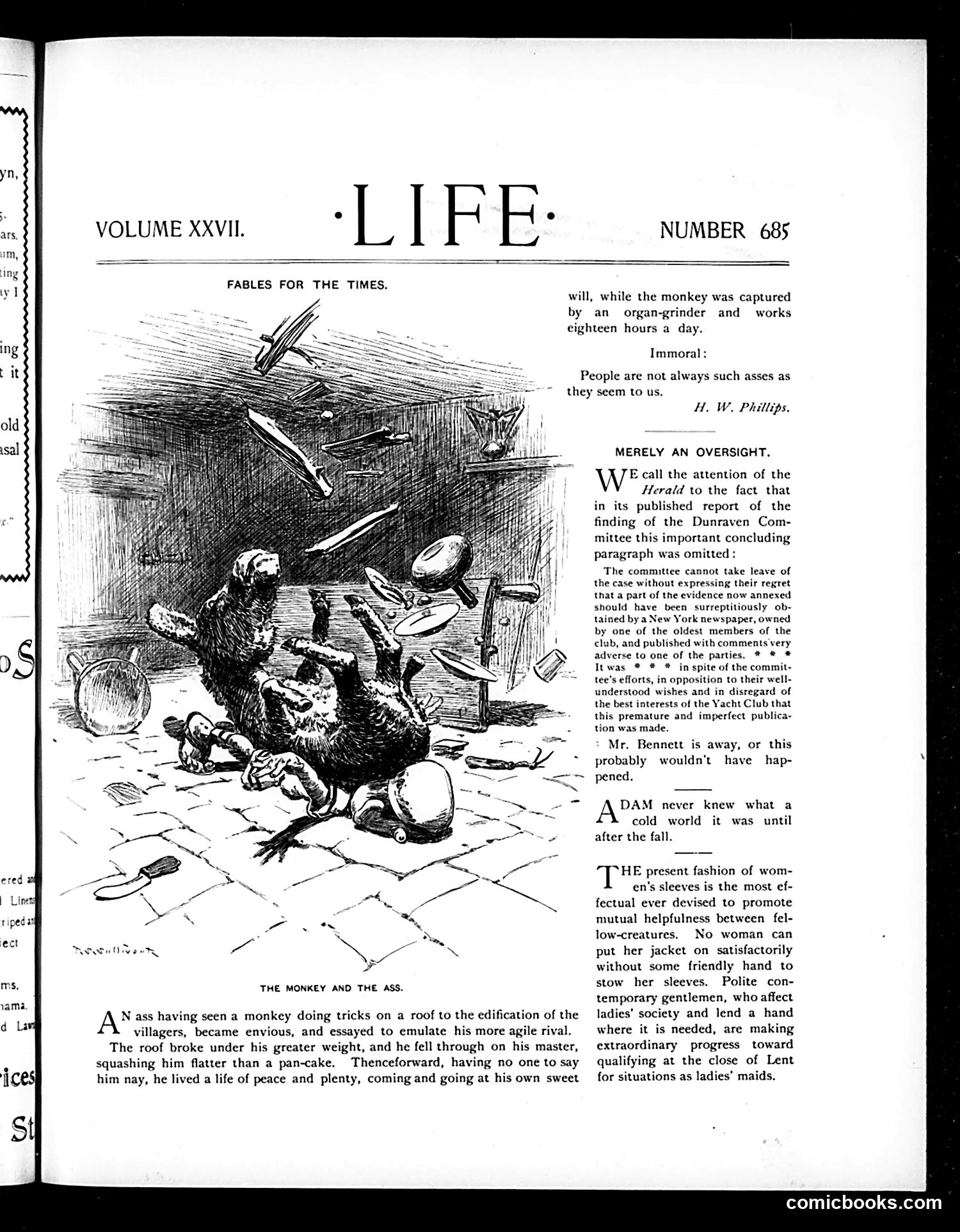
This is a satirical fable mocking human folly through animal characters. An ass, envious of a monkey's acrobatic tricks, attempts to imitate him but lacks the ability. The monkey breaks the roof under excessive weight when the ass tries copying its performance, and the ass falls through, crushing his master. The moral: attempting to emulate others without possessing their natural talents leads to disaster. The satire targets human vanity and foolish imitation. The page also includes unrelated social commentary on women's sleeve fashion aiding female domestics, and criticism of the *Herald* newspaper's omission of evidence in reporting on the Dunraven Committee yacht club matter. This represents *Life* magazine's typical blend of political satire, social criticism, and humorous fables.
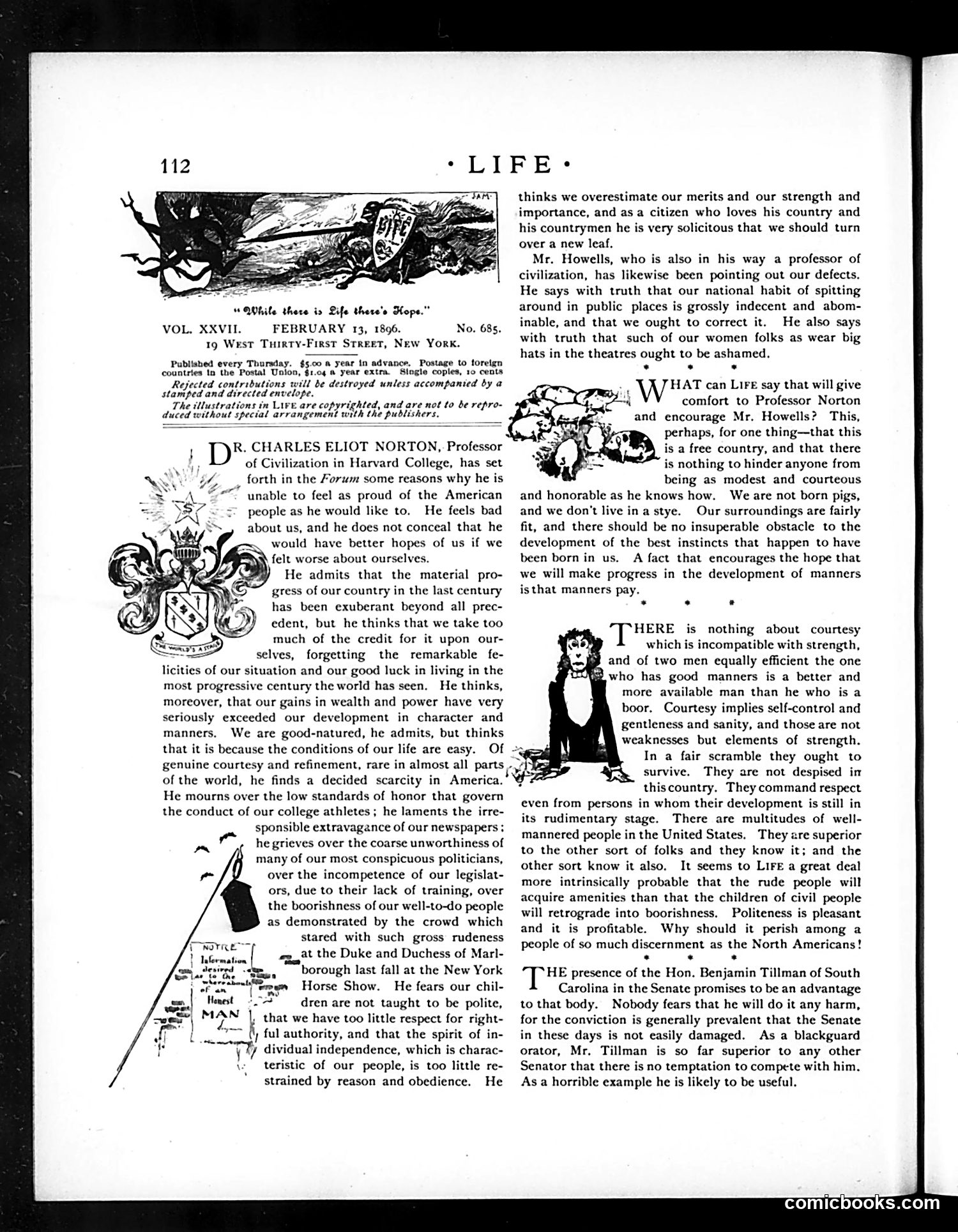
The page features an editorial by Dr. Charles Eliot Norton, a Harvard professor, critiquing American social behavior and manners. The text argues that Americans are overly confident in their merits while lacking proper courtesy and refinement—particularly regarding public behavior in theaters and spitting. The small cartoon at bottom left appears to satirize American rudeness and lack of obedience to authority, depicting a figure labeled "MAN" in contrast to refined conduct. The editorial praises courtesy as compatible with strength and cites Senator Benjamin Tillman of South Carolina as an example of a blackguard orator whose conduct demonstrates how poor manners can damage one's credibility, even among politicians. The piece advocates that good manners represent strength, not weakness, and benefit national development.
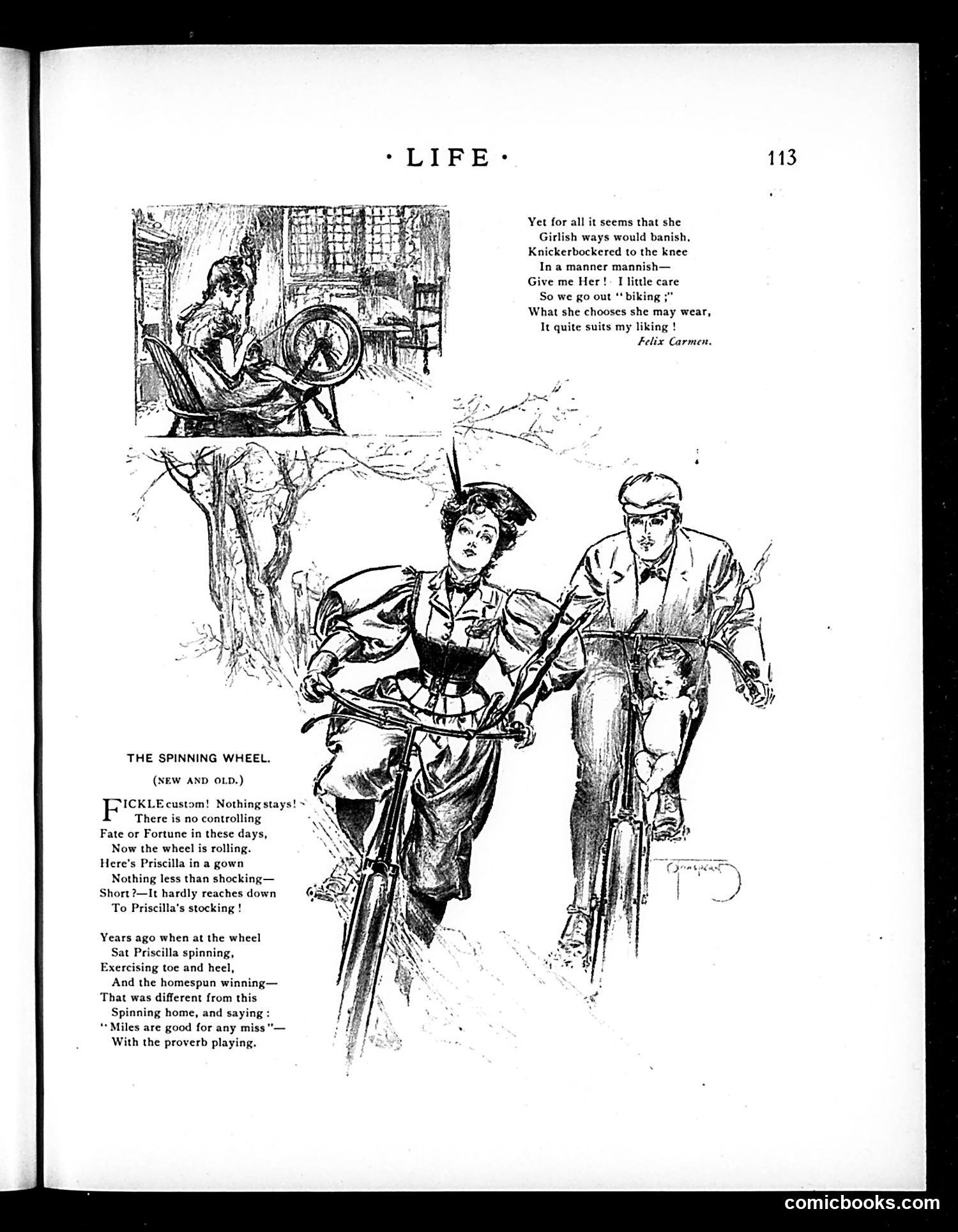
This page contains two illustrations satirizing women's changing social roles in the early 20th century. The **upper section** mocks the "New Woman" who rejects traditional domestic duties—specifically spinning yarn. The text dismisses old-fashioned domestic ideals with sarcasm: women now choose their own clothing and activities, defying expectations. The **lower illustration**, titled "The Spinning Wheel," depicts a woman on a bicycle (the "wheel") with a man accompanying her, replacing the old spinning wheel. The accompanying verse contrasts Priscilla's past—spinning at home saying "miles are good for any miss"—with the modern woman's active lifestyle on bicycles. The satire suggests women's liberation through cycling and outdoor activities has replaced Victorian domesticity, which the magazine presents as both shocking and inevitable.
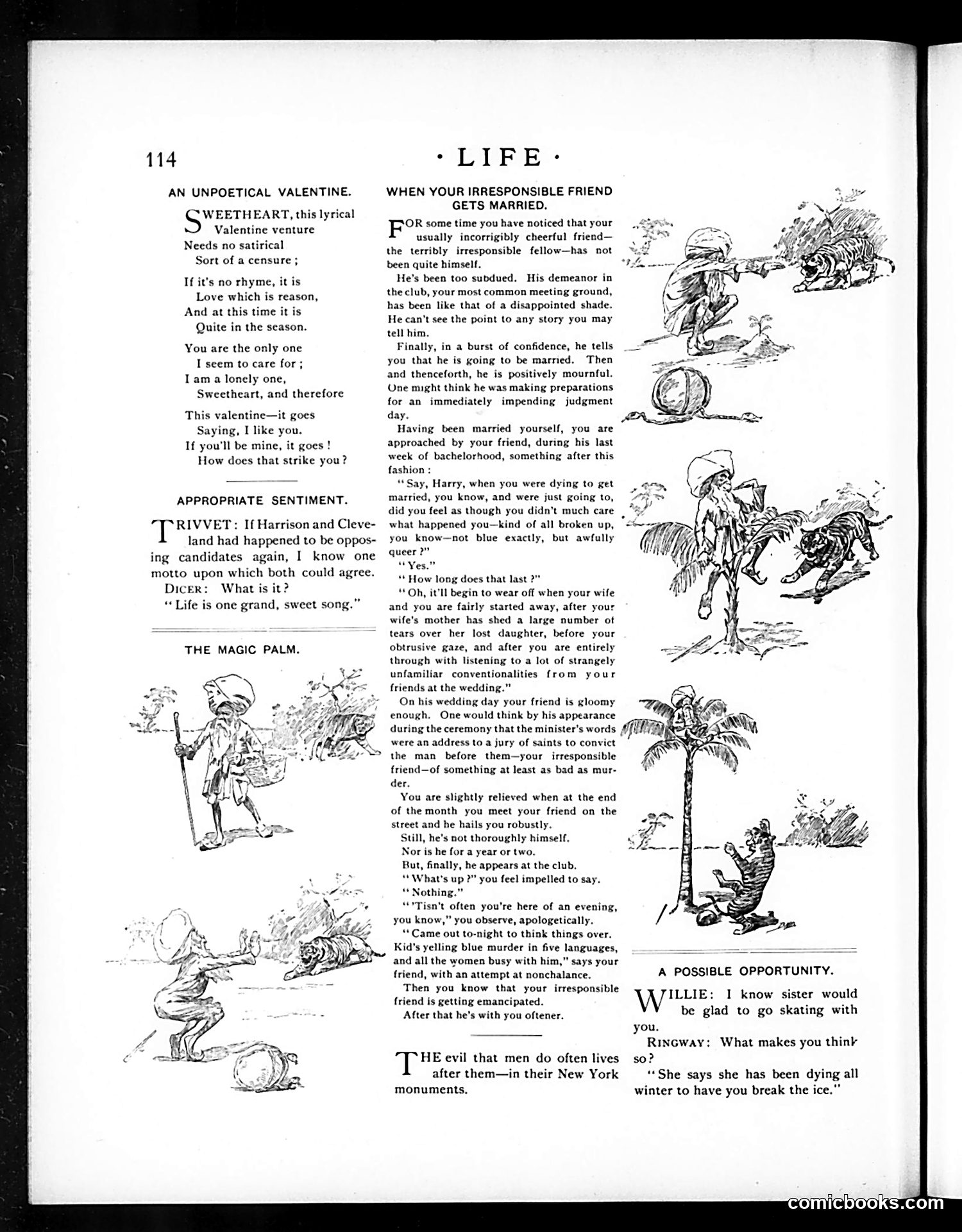
This page contains three separate humor pieces targeting early 20th-century social conventions: 1. **"An Unpoetical Valentine"** mocks insincere romantic gestures, advising a suitor to be honest rather than poetic. 2. **"When Your Irresponsible Friend Gets Married"** satirizes a specific male character type—the perpetually immature bachelor who finally marries. The satire describes his gloomy wedding day and subsequent emotional detachment, suggesting marriage hasn't actually reformed him. The humor targets how such men treat matrimony as a burden rather than commitment. 3. **"The Magic Palm"** and **"A Possible Opportunity"** are brief comic dialogues about winter activities (skating), using wordplay and misunderstanding for humor. The illustrations throughout are whimsical line drawings typical of Life's style, depicting everyday social situations rather than political content.
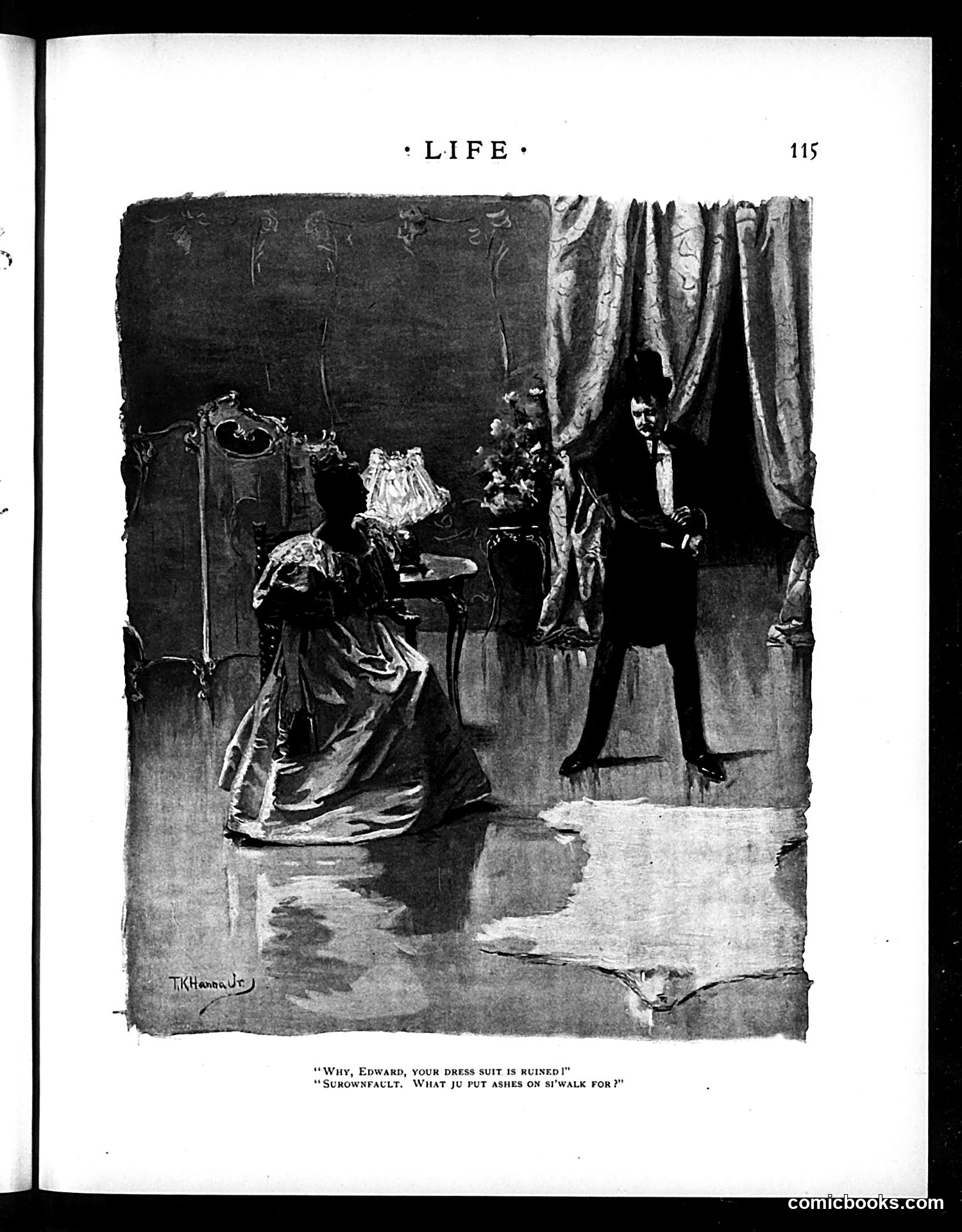
This is a single-panel cartoon satirizing domestic conflict over fashion and cleanliness standards. The scene depicts an interior with two figures: a woman seated (appearing distressed) and a man standing, with a third figure visible in the background near curtains. The caption reads: "Why, Edward, your dress suit is ruined!" / "Sunbowfault. What ju put ashes on su'walk for?" The satire targets a husband's casual disregard for his formal clothing—he's apparently gotten ashes on his dress suit, and he's blaming his wife for placing ashes on the sidewalk rather than taking responsibility. This illustrates marital tensions over domestic responsibilities and masculine indifference to appearance and household management—themes common in early 20th-century American humor about gender roles and domestic life.
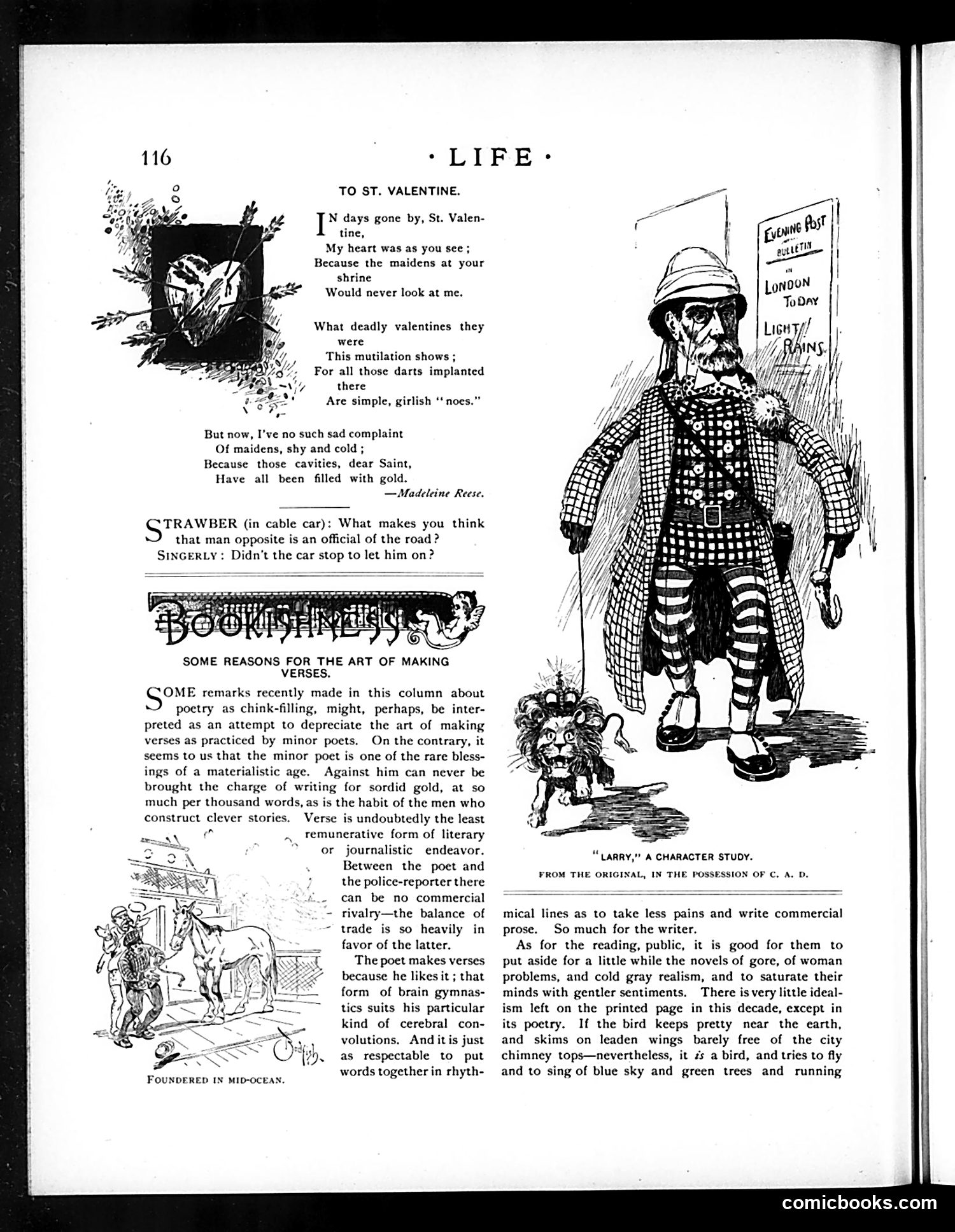
This page contains several distinct elements: **"To St. Valentine"** — A poem by Madeline Reese criticizing the tradition of valentine's day gifts, particularly darts and thorns ("girish noes") that men receive from women, contrasted with modern valentines filled with gold. **"Strawber in Cable Car"** — A brief dialogue joke about mistaking someone for a road official. **"Some Reasons for the Art of Making Verses"** — An essay defending poetry as a legitimate literary form against claims it's merely a commercial endeavor, arguing poets deserve respect for their cerebral work, even if less remunerative than prose writing. **Illustrations** include period sketches: a character study labeled "Larry" showing a costumed figure with a small dog, and smaller vignettes depicting various scenes. The overall theme advocates for poetry's artistic and intellectual value in early 20th-century American culture.
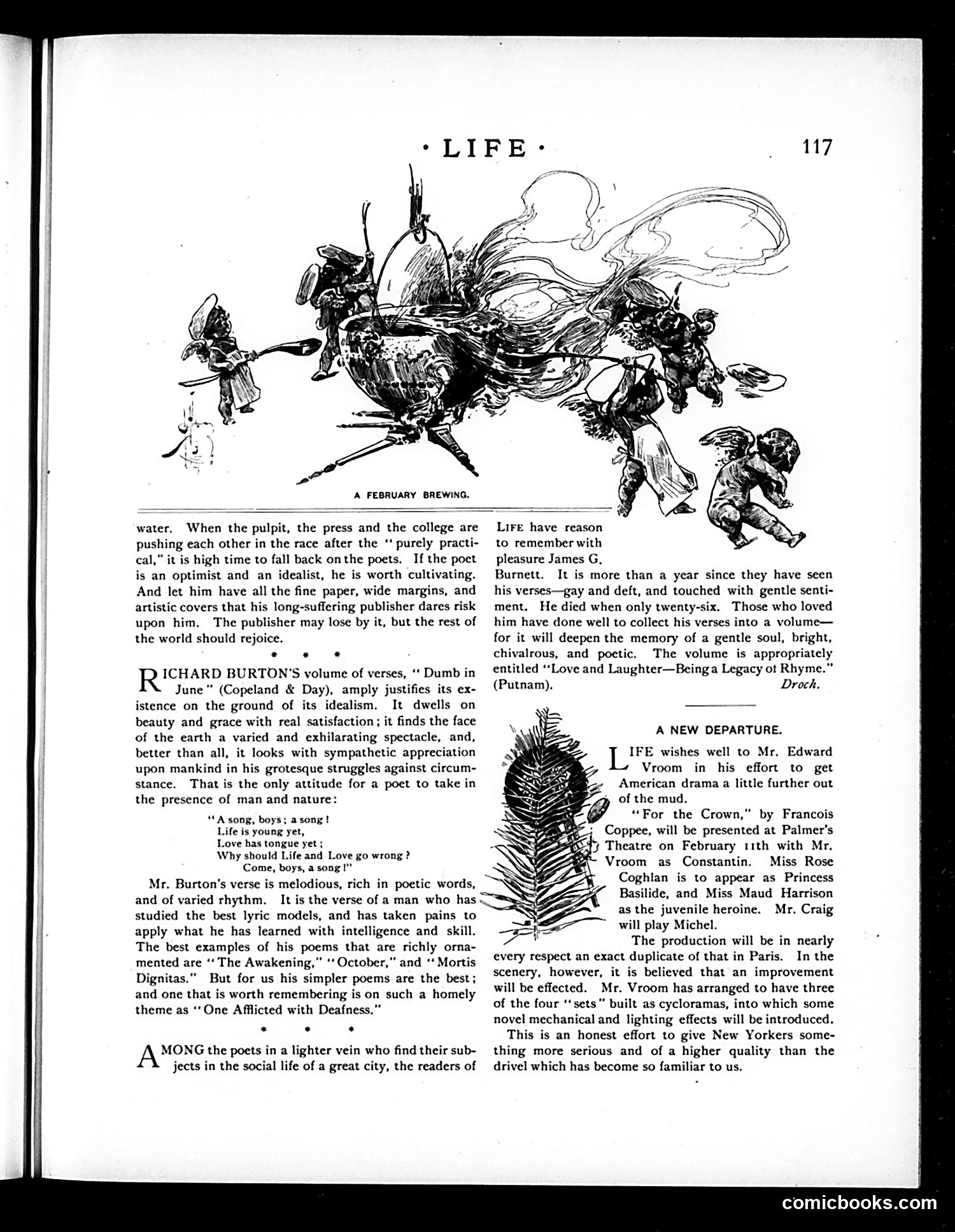
This cartoon depicts allegorical figures—likely representing literary and artistic forces or publications—engaged in frenzied activity around a central cauldron or vessel. The swirling, energetic composition suggests creative chaos or competition. The accompanying text discusses Richard Burton's poetry volume "Dumb in Jane" and James G. Burnett's verses, praising poets who address social life and human struggles with sympathy. The page also announces Edward Vroom's theatrical production "For the Crown" at Palmer's Theatre, featuring innovative mechanical and lighting effects. The cartoon's title "A February Brewing" likely refers to this ferment of cultural activity—theatrical productions, poetry publications, and artistic competition—happening simultaneously in New York's literary and theatrical world.
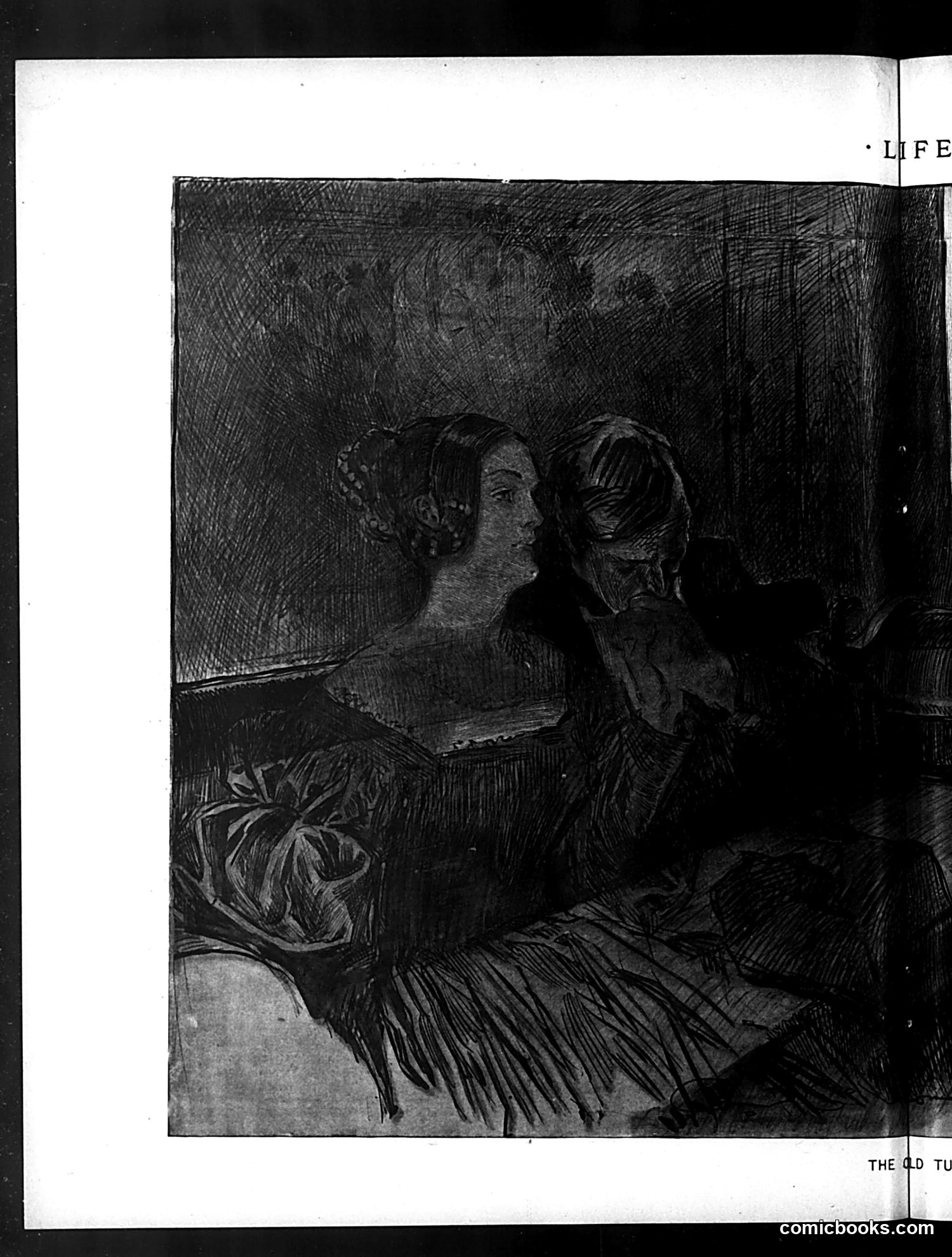
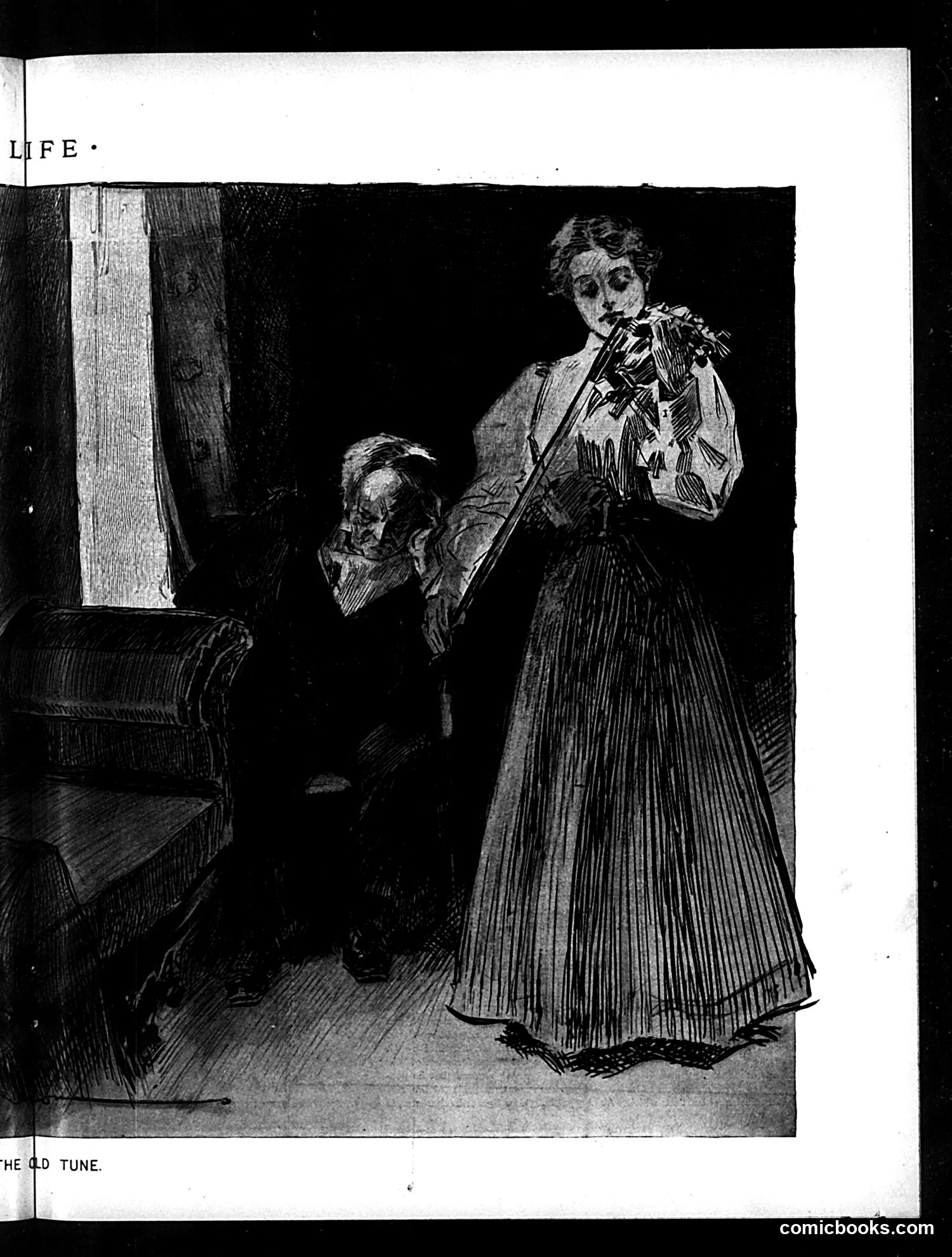
This appears to be an etching or engraving from Life magazine depicting two figures in profile seated together. The woman on the left wears an ornate dress with detailed fabric rendering, while the man on the right is rendered in darker, more heavily shadowed lines. They appear to be in an interior setting, possibly a drawing room or social setting. Without clearer identifying text or captions visible in this image, I cannot definitively identify who these figures represent or what specific political or social commentary is intended. The artistic style and composition suggest this may be satirizing a particular social relationship or public figures from the period, but I cannot assert specific identities or references with confidence based solely on what's visible here. The page appears to be a partial reproduction, which limits contextual information.
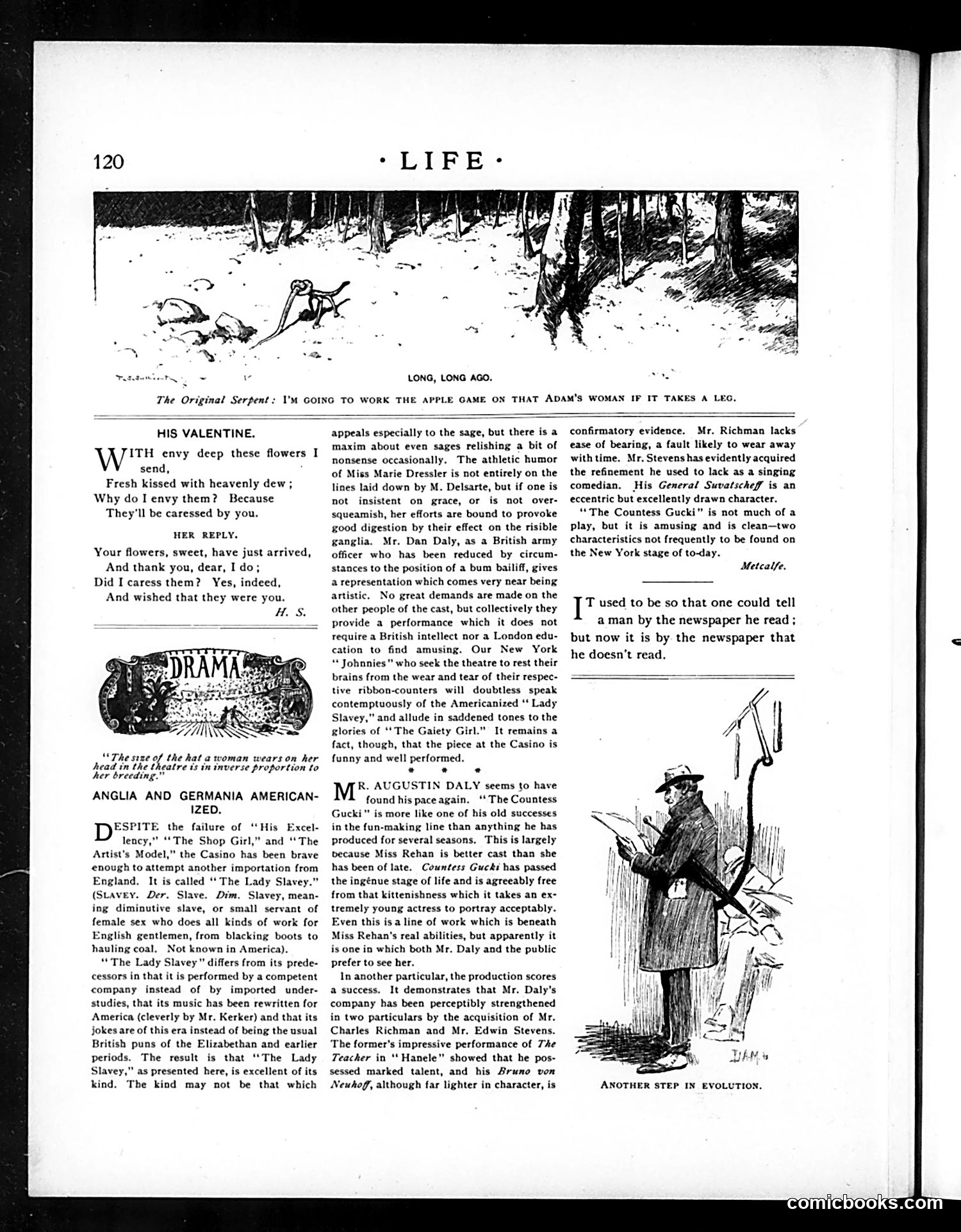
**Top Cartoon ("Long, Long Ago"):** A crude visual pun depicting the Biblical serpent approaching Eve in Eden, with the caption revealing the serpent's predatory intent toward "Adam's woman." This is satirizing the original temptation narrative as a seduction scheme—essentially a crude joke equating the Fall of Man with a pickup attempt. **"His Valentine" Section:** A sentimental poem exchange between lovers, where he sends flowers and she reciprocates with flirtation. The accompanying joke about women's theater hats mocks female vanity—a common satirical target of the era. **Theater Reviews:** The page primarily contains drama criticism. "The Lady Slavey" (an English import) is reviewed favorably despite being lowbrow entertainment. The reviewer notes it's been "Americanized" for New York audiences. "The Countess Gucki," directed by Augustin Daly, is praised for casting actress Ada Rehan in a mature role better suited to her abilities, and for featuring strong supporting actors Richman and Stevens. The page reflects *Life*'s dual mission: satirical commentary on social mores alongside entertainment criticism for educated readers.
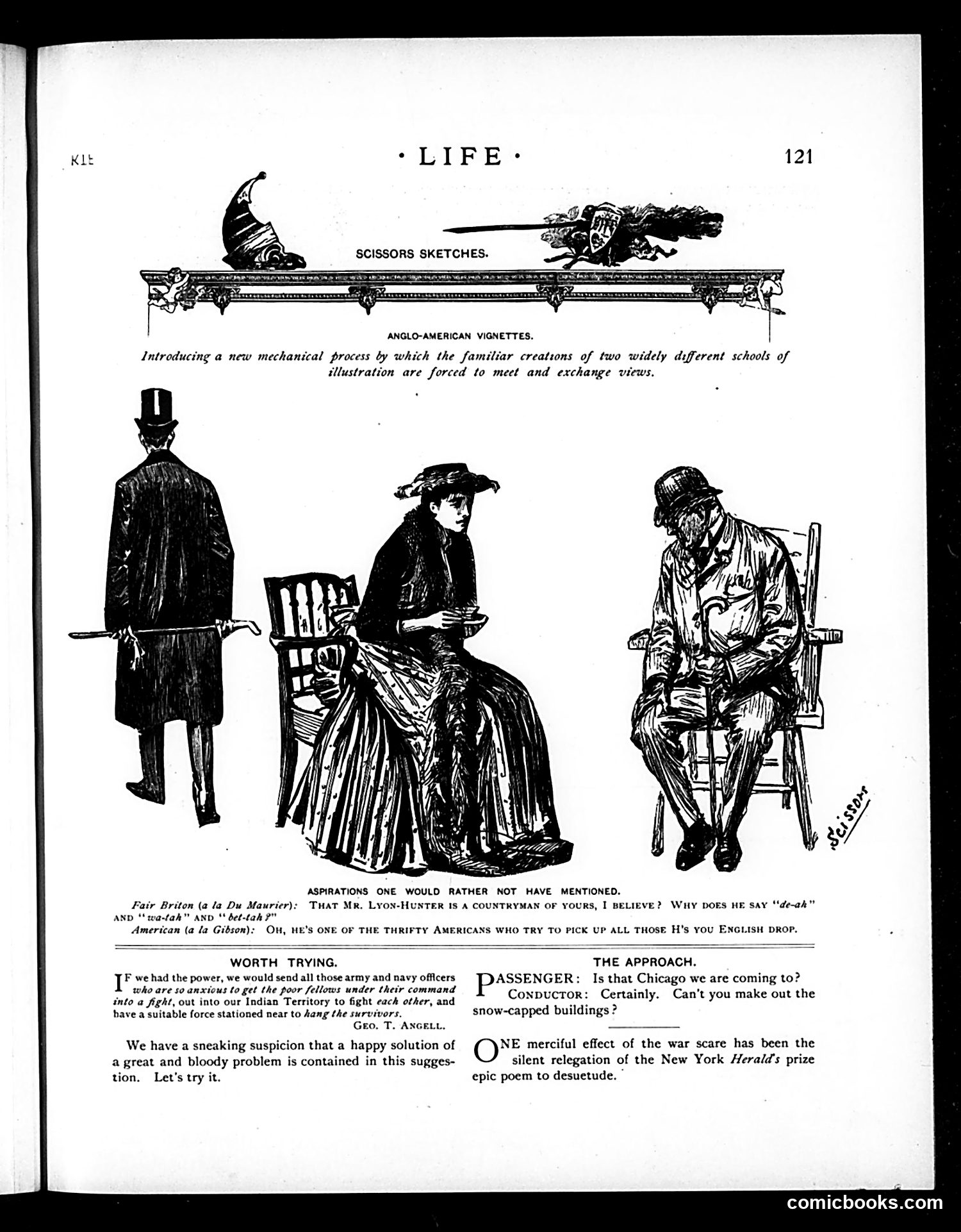
This page presents Anglo-American cultural commentary through illustrated vignettes. The top cartoon mocks accent differences: a proper English gentleman questions why an American named Lyon-Hunter affects British pronunciation ("de-ah," "wa-fah"), and the American replies that Lyon-Hunter is one of "thrifty Americans" trying to adopt the dropped H's that English speakers omit—a jab at class pretension and transatlantic affectation. Below, George T. Angell's "Worth Trying" sarcastically proposes sending war-eager naval and military officers into Indian Territory to fight each other instead of risking common soldiers' lives—dark commentary on military leadership's distance from combat consequences. "The Approach" presents a conductor's joke: a passenger mistakes Chicago's industrial buildings for snow-capped mountains, satirizing either the city's stark industrial appearance or American ignorance of geography. The page frames these as "Anglo-American vignettes" contrasting British (Du Maurier-style) and American (Gibson-style) illustration traditions meeting through satire.
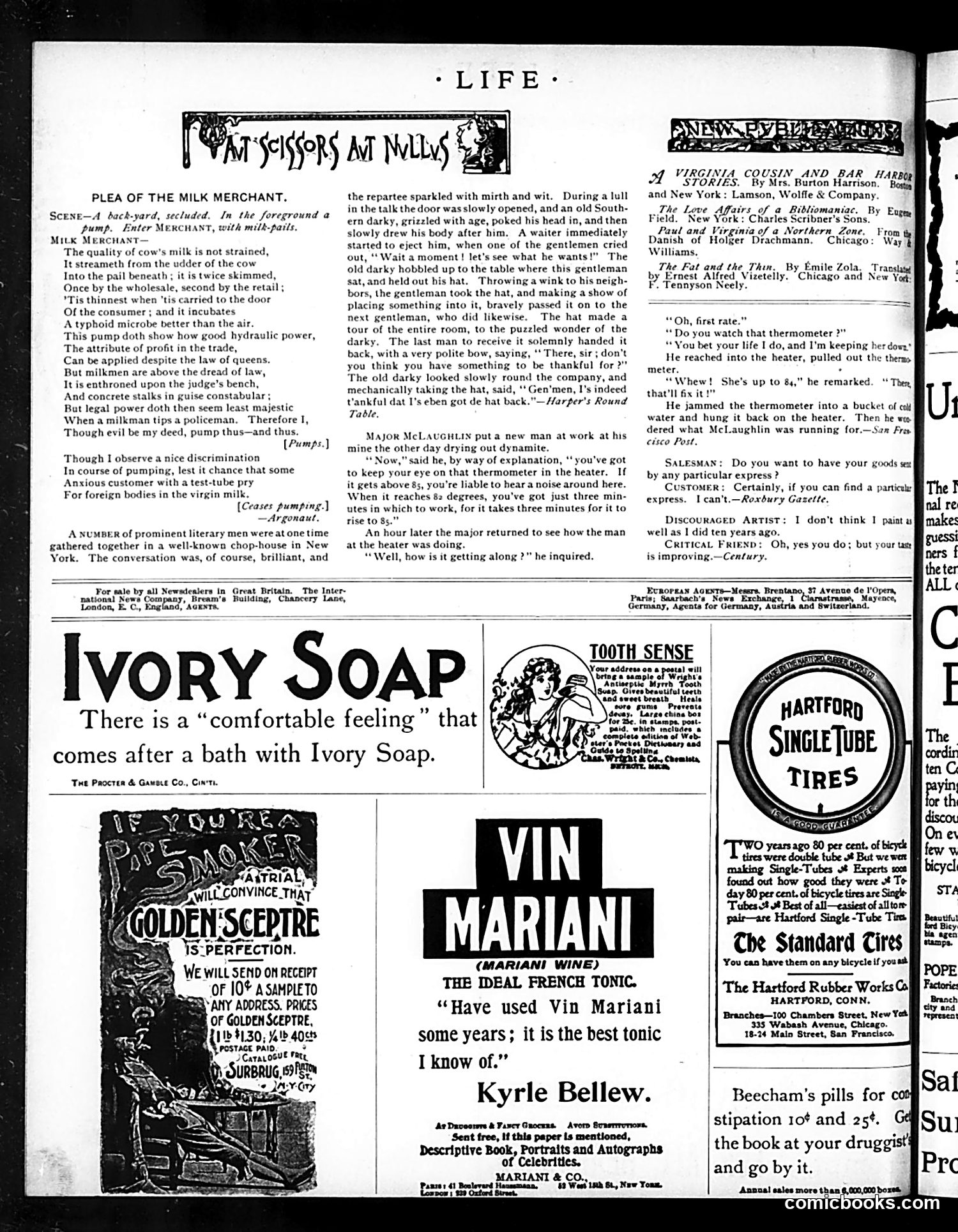
This page is primarily **advertising with satirical content** rather than political cartoons. The main satirical pieces are two humorous prose sketches: 1. **"Plea of the Milk Merchant"** — A parody of Shakespeare's *Merchant of Venice* that mocks corrupt milkmen who water down or adulterate milk using a pump. The satire targets public health concerns about contaminated milk and suggests that milkmen bribe police ("a milkman tips a policeman") to avoid prosecution. This reflects genuine Progressive Era anxieties about food safety. 2. **The Southern Darky Anecdote** — A racist sketch depicting an elderly Black man being mocked by white gentlemen who pretend to donate money to his hat while actually giving nothing. The "humor" relies on demeaning racial stereotypes common to the period. The page also contains product advertisements (Ivory Soap, Vin Mariani tonic, Hartford Tires) typical of *Life* magazine's revenue model. No specific political figures are caricatured here.
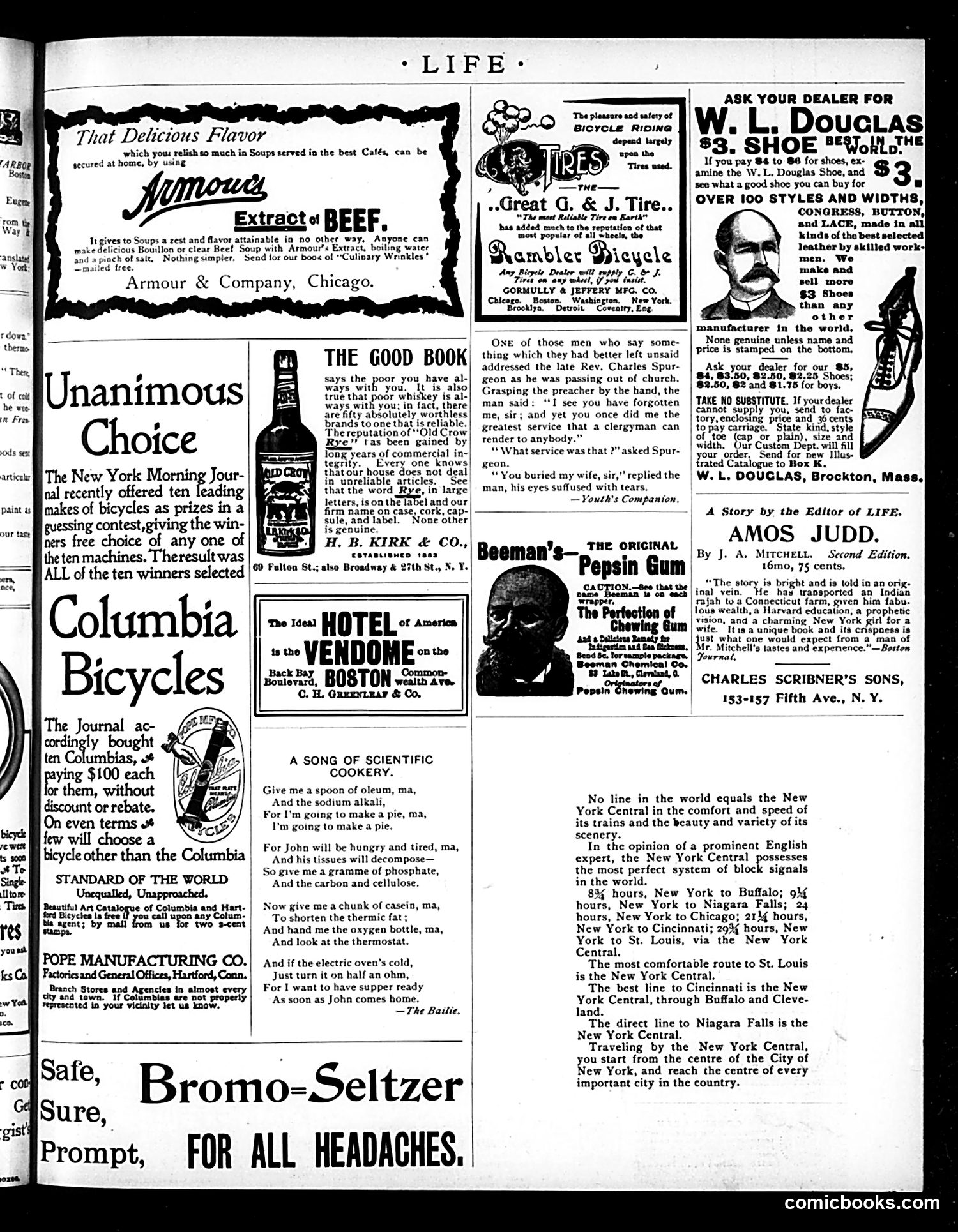
This page is primarily **advertising**, with one notable satirical poem. Key content: **"Unanimous Choice" (Columbia Bicycles)**: A puff piece claiming the New York Morning Journal's contest proved Columbia bicycles were universally preferred. This is native advertising disguised as editorial content—the modern equivalent of sponsored social media posts. **"A Song of Scientific Cookery"**: A humorous poem mocking pretentious "scientific" cooking trends of the era. It satirizes women who over-complicate homemaking by using chemistry jargon (oleum, sodium alkali, phosphate, casein, thermostat, ohms) instead of traditional cooking methods. The joke: overly intellectual cooking is absurd and unnecessary. **Other ads**: Armour beef extract, W.L. Douglas shoes, Beeman's chewing gum, and Bromo-Seltzer—typical early 1900s patent medicines and consumer goods. The anecdote about Rev. Charles Spurgeon appears to be filler text without satirical intent.
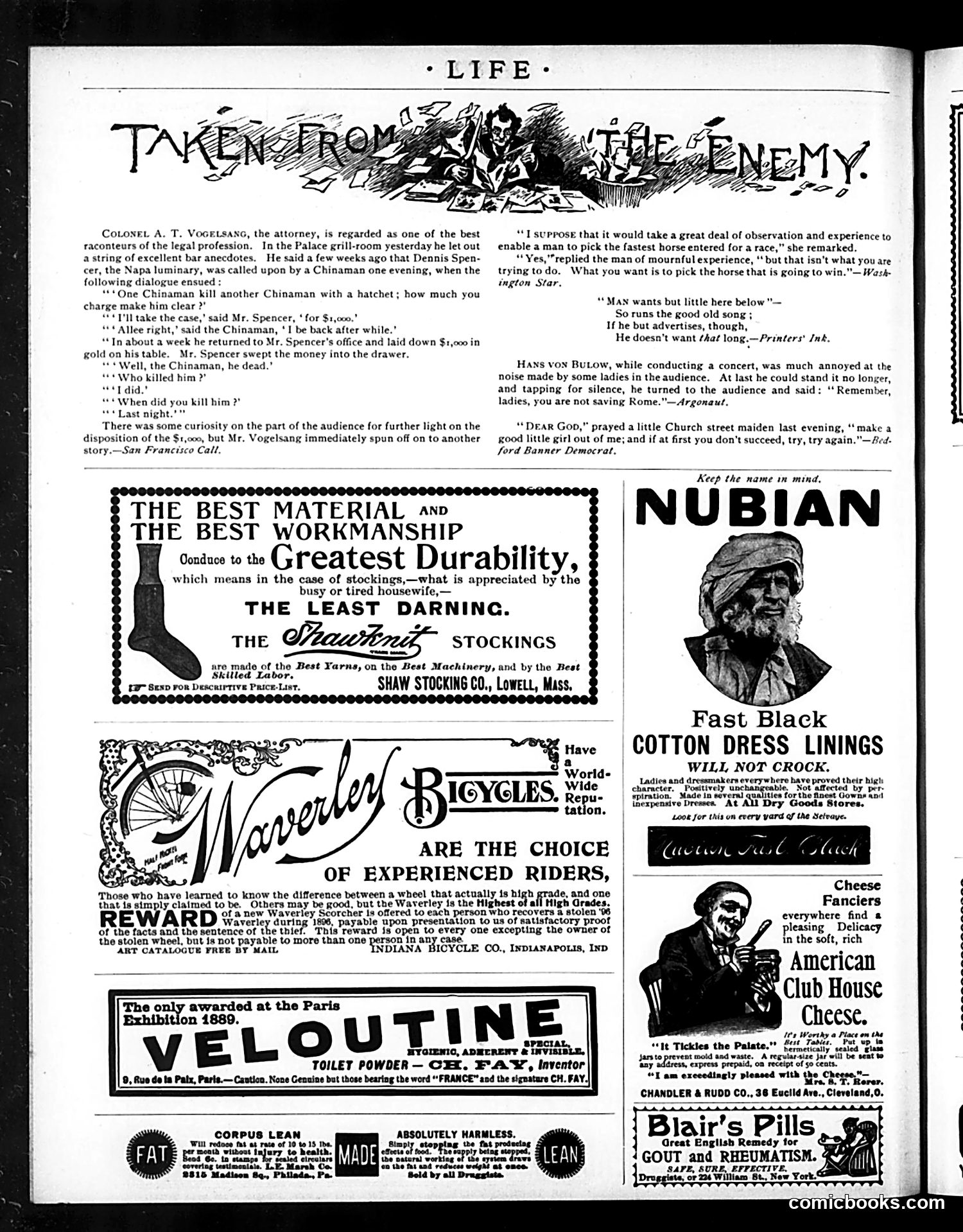
This page's main cartoon concerns attorney **Dennis Spencer's** dubious handling of a murder case. The anecdote ridicules Spencer's eagerness to accept $1,000 from a Chinese client to defend a Chinaman accused of killing another with a hatchet—only for the client to later confess *he* committed the murder himself. Spencer pockets the money anyway, raising the joke's implication: the lawyer profited from what appears to be either fraud or aiding a criminal. The satire targets **dishonest legal practices** and reflects period prejudices: the story treats Chinese immigrants as both disposable figures and comic relief. The dialogue's pidgin English stereotypes Chinese speakers. The page is otherwise **advertising** (stockings, bicycles, cheese, patent medicines), with brief inserted anecdotes (about conductor von Bülow, a child's prayer) that fill space typical of Life magazine's format.
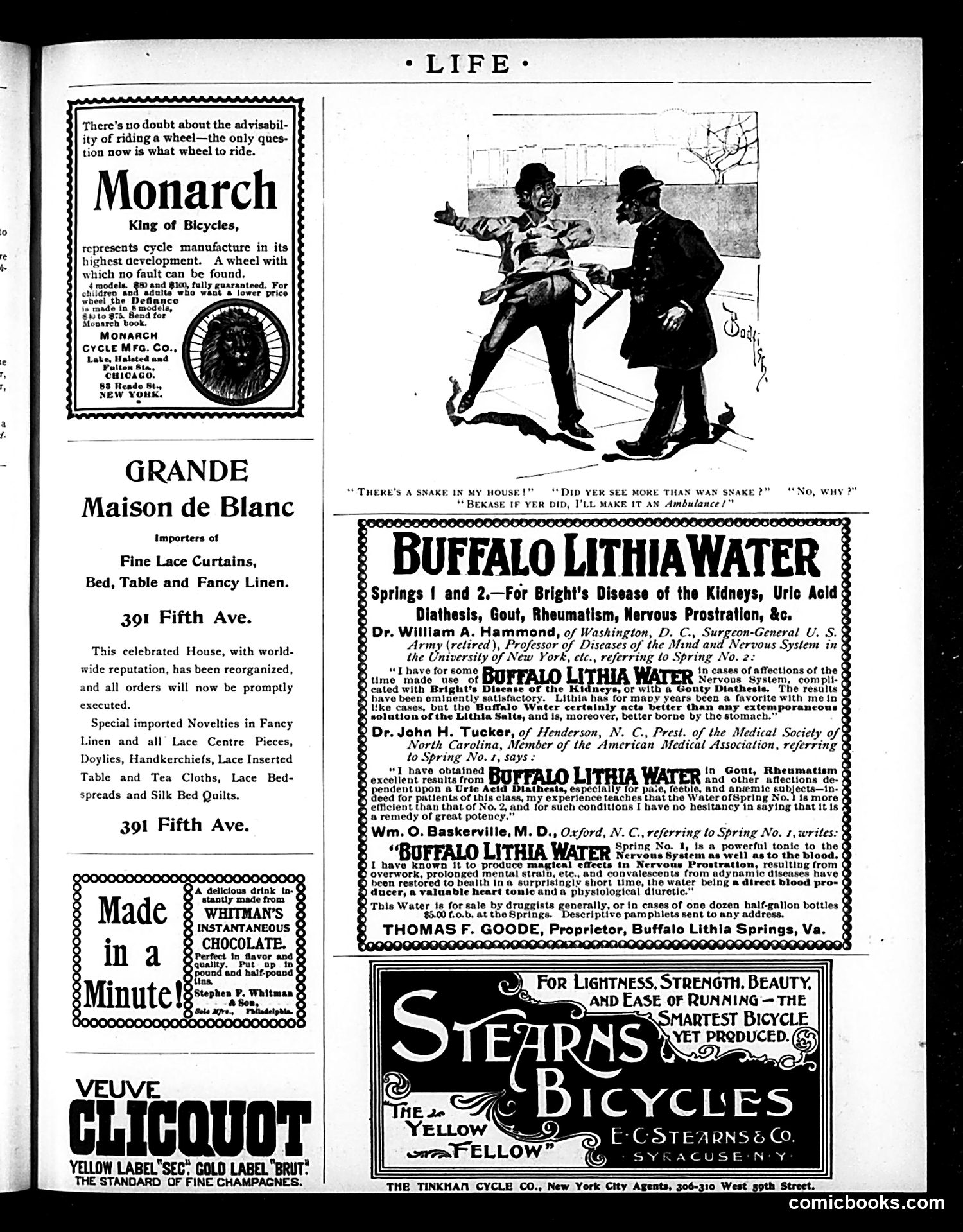
This satirical cartoon mocks a domestic dispute over a minor household incident—one person claims to have seen a snake indoors. The other responds with exaggerated concern, jokingly offering to call an ambulance if the first person actually saw something worse than a snake. The humor lies in the absurd overreaction: the threat of summoning an ambulance for witnessing a snake is comedically disproportionate. The cartoon likely satirizes contemporary anxieties about urban dangers or domestic crises, or simply ridicules how people dramatize minor household problems. The page itself is primarily **advertising**—bicycles (Monarch, Stearns), fine linens, champagne, and patent medicines dominate. The Buffalo Lithia Water ad features endorsements from doctors claiming miraculous cures for kidney disease, gout, and rheumatism—typical exaggerated medical advertising of the era. These ads reveal late-19th-century consumer culture and dubious medical claims accepted without modern regulation.
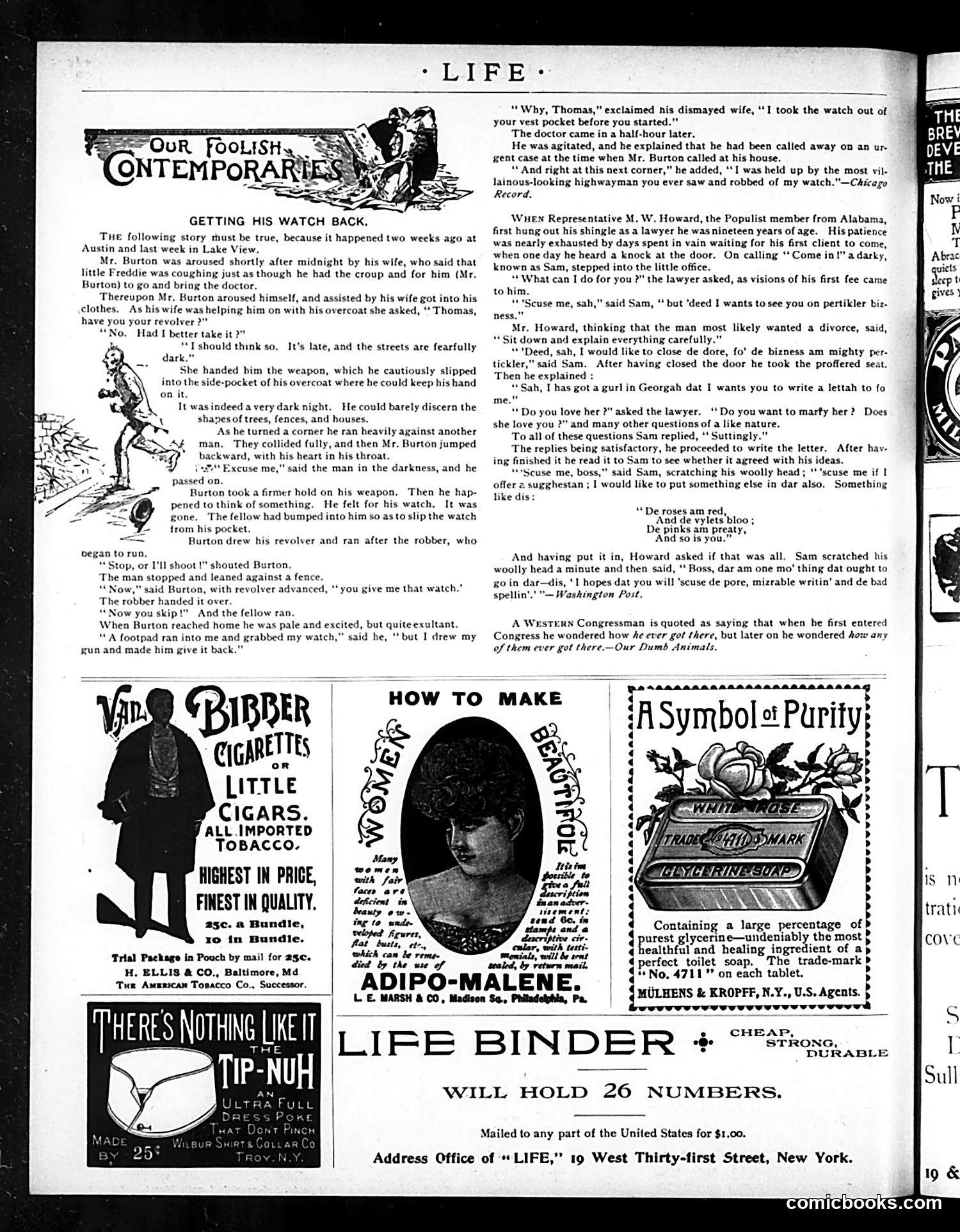
This page contains a humorous anecdote about Mr. Burton, who is awakened at midnight to fetch a doctor for his coughing child. His wife gives him a revolver for safety on the dark streets. **The joke:** While walking, Burton collides with a stranger who steals his watch. Burton chases the thief at gunpoint and forces him to return it. Triumphantly, he tells his wife he recovered the watch from a "highwayman" through armed confrontation. **The twist:** His wife then reveals she had removed the watch from his vest pocket *before* he left—meaning Burton actually robbed an innocent man at gunpoint and took back his own watch from a stranger. The humor relies on dramatic irony: Burton believes himself a hero when he's unknowingly committed a crime. The story's final detail—the doctor himself was robbed by the same "highwayman" that same night—adds circular absurdity, suggesting the innocent man Burton accosted then robbed the doctor in retaliation.
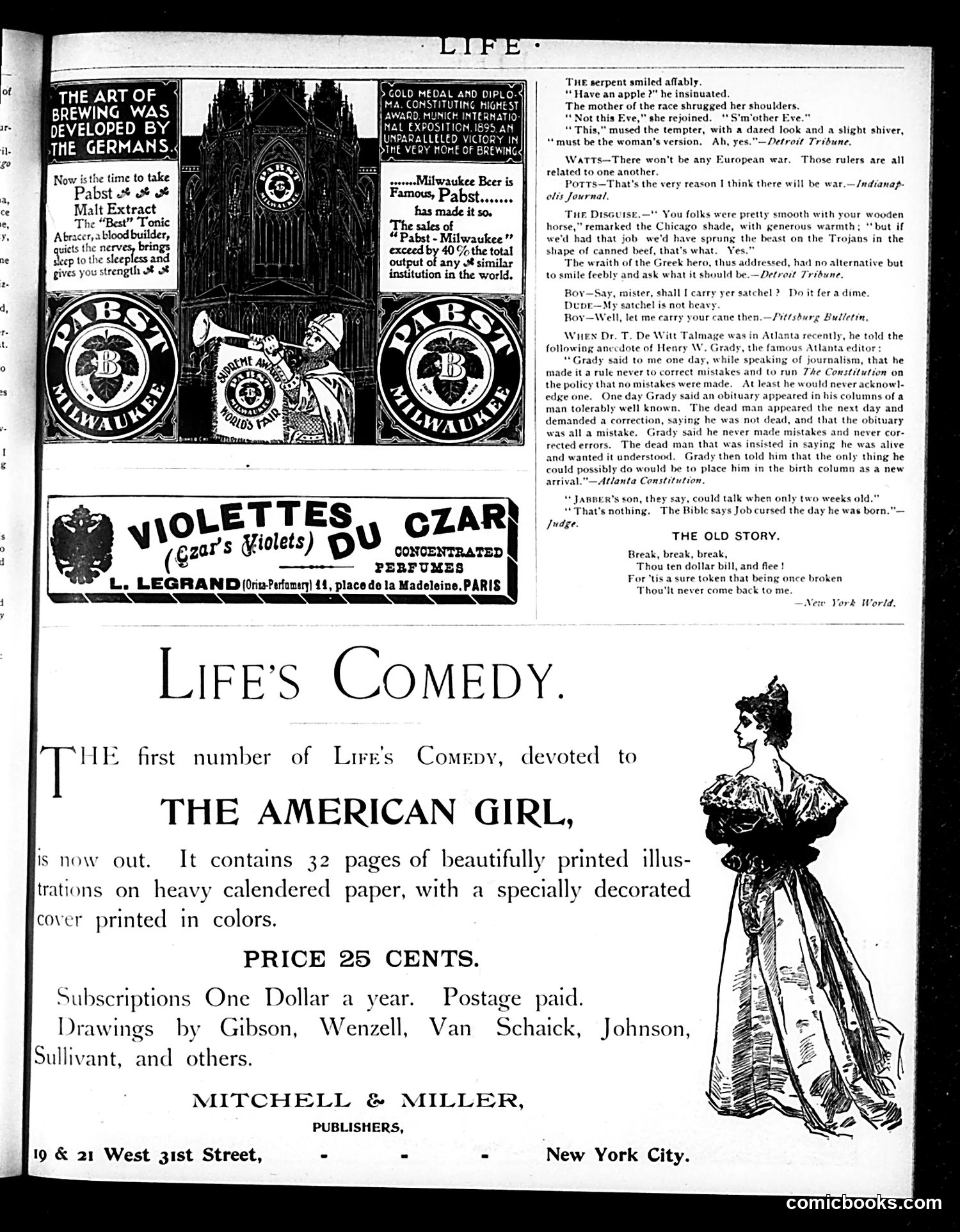
This page is primarily **advertising and promotional content** for Life magazine itself, with some short humorous anecdotes scattered throughout. The main feature advertises "Life's Comedy," a new publication devoted to "The American Girl," featuring 32 pages of illustrations by prominent artists (Gibson, Wenzell, Van Schaick, etc.). Price: 25 cents; subscriptions: $1/year. The upper left contains a **Pabst Beer advertisement** emphasizing German brewing expertise and the product's superiority. Interspersed are brief **satirical jokes and anecdotes**: one plays on the Adam and Eve story (a modern Eve rejecting temptation), another discusses European war among related monarchs, and a longer piece recounts Henry W. Grady's humorous refusal to correct a newspaper error about publishing a dead man's obituary. These represent typical Life magazine humor—urbane, topical, and literary rather than visual satire. The page reflects early 1900s advertising aesthetics and Life's identity as a sophisticated humor publication.
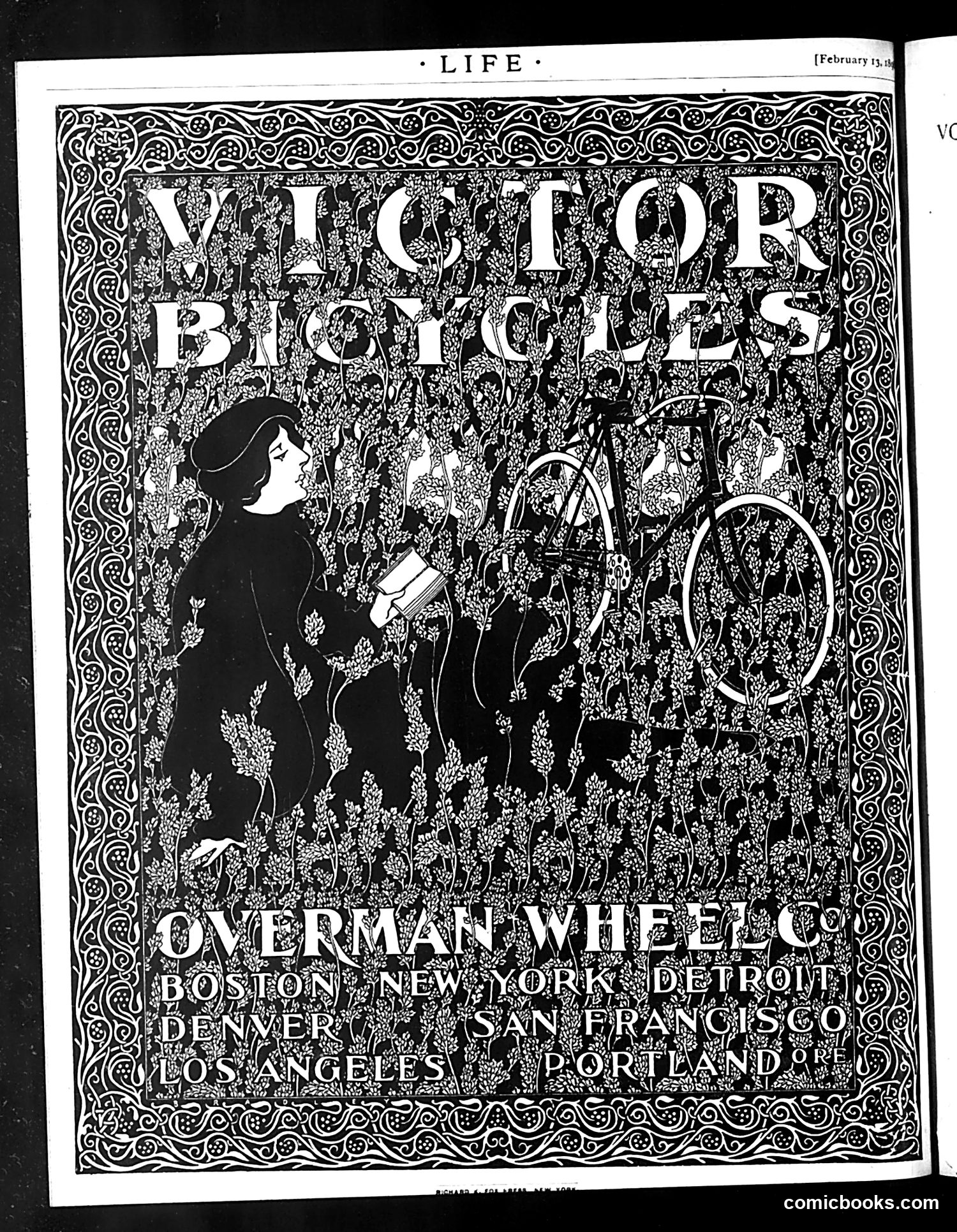
This is an advertisement for Victor Bicycles by the Overman Wheel Company, featuring locations in Boston, New York, Detroit, Denver, San Francisco, Los Angeles, and Portland. The image shows a woman in profile wearing dark clothing, reading what appears to be a book or pamphlet, with a bicycle positioned behind her in an ornate floral background. The decorative border and Art Nouveau styling suggests this is from the early 20th century. This represents bicycle marketing during the era when bicycles were gaining popularity as personal transportation and recreation, particularly among women. The educated, refined woman depicted suggests bicycles were being marketed as products for the modern, progressive woman—linking cycling to women's independence and leisure activities.