
Life, 1896-02-13 · page 12 of 20
Life — February 13, 1896 — page 12: what you’re looking at
What you’re looking at
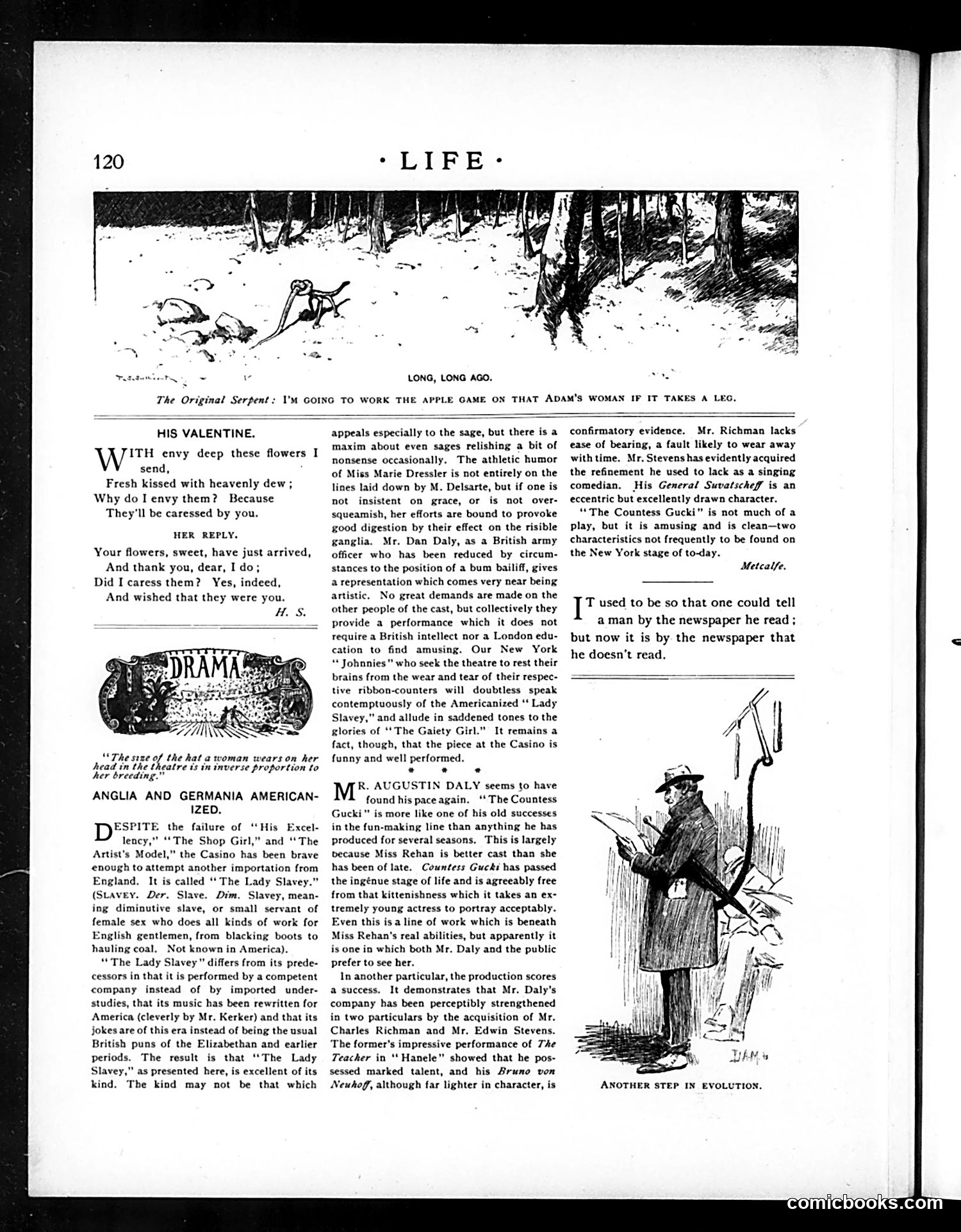
**Top Cartoon ("Long, Long Ago"):** A crude visual pun depicting the Biblical serpent approaching Eve in Eden, with the caption revealing the serpent's predatory intent toward "Adam's woman." This is satirizing the original temptation narrative as a seduction scheme—essentially a crude joke equating the Fall of Man with a pickup attempt. **"His Valentine" Section:** A sentimental poem exchange between lovers, where he sends flowers and she reciprocates with flirtation. The accompanying joke about women's theater hats mocks female vanity—a common satirical target of the era. **Theater Reviews:** The page primarily contains drama criticism. "The Lady Slavey" (an English import) is reviewed favorably despite being lowbrow entertainment. The reviewer notes it's been "Americanized" for New York audiences. "The Countess Gucki," directed by Augustin Daly, is praised for casting actress Ada Rehan in a mature role better suited to her abilities, and for featuring strong supporting actors Richman and Stevens. The page reflects *Life*'s dual mission: satirical commentary on social mores alongside entertainment criticism for educated readers.
📄 Transcribed text from this page (OCR, searchable)
Machine-transcribed from the original scan — historical spelling and the odd misread are preserved.
LONG, LONG AGO. The Original Serpent: VM GOING TO WORK THE APPLE GAME ON THAT ADAM'S WOMAN IF IT TAKES A LI HIS VALENTINE. ITH envy deep these flowers I send, Fresh kissed with heavenly dew ; Why do lenvy them? Because They'll be caressed by you. HER REPLY. Your flowers, sweet, have just arrived, And thank you, dear, I do; Did I caress them? Yes, indeed, And wished that they were you. “The size of the hat a woman wears on her head in the theatre is in inverse proportion to her breeding.” ANGLIA AND GERMANIA AMERICAN- IZED. ESPITE the failure of “His Excel- lency,” ‘*The Shop Girl,” and “The Artist's Model,” the Casino has been brave enough to attempt another importation from England. It is called ‘* The Lady Slavey. (Stavey. Der. Slave. Dim. Slavey, mean- ing diminutive slave, or small servant of female sex who does all kinds of work for English gentlemen, from blacking boots to hauling coal, Not known in America). “The Lady Slavey” differs from its prede- cessors in that it is performed by a competent company instead of by imported under- studies, that its music has been rewritten for America (cleverly by Mr. Kerker) and that its jokes are of this era instead of being the usual British puns of the Elizabethan and earlier periods. The result is that ‘The Lady Slavey,” as presented here, is excellent of its kind. The kind may not be that which appeals especially to the sage, but there is a maxim about even sages relishing a bit of nonsense occasionally, The athletic humor of Miss Marie Dressler is not entirely on the lines laid down by M. Delsarte, but if one is not insistent on grace, or is not over- squeamish, her efforts are bound to provoke good digestion by their effect on the risible ganglia. Mr. Dan Daly, as a British army officer who has been reduced by circum- stances to the position of a bum bailiff, gives a representation which comes very near being artistic. No great demands are made on the other people of the cast, but collectively they provide a performance which it does not require a British intellect nor a London edu- cation to find amusing. Our New York “* Johnnies” who seek the theatre to rest their brains from the wear and tear of their respec- tive ribbon-counters will doubtless speak contemptuously of the Americanized ‘* Lady Slavey,” and allude in saddened tones to the glories of *‘ The Gaiety Girl.” It remains a fact, though, that the piece at the Casino is funny and well performed. * * R. AUGUSTIN DALY seems to have found his pace again. ‘ The Countess Gucki" is more like one of his old successes in the fun-making line than anything he has produced for several seasons, This is largely because Miss Rehan is better cast than she has been of late. Countess Gucks has passed the ingénue stage of life and is agreeably free from that kittenishness which it takes an ex- tremely young actress to portray acceptably. Even this isa line of work which is beneath Miss Rehan’s real abilities, but apparently it is one in which both Mr. Daly and the public prefer to see her. In another particular, the production scores a success. It demonstrates that Mr. Daly's company has been perceptibly strengthened in two particulars by the acquisition of Mr. Charles Richman and Mr, Edwin Stevens. ‘The former's impressive performance of The Teacher in ‘‘ Hanele” showed that he pos- sessed marked talent, and his Aruno von Neuho, although far lighter in character, is confirmatory evidence. Mr, Richman lacks ease of bearing, a fault likely to wear away with time. Mr, Stevens has evidently acquired the refinement he used to lack as a singing comedian. His General Suvatschef is an eccentric but excellently drawn character. “The Countess Gucki" is not much of a play, but it is amusing and is clean—two characteristics not frequently to be found on the New York stage of to-day. Metcalfe. T used to be so that one could tell aman by the newspaper he read ; but now it is by the newspaper that he doesn’t read. ANOTHER STEP IN EVOLUTION,