
Life, 1896-02-13 · page 9 of 20
Life — February 13, 1896 — page 9: what you’re looking at
What you’re looking at
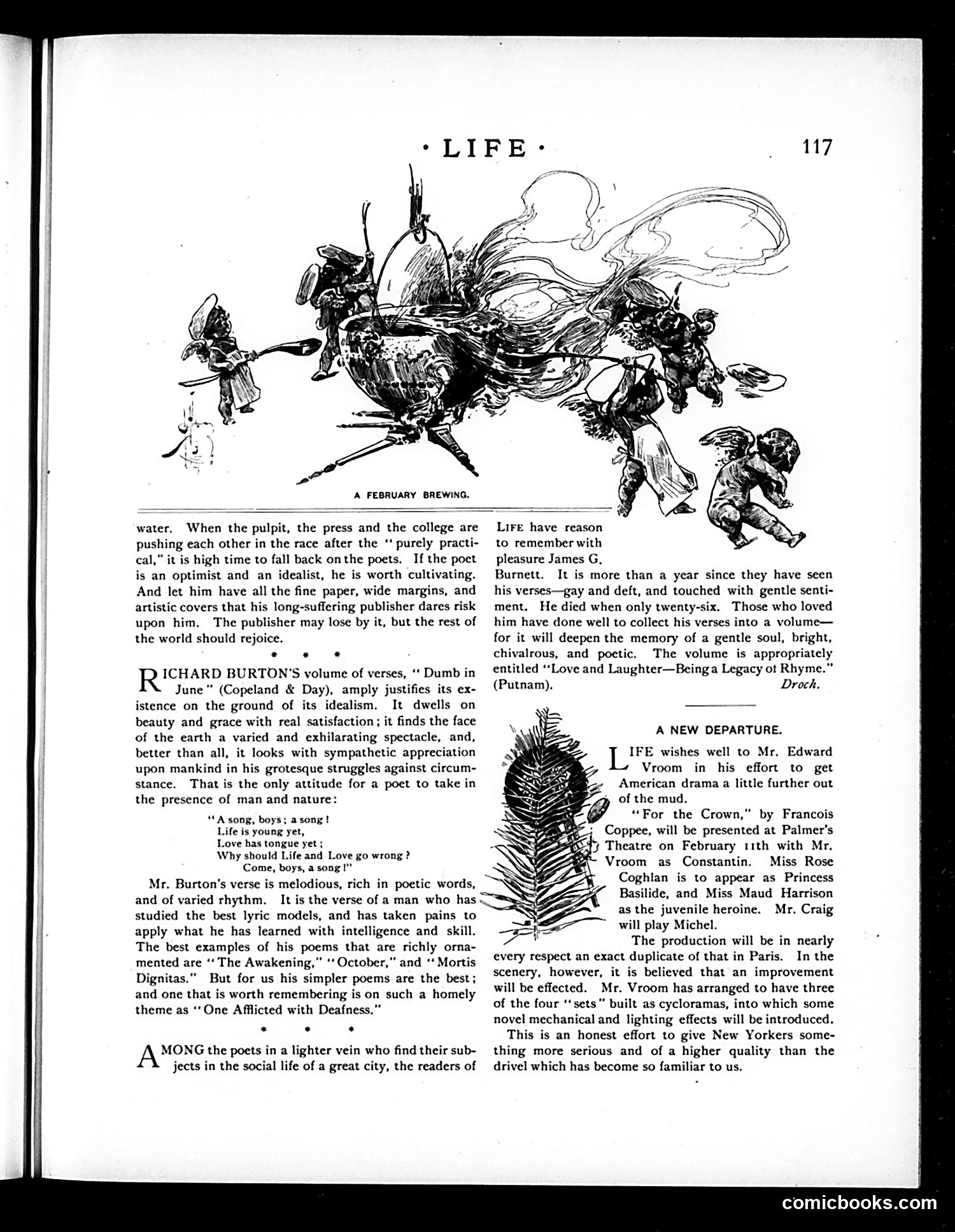
This cartoon depicts allegorical figures—likely representing literary and artistic forces or publications—engaged in frenzied activity around a central cauldron or vessel. The swirling, energetic composition suggests creative chaos or competition. The accompanying text discusses Richard Burton's poetry volume "Dumb in Jane" and James G. Burnett's verses, praising poets who address social life and human struggles with sympathy. The page also announces Edward Vroom's theatrical production "For the Crown" at Palmer's Theatre, featuring innovative mechanical and lighting effects. The cartoon's title "A February Brewing" likely refers to this ferment of cultural activity—theatrical productions, poetry publications, and artistic competition—happening simultaneously in New York's literary and theatrical world.
📄 Transcribed text from this page (OCR, searchable)
Machine-transcribed from the original scan — historical spelling and the odd misread are preserved.
A FEBRUARY BREWING. water. When the pulpit, the press and the college are pushing each other in the race after the ‘* purely practi- cal,” it is high time to fall back onthe poets. If the poct is an optimist and an idealist, he is worth cultivating. And let him have all the fine paper, wide margins, and artistic covers that his long-suffering publisher dares risk upon him, The publisher may lose by it, but the rest of the world should rejoice. eo 8 * ‘ ICHARD BURTON'S volume of verses, ‘* Dumb in June” (Copeland & Day), amply justifies its ex- istence on the ground of its idealism. It dwells on beauty and grace with real satisfaction; it finds the face of the earth a varied and exhilarating spectacle, and, better than all, it looks with sympathetic appreciation upon mankind in his grotesque struggles against circum- stance. That is the only attitude for a poet to take in the presence of man and nature: “A song, boys; asong! Life is young yet, Love has tongue yet ; Why should Life and Love go wrong ? Come, boys, a song!” Mr. Burton's verse is melodious, rich in poetic words, and of varied rhythm. studied the best lyric models, and has taken pains to apply what he has learned with intelligence and_ skill. The best examples of his poems that are richly orna- mented are ‘‘ The Awakening,” ‘‘ October,” and ‘ Mortis Dignitas.” But for us his simpler poems are the best; and one that is worth remembering is on such a homely theme as ‘One Afflicted with Deafness.” . . . AMONG the poets in a lighter vein who find their sub- jects in the social life of a great city, the readers of It is the verse of a man who has ~ Lire have reason to remember with pleasure James G, Burnett. It is more than a year since they have seen his verses—gay and deft, and touched with gentle senti- ment. He died when only twenty-six. Those who loved him have done well to collect his verses into a volume— for it will deepen the memory of a gentle soul, bright, chivalrous, and poetic. The volume is appropriately entitled ‘‘Love and Laughter—Beinga Legacy ot Rhyme.” (Putnam). Droch, A NEW DEPARTURE. IFE wishes well to Mr. Edward Vroom in his effort to get American drama a little further out of the mud. “For the Crown,” by Francois Coppee, will be presented at Palmer's ry Theatre on February 11th with Mr. Vroom as Constantin, Miss Rose Coghlan is to appear as Princess Basilide, and Miss Maud Harrison SY as the juvenile heroine. Mr. Craig = will play Michel. The production will be in nearly every respect an exact duplicate of that in Paris. In the scenery, however, it is believed that an improvement will be effected. Mr. Vroom has arranged to have three of the four ‘‘sets” built as cycloramas, into which some novel mechanical and lighting effects will be introduced. This is an honest effort to give New Yorkers some- thing more serious and of a higher quality than the drivel which has become so familiar to us. comicbooks.com