
Life, 1896-02-13 · page 8 of 20
Life — February 13, 1896 — page 8: what you’re looking at
What you’re looking at
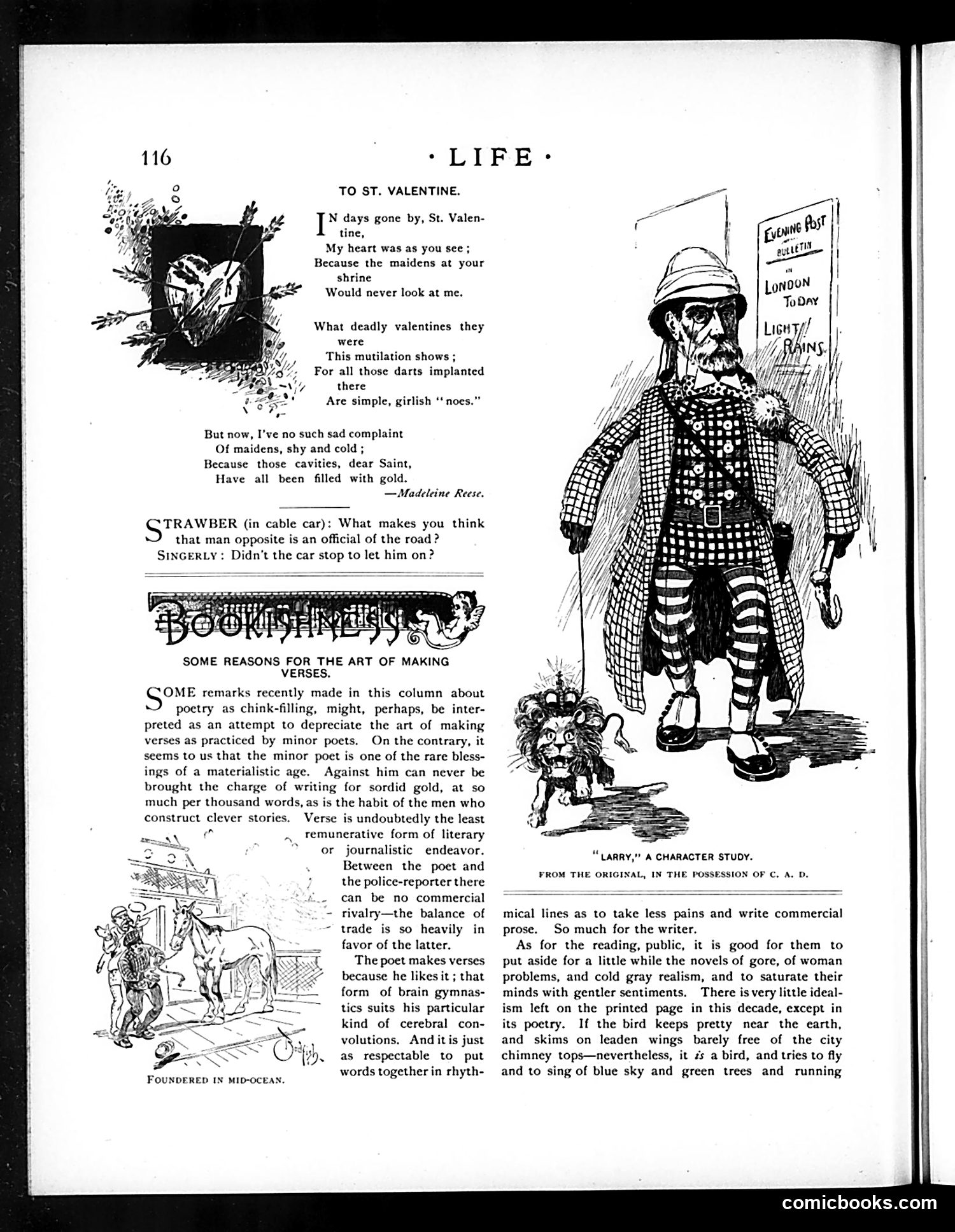
This page contains several distinct elements: **"To St. Valentine"** — A poem by Madeline Reese criticizing the tradition of valentine's day gifts, particularly darts and thorns ("girish noes") that men receive from women, contrasted with modern valentines filled with gold. **"Strawber in Cable Car"** — A brief dialogue joke about mistaking someone for a road official. **"Some Reasons for the Art of Making Verses"** — An essay defending poetry as a legitimate literary form against claims it's merely a commercial endeavor, arguing poets deserve respect for their cerebral work, even if less remunerative than prose writing. **Illustrations** include period sketches: a character study labeled "Larry" showing a costumed figure with a small dog, and smaller vignettes depicting various scenes. The overall theme advocates for poetry's artistic and intellectual value in early 20th-century American culture.
📄 Transcribed text from this page (OCR, searchable)
Machine-transcribed from the original scan — historical spelling and the odd misread are preserved.
- LIFE: TO ST. VALENTINE. N days gone by, St. Valen- tine, My heart was as you see ; Because the maidens at your shrine Would never look at me, What deadly valentines they were This mutilation shows ; For all those darts implanted there Are simple, girlish ‘ noes.” But now, I’ve no such sad complaint Of maidens, shy and cold ; Because those cavities, dear Saint, Have all been filled with gold. —Madeleine Reese. TRAWBER (in cable car): What makes you think that man opposite is an official of the road ? SINGERLY: Didn't the car stop to let him on? SOME REASONS FOR THE ART OF MAKING VERSES. ~OME remarks recently made in this column about poetry as chink-filling, might, perhaps, be inter- preted as an attempt to depreciate the art of making verses as practiced by minor poets. On the contrary, it seems to us that the minor poet is one of the rare bless- ings of a materialistic age. Against him can never be brought the charge of writing for sordid gold, at so much per thousand words, as is the habit of the men who construct clever stories, Verse is undoubtedly the least remunerative form of literary or journalistic endeavor. Between the poet and the police-reporter there can be no commercial rivalry—the balance of trade is so heavily in favor of the latter. The poet makes verses because he likes it ; that form of brain gymnas- tics suits his particular kind of cerebral con- volutions, And itis just as respectable to put words together in rhyth- FOUNDERED IN MID-OCEAN. ““ LARRY," A CHARACTER STUDY. FROM THE ORIGINAL, IN THE POSSESSION OF C. A. D. mical lines as to take less pains and write commercial prose. So much for the writer. As for the reading, public, it is good for them to put aside for a little while the novels of gore, of woman problems, and cold gray realism, and to saturate their minds with gentler sentiments. There is very little ideal- ism left on the printed page in this decade, except in its poetry. If the bird keeps pretty near the earth, and skims on leaden wings barely free of the city chimney tops—nevertheless, it #s a bird, and tries to fly and to sing of blue sky and green trees and running comicbooks.com