
Life, 1896-02-13 · page 4 of 20
Life — February 13, 1896 — page 4: what you’re looking at
What you’re looking at
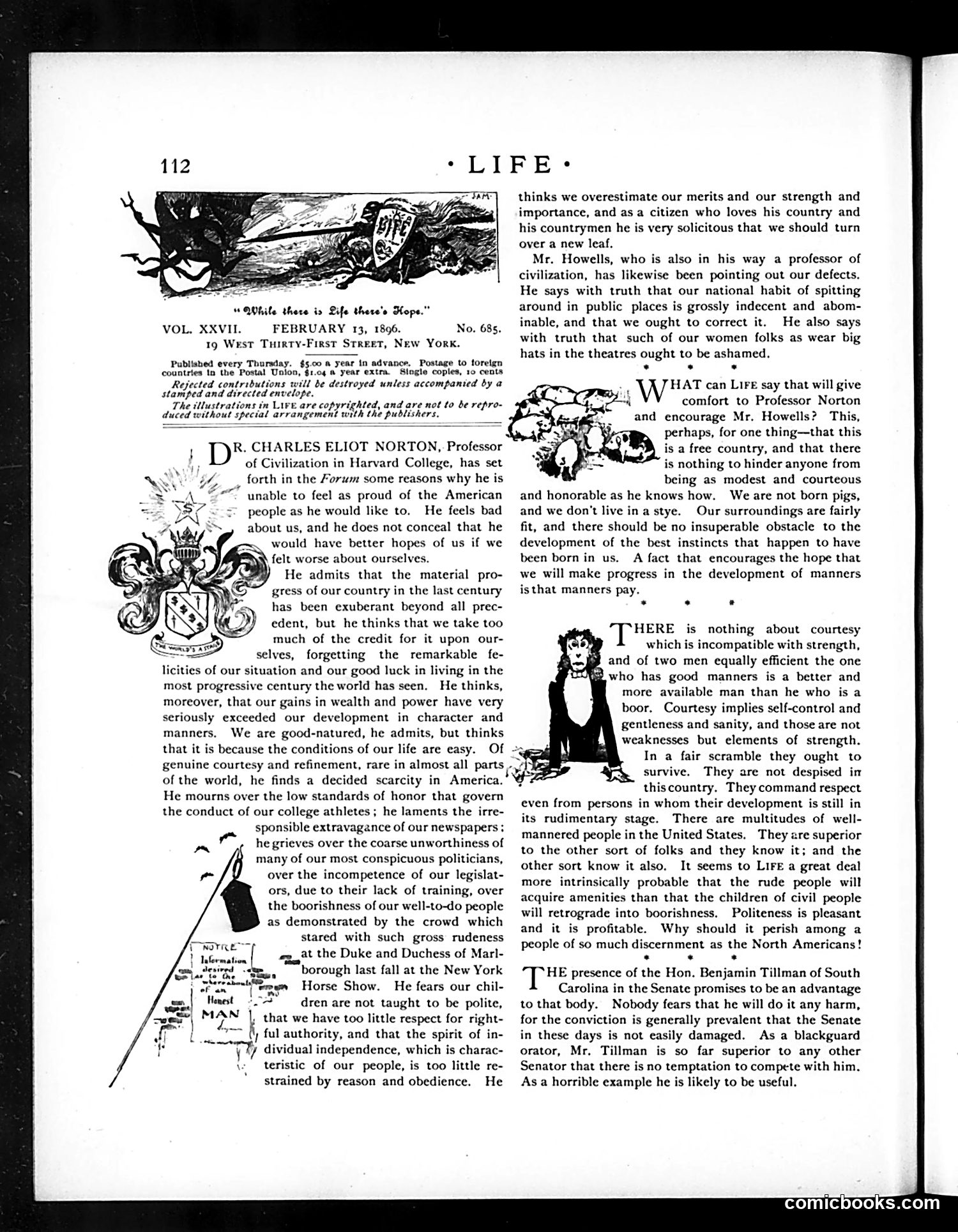
The page features an editorial by Dr. Charles Eliot Norton, a Harvard professor, critiquing American social behavior and manners. The text argues that Americans are overly confident in their merits while lacking proper courtesy and refinement—particularly regarding public behavior in theaters and spitting. The small cartoon at bottom left appears to satirize American rudeness and lack of obedience to authority, depicting a figure labeled "MAN" in contrast to refined conduct. The editorial praises courtesy as compatible with strength and cites Senator Benjamin Tillman of South Carolina as an example of a blackguard orator whose conduct demonstrates how poor manners can damage one's credibility, even among politicians. The piece advocates that good manners represent strength, not weakness, and benefit national development.
📄 Transcribed text from this page (OCR, searchable)
Machine-transcribed from the original scan — historical spelling and the odd misread are preserved.
LIFE “While there is Life there's Hope.” VOL, XXVII. FEBRUARY 13, 1896. No. 685. 1g West Tuirty-First Street, New York. Published every Thursday. $$.00 a year in advance. Postage to foreign countries In the Postal Union, $1.04 @ year extra. Stogle coples, 10 cents Rejected contributions will be destroyed unless accompanied by a stamped and directed envelope. The illustrations in Live are copyrighted, and are not to be repro- duced without special arrangement with the publishers. R. CHARLES ELIOT NORTON, Professor ivilization in Harvard College, has set forth in the Forum some reasons why he is * unable to feel as proud of the American people as he would like to. He feels bad about us, and he does not conceal that he ~ would have better hopes of us if we felt worse about ourselves. He admits that the material pro- gress of our country in the last century has been exuberant beyond all prec- edent, but he thinks that we take too much of the credit for it upon our- selves, forgetting the remarkable fe- licities of our situation and our good luck in living in the most progressive century the world has seen. He thinks, moreover, that our gains in wealth and power have very seriously exceeded our development in character and manners. We are good-natured, he admits, but thinks that it is because the conditions of our life are easy. Of - genuine courtesy and refinement, rare in almost all parts of the world, he finds a decided scarcity in America. ee He mourns over the low standards of honor that govern the conduct of our college athletes ; he laments the irre- sponsible extravagance of our newspapers ; ~ - he grieves over the coarse unworthiness of many of our most conspicuous politicians, over the incompetence of our legislat- ors, due to their lack of training, over the boorishness of our well-to-do people as demonstrated by the crowd which stared with such gross rudeness #2,%t the Duke and Duchess of Marl- borough last fall at the New York He fears our chil- dren are not ‘taught to be polite, ; that we have too little respect for right- a ful authority, and that the spirit of in- ra dividual independence, which is charac- \ teristic of our people, is too little re- strained by reason and obedience. He thinks we overestimate our merits and our strength and importance, and as a citizen who loves his country and his countrymen he is very solicitous that we should turn over a new leaf. Mr. Howells, who is also in his way a professor of civilization, has likewise been pointing out our defects. He says with truth that our national habit of spitting around in public places is grossly indecent and abom- inable, and that we ought to correct it. He also says with truth that such of our women folks as wear big hats in the theatres ought to be ashamed. . . . HAT can Lire say that will give comfort to Professor Norton and encourage Mr. Howells? This, perhaps, for one thing—that this is a free country, and that there is nothing to hinder anyone from being as modest and courteous and honorable as he knows how. We are not born pigs, and we don't live in a stye. Our surroundings are fairly fit, and there should be no insuperable obstacle to the development of the best instincts that happen to have been born in us. A fact that encourages the hope that we will make progress in the development of manners isthat manners pay. . . * HERE is nothing about courtesy which is incompatible with strength, and of two men equally efficient the one who has good manners is a better and more available man than he who is a boor. Courtesy implies self-control and gentleness and sanity, and those are not weaknesses but elements of strength. In a fair scramble they ought to survive. They are not despised in thiscountry. They command respect even from persons in whom their development is still in its rudimentary stage. There are multitudes of well- mannered people in the United States. They are superior to the other sort of folks and they know it; and the other sort know it also. It seems to LIFE a great deal more intrinsically probable that the rude people will acquire amenities than that the children of civil people will retrograde into boorishness. Politeness is pleasant and it is profitable. Why should it perish among a people of so much discernment as the North Americans! . . . HE presence of the Hon. Benjamin Tillman of South Carolina in the Senate promises to be an advantage to that body. Nobody fears that he will do it any harm, for the conviction is generally prevalent that the Senate in these days is not easily damaged. As a blackguard orator, Mr, Tillman is so far superior to any other Senator that there is no temptation to compete with him. As a horrible example he is likely to be useful. comicbooks.com