
A complete issue · 20 pages · 1896
Life — February 6, 1896
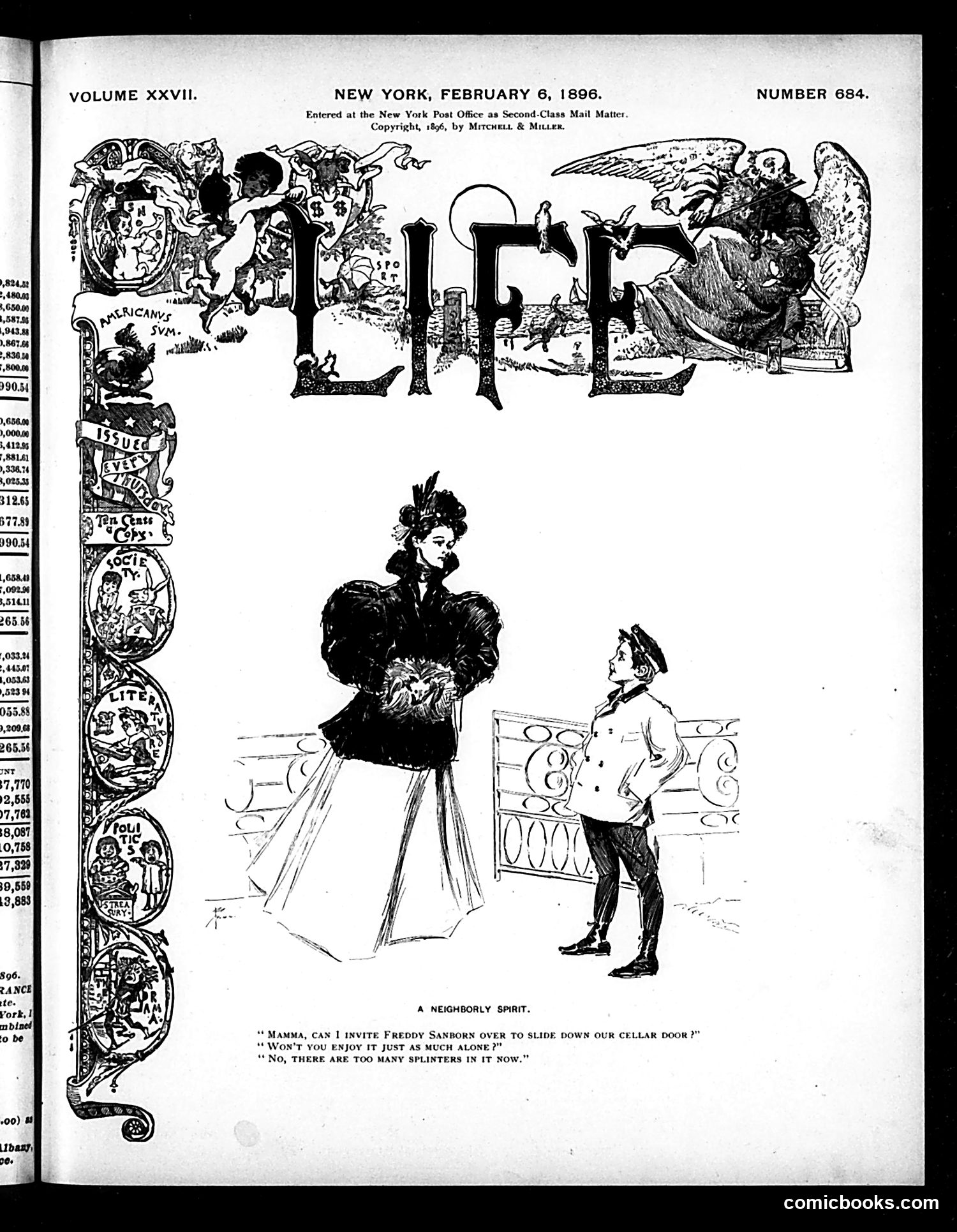
This cartoon depicts a social interaction between two figures on what appears to be a balcony or terrace. The caption reads: "Mama, I want to slide down our banisters to slide down our cellar door!" / "Won't you enjoy it just as much alone?" / "No, there are too many splinters in it now." The humor appears to center on childhood mischief and parental concern. The adult (likely a mother) suggests the child enjoy the activity alone, implying the dangerous or destructive nature of the activity. The child's response about "splinters" suggests previous damage or wear from repeated use—possibly hinting that neighborhood children have already damaged the bannister through similar play. The satire likely comments on common childhood behaviors and parental attitudes toward supervision and safety during the Victorian era.
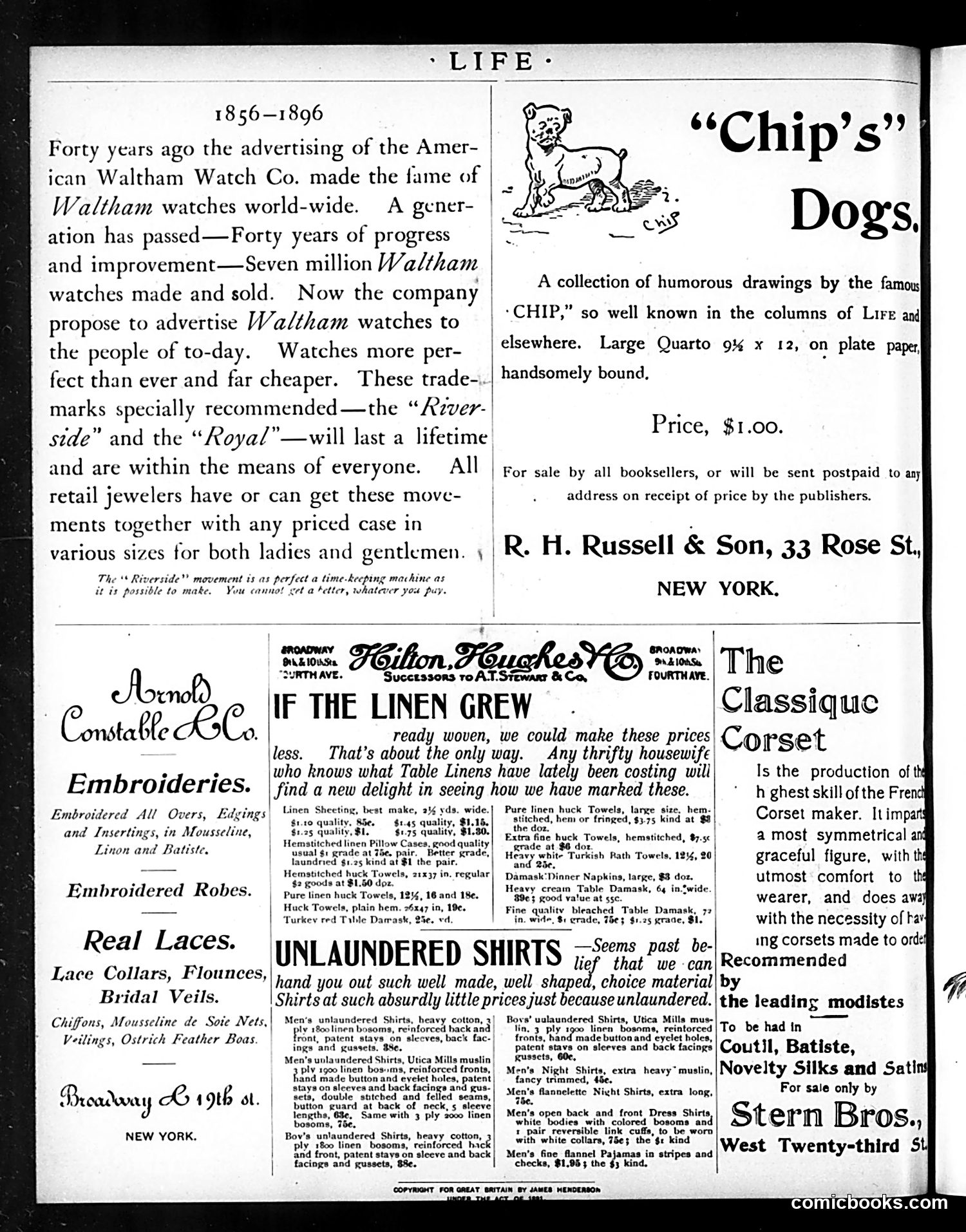
This page is primarily **advertising**, not political satire. The main content features: 1. **"Chip's Dogs"** — A book advertisement for humorous dog drawings by "Chip," a cartoonist known for contributions to *Life* magazine. It's a collection of dog illustrations, priced at $1.00, sold by R.H. Russell & Son in New York. 2. **Other advertisements** dominate the page: Waltham watches, Arnold Constable embroideries and laces, Halton Hosiery unlaundered shirts, and The Classique Corset. The small cartoon at top shows a simple, whimsical dog drawing — typical of the humorous style advertised. This is a commercial, not editorial page, reflecting *Life*'s role as both satirical magazine and advertising vehicle in the 1890s.
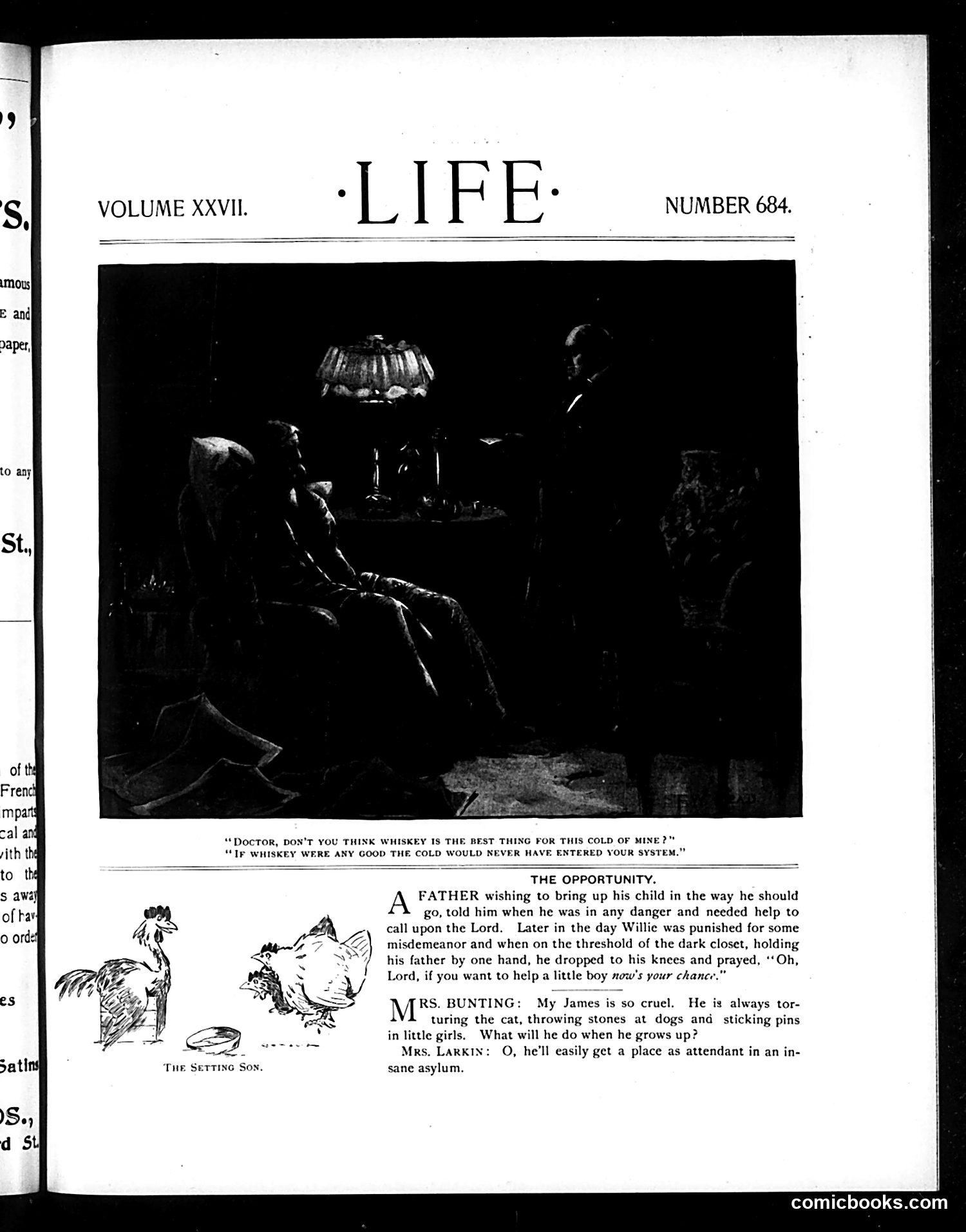
This page contains two distinct pieces: **Top Image**: A dramatic nighttime scene showing figures in conversation, with a caption about whiskey and cold remedy. The theatrical lighting and composition suggest this illustrates a dramatic or humorous domestic scenario about folk medicine practices. **Bottom Section**: "The Opportunity" presents a moral dialogue between two women—Mrs. Hunting and Mrs. Larkin—discussing child-rearing philosophy. Mrs. Hunting worries her son James is cruel (tormenting animals), while Mrs. Larkin grimly suggests he'll simply "get a place as attendant in an insane asylum." **"The Sitting Son"**: A small illustrative comic featuring a rooster and hen. The page satirizes both folk remedies and parenting anxieties of the era, using dark humor to critique both medical superstition and social attitudes toward behavioral problems in children.
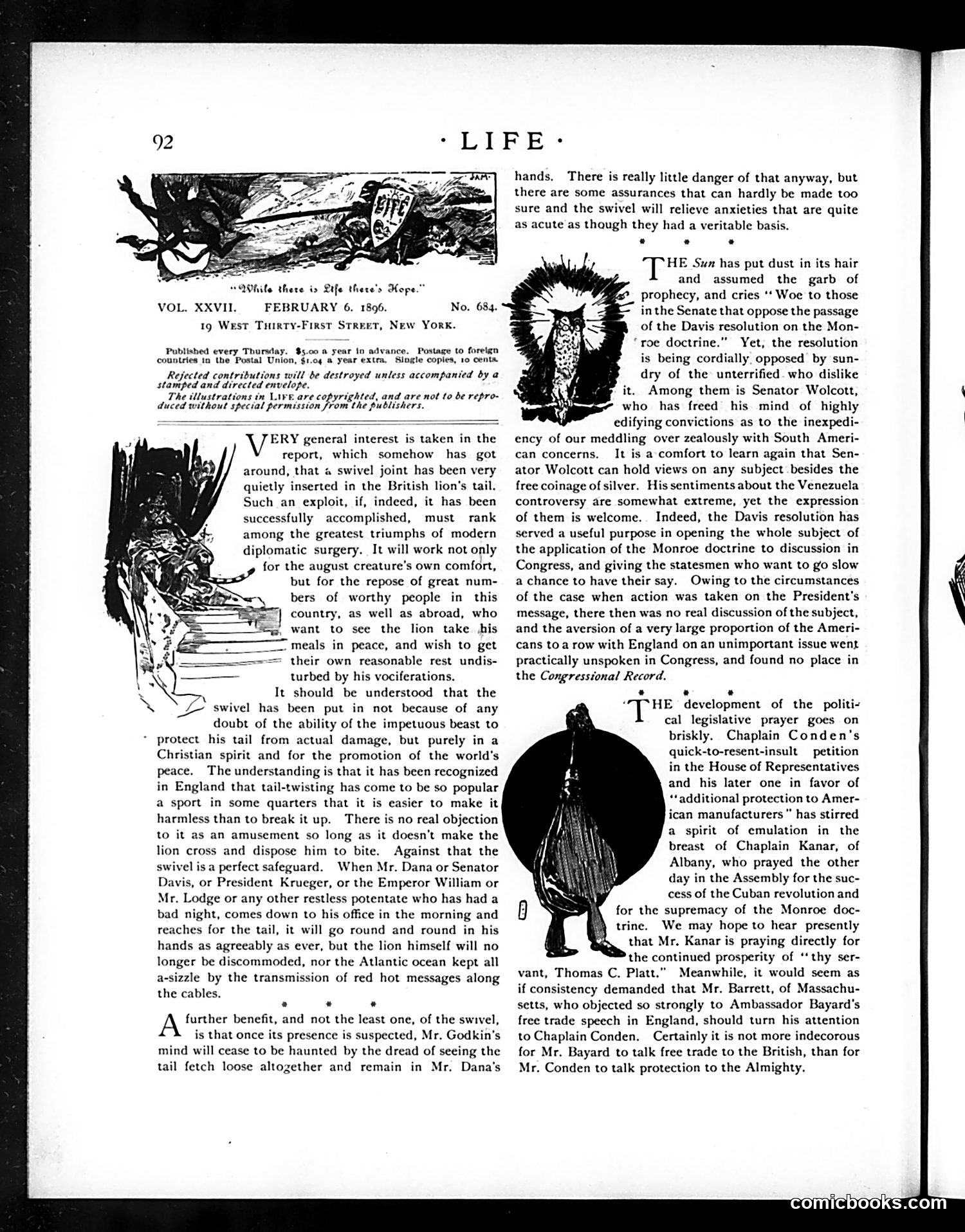
This page discusses a controversial "swivel" device attached to a lion's tail—apparently a real diplomatic incident. The cartoons mock prominent American politicians who debated its purpose. The satire targets Senator Wolcott and others who opposed the Monroe Doctrine resolution regarding Venezuela. The "swivel" becomes a metaphor: politicians argue it protects the lion's tail from damage, but the real purpose seems to be preventing the lion itself from biting—a jab at those who claim protective measures while actually seeking to restrain American power or avoid confrontation. References to "Mr. Dana," "President Kruger," and the "Cuban revolution" suggest broader debates about American interventionism and free trade policy in the 1890s. The tone is dismissive toward politicians the editor considers inconsistent or cowardly.
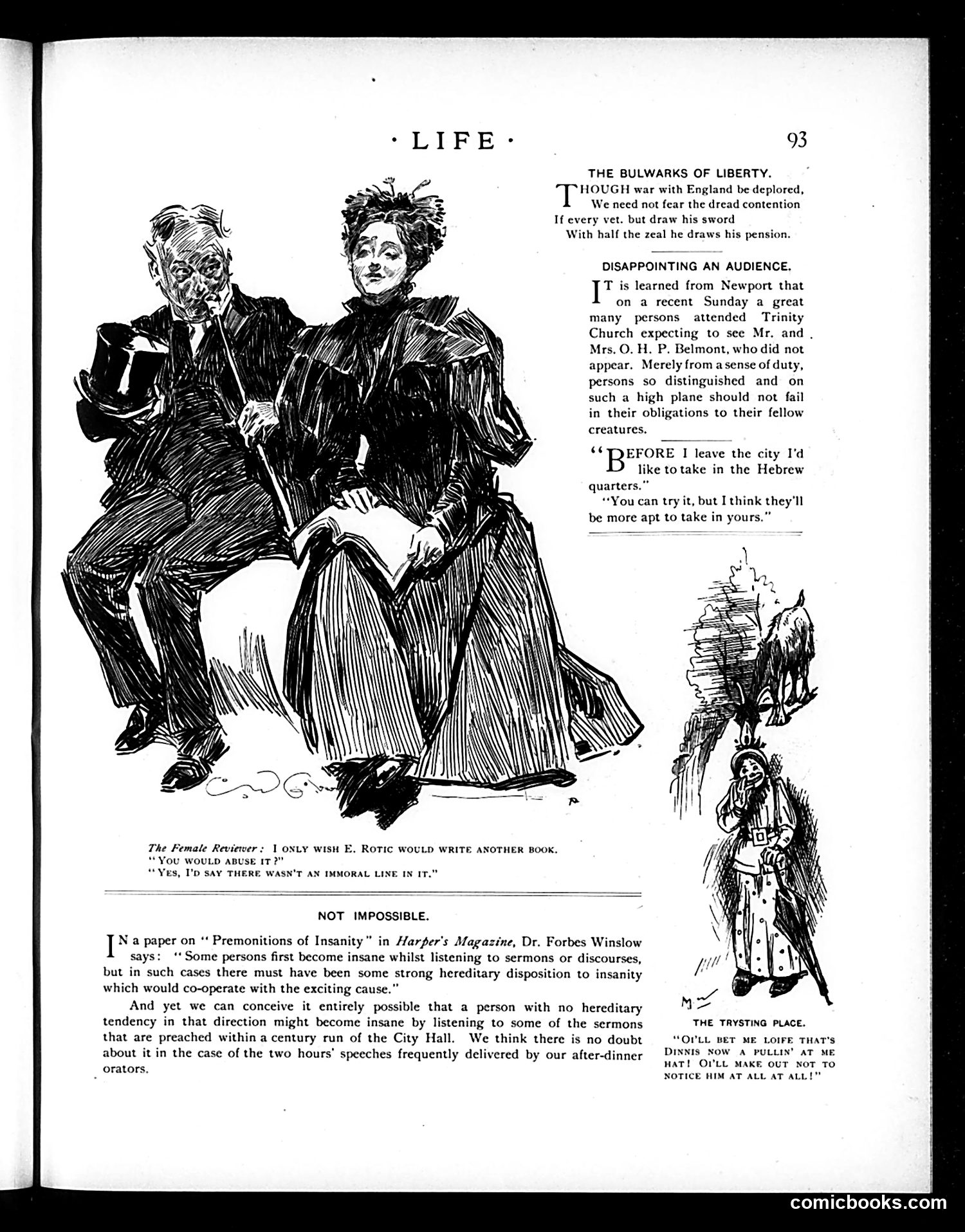
The main cartoon depicts a well-dressed couple at what appears to be a social gathering. The caption references "The Female Reviver" and includes a joke about E. Rotic writing another book, with banter about "immoral lines." Below are three separate satirical pieces: 1. **"The Bulwarks of Liberty"** — a brief poem mocking inadequate military pensions for war veterans. 2. **"Disappointing an Audience"** — a anecdote about Mr. and Mrs. O.H.P. Belmont failing to appear at Trinity Church, criticized for neglecting social obligations. 3. **"Not Impossible"** — commentary on a *Harper's Magazine* article about insanity, suggesting that tedious speeches (specifically "after-dinner orators") could plausibly drive listeners mad. The humor targets social hypocrisy, broken commitments, and pompous public speakers.
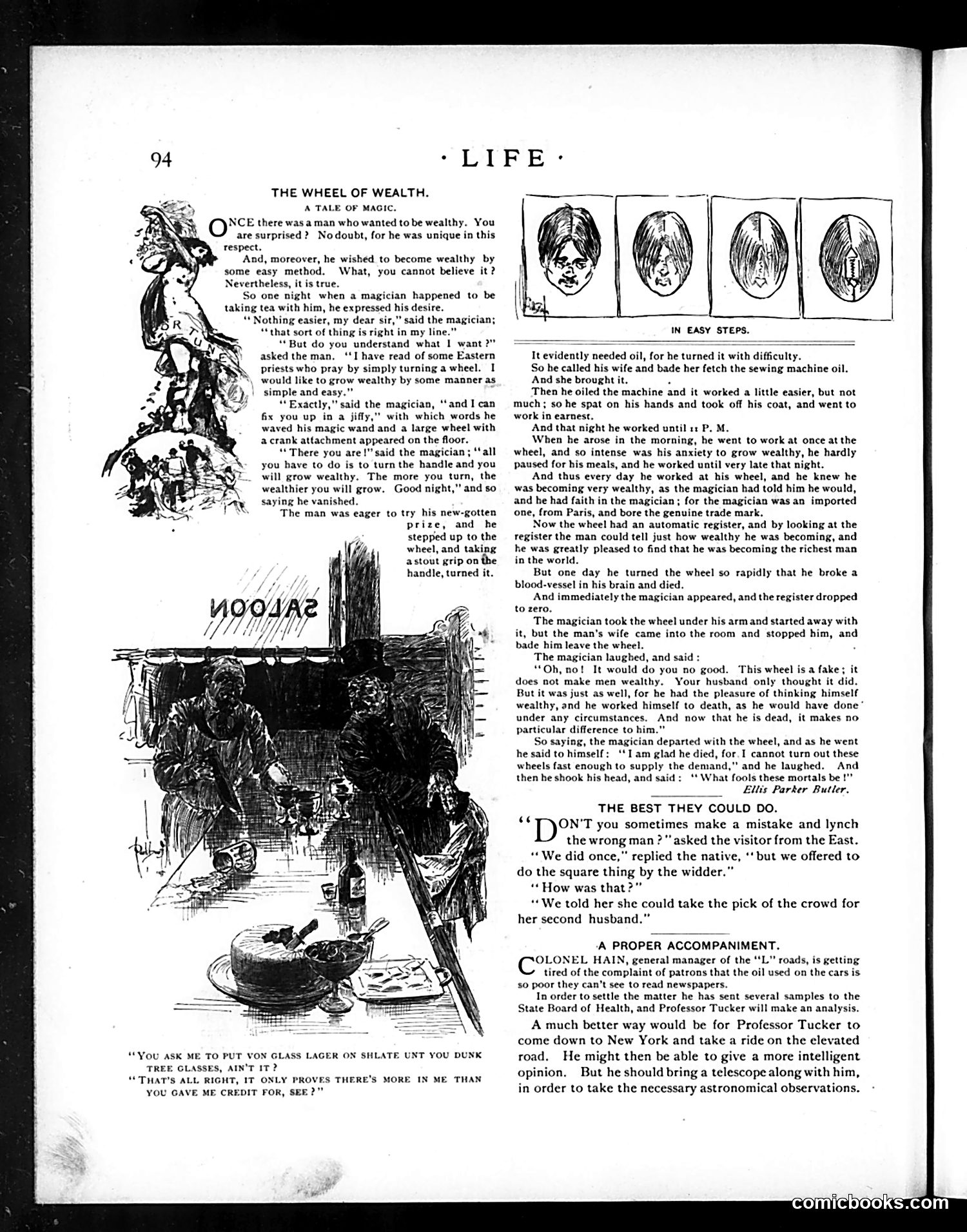
This satirical story mocks the fantasy of effortless wealth-building. A magician promises a poor man that turning a magical wheel will generate riches—the more he turns, the wealthier he becomes. The man obsessively works the wheel until it breaks from overuse, destroying his health in the process. The magician's departure with the wheel, leaving the man with nothing, reveals the con. When the man's wife confronts him, the magician delivers the satire's moral: the man's wealth came from *his own labor*, not magic. The wheel was merely a distraction. The piece satirizes get-rich-quick schemes and the false promise that shortcuts to wealth exist—that prosperity requires actual work and self-reliance, not magical thinking.
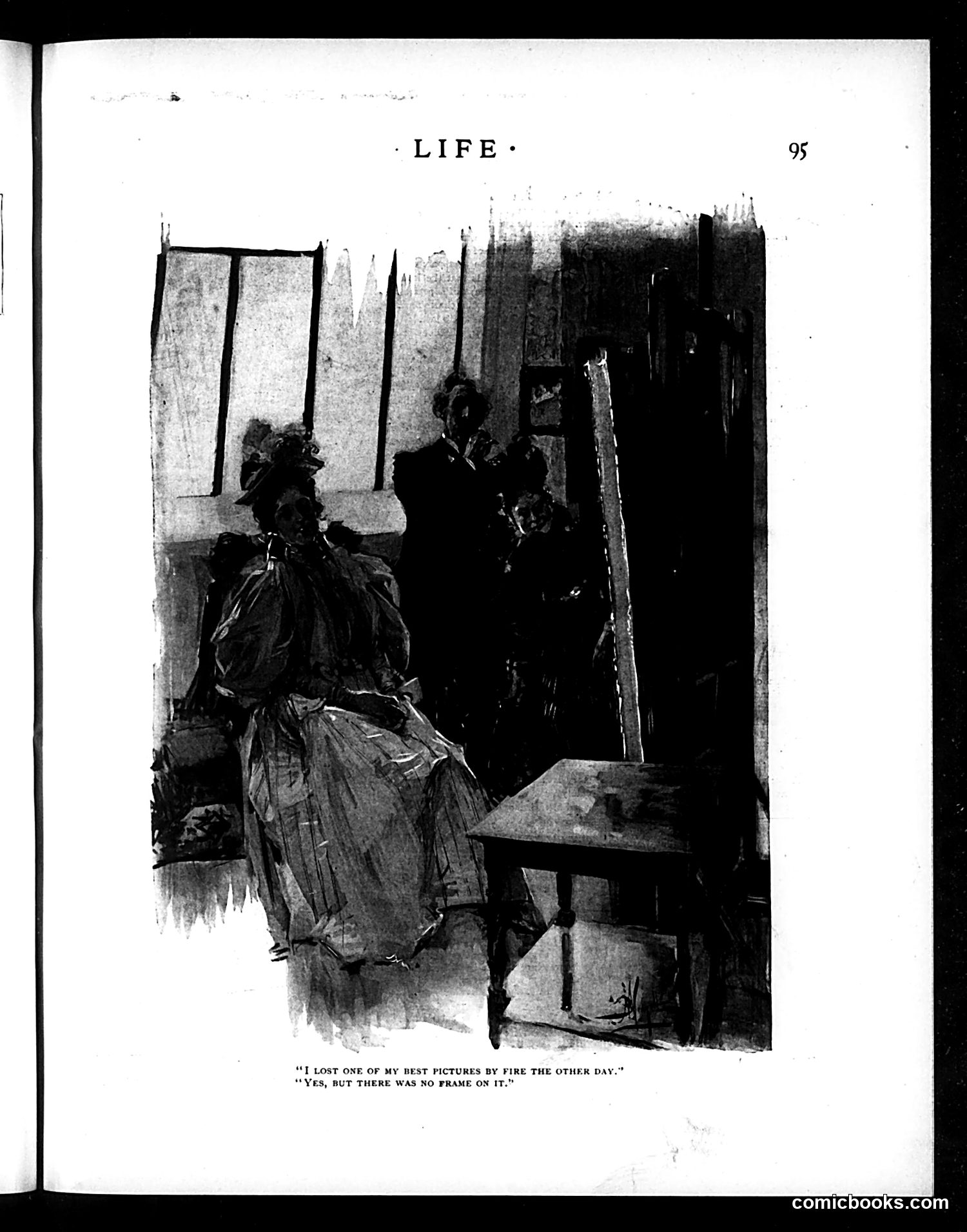
This illustration depicts an interior scene with two figures—a woman in an elaborate dress seated on the left and a man in dark formal attire standing. The caption reads: "I LOST ONE OF MY BEST PICTURES BY FIRE THE OTHER DAY." / "Yes, BUT THERE WAS NO FRAME ON IT." The satire appears to be a commentary on materialism and misplaced priorities. The man's response to hearing about a lost picture focuses not on the artistic or sentimental loss, but on the absence of an expensive frame—suggesting he values the material worth of the object over its actual content. This critiques wealthy society's tendency to prioritize luxury and ornamentation rather than genuine artistic or emotional value. The joke mocks shallow consumerism among the upper class depicted here.
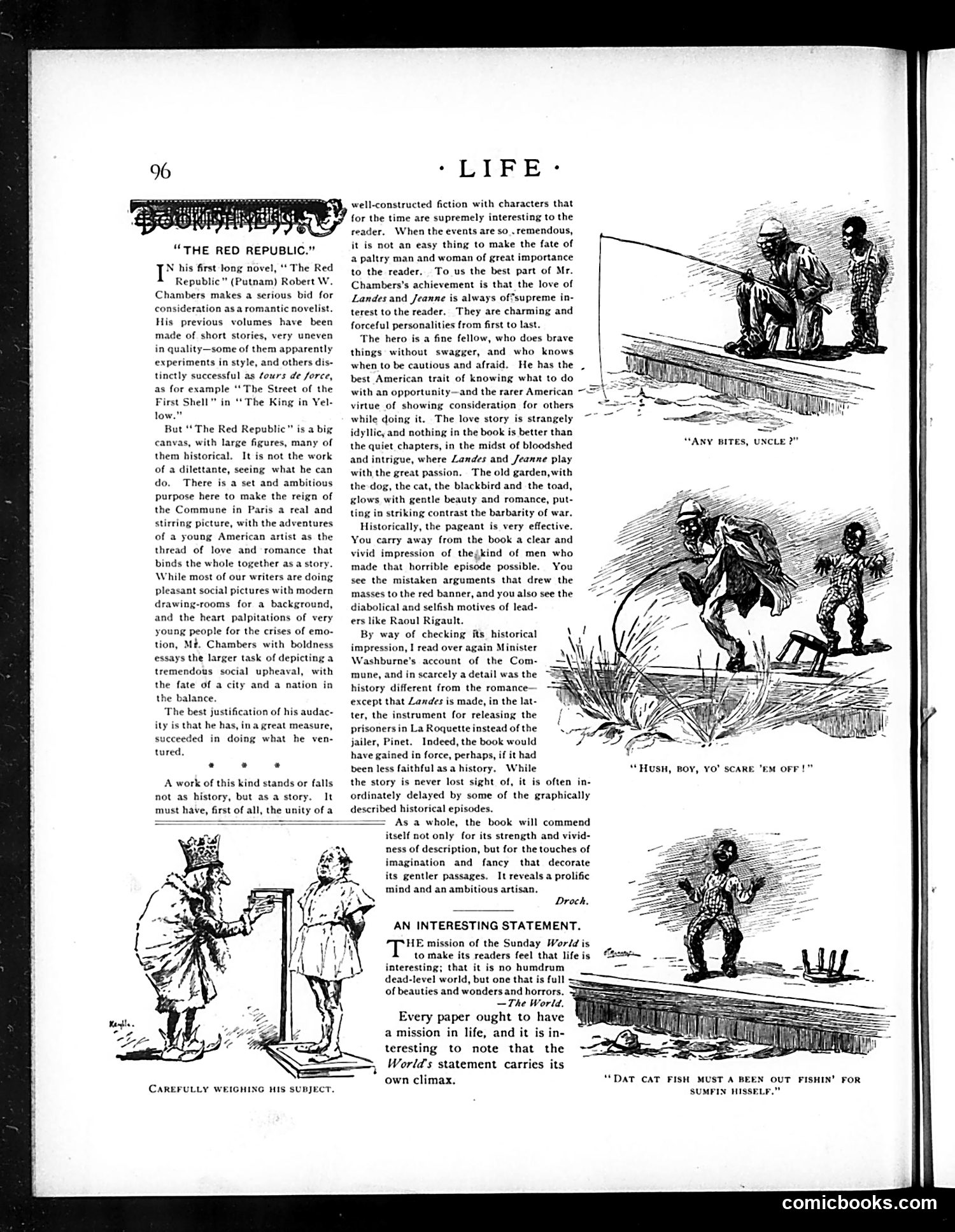
This page reviews Robert W. Chambers' novel "The Red Republic," praising it as ambitious historical fiction set during the Paris Commune. The review emphasizes the book's romantic elements—particularly the love story between characters named Landis and Jeanne—while acknowledging its depiction of the Commune as a historical event. The accompanying illustrations appear to be scenes from the novel rather than political satire. They show figures in period dress in various situations, including what appear to be scenes of conflict or dramatic moments. The review's tone is literary criticism rather than political commentary, focusing on Chambers' narrative skill, character development, and ability to blend romance with historical events. No modern political figures or contemporary satire are evident on this page.
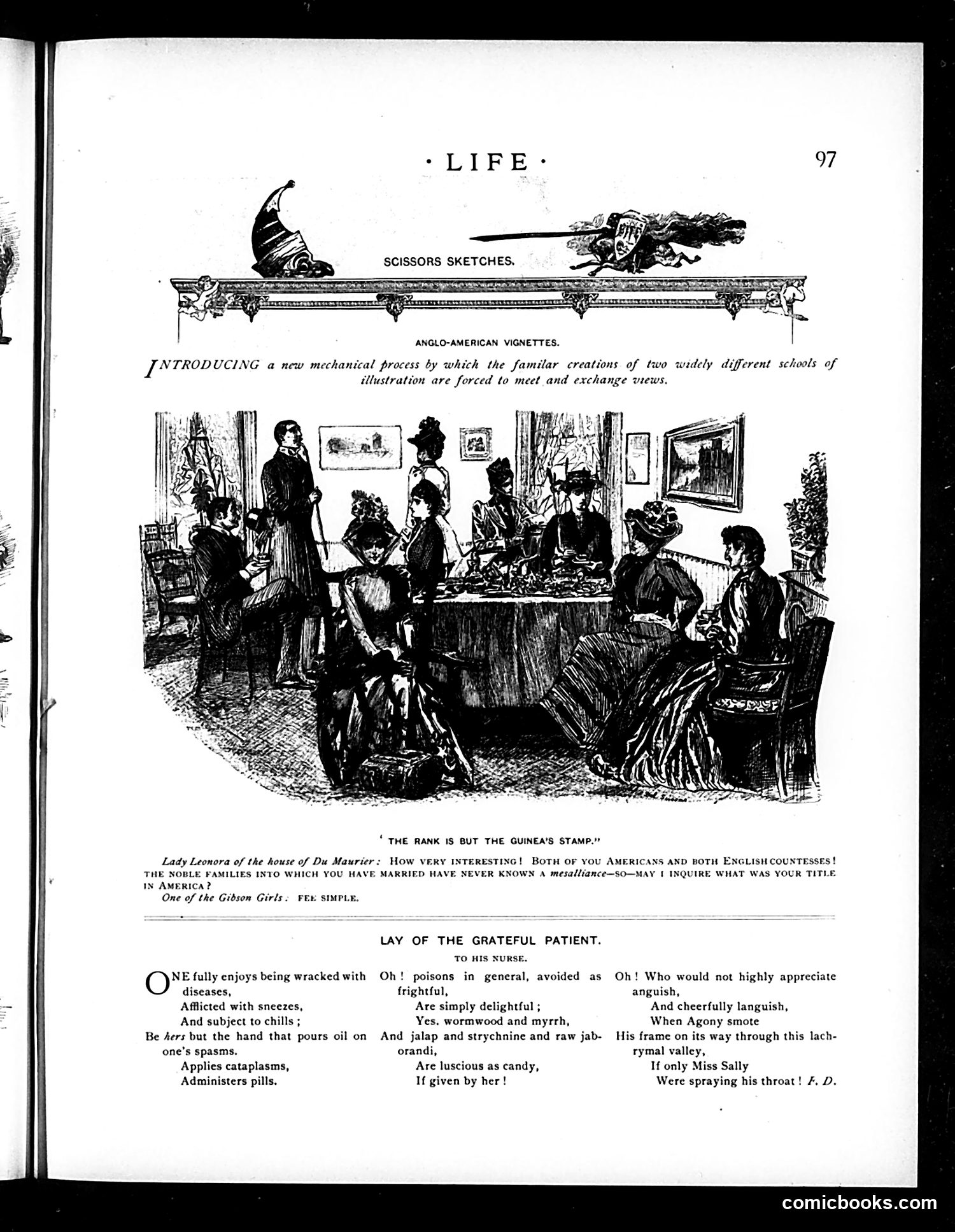
This page satirizes **class pretension and transatlantic snobbery** among wealthy Americans. The main cartoon depicts a social gathering where American women (likely wealthy) are being corrected about their titles by English countesses. The caption's joke centers on "rank" being merely a "guinea's stamp"—suggesting that European nobility's superiority is overrated, especially since Americans married into these families without understanding the social hierarchy. The satirical poem "Lay of the Grateful Patient" below mocks the nursing profession, contrasting a nurse's genuine care ("hand that pours oil") with useless medical treatments (pills, poisons, jalap). The satire suggests modern medicine's ineffectiveness compared to human compassion—a common 19th-century critique of medical practice.
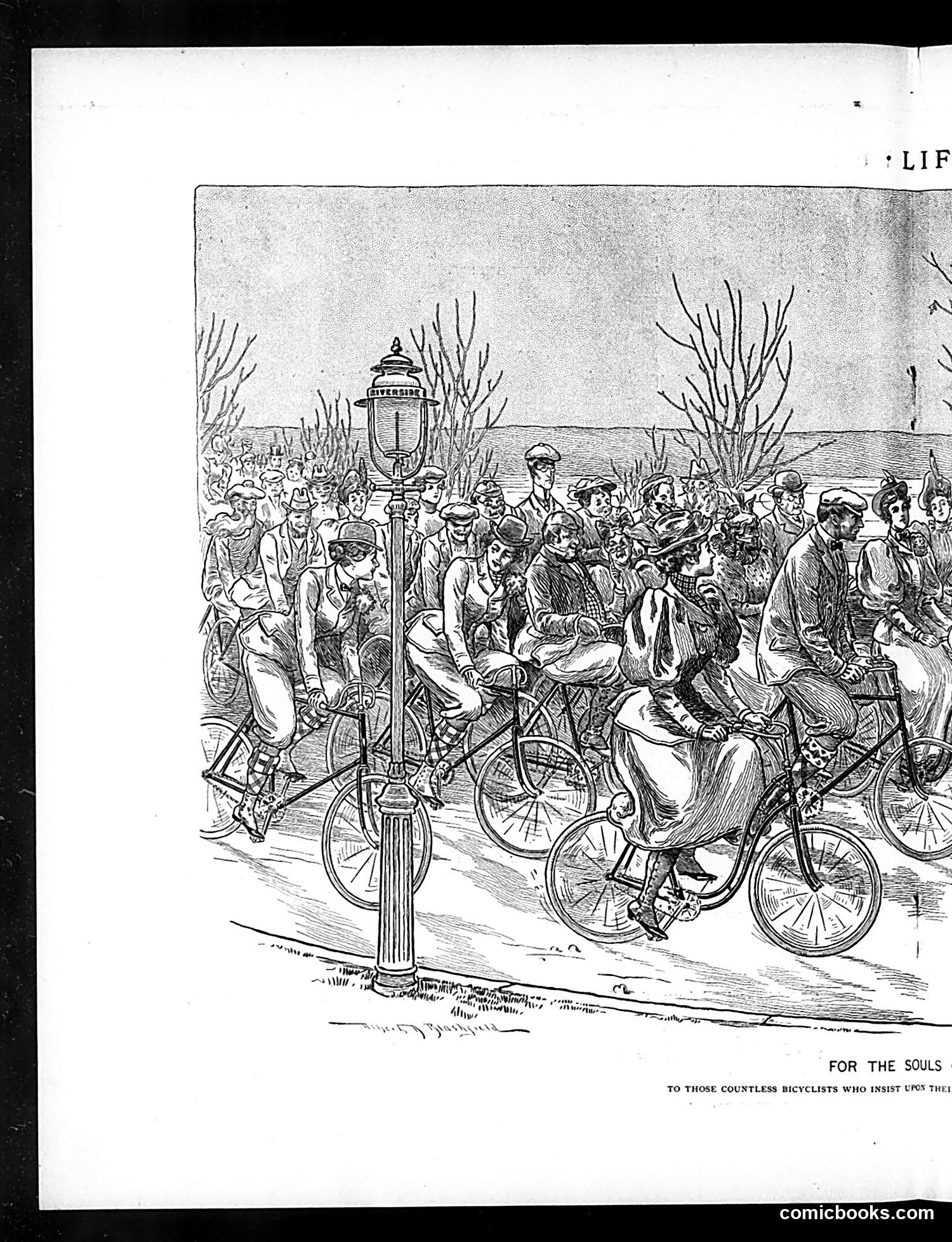
This is a satirical illustration titled "FOR THE SOULS OF THE COUNTLESS BICYCLISTS WHO INSIST UPON..." (text cut off). The cartoon depicts a large crowd of cyclists gathered around an ornate street lamp or monument in what appears to be a public space, with bare trees in the background. The satire appears to mock cyclists' disregard for traffic laws or safety—the phrase "for the souls" suggests the lamp is a memorial or warning about bicycle-related dangers. The crowded, chaotic scene of riders suggests reckless riding behavior that was apparently a social concern in Life magazine's era (likely late 19th or early 20th century, when bicycling was wildly popular). The joke targets bicycle riders as a group, treating them humorously as hazards to themselves and others.
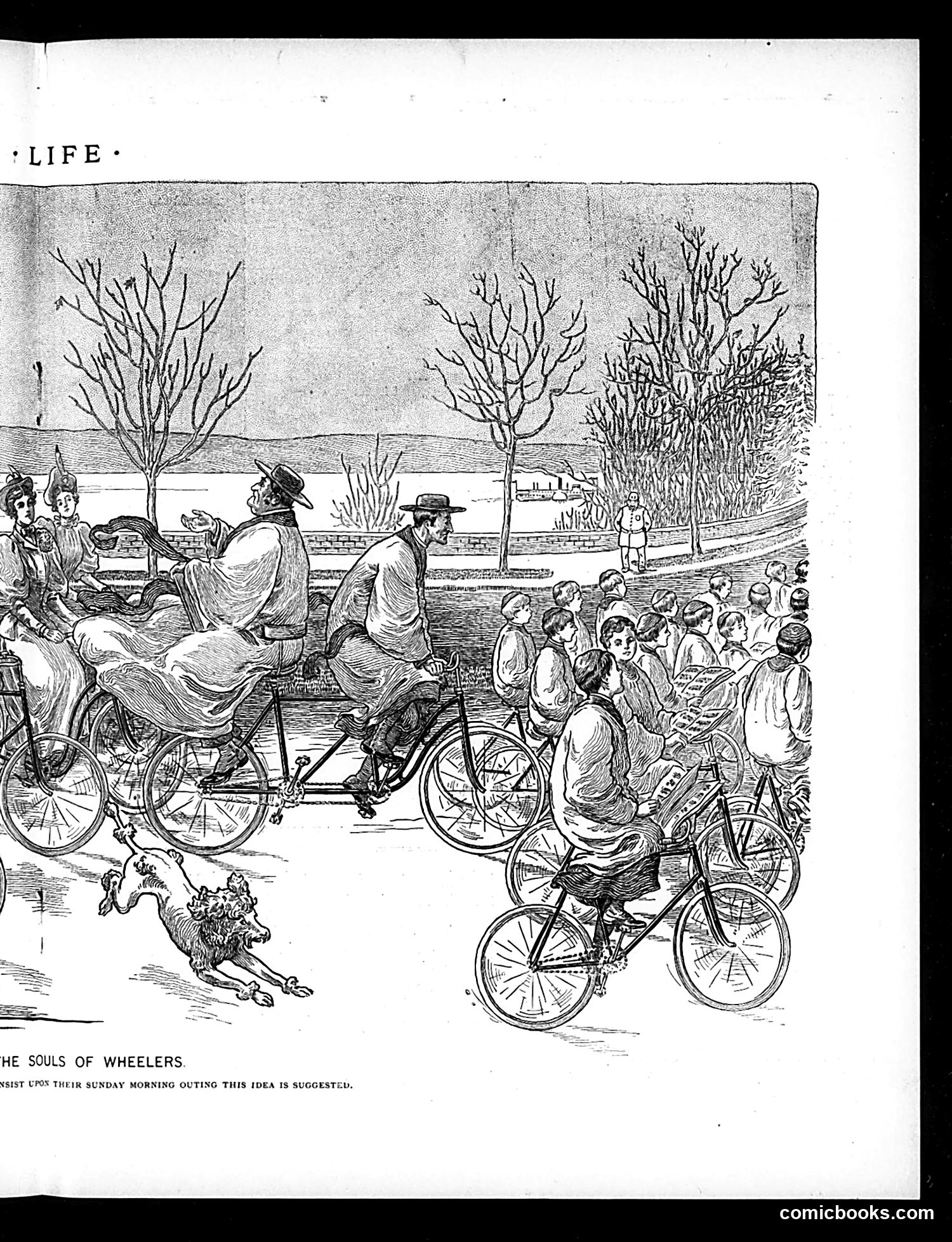
This satirical illustration depicts a bicycle craze—likely from the 1890s when bicycling became wildly popular. The title "The Souls of Wheelers" suggests bicyclists are obsessed or spiritually devoted to their cycles. The image shows numerous cyclists, including women in long skirts, gathered for a Sunday outing. A dog appears in the foreground, suggesting chaos or the crowded nature of such recreational gatherings. The satire likely mocks the bicycle-riding culture's intensity and social status-consciousness. The inclusion of multiple riders—particularly fashionably-dressed women—comments on how cycling became a leisure activity for the middle and upper classes. The phrase "consist upon their sunday morning outing" implies the ritual, almost religious devotion cyclists had to their Sunday rides.
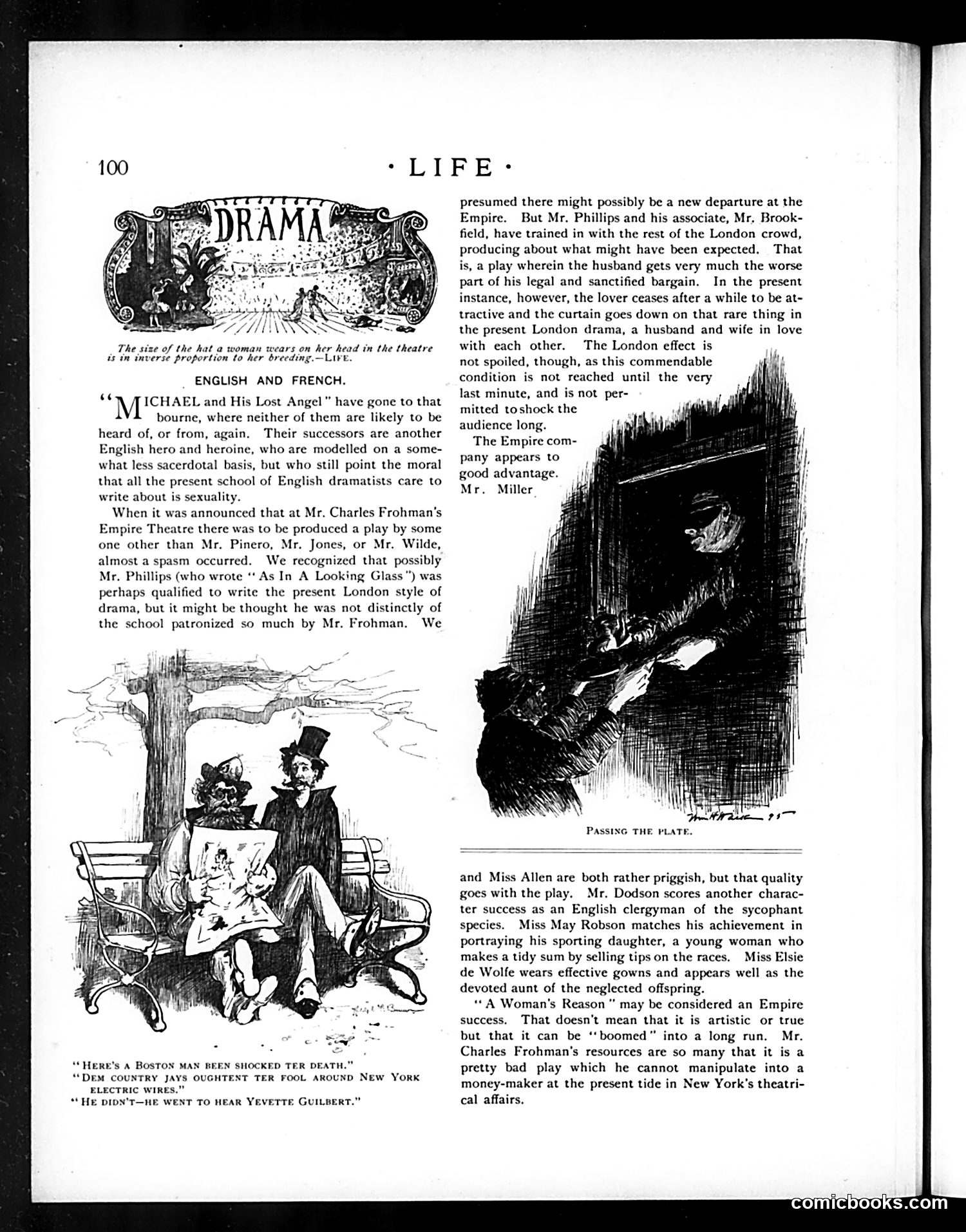
This page reviews contemporary London theatrical productions for an American audience. The main text critiques a new play at Charles Frohman's Empire Theatre, criticizing the era's English dramatists—particularly Pinero, Jones, and Wilde—for obsessing over sexuality and marital infidelity as dramatic subjects. The reviewer notes that this particular play ("A Woman's Reason") unusually ends with a husband and wife actually in love, though this redemptive moment is delayed until the final minutes. The two cartoons satirize theater audiences and social pretension. The upper illustration mocks women wearing excessively large hats that obstruct others' views—captioned with Life's observation that hat size is "in inverse proportion to her breeding" (refinement). The lower cartoon's caption references Yvette Guilbert, a famous French cabaret singer, sarcastically suggesting someone avoided theater to hear her instead. Overall, the page combines theatrical criticism with gentle social satire about audience behavior and taste.
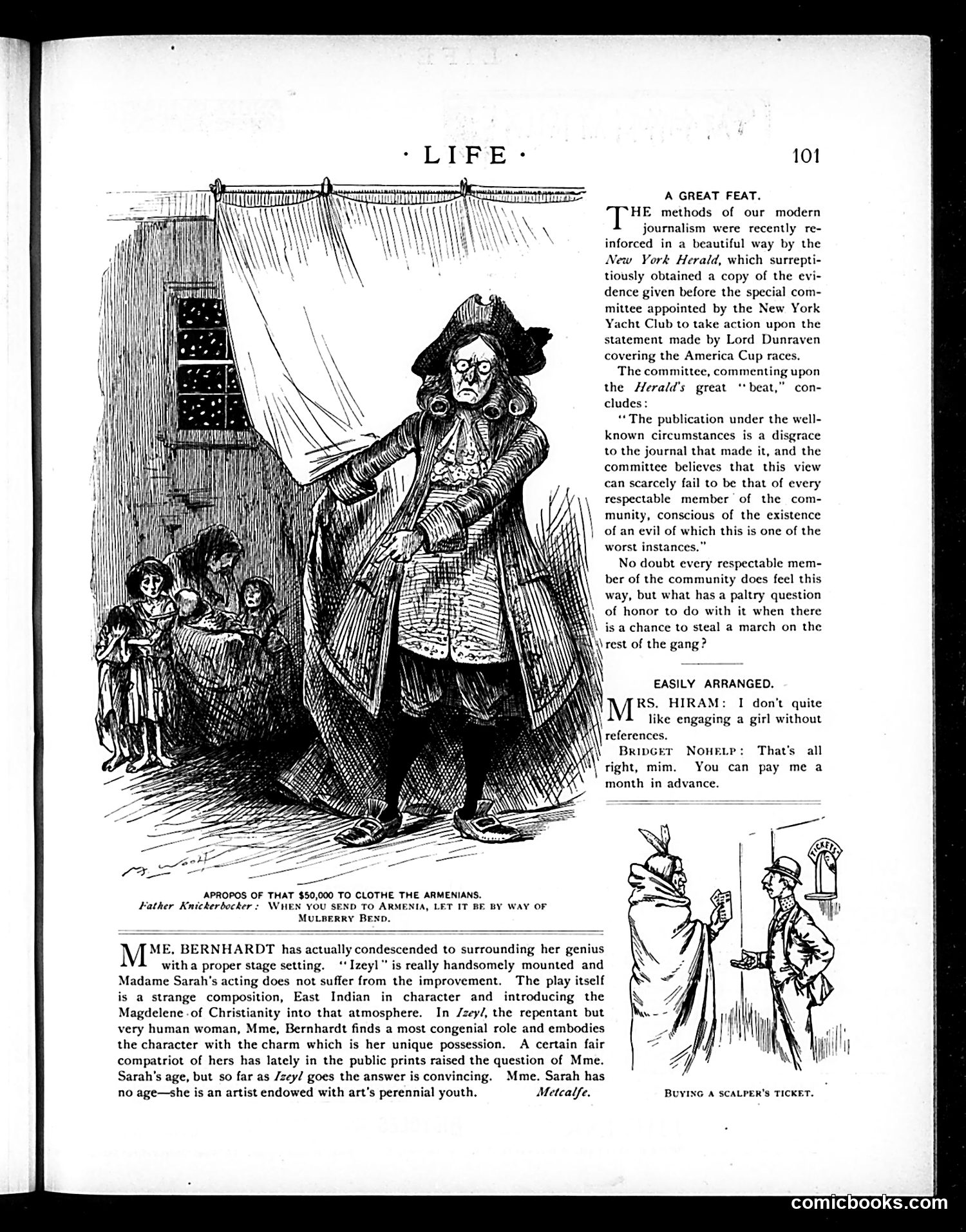
**"A Great Feat"** mocks the *New York Herald's* journalism ethics. The Herald secretly obtained confidential evidence from a New York Yacht Club committee investigating Lord Dunraven's America Cup race complaint. While the committee condemned this breach as "a disgrace," the satire notes cynically that newspapers prioritize getting a competitive "scoop" over honor or propriety. **"Easily Arranged"** is a brief joke about servant hiring: Mrs. Hiram wants references before employing a maid, but the prospective employee (Bridget Nolan) bypasses this by offering to accept advance monthly payment instead—implying she has something to hide. **"Apropos of that $50,000"** references charitable donations for Armenian relief, sarcastically suggesting Father Knickerbocker should route aid through "Mulberry Bend" (a notorious slum), likely criticizing corruption or inefficiency in charity distribution. The page also discusses actress Sarah Bernhardt's production of *Izyl*, praising her performance despite her age.
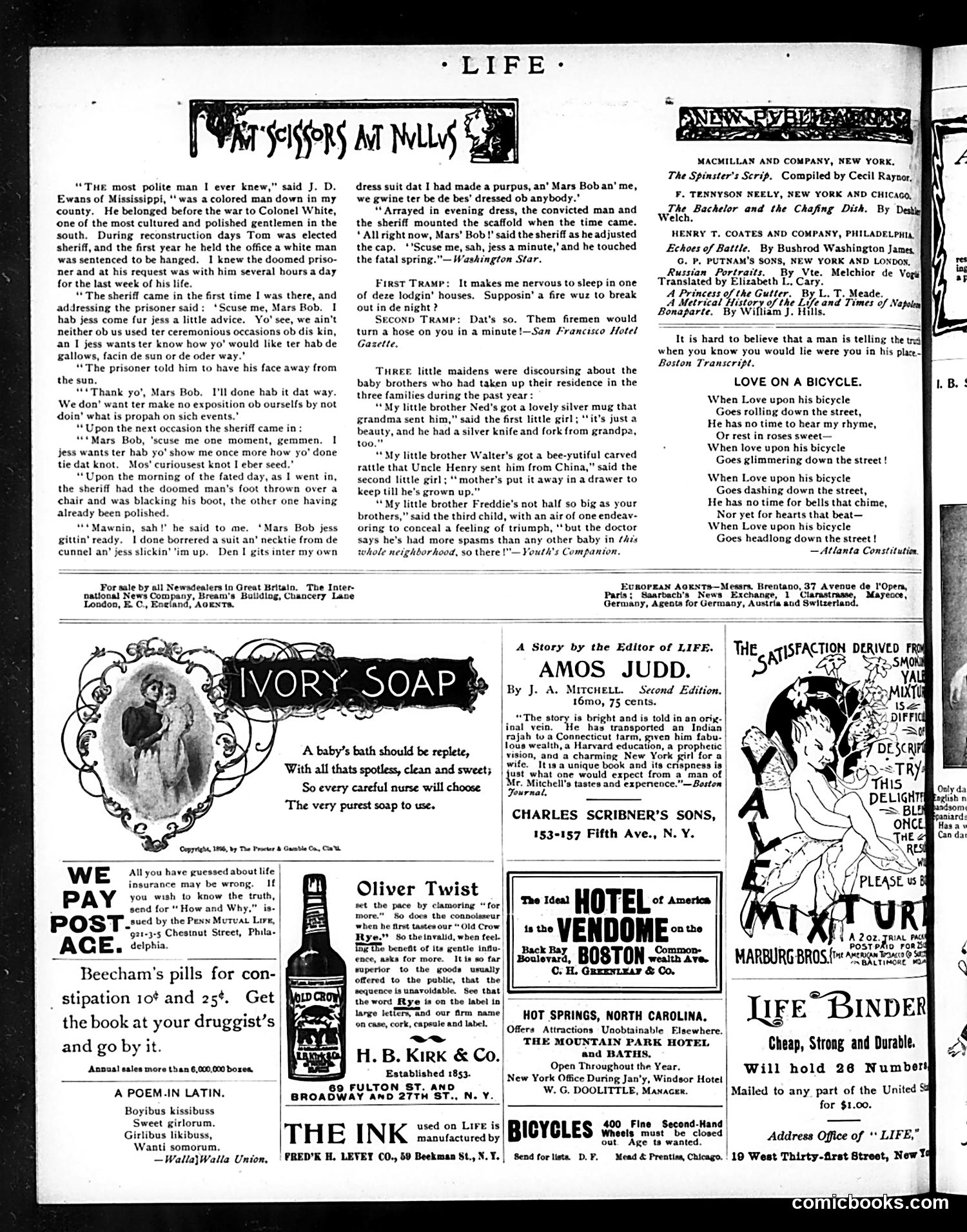
This page consists primarily of **humorous anecdotes and advertisements** rather than political cartoons. The main narrative satirizes **racial dynamics in the post-Reconstruction South**. It depicts a Black sheriff ("Tom") executing a white prisoner with exaggerated deference and politeness—using dialect and subservient behavior ("Mars Bob," "Scuse me"). The satire cuts two ways: it mocks both the absurdity of a Black official deferring to a condemned white man, and critiques the social pretense masking racial hierarchy. The sheriff's meticulous concern for propriety (polishing boots, borrowing formal dress) during an execution is darkly comic, highlighting the performative nature of racial etiquette. The other anecdotes joke about homeless men and infant mortality/illness—lighter fare typical of the magazine. The page is heavily advertisement-focused, promoting soap, pills, hotels, and bicycles—reflecting the magazine's commercial function alongside satire.
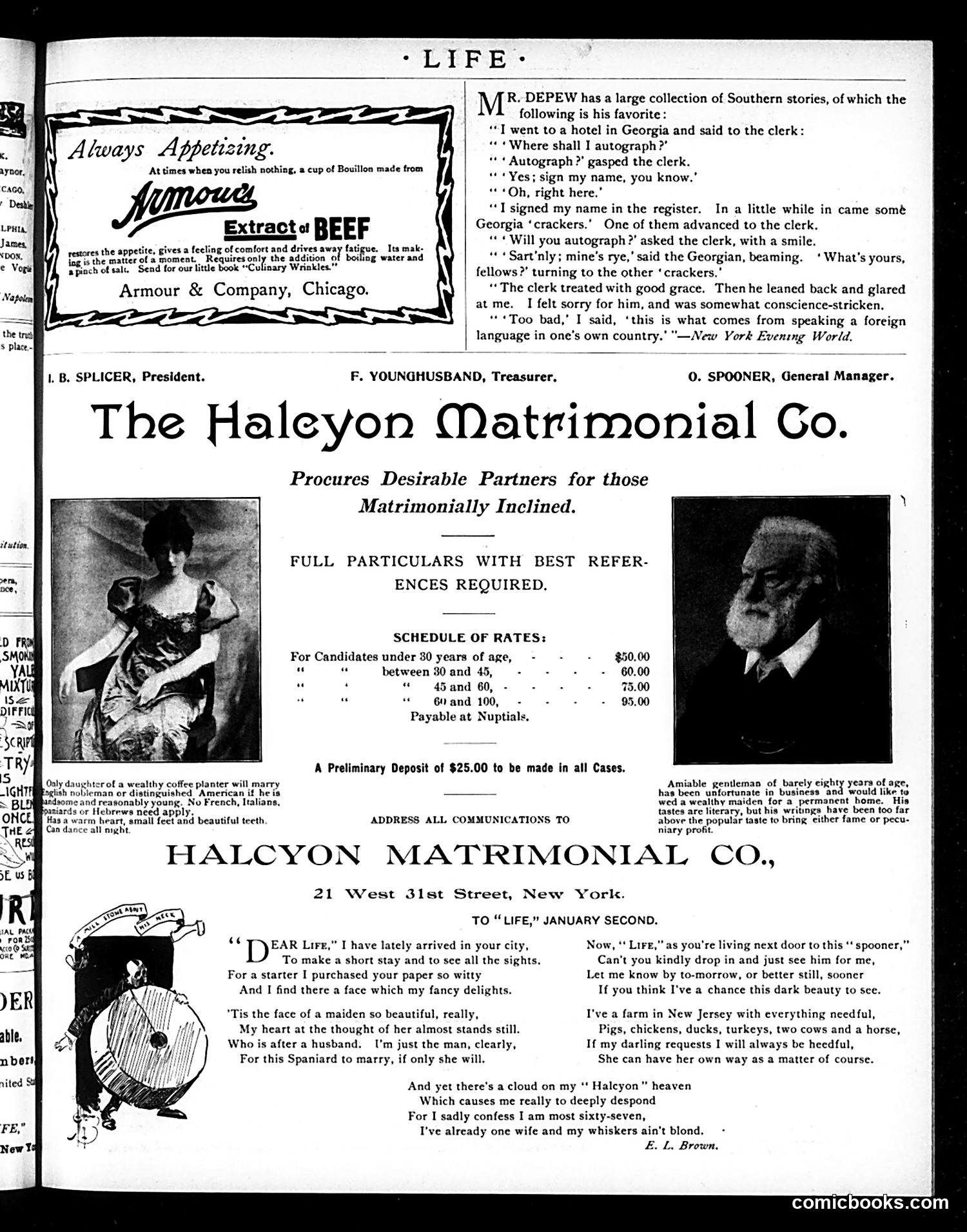
This page satirizes early matchmaking services and the absurdities of commercialized marriage. The central advertisement for "The Halcyon Matrimonial Co." presents a fake matrimonial brokerage with a tiered pricing structure based on age—"Candidates under 30 years" cost $50, escalating to $95 for those aged 60-100. The accompanying poem mocks the desperation and deception in these arrangements. A 67-year-old man seeks a young Spanish woman, mentioning his "farm in New Jersey" and claiming romantic availability—while casually revealing he's already married with non-blond whiskers. The humor targets both the absurd commodification of marriage and the self-deceptive language men use in such advertisements. The top story about R. Depew's Georgia hotel anecdote jokes about cultural snobbery: a Northern gentleman's use of "autograph" (implying celebrity) embarrasses a clerk, yet rural Georgia men confidently misuse the term for their whiskey preferences. Both pieces mock pretension and social awkwardness across class lines.
This page mixes editorial content with period advertising, lacking a primary political cartoon. **"The Advanced Woman"** is a poem satirizing the women's suffrage and dress-reform movements of the early 1900s. It mocks women who wear bloomers, smoke publicly, engage in politics, and pursue independence—depicting them as inherently contrary and unreliable ("she doesn't care to do them when she can"). The satire presents women's liberation as frivolous rather than principled. **The anecdotes** ("Taken from the Enemy") mock immigrant speech and legal proceedings: one features a German couple seeking divorce via axe-wielding domestic violence; another describes a tavern keeper's folk wisdom. **The advertisements**—for Haviland China, Hunter Whiskey, Piperazin Water (for gout), and Whitman's Chocolates—reflect early-1900s consumer culture, including patent medicines and the medicinal endorsement of whiskey. The page reflects Life's satirical stance against progressive social movements while showcasing period commercial products and ethnic caricature.
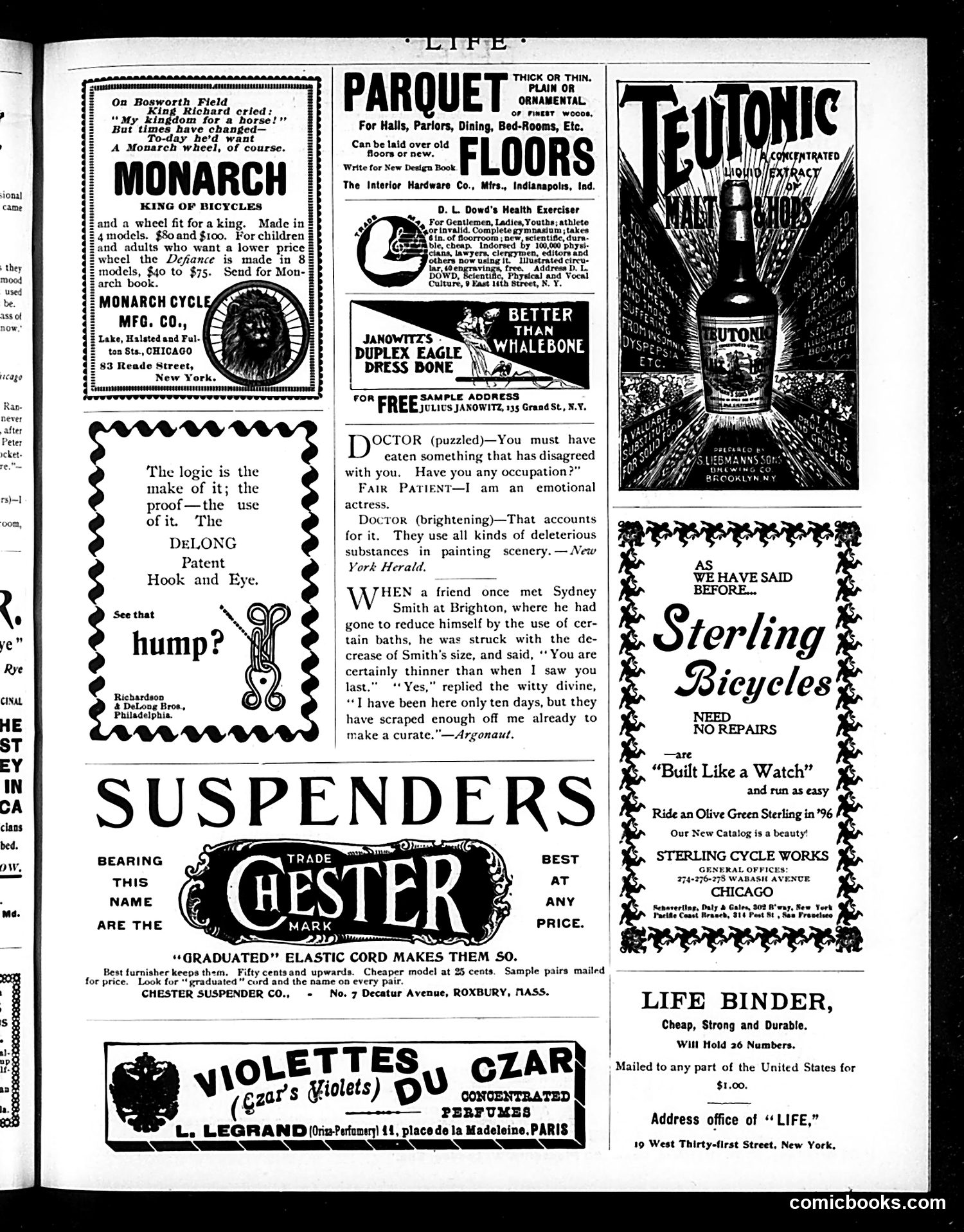
This is primarily an **advertising page** from an early American satirical magazine, with minimal editorial content. The ads promote bicycles, health equipment, perfume, and office supplies typical of the period. The only substantive editorial content is a brief **humor exchange** between a doctor and actress patient. The joke plays on period stereotypes: the doctor assumes the actress's digestive upset stems from theatrical paint chemicals, reflecting contemporary concerns about stage makeup toxicity and the lower social status of theatrical performers. A secondary humor piece references **Sydney Smith**, a famous 19th-century wit, joking about extreme weight loss from spa treatments—a satirical jab at Victorian spa culture's dubious health claims. The **"Monarch" bicycle** ad cleverly references Shakespeare's *Richard III* ("My kingdom for a horse!"), suggesting modern monarchs would prefer bicycles to actual horses—light satire on technological progress replacing tradition. Otherwise, this page reflects period commercial culture more than political satire.
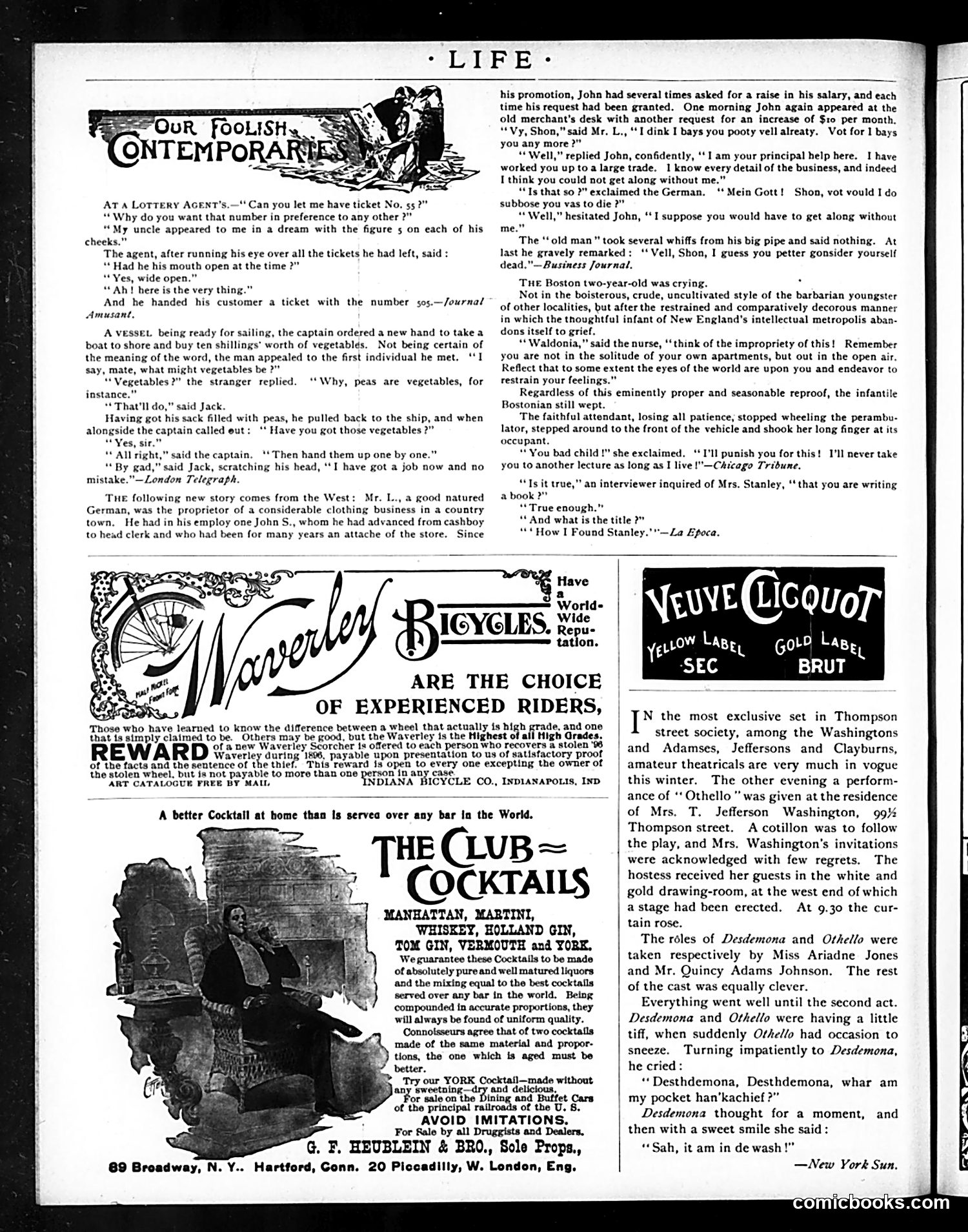
This page contains four short humorous anecdotes satirizing human foolishness and absurdity: 1. **Lottery Agent**: A man requests ticket #55 because he dreamed of the number 5 on his uncle's cheeks. The agent cleverly interprets an open mouth as showing "505." 2. **Sailor and Vegetables**: A new sailor, unfamiliar with the word "vegetables," asks a stranger for a definition. Given only "peas" as an example, he returns with a sack of peas alone—misunderstanding instructions to buy "ten shillings' worth." 3. **German Employer and Employee**: John, a valued clerk, requests a raise. His German boss responds that John is irreplaceable, then deadpan suggests John "consider yourself dead"—implying his value makes him replaceable only if he's gone. 4. **Boston Child**: A nurse corrects a crying toddler for displaying "improper" grief in public, threatening to stop taking her to lectures—satirizing New England's overly refined, intellectual pretensions. Each joke mocks human credulity, literal-mindedness, or social pretension. The page also contains period advertisements (bicycles, cocktails).
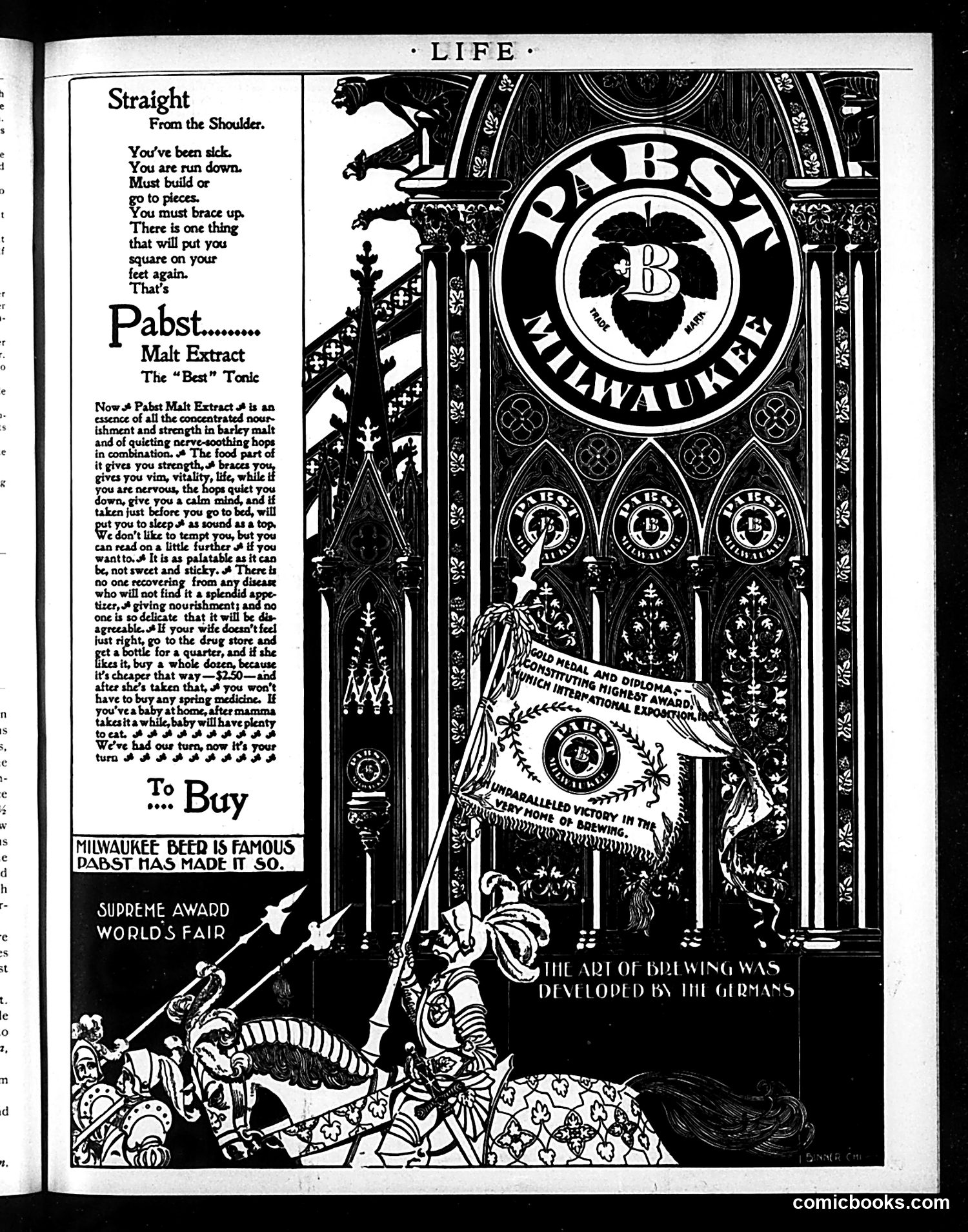
This is primarily a **Pabst Malt Extract advertisement**, not a political cartoon. The left column contains health claims for the product, marketed as a tonic for recovery from illness and nervousness—typical of early 20th-century patent medicine advertising. The right side features an **ornate, German-inspired design** celebrating Pabst's brewing heritage and awards. The text explicitly states "The art of brewing was developed by the Germans," capitalizing on the association between German craftsmanship and beer quality—a major marketing angle for American breweries of this era. The elaborate decorative architecture and heraldic imagery are meant to evoke Old World prestige and legitimacy. The "Supreme Award World's Fair" reference indicates Pabst won recognition at a major exposition. This reflects the pre-Prohibition era when malt extract was marketed as medicinal and nutritious, before regulations restricted health claims for alcohol-adjacent products.
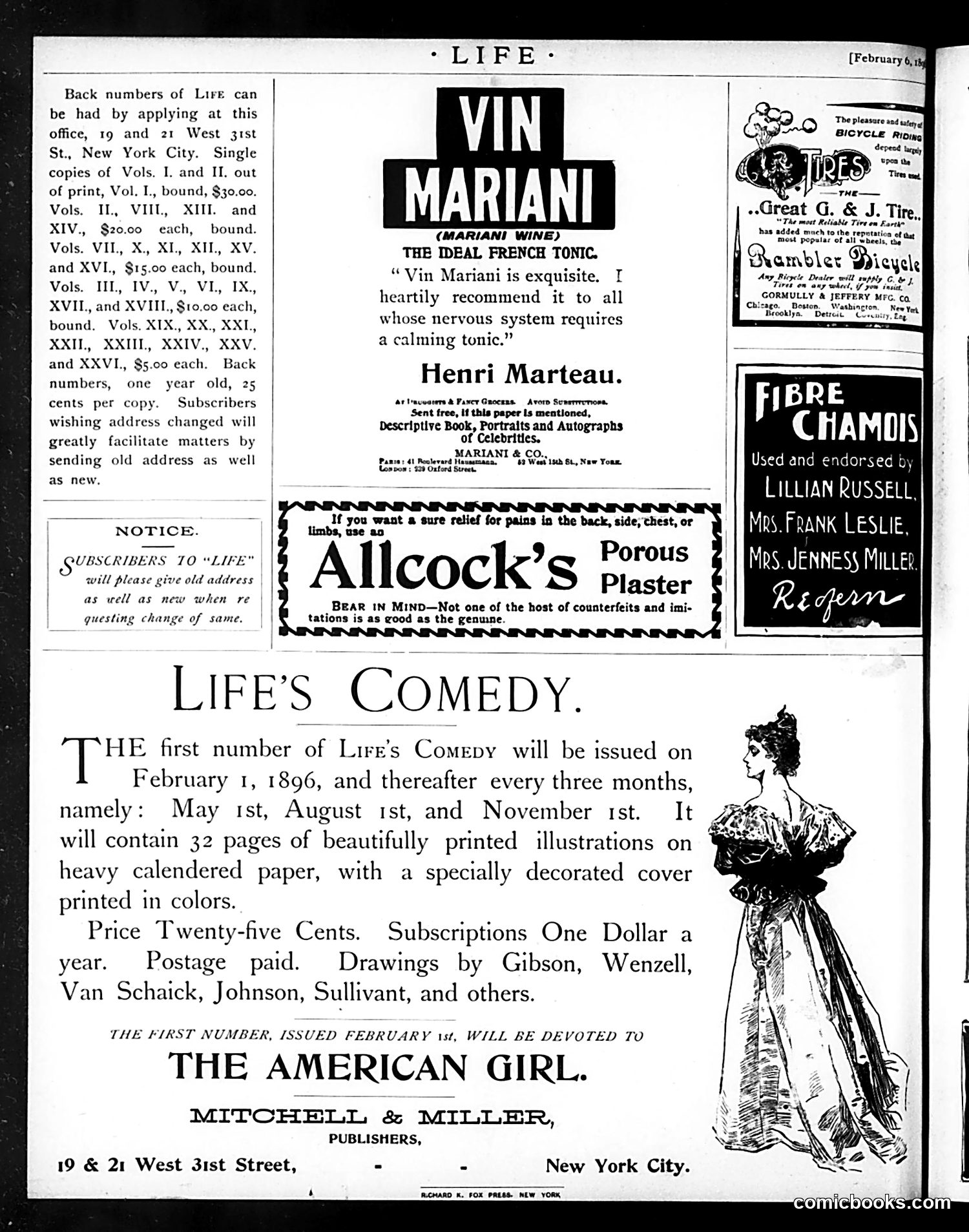
This is primarily an **advertising and announcement page** from Life magazine (February 6, 1896). It contains no political cartoons or satire requiring historical context. The page announces Life's new companion publication, **"Life's Comedy,"** launching February 1, 1896—a quarterly illustrated humor magazine devoted to "The American Girl," featuring drawings by prominent illustrators including Gibson (likely Charles Dana Gibson, famous for the "Gibson Girl"). The remaining content is commercial advertising: Vin Mariani wine (marketed as a "calming tonic," a popular patent medicine of the era), bicycle tires, Allcock's Porous Plaster (a medical product), and Fibre Chamois endorsed by celebrities like Lillian Russell and Mrs. Frank Leslie. The left column contains subscription information for back issues of Life magazine itself, with pricing details. This is essentially a business/promotional page with no satirical content to decode.