
Life, 1896-02-06 · page 4 of 20
Life — February 6, 1896 — page 4: what you’re looking at
What you’re looking at
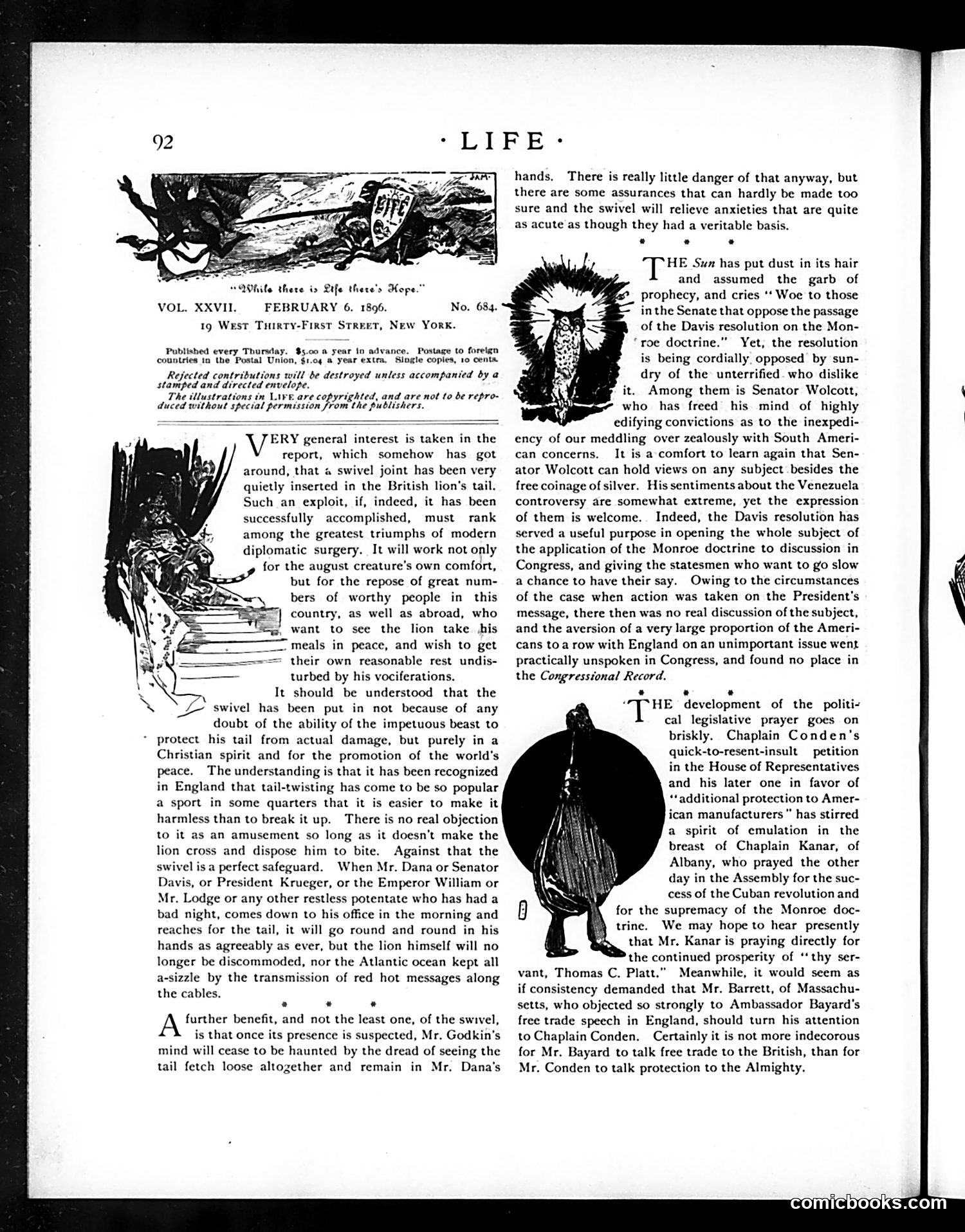
This page discusses a controversial "swivel" device attached to a lion's tail—apparently a real diplomatic incident. The cartoons mock prominent American politicians who debated its purpose. The satire targets Senator Wolcott and others who opposed the Monroe Doctrine resolution regarding Venezuela. The "swivel" becomes a metaphor: politicians argue it protects the lion's tail from damage, but the real purpose seems to be preventing the lion itself from biting—a jab at those who claim protective measures while actually seeking to restrain American power or avoid confrontation. References to "Mr. Dana," "President Kruger," and the "Cuban revolution" suggest broader debates about American interventionism and free trade policy in the 1890s. The tone is dismissive toward politicians the editor considers inconsistent or cowardly.
📄 Transcribed text from this page (OCR, searchable)
Machine-transcribed from the original scan — historical spelling and the odd misread are preserved.
*LIFE: “While there is Life there's Hope.” VOL. XXVII. FEBRUARY 6. 1896. No. 684. 1g West Tuirty-First Street, New York. Published every Thursday. $5.00 a sear to advance. Postage to foreign countries in the Postal Union, §t.04 @ year extra, Single copies, 10 cents. Rejected contributions will be destroyed unless accompanied by a stamped and directed envelope. The illustrations in Live are copyrighted, and are not to be repro- duced without special permission from the publishers. ERY general interest is taken in the report, which somehow has got around, that a swivel joint has been very quietly inserted in the British lion's tail. Such an exploit, if, indeed, it has been successfully accomplished, must rank among the greatest triumphs of modern diplomatic surgery. It will work not only for the august creature’s own comfort, but for the repose of great num- bers of worthy people in this country, as well as abroad, who want to see the lion take his meals in peace, and wish to get = their own reasonable rest undis- turbed by his vociferations. It should be understood that the swivel has been put in not because of any doubt of the ability of the impetuous beast to protect his tail from actual damage, but purely in a Christian spirit and for the promotion of the world’s peace. The understanding is that it has been recognized in England that tail-twisting has come to be so popular a sport in some quarters that it is easier to make it harmless than to break it up. There is no real objection to it as an amusement so long as it doesn’t make the lion cross and dispose him to bite. Against that the swivel is a perfect safeguard. When Mr. Dana or Senator Davis, or President Krueger, or the Emperor William or Mr. Lodge or any other restless potentate who has had a bad night, comes down to his office in the morning and reaches for the tail, it will go round and round in his hands as agreeably as ever, but the lion himself will no longer be discommoded, nor the Atlantic ocean kept all a-sizzle by the transmission of red hot messages along the cables. . * * further benefit, and not the least one, of the swivel, is that once its presence is suspected, Mr. Godkin's mind will cease to be haunted by the dread of seeing the tail fetch loose altogether and remain in Mr. Dana's hands, There is really little danger of that anyway, but there are some assurances that can hardly be made too sure and the swivel will relieve anxieties that are quite as acute as though they had a veritable basis. * * . HE Sux has put dust in its hair and assumed the garb of prophecy, and cries ‘* Woe to those in the Senate that oppose the passage of the Davis resolution on the Mon- ‘roe doctrine.” Yet, the resolution is being cordially, opposed by sun- dry of the unterrified. who dislike it. Among them is Senator Wolcott, who has freed his mind of highly edifying convictions as to the inexpedi- ency of our meddling over zealously with South Ameri- can concerns. It is a comfort to learn again that Sen- ator Wolcott can hold views on any subject besides the free coinage of silver. His sentiments about the Venezuela controversy are somewhat extreme, yet the expression of them is welcome. Indeed, the Davis resolution has served a useful purpose in opening the whole subject of the application of the Monroe doctrine to discussion in Congress, and giving the statesmen who want to go slow a chance to have their say. Owing to the circumstances of the case when action was taken on the President's message, there then was no real discussion of the subject, and the aversion of a very large proportion of the Ameri- cans toa row with England on an unimportant issue went practically unspoken in Congress, and found no place in the Congressional Record. * . . ‘THE development of the politi- cal legislative prayer goes on briskly. Chaplain Conden’'s quick-to-resent-insult petition in the House of Representatives and his later one in favor of ‘additional protection to Amer- ican manufacturers " has stirred a spirit of emulation in the breast of Chaplain Kanar, of Albany, who prayed the other day in the Assembly for the suc- cess of the Cuban revolution and for the supremacy of the Monroe doc- trine. We may hope to hear presently that Mr. Kanar is praying directly for the continued prosperity of ‘‘thy ser- vant, Thomas C. Platt.” Meanwhile, it would seem as if consistency demanded that Mr. Barrett, of Massachu- setts, who objected so strongly to Ambassador Bayard's free trade speech in England, should turn his attention to Chaplain Conden. Certainly it is not more indecorous for Mr. Bayard to talk free trade to the British, than for Mr. Conden to talk protection to the Almighty.