
Life, 1896-02-06 · page 12 of 20
Life — February 6, 1896 — page 12: what you’re looking at
What you’re looking at
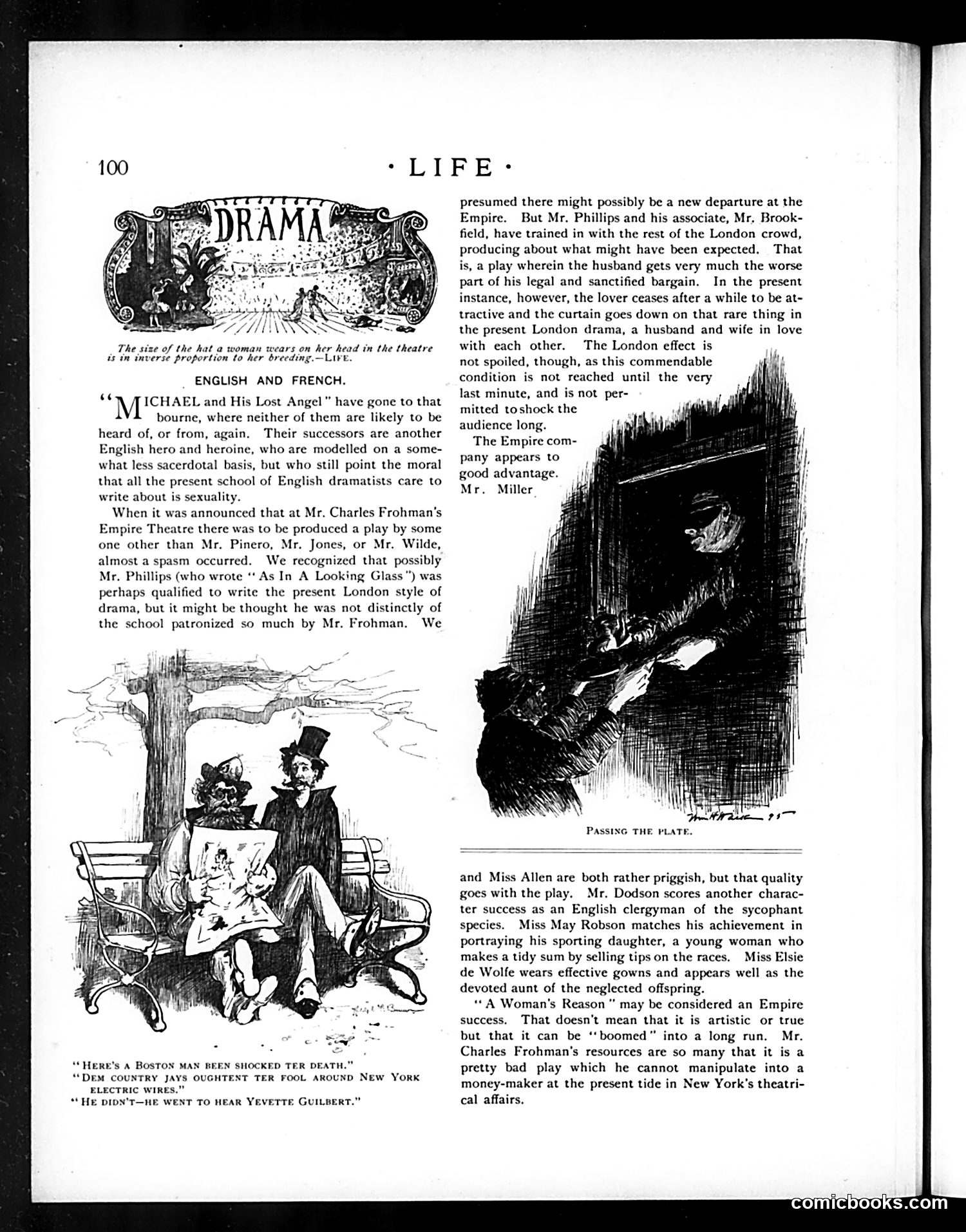
This page reviews contemporary London theatrical productions for an American audience. The main text critiques a new play at Charles Frohman's Empire Theatre, criticizing the era's English dramatists—particularly Pinero, Jones, and Wilde—for obsessing over sexuality and marital infidelity as dramatic subjects. The reviewer notes that this particular play ("A Woman's Reason") unusually ends with a husband and wife actually in love, though this redemptive moment is delayed until the final minutes. The two cartoons satirize theater audiences and social pretension. The upper illustration mocks women wearing excessively large hats that obstruct others' views—captioned with Life's observation that hat size is "in inverse proportion to her breeding" (refinement). The lower cartoon's caption references Yvette Guilbert, a famous French cabaret singer, sarcastically suggesting someone avoided theater to hear her instead. Overall, the page combines theatrical criticism with gentle social satire about audience behavior and taste.
📄 Transcribed text from this page (OCR, searchable)
Machine-transcribed from the original scan — historical spelling and the odd misread are preserved.
‘LIFE: seb bik ALS THANNNSS The size of the hat a woman wears on her head in the theatre ts in inverse proportion to her breeding.—Li¥e. 66 M ICHAEL and His Lost Angel” have gone to that AVL bourne, where neither of them are likely to be heard of, or from, again. Their successors are another English hero and heroine, who are modelled on a some- what less sacerdotal basis, but who still point the moral that all the present school of English dramatists care to write about is sexuality. When it was announced that at Mr. Charles Frohman’s Empire Theatre there was to be produced a play by some one other than Mr. Pinero, Mr. Jones, or Mr. Wilde, almost a spasm occurred. We recognized that possibly Mr. Phillips (who wrote ‘* As In A Looking Glass”) was perhaps qualified to write the present London style of drama, but it might be thought he was not distinctly of the school patronized so much by Mr. Frohman. We ENGLISH AND FRENCH. “HE DIDN'T—HE WENT TO HEAR YEVETTE GUILBERT.” presumed there might possibly be a new departure at the Empire. But Mr. Phillips and his associate, Mr. Brook- field, have trained in with the rest of the London crowd, producing about what might have been expected, That is, a play wherein the husband gets very much the worse part of his legal and sanctified bargain. In the present instance, however, the lover ceases after a while to be at- tractive and the curtain goes down on that rare thing in the present London drama, a husband and wife in love with each other. The London effect is not spoiled, though, as this commendable condition is not reached until the very last minute, and is not per- mitted toshock the audience long. The Empire com- pany appears to good advantage. Mr. Miller PASSING THE PLATE. and Miss Allen are both rather priggish, but that quality goes with the play. Mr. Dodson scores another charac- ter success as an English clergyman of the sycophant species. Miss May Robson matches his achievement in portraying his sporting daughter, a young woman who makes a tidy sum by selling tips on the races. Miss Elsie de Wolfe wears effective gowns and appears well as the devoted aunt of the neglected offspring. **A Woman's Reason" may be considered an Empire success. That doesn't mean that it is artistic or true but that it can be ‘‘boomed” into a long run. Mr. Charles Frohman's resources are so many that it is a pretty bad play which he cannot manipulate into a money-maker at the present tide in New York's theatri- cal affairs.