
Life, 1896-02-06 · page 8 of 20
Life — February 6, 1896 — page 8: what you’re looking at
What you’re looking at
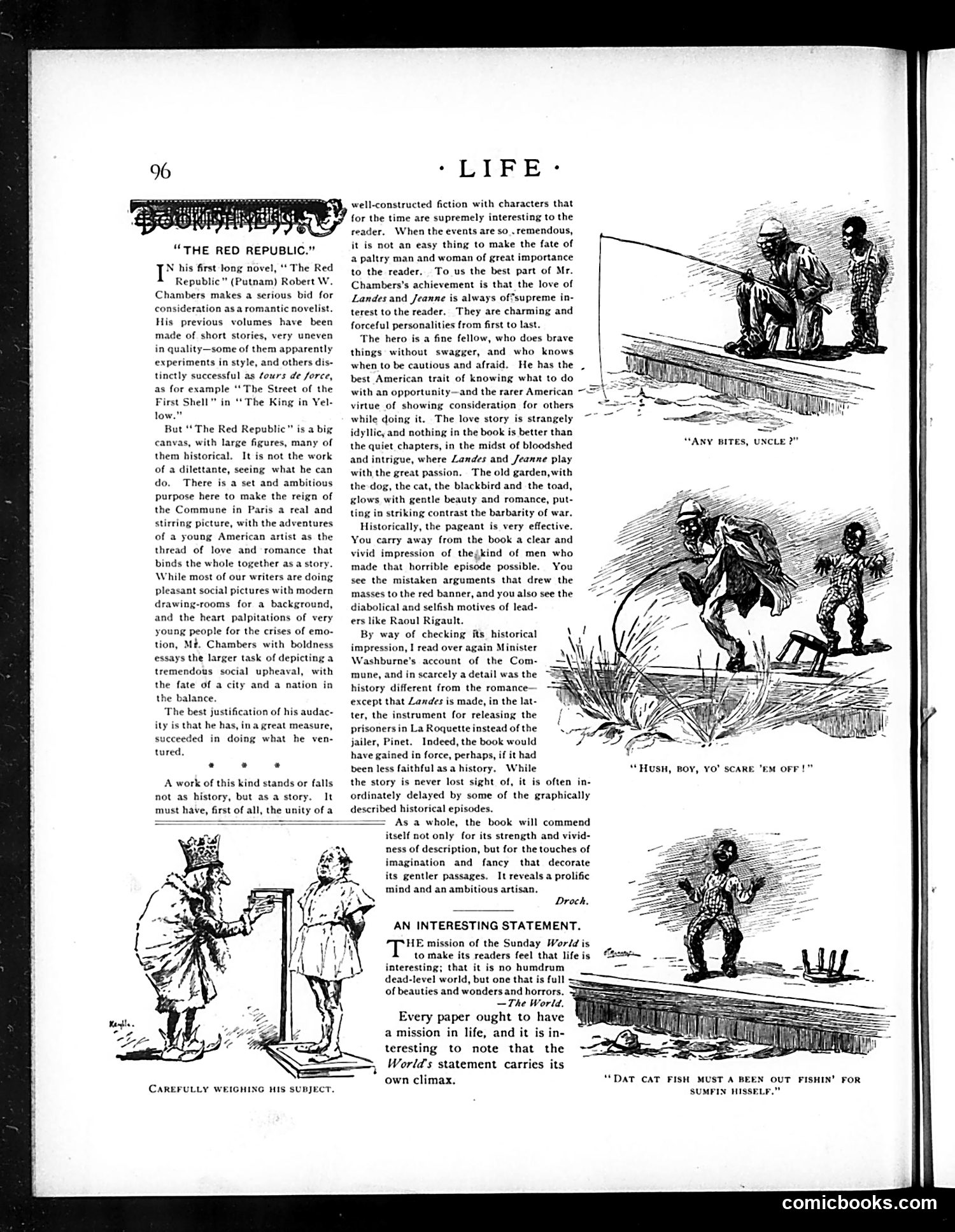
This page reviews Robert W. Chambers' novel "The Red Republic," praising it as ambitious historical fiction set during the Paris Commune. The review emphasizes the book's romantic elements—particularly the love story between characters named Landis and Jeanne—while acknowledging its depiction of the Commune as a historical event. The accompanying illustrations appear to be scenes from the novel rather than political satire. They show figures in period dress in various situations, including what appear to be scenes of conflict or dramatic moments. The review's tone is literary criticism rather than political commentary, focusing on Chambers' narrative skill, character development, and ability to blend romance with historical events. No modern political figures or contemporary satire are evident on this page.
📄 Transcribed text from this page (OCR, searchable)
Machine-transcribed from the original scan — historical spelling and the odd misread are preserved.
“THE RED REPUBLIC.” N his first long novel, “ The Red Republic" (Putnam) Robert W. Chambers makes a serious bid for consideration asa romantic novelist. His previous volumes have been made of short stories, very uneven in quality—some of them apparently experiments in style, and others dis- tinctly successful as fours de force, as for example “The Street of the First Shell” in ‘The King in Yel- low But “The Red Republic” is a big canvas, with large figures, many of them historical. It is not the work of a dilettante, seeing what he can do. There is a set and ambitious purpose here to make the reign of the Commune in Paris a real and stirring picture, with the adventures of a young American artist as the thread of love and romance that binds the whole together as a story. While most of our writers are doing pleasant social pictures with modern drawing-rooms for a background, and the heart palpitations of very young people for the crises of emo- tion, Mé. Chambers with boldness essays the larger task of depicting a tremendots social upheaval, with the fate of a city and a nation in the balance. The best justification of his audac- ity is that he has, ina great measure, succeeded in doing what he ven- tured, . 8 @ A work of this kind stands or falls not as history, but asa story. It must have, first of all, the unity of a CAREFULLY WEIGHING HIS SUBJECT. *- LIFE: well-constructed fiction with characters that for the time are supremely interesting to the reader. When the events are so .remendous, it is not an easy thing to make the fate of a paltry man and woman of great importance to the reader. To us the best part of Mr. Chambers’s achievement is that the love of Landes and Jeanne is always of?supreme in- terest tothe reader. They are charming and forceful personalities from first to last. The hero is a fine fellow, who does brave things without swagger, and who knows when to be cautious and afraid. best American trait of knowing what to do with an opportunity—and the rarer American virtue of showing consideration for others while doing it. The love story is strangely idyllic, and nothing in the book is better than the quiet chapters, in the midst of bloodshed and intrigue, where Landes and Jeanne play with the great passion. The old garden,with the dog, the cat, the blackbird and the toad, glows with gentle beauty and romance, put- ting in striking contrast the barbarity of war. Historically, the pageant is very effective. You carry away from the book a clear and vivid impression of thegkind of men who made that horrible episode possible. You see the mistaken arguments that drew the masses to the red banner, and you also see the diabolical and selfish motives of lead- ers like Raoul Rigault. By way of checking its historical impression, I read over again Minister Washburne’s account of the Com- mune, and in scarcely a detail was the history different from the romance except that Landes is made, in the lat- ter, the instrument for releasing the prisoners in La Roquette instead of the jailer, Pinet. Indeed, the book would have gained in force, perhaps, if it had been less faithful asa history. While the story is never lost sight of, often in- ordinately delayed by some of the graphically described historical episodes. As a whole, the book will commend itself not only for its strength and vivid- ness of description, but for the touches of imagination and fancy that decorate its gentler passages. It reveals a prolific mind and an ambitious artisan. Droch. AN INTERESTING STATEMENT. HE mission of the Sunday World is to make its readers feel that life is interesting; that it is no humdrum dead-level world, but one that is full of beauties and wonders and horrors. —The World. Every paper ought to have a mission in life, and it is in- teresting to note that the World's statement carries its own climax. He has the , | “HUSH, BOY, YO" SCARE 'EM OFF!" “DAT CAT FISH MUST A BEEN OUT FISHIN’ FOR SUMFIN HISS comicbooks.com