
A complete issue · 51 pages · 1895
Life — December 26, 1895
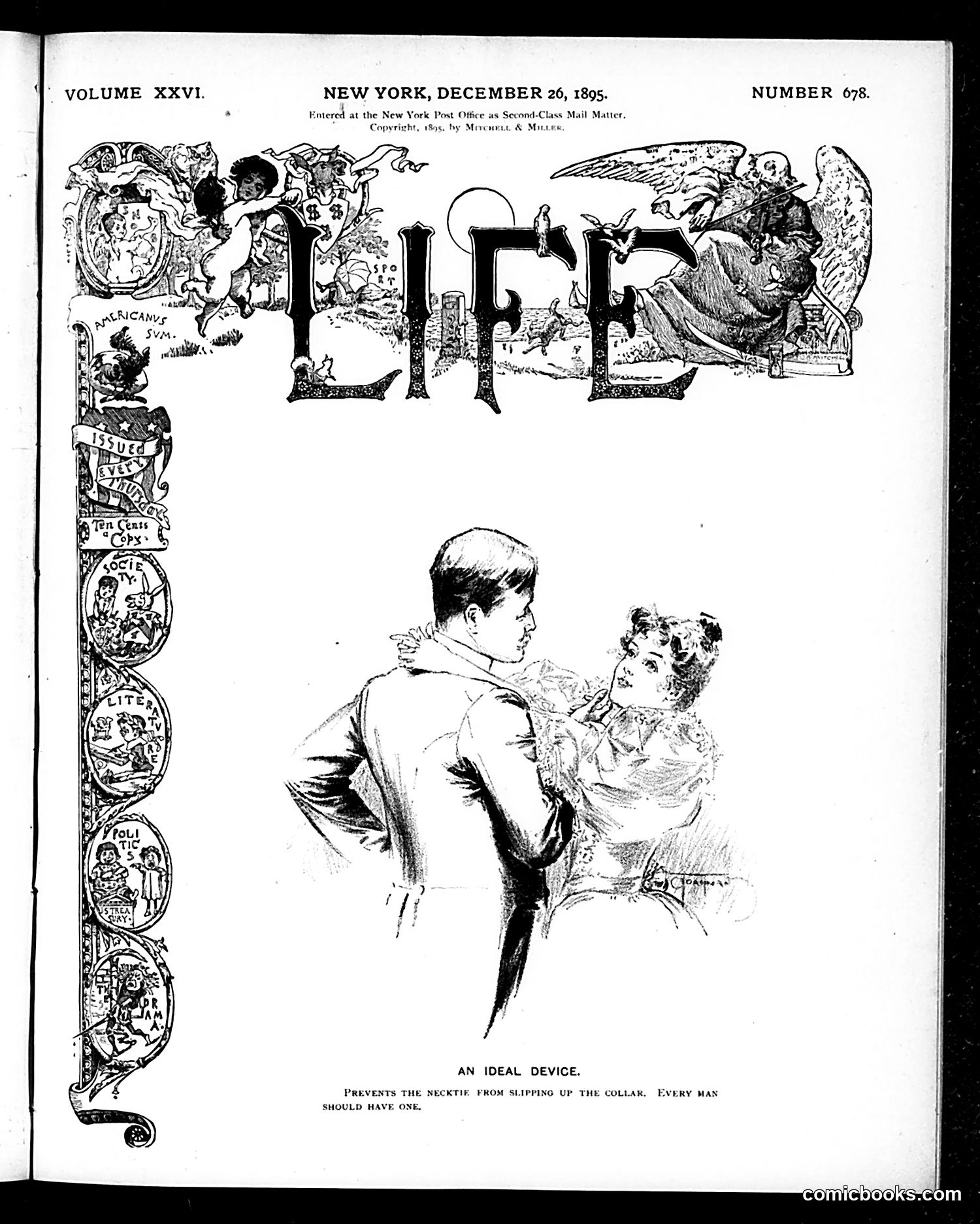
This page features a single cartoon titled "An Ideal Device" with the subtitle "Prevents the necktie from slipping up the collar. Every man should have one." The image shows a man from behind with a woman embracing him from the front, her arms around his neck. The joke is a double entendre playing on Victorian propriety: the caption presents the woman as a practical "device" to keep a man's necktie in place by holding his collar area—but the real humor lies in the intimate physical contact itself, which would be scandalous by 1890s standards. The satire gently mocks both men's fashion concerns and Victorian social conventions around acceptable physical proximity between unmarried men and women.
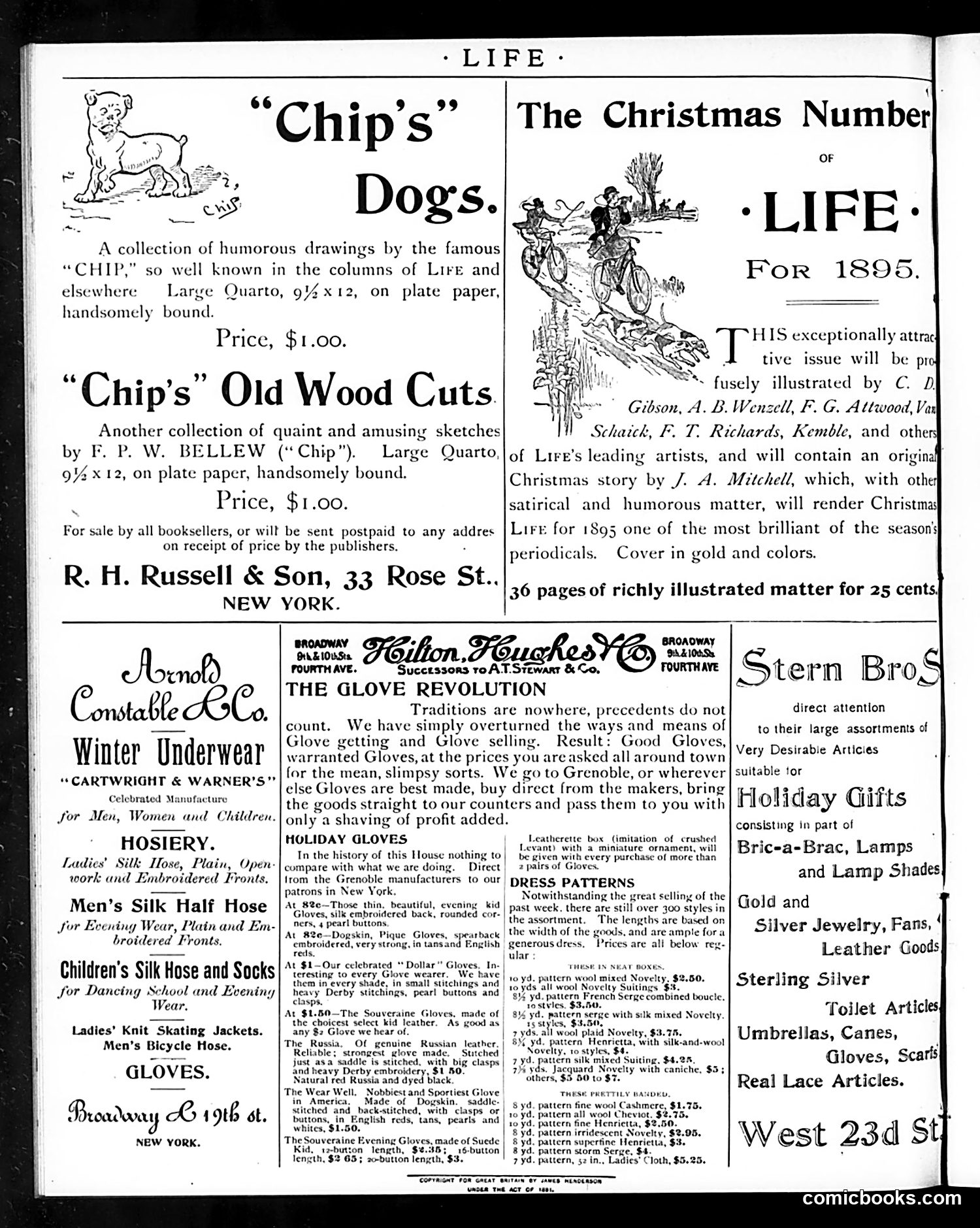
This page is primarily **advertising and product announcements** rather than satirical content. The left side advertises "Chip's Dogs" — humorous dog drawings by a cartoonist known as "Chip" — and "Chip's Old Wood Cuts," both priced at $1.00. These appear to be collections of animal sketches sold as books. The center announces **Life's Christmas Number for 1895**, featuring illustrations by prominent artists and a Christmas story by J.A. Mitchell. The right side contains advertisements for **holiday merchandise**: winter underwear and gloves from Arnold Constable & Co., dress patterns and holiday gifts (lamps, jewelry, silverware) from Stern Bros., and gloves from Broadway & 191st Street in New York. This reflects late-19th-century magazine structure, mixing editorial content with commercial advertisements targeted at holiday shoppers.
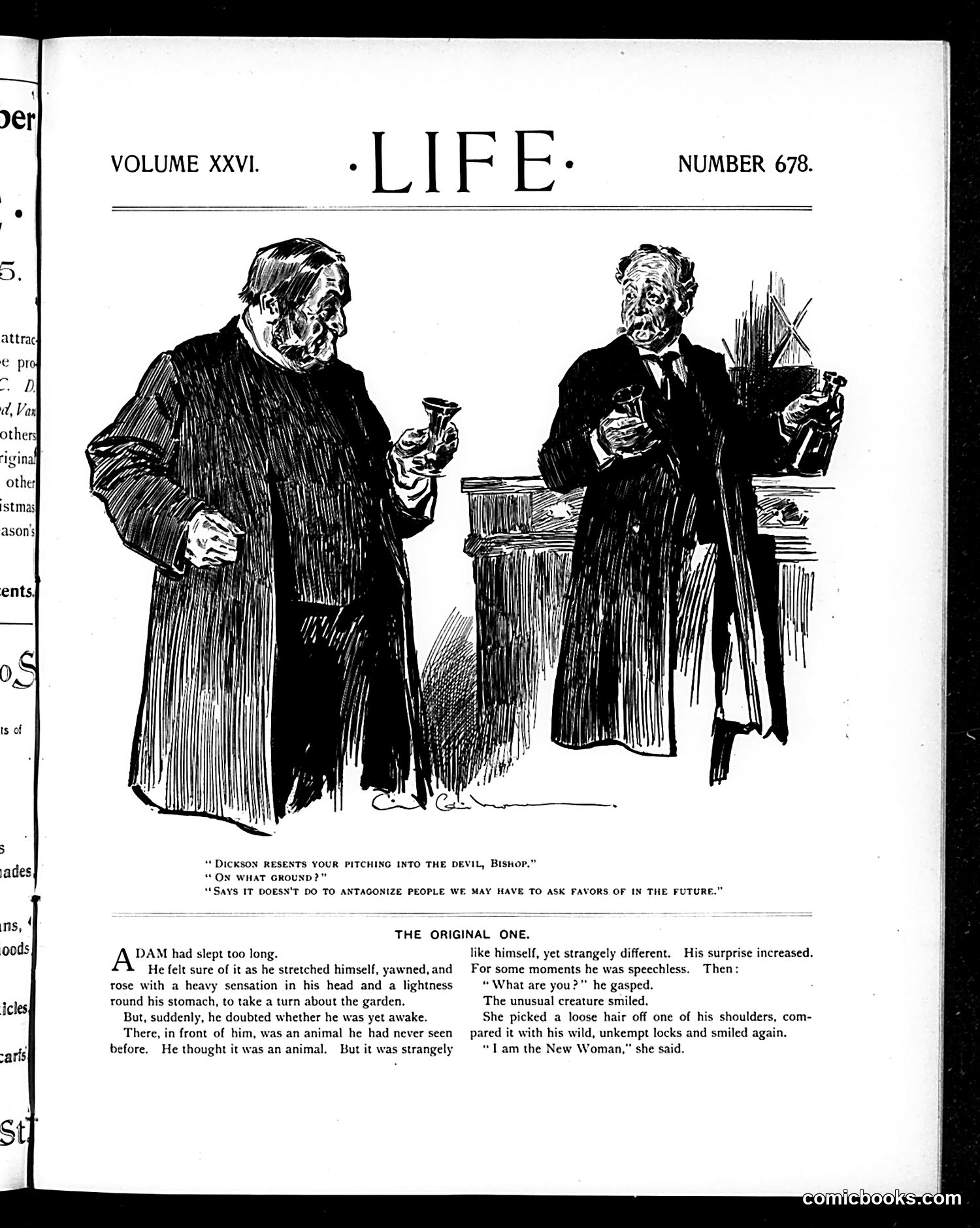
The cartoon shows two men in formal dress having a conversation. The caption reads: "Dickson resents your pitching into the devil, Bishop" / "On what ground?" / "Says it doesn't do to antagonize people we may have to ask favors of in the future." This appears to be political satire criticizing pragmatic compromise in religious or moral matters. A "Bishop" (likely representing religious authority) is being rebuked by someone named Dickson for condemning evil ("the devil"), because doing so might offend powerful people from whom future favors are needed. The joke satirizes cynical politicians or power brokers who believe maintaining relationships with corrupt or immoral figures is more important than taking principled moral stands. It's commentary on how practical self-interest often overrides ethical conviction in public life.
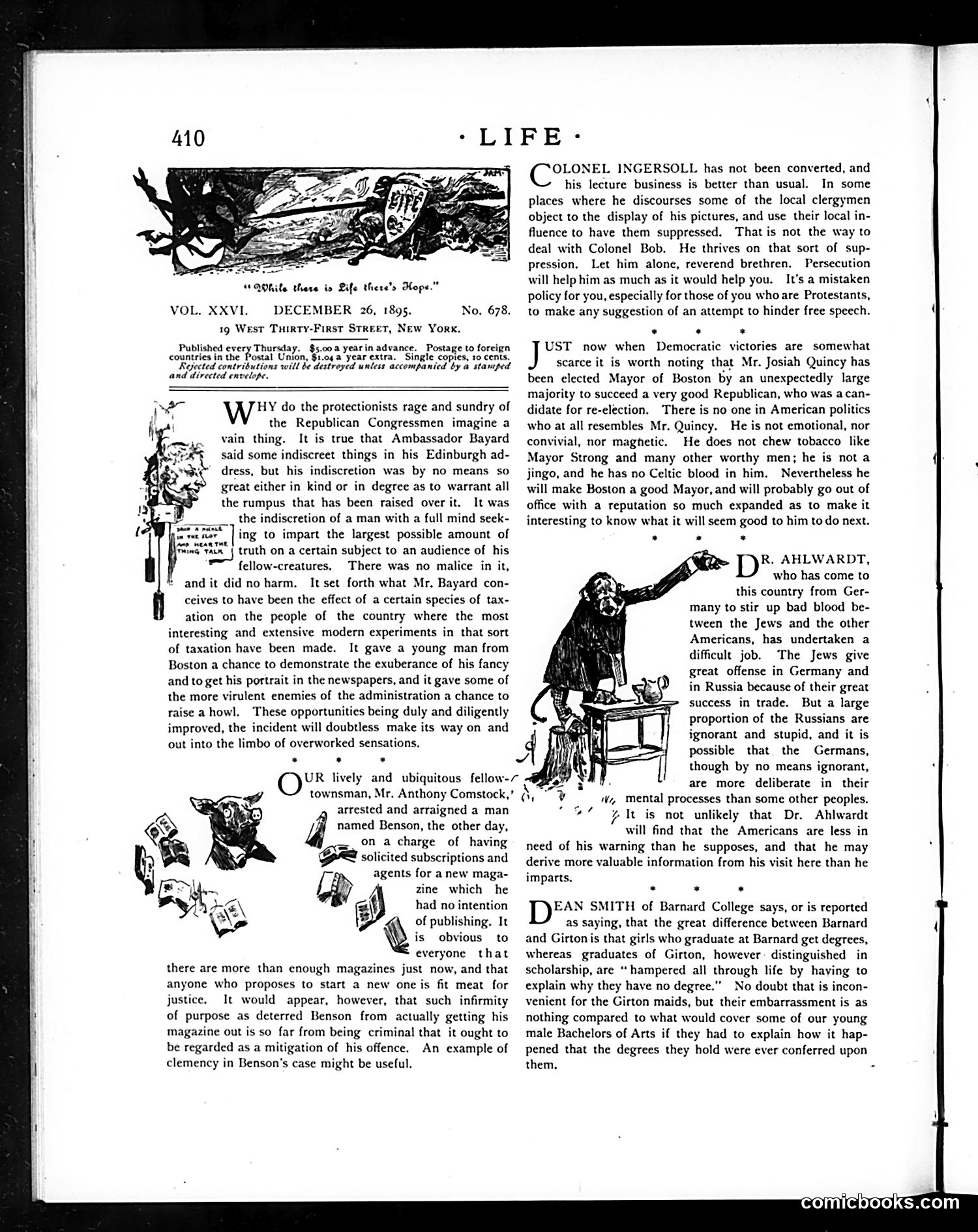
This page contains three separate editorial commentary pieces with accompanying illustrations. The first discusses Colonel Ingersoll (a famous atheist lecturer), defending his right to free speech against suppressionists—a direct jab at those opposing his lectures. The second criticizes Republican Congressmen for exaggerating concerns about Ambassador Bayard's Edinburgh address, calling their outrage disproportionate and questioning their judgment. The third celebrates Boston's new Mayor Josiah Quincy, contrasting him favorably with his Republican predecessor—a Democratic victory worth noting given the era's tight electoral competition. Below these is a cartoon mocking Anthony Comstock's arrest of a man for soliciting magazine subscriptions, satirizing Comstock's overzealous moral policing as absurdly criminalizing ordinary business practices.
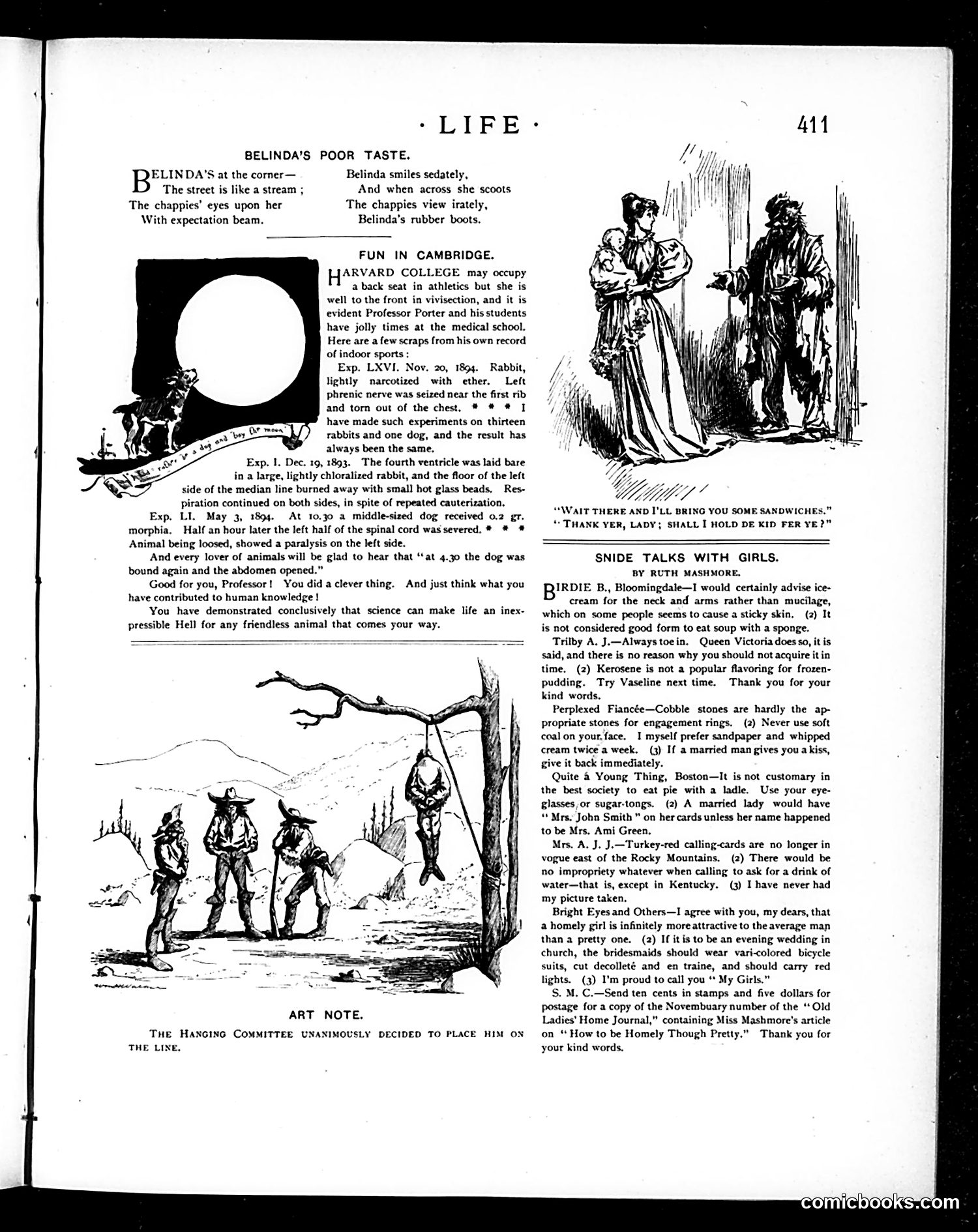
This page contains three separate humor sections: **"Belinda's Poor Taste"** features a poem about a street urchin named Belinda, mocking her shabby appearance and worn rubber boots—typical class-based Victorian humor targeting the poor. **"Fun in Cambridge"** describes medical school experiments at Harvard, detailing vivisection tests on rabbits and dogs. The text presents these procedures matter-of-factly, reflecting early 1890s attitudes toward animal research with no ethical concern—practices now considered cruel. **"Snide Talks with Girls"** offers satirical etiquette advice to women on topics like ice cream, kerosene, engagement rings, and social comportment. It reflects period gender stereotypes and arbitrary social rules governing women's behavior. The cartoons throughout illustrate these satirical scenarios with period-appropriate sketches, using humor to comment on class, scientific practices, and social conventions of the era.
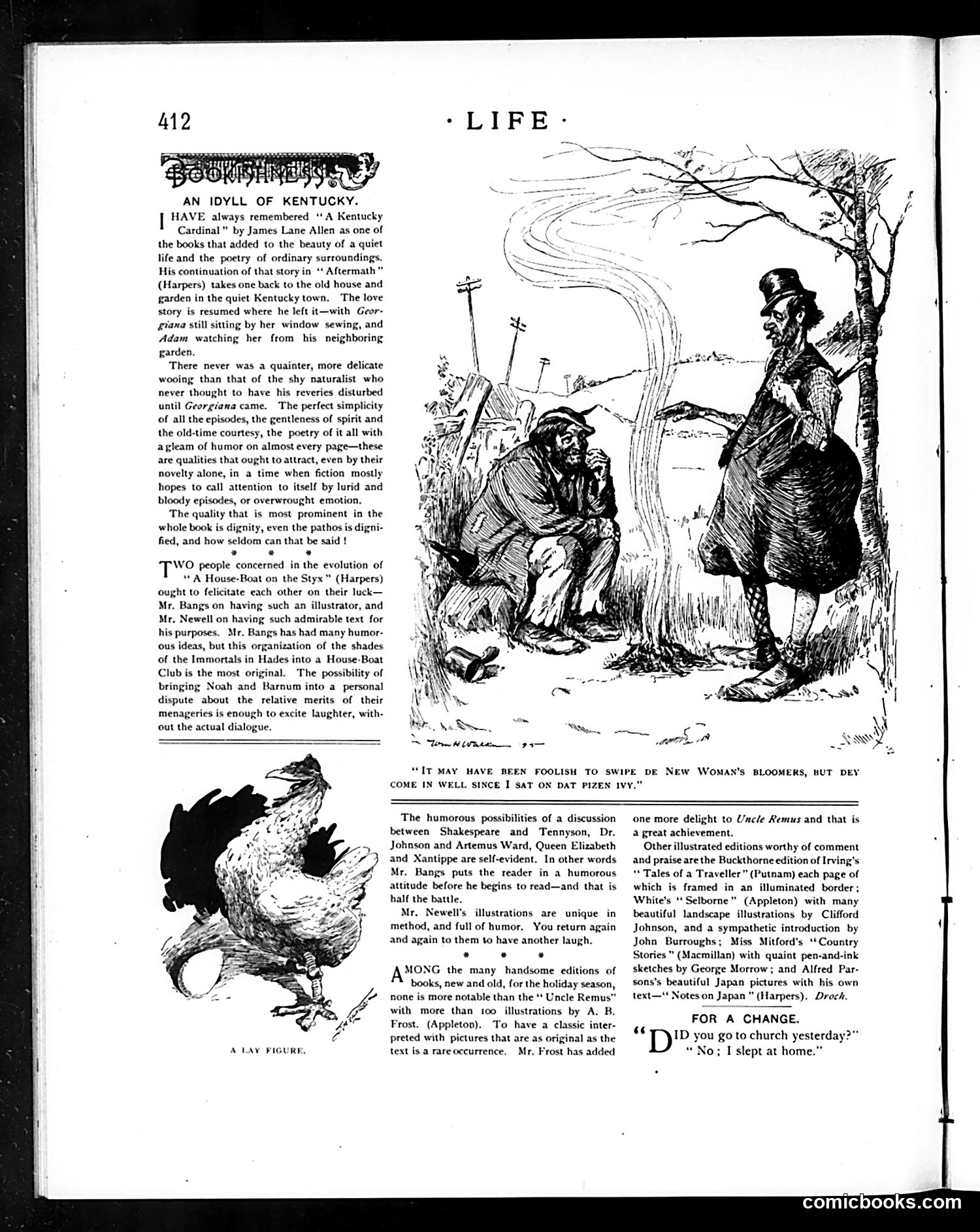
This page contains a literary review section titled "An Idyll of Kentucky," discussing James Lane Allen's Kentucky stories. The main cartoon depicts two men in rural 19th-century dress standing near a cemetery with crosses visible. The caption reads: "It may have been foolish to swipe de new woman's bloomers, but dey come in well since I sat on dat pizen ivy." The joke references the "New Woman" social movement of the late 1800s—women advocating for dress reform, including wearing bloomers (baggy pants). The cartoon satirizes rural/working-class men pragmatically repurposing stolen women's bloomers as a remedy for poison ivy exposure, treating progressive women's fashion ironically as merely useful rags rather than symbols of women's liberation.
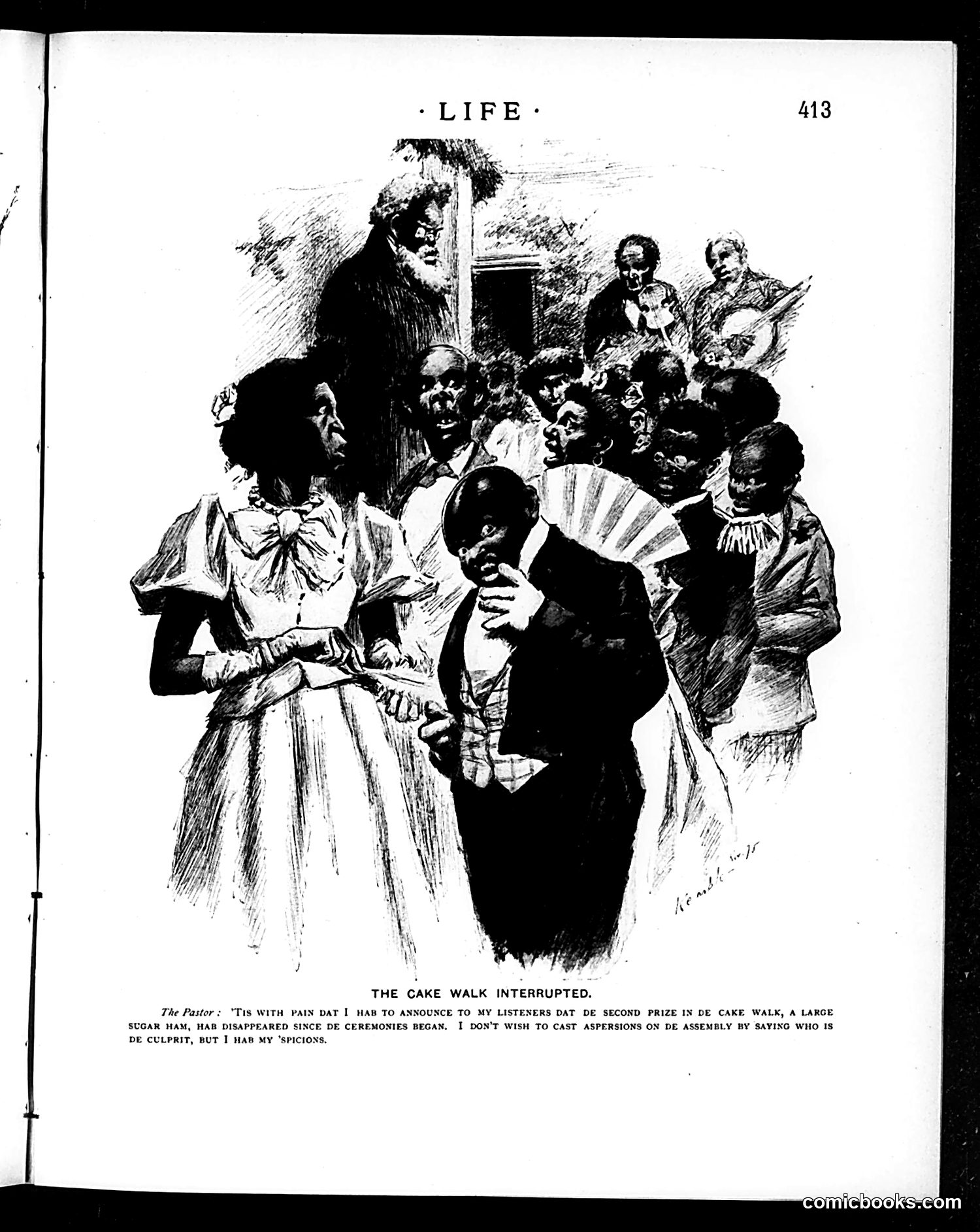
This satirical illustration depicts a disrupted "cake walk"—a popular dance competition of the era (originally a minstrel show tradition). A pastor interrupts the festivities to announce that the second prize in the cake walk has disappeared, suspecting theft by someone named "Savido" whom he describes as a "culprit." The humor targets religious hypocrisy: a clergyman presiding over what was considered frivolous entertainment, then making accusations about moral failings. The crowded, animated scene of dancers contrasts with the pastor's stern intervention, satirizing how religious authority figures policed social behavior and amusements in early 20th-century American communities. The racial dynamics of cake walks themselves (rooted in minstrelsy) add another layer, though the specific social commentary here focuses on institutional moralism.
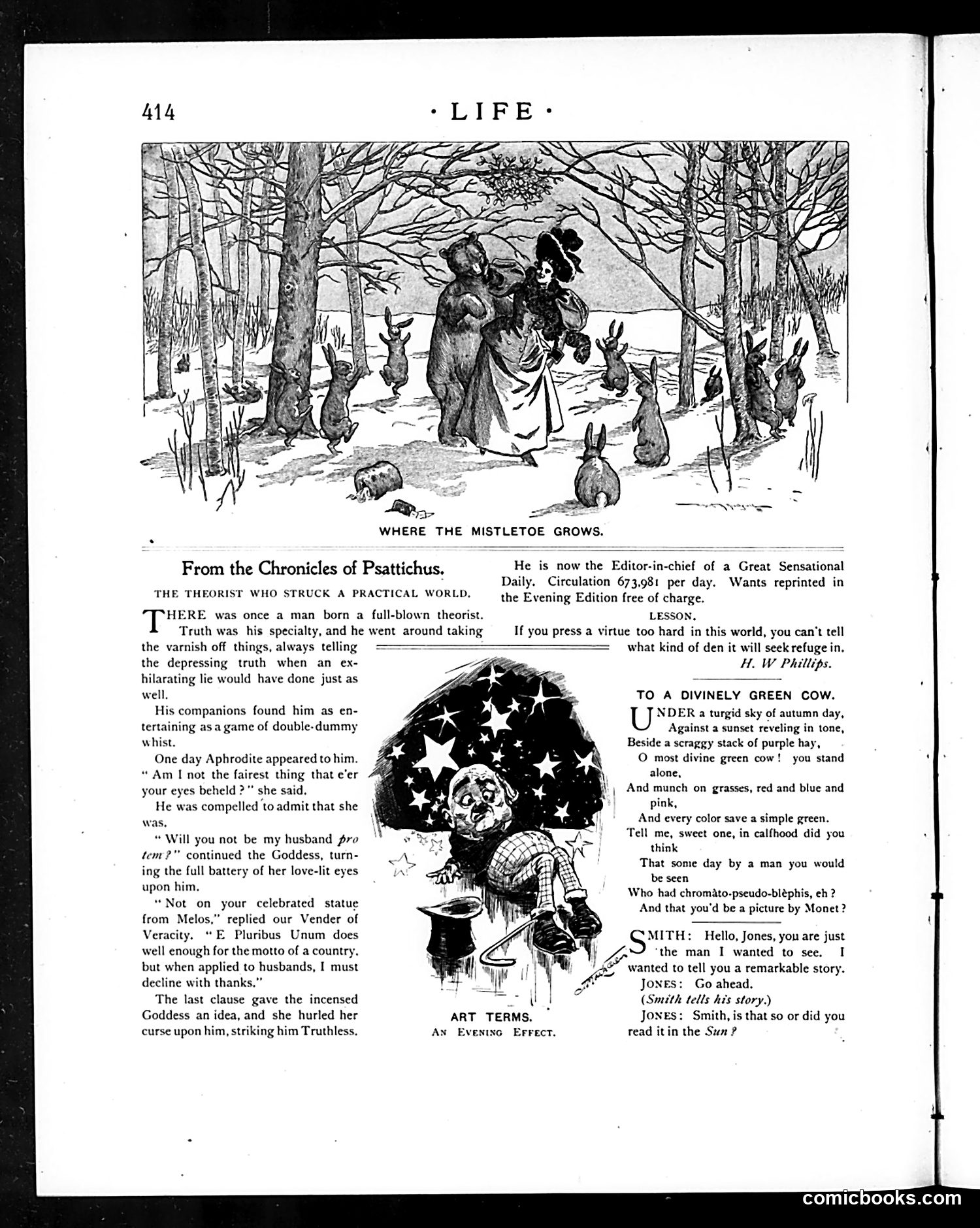
**Top Illustration ("Where the Mistletoe Grows"):** A Victorian-era Christmas scene showing anthropomorphic rabbits gathered around two human figures (a woman and man in period dress) beneath mistletoe in a winter forest. This is a humorous holiday illustration playing on the romantic tradition of kissing under mistletoe. **"The Theorist Who Struck a Practical World":** A satirical story mocking an intellectual who theorizes constantly but proves ineffectual in practice. When confronted by the goddess Aphrodite, he substitutes philosophical debate for action—criticized for hiding behind abstract principles rather than engaging reality. The satire targets impractical academia and verbose theorizing. **"To a Divinely Green Cow":** A poetic piece celebrating pastoral simplicity, likely contrasting rural authenticity with urban artificiality.
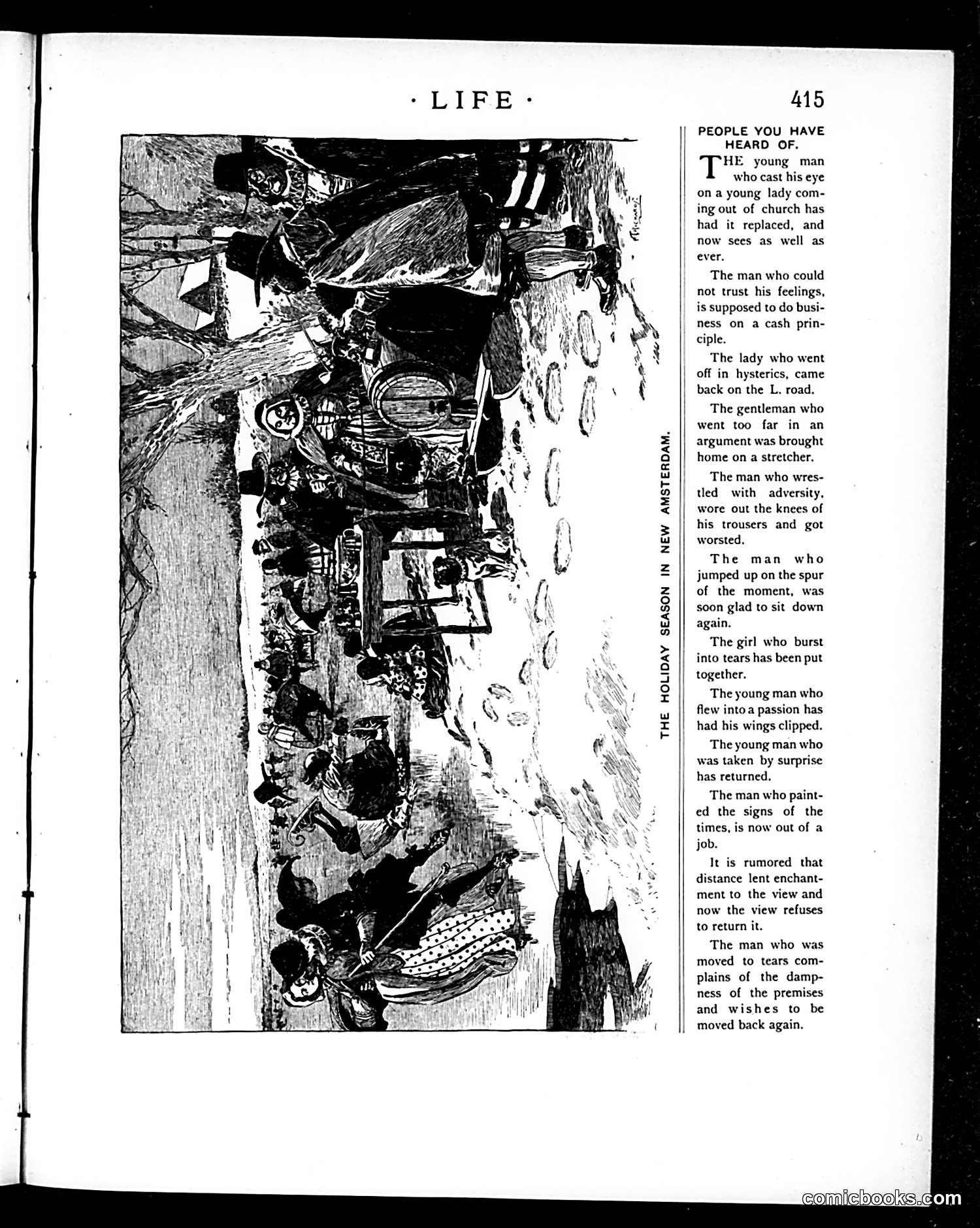
This is a humorous column titled "People You Have Heard Of" from Life magazine's section "The Cloudy Season in New Amsterdam." The text consists of satirical one-liners about various social types and their comeuppances—a young man distracted by a girl at church, a hysterical lady, someone injured in an argument, failed romantics, and struggling professionals. The crude woodcut illustration (rotated 90 degrees in the layout) appears to depict a chaotic domestic or social scene, though specific details are difficult to discern. The satire targets pretension and foolish behavior among the urban middle class. Each brief anecdote suggests comeuppance—the passionate man has "his wings clipped," the ambitious painter is "out of a job"—implying that overconfidence or emotional excess leads to downfall. This reflects Life's characteristic gentle mockery of contemporary American social foibles.
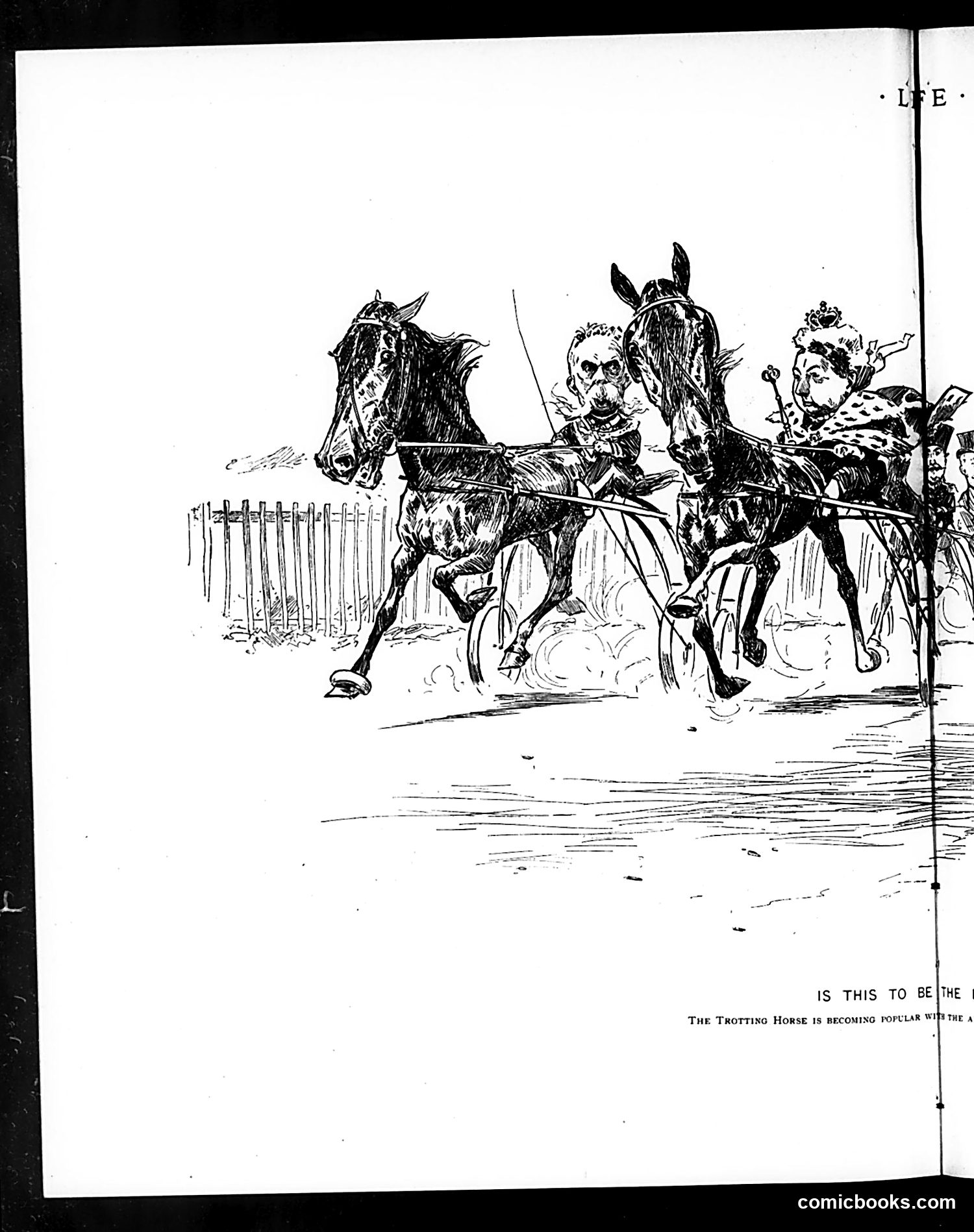
This appears to be a satirical cartoon about horse-drawn carriages becoming fashionable. The caption reads "The Trotting Horse is becoming popular with the..." (text cut off). The image shows two figures in an open carriage pulled by horses. Based on the elaborate clothing and crowns/ornaments visible, these appear to be wealthy or aristocratic individuals—possibly royalty or high society. The style of dress and the formal carriage suggest late 19th-century aristocratic life. The satire likely mocks the upper classes' adoption of trotting horses as a fashionable pursuit or status symbol. The exaggerated, somewhat caricatured facial features emphasize the pretentiousness of the wealthy embracing this trend. Without seeing the complete caption, the specific target of satire remains unclear, but it's mocking some aspect of elite social behavior or fashion.
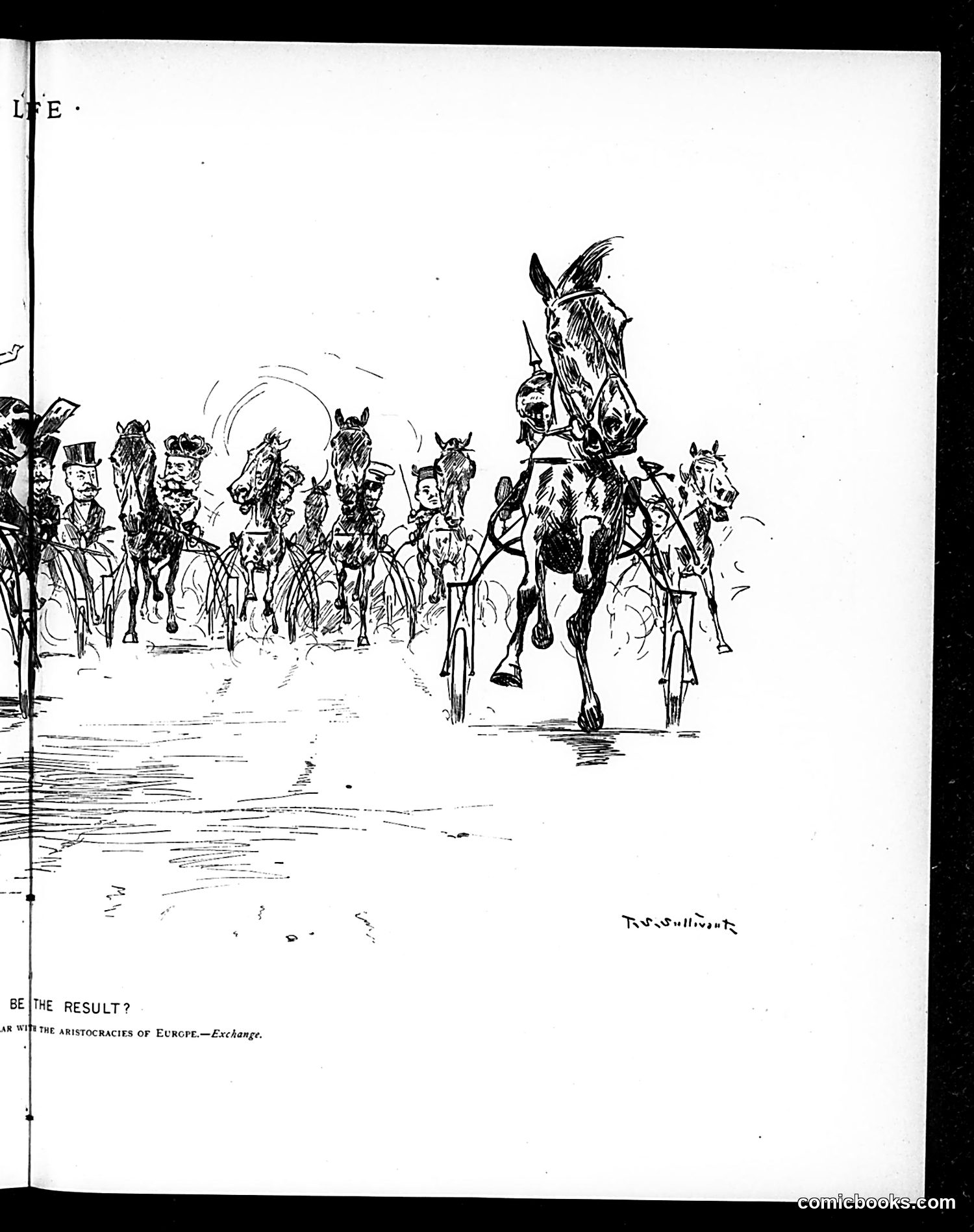
This cartoon, titled "BE THE RESULT?" from *Life* magazine, appears to satirize European aristocracies and their military establishments. The image shows mounted cavalry officers—identifiable by their elaborate uniforms and decorations—parading before a crowd, with one prominent figure on horseback at center-right. The caption references "THE ARISTOCRACIES OF EUROPE—Exchange," suggesting the cartoon critiques the nature of European nobility and military leadership. The question "BE THE RESULT?" implies skepticism about what these aristocratic displays actually accomplish—whether all this pageantry and military posturing produces meaningful results. The satirical point appears to target the perceived disconnect between aristocratic pretension and actual utility, a common theme in early 20th-century American satire of European elites.
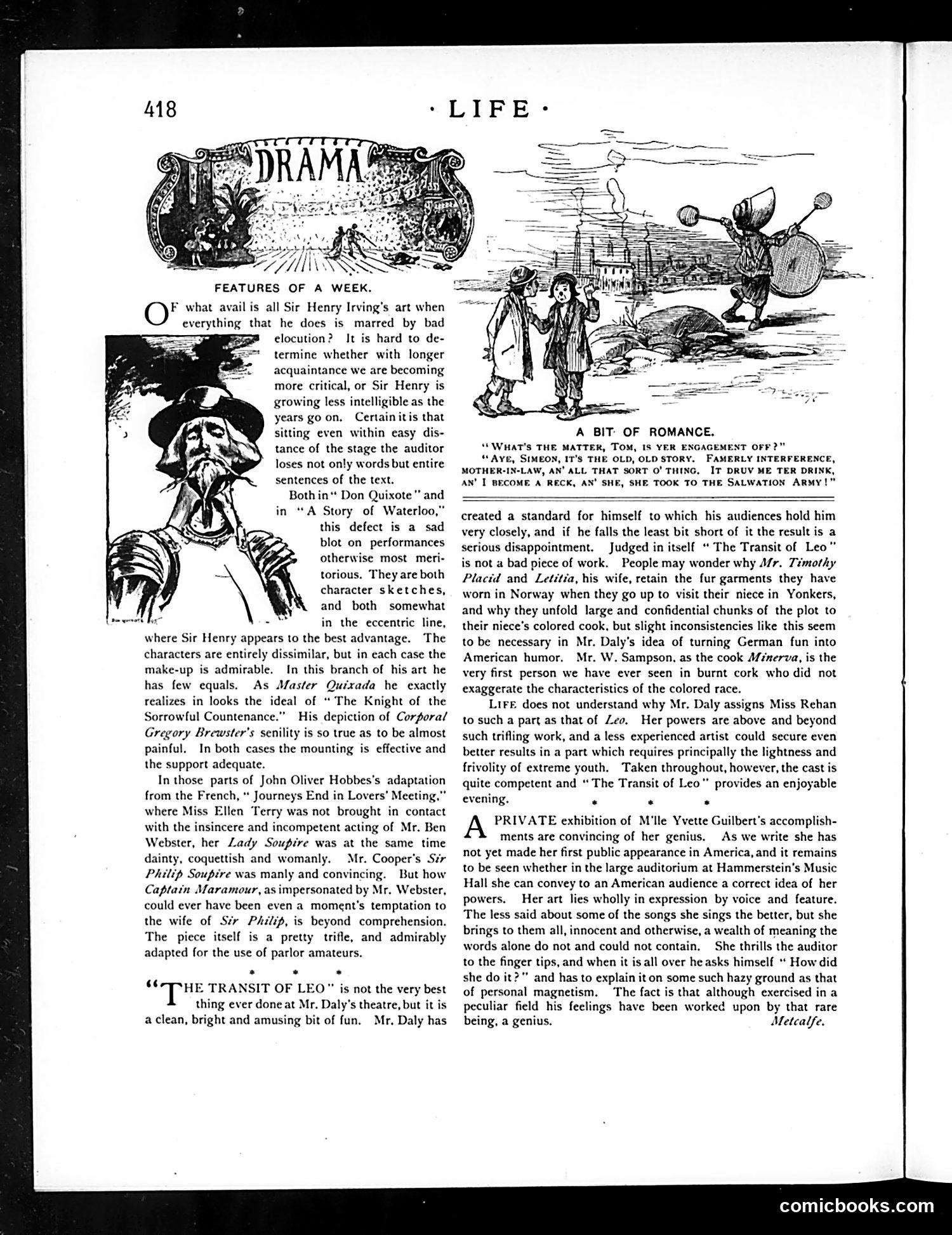
This page reviews contemporary theatrical productions, primarily criticizing **Sir Henry Irving**, a famous British actor. The text complains that Irving's elocution (speech clarity) has deteriorated with age—audiences cannot hear entire sentences despite sitting close to the stage. He's praised for excellent makeup and character work in *Don Quixote* and *A Story of Waterloo*, but his diction undermines otherwise strong performances. The page also reviews other productions: *Journeys End in Lovers' Meeting* (praising Ellen Terry), *The Transit of Leo* at Mr. Daly's theatre, and mentions French actress M'lle Yvette Guilbert's upcoming American debut. The small cartoon captioned "A Bit of Romance" shows working-class dialect humor: a man blames his broken engagement on family interference and drink, while his fiancée joined the Salvation Army—typical Victorian-era sentimental melodrama material used for satirical effect.
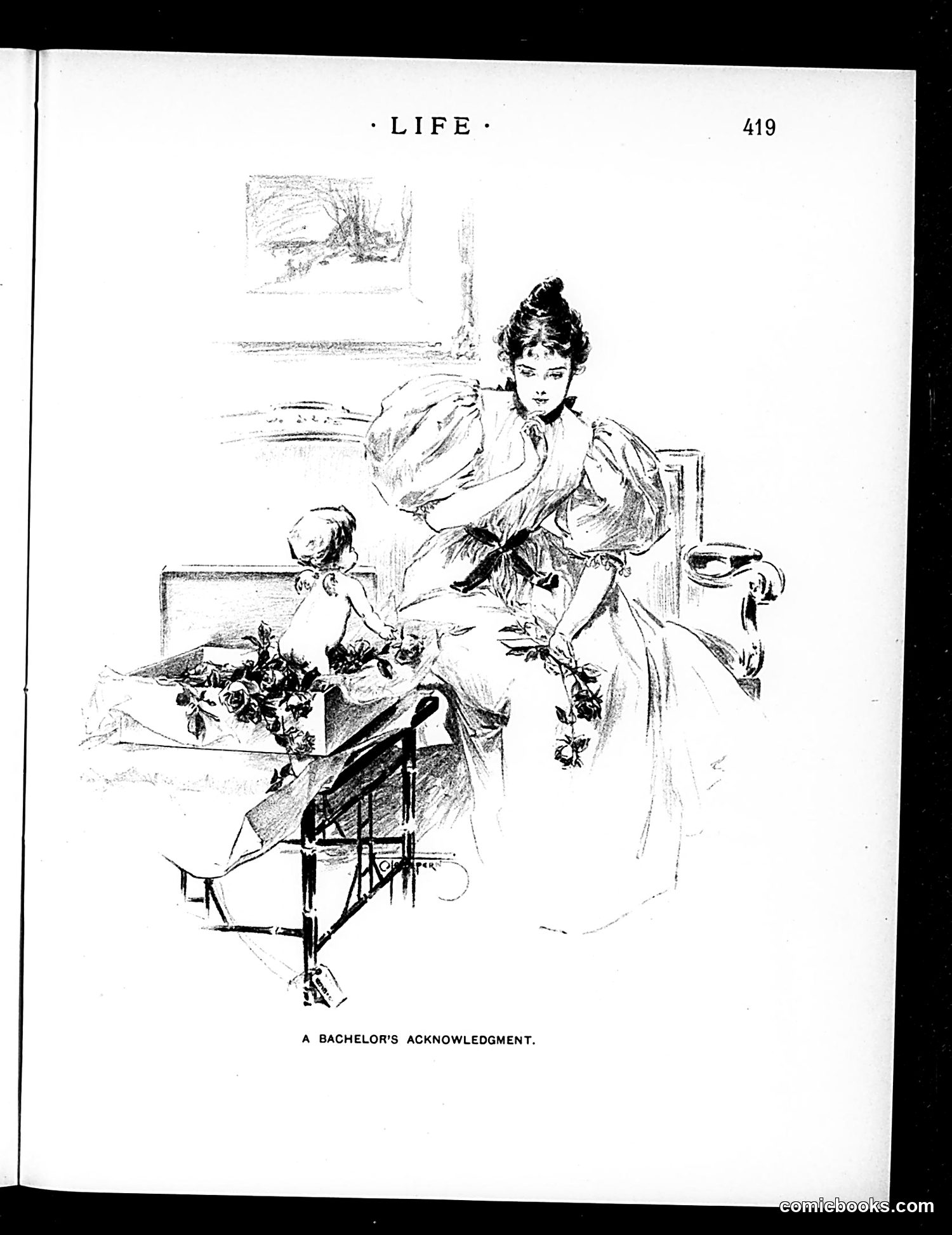
This illustration from *Life* magazine (page 419) depicts a satirical scene about bachelor life and romantic obligations. A well-dressed woman sits surrounded by wilted flowers, holding what appears to be a bouquet in disarray. A cherub or cupid figure hovers nearby. The cartoon's joke centers on the title's irony: a bachelor's "acknowledgment" of romantic gestures—likely that he's failed to properly maintain or appreciate flowers (a traditional romantic gift). The wilted state of the blooms suggests neglect or forgetfulness, common bachelor stereotypes of the era. The scene mocks unmarried men's perceived inability or unwillingness to maintain romantic courtesies that married men or serious suitors would provide. The tone is lighthearted social satire about gender relations and domestic competence.
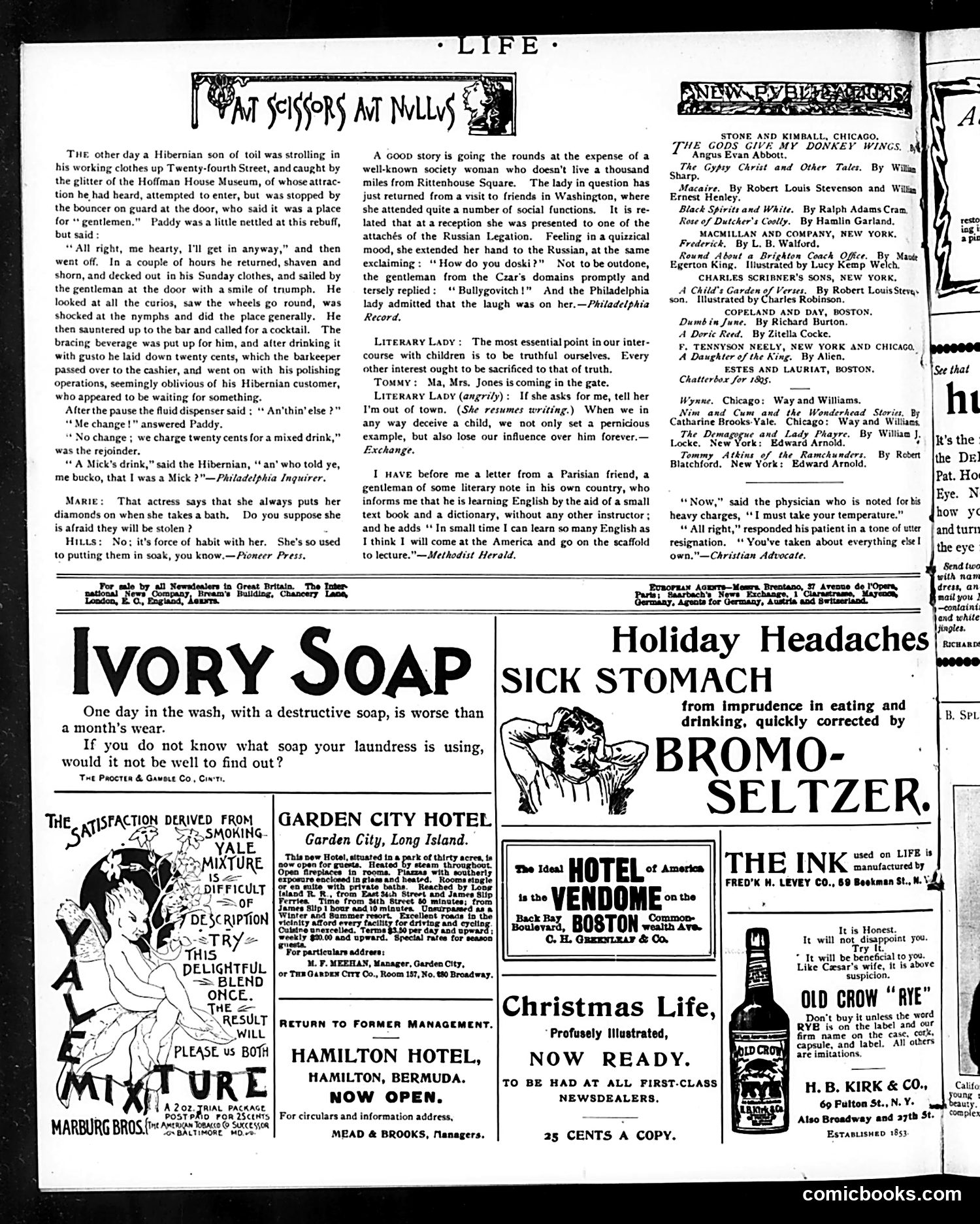
This page from *Life* contains mostly humorous anecdotes and advertisements, reflecting late 19th-century American class and ethnic attitudes. The main story—titled "At Scissors at Wills"—features a working-class Irish man (Paddy) initially denied entry to the Hoffman House Museum because he's not dressed as a "gentleman." He returns in fine clothes, gains entry, then orders a drink at the bar. When charged 20 cents, he expects change from a larger bill, but the bartender claims "no change" for mixed drinks. Paddy protests being treated like "a Mick" (a derogatory term for Irish immigrants), challenging the assumption that he's unintelligent about money. The satire targets both working-class exclusion from "respectable" establishments and casual ethnic stereotyping. The joke's irony: despite his working-class background, Paddy proves he's "gentlemanly" enough to be treated fairly—yet still faces prejudice. The other brief anecdotes mock hypocritical society women and humorous language-learning attempts.
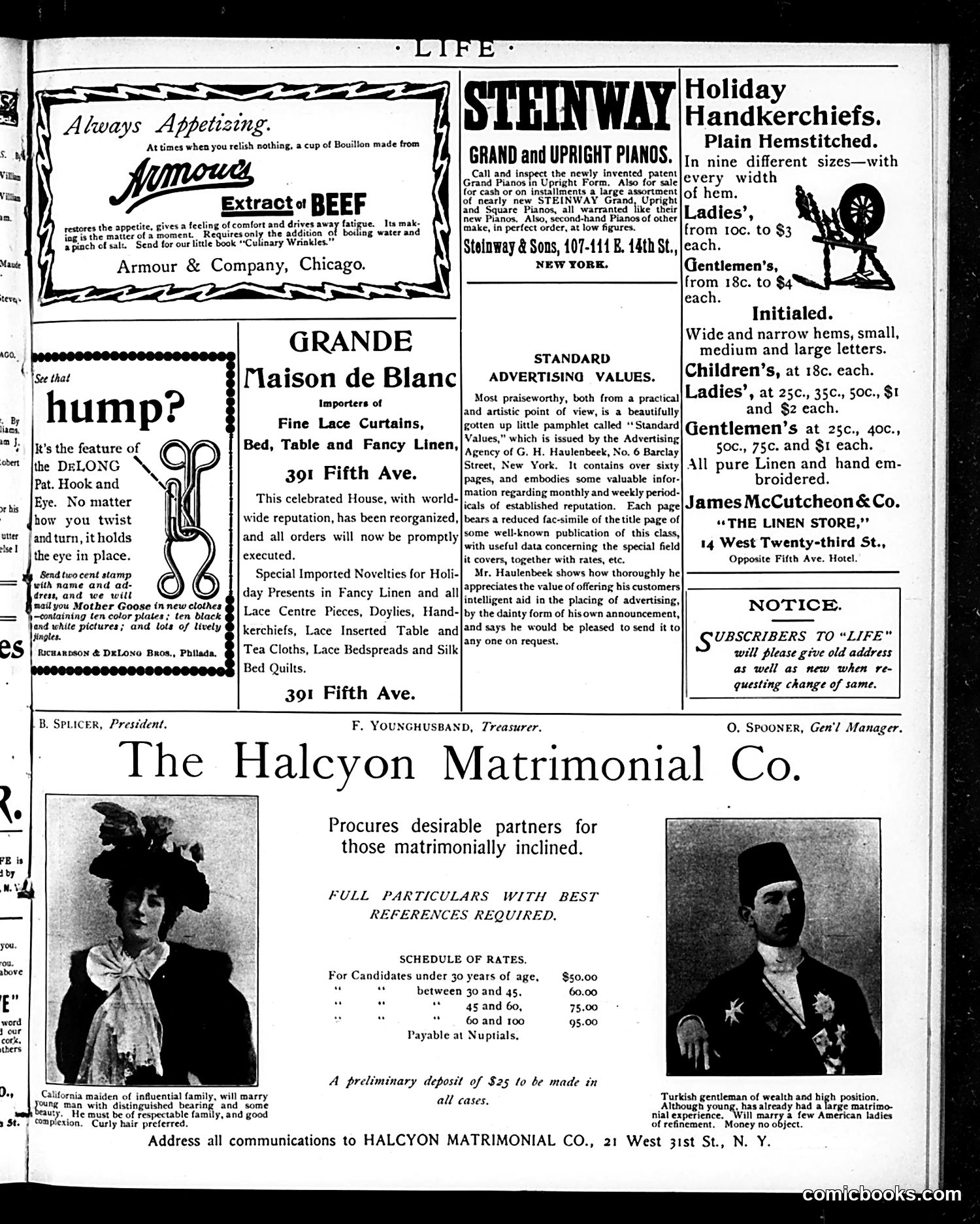
This magazine page is primarily **advertising**, not satire or political commentary. However, one ad deserves explanation: **The Halcyon Matrimonial Co.** operates as a marriage-broker service. It procures romantic partners for clients on a fee-based schedule ($50-$95 depending on age). The two photographs show example clients: a "California maiden of influential family" and a "Turkish gentleman of wealth and high position." This reflects a historical practice where wealthy individuals—particularly those from different countries or social circles—used formal matchmaking services. The transactional nature (payment "at nuptials") and emphasis on wealth/status would strike modern readers as strikingly commercial and different from today's dating practices, though the basic concept echoes contemporary matchmaking or dating apps. The rest of the page contains standard period advertisements for pianos, beef extract, lace goods, and handkerchiefs.
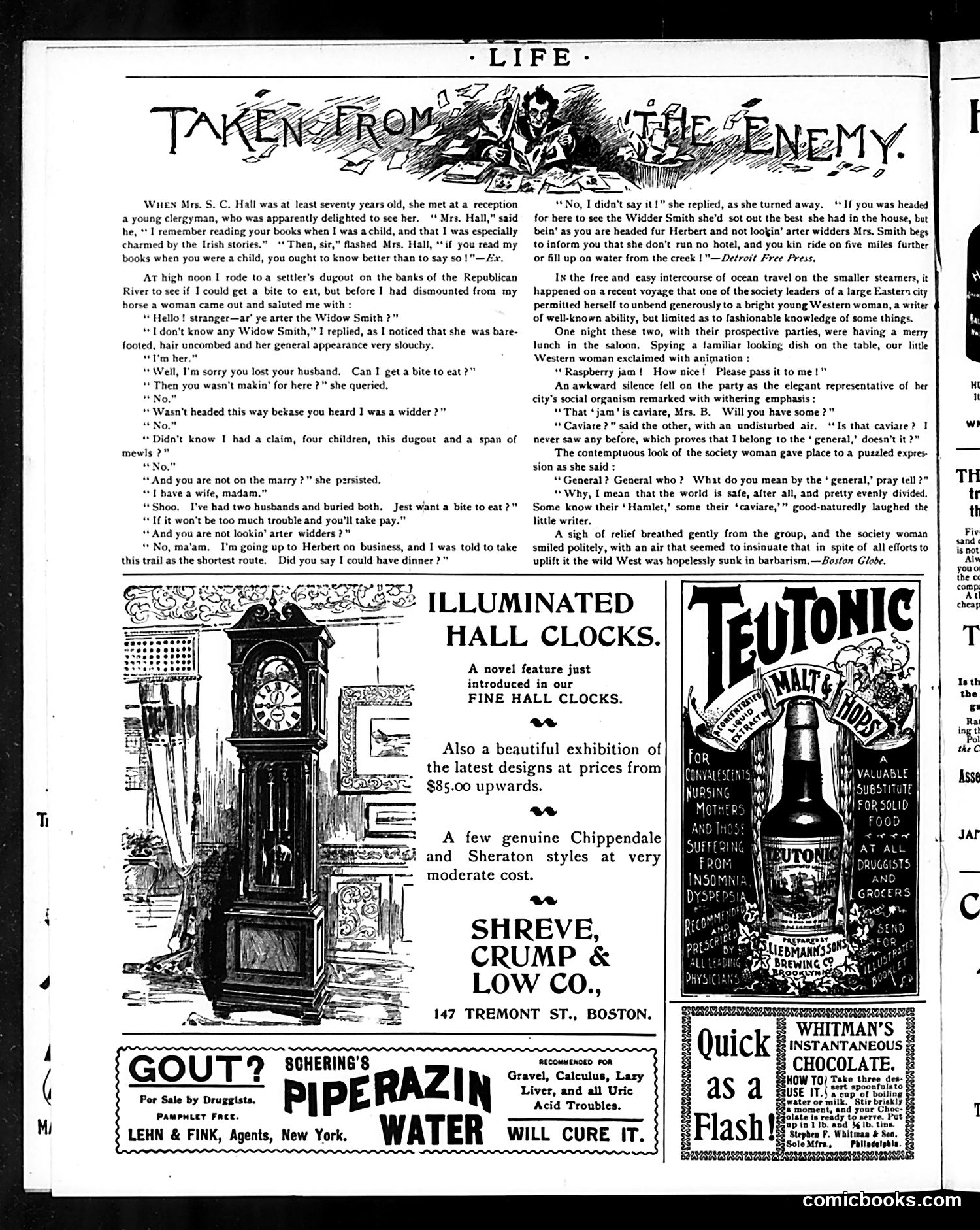
This page contains three humorous anecdotes satirizing social pretension and class distinctions in late 19th/early 20th-century America. The first story mocks a clergyman who flatters an elderly author (Mrs. S. C. Hall) by claiming her childhood books inspired him—she retorts that if he read them as a child, he should know better than to make such patronizing comments. The second depicts a frontier widow aggressively pursuing a male traveler, misinterpreting his polite request for dinner as romantic interest. The humor lies in her blunt, desperate behavior contrasting with frontier poverty. The third satirizes urban social snobbery: an Eastern society woman corrects a Western writer's calling caviar "raspberry jam," expecting embarrassment. Instead, the writer gracefully responds that such distinctions prove the world remains "evenly divided"—some know Hamlet, others know caviar—deflating the snob's pretensions with good humor. The advertisements below are period products (clocks, medicinal water, chocolate).
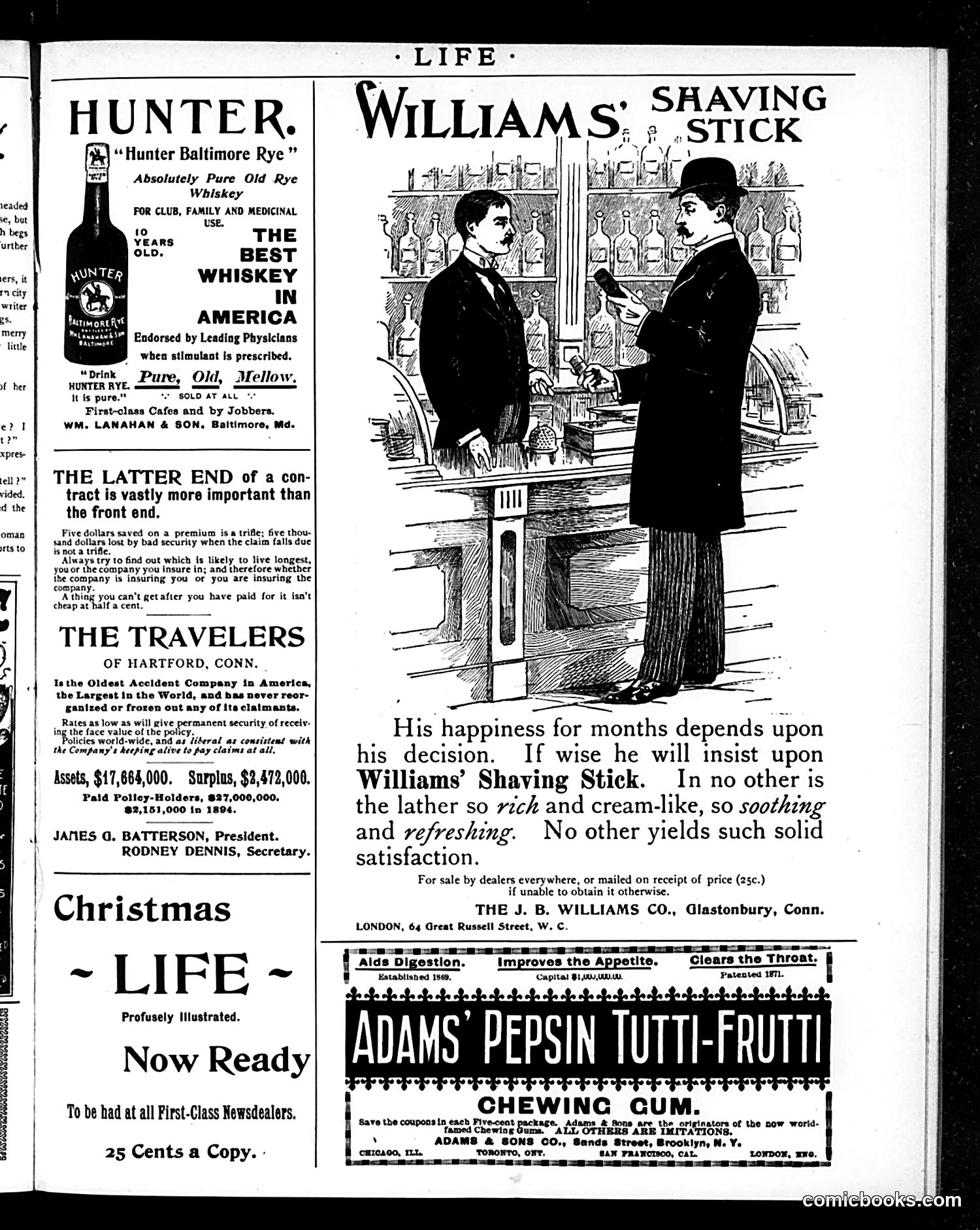
This is a period advertisement disguised as social commentary. The cartoon depicts two well-dressed men in conversation aboard what appears to be a train or ship, with crowded passengers visible in the background. The accompanying text uses a common advertising trope of the era: a man's romantic and professional success depends entirely on his grooming choice. The copy claims that Williams' Shaving Stick produces uniquely "rich and cream-like" lather, asserting superiority over competitors through flowery language ("soothing and refreshing"). The "joke" or sales pitch relies on early 20th-century masculine anxiety—the implication that proper shaving directly impacts "his happiness for months" and by extension, his social standing. This reflects period advertising conventions that linked personal grooming to male success and respectability. The page is primarily commercial rather than satirical; *Life* magazine carried substantial advertising alongside editorial content.
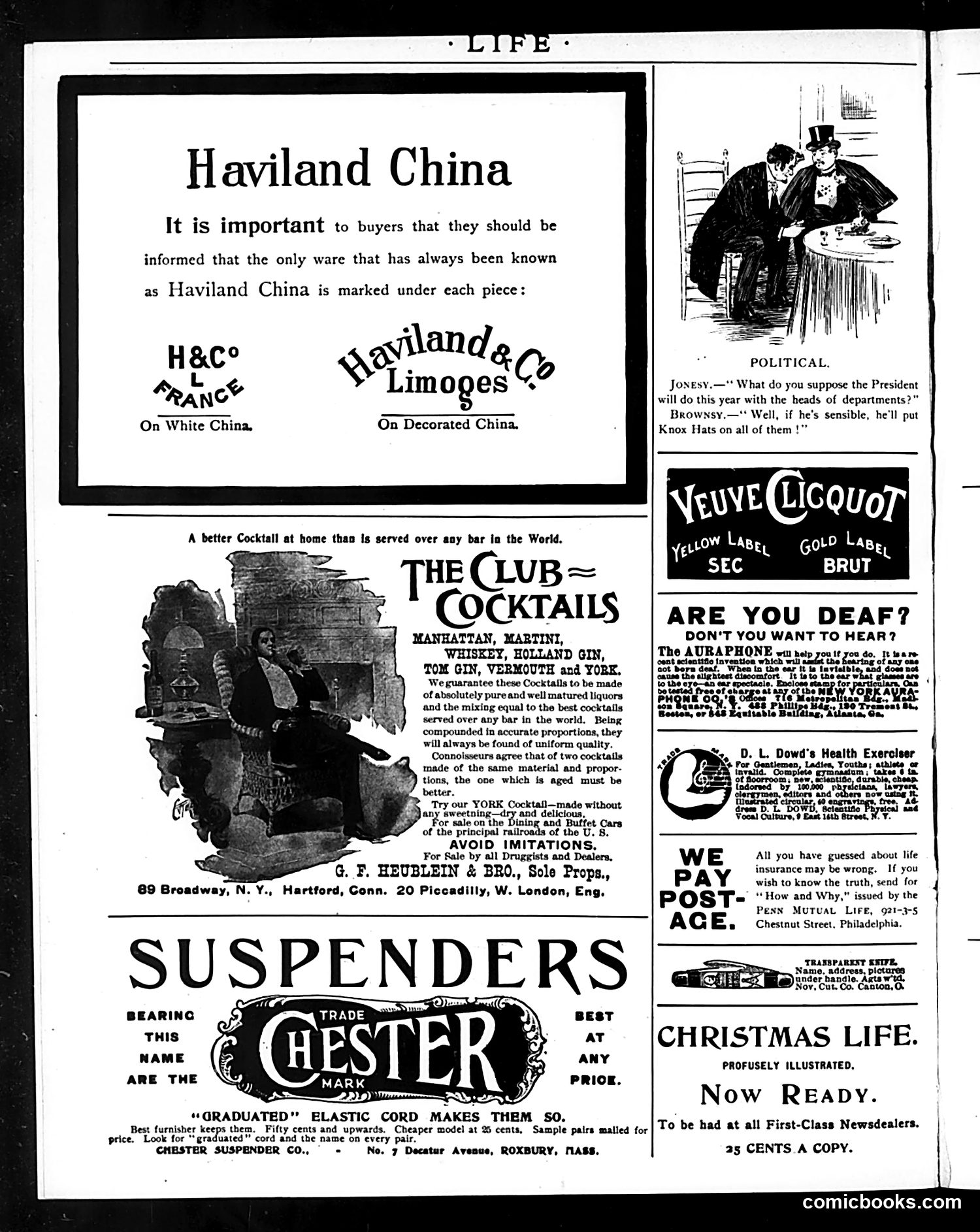
This page is primarily **advertising** with one small political cartoon labeled "POLITICAL" in the upper right. The cartoon depicts two men in conversation. One asks what the President will do "this year with the heads of departments." The other replies that "if he's sensible, he'll put Knox Hats on all of them!" **The satire**: This is a joke about **Knox Hats**, a real hat brand being advertised elsewhere on the page. The humor relies on Knox being so ubiquitous and essential that it's treated as a solution to governmental competence—suggesting that simply equipping cabinet members with Knox Hats would make them adequate for their jobs. It's a lighthearted, self-aware advertisement disguised as political commentary, typical of *Life* magazine's advertising-as-humor approach. The reference to "the President" and "heads of departments" places this during a presidential administration, but the OCR provides no specific date to identify which president is meant.
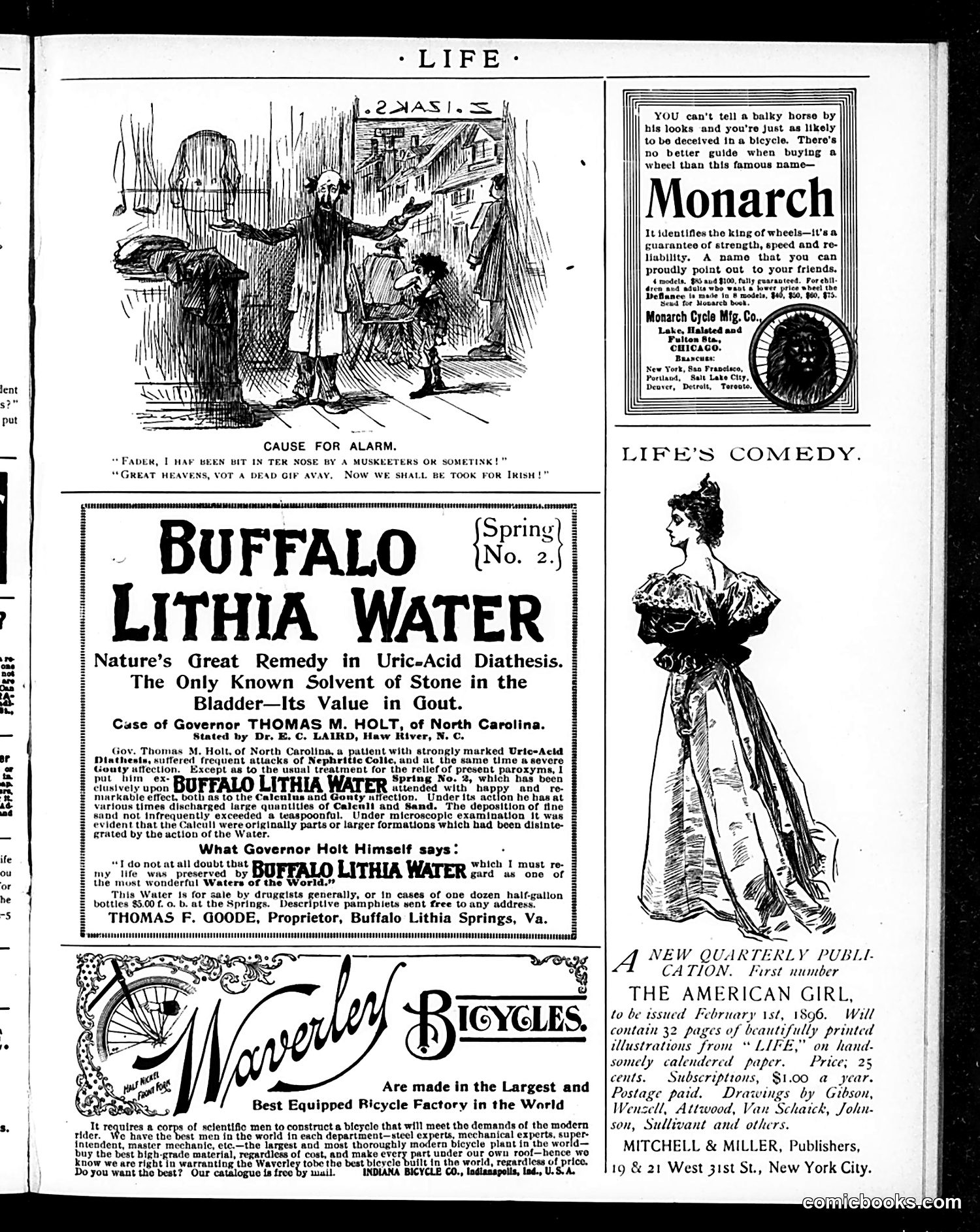
This is primarily an advertising page with one small cartoon. The cartoon titled "Cause for Alarm" shows an Irish immigrant family being confronted by what appears to be an authority figure or official. The dialogue indicates ethnic stereotyping: the father, speaking in exaggerated dialect ("FADER," "MUSKEETERS," "SOMETINK"), fears being mistaken for Irish after his child is bitten on the nose—implying Irish people were perceived as disease-ridden, dangerous, or otherwise disreputable in turn-of-the-century America. The satire targets anti-Irish prejudice through ironic exaggeration. The comic "alarm" is that the family themselves fear the stigma of appearing Irish. The page is otherwise dominated by patent medicine advertisements (Buffalo Lithia Water for gout) and bicycle advertisements (Monarch, Waverley), typical of Life magazine's commercial content in the 1890s.
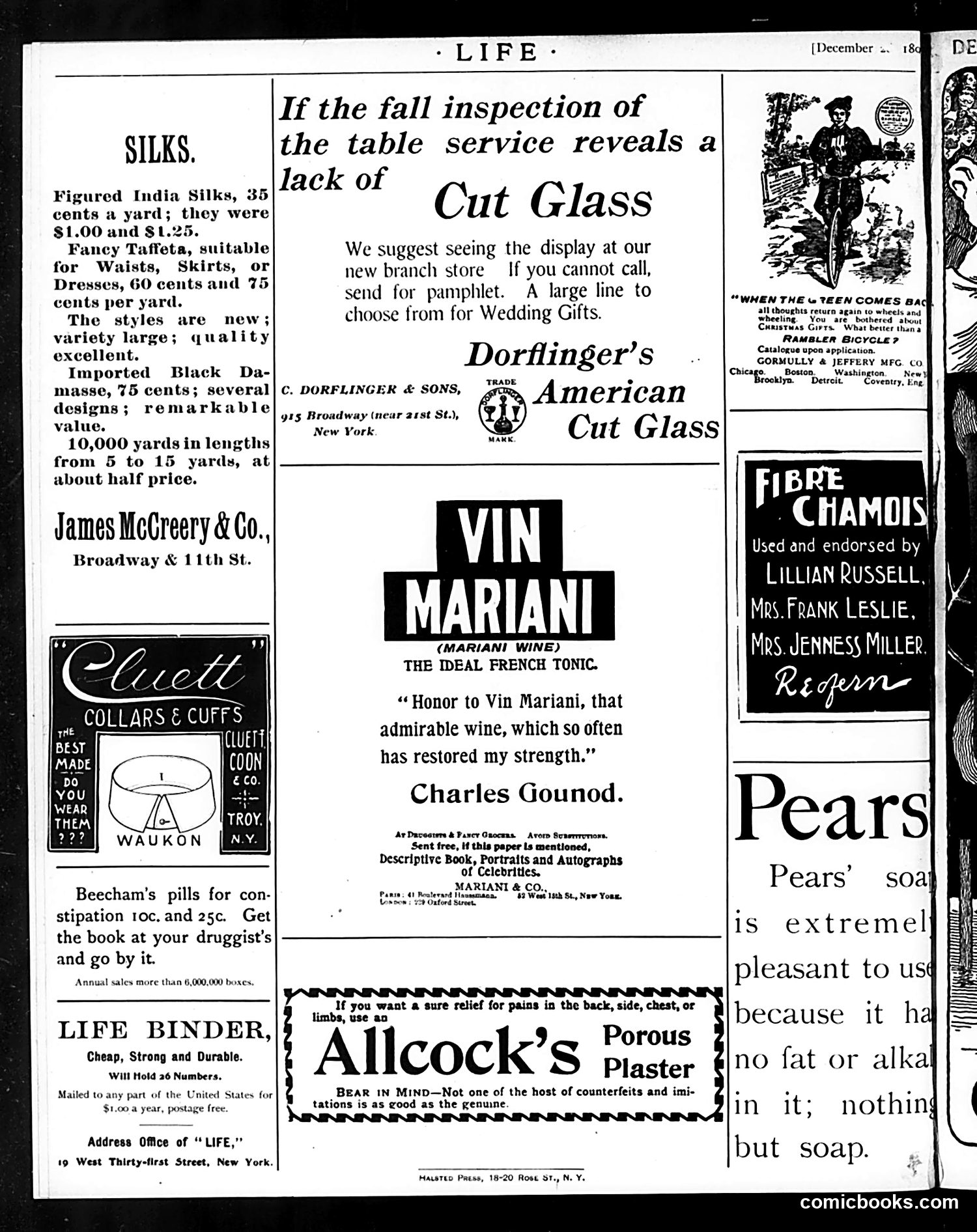
This is primarily an **advertising page** from Life magazine (December 1882, based on the visible date). It contains no political cartoons or satire in the traditional sense. The page features period product advertisements including: - **Silks and textiles** from James McCreery & Co. - **Dorflinger's American Cut Glass** for wedding gifts - **Vin Mariani** wine, endorsed with a quote attributed to composer Charles Gounod, marketed as a restorative tonic - **Fibre Chamois** soap, endorsed by celebrities including Lillian Russell - **Allcock's Porous Plaster** (a medical/pain relief product) - **Beecham's Pills** for constipation - **Pears' Soap** - **Life Binder** (magazine storage) The small illustration at top right ("When the I Teen Comes Back") appears to be a bicycle advertisement featuring the "Rambler Bicycle." This reflects late-19th-century consumer culture and advertising practices rather than satirical content.
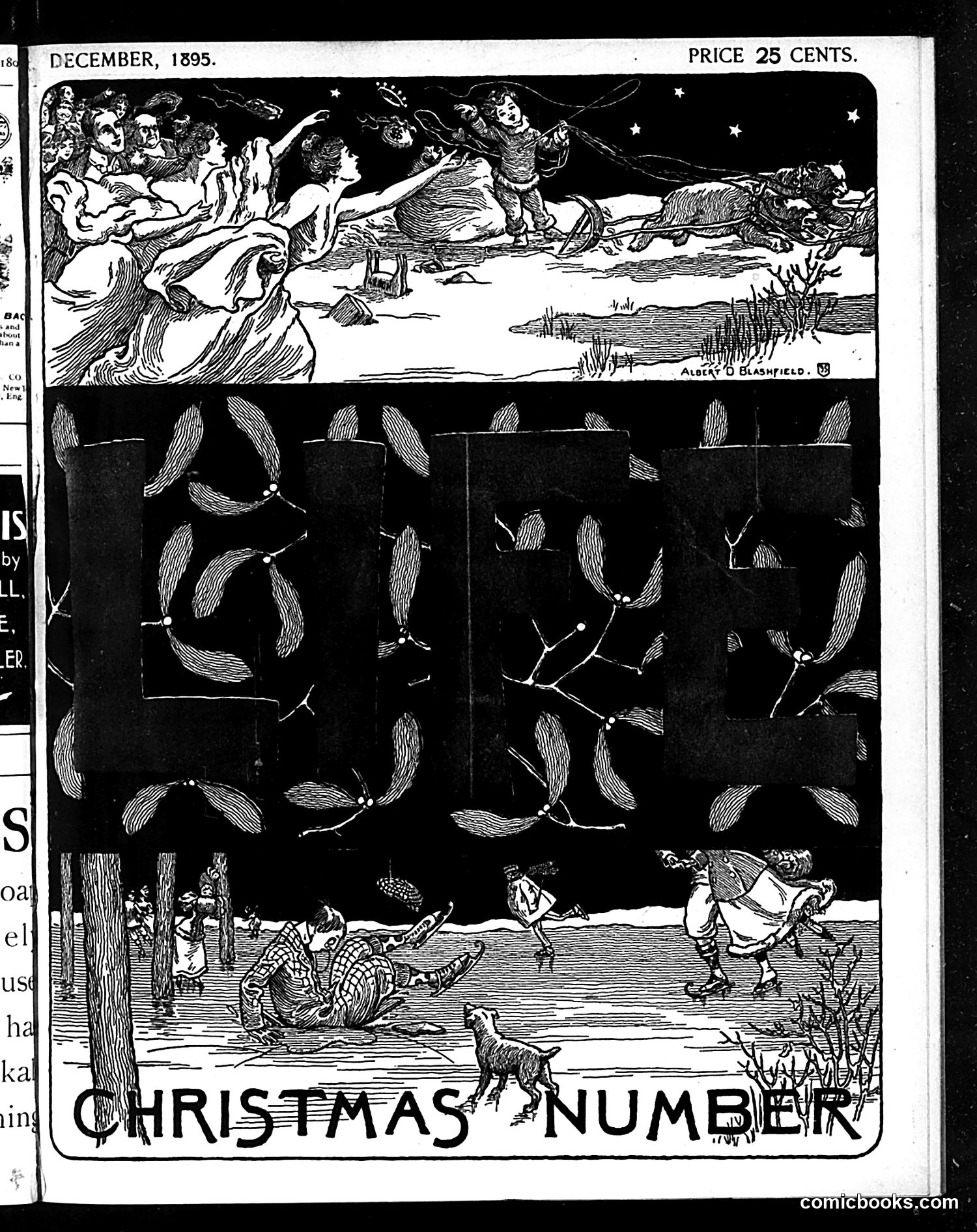
This page displays **Life magazine's Christmas Number** from December 1895. The top illustration by Albert D. Blashfield shows a whimsical nighttime scene with Santa's sleigh drawn by reindeer, accompanied by flying cherubs and magical figures—a festive, fantastical depiction of Christmas mythology. The large central section displays what appear to be **botanical illustrations of seed pods or plant specimens** against a dark background, likely serving as decorative filler or botanical artwork common in period magazines. The bottom illustration shows a winter scene with figures engaged in holiday activities—possibly ice skating or Christmas festivities by a frozen body of water. As a **Christmas special edition**, this page emphasizes holiday themes rather than political satire, distinguishing it from Life's typical satirical content.
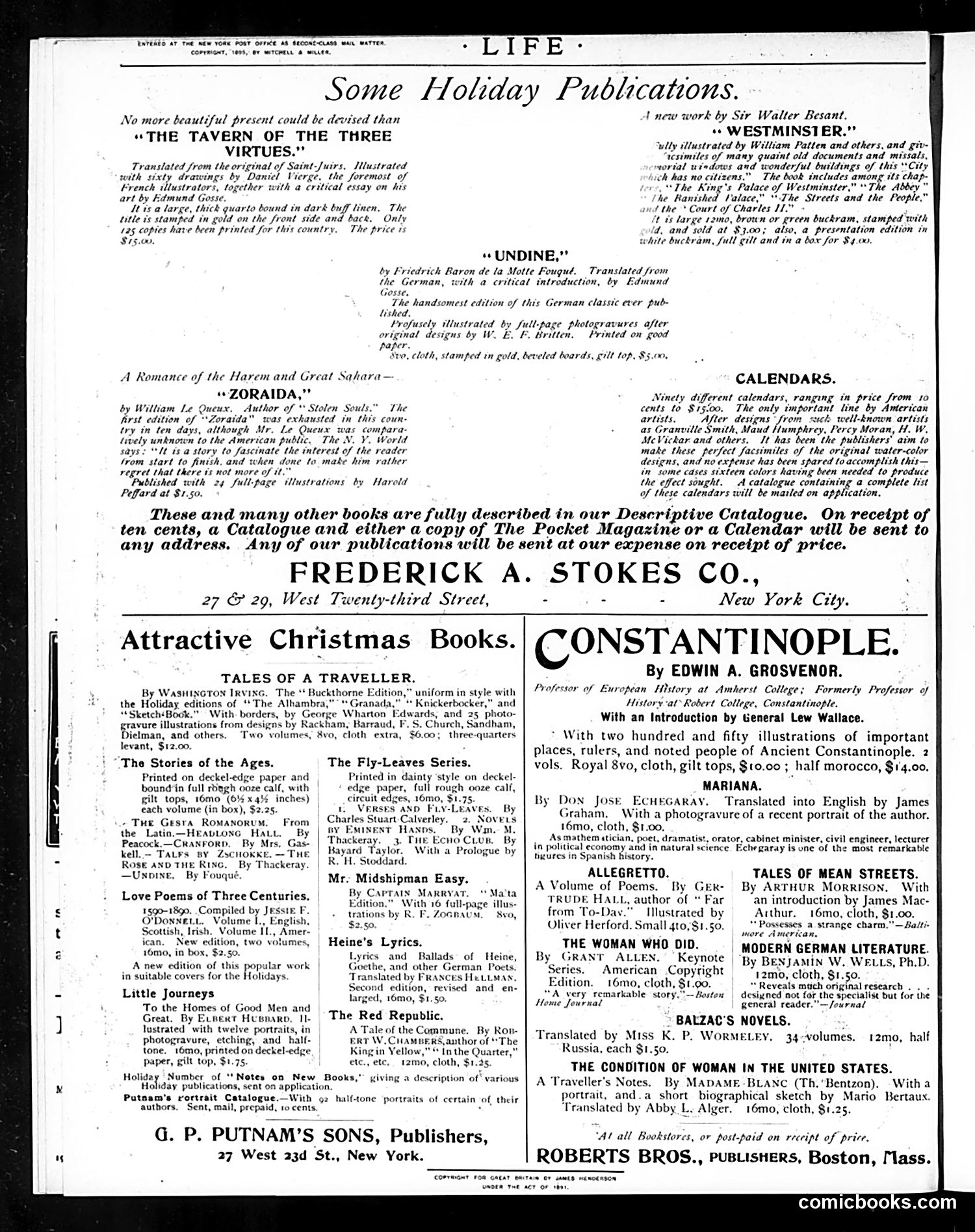
This page is primarily **advertising**, not a satirical cartoon. It's a book advertisement section from *Life* magazine (1895). The page showcases holiday gift books from two major publishers: Frederick A. Stokes Co. and G. P. Putnam's Sons. Featured titles include literary classics like Washington Irving's *Tales of a Traveller*, Sir Walter Besant's *Westminster*, and translations of European works like *Undine* and *Zoraida*. The ads emphasize luxurious production values—fine bindings, gilt edges, photogravure illustrations by notable artists (Edmund Gosse, William Patten, Daniel Vierge)—appealing to wealthy readers seeking prestigious Christmas gifts. Prices range from modest ($1.50) to extremely expensive ($75.00 for a limited 125-copy edition), reflecting the market for high-end collector's editions. The page also advertises calendars designed by popular American artists. This is straightforward commercial content targeting *Life*'s affluent readership, not satire.
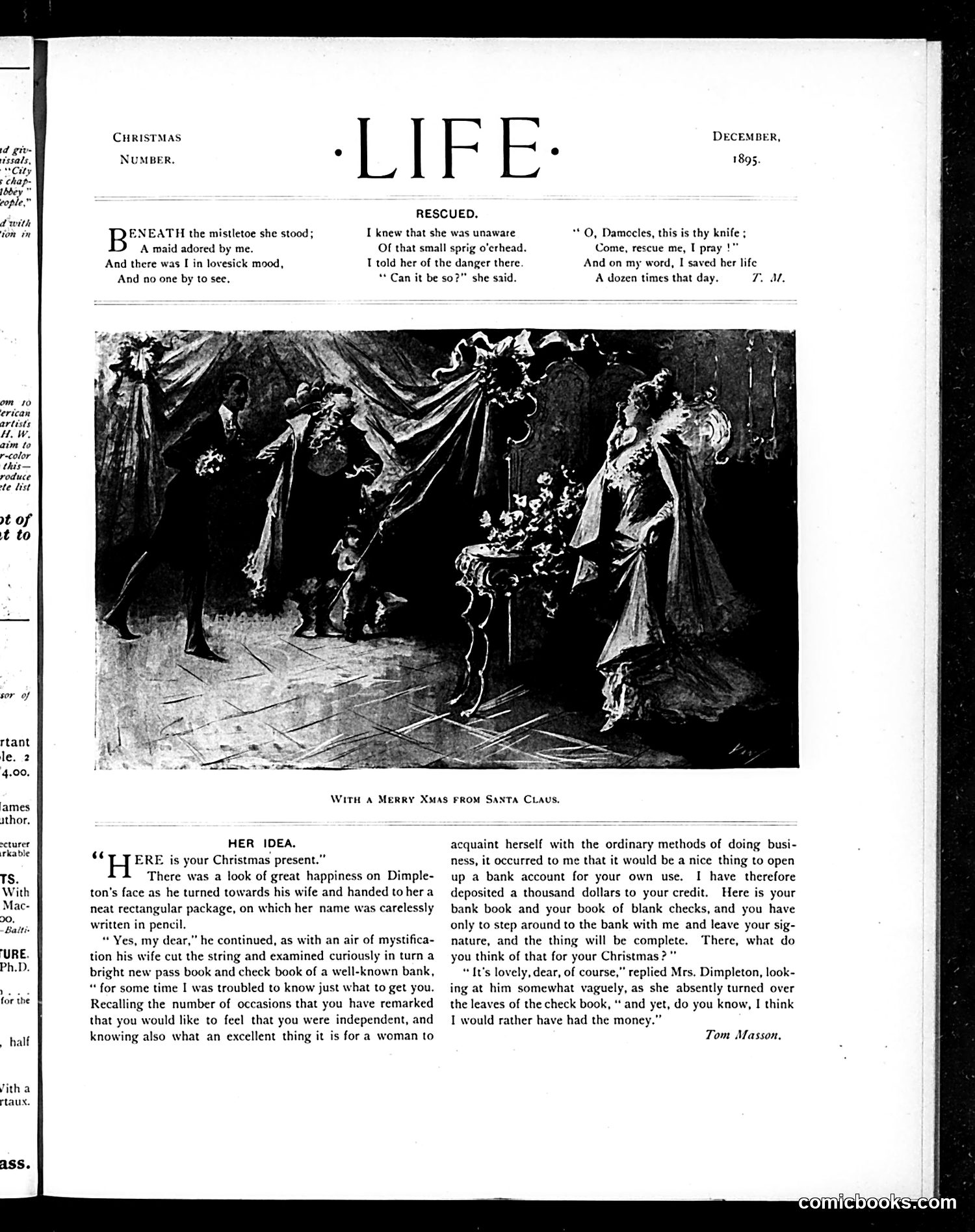
This Christmas 1895 *Life* magazine page contains two pieces: **"Rescued"** is a humorous poem about a man using the mistletoe as a pretext to "rescue" a woman from danger by repeatedly warning her of the sprig overhead—a transparent excuse for romantic attention. The joke plays on the social convention of mistletoe as permission for kissing. **"Her Idea"** is a satirical story about a husband presenting his wife with a bank account as a Christmas gift, framed as promoting her independence and financial literacy. The joke's punchline—the wife saying she'd have preferred actual money—mocks both the husband's condescension (treating financial responsibility as a novelty gift for women) and suggests the wife's practical preference for direct cash over the burden of managing accounts. It satirizes the gap between progressive rhetoric about female independence and the reality of women's limited financial autonomy in the 1890s. The illustration above shows figures in formal dress in an interior setting, likely depicting the mistletoe scene.
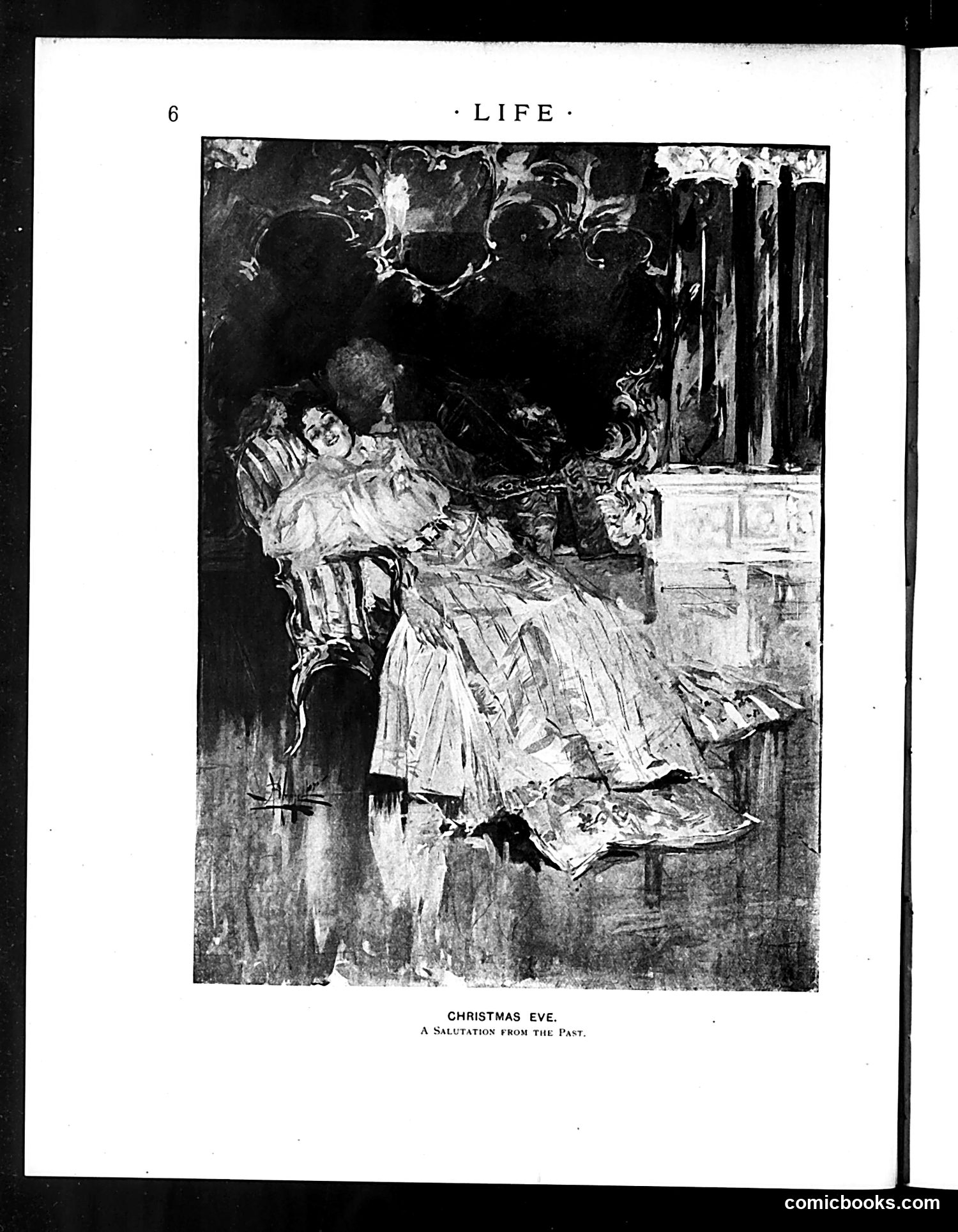
This Life magazine illustration depicts a romanticized Victorian-era Christmas scene. A woman in an elaborate white dress sits with children, appearing to receive ghostly or ethereal visitations from figures emerging from the dark background—likely representing departed loved ones or spirits of Christmas past, referencing the supernatural holiday theme popular in 19th-century literature (notably Dickens's "A Christmas Carol"). The satire likely mocks contemporary society's nostalgia for an idealized past. By showing "salutations from the past," the cartoonist may be commenting on how people sentimentalize previous eras while ignoring present-day realities—a common Life magazine theme. The ethereal quality suggests both beauty and artificiality of these romantic historical projections.
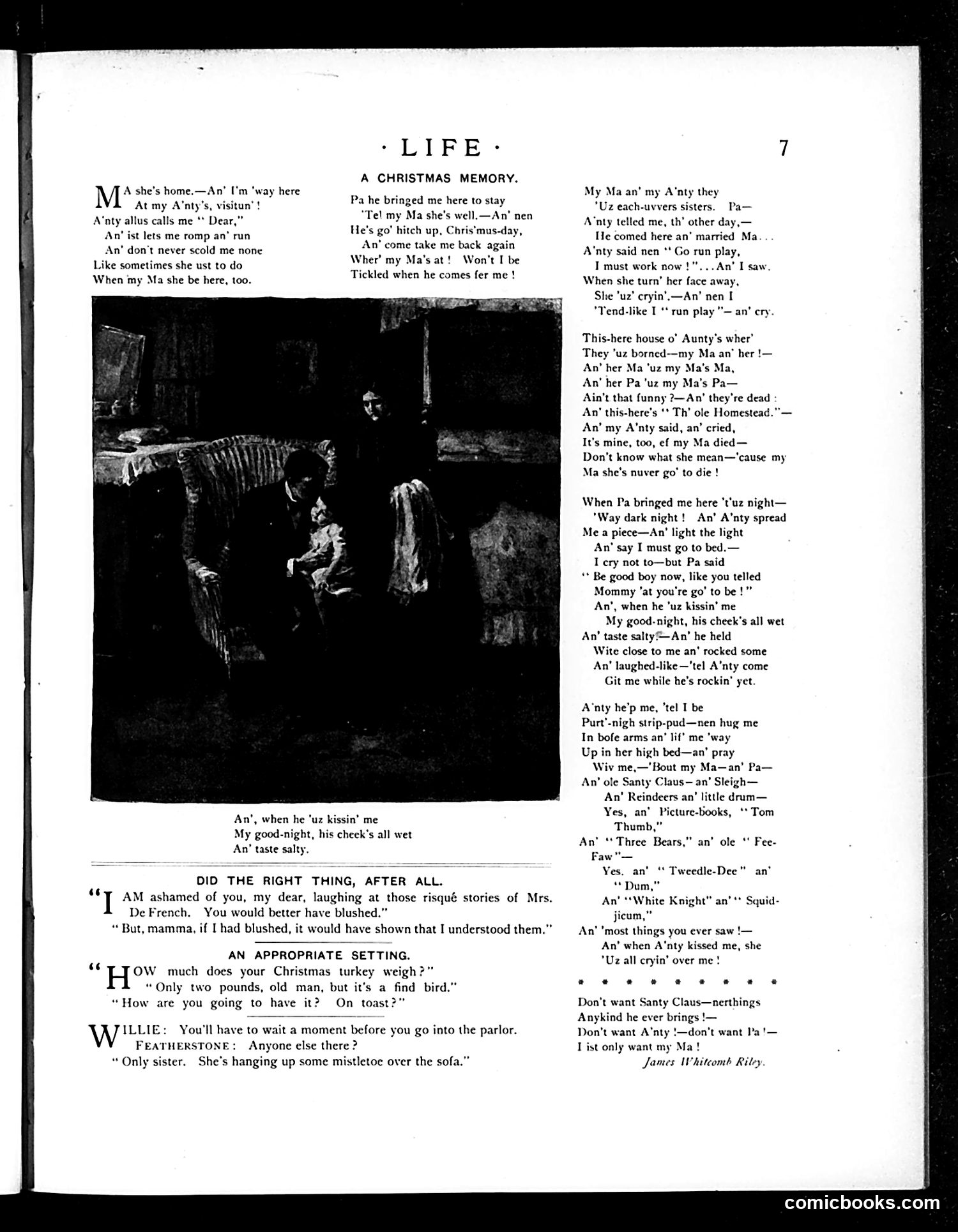
This page contains **three brief satirical jokes** and one sentimental **dialect poem** by James Whitcomb Riley (a popular Hoosier poet of the era). The humor pieces mock middle-class propriety: 1. **"Did the Right Thing"**: A daughter defends laughing at risqué stories by arguing that *not* blushing proves she didn't understand them—a clever inversion of Victorian modesty expectations. 2. **"Appropriate Setting"**: A joke about a scrawny two-pound Christmas turkey, playing on expectations of holiday abundance. 3. **"Mistletoe"**: A setup implying flirtation or romance when someone hangs mistletoe, a common Christmas trope. **"A Christmas Memory"** is Riley's sentimental poem in rural dialect about a child visiting an aunt at Christmas while separated from his mother—touching on themes of family, loss, and childhood longing. The accompanying illustration shows an intimate domestic scene. The page reflects *Life*'s dual nature: satirizing upper-class manners while also publishing nostalgic Americana that appealed to readers' sentimentality.
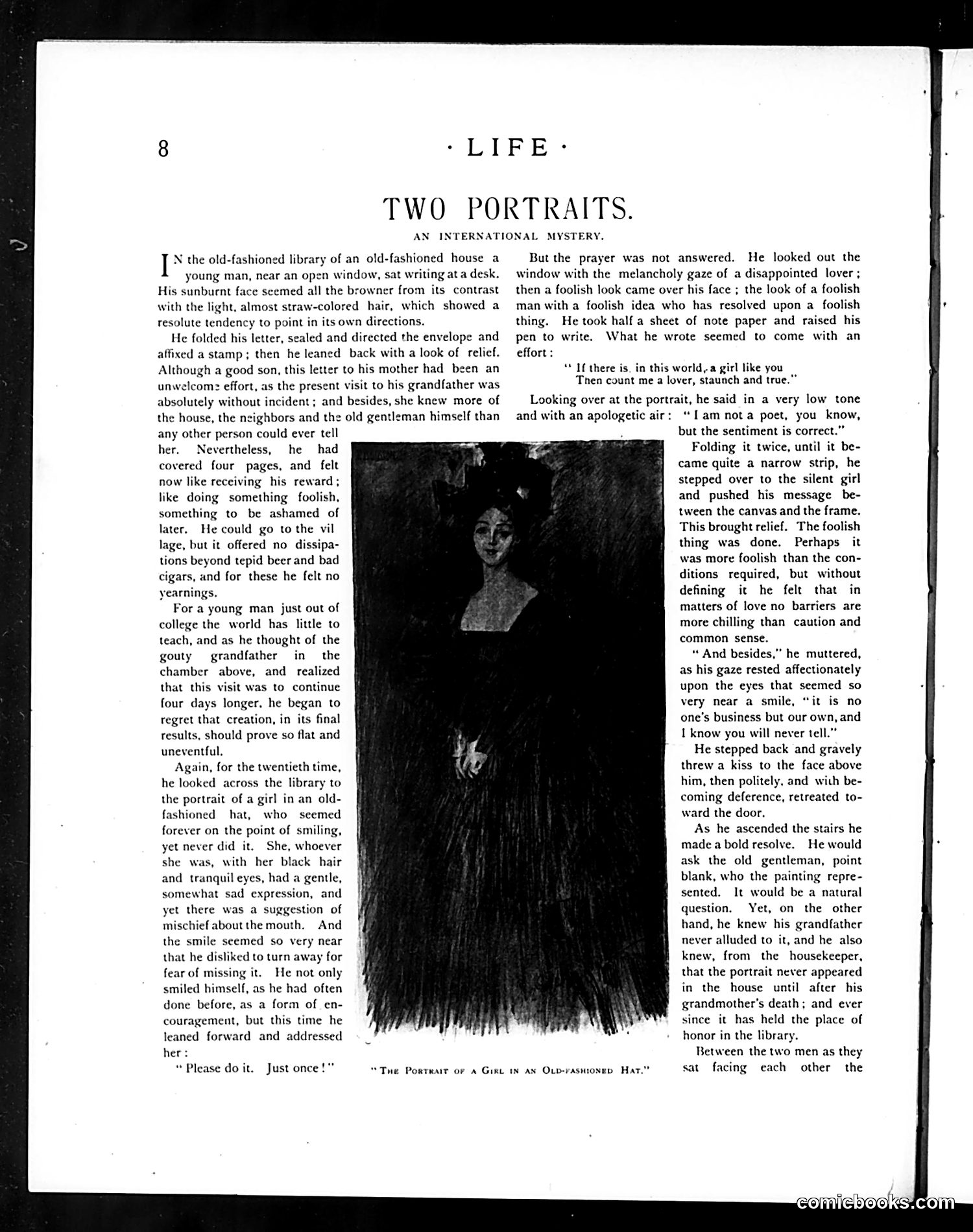
This is not a political cartoon but rather an illustrated short story about a young man's romantic fancy. The single image shows a portrait of a girl wearing an old-fashioned hat—the object of the protagonist's attention. The narrative depicts a bored college graduate visiting his grandfather, who becomes enchanted by a mysterious portrait hanging in the library. The girl in the painting appears perpetually on the verge of smiling but never quite does. Growing restless during his visit, the young man impulsively writes a flirtatious poem ("If there is in this world, a girl like you / Then count me a lover, staunch and true") and hides it between the portrait's canvas and frame. The "international mystery" referenced in the subtitle likely refers to the portrait's unknown subject—the old gentleman never discusses it, and even the housekeeper claims it never previously appeared in the house. The story plays on the Romantic-era theme of yearning for an idealized, unattainable woman.
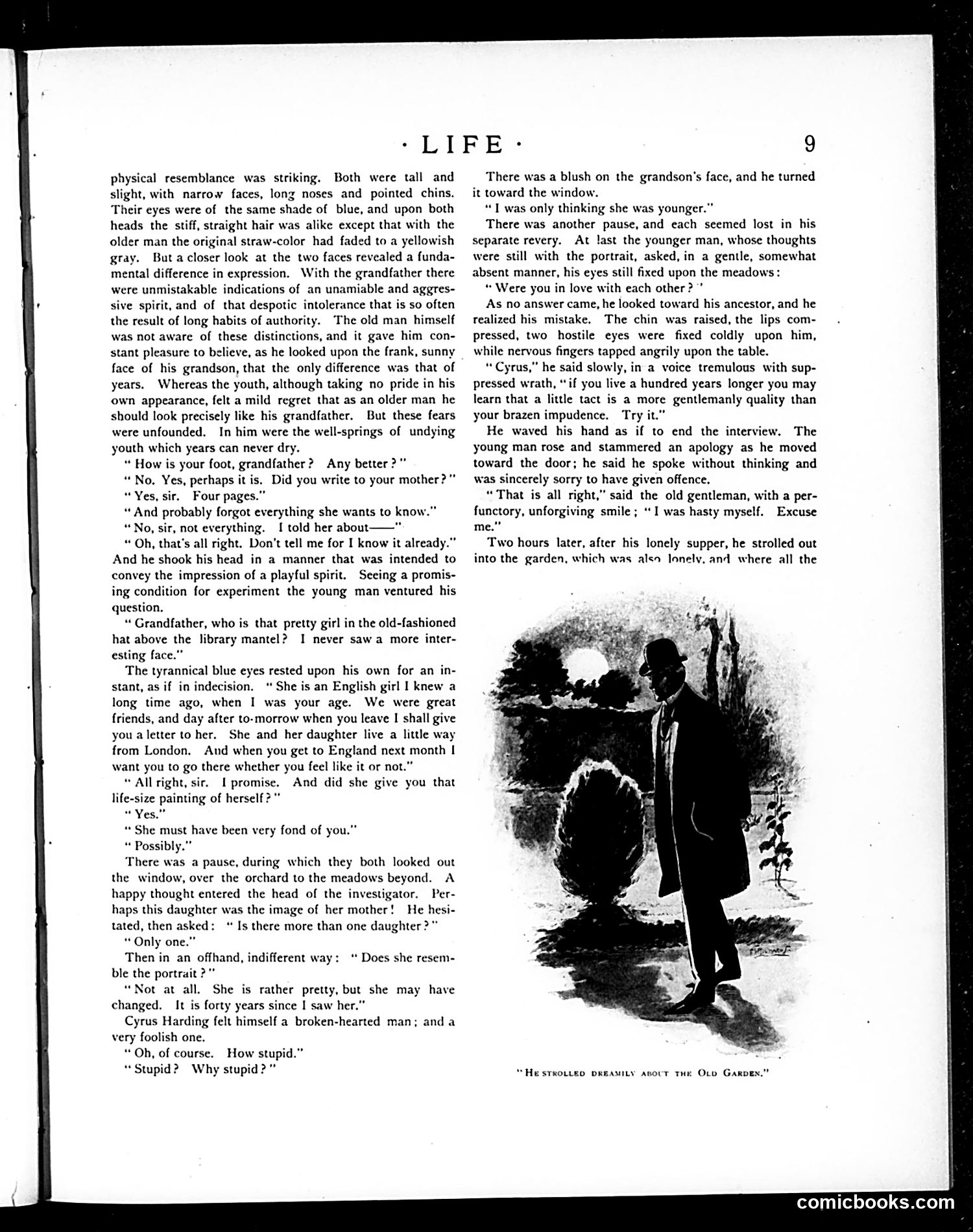
This page contains a serialized short story (not a political cartoon) depicting a conversation between an elderly grandfather and his young grandson, Cyrus Harding, in what appears to be an English country house setting. The narrative explores generational tension and reveals the grandfather's guarded past: he once knew an English woman and has kept a life-size portrait of her above the library mantel for decades. When Cyrus naively asks if the grandfather was "in love with each other," the old man becomes visibly angry—his "tyrannical blue eyes" turn hostile, his chin raises, and his fingers tap angrily on the table. The accompanying illustration shows two figures strolling in a garden, captioned "He strolled dreamily about the old garden." The satire lies in the clash between the frank, sunny youth and the autocratic, emotionally repressed grandfather—a common *Life* magazine theme exploring how rigidity and hidden emotional wounds characterize the older generation, while youth approaches life with innocent directness.
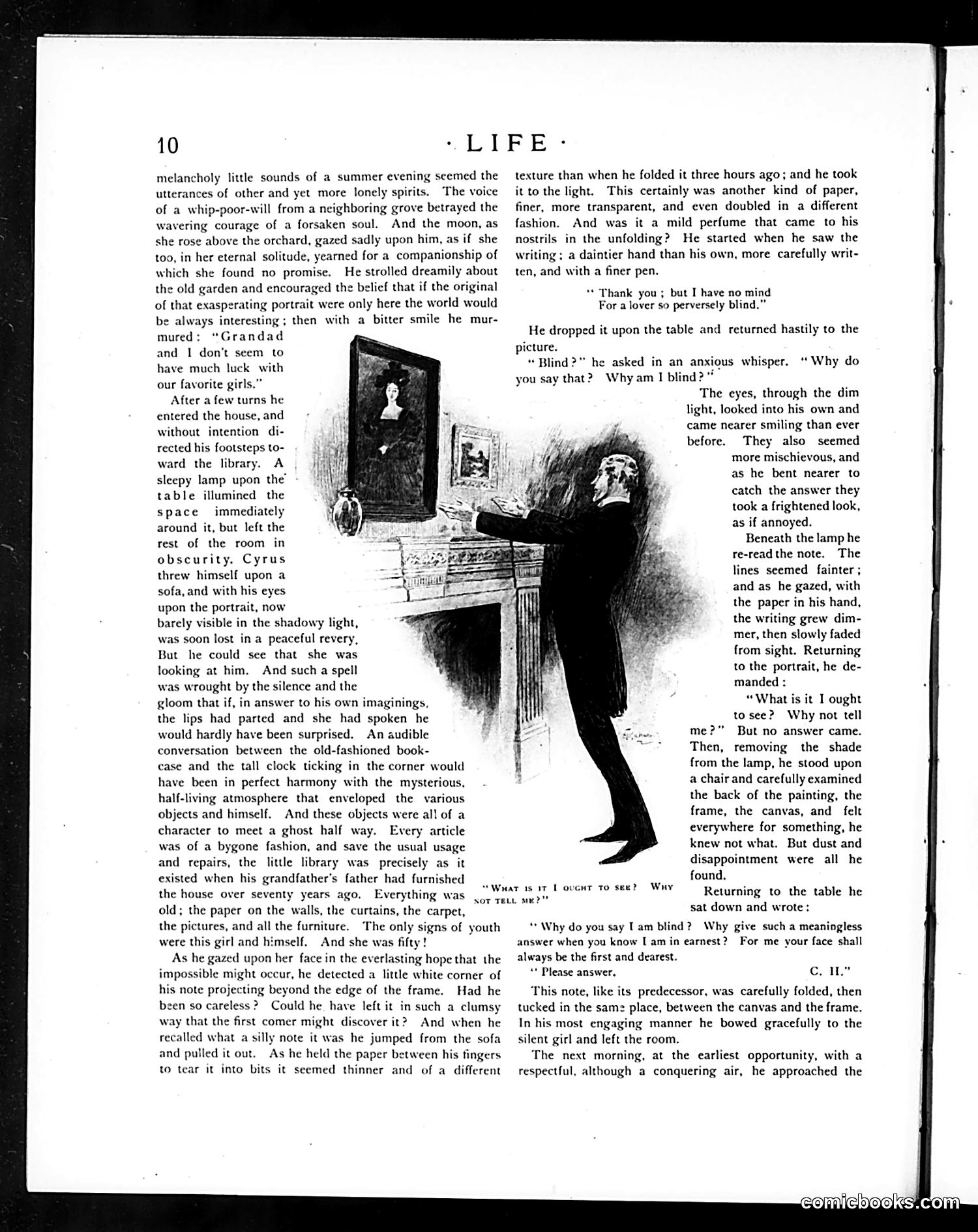
This page presents a romantic short story with illustration rather than political satire. The narrative depicts a young man (Cyrus) examining a portrait of a girl in his grandfather's old library. He discovers a mysterious note hidden in the portrait's frame praising him while calling him "perversely blind." The illustration shows Cyrus examining the painting under lamplight, discovering the hidden message. The story explores themes of unrequited love and mystery—the girl's identity remains unclear, and her cryptic note suggests he's emotionally blind to her affection. **This is literary fiction, not satire.** There are no political references, caricatures, or social commentary visible. The "Life" magazine that published this mixed satirical cartoons with romantic fiction and advertisements, making this a straightforward romantic narrative rather than humorous social commentary.
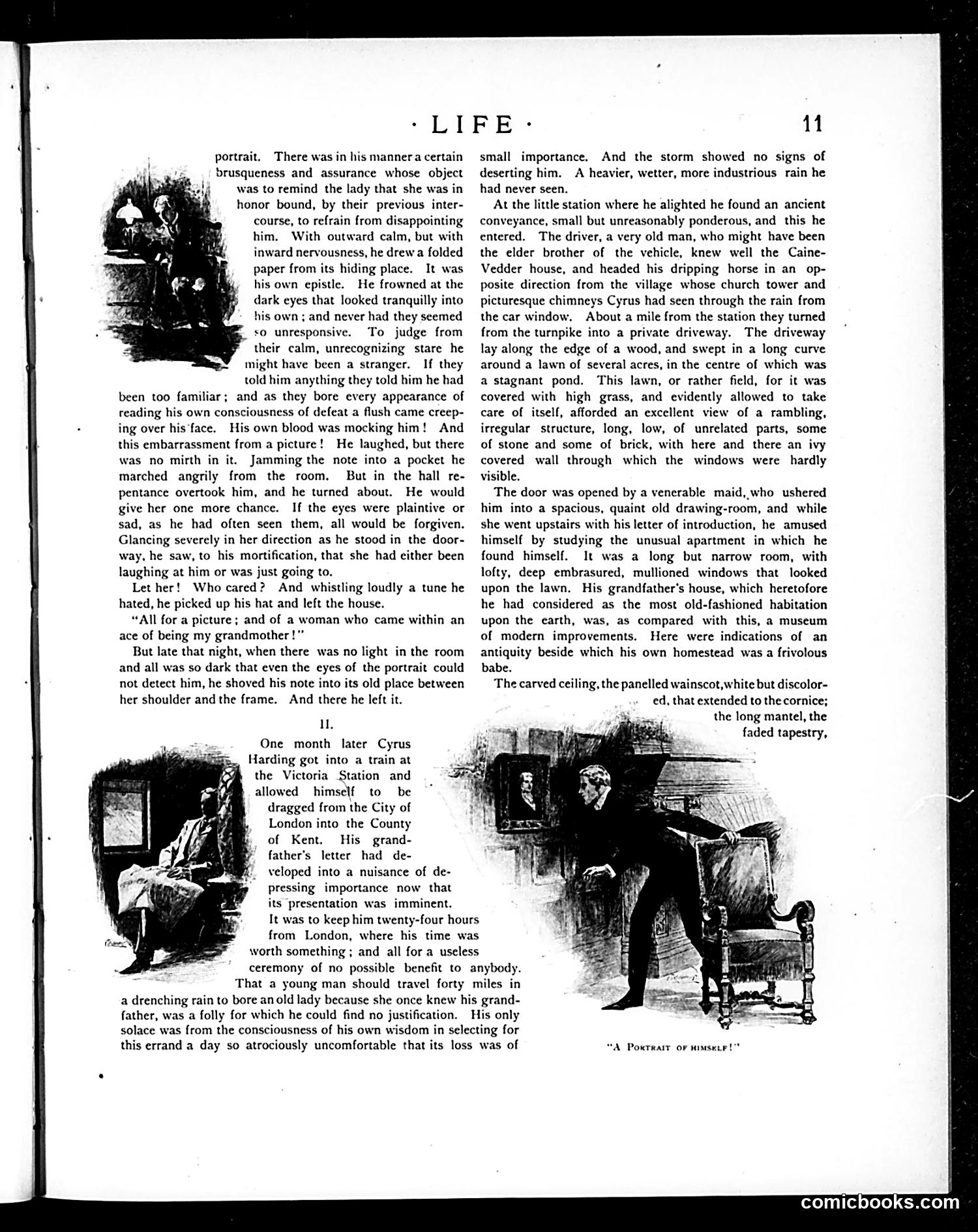
This page contains two narrative illustrations from what appears to be a serialized short story about a young man named Cyrus Harding. **The first illustration** shows a man confronting a portrait of a woman. The text reveals his awkward attempt to impress her by leaving a love note tucked behind the portrait's frame—only to be deflated by her painted expression of apparent indifference or amusement. The satire targets masculine vanity and the absurdity of romantic gestures made to *inanimate objects*. His embarrassment—blushing before a picture—mocks his self-importance. **The second illustration** depicts Cyrus arriving at his grandfather's country house in Kent, a rambling, old-fashioned estate. The accompanying narrative emphasizes the building's antiquated, disheveled appearance. The overall tone is gently mocking: a young man humiliated by a portrait, now obligated to visit an elderly relative's decrepit country home. The humor relies on depicting masculine discomfort and social awkwardness rather than explicit political satire.
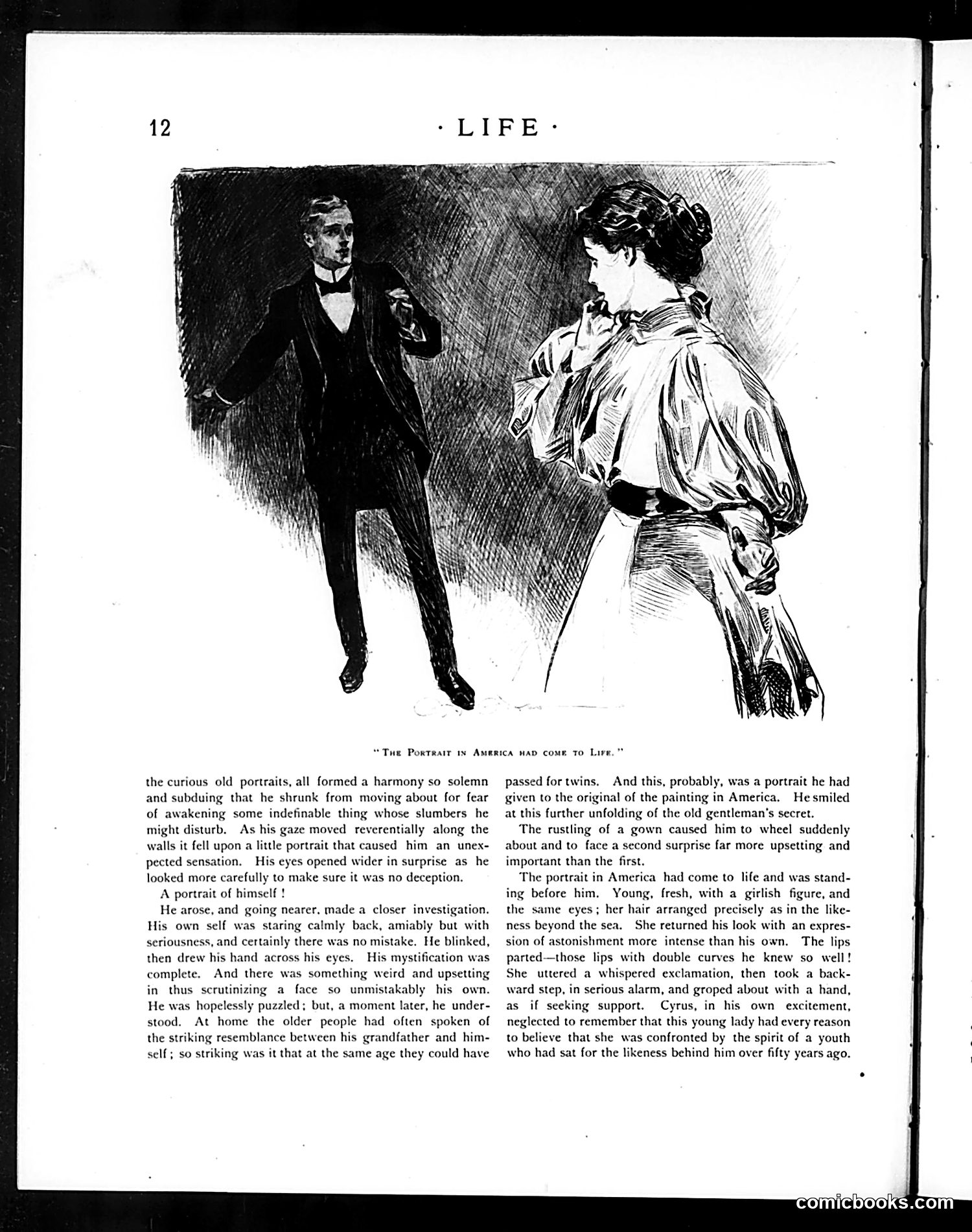
This is a serialized fiction story rather than political satire. The narrative concerns a man who discovers a portrait of himself in America—initially puzzling him until he realizes it resembles his grandfather, suggesting a family likeness across generations. The illustration shows the moment of supernatural revelation: a young woman emerges from the portrait, alive and present before him. The "joke" or narrative twist plays on the Gothic/supernatural: the woman, believing herself confronted by the spirit of a young man from fifty years past (the original portrait's subject), is terrified. Meanwhile, the protagonist is equally shocked to see the portrait come to life as a young woman. This appears to be romantic or fantastical fiction typical of early-20th-century *Life* magazine's fiction content—playing with themes of time, family resemblance, and mysterious encounters rather than social or political commentary.
This is a humorous short story, not a political cartoon. It satirizes American male vanity and social awkwardness, likely from the early 20th century. A man visits a woman's home and is struck by her resemblance to a portrait of her grandmother hanging nearby. Attempting flattery, he compounds his awkwardness by clumsily commenting on the painting's accuracy while praising the woman's superior beauty. His compliments become increasingly effusive and absurd—he claims no face he's ever seen "represents so much that is lovable and winning." The satire targets his obliviousness: he doesn't recognize that his overwrought vanity (praising himself through praising her) is transparent and ridiculous. The woman's speechlessness at his "stupendous overpowering mixture of simplicity and conceit" conveys that his behavior is socially incomprehensible to her, suggesting he represents a particularly American type of self-absorbed superficiality.
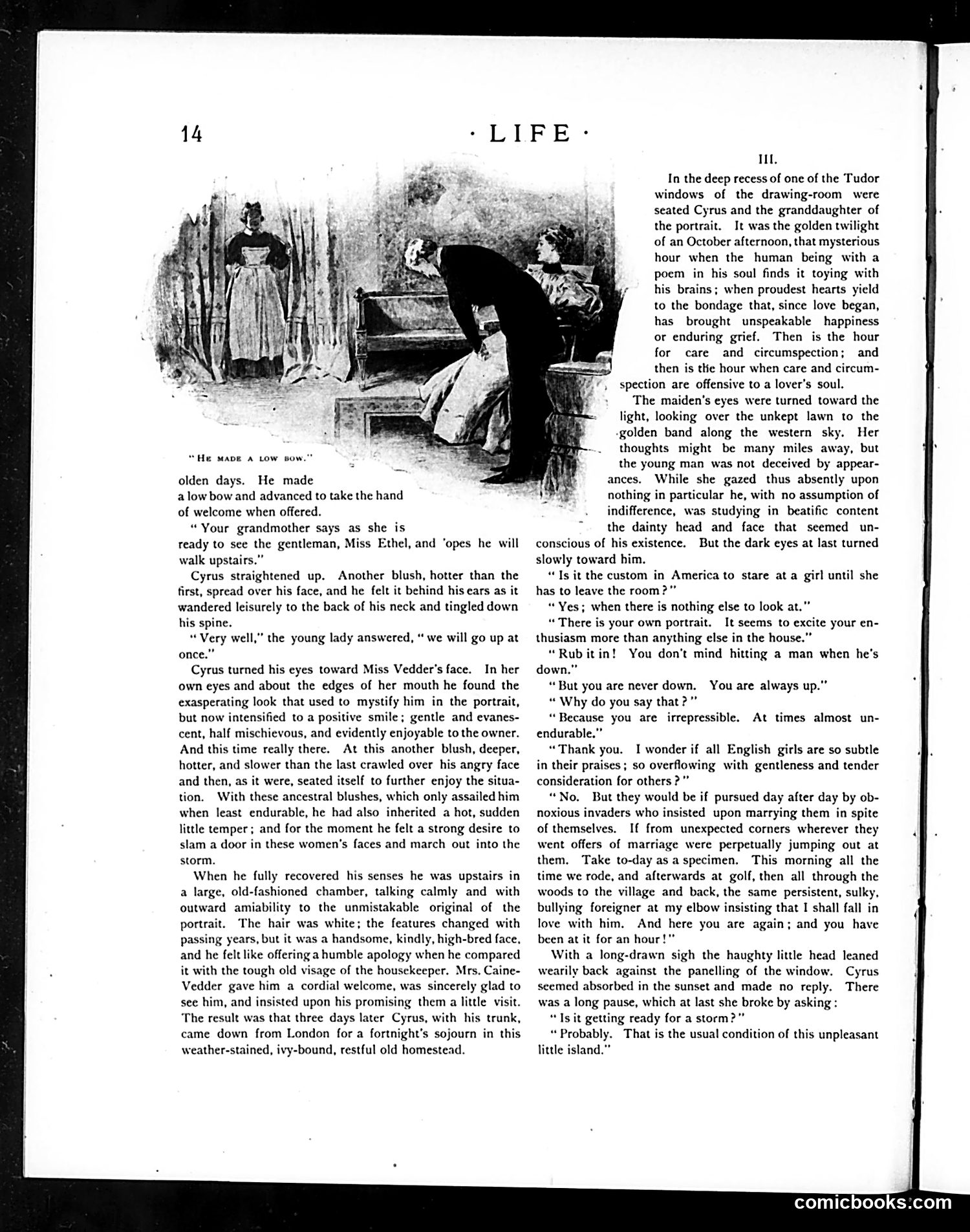
This page depicts a romantic narrative between an American man named Cyrus and an English woman (granddaughter of a portrait he once knew). The illustration shows a scene of courtship in a Tudor drawing room. The satire targets **Anglo-American cultural differences**, particularly around courtship customs and temperament. Cyrus, the American, is portrayed as direct and bold—literally staring at the woman until she protests. The English woman responds with subtle, mocking wit, testing his composure. The humor lies in contrasting American forthrightness with English reserve and restraint. Cyrus blushes repeatedly and struggles with his "hot, sudden little temper," while she maintains composed, gentle mockery. The text mocks both: American brazenness ("custom in America to stare") and English girls' "subtle" passive-aggressive precision. This reflects early 20th-century *Life* magazine's frequent satirization of American tourists and their social awkwardness abroad.
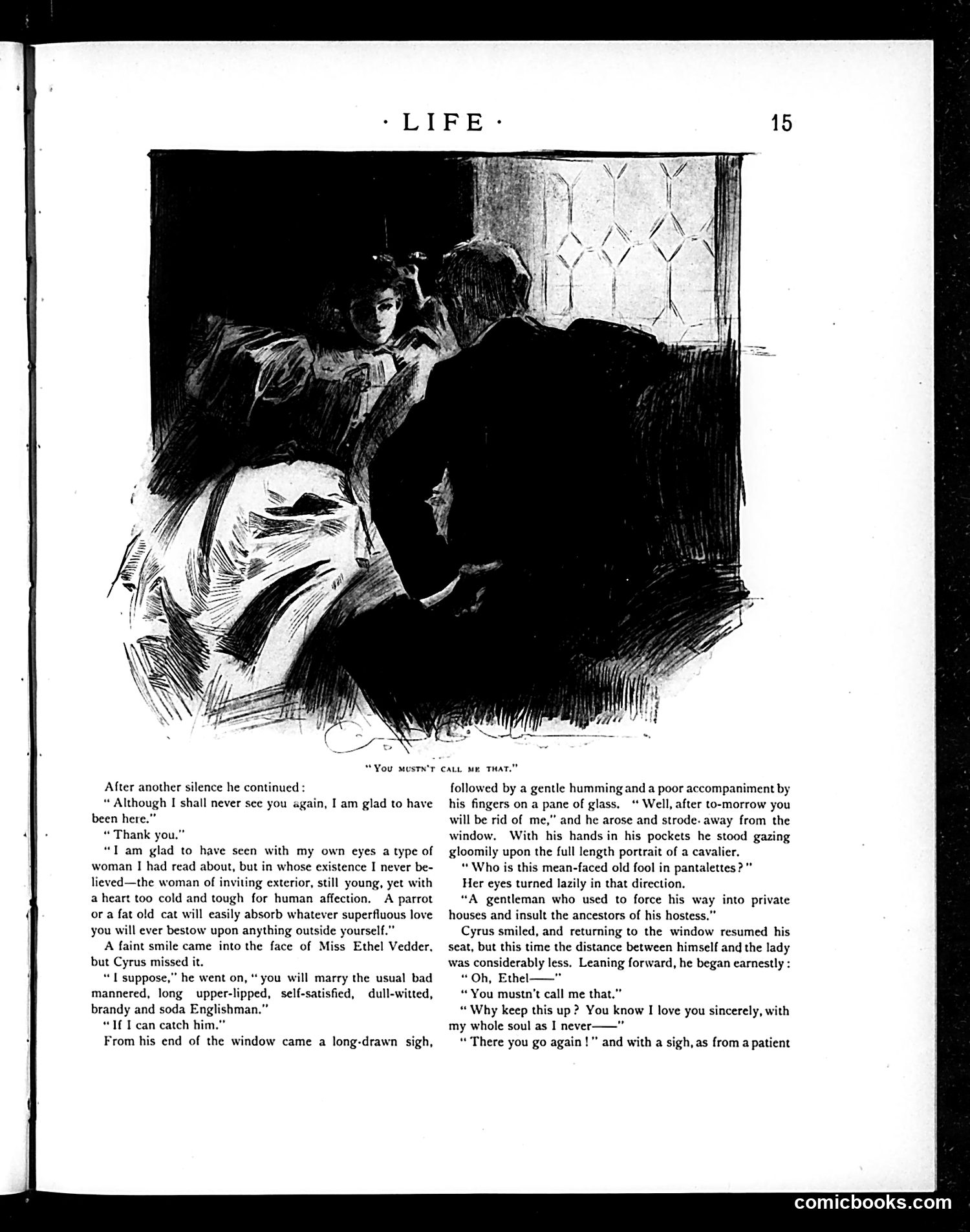
This is a satirical romantic scene from *Life* magazine featuring dialogue between two characters: Cyrus (a man) and Miss Ethel Vedder (a woman). The humor targets male romantic posturing and self-deception. Cyrus delivers insulting pseudo-compliments, calling Ethel emotionally cold and predicting she'll marry an "upper-lipped, self-satisfied, dull-witted" Englishman—essentially insulting her to manipulate her affections. When she corrects him about using her first name ("You mustn't call me that"), he interprets this formality as romantic tension rather than a boundary. The satire mocks Cyrus's obliviousness: he believes his emotional display and transparent emotional manipulation constitute genuine seduction, while Ethel's weary sighs and patient corrections suggest she finds him tedious and presumptuous. The illustration shows him leaning toward her at the window while she reclines, visually emphasizing his unwanted advances and her disengagement. The joke targets male romantic entitlement and self-absorbed courtship tactics.
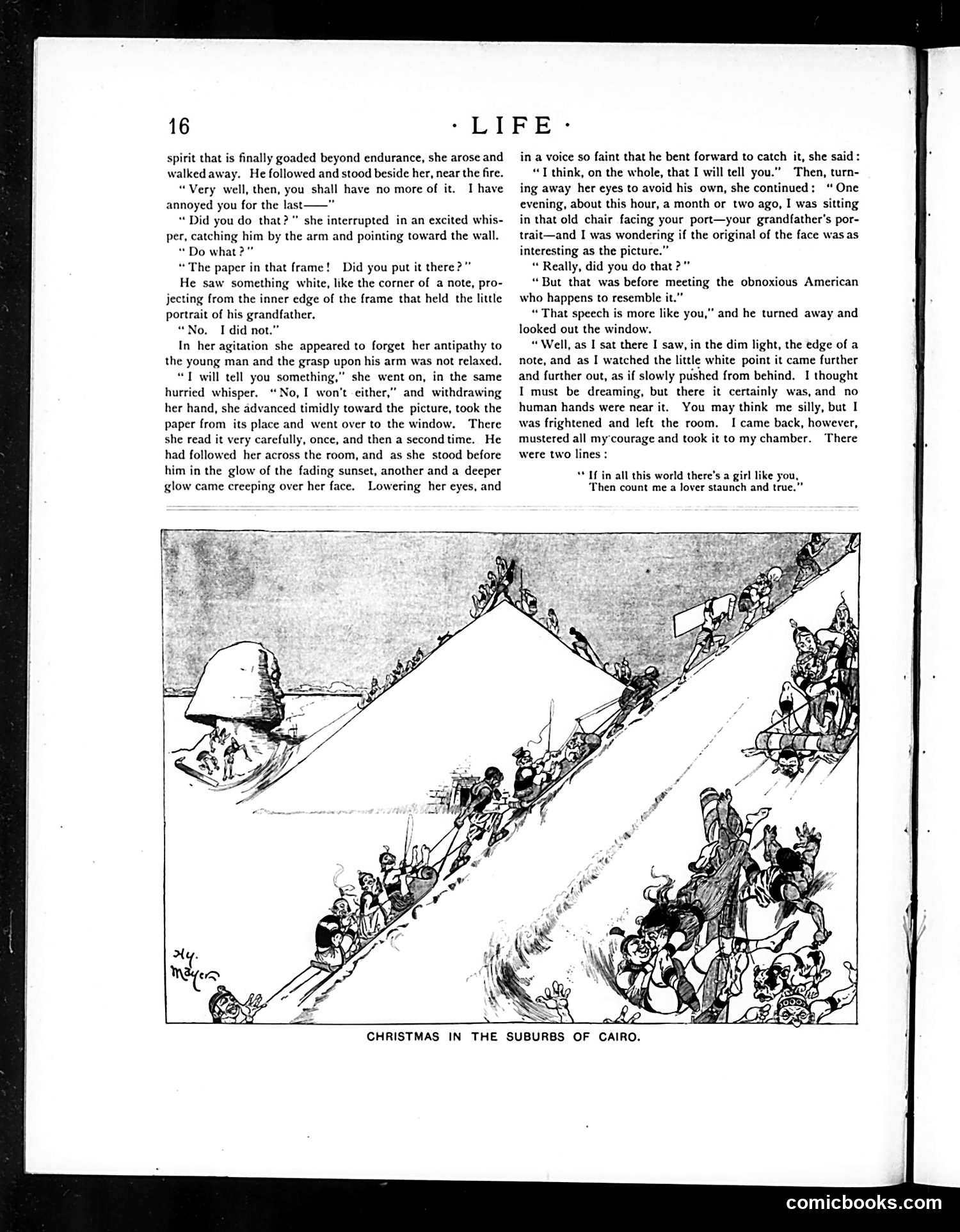
This page contains two distinct elements: **The Main Text:** A romantic narrative (appears to be fiction serialized in Life magazine) depicting a conversation between a young man and woman. She describes finding a mysteriously-appearing love note in a picture frame, which had somehow emerged on its own. The note contains a verse declaring romantic devotion. This is a sentimental domestic scene with supernatural/mysterious overtones—typical serialized melodrama of the era. **The Cartoon:** Titled "Christmas in the Suburbs of Cairo," it depicts a satirical winter scene with Egyptian or Middle Eastern figures sledding and celebrating Christmas in snow. The joke appears to mock either the incongruity of Christmas celebration in Cairo (a hot climate where snow is impossible) or the spread of Western customs to non-Western regions. The visual absurdity—people sledding in the Cairo suburbs—is the primary satirical point. The two elements are unrelated; the page simply combines fiction with editorial cartooning, as was typical for Life magazine's format.
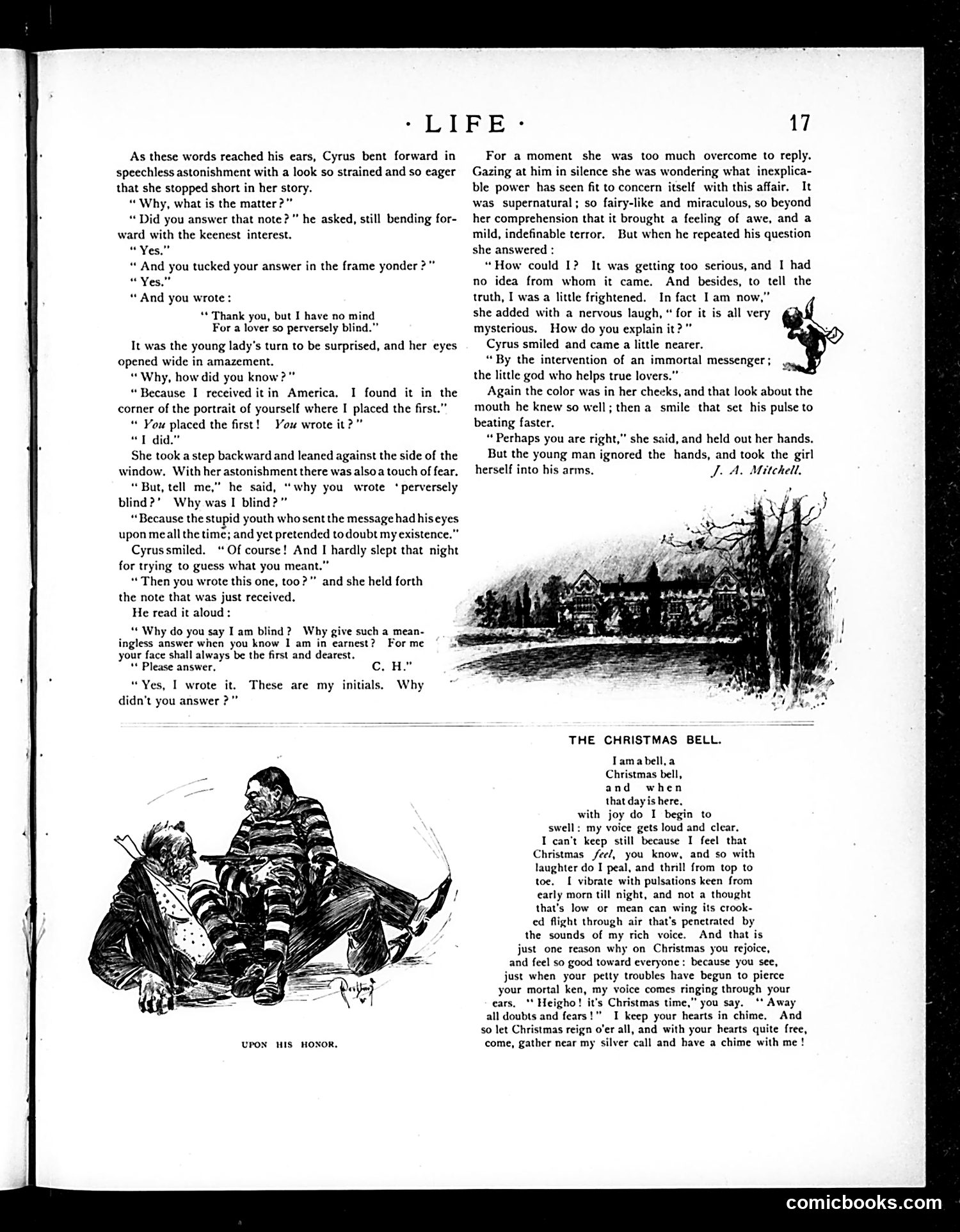
This page contains two distinct pieces of fiction: **Upper Section - Romantic Narrative**: A serialized love story featuring characters named Cyrus and a young woman. The plot involves exchanged love notes hidden in a portrait frame that created a mysterious connection between them. Cyrus poses as a romantic messenger, eventually revealing himself. The text shows typical early 20th-century sentimental romance writing, with the couple's emotional reunion depicted in the illustration labeled "Upon His Honor." **Lower Section - "The Christmas Bell"**: A whimsical personification poem where a Christmas bell speaks directly to readers about the holiday's emotional power. The bell describes its loud, joyful ringing and its ability to dispel doubts and troubles, serving as a reminder of Christmas cheer and goodwill toward others. Both pieces exemplify Life magazine's content: sentimental serialized fiction and light verse aimed at middle-class readers. The illustrations support the romantic and festive moods respectively, with no apparent political satire on this particular page.
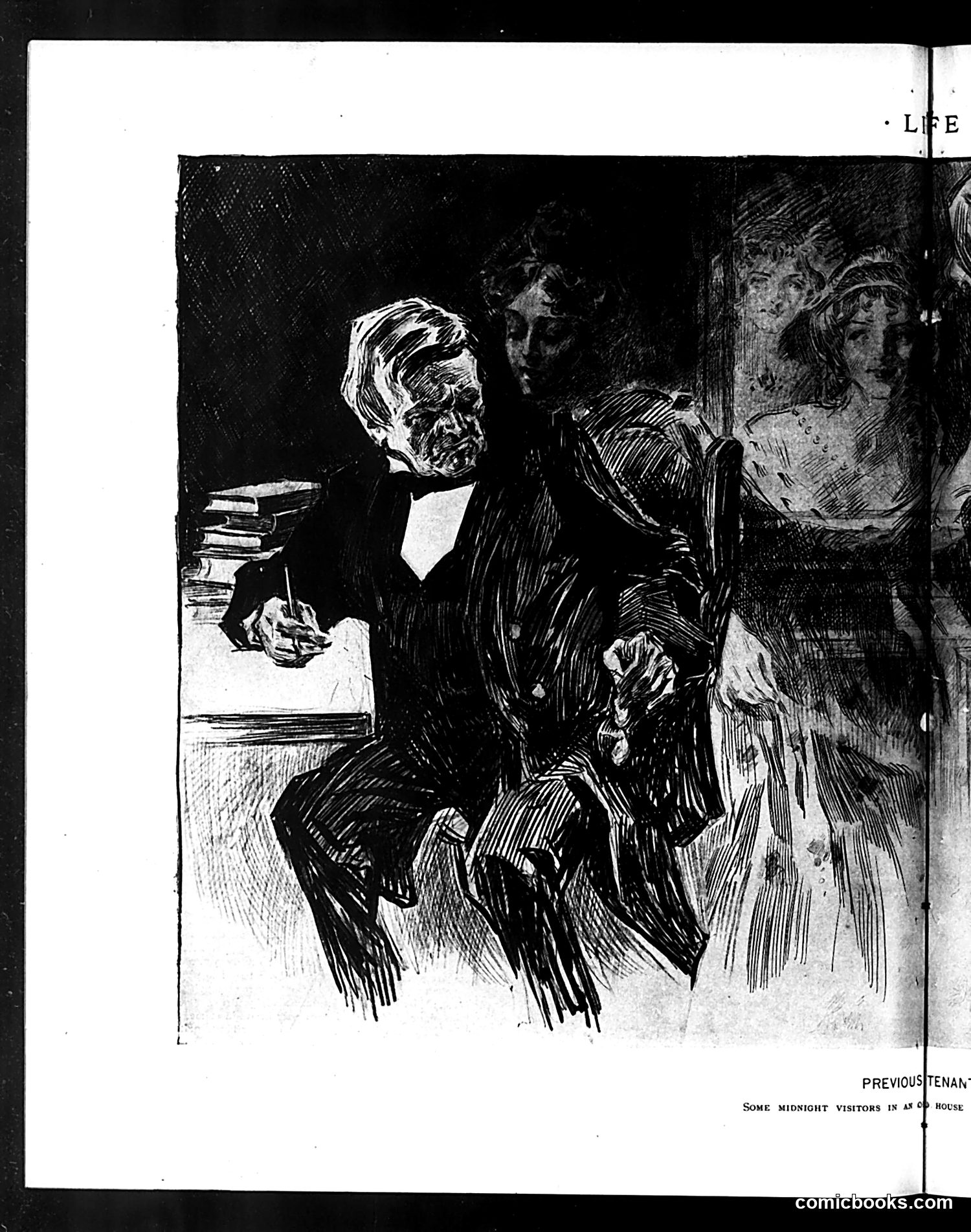
This appears to be a satirical illustration titled "Some Midnight Visitors in a Lodging House," likely depicting a social commentary scene. The sketch shows several figures in what appears to be an interior setting—a well-dressed older man seated at left (possibly a landlord or authority figure) with papers/books nearby, and other figures including what seems to be visitors or residents on the right side of the composition. The "Previous Tenant" caption suggests this illustrates a narrative about lodging house life and its transient occupants. The dark, expressive linework and dramatic contrasts are typical of Life magazine's satirical style. Without additional context about the specific issue date, the exact social critique remains unclear, though it likely comments on class dynamics, housing conditions, or the bohemian life of the era.
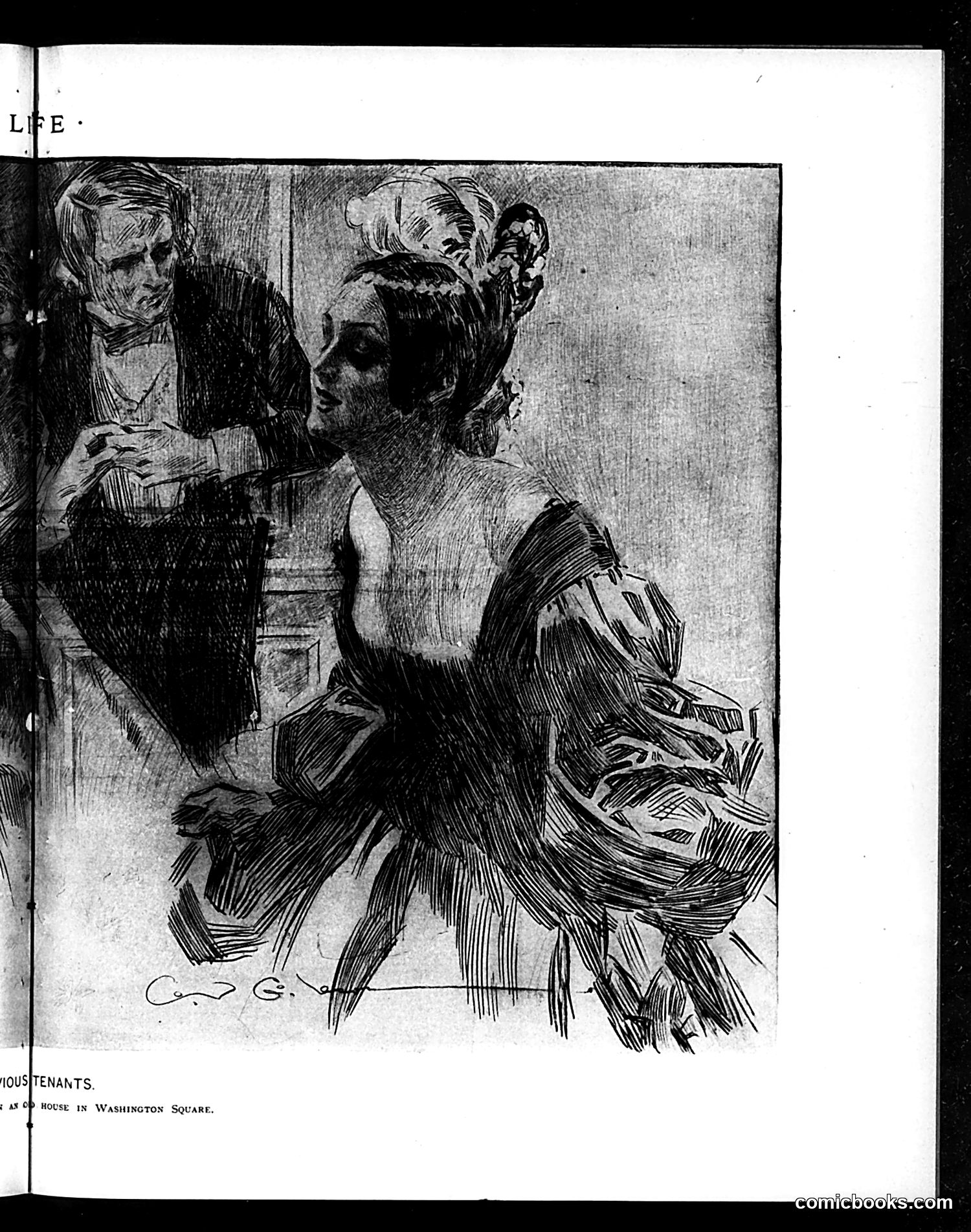
This appears to be a satirical sketch from *Life* magazine showing a domestic scene. The OCR text references "tenants" and "a house in Washington Square," suggesting social commentary about New York City housing. The drawing depicts a woman in an elaborate dress being observed by a man in the background. The artist's signature appears to be "C.D.G." or similar. Without clearer context or caption text, the specific satire isn't entirely certain, but given the Washington Square location reference and the emphasis on the woman's fashionable attire, this likely mocks either: tenant housing conditions in wealthy Manhattan neighborhoods, or social pretensions among residents of that area. The sketch style is characteristic of early 20th-century *Life* magazine's social commentary. More context would be needed to identify the exact figures or political reference intended.
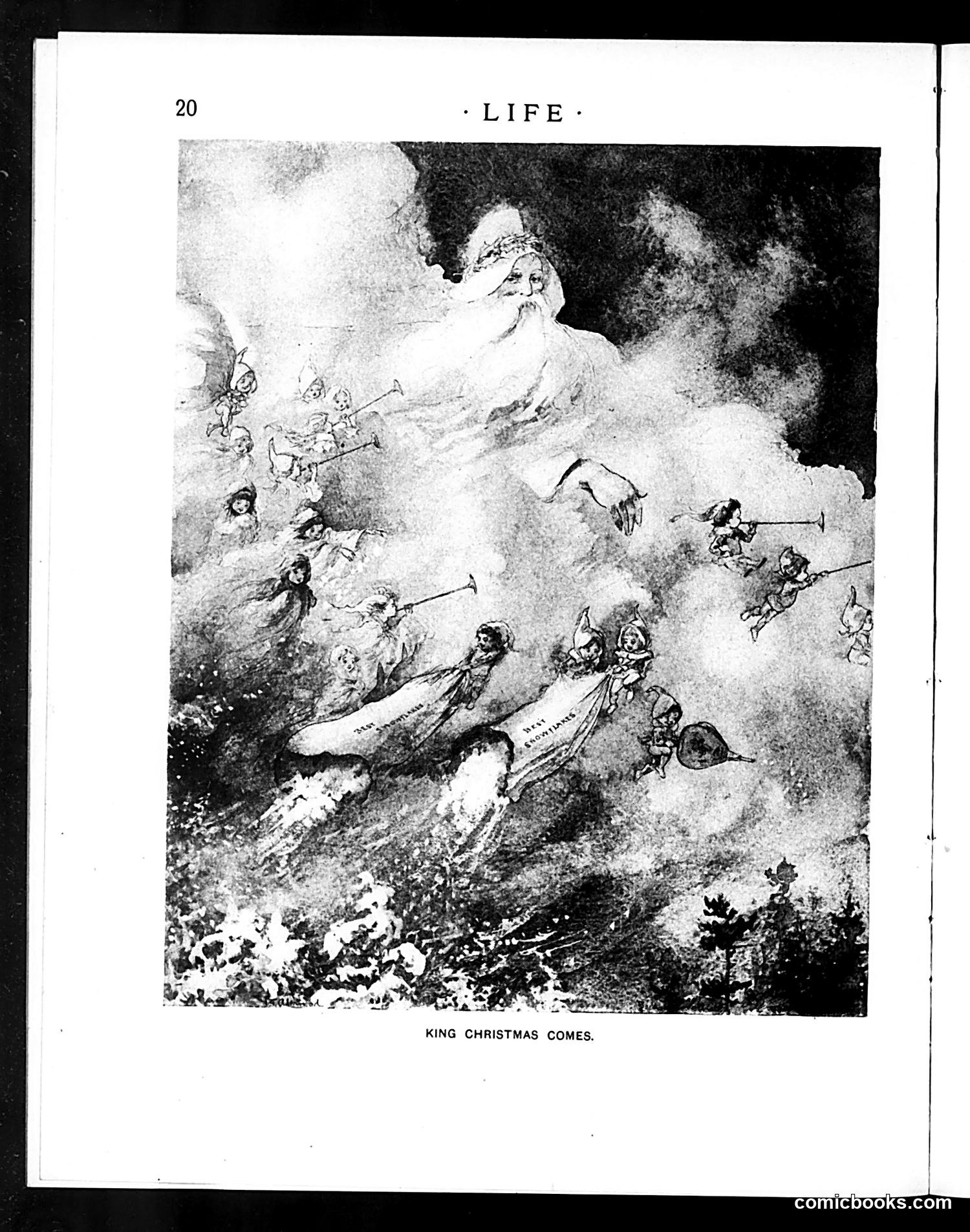
This illustration depicts Santa Claus as a large, benevolent king figure descending through clouds, surrounded by flying cherubs and children in festive attire playing trumpets below. The composition presents Christmas as a joyful, almost religious or mythological event—"King Christmas" arriving to bring celebration and abundance. The satire likely mocks the commercialization and grandiosity of American Christmas celebrations, treating what should be a humble holiday with ironic, exaggerated majesty. By portraying Santa/Christmas as royalty descending from the heavens with attendant cherubs, Life appears to be satirizing how Americans have elevated consumer celebration and gift-giving into something approaching religious significance. The exact publication date isn't visible, but this reflects turn-of-the-century attitudes toward Christmas's transformation into a commercial spectacle.
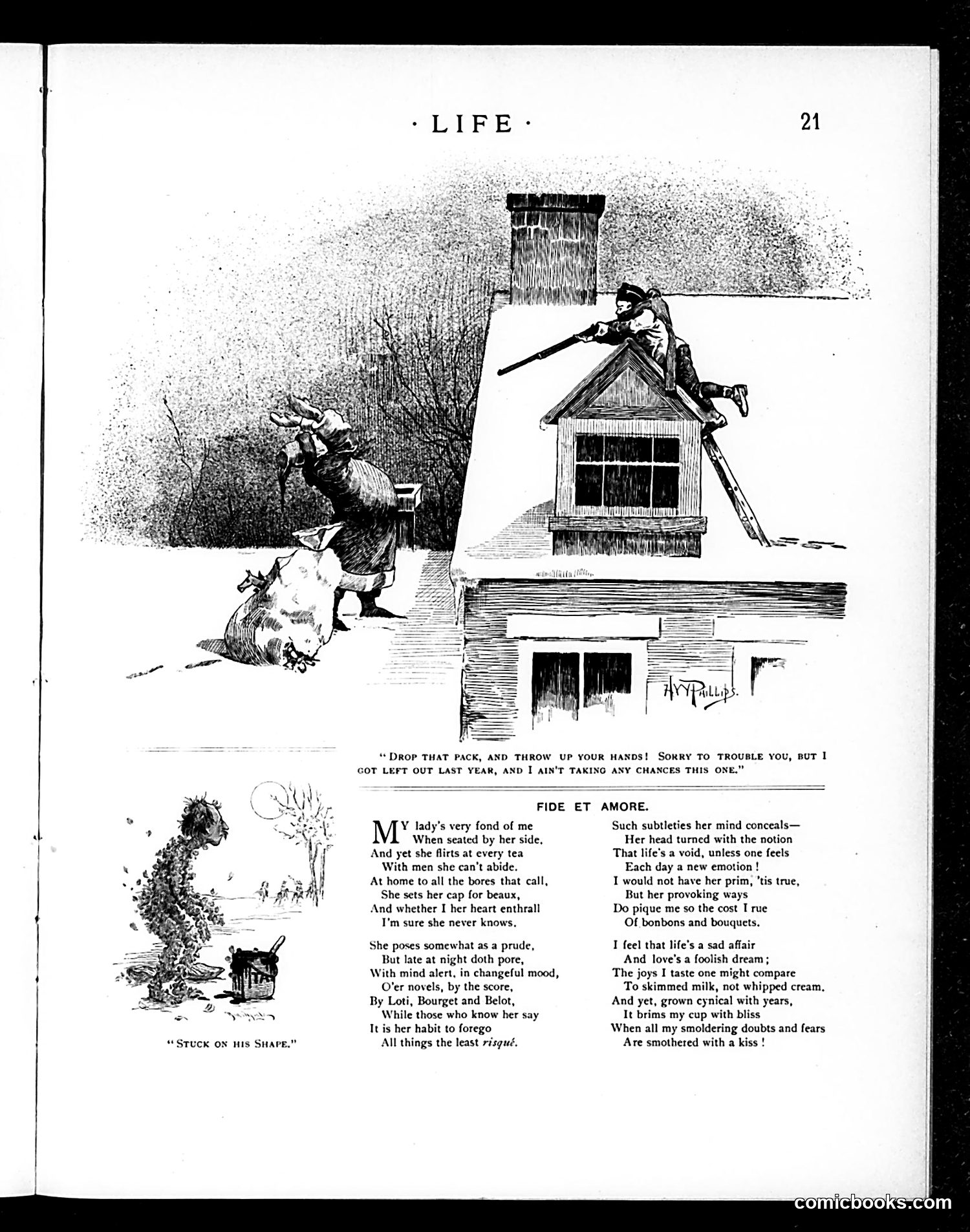
**Top Cartoon:** A burglar confronts a homeowner on a rooftop, demanding surrender. The robber explains he was "left out last year" and won't risk missing again—a satirical commentary on crime patterns, suggesting thieves target homes systematically and repeat their victims if unsuccessful. **"Stuck on His Shape"** (lower left): A small illustration, likely a visual pun about romantic entanglement, though details are unclear. **"Fide et Amore" (main poem):** A man's cynical lament about his lady's contradictions—she flirts while claiming prudishness, reads scandalous novels while appearing proper, craves emotional excitement daily, yet costs him dearly in gifts. Despite his disillusionment with love itself ("skimmed milk, not whipped cream"), a kiss from her restores his hope. **The satire targets** the artificiality and emotional volatility of society women of the era, and men's exasperation with their inconsistency—a common theme in period humor about courtship and marriage dynamics.
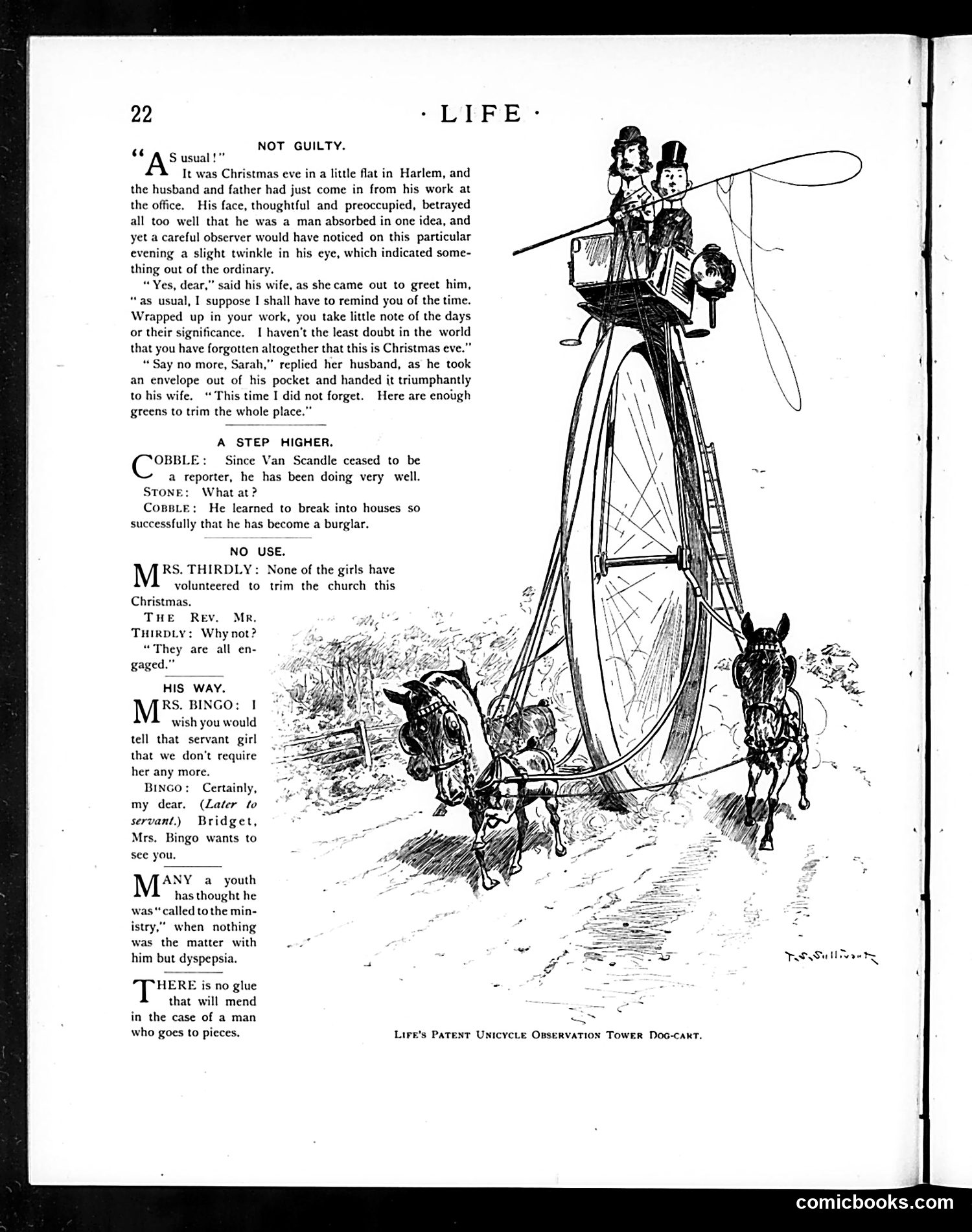
This page contains multiple brief satirical humor pieces typical of early Life magazine: **"Not Guilty"** depicts a husband who remembers Christmas Eve and brings home decorative greens—presented as noteworthy because he usually forgets important dates while absorbed in work. **"A Step Higher"** is a dark joke: a former reporter named Van Scandle has become successful by turning to burglary, implying journalism was less lucrative than crime. **"No Use"** jokes that no church girls volunteered for Christmas decoration duty because they're all engaged—suggesting engagement as an excuse or deflection. **"His Way"** shows indirect communication: a master asks a servant to fire a maid by having the servant relay the message. The main illustration is captioned "Life's Patent Unicycle Observation Tower Dog-Cart"—a humorous invention drawing showing an improbably tall unicycle contraption with passengers and dogs, typical of Life's absurdist visual humor satirizing technological fads and pretension.
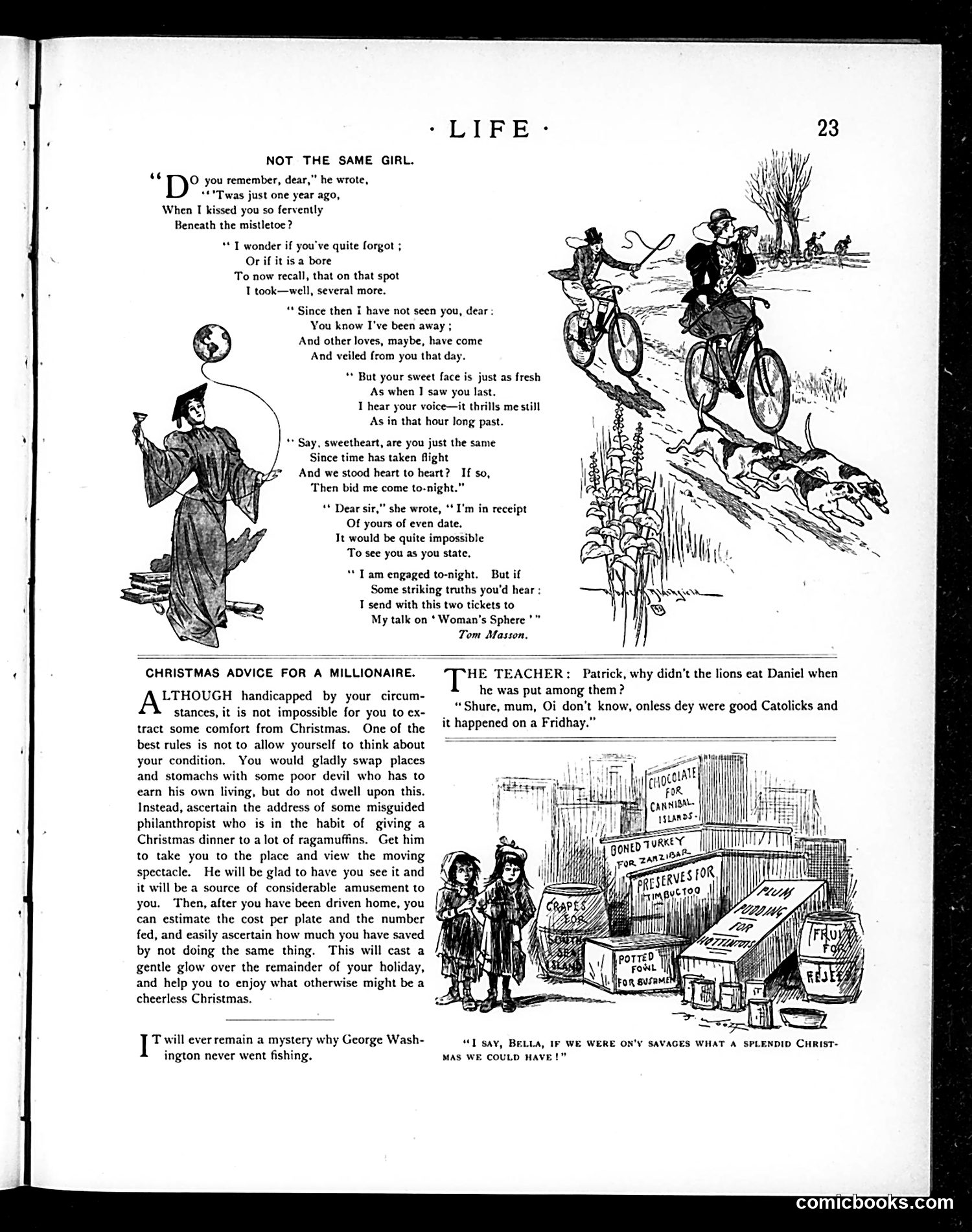
This page contains three satirical pieces typical of early 20th-century humor: **"Not the Same Girl"** (top): A poem by Tom Masson about a man's romantic letter to a woman he hasn't seen in a year. He reminisces about kissing her beneath mistletoe and asks if she's "just the same." Her response: she's engaged and invites him instead to attend her lecture on "Woman's Sphere"—a sharp rejection wrapped in intellectual self-advancement, suggesting women's changing roles and independence. **"Christmas Advice for a Millionaire"** (center): Satire on wealthy hypocrisy. The piece sarcastically advises rich men to attend charity dinners for poor people, then go home and calculate how much money they saved by *not* providing such meals themselves—mocking the self-satisfied morality of the privileged. **Two brief jokes** (bottom): A priest joke about Daniel and the lions (playing on Irish accent and Catholic stereotypes), and a caption about "savages" and Christmas—likely satirizing primitivism or colonial attitudes of the era. The overall tone: skeptical of romance, wealth, and social pretense.
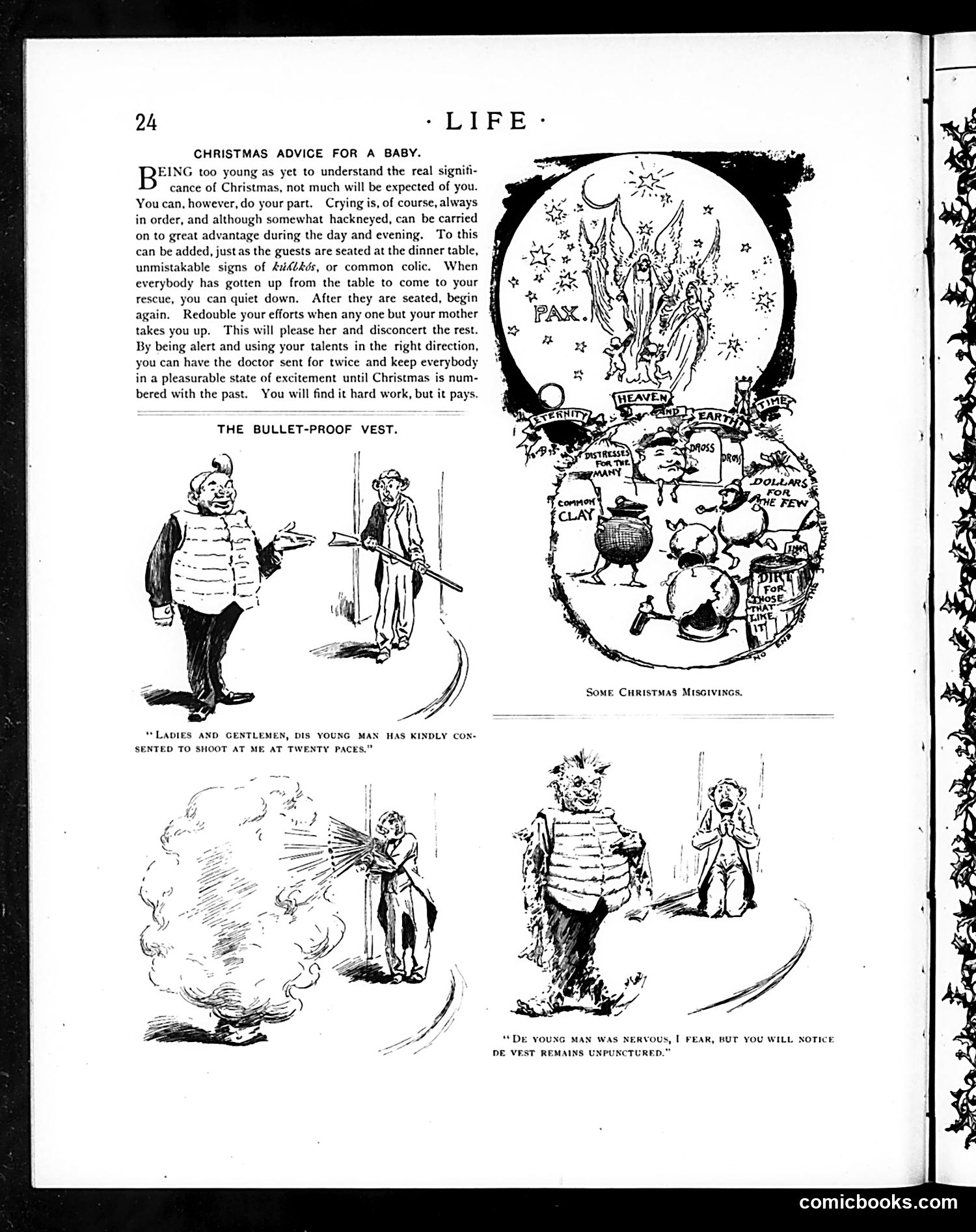
This page contains Christmas-themed humor typical of early 20th-century Life magazine's satirical style. **"Christmas Advice for a Baby"** mockingly advises infants to exploit their helplessness—crying strategically during dinner to disrupt gatherings and summon doctors repeatedly. The joke targets both babies' manipulation tactics and parents' indulgence, presenting infant behavior as calculated performance rather than genuine distress. **"The Bullet-Proof Vest"** shows a carnival-style stunt performer demonstrating a vest's durability by allowing shooting at close range. The caption's broken dialect ("dis young man," "de vest") and the performer's visible nervousness create dark comedy—the humor derives from both the absurdity of the dangerous stunt and the implicit racial caricature suggested by the dialect. Both sketches use exaggeration and uncomfortable subject matter (infant manipulation, casual gun violence) as vehicles for social commentary on gullibility and spectacle, characteristic of Life's irreverent editorial voice.
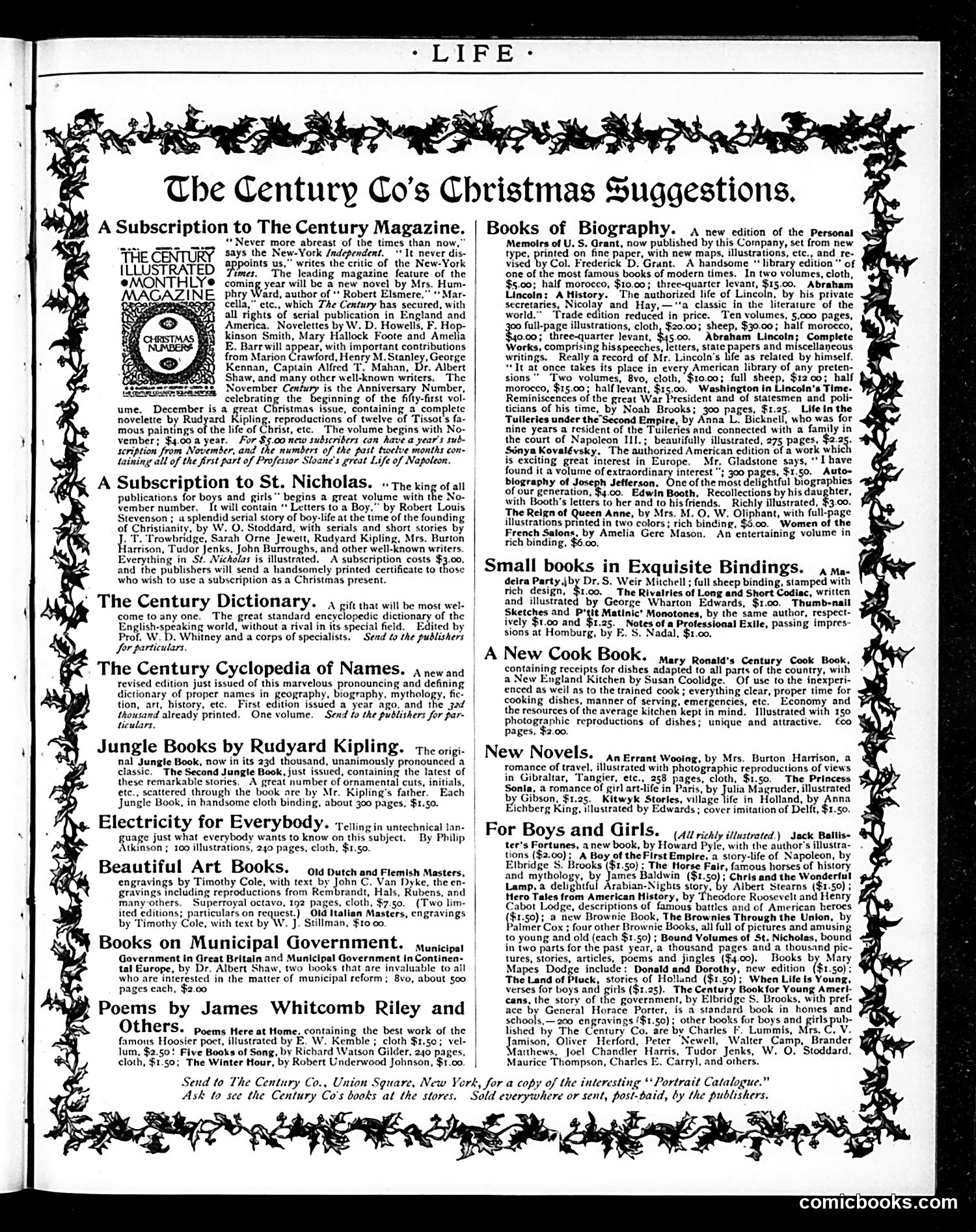
This is primarily **advertising content**, not political satire. The Century Company uses Life's pages to promote holiday gift subscriptions and book purchases. The page advertises: - **The Century Magazine** subscription, highlighting upcoming serialized novels by Mrs. Humphry Ward and contributions from prominent writers (W.D. Howells, Henry M. Stanley, Marion Crawford) - **St. Nicholas magazine** for children, described as "the king of all publications for boys and girls" - **Biography collections**, notably multiple volumes about Abraham Lincoln and biographies of Joseph Jefferson and Edwin Booth (prominent figures of the era) - **Reference works** like The Century Dictionary and books on electricity, art, and cooking The satire appears minimal—this is straightforward holiday gift marketing, appealing to educated, affluent readers by emphasizing literary prestige and patriotic subjects (Lincoln biographies). The decorative holly border frames the content festively for the Christmas season.
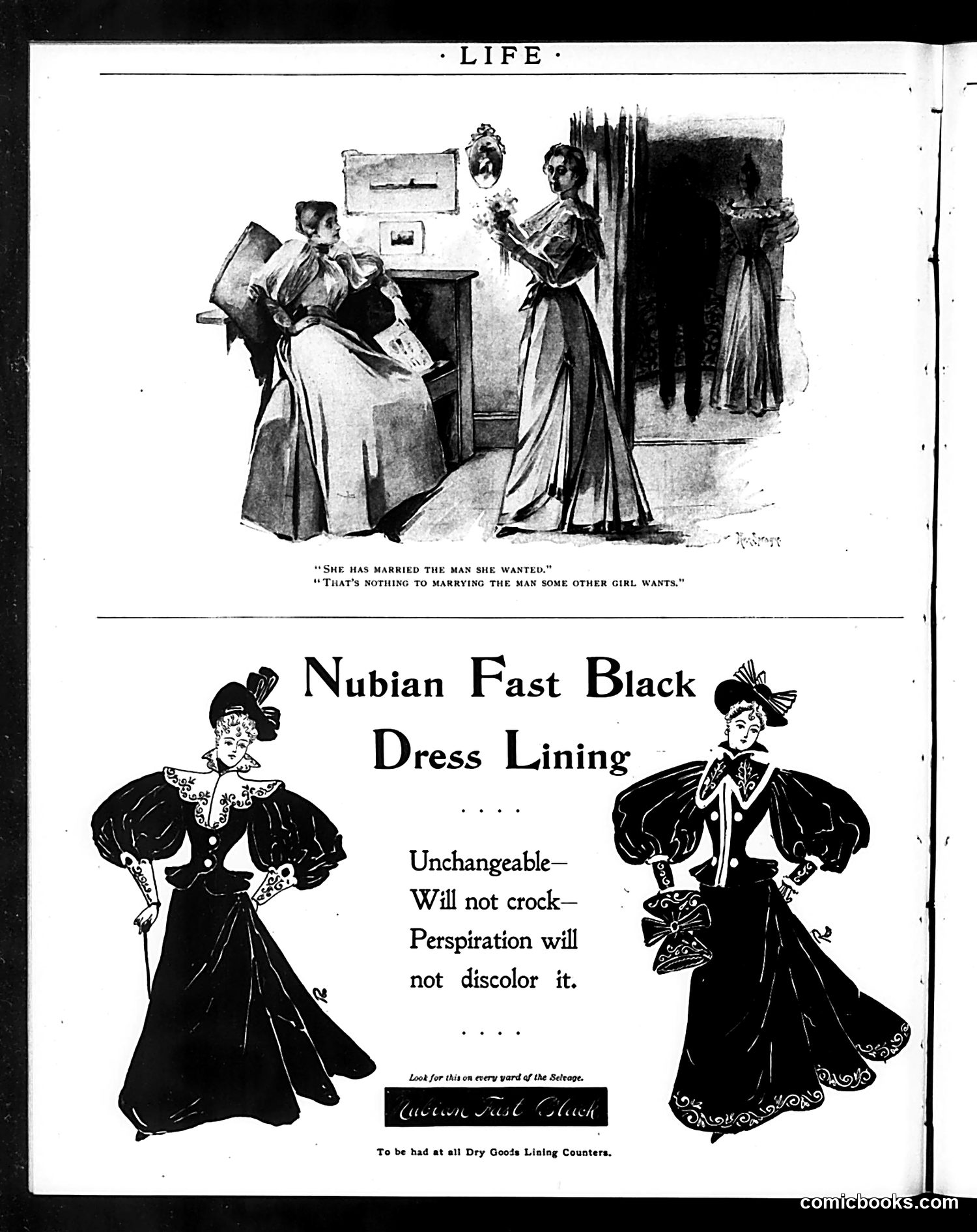
**Top Cartoon:** A satirical domestic scene depicting early 20th-century gender dynamics. A woman boasts to friends that she married the man she wanted, to which another responds that securing a man already desired by other women is the real achievement. The humor targets female competitiveness and the social value placed on "winning" romantic partners—satirizing both women's limited agency (marriage as prize) and their rivalry over men. **Advertisement:** The lower half promotes "Nubian Fast Black Dress Lining," emphasizing durability ("will not crock," "perspiration will not discolor it"). The name "Nubian" and accompanying illustrated women in fashionable black dresses appear designed to appeal to early 1900s consumers seeking reliable garment materials. The advertisement is straightforward product marketing without apparent satirical intent. The page contrasts social commentary with commercial advertising, typical of Life magazine's format blending humor and consumer content.
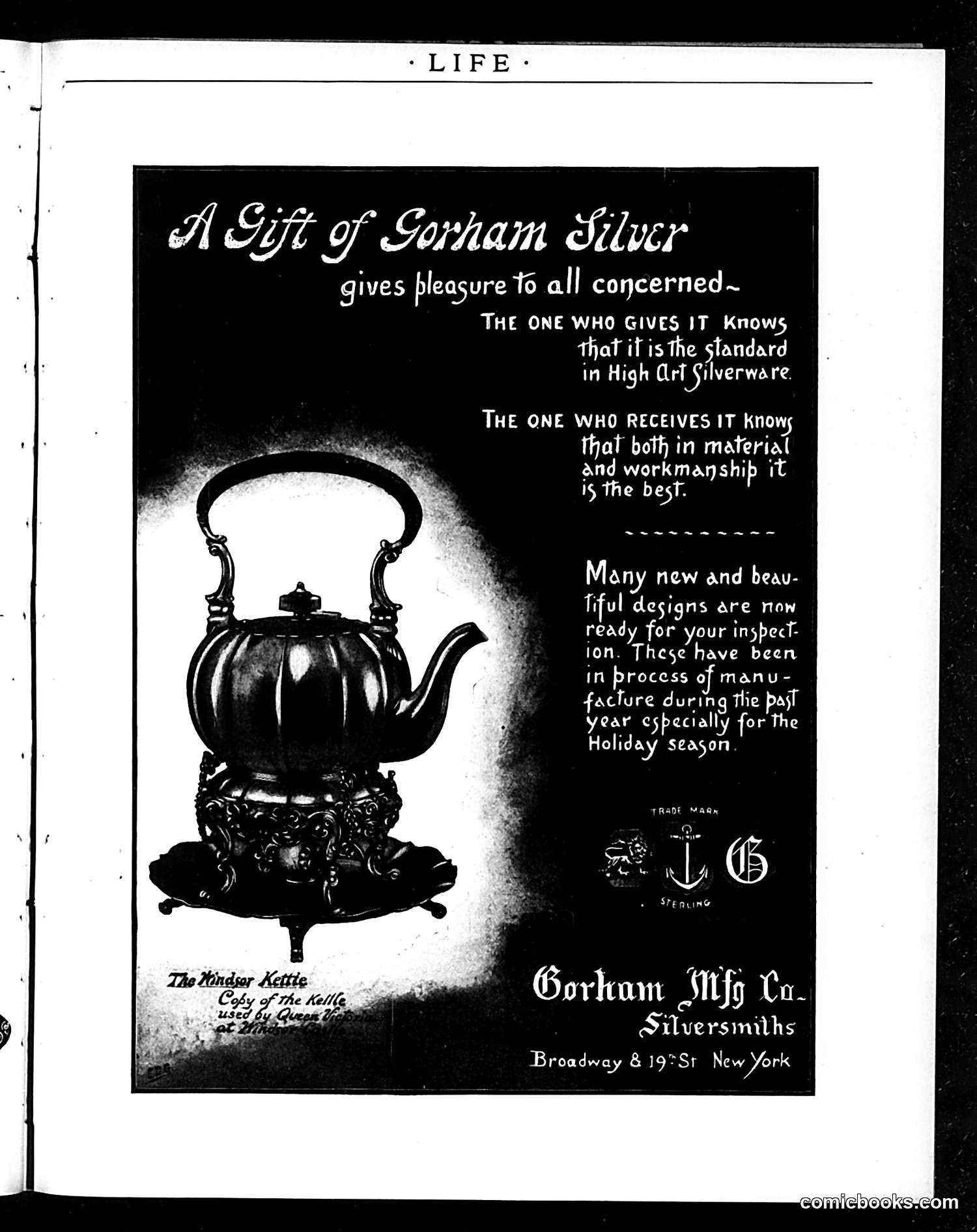
This is a **Gorham Manufacturing Company advertisement**, not political satire or a cartoon. It promotes Gorham silver tableware as an upscale holiday gift. The page features an ornate silver teakettle with an elaborate stand—"The Windsor Kettle"—presented as aspirational luxury goods. The ad's messaging appeals to gift-givers' desire to appear cultured ("High Art Silverware") and gift-receivers' appreciation for quality craftsmanship. The text emphasizes that Gorham silver signifies good taste and superior manufacturing, marketed specifically for the holiday shopping season. The prominent display of the sterling mark and company address (Broadway & 19th Street, New York) establishes credibility and prestige. This represents early 20th-century **luxury consumer advertising**—using elegant imagery and refined language to position silver tableware as a status symbol and appropriate prestigious gift.
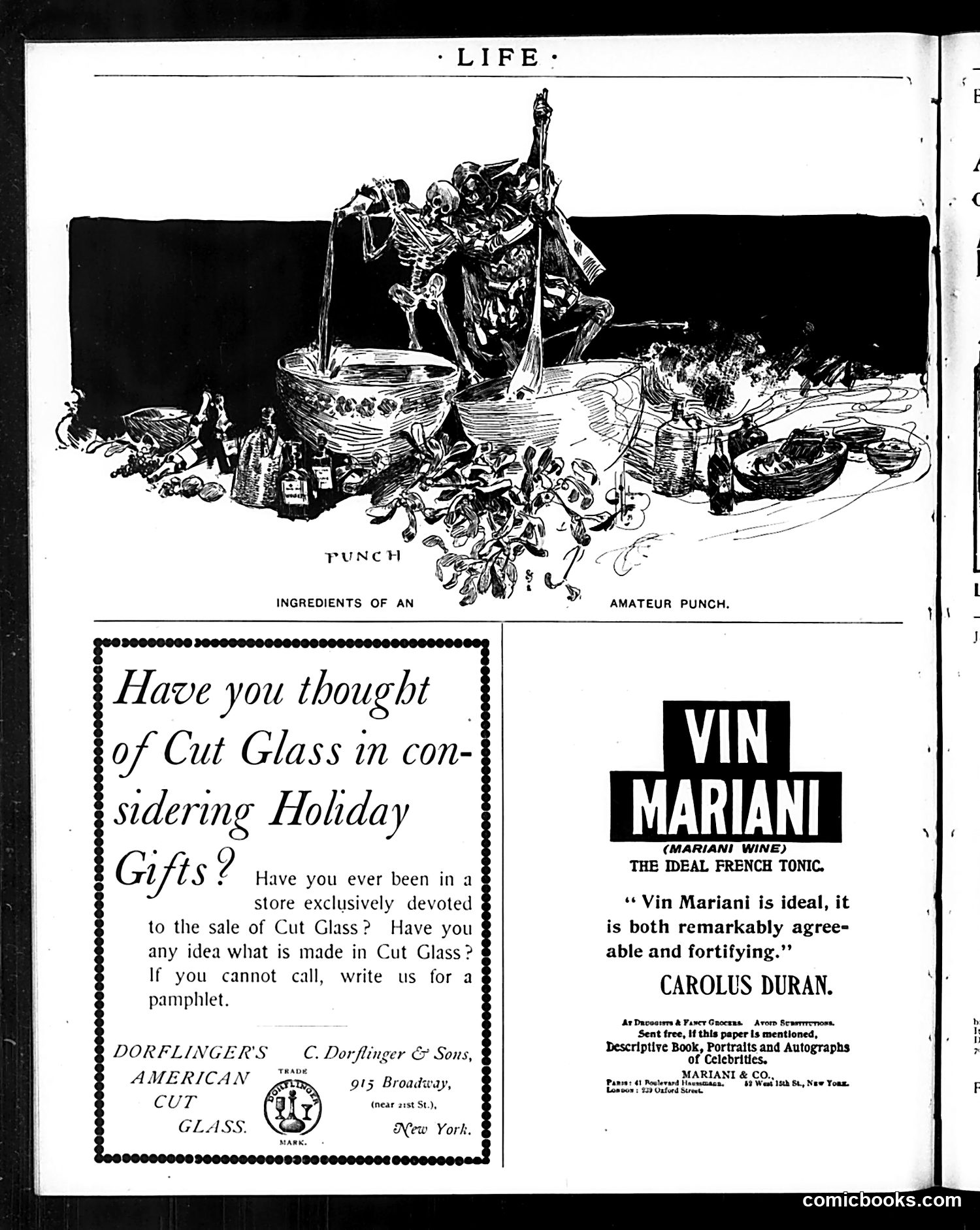
This page is primarily **advertising** rather than editorial content or satire. The main illustration titled "Ingredients of an Amateur Punch" is a decorative **still-life drawing** showing skeleton figures and various bottles/ingredients arranged around a punch bowl—a humorous visual pun on "punch" that plays on the macabre imagery popular in period humor. Below are two unrelated advertisements: 1. **Dorflinger's American Cut Glass** — promotes their store's cut glass wares as holiday gifts, encouraging readers unfamiliar with the product to visit or request a pamphlet. 2. **Vin Mariani** — advertises a French wine tonic, quoting endorsement from artist Carolus Duran. Vin Mariani was a popular patent medicine/fortified wine of the era containing coca leaf extract. There is no political satire or social commentary on this page. It represents typical early 20th-century magazine advertising practices.
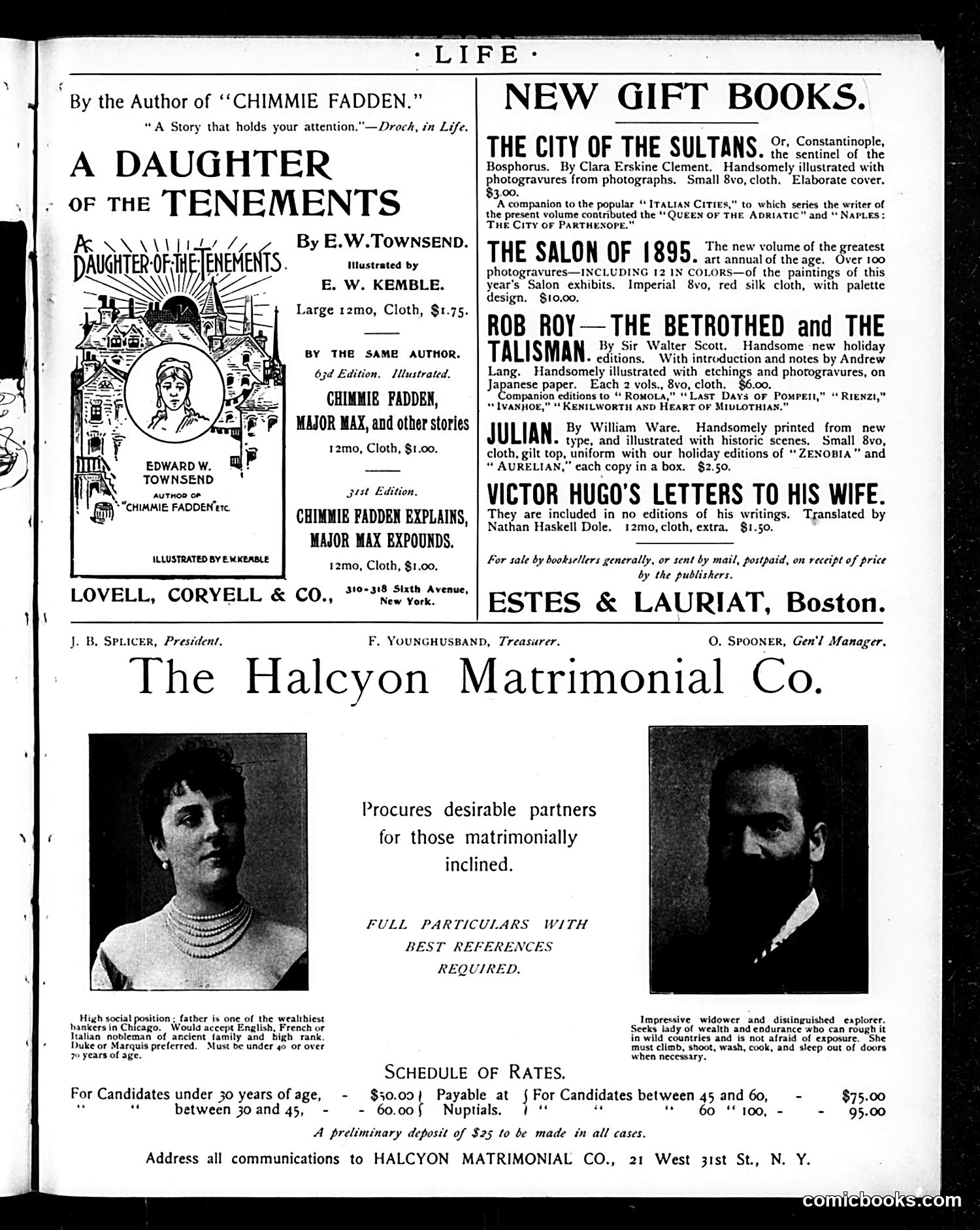
This page contains primarily book advertisements and a satirical advertisement disguised as the real thing. The left side promotes books by E.W. Townsend, notably "A Daughter of the Tenements" and "Chimmie Fadden"—realistic fiction about working-class urban life ("tenement" refers to poor city housing). These were popular contemporary works. The center advertises "gift books"—expensive, elaborately illustrated volumes typical of wealthy Victorian holiday gift-giving, with titles like works by Walter Scott. The satire lies in **The Halcyon Matrimonial Co.** advertisement: a fake matchmaking service. It mockingly presents absurd client profiles—a wealthy Chicago banker's daughter seeking a European nobleman of specific age parameters, and an "intrepid explorer widower" seeking a woman tough enough for wilderness roughing. The sardonic descriptions ("must climb, shoot, wash, cook, and sleep out of doors") satirize the era's matrimonial agencies and the transactional, class-conscious nature of marriage negotiations among the wealthy. This is *Life* magazine's characteristic social commentary, ridiculing pretension and mercenary marriage practices.
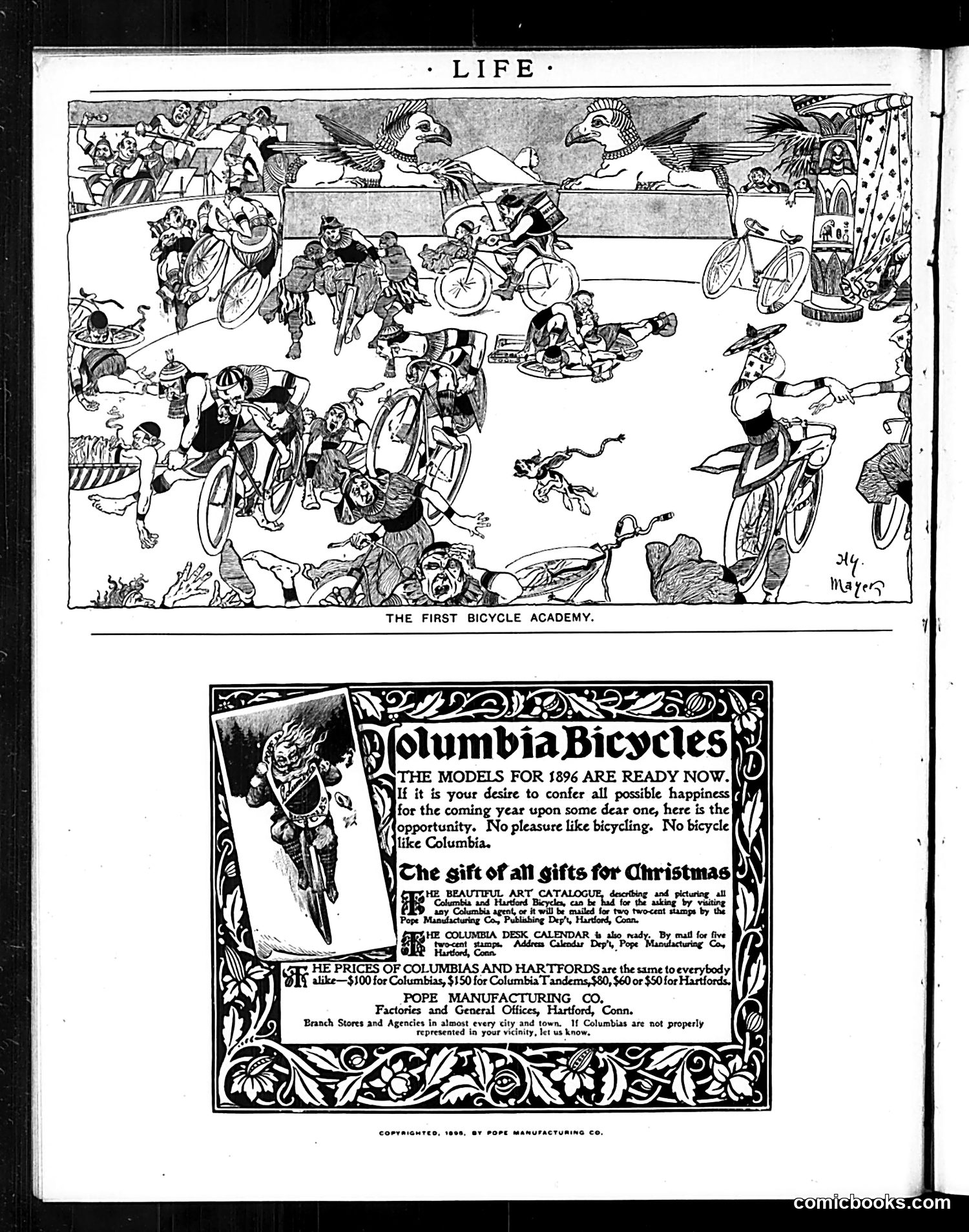
This page combines satire with advertising. The top cartoon, titled "The First Bicycle Academy," depicts chaotic bicycle instruction—riders falling, colliding, and struggling while instructors gesture helplessly. It mocks the bicycle craze of the 1890s, specifically the difficulty novices faced learning to ride. The humor targets both incompetent "teachers" and the faddish enthusiasm for bicycles despite widespread accidents. Below is a Columbia Bicycles advertisement (Pope Manufacturing Co., Hartford, Connecticut) promoting their 1896 models as Christmas gifts. The ad's tagline—"No pleasure like bicycling. No bicycle like Columbia"—directly follows the cartoon's visual joke about bicycle mishaps, creating ironic contrast: the ad encourages buying bicycles for loved ones moments after depicting dangerous, embarrassing failures. The pricing structure ($100-$300) indicates bicycles were luxury items. This pairing of satire with earnest sales pitch was typical of Life's editorial-advertising blend.
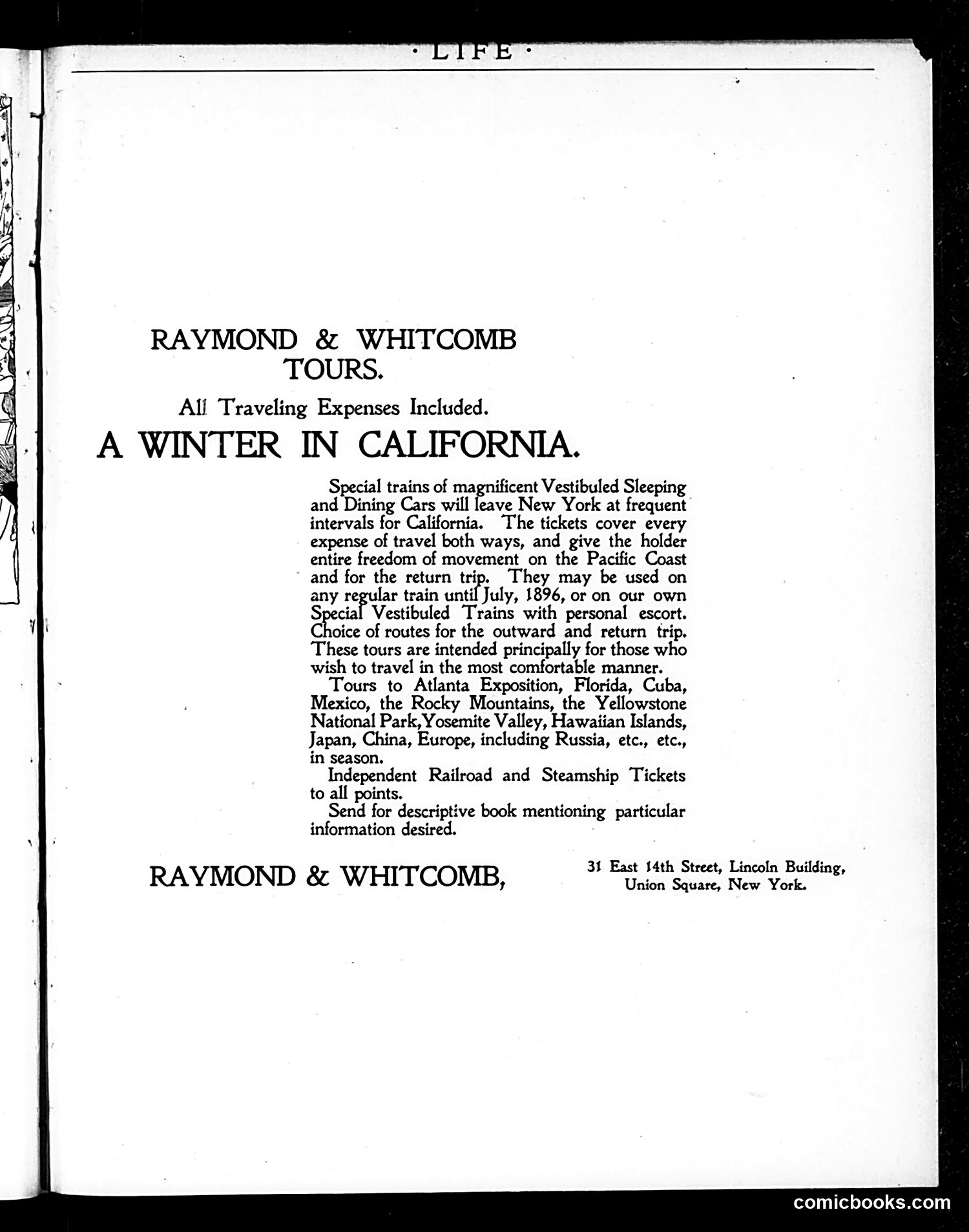
This page contains **no cartoon or satirical content**. It is a straightforward **travel advertisement** from Raymond & Whitcomb Tours, a luxury tour operator based in New York (Union Square, Lincoln Building). The ad promotes all-inclusive winter tours to California via special Vestibuled (luxury) sleeping and dining train cars departing from New York. Tickets cover all travel expenses and include freedom of movement on the Pacific Coast through July 1896. The company also offers tours to other destinations: Atlanta Exposition, Florida, Cuba, Mexico, the Rocky Mountains, Yellowstone, Yosemite, Hawaiian Islands, Japan, China, Europe, and Russia. The advertisement targets wealthy travelers seeking comfortable leisure travel. While this appears in *Life* magazine (known for satire), **this particular page is purely commercial advertising with no political or social commentary**.
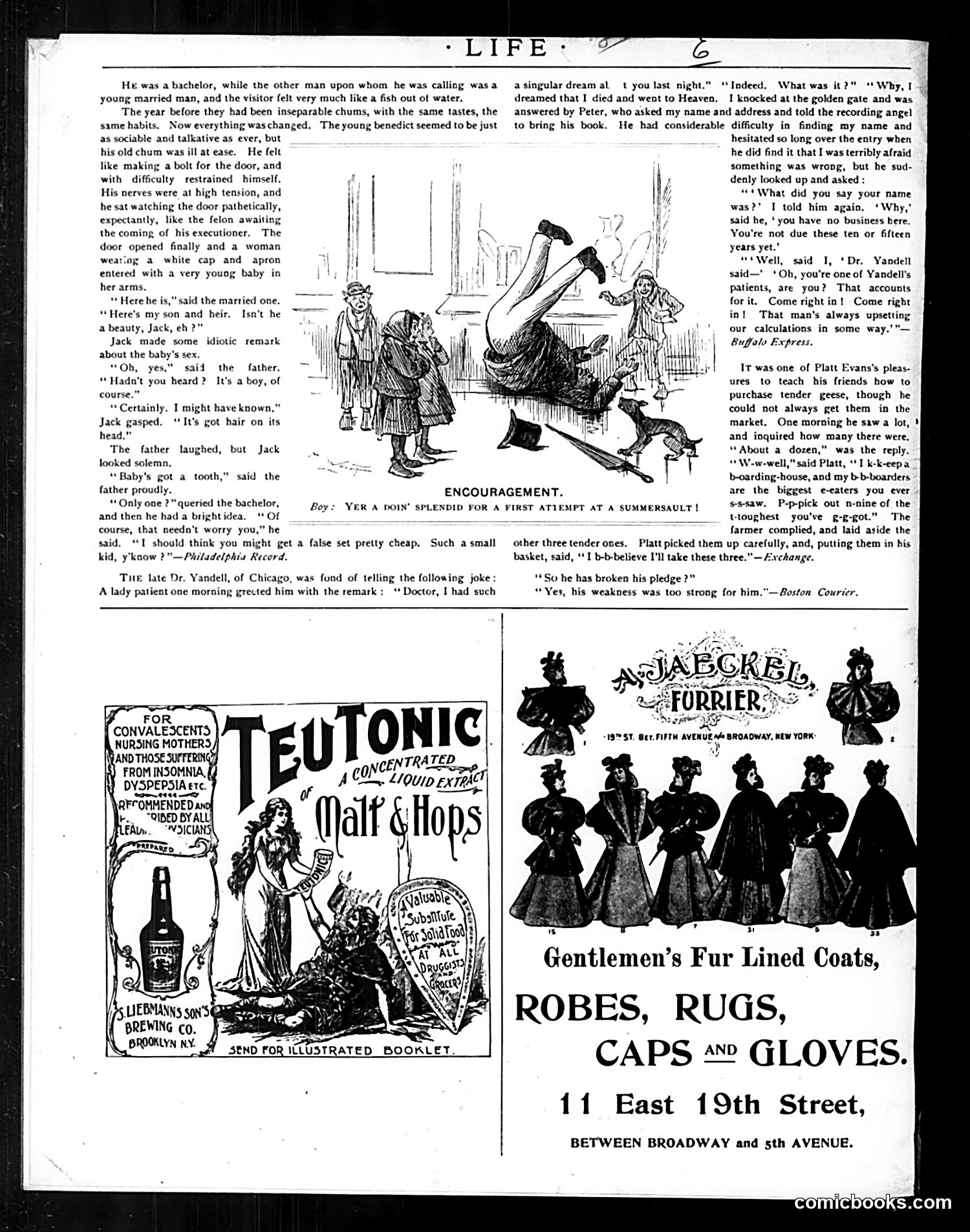
The main cartoon, titled "ENCOURAGEMENT," depicts a young boy attempting his first summersault while an adult watches approvingly. The satire is gentle: the boy is doing a clumsy, awkward flip, yet the adult offers enthusiastic praise for this "splendid" first attempt. The joke critiques how adults patronize children's early efforts with excessive encouragement regardless of actual competence—a mild social observation about parenting and praise culture. Below are three brief anecdotes: one about a bachelor visiting a married friend and feeling awkward around the new baby (highlighting social discomfort with domesticity); another poking fun at Dr. Yandell of Chicago, whose unconventional medical practices apparently violate heavenly record-keeping; and a third about a man named Platt Evans who stammers while buying geese and deliberately selects the toughest birds (implying he's breaking some pledge, likely temperance-related). The page otherwise contains period advertisements for Teutonic Malt & Hops tonic and a fur clothing merchant.
I can see this is a nearly entirely black page with only minimal visible content—some faint text fragments on the left margin and the "comicbooks.com" watermark at the bottom right. The image quality and darkness make it impossible to discern any cartoon imagery, caricatures, political figures, or satirical content that would typically appear in a Life magazine page. Without being able to read the OCR text clearly or see the actual content, I cannot identify what figures, events, or satirical points are being referenced. This appears to be either a scanning error, a blank or heavily darkened page, or a technical issue with the image reproduction.