
Life, 1895-12-26 · page 12 of 51
Life — December 26, 1895 — page 12: what you’re looking at
What you’re looking at
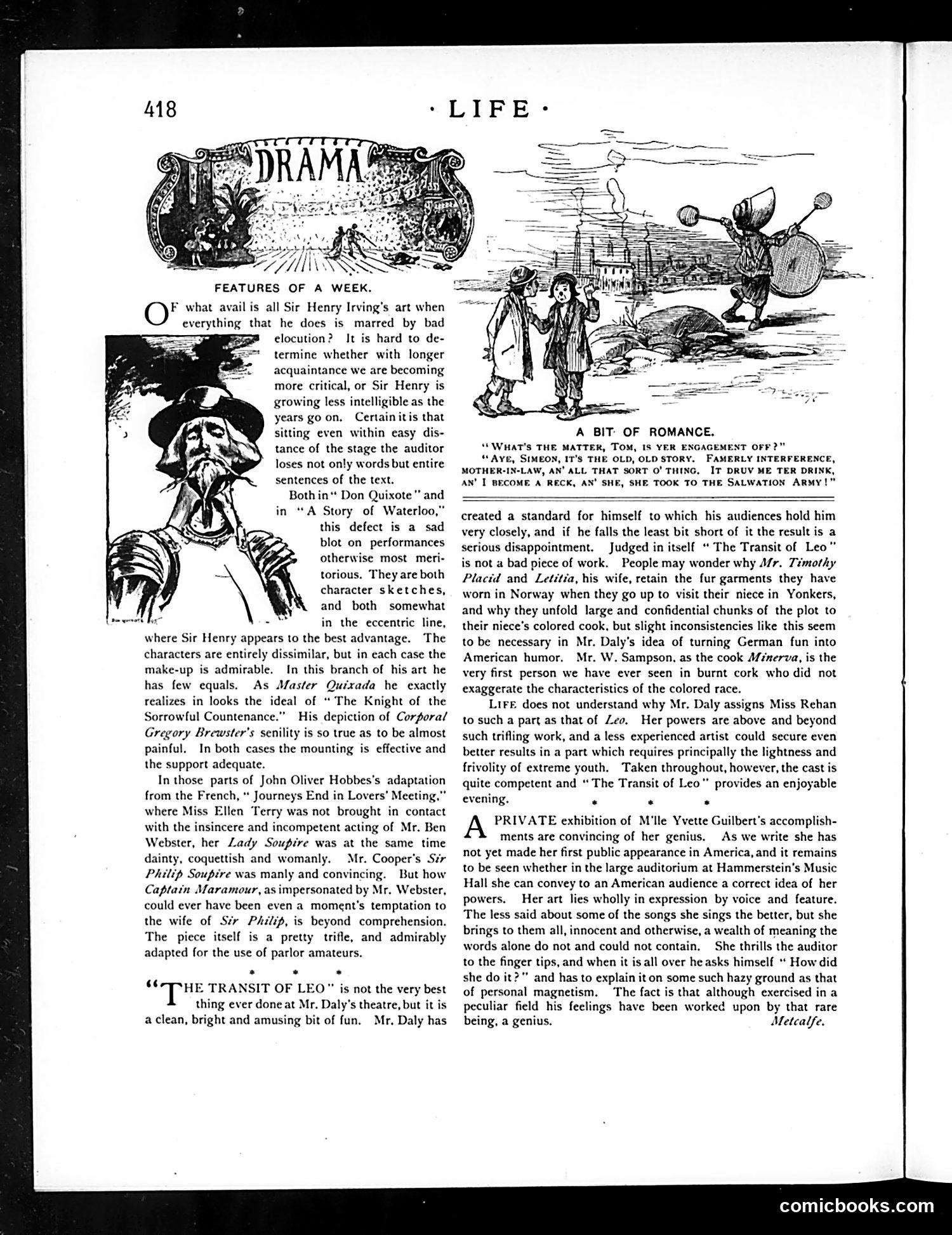
This page reviews contemporary theatrical productions, primarily criticizing **Sir Henry Irving**, a famous British actor. The text complains that Irving's elocution (speech clarity) has deteriorated with age—audiences cannot hear entire sentences despite sitting close to the stage. He's praised for excellent makeup and character work in *Don Quixote* and *A Story of Waterloo*, but his diction undermines otherwise strong performances. The page also reviews other productions: *Journeys End in Lovers' Meeting* (praising Ellen Terry), *The Transit of Leo* at Mr. Daly's theatre, and mentions French actress M'lle Yvette Guilbert's upcoming American debut. The small cartoon captioned "A Bit of Romance" shows working-class dialect humor: a man blames his broken engagement on family interference and drink, while his fiancée joined the Salvation Army—typical Victorian-era sentimental melodrama material used for satirical effect.
📄 Transcribed text from this page (OCR, searchable)
Machine-transcribed from the original scan — historical spelling and the odd misread are preserved.
FEATURES OF A WEEK. F what avail is all Sir Henry Irving's art when everything that he does is marred by bad elocution? It is hard to de- termine whether with longer acquaintance we are becoming more critical, or Sir Henry is growing less intelligible as the years go on, Certainitis that sitting even within easy dis- tance of the stage the auditor loses not only words but entire sentences of the text. Both in* Don Quixote" and in “A Story of Waterloo,” this defect is a sad blot on performances otherwise most meri- torious. They are both character sketches, and both somewhat - in the eccentric line, where Sir Henry appears to the best advantage. The characters are entirely dissimilar, but in each case the make-up is admirable. In this branch of his art he has few equals. As Master Quixada he exactly realizes in looks the ideal of “ The Knight of the Sorrowful Countenance.” His depiction of Corporal Gregory Brewster's senility is so true as to be almost painful. In both cases the mounting is effective and the support adequate. In those parts of John Oliver Hobbes’s adaptation from the French, “ Journeys End in Lovers’ Meeting,” where Miss Ellen Terry was not brought in contact with the insincere and incompetent acting of Mr. Ben Webster, her Lady Soupire was at the same time dainty, coquettish and womanly. Mr. Cooper's Str Philip Souptre was manly and convincing. But how Captain Maramour, as impersonated by Mr. Webster, could ever have been even a moment's temptation to the wife of Str Philip, is beyond comprehension. The piece itself is a pretty trifle, and admirably adapted for the use of parlor amateurs. 66-TOHE TRANSIT OF LEO” is not the very best thing ever done at Mr. Daly's theatre, but it is a clean, bright and amusing bit of fun. Mr, Daly has A BIT OF ROMANCE. “WHAT'S THE MATTER, ToM, 18 YER ENGAGEMENT OFF?” “AYE, SIMEON, IT'S THE OLD, OLD STORY. FAMERLY INTERFERENCE, MOTHER-IN-LAW, AN’ ALL THAT SORT O' THING, IT DRUV ME TER DRINK, AN’ | BECOME A RECK, AN’ SHE, SHE TOOK TO THE SALWATION ARMY!” created a standard for himself to which his audiences hold him very closely, and if he falls the least bit short of it the result is a serious disappointment. Judged in itself “ The Transit of Leo” is not a bad piece of work. People may wonder why Afr. Timothy Placid and Letitia, his wife, retain the fur garments they have worn in Norway when they go up to visit their niece in Yonkers, and why they unfold large and confidential chunks of the plot to their niece's colored cook, but slight inconsistencies like this seem to be necessary in Mr. Daly's idea of turning German fun into American humor, Mr. W. Sampson. as the cook Minerva, is the very first person we have ever seen in burnt cork who did not exaggerate the characteristics of the colored race. Lire does not understand why Mr. Daly assigns Miss Rehan to such a part as that of Leo. Her powers are above and beyond such trifling work, and a less experienced artist could secure even better results in a part which requires principally the lightness and frivolity of extreme youth, Taken throughout, however, the cast is quite competent and “ The Transit of Leo” provides an enjoyable evening. * Pa Py PRIVATE exhibition of M'lle Yvette Guilbert’s accomplish- ments are convincing of her genius. As we write she has not yet made her first public appearance in America, and it remains to be seen whether in the large auditorium at Hammerstein’s Music Hall she can convey to an American audience a correct idea of her powers. Her art lies wholly in expression by voice and feature. The less said about some of the songs she sings the better, but she brings to them all, innocent and otherwise, a wealth of meaning the words alone do not and could not contain. She thrills the auditor to the finger tips, and when it is all over he asks himself * How did she do it?" and has to explain it on some such hazy ground as that of personal magnetism. The fact is that although exercised in a peculiar field his feelings have been worked upon by that rare being, a genius. Metcalfe. comicbooks.com