
Life, 1895-12-26 · page 6 of 51
Life — December 26, 1895 — page 6: what you’re looking at
What you’re looking at
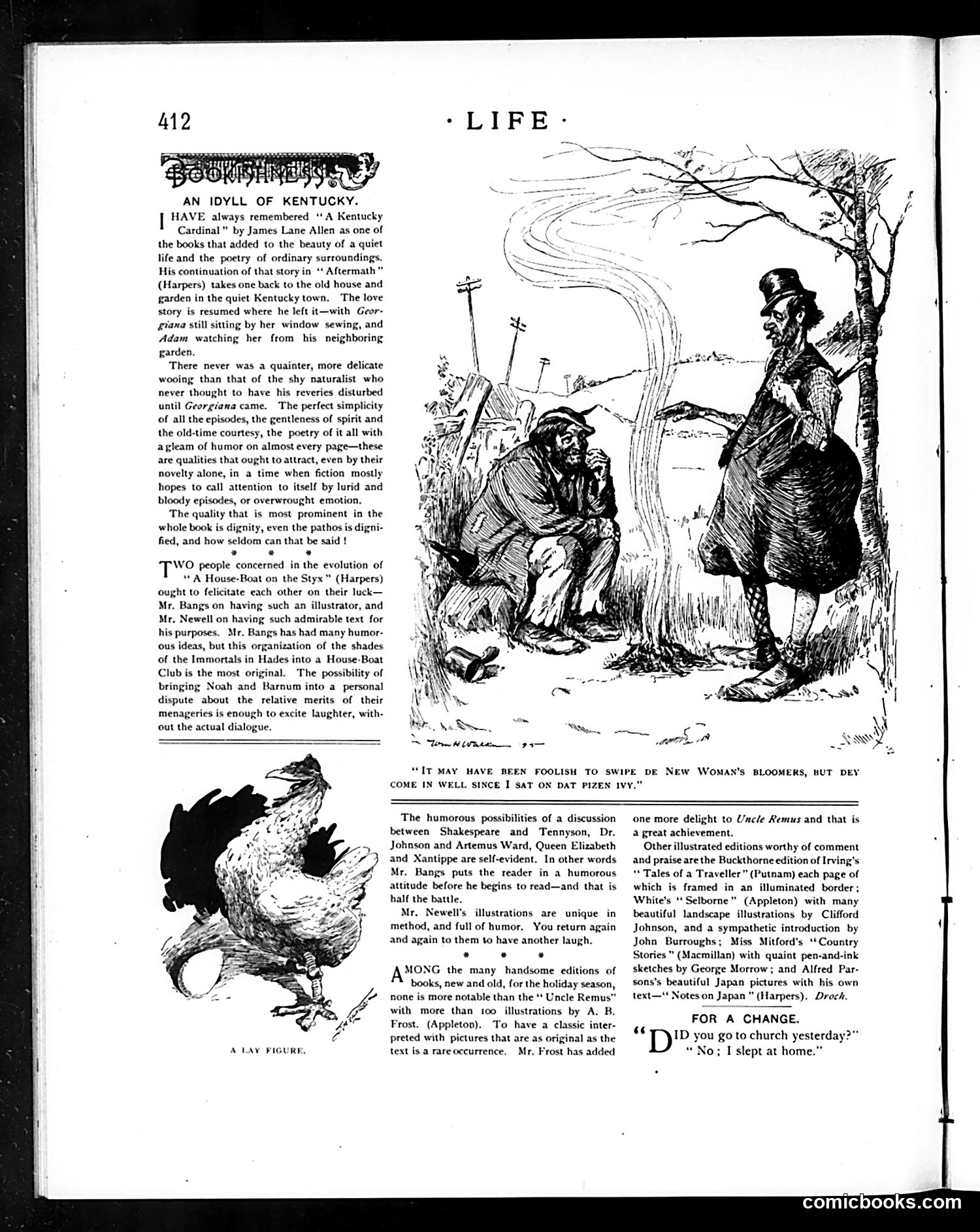
This page contains a literary review section titled "An Idyll of Kentucky," discussing James Lane Allen's Kentucky stories. The main cartoon depicts two men in rural 19th-century dress standing near a cemetery with crosses visible. The caption reads: "It may have been foolish to swipe de new woman's bloomers, but dey come in well since I sat on dat pizen ivy." The joke references the "New Woman" social movement of the late 1800s—women advocating for dress reform, including wearing bloomers (baggy pants). The cartoon satirizes rural/working-class men pragmatically repurposing stolen women's bloomers as a remedy for poison ivy exposure, treating progressive women's fashion ironically as merely useful rags rather than symbols of women's liberation.
📄 Transcribed text from this page (OCR, searchable)
Machine-transcribed from the original scan — historical spelling and the odd misread are preserved.
AN IDYLL OF KENTUCKY. HAVE always remembered “A Kentucky Cardinal” by James Lane Allen as one of the books that added to the beauty of a quiet life and the poetry of ordinary surroundings. His continuation of that story in “ Aftermath” (Harpers) takes one back to the old house and garden in the quiet Kentucky town. The love story is resumed where he left it—with Geor- giana still sitting by her window sewing, and Adam watching her from his neighboring garden. There never was a quainter, more delicate wooing than that of the shy naturalist who never thought to have his reveries disturbed until Georgiana came. The perfect simplicity of all the episodes, the gentleness of spirit and the old-time courtesy, the poetry of it all with agleam of humor on almost every page—these are qualities that ought to attract, even by their novelty alone, in a time when fiction mostly hopes to call attention to itself by lurid and bloody episodes, or overwrought emotion, ‘The quality that is most prominent in the whole book is dignity, even the pathos is digni- fied, and how seldom can that be said ! * * * TWO people concerned in the evolution of “A House-Boat on the Styx" (Harpers) ought to felicitate each other on their luck— Mr. Bangs on having such an illustrator, and Mr, Newell on having such admirable text for his purposes. Mr. Bangs has had many humor- ous ideas, but this organization of the shades of the Immortals in Hades into a House-Boat Club is the most original. ‘The possibility of bringing Noah and Barnum into a personal dispute about the relative merits of their menageries is enough to excite laughter, with- out the actual dialogue. A LAY FIGURE, — iii! hi wot a “IT MAY HAVE BEEN FOOLISH TO SWIPE DE NEW WOMAN'S BLOOMERS, BUT DEY COME IN WELL SINCE I SAT ON DAT PIZEN IVY.” The humorous possibilities of a discussion between Shakespeare and Tennyson, Dr. Johnson and Artemus Ward, Queen Elizabeth and Xantippe are self-evident. In other words Mr. Bangs puts the reader in a humorous attitude before he begins to read—and that is half the battle. Mr. Newell's illustrations are unique in method, and full of humor. You return again and again to them to have another laugh. * . * MONG the many handsome editions of books, new and old, for the holiday season, none is more notable than the * Uncle Remus" with more than 100 illustrations by A. B. Frost. (Appleton). To have a classic inter- preted with pictures that are as original as the text isa rareoccurrence. Mr. Frost has added one more delight to Uncle Remus and that is a great achievement. Other illustrated editions worthy of comment and praise are the Buckthorne edition of Irving's “ Tales of a Traveller” (Putnam) each page of which is framed in an illuminated border; White's “ Selborne” (Appleton) with many beautiful landscape illustrations by Clifford Johnson, and a sympathetic introduction by John Burroughs; Miss Mitford's ‘Country Stories " (Macmillan) with quaint pen-and-ink sketches by George Morrow; and Alfred Par- sons's beautiful Japan pictures with his own text—"* Notes on Japan " (Harpers). Droch. FOR A CHANGE. ID you goto church yesterday?” “No; I slept at home.” “cc comicbooks.com