
Life, 1895-12-26 · page 29 of 51
Life — December 26, 1895 — page 29: what you’re looking at
What you’re looking at
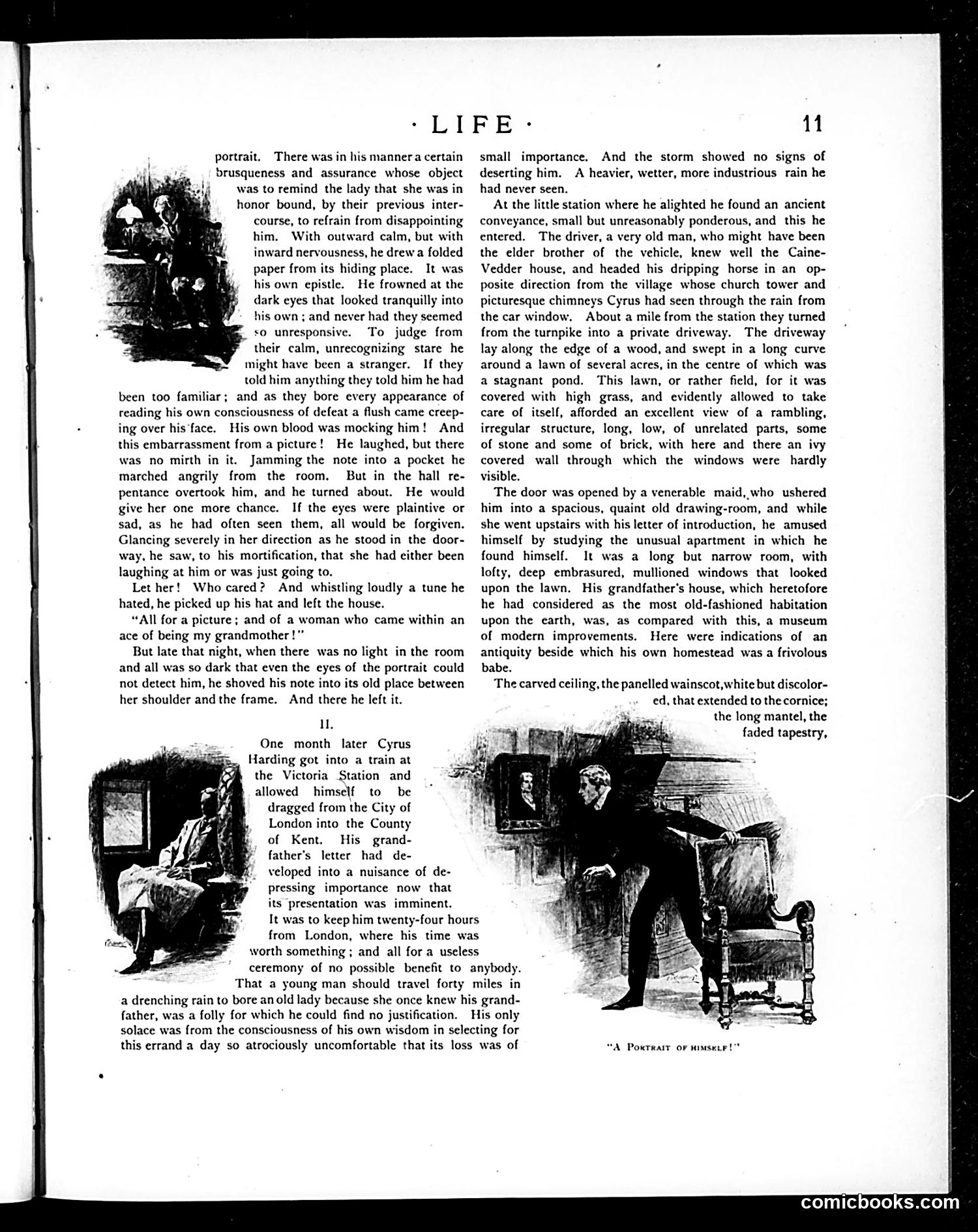
This page contains two narrative illustrations from what appears to be a serialized short story about a young man named Cyrus Harding. **The first illustration** shows a man confronting a portrait of a woman. The text reveals his awkward attempt to impress her by leaving a love note tucked behind the portrait's frame—only to be deflated by her painted expression of apparent indifference or amusement. The satire targets masculine vanity and the absurdity of romantic gestures made to *inanimate objects*. His embarrassment—blushing before a picture—mocks his self-importance. **The second illustration** depicts Cyrus arriving at his grandfather's country house in Kent, a rambling, old-fashioned estate. The accompanying narrative emphasizes the building's antiquated, disheveled appearance. The overall tone is gently mocking: a young man humiliated by a portrait, now obligated to visit an elderly relative's decrepit country home. The humor relies on depicting masculine discomfort and social awkwardness rather than explicit political satire.
📄 Transcribed text from this page (OCR, searchable)
Machine-transcribed from the original scan — historical spelling and the odd misread are preserved.
> LIFE: portrait. There was in his manner a certain brusqueness and assurance whose object was to remind the lady that she was in honor bound, by their previous inter- course, to refrain from disappointing him. With outward calm, but with inward nervousness, he drew a folded paper from its hiding place. It was his own epistle. He frowned at the dark eyes that looked tranquilly into his own ; and never had they seemed so unresponsive. To judge from their calm, unrecognizing stare he might have been a stranger. If they told him anything they told him he had been too familiar; and as they bore every appearance of reading his own consciousness of defeat a flush came creep- ing over his‘face. His own blood was mocking him! And this embarrassment from a picture! He laughed, but there was no mirth in it. Jamming the note into a pocket he marched angrily from the room. But in the hall re- pentance overtook him, and he turned about. He would give her one more chance. If the eyes were plaintive or sad, as he had often seen them, all would be forgiven. Glancing severely in her direction as he stood in the door- way, he saw, to his mortification, that she had cither been laughing at him or was just going to. Let her! Who cared? And whistling loudly a tune he hated, he picked up his hat and left the house. “All for a picture; and of a woman who came within an ace of being my grandmother!" But late that night, when there was no light in the room and all was so dark that even the eyes of the portrait could not detect him, he shoved his note into its old place between her shoulder and the frame. And there he left it. aah I. One month later Cyrus Harding got into a train at the Victoria Station and allowed himself to be dragged from the City of London into the County of Kent, His grand- father's letter had de- veloped into a nuisance of de- pressing importance now that its presentation was imminent, 11 small importance. And the storm showed no signs of deserting him. A heavier, wetter, more industrious rain he had never seen. At the little station where he alighted he found an ancient conveyance, small but unreasonably ponderous, and this he entered. The driver, a very old man, who might have been the elder brother of the vehicle, knew well the Caine- Vedder house, and headed his dripping horse in an op- posite direction from the village whose church tower and picturesque chimneys Cyrus had seen through the rain from the car window. About a mile from the station they turned from the turnpike into a private driveway. The driveway lay along the edge of a wood, and swept in a long curve around a lawn of several acres, in the centre of which was a stagnant pond. This lawn, or rather field, for it was covered with high grass, and evidently allowed to take care of itself, afforded an excellent view of a rambling, irregular structure, long, low, of unrelated parts, some of stone and some of brick, with here and there an ivy covered wall through which the windows were hardly visible. The door was opened by a venerable maid, who ushered him into a spacious, quaint old drawing-room, and while she went upstairs with his letter of introduction, he amused himself by studying the unusual apartment in which he found himself. It was a long but narrow room, with lofty, deep embrasured, mullioned windows that looked upon the lawn. His grandfather's house, which heretofore he had considered as the most old-fashioned habitation upon the earth, was, as compared with this, a museum of modern improvements. Here were indications of an antiquity beside which his own homestead was a frivolous babe. The carved ceiling, the panelled wainscot,white but discolor- ed, that extended to the cornice; the long mantel, the faded tapestry, It was to keep him twenty-four hours. from London, where his time was worth something ; and all for a useless ceremony of no possible benefit to anybody. That a young man should travel forty miles in a drenching rain to bore an old lady because she once knew his grand- father, was a folly for which he could find no justification. His only solace was from the consciousness of his own wisdom in selecting for this errand a day so atrociously uncomfortable that its loss was of “A Powrrart ov HIMSKL comicbooks.com