
A complete issue · 26 pages · 1895
Life — April 11, 1895
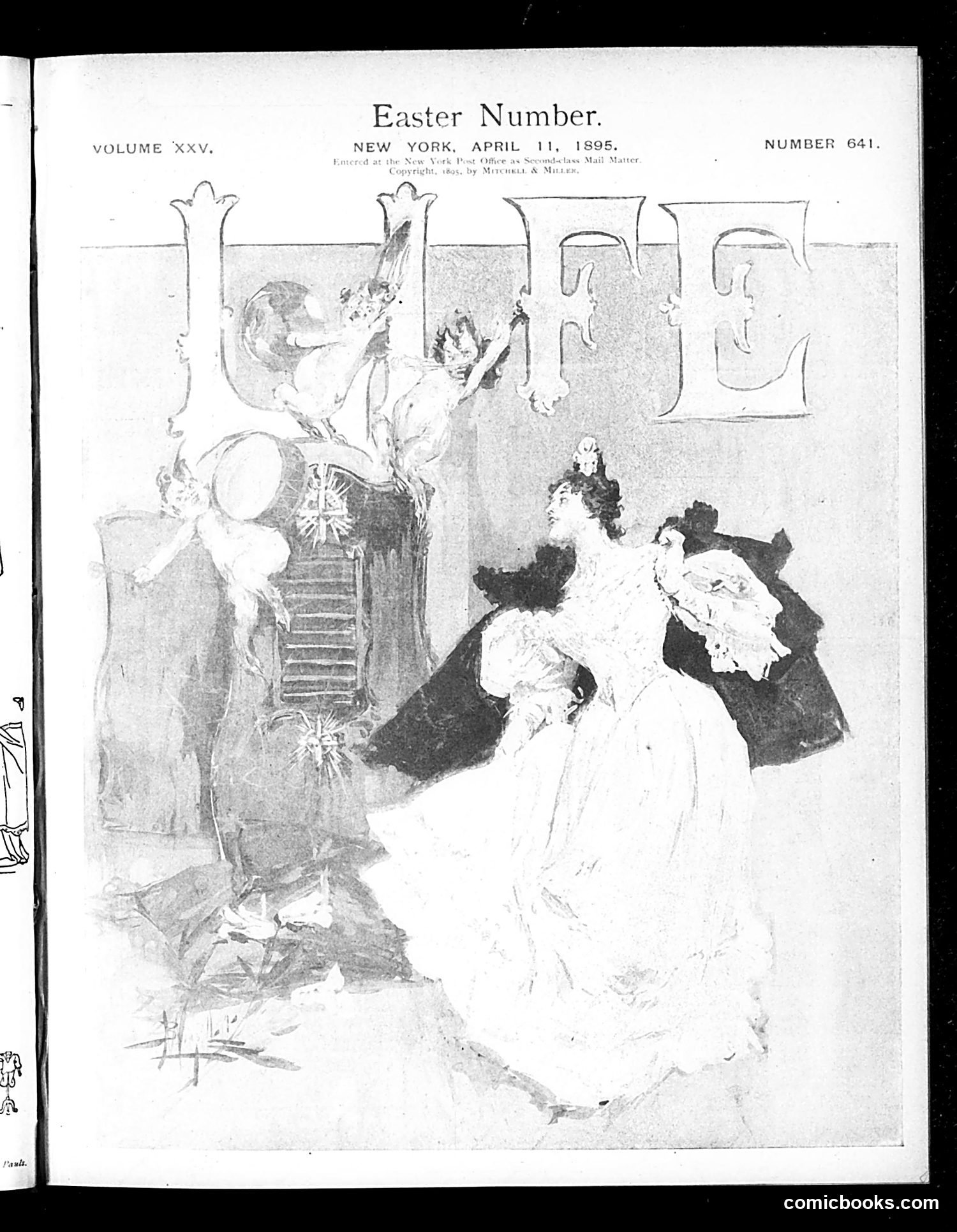
This is the cover of Life magazine's Easter Number (April 11, 1895). The large letters "LIFE" dominate the top half in a decorative Easter style. The illustration below depicts three elegantly dressed women in 1890s fashion examining what appears to be an ornate Easter display or decoration featuring religious imagery (a cross and cherub figures are visible). The women wear white and black clothing typical of the period's high fashion. The satire likely mocks the commercialization of Easter—transforming a religious holiday into a fashionable social event for wealthy women focused on display and material goods rather than spiritual observance. The elaborate, ornamental Easter decorations suggest how the holiday had become increasingly secularized and commodified by the 1890s, emphasizing fashion and ostentation over religious meaning.
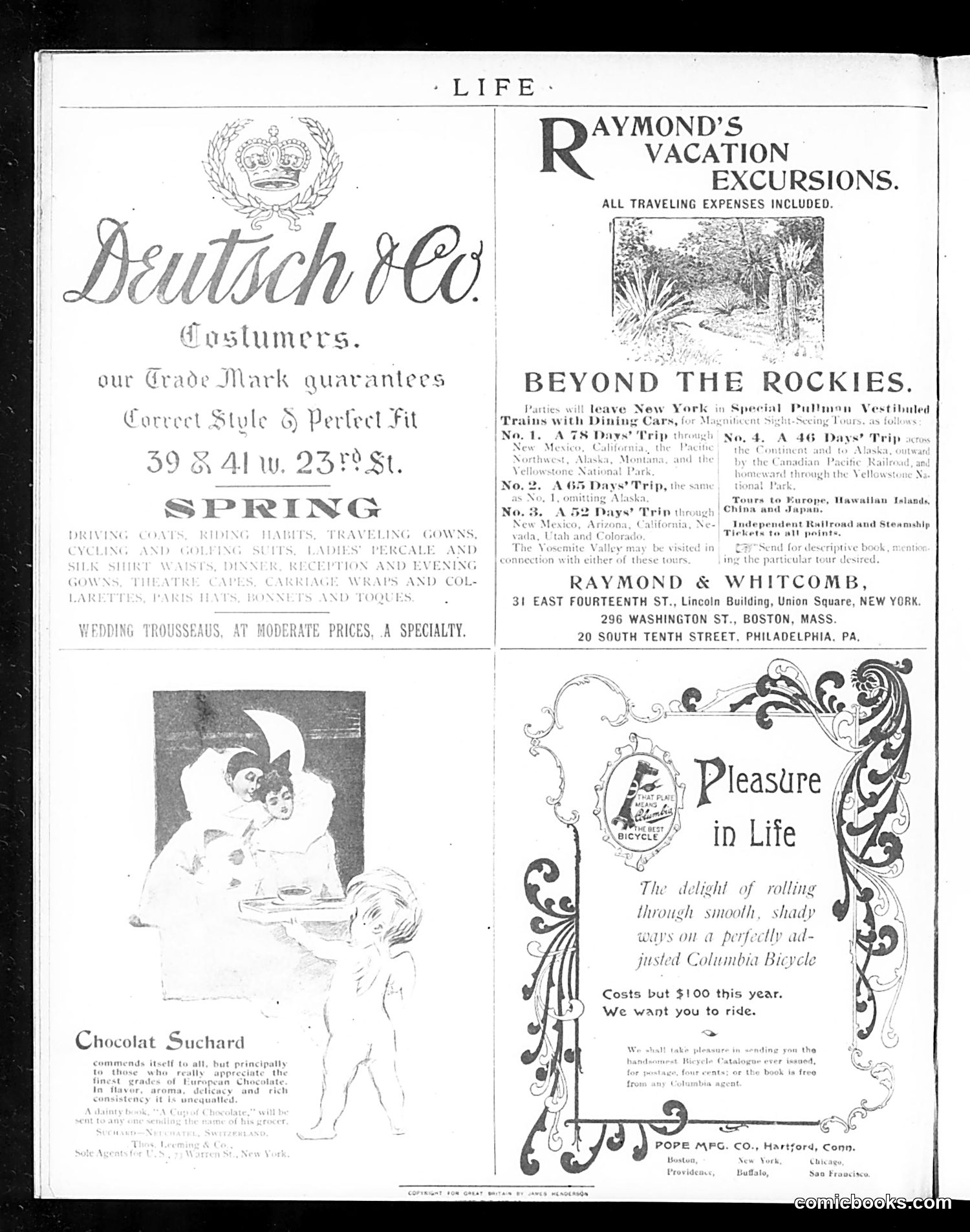
This page is **primarily advertisements** rather than political satire or editorial content. The left side features ads for **Deutsch & Co. Costumers** (clothing store at 39 & 41 W. 23rd St.) and **Chocolate Suchard** (Swiss chocolate brand). The chocolate ad includes an illustration of a woman and cherub, marketing European chocolate quality. The right side contains travel and consumer ads: **Raymond's Vacation Excursions** (multi-day train tours "Beyond the Rockies"), **Raymond & Whitcomb** (travel agency with multiple locations), and a **Columbia Bicycle** advertisement emphasizing leisure pleasure at $100. There is **no apparent political cartoon or satire** on this page. It represents typical turn-of-the-century advertising appealing to affluent readers—luxury goods, European imports, and leisure activities.
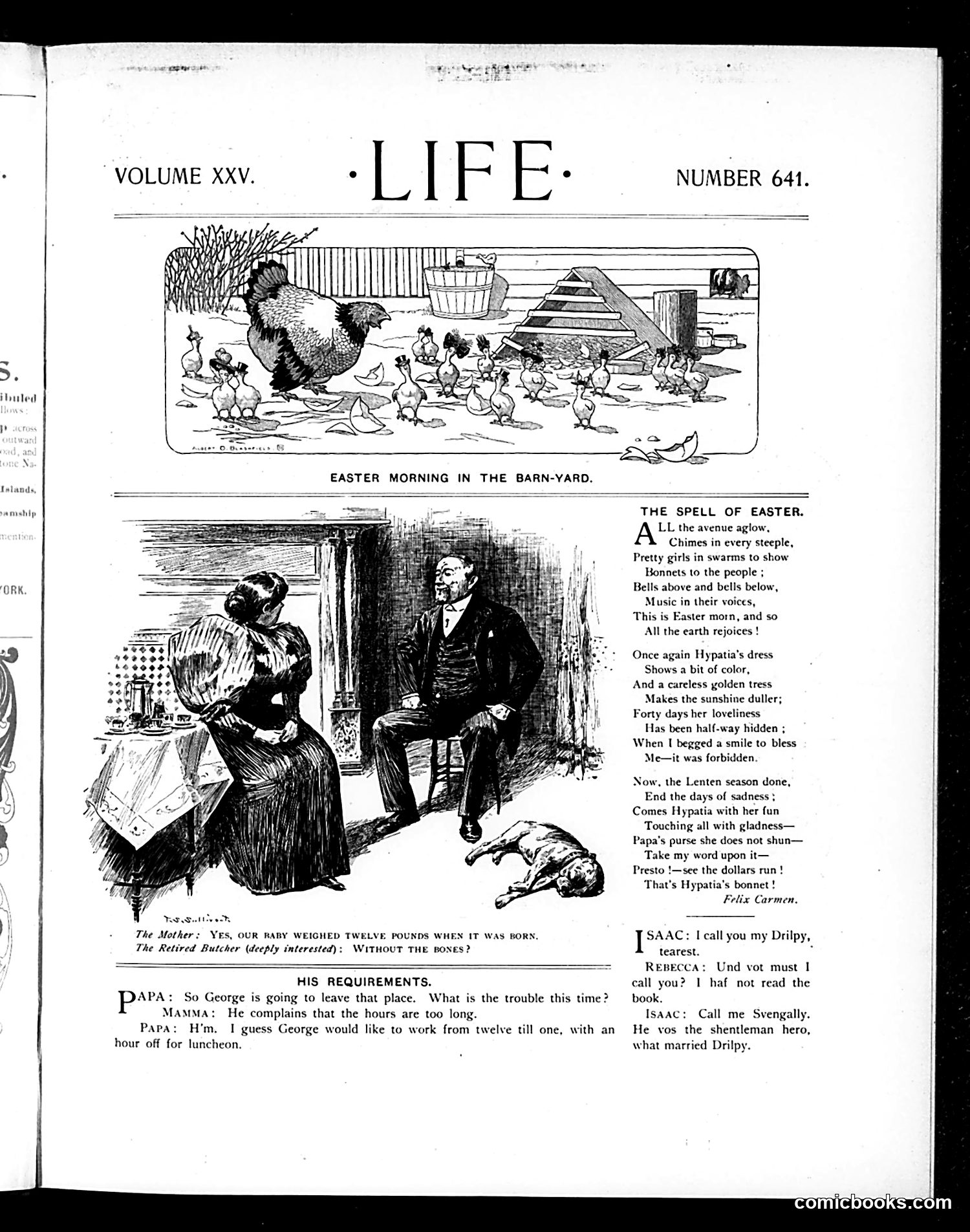
This page contains Easter-themed humor and domestic comedy rather than political satire. **Top illustration** ("Easter Morning in the Barn-Yard"): A rooster and hen oversee chicks, satirizing the pastoral Easter tradition. The caption's dialogue between "The Mother" and "The Retired Butcher" jokes about a baby's birth weight, playing on the surprise of unexpected outcomes. **"The Spell of Easter"** (poem by Felix Carmen): Celebrates Easter's religious and seasonal renewal—church bells, spring colors, and the lifting of Lenten restrictions. **"His Requirements"** (dialogue): Domestic humor about a worker named George wanting shorter hours (twelve till one, with lunch break). Papa and Mamma discuss his employment demands—typical working-class negotiation comedy. No specific political figures or events are referenced.
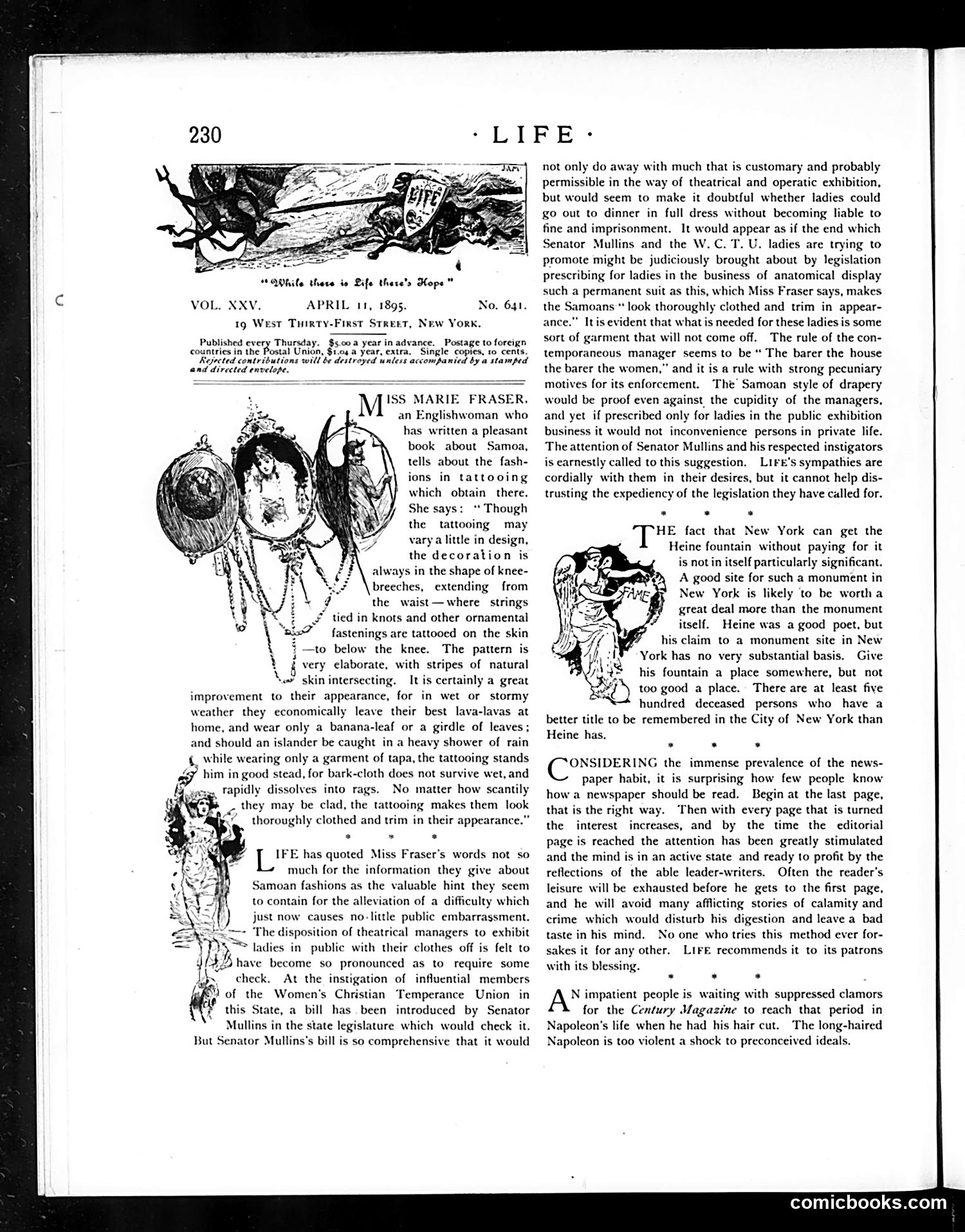
This page discusses Miss Marie Fraser's book about Samoa, focusing on traditional tattooing practices. The left column illustrates Samoan tattoo designs with decorative engravings showing ornamental patterns worn on the body. The main satirical content concerns Senator Mullins and the Women's Christian Temperance Union proposing legislation to restrict women's public dress. The article mocks this effort as overly prudish and impractical—suggesting rules against "full dress" would make dining out impossible and infringe on personal liberty. The satire targets moral reformers' attempts to legislate women's appearance and behavior. The page also includes brief commentary on acquiring the Heine fountain for New York and criticizes newspaper reading habits, recommending readers start from the last page for better editorial quality.
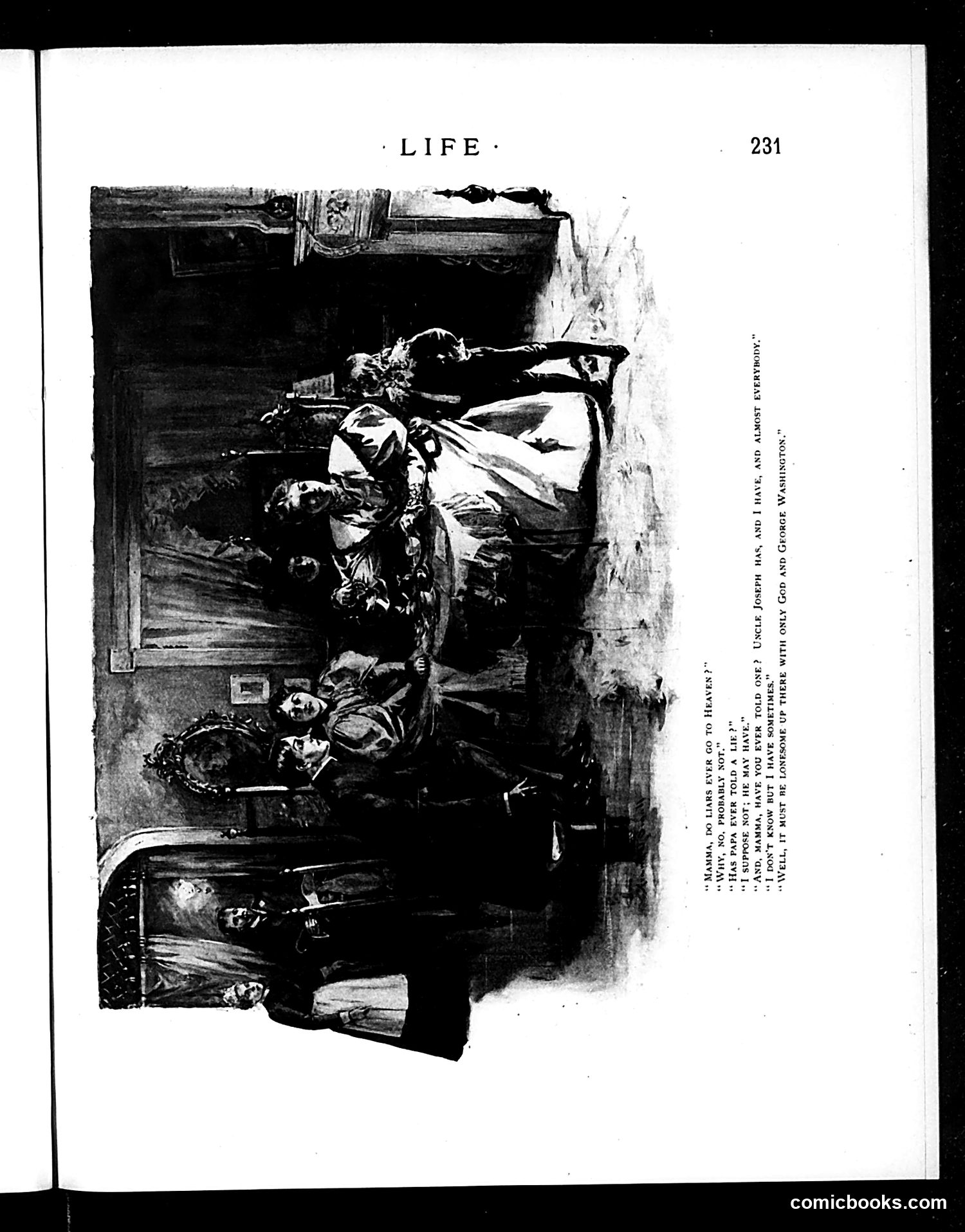
I can see this is page 231 from Life magazine, but the image quality and rotation make it difficult to read the accompanying text clearly. The illustration appears to be a dark, dramatic scene rendered in black and white, possibly depicting a historical or allegorical moment with multiple figures in what looks like an interior setting. However, without being able to reliably read the caption or article text, I cannot confidently identify the specific figures, historical event, or satirical point being made. To provide accurate analysis rather than speculation, I would need either a clearer image or legible OCR text that specifically identifies the subject matter and context of this particular cartoon or illustration.
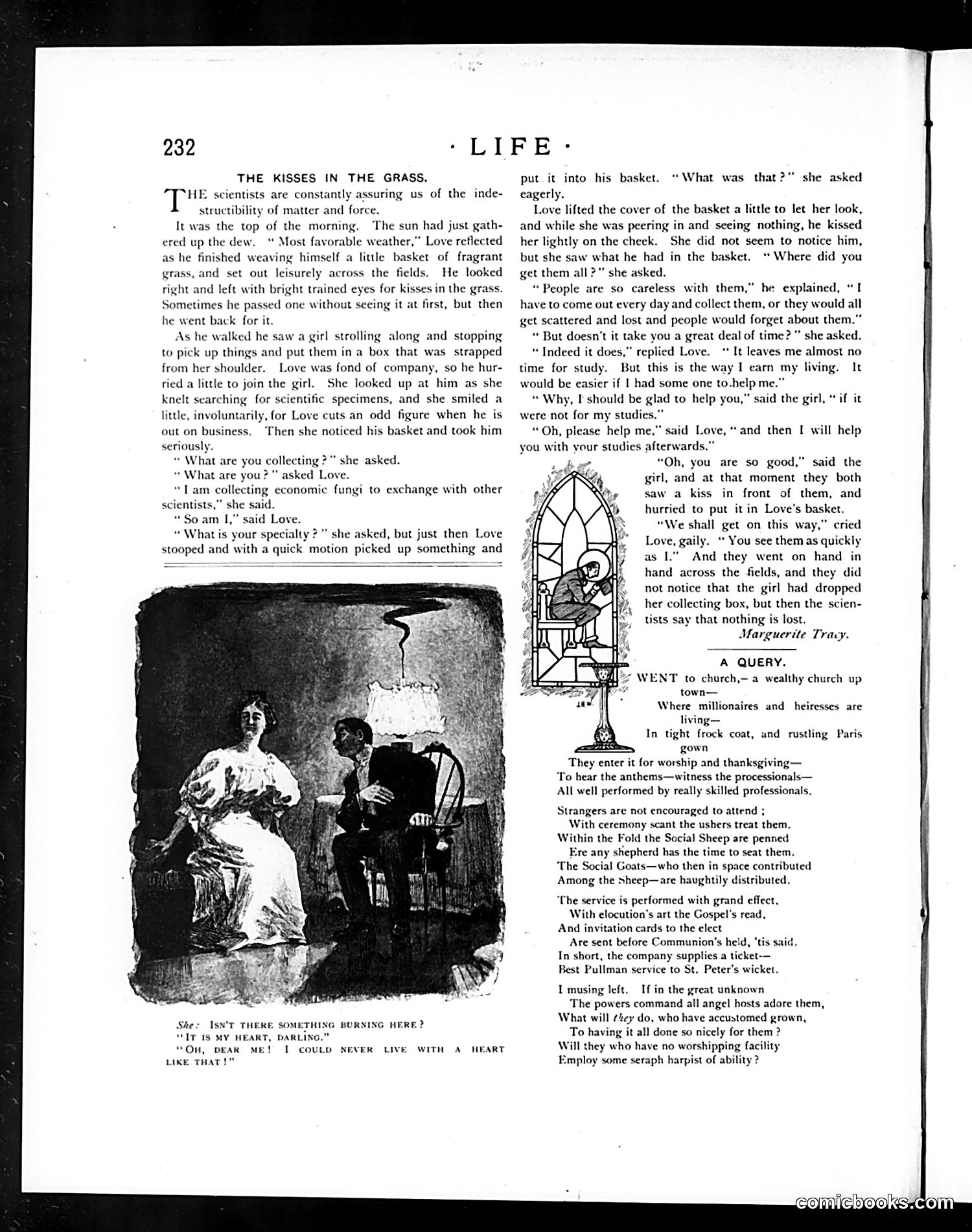
This page contains two distinct pieces: **"The Kisses in the Grass"** (main story with illustration): A romantic narrative about a young man named Love collecting scientific specimens who encounters a girl. The story plays on the double meaning of his name—their interaction becomes flirtatious despite his ostensible scientific purpose. The illustration shows a couple in an intimate moment. **"A Query"** (poem on right): A satirical poem critiquing wealthy churchgoers. It mocks the ostentatious nature of wealthy church attendance ("millionaires and heiresses"), questions whether such performative worship serves genuine spiritual purpose, and suggests the "Social Sharp" and "Social Goats" (upper-class attendees) may lack authentic faith. The satire targets class-based religiosity rather than faith itself. Neither piece references specific political events or figures.
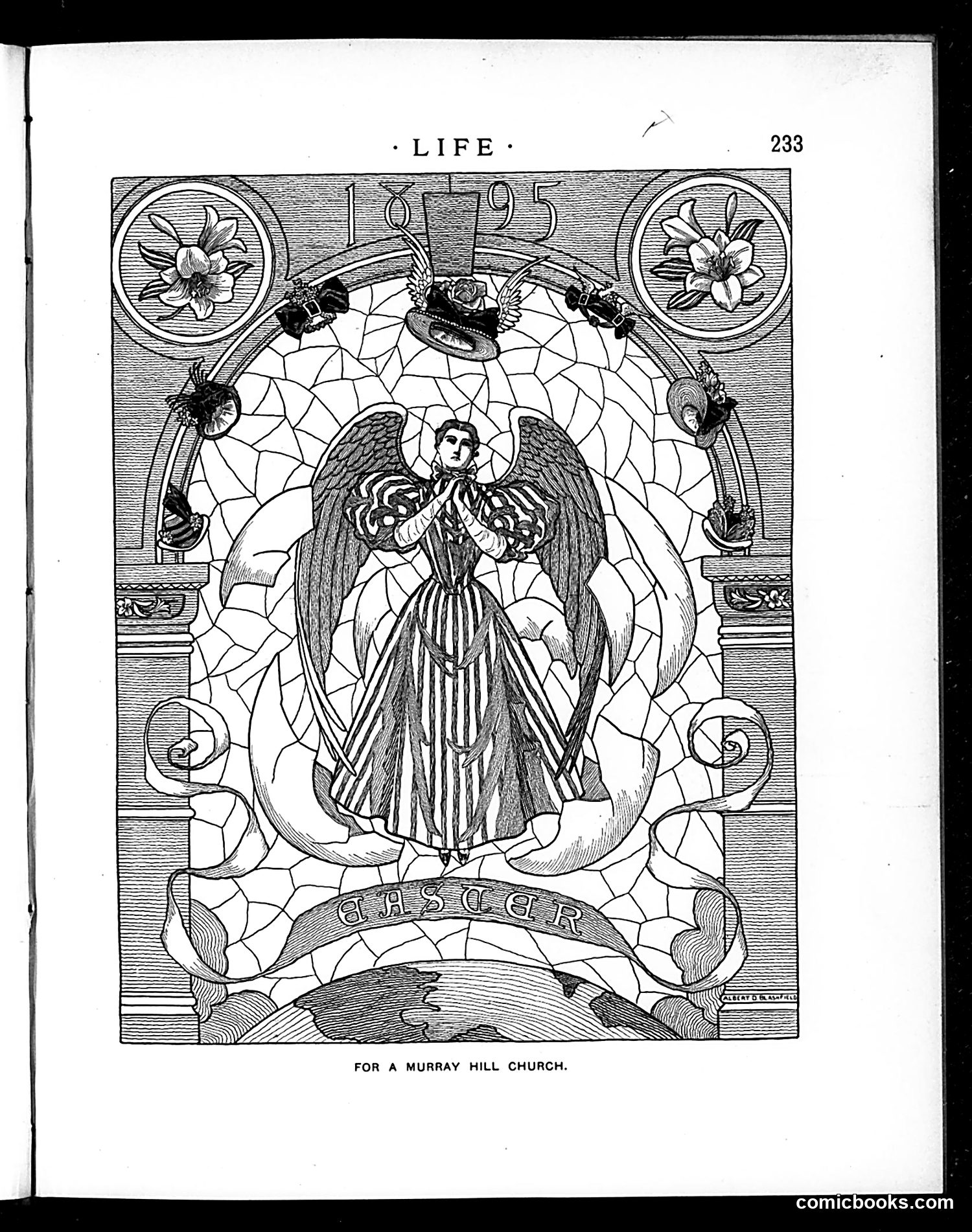
This page presents a stained-glass window design labeled "FOR A MURRAY HILL CHURCH." The image depicts an angel figure with wings, centered within ornate ecclesiastical framing. The design includes decorative floral medallions in the corners and classical architectural elements typical of church window commissions. This appears to be a architectural or design proposal rather than satirical content. The page number (233) and "LIFE" header suggest this comes from the magazine's design or arts section. Without additional context or visible satirical elements, this seems to document an actual church window commission for a Murray Hill (Manhattan) congregation, presented as an example of contemporary ecclesiastical art and craftsmanship. The ornate style reflects early-twentieth-century aesthetic preferences in religious architecture.
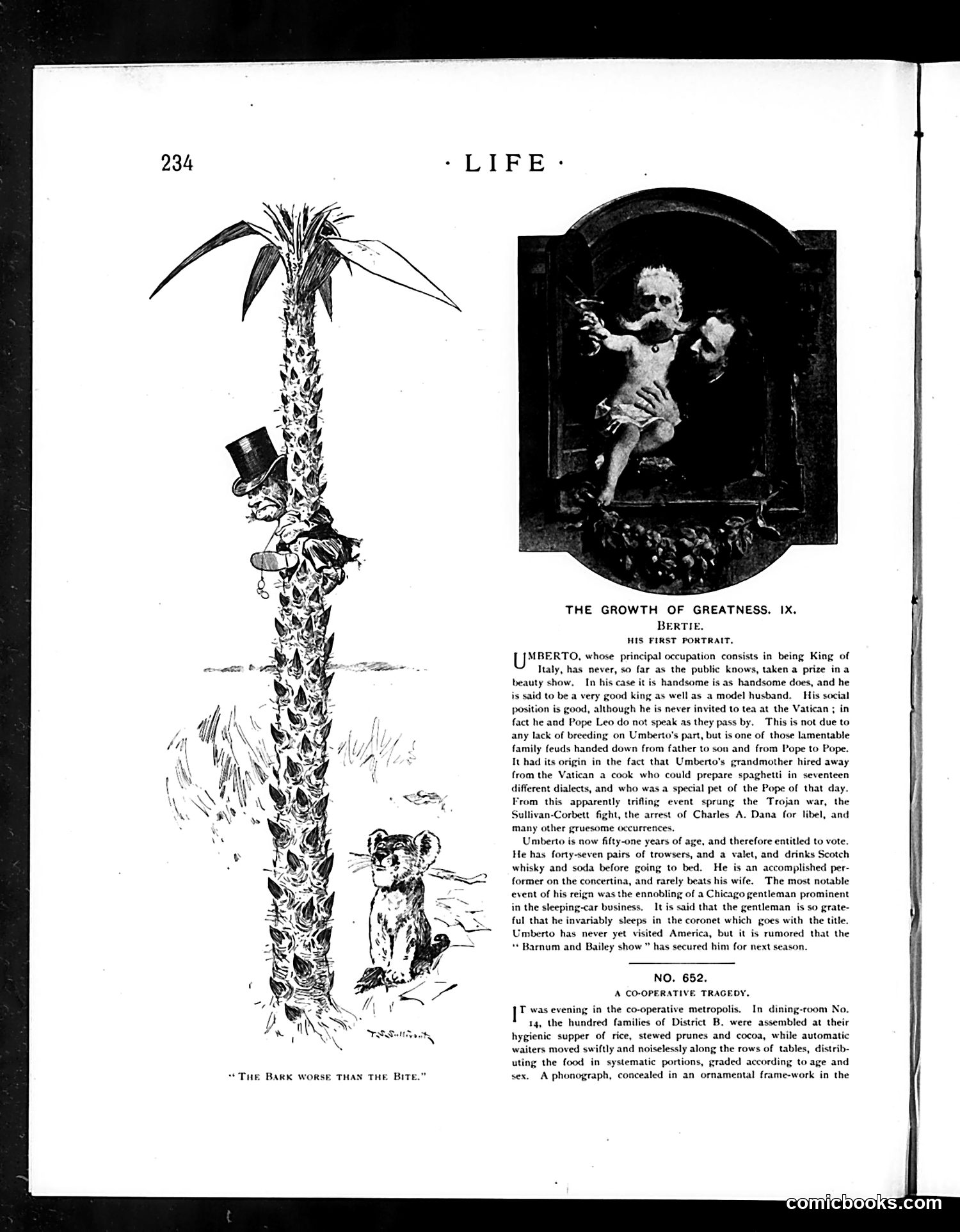
**Left cartoon:** "The Bark Worse Than the Bite" depicts a palm tree with a small animal (appears to be a monkey or similar creature) at its base. The satirical caption suggests something that seems threatening is actually harmless—a common idiom. The specific target is unclear without additional context. **Right section:** "The Growth of Greatness, IX: Bertie" features a portrait and biographical text about Umberto, identified as King of Italy. The piece satirizes his modest accomplishments and position, noting his lack of Vatican invitations and questionable family lineage (his grandmother was reportedly a Vatican cook). This appears to mock European royalty and their pretensions to importance, a typical Life magazine satirical approach of the era.
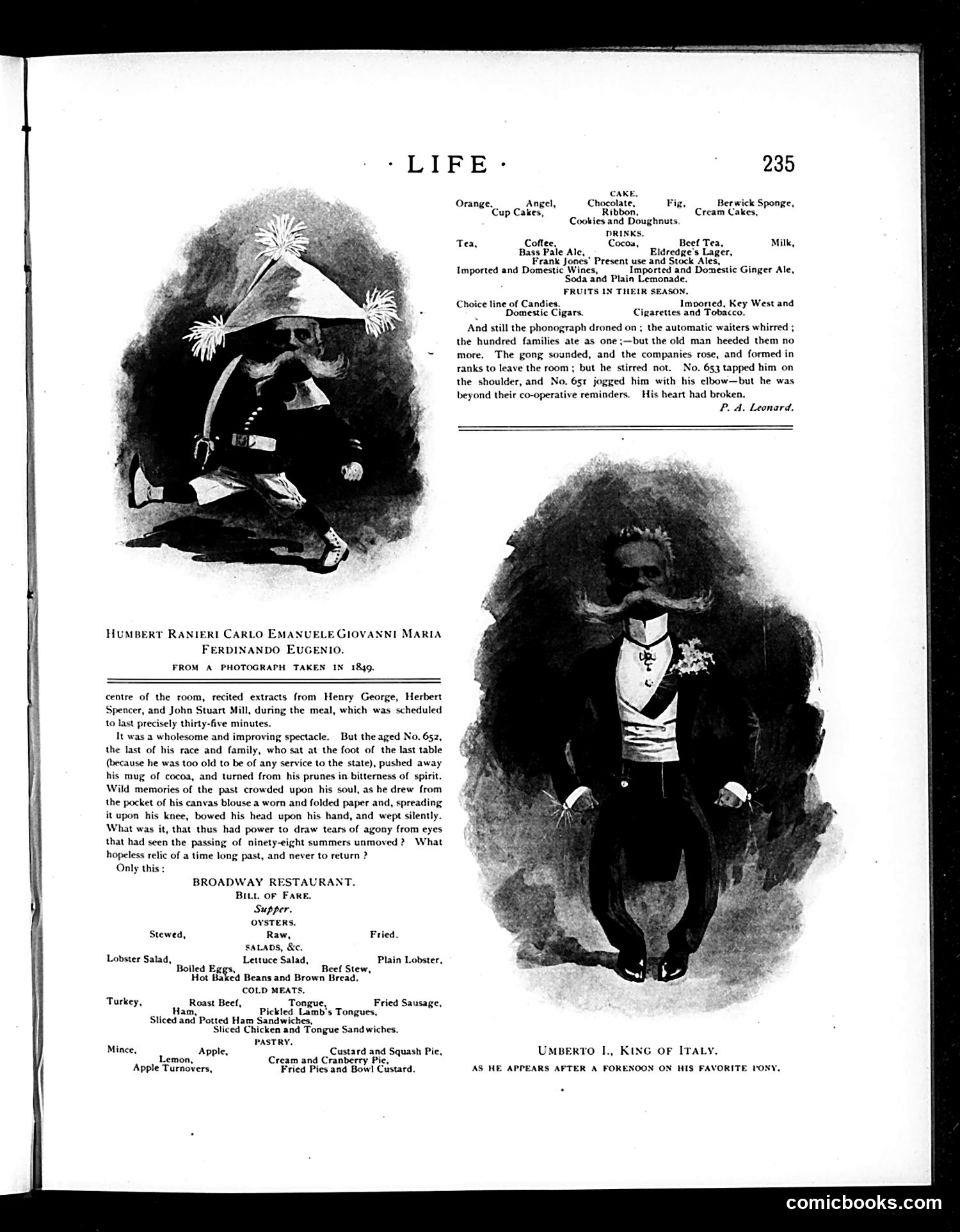
This page from *Life* magazine features two satirical illustrations of elderly European nobility from 1899. The upper image shows "Humbert Ranieri Carlo Emanuele Giovanni Maria Ferdinando Eugenio"—King Humbert I of Italy—depicted as a caricatured, elderly gentleman with exaggerated facial features. The lower illustration shows "Umberto I, King of Italy, as he appears after a forenoon on his favorite pony," presenting him in an undignified, disheveled state following equestrian activity. The satirical point targets the aging monarch's physical decline and unfitness—mocking his age (nearly 98 summers mentioned in the text) and inability to maintain dignity or function effectively. The humor derives from contrasting royal pretense with physical reality and decrepitude, a common *Life* magazine practice of ridiculing elderly or ineffectual political figures.
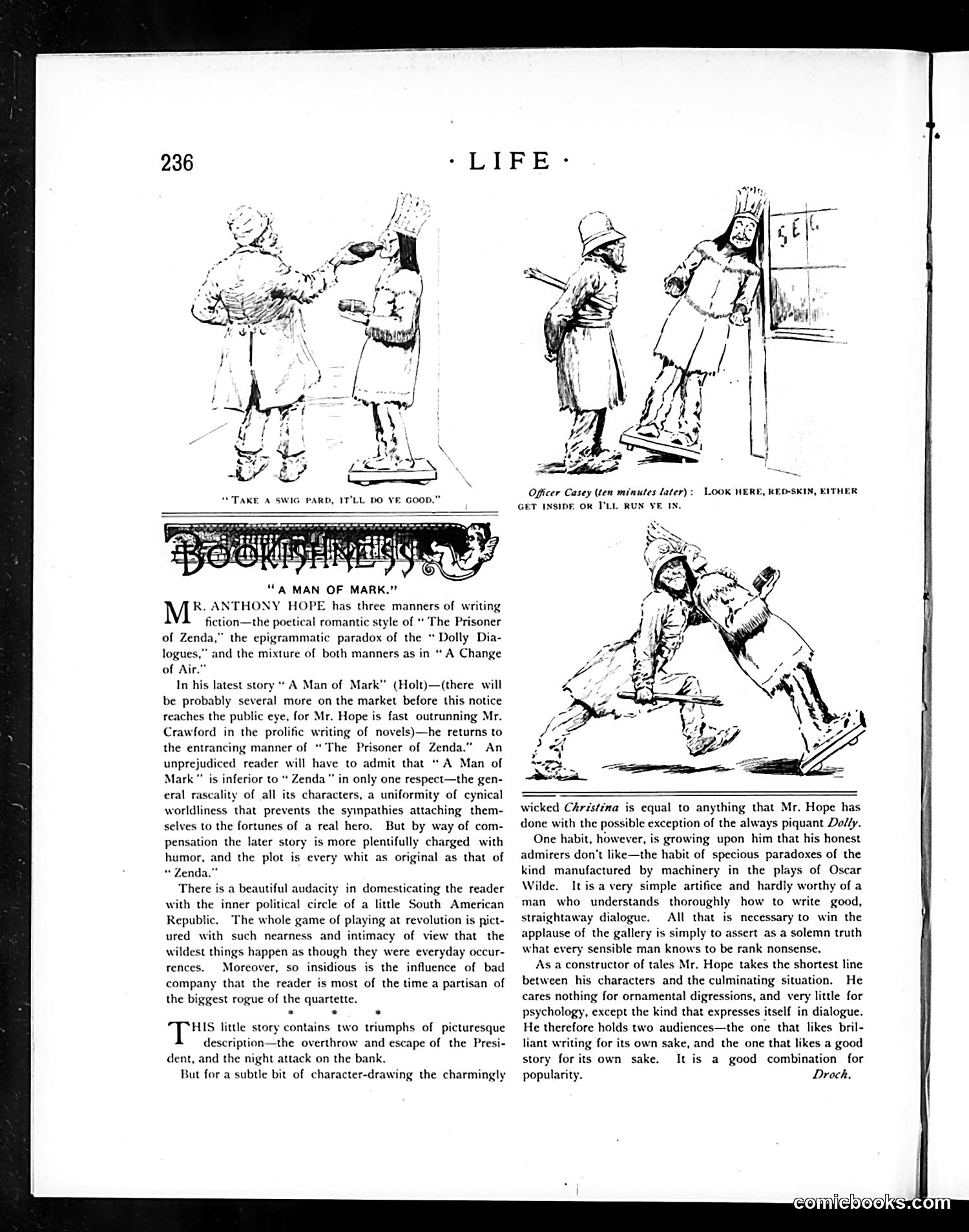
This page reviews Anthony Hope's story "A Man of Mark." The top cartoons illustrate scenes from the narrative: one shows a soldier confronting someone about parting, another depicts an officer warning someone to "look here, red-skin, either get inside or I'll run ye in." The review praises Hope's three writing styles—romantic, epigrammatic, and mixed—while noting his characters lack depth, displaying "cynical worldliness" rather than genuine sympathy. The critic acknowledges Hope excels at plot construction and dialogue but criticizes his reliance on "machinery" similar to Oscar Wilde's theatrical techniques. The reviewer concludes the story combines "brilliant writing" with popular appeal, though it prioritizes entertainment over psychological complexity. The author is identified as "Droch."
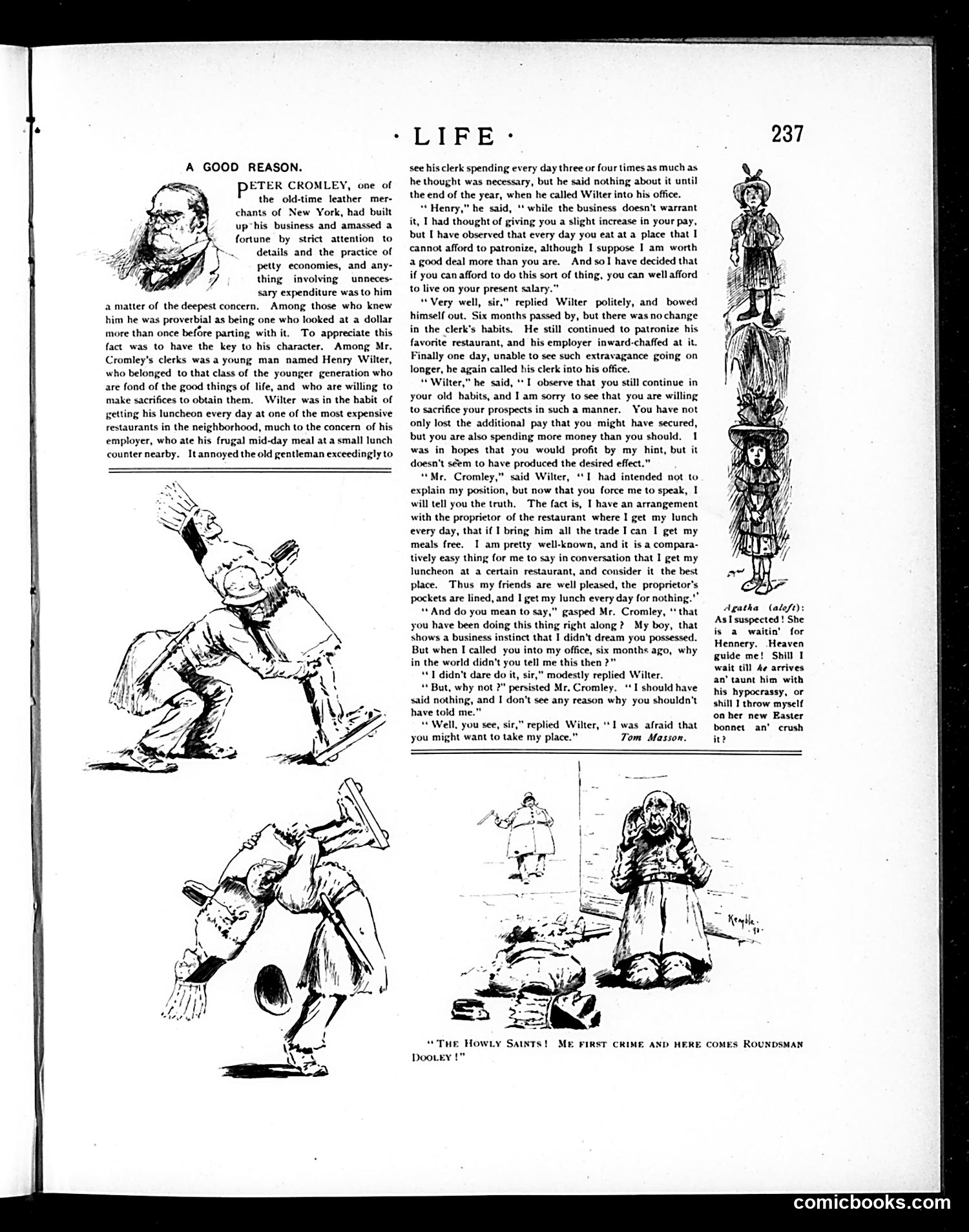
This page satirizes workplace dynamics and class economics in early 20th-century America. The story concerns **Peter Cromley**, a wealthy New York merchant who discovers his office clerk **Wilter** has been eating free lunches daily at a restaurant in exchange for bringing the proprietor business. When Cromley confronts him about not revealing this arrangement six months prior, Wilter explains he made a deliberate choice: accepting modest pay while securing free meals represented better economics than earning slightly more while paying for lunch. The satire mocks both the clerk's calculating pragmatism and Cromley's surprise that an employee would optimize personal finances over loyalty. The accompanying illustrations depict their confrontation. The final cartoon references a separate story about "Roundsman Dooley."
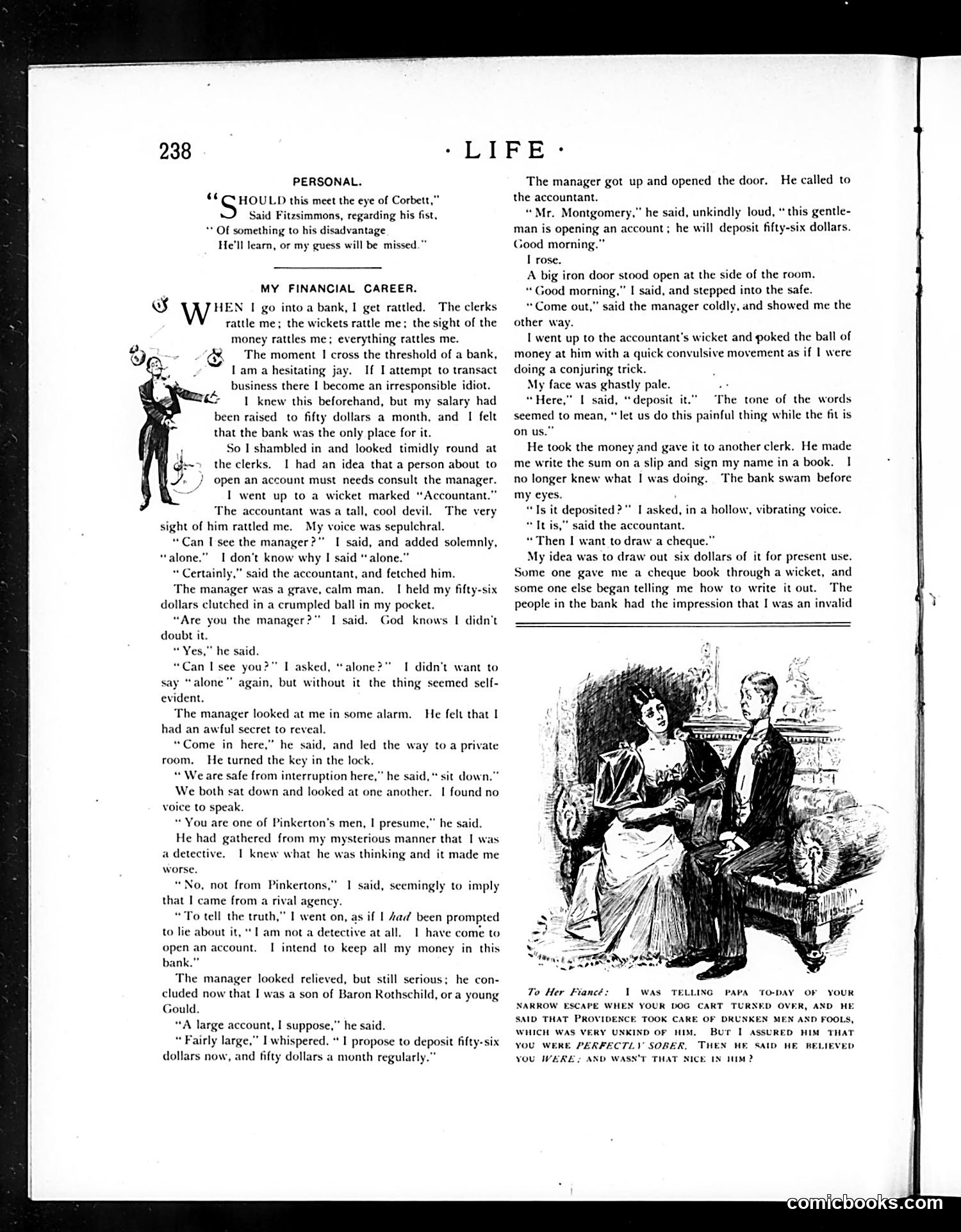
This page contains two distinct pieces from *Life* magazine: **1. The "Personal" section** (top) references a boxing rivalry between **James J. Corbett** and **Bob Fitzsimmons**, prominent prizefighters of the 1890s. The quip about Fitzsimmons' fist suggests confidence in an upcoming match. **2. "My Financial Career"** (main text and illustration) is a humorous autobiographical essay about the author's anxiety opening a bank account with his modest $56 salary increase. The comedy hinges on his extreme nervousness being misinterpreted by the bank manager as suspicious behavior—first as a Pinkerton detective, then as a wealthy magnate like Baron Rothschild or Jay Gould. The illustration shows him describing his account to bank staff. The satire mocks both the narrator's social insecurity and banks' tendency to judge customers by perceived wealth. For modern readers, the key is understanding that $50-56/month represented ordinary working-class income, making his anxiety about "large deposits" absurdly disproportionate to the actual amounts involved.
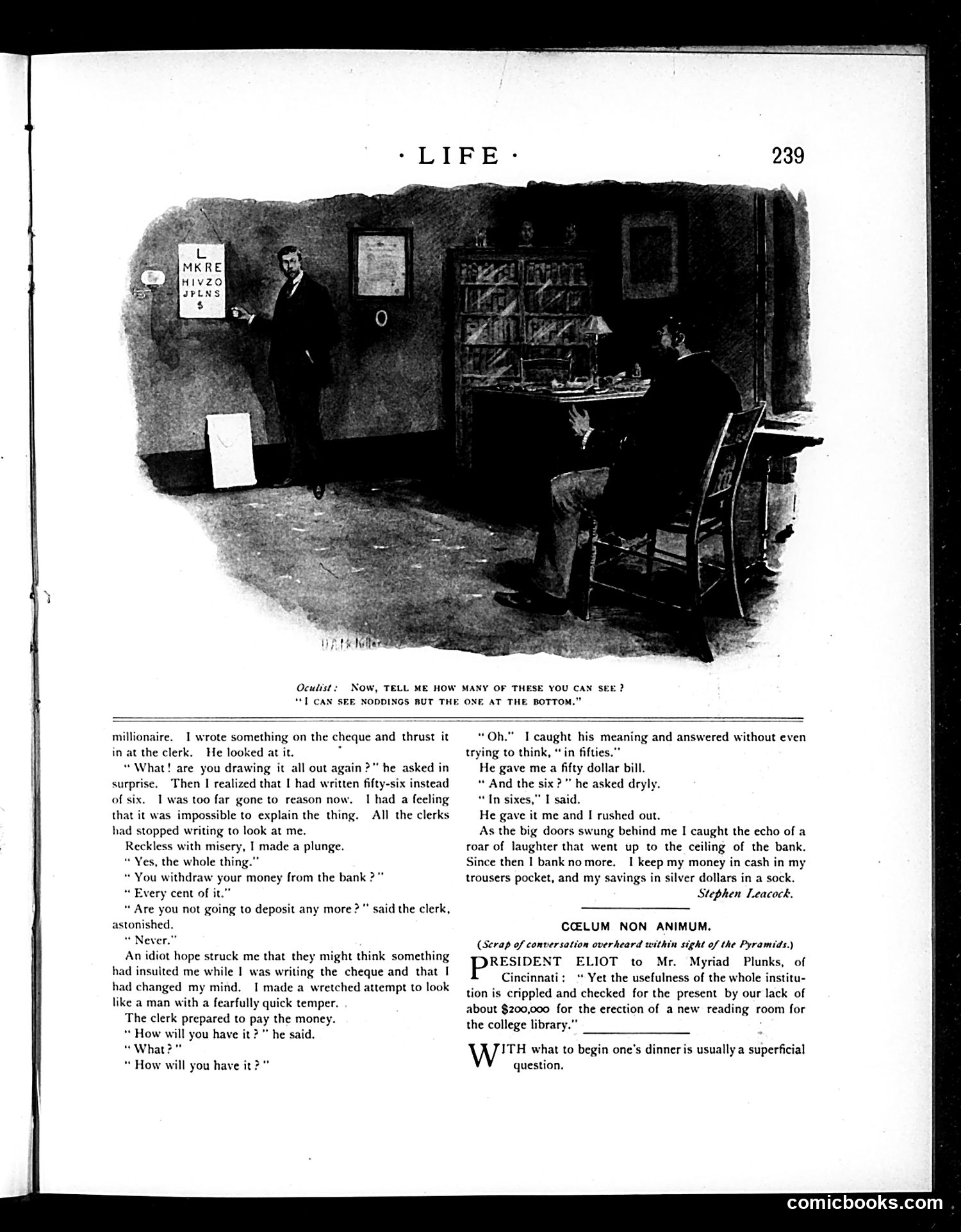
The page contains two separate humorous pieces: **Top Cartoon:** An oculist (eye doctor) tests a patient's vision using an eye chart. The joke is that the patient can only see "the one at the bottom"—implying he's so nearsighted that despite the chart displaying multiple lines, he can only discern the largest letter. This is a straightforward visual gag about poor eyesight. **Text Story by Stephen Leacock:** A man accidentally writes a check for $56 instead of $6 to a millionaire. Too embarrassed to correct it, he withdraws the full amount. When the clerk asks "How will you have it?" (meaning what denominations), the panicked narrator absurdly responds "in fifties," receiving one $50 bill. When asked about "the six," he says "in sixes"—nonsensical answers that humiliate him further. The bank staff laughs at his exit. Leacock satirizes social anxiety and the paralysis of embarrassment that prevents rational action. **Lower Item:** A brief note about President Eliot seeking $200,000 for a college library reading room—a fundraising appeal.
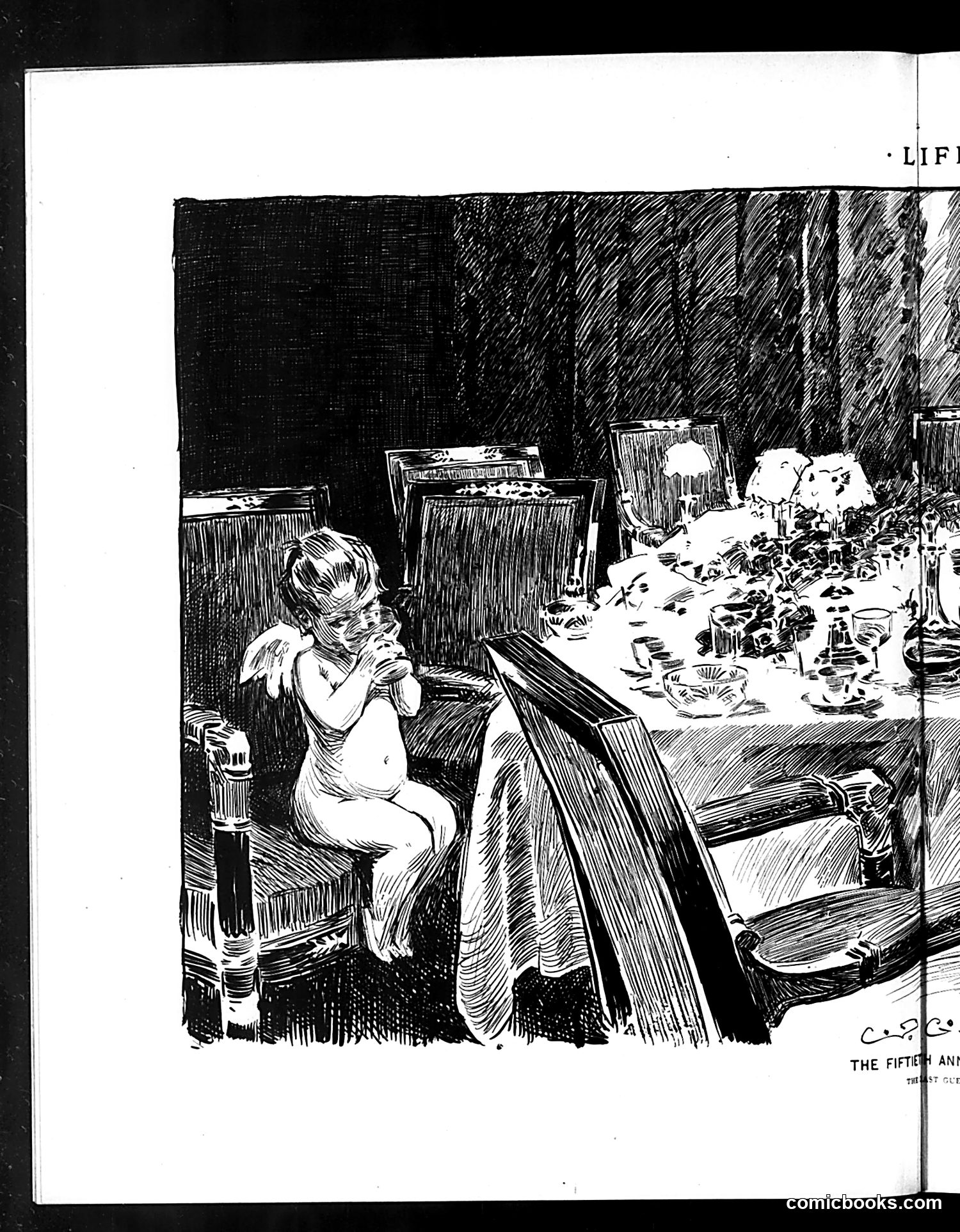
This appears to be a satirical illustration from *Life* magazine depicting a cherub or cupid-like figure sitting alone at the edge of an elaborate dinner party or social gathering. The figure is shown in a contemplative or melancholic pose, separated from the festivities visible in the background—where other figures dine at a laden table. The caption references "The Fiftieth Anniversary" (partially legible), suggesting this may commemorate a specific social or institutional milestone. The satire likely critiques exclusion or marginalization during what should be a celebratory occasion, or comments on feelings of loneliness amid festivity. Without clearer OCR text, the exact target and meaning remain somewhat unclear, though the visual contrast between isolation and celebration is the apparent point.
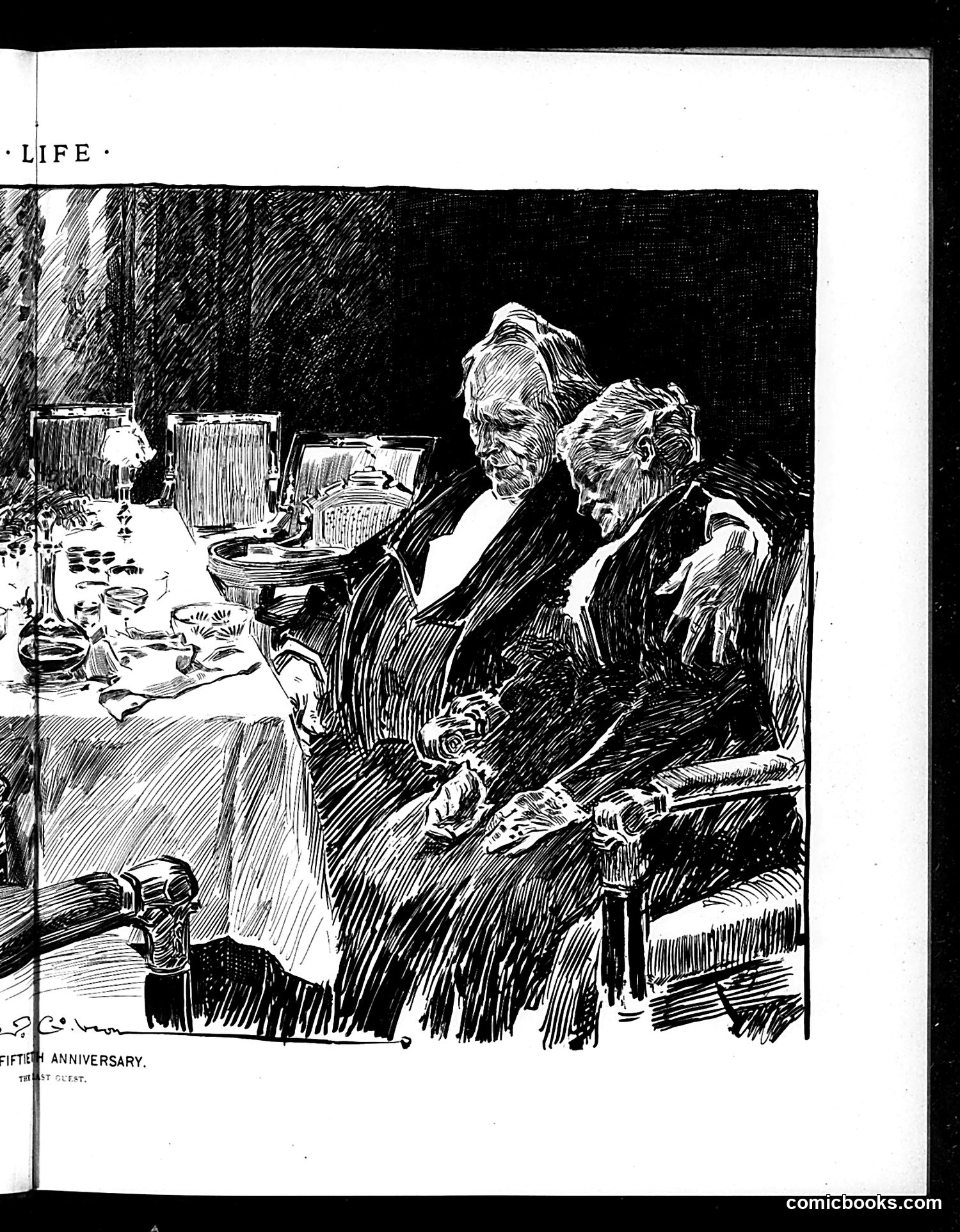
This page from *Life* magazine shows a black and white sketch titled "FIFTIETH ANNIVERSARY" (likely referencing Life's 50th anniversary). The image depicts three elderly men in formal Victorian-era clothing seated at a dining table with various dishes and vessels. The caption reads "THE GUEST" (partially visible). Based on the formal dress, elderly appearance, and "fiftieth anniversary" context, this appears to be satirical commentary on aging or longevity—possibly celebrating long-lived figures or poking fun at elderly statesmen or business leaders of the period. Without clearer identification of the specific individuals caricatured, I cannot definitively state who these figures represent. The satirical intent seems connected to aging, tradition, or institutional longevity, but the exact political or social reference remains unclear from the image alone.
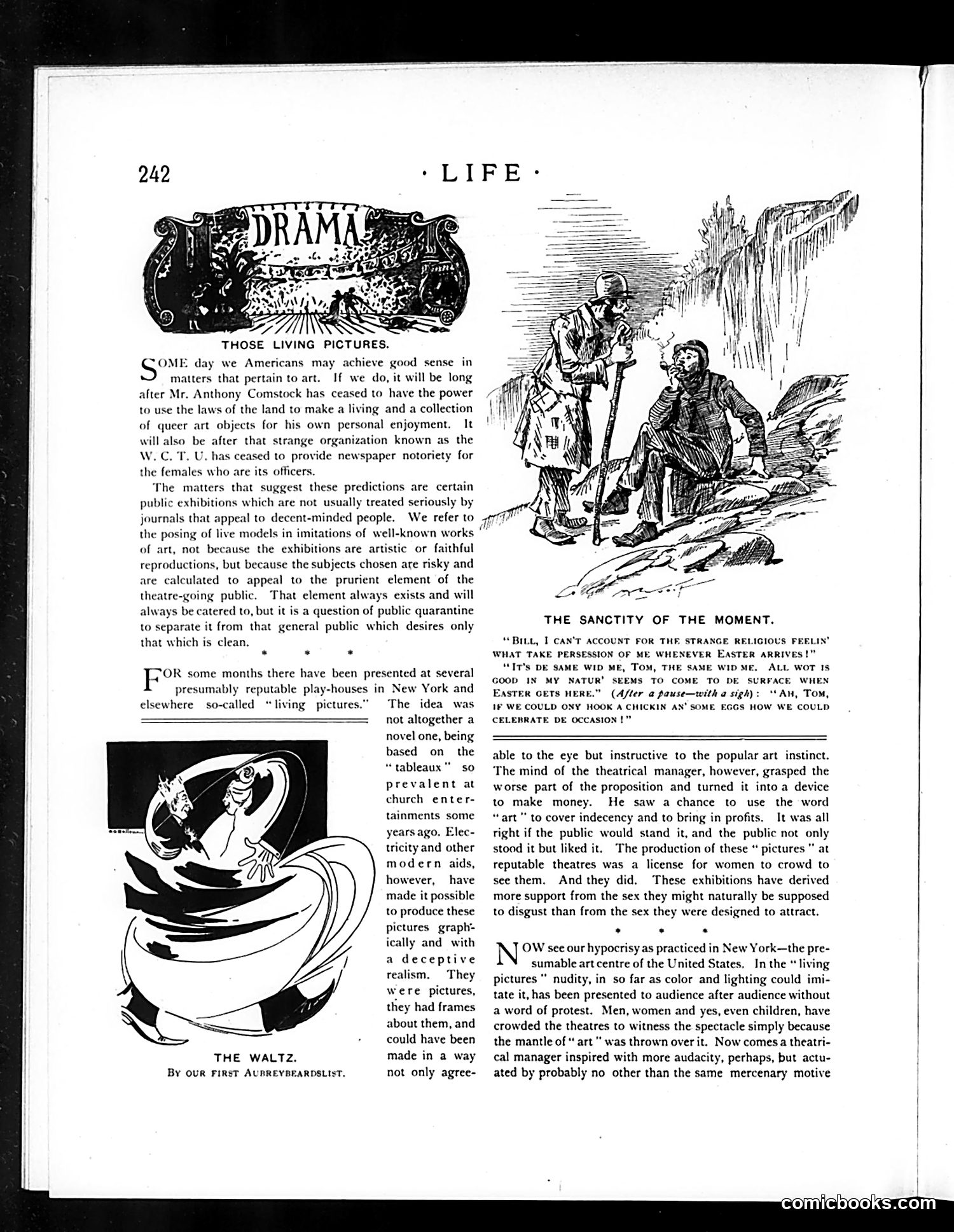
This article criticizes the hypocrisy surrounding "living pictures"—theatrical exhibitions featuring nude or scantily-clad models posed as artworks in New York theaters. **Key targets:** - **Anthony Comstock**: the real-life anti-obscenity crusader who policed morality through law - The **W.C.T.U.** (Women's Christian Temperance Union): criticized for using these shows for publicity while claiming moral authority - **Theater managers**: exploiting "art" as cover for profiteering from indecency **The satire's point:** New Yorkers gladly attended these exhibitions when labeled "art," yet would condemn actual indecency. The author argues this reveals American moral bankruptcy—we accept nudity if given artistic pretense, while sanctimonious figures like Comstock use obscenity laws selectively for personal gain and notoriety. **The cartoon "The Waltz"** (lower left) appears to be unrelated visual satire. The piece exposes performative moralism and class hypocrisy in Gilded Age America.
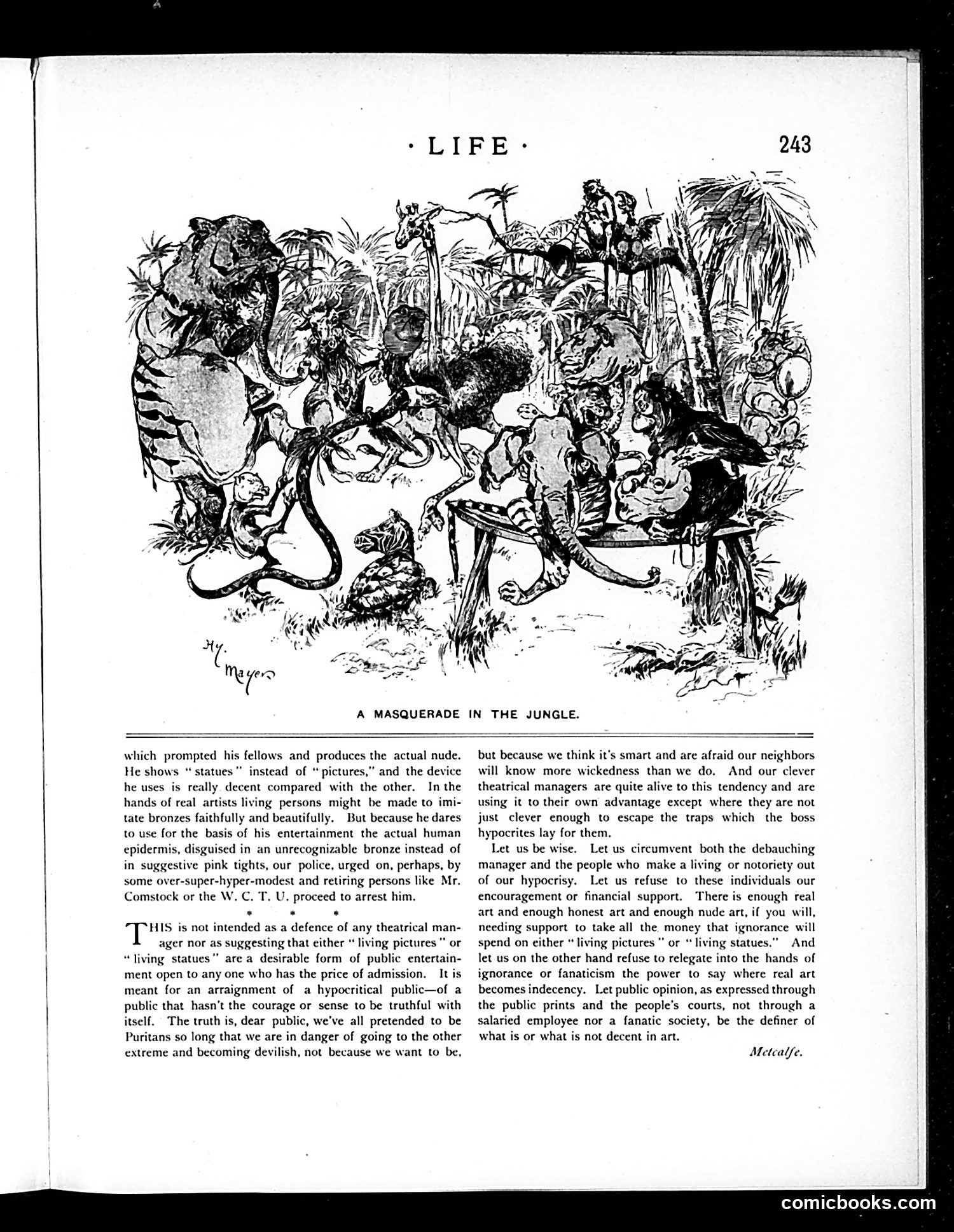
This satirical cartoon and accompanying essay critique American hypocrisy regarding nudity in theater. The illustration shows performers in a jungle setting, likely referencing "living picture" shows—theatrical performances where nude or nearly-nude actors posed as statues or artistic tableaux. The text, signed by Metcalfe, attacks the moral inconsistency of authorities (specifically naming Anthony Comstock, the famous censorship crusader, and the Women's Christian Temperance Union) who arrest theatrical managers for displaying the human body in bronze paint while secretly desiring the same spectacles. The essay argues that genuine art and honest nudity deserve support more than these exploitative "living statue" performances, and that public *opinion*—not zealous censors or moralists—should determine what constitutes indecency. The cartoon's chaotic jungle scene appears to visualize this moral "masquerade": society's pretense of purity while actually craving the forbidden.
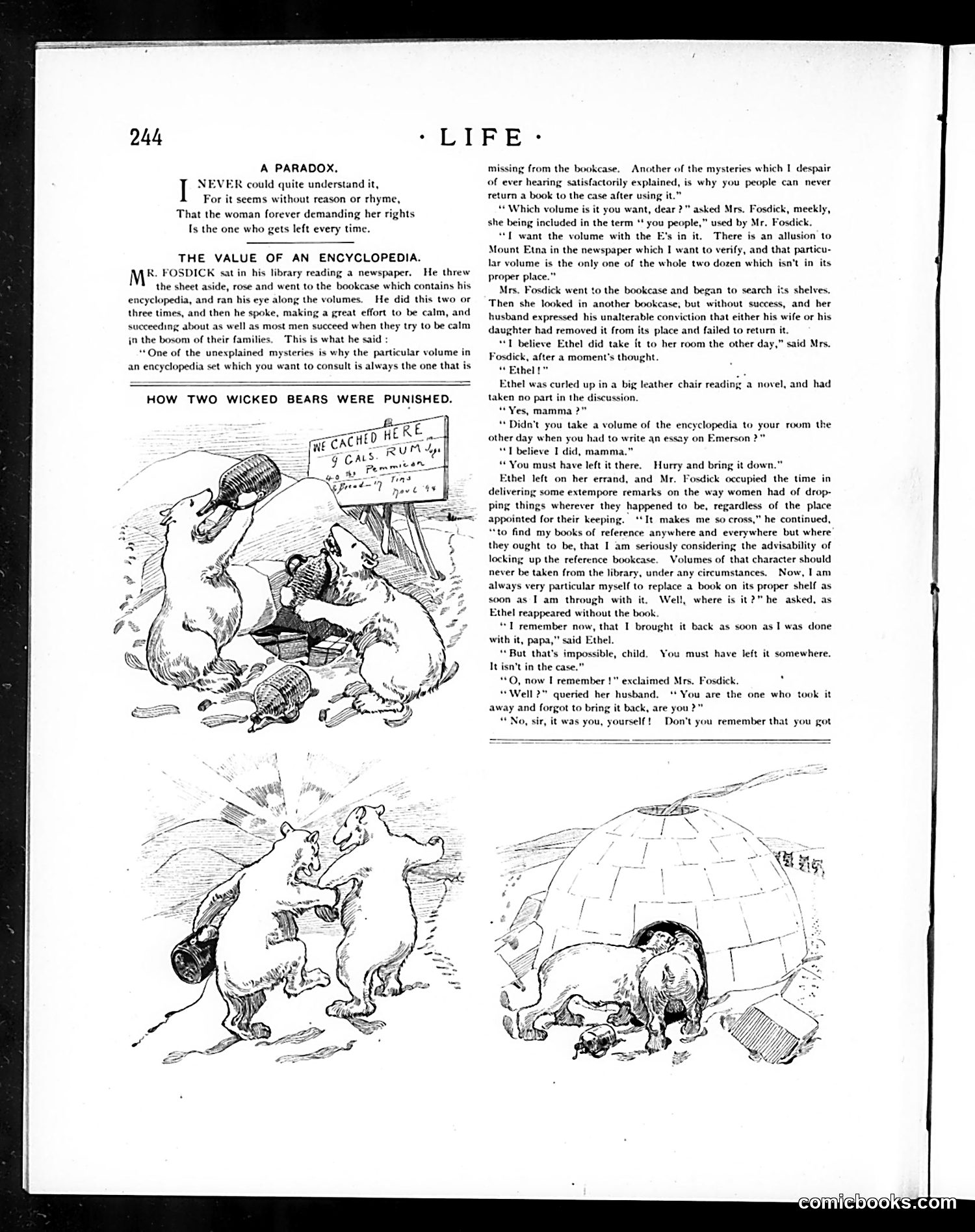
This page contains three distinct pieces of satirical content: **"A Paradox"** — A brief poem mocking the irony that women who most vocally demand equal rights are often abandoned or left behind by men—likely commentary on early women's suffrage debates. **"The Value of an Encyclopedia"** — A domestic humor sketch about Mr. Fosdick searching his home library for a missing encyclopedia volume. The joke reveals hypocrisy: he angrily blames his wife and daughter for never returning books to their proper places, but ultimately discovers *he* was the one who removed it and forgot to return it. This satirizes men's tendency to criticize women's organizational habits while being equally guilty themselves. **"How Two Wicked Bears Were Punished"** — Three illustrations showing bears being disciplined (one trapped under furniture, others in various predicaments). The caption and sketches suggest a children's moral tale about misbehaving animals facing consequences, though the specific narrative isn't fully explained on this page. All pieces use humor to critique social pretension and hypocrisy, particularly around gender roles and domestic life.
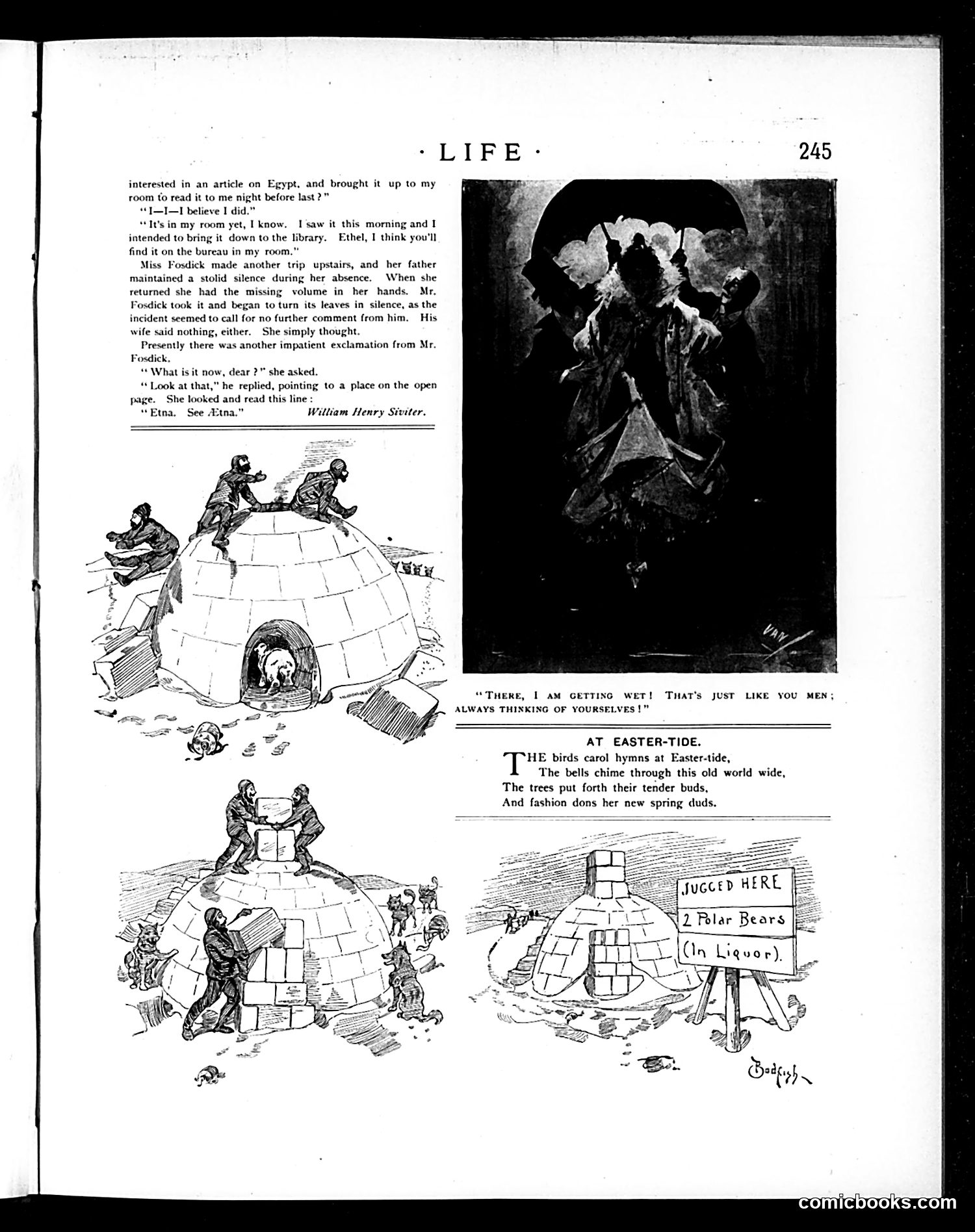
This page contains a domestic humor piece about Mr. Fosdick discovering his daughter Ethel's careless annotation in a library book about Egypt—she's written "Etna, See Aetna" (likely a joke referencing the insurance company). The satire targets the thoughtlessness of returning marked-up books to libraries, implying casual disregard for shared public property. Below, three whimsical illustrations show people building igloos, captioned "Jugged Here: 2 Polar Bears (In Liquor)." This appears to be visual wordplay—"jugged" meaning imprisoned or caged, with the secondary meaning of alcohol consumption. The "At Easter-Tide" poem celebrates spring renewal. The cartoons and text together represent typical early 20th-century *Life* magazine humor: domestic comedy, puns, and seasonal observations targeting middle-class anxieties about propriety and social responsibility.
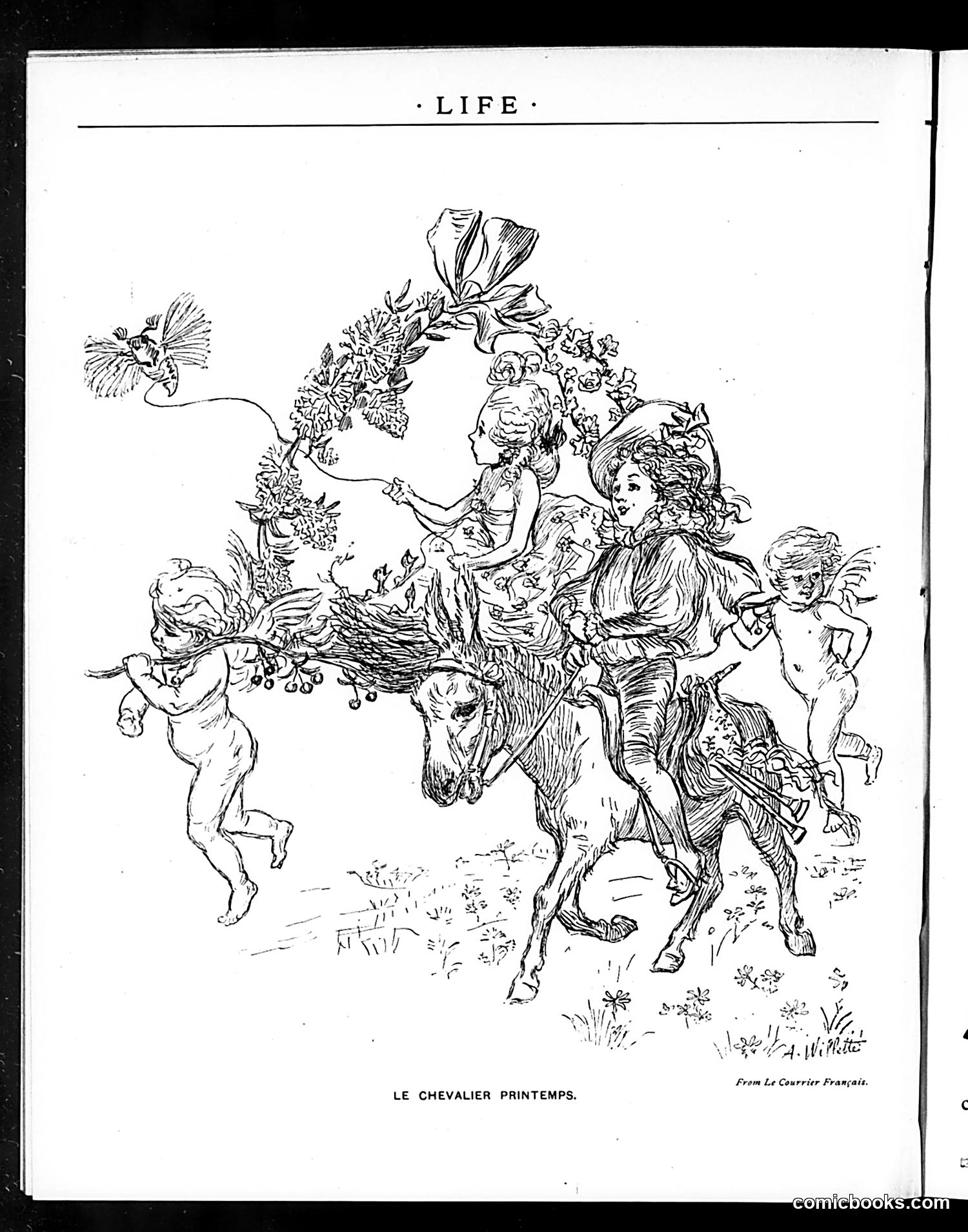
This illustration depicts "The Knight of Spring" (Le Chevalier Printemps), a personification of springtime presented as a romantic, idealized figure. A well-dressed woman rides a decorated horse adorned with flowers and ribbons, accompanied by cherubs and attendants carrying floral garlands. A bird flies above, and flowers bloom around them. The satire likely mocks the sentimental, overly romanticized depictions of spring common in 19th-century French literature and art. The elaborate, fanciful presentation—with its abundance of cherubs, flowers, and courtly pageantry—appears designed to gently ridicule the flowery sentimentality ("Le Courrier Français" is credited as the source) that characterized Romantic-era treatments of nature and seasons. The exaggerated ornamentation suggests mockery of such precious, artificial aestheticism.
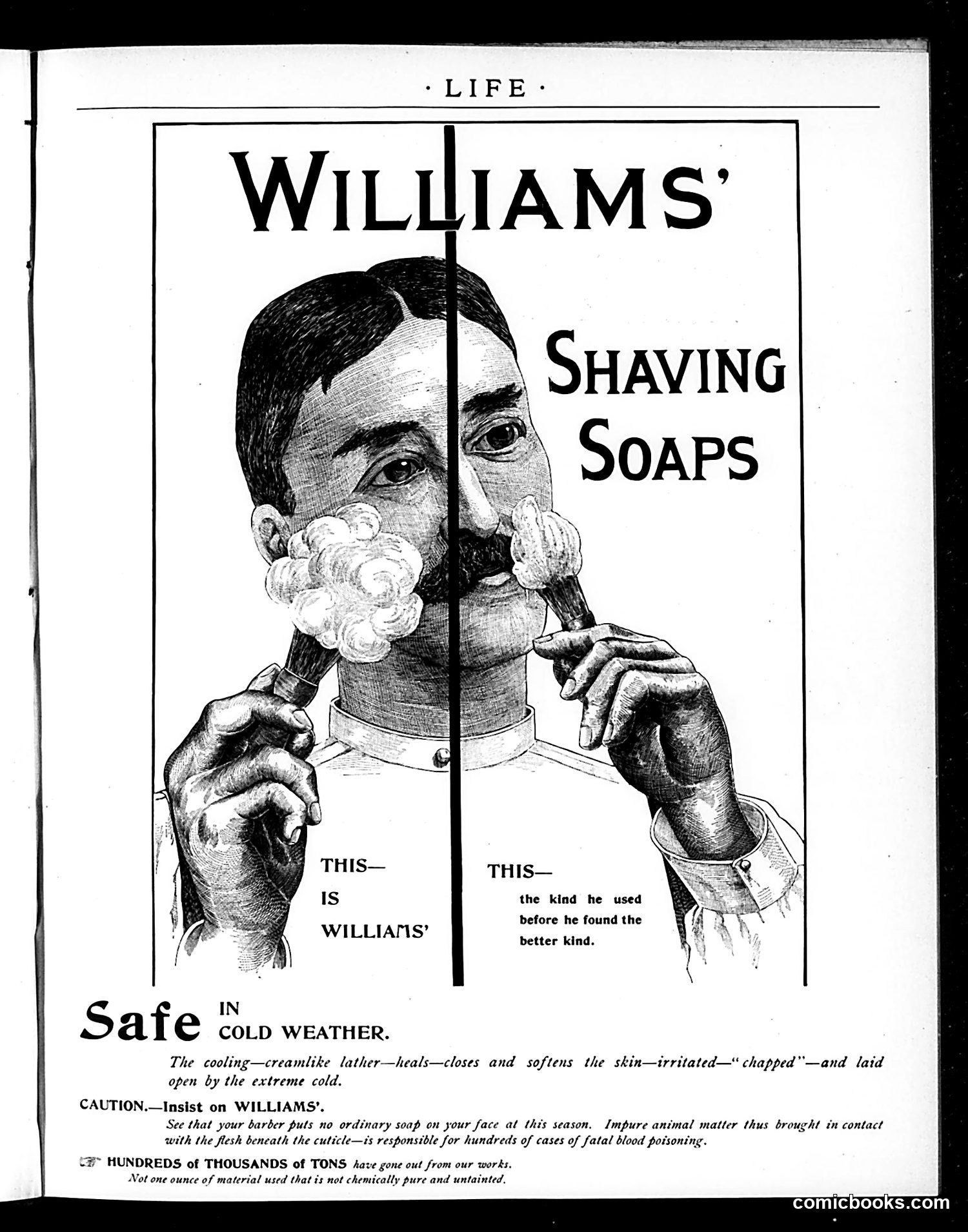
This is a product advertisement, not political satire. It promotes Williams' brand shaving soap by contrasting two products: an inferior soap (left) versus Williams' superior formula (right). The ad uses a before-and-after visual argument: a man's face showing poor lather on one side, better lather on the other. The selling point targets winter customers—claiming Williams' soap heals skin irritated and chapped by cold weather, while warning that ordinary soaps (implied to contain impure animal matter) can cause dangerous blood poisoning through contact with cracked skin. The "CAUTION" section directly advises customers to insist barbers use only Williams' brand, emphasizing safety and chemical purity. This reflects early 20th-century consumer anxiety about product quality and health risks—concerns that would have seemed serious to contemporary readers.
This page from *Life* magazine contains several short humorous anecdotes rather than political cartoons. The jokes satirize: **Religious hypocrisy and decorum**: A Methodist woman's enthusiastic "Glory!" disrupts staid Episcopal service; she's forcibly removed, yet claims honor in being "carried by two" (like Christ on an ass). **Parental naiveté**: A father brags about fighting, unaware his son's innocent question—"couldn't knock brains out of you, could he?"—implies he has none. **Political pomposity**: A congresseman arrests attempts to invoke his office to a local policeman, who dismissively warns him not to "give it away" for a lighter sentence—mocking politicians' perceived arrogance. **Miserly piety**: Young Benny exploits the preacher's lesson about "cheerful givers" by donating the nickel rather than quarter, reasoning he can smile more convincingly about less money. The humor relies on satirizing American social pretension, religious excess, and moral flexibility. The page is primarily text-based humor rather than visual satire.
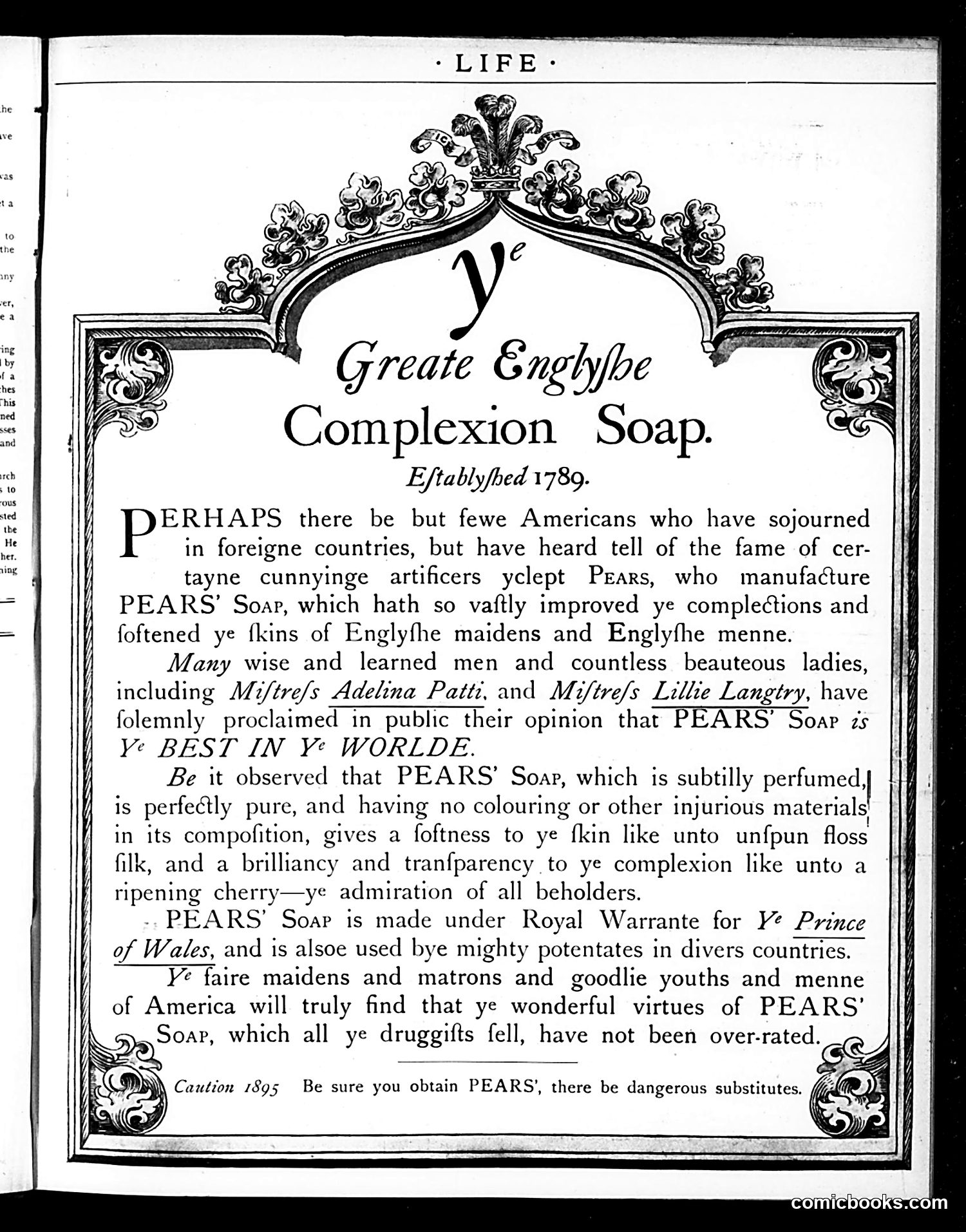
This is **not satire**—it's a straightforward advertisement for Pears' Soap, though presented in deliberately archaic English ("Ye Greate Englybe," "yclept," "foftness") that mimics old manuscripts for quaint effect. The ad targets American readers by claiming the British soap has won endorsements from famous performers like Adelina Patti and Lillie Langtry, and boasts a royal warrant from the Prince of Wales. It promises the soap will improve complexion and skin softness. The caution at bottom ("Be sure you obtain PEARS', there be dangerous substitutes") suggests counterfeit competition was already a problem by 1895. The mock-medieval language styling was a common advertising gimmick of the era—lending products false prestige through faux historical legitimacy. Modern readers might mistake this for satire, but *Life* magazine published genuine ads alongside humor.
This satirical piece mocks the popular novel *Trilby* by George du Maurier (1894), which became a cultural phenomenon. The cartoon presents a street-smart character explaining the plot in exaggerated lower-class dialect to mock both the novel's melodramatic storyline and readers' obsession with it. The joke targets the gap between the book's sophistication and public enthusiasm: a common laborer can summarize its convoluted romantic plot (involving a Parisian model, multiple male suitors, a mesmerizing musician, and tragic endings), yet educated readers found it profound. The satire suggests contemporary society foolishly lionized this sentimental story. The character's crude vernacular ("wot's," "hully gee," "dago") emphasizes the crude sensationalism underlying the novel's appeal—it's melodrama dressed as literature. Life magazine used this to ridicule both the novel's popularity and the pretensions of its admirers.
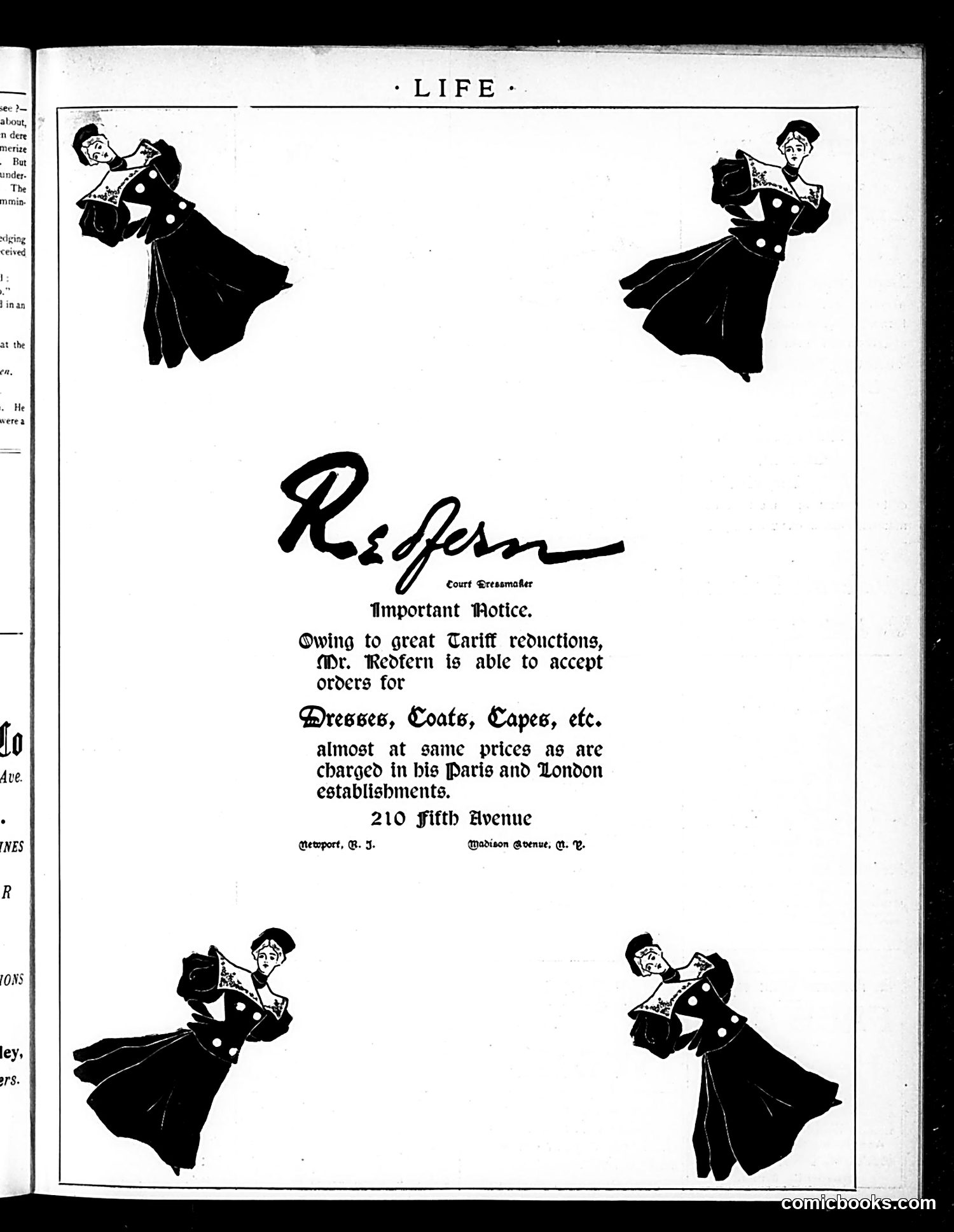
This page is primarily a **commercial advertisement** for Redfern, a court dressmaker. The four illustrated figures in stylish black coats with polka dots represent fashionable women modeling the designer's work. The "Important Notice" announces that due to tariff reductions, Redfern can now accept orders at prices nearly matching those in Paris and London. This references **early 20th-century trade policy debates** — tariff changes that affected import costs for luxury goods. The satire is subtle: the ad uses Life's editorial platform to trumpet how *lowered tariffs* make French/London fashion more affordable in America. This would have been timely commentary on protectionist versus free-trade debates of the era. The page shows how commercial interests capitalized on policy changes affecting consumer prices for luxury items.
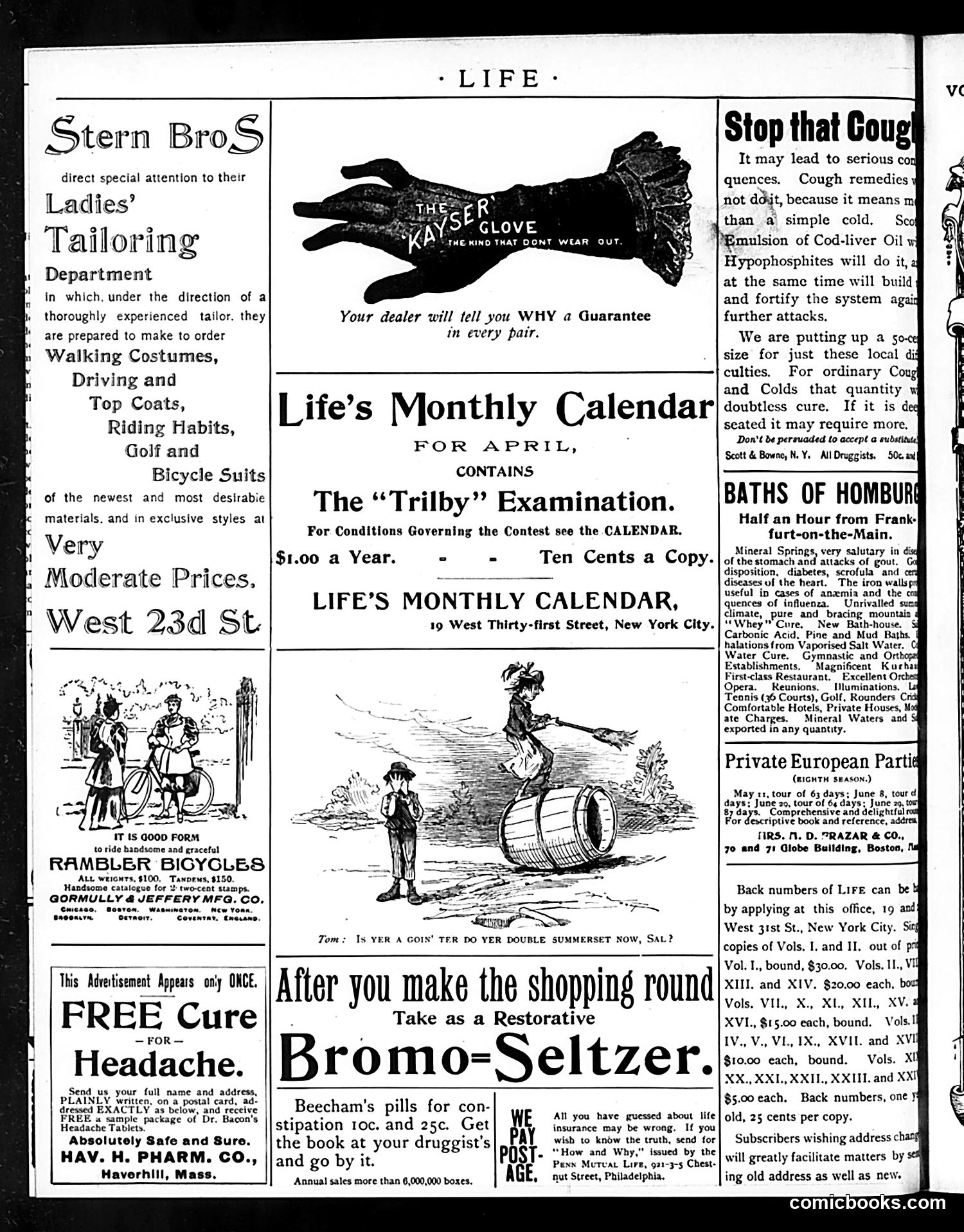
This is primarily an **advertising and announcement page** from Life magazine's April issue, with minimal satirical content. The main cartoon (center-bottom) depicts a simple domestic scene: a man named Tom addresses a woman named Sal, asking "Is yer a goin' ter do yer double summerset now, Sal?" while she balances on a barrel. This appears to be gentle, class-based humor playing on rural or working-class dialect and the image of a woman performing a gymnastics trick—likely mocking either her ambitions or physical abilities in a light, non-malicious way typical of period humor. The rest of the page consists of advertisements for **Stern Bros. tailoring, Kaiser gloves, Bromo-Seltzer, Beecham's pills, and various travel/leisure services**. A notable insert announces **Life's Monthly Calendar for April containing "The 'Trilby' Examination"** (likely referencing a popular novel or character), available for $1 yearly or 10 cents per copy. The page reflects early 20th-century consumer culture and publication business practices rather than sustained political satire.