
Life, 1895-04-11 · page 4 of 26
Life — April 11, 1895 — page 4: what you’re looking at
What you’re looking at
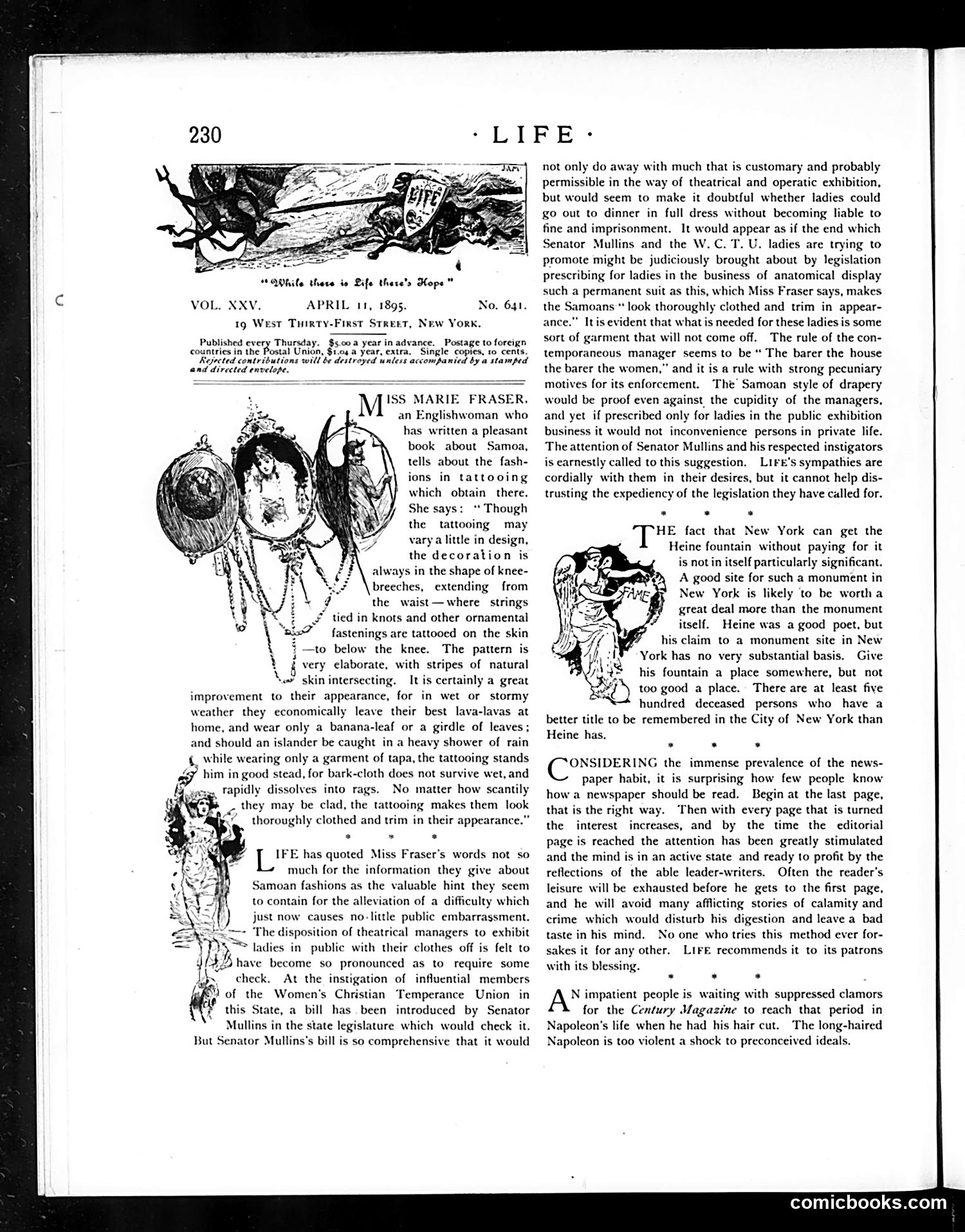
This page discusses Miss Marie Fraser's book about Samoa, focusing on traditional tattooing practices. The left column illustrates Samoan tattoo designs with decorative engravings showing ornamental patterns worn on the body. The main satirical content concerns Senator Mullins and the Women's Christian Temperance Union proposing legislation to restrict women's public dress. The article mocks this effort as overly prudish and impractical—suggesting rules against "full dress" would make dining out impossible and infringe on personal liberty. The satire targets moral reformers' attempts to legislate women's appearance and behavior. The page also includes brief commentary on acquiring the Heine fountain for New York and criticizes newspaper reading habits, recommending readers start from the last page for better editorial quality.
📄 Transcribed text from this page (OCR, searchable)
Machine-transcribed from the original scan — historical spelling and the odd misread are preserved.
-LIFE-: VOL. XXV. APRIL 11, 1895 19 West Twirty-First Street, New York. Published every Thursday. $s.00a year in advance. Postage to foreign countries in the Postal Union, $1.04 a year, extra, Single copies, 10 cents. Rejected contributions will be destroyed untess accompanied by a stamped 4M and directed envelope. ISS MARIE FRASER, an Englishwoman who has written a pleasant book about Samoa, tells about the fash- ions in tattooing which obtain there. She sa‘ “ Though the tattooing may vary a little in design, the decoration is always in the shape of knee- breeches, extending from the waist—where strings tied in knots and other ornamental fastenings are tattooed on the skin —to below the knee. The pattern is very elaborate, with stripes of natural ting. It is certainly a great improvement to their appearance, for in wet or stormy weather they economically leave their best lava-lavas at home, and wear only a banana-leaf or a girdle of leaves; and should an islander be caught in a heavy shower of rain 4. while wearing only a garment of tapa, the tattooing stands PA him in good stead, for bark-cloth does not survive wet, and i rapidly dissolves into rags. No matter how scantily ic they may be clad, the tattooing makes them look «thoroughly clothed and trim in their appearance.” * » . IFE has quoted Miss Fraser's words not so much for the information they give about Samoan fashions as the valuable hint they seem to contain for the alleviation of a difficulty which just now causes no-little public embarrassment. << ——- The disposition of theatrical managers to exhibit PES => ladies in public with their clothes off is felt to 4/35 have become so pronounced as to require some check. At the instigation of influential members 2 of the Women's Christian Temperance Union in this State, a bill has been introduced by Senator Mullins in the state legislature which would check it. But Senator Mullins’s bill is so comprehensive that it would not only do away with much that is customary and probably permissible in the way of theatrical and operatic exhibition, but would seem to make it doubtful whether ladies could go out to dinner in full dress without becoming liable to fine and imprisonment. It would appear as if the end which Senator Mullins and the W.C. T. U. ladies are trying to promote might be judiciously brought about by legislation prescribing for ladies in the business of anatomical display such a permanent suit as this, which Miss Fraser says, makes the Samoans“ look thoroughly clothed and trim in appear- ance.” Itis evident that what is needed for these ladies is some sort of garment that will not come off. The rule of the con- temporaneous manager seems to be “ The barer the house the barer the women,” and it is a rule with strong pecuniary motives for its enforcement. The’ Samoan style of drapery would be proof even against, the cupidity of the managers, and yet if prescribed only for ladies in the public exhibition business it would not inconvenience persons in private life. The attention of Senator Mullins and his respected instigators is earnestly called to this suggestion. Lire’s sympathies are cordially with them in their desires, but it cannot help dis- trusting the expediency of the legislation they have called for. . . . HE fact that New York can get the Heine fountain without paying for it is notin itself particularly significant. A good site for such a monument in New York is likely to be worth a great deal more than the monument itself. Heine was a good poet, but his claim to a monument site in New York has no very substantial basis. Give his fountain a place somewhere, but not too good a place. There are at least five hundred deceased persons who have a better title to be remembered in the City of New York than Heine has. * . . ONSIDERING the immense prevalence of the news- paper habit, it is surprising how few people know how a newspaper should be read. Begin at the last page, that is the right way. Then with every page that is turned the interest increases, and by the time the editorial page is reached the attention has been greatly stimulated and the mind is in an active state and ready to profit by the reflections of the able leader-writers. Often the reader's leisure will be exhausted before he gets to the first page, and he will avoid many afflicting stories of calamity and crime which would disturb his digestion and leave a bad taste in his mind. No one who tries this method ever for- sakes it for any other. LIFE recommends it to its patrons with its blessing. . . AS impatient people is waiting with suppressed clamors for the Century Magazine to reach that period in poleon’s life when he had his hair cut. The long-haired Napoleon is too violent a shock to preconceived ideals. comicbooks.com