
Life, 1895-04-11 · page 11 of 26
Life — April 11, 1895 — page 11: what you’re looking at
What you’re looking at
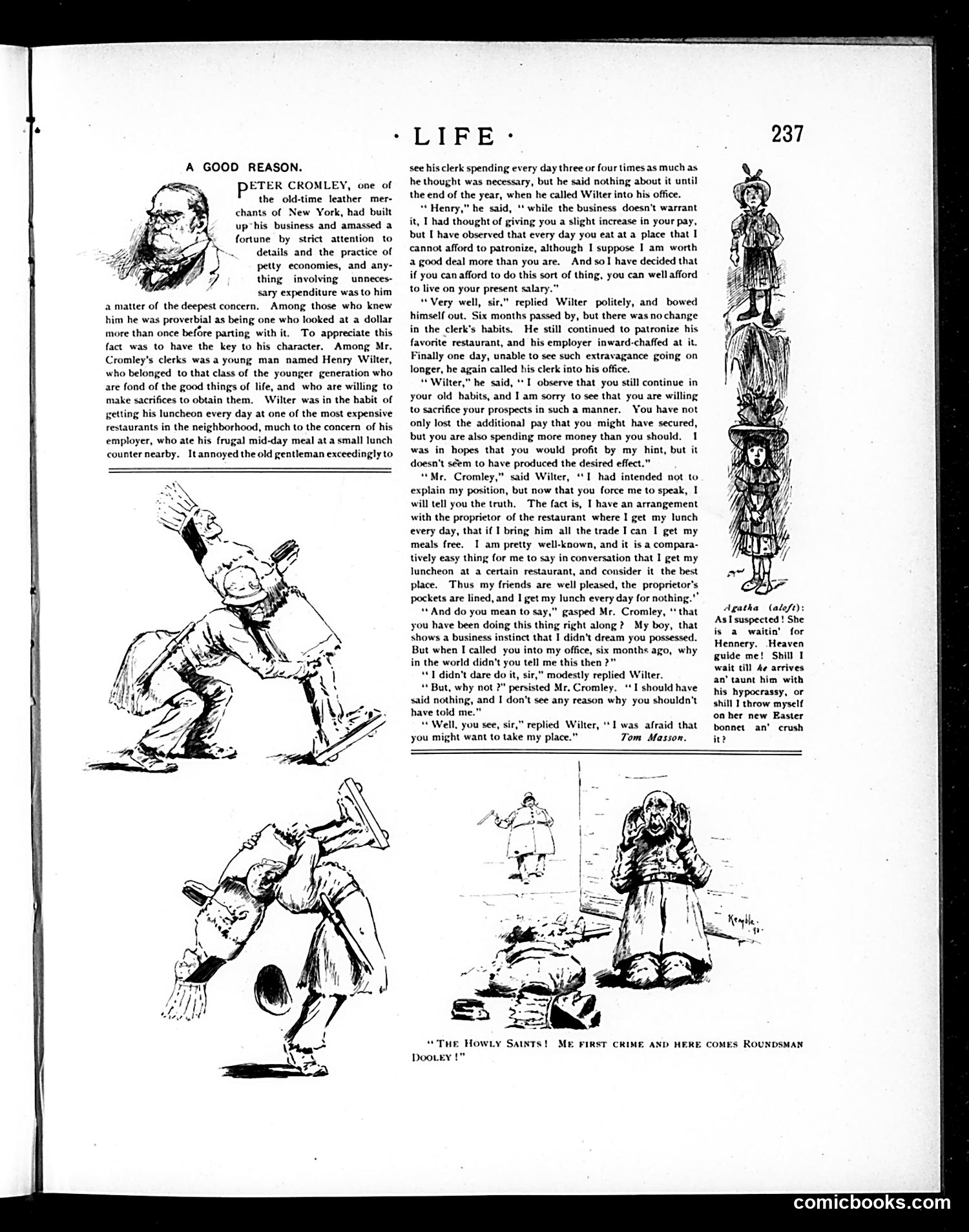
This page satirizes workplace dynamics and class economics in early 20th-century America. The story concerns **Peter Cromley**, a wealthy New York merchant who discovers his office clerk **Wilter** has been eating free lunches daily at a restaurant in exchange for bringing the proprietor business. When Cromley confronts him about not revealing this arrangement six months prior, Wilter explains he made a deliberate choice: accepting modest pay while securing free meals represented better economics than earning slightly more while paying for lunch. The satire mocks both the clerk's calculating pragmatism and Cromley's surprise that an employee would optimize personal finances over loyalty. The accompanying illustrations depict their confrontation. The final cartoon references a separate story about "Roundsman Dooley."
📄 Transcribed text from this page (OCR, searchable)
Machine-transcribed from the original scan — historical spelling and the odd misread are preserved.
A GOOD REASON. ETER CROMLEY, one of the old-time leather mer- chants of New York, had built up’ his business and amassed a fortune by strict attention to details and the practice of petty economies, and any- thing involving _unneces- sary expenditure was to him a matter of the deepest concern. Among those who knew him he was proverbial as being one who looked at a dollar more than once before parting with it. To appreciate this fact was to have the key to his character. Among Mr. Cromley's clerks was a young man named Henry Wilter, who belonged to that class of the younger generation who are fond of the good things of life, and who are willing to make sacrifices to obtain them. Willer was in the habit of getting his luncheon every day at one of the most expensive restaurants in the neighborhood, much to the concern of his employer, who ate his frugal mid-day meal at a small lunch counter nearby. It annoyed the old gentleman exceedingly to “RE see his clerk spending every day three or four times as much as he thought was necessary, but he said nothing about it until the end of the year, when he called Wilter into his office. “Henry,” he said, ‘while the business doesn't warrant it, I had thought of giving you a slight increase in your pay, but I have observed that every day you eat ata place that I cannot afford to patronize, although I suppose | am worth a good deal more than you are. And sol have decided that if you can afford to do this sort of thing, you can well afford to live on your present salary.” replied Wilter politely, and bowed himself out. Six months passed by, but there was nochange in the clerk's habits. He still continued to patronize his favorite restaurant, and his employer inward-chaffed at it. Finally one day, unable to see such extravagance going on longer, he again called his clerk into his office. ** Wilter,” he said, ‘I observe that you still continue in your old habits, and I am sorry to see that you are willing to sacrifice your prospects in such a manner. You have not only lost the additional pay that you might have secured, but you are also spending more money than you should. 1 was in hopes that you would profit by my hint, but it doesn't séem to have produced the desired effect.” “Mr. Cromley,” said Wilter, “1 had intended not to explain my position, but now that you force me to speak, I will tell you the truth, The fact is, I have an arrangement with the proprietor of the restaurant where I get my lunch every day, that if | bring him all the trade Tcan I get my meals free. I am pretty well-known, and it is a compara- tively easy thing for me to say in conversation that I get my luncheon at a certain restaurant, and consider it the best place. Thus my friends are well pleased, the proprietor's pockets are lined, and I get my lunch every day for nothing.” “And do you mean to say,” gasped Mr. Cromley, “that 1eatha (ale/t): you have been doing this thing right along? My boy, that 4 eatin, She shows a business instinct that I didn't dream you possessed. 42 waitie’ for But when I called you into my office, six months ago, why waeeal RINT in the world didn’t you tell me this then 2” wear eaves “I didn’t dare do it, sir,” modestly replied Wilter. a tae Lica “ But, why not 2" persisted Mr. Cromley. ‘I should have . his hypocrassy, or said nothing, and I don't see any reason why you shouldn't hil Punrow enpself have told me.” 7 oe on her new Easter “ Well, you see, sir,” replied Wilter, 1 was afraid that bonnet an’ crush you might want to take my place." Tom Masson. in? “THE HOWLY SAINTS! ME FIRST CRIME AND HERE COMES ROUNDSMAN Dootey !" comicbooks.com