
Life, 1895-04-11 · page 10 of 26
Life — April 11, 1895 — page 10: what you’re looking at
What you’re looking at
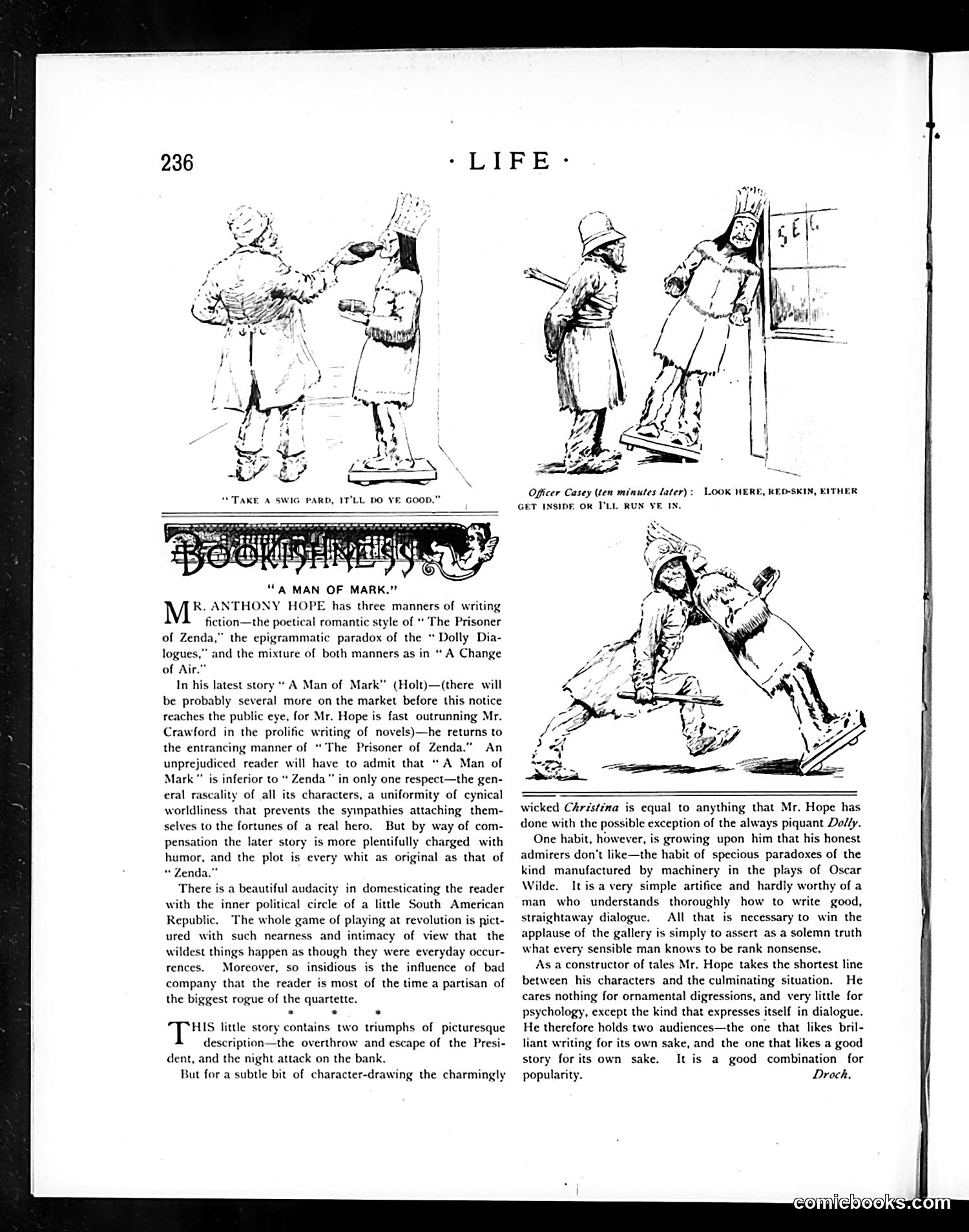
This page reviews Anthony Hope's story "A Man of Mark." The top cartoons illustrate scenes from the narrative: one shows a soldier confronting someone about parting, another depicts an officer warning someone to "look here, red-skin, either get inside or I'll run ye in." The review praises Hope's three writing styles—romantic, epigrammatic, and mixed—while noting his characters lack depth, displaying "cynical worldliness" rather than genuine sympathy. The critic acknowledges Hope excels at plot construction and dialogue but criticizes his reliance on "machinery" similar to Oscar Wilde's theatrical techniques. The reviewer concludes the story combines "brilliant writing" with popular appeal, though it prioritizes entertainment over psychological complexity. The author is identified as "Droch."
📄 Transcribed text from this page (OCR, searchable)
Machine-transcribed from the original scan — historical spelling and the odd misread are preserved.
‘A MAN OF MARK.” R. ANTHONY HOPE has three manners of writing fiction—the poetical romantic style of “ The Prisoner of Zenda,” the epigrammatic paradox of the “Dolly Dia- and the mixture of both manners as in “ A Change be probably several more on the market before this notice aches the public eye, for Mr. Hope is fast outrunning Mr. Crawford in the prolific writing of novels)—he returns to the entrancing manner of “The Prisoner of Zenda.” An unprejudiced reader will have to admit that * A Man of Mark” is inferior to * Zenda” in only one respect—the gen- eral rascality of all its characters, a uniformity of cynical worldliness that prevents the syinpathies attaching them- selves to the fortunes of a real hero, But by way of com- pensation the later story is more plentifully charged with humor, and the plot is ry whit as original as that of “ Zenda.” a beautiful audacity in domesticating the reader with the inner political circle of a little South American Republic. The whole game of playing at revolution is pict- ured with such nearness and intimacy of view that the wildest things happen as though they were everyday occur- rences. Moreover, so insidious is the influence of bad company that the reader is most of the time a partisan of the biggest rogue of the quartette. . . . “THe little story contains two triumphs of picturesque description—the overthrow and escape of the Presi- dent, and the night attack on the bank. But for a subtle bit of character-drawing the charmingly Officer Casey (ten minutes later) : GET INSIDE OR TLL RUN YE IN. Look HERE, KED-SKIN, EITHER, wicked Christina is equal to anything that Mr. Hope has done with the possible exception of the always piquant Dolly. One habit, however, is growing upon him that his honest admirers don’t like—the habit of specious paradoxes of the kind manufactured by machinery in the plays of Oscar Wilde. It is a very simple artifice and hardly worthy of a man who understands thoroughly how to write good, straightaway dialogue. All that is necessary to win the applause of the gallery is simply to assert as a solemn truth what every sensible man knows to be rank nonsense. As a constructor of tales Mr. Hope takes the shortest line between his characters and the culminating situation. He cares nothing for ornamental digressions, and very little for psychology, except the kind that expresses itself in dialogue. He therefore holds two audiences—the one that likes bril- liant writing for its own sake, and the one that likes a good story for its own sake. It is a good combination for popularity. Droch.