
Life, 1895-04-11 · page 12 of 26
Life — April 11, 1895 — page 12: what you’re looking at
What you’re looking at
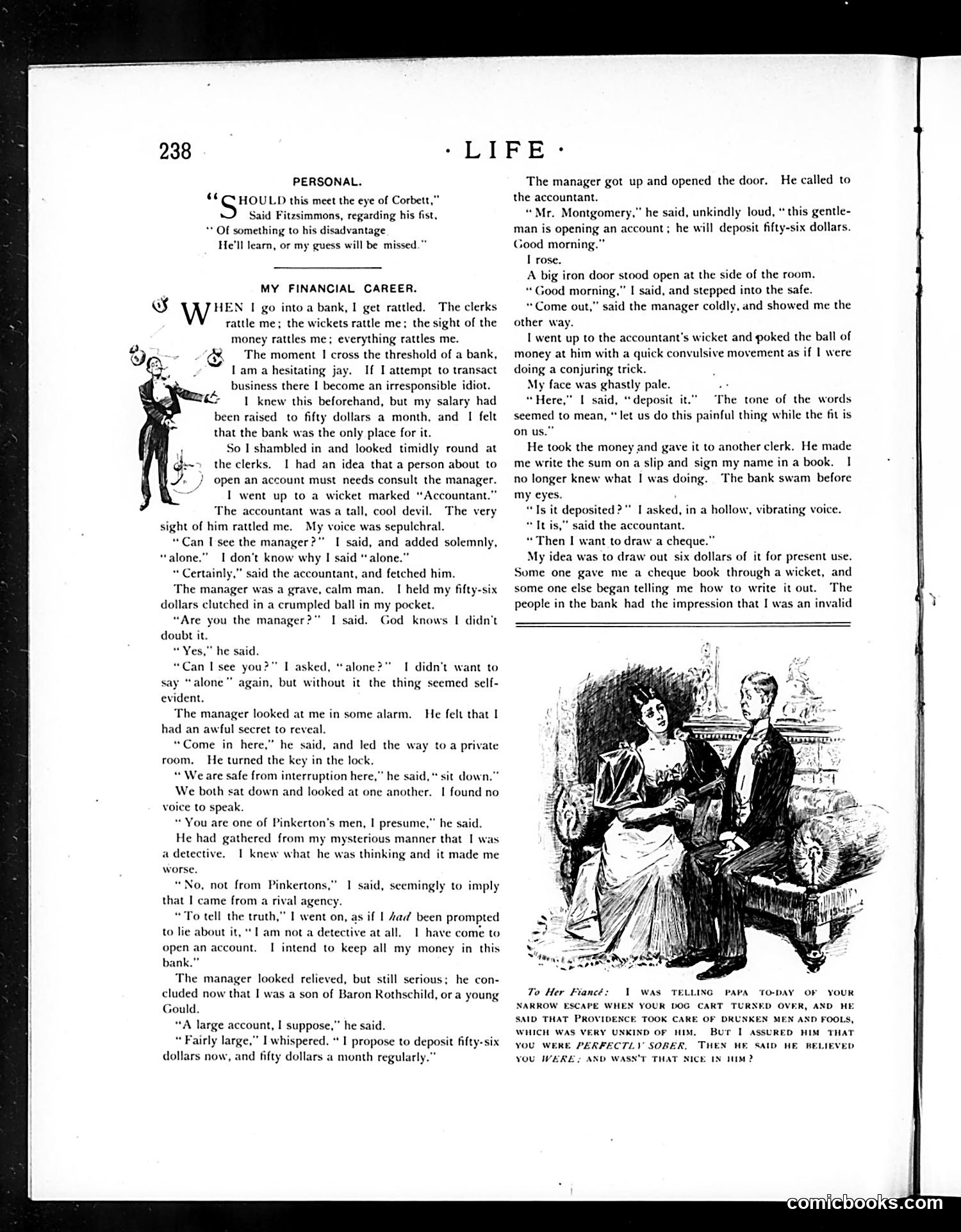
This page contains two distinct pieces from *Life* magazine: **1. The "Personal" section** (top) references a boxing rivalry between **James J. Corbett** and **Bob Fitzsimmons**, prominent prizefighters of the 1890s. The quip about Fitzsimmons' fist suggests confidence in an upcoming match. **2. "My Financial Career"** (main text and illustration) is a humorous autobiographical essay about the author's anxiety opening a bank account with his modest $56 salary increase. The comedy hinges on his extreme nervousness being misinterpreted by the bank manager as suspicious behavior—first as a Pinkerton detective, then as a wealthy magnate like Baron Rothschild or Jay Gould. The illustration shows him describing his account to bank staff. The satire mocks both the narrator's social insecurity and banks' tendency to judge customers by perceived wealth. For modern readers, the key is understanding that $50-56/month represented ordinary working-class income, making his anxiety about "large deposits" absurdly disproportionate to the actual amounts involved.
📄 Transcribed text from this page (OCR, searchable)
Machine-transcribed from the original scan — historical spelling and the odd misread are preserved.
- LIFE: PERSONAL. 66 CHOULD this meet the eye of Corbett,” Said Fitzsimmons, regarding his fist, ** Of something to his disadvantage He'll learn, or my guess will be missed.” MY FINANCIAL CAREER. Oy WHEN | go into a bank, 1 get rattled. The clerks rattle me; the wickets rattle me; the sight of the money rattles me; everything rattles me. The moment | cross the threshold of a bank, lam a hesitating jay. If I attempt to transact business there | become an irresponsible idiot. Rit: 1 knew this beforehand, but my salary had been raised to fifty dollars a month, and | felt that the bank was the only place for it. 1 So I shambled in and looked timidly round at @s~> the clerks. I had an idea that a person about to fo} 7: } open an account must needs consult the manager. I went up to a wicket marked “Accountant.” The accountant was a tall, cool devil. The very sight of him rattled me. My voice was sepulchral. “Can [see the manager?" I said, and added solemnly, “alone.” 1 don't know why I said “alone.” “ Certainly, id the accountant, and fetched him. The manager was a grave, calm man, I held my fifty-si dollars clutched in a crumpled ball in my pocket. “Are you the manager?" I said. God knows I didn’t doubt it. “Yes,” he said. “Can [see you?” I say “alone” evident. asked, “alone?” 1 didn’t want to again, but without it the thing seemed self- The manager looked at me in some alarm. He felt that I had an awful secret to reveal. “Come in here,” he said, and led the way toa private room. He turned the key in the lock. “ Weare safe from interruption here,” he said," sit down.” We both sat down and looked at one another. | found no voice to speak. “ You are one of Pinkerton’s men, | presume,” he said. He had gathered from my mysterious manner that I was a detect 1 knew what he was thinking and it made me worse. “No, not from Pinkertons,” that I came from a rival agency. “To tell the truth,” I went on, as if | Zad been prompted to lie about it, “1 am not a detective at all. 1 have come to open an account. I intend to keep all my money in this bank.” The manager looked relieved, but still serious; he con- cluded now that I was a son of Baron Rothschild, or a young Gould. “A large account, | suppose,” he said. “Fairly large,” I whispered. “' I propose to deposit fifty-six dollars now, and fifty dollars a month regularly. I said, seemingly to imply The manager got up and opened the door, He called to the accountant. “Mr. Montgomer: man is opening an account; he will deposit fifty- Good morning.” I ro: A big iron door stood open at the side of the room. “ Good morning,” I said, and stepped into the safe. “Come out,” said the manager coldly, and showed me the other way. I went up to the accountant’s wicket and poked the ball of money at him with a quick convulsive movement as if I were doing a conjuring trick. My face was ghastly pale. “Here,” I said, “deposit it.” The tone of the words. seemed to mean, “let us do this painful thing while the fit is on us.” He took the money and gave it to another clerk. He made me write the sum on a slip and sign my name in a book. 1 no longer knew what I was doing. The bank swam before my eyes “Is it deposited?" I asked, in a hollow, vibrating voice. “Ttis,” said the accountant. “Then I want to draw a cheque.” My idea was to draw out six dollars of it for present use. Some one gave me a cheque book through a wicket, and some one else began telling me how to write it out. The people in the bank had the impression that I was an invalid “he said, unkindly loud, “this gentle- x dollars. To Her Fiancé: 1 WAS TELLING PAPA NARROW ESCAPE WHEN YOUR DOG CART TURNEI SAID THAT PROVIDENCE TOOK CARE OF DRI N MEN AND FOOLS, WHICH WAS VERY UNKIND OF MIM, But I AssURED HIM THAT YOU WERE PERFECTLY SOBER, THEN HE SAID HE RELIEVED YOU WERE; AND WASN'T THAT NICE IN HIM? TO-DAY OF YOUR OVER, AND HE