
A complete issue · 18 pages · 1895
Life — March 14, 1895
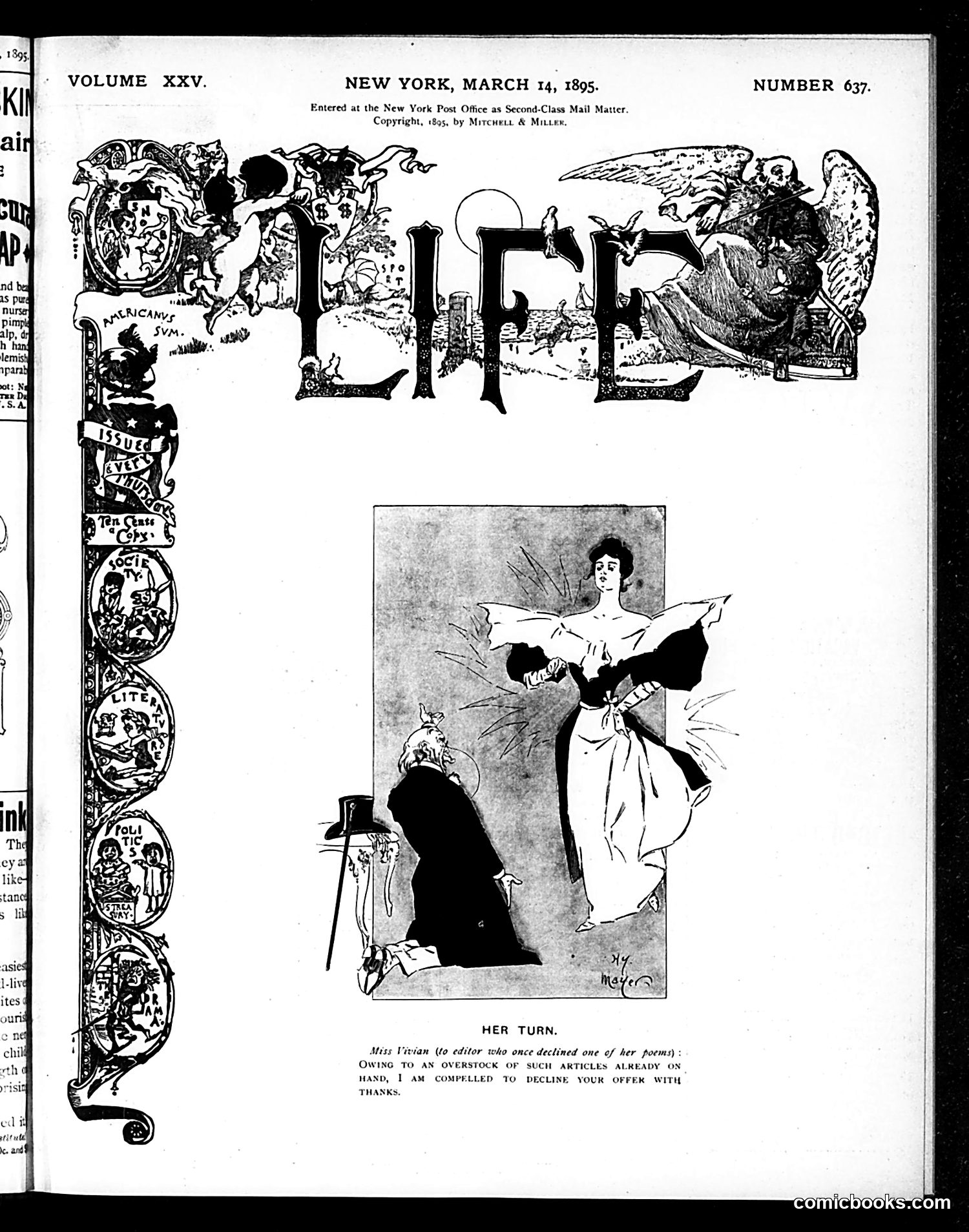
The main cartoon, titled "Her Turn," depicts a woman in an elegant dress rejecting a suitor in formal attire. The accompanying text indicates this is addressed to "Miss Vivian (to editor who once declined one of her poems)" and states: "Owing to an overstock of such articles already on hand, I am compelled to decline your offer with thanks." The satire humorously reverses rejection roles: just as the editor rejected the woman's poetry submission, she now rejects his romantic advances. This is a witty commentary on women's agency and reciprocal rejection—turning the tables on a male figure of authority. The joke relies on the implied entitlement of men in positions of power and the satisfaction of a woman refusing advances on her own terms.
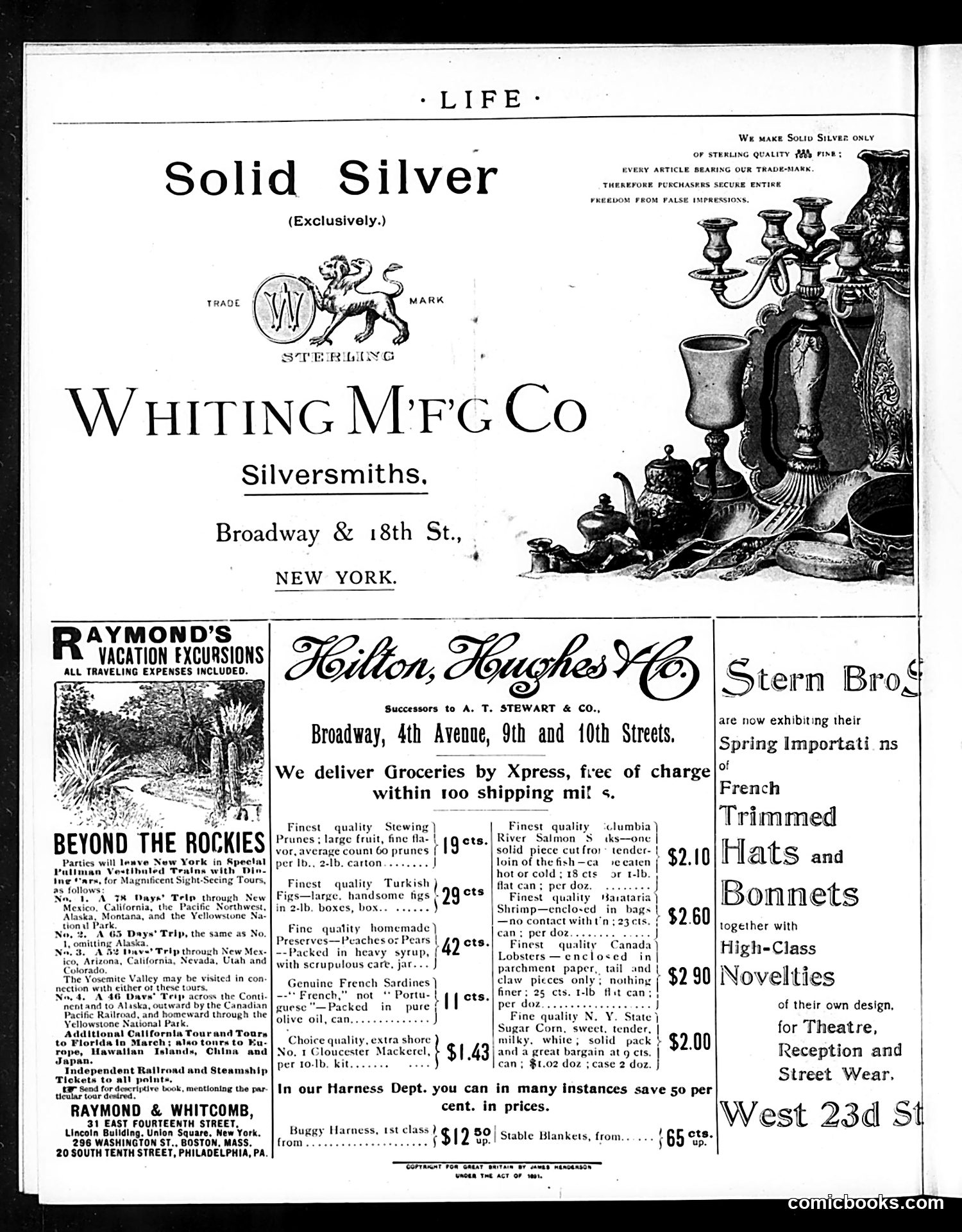
This page is primarily **advertising**, not satire or editorial content. It features multiple commercial advertisements from late 19th or early 20th-century New York businesses: - **Whiting M'FG Co**: Solid sterling silver goods from Broadway & 18th Street - **Hilton, Hughes & Co**: A grocery delivery service offering fine foods - **Stern Bros**: Advertising spring importations of French trimmed hats and bonnets for "Theatre, Reception and Street Wear" on West 23rd Street - **Raymond & Whitcomb**: Travel excursions "Beyond the Rockies" The decorative silver serving pieces illustrated at top right exemplify the luxury goods being marketed. This is a typical Life magazine page mixing travel, fashion, and household goods advertising for affluent urban consumers of the era.
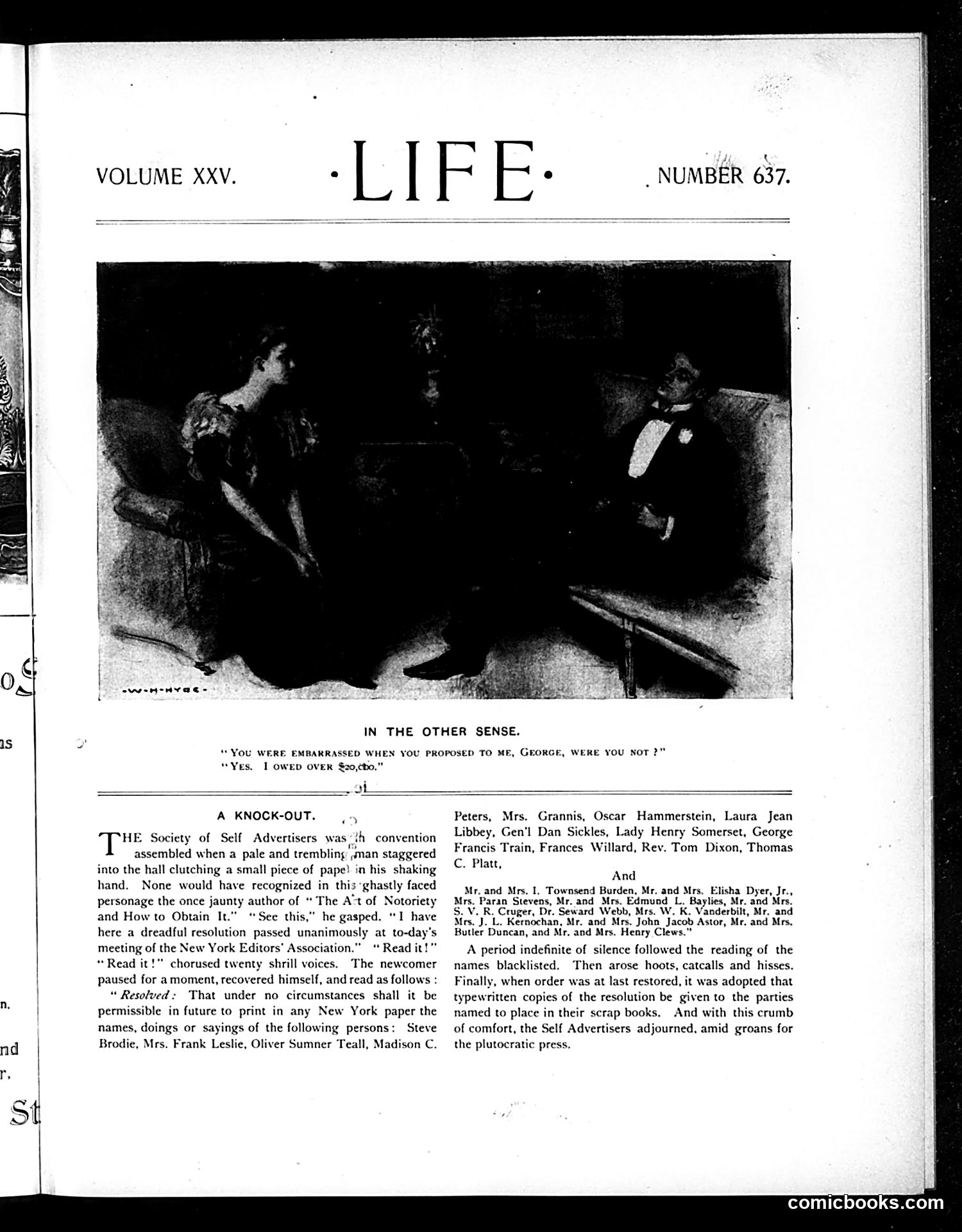
This cartoon depicts a scene captioned with dialogue: "You were embarrassed when you proposed to me, George, were you not?" / "Yes. I owed over $20,000." The joke plays on the double meaning of "embarrassed"—the woman interprets it as emotional awkwardness during a romantic proposal, while the man reveals he was actually financially embarrassed (meaning in debt). This satirizes either the man's focus on money over romance or, conversely, the practical financial realities underlying marriage proposals of the era. The accompanying text describes a Society of Self Advertisers convention where members debated publishing personal information in newspapers—a satirical commentary on early 20th-century self-promotion culture and privacy concerns that remain relevant today.
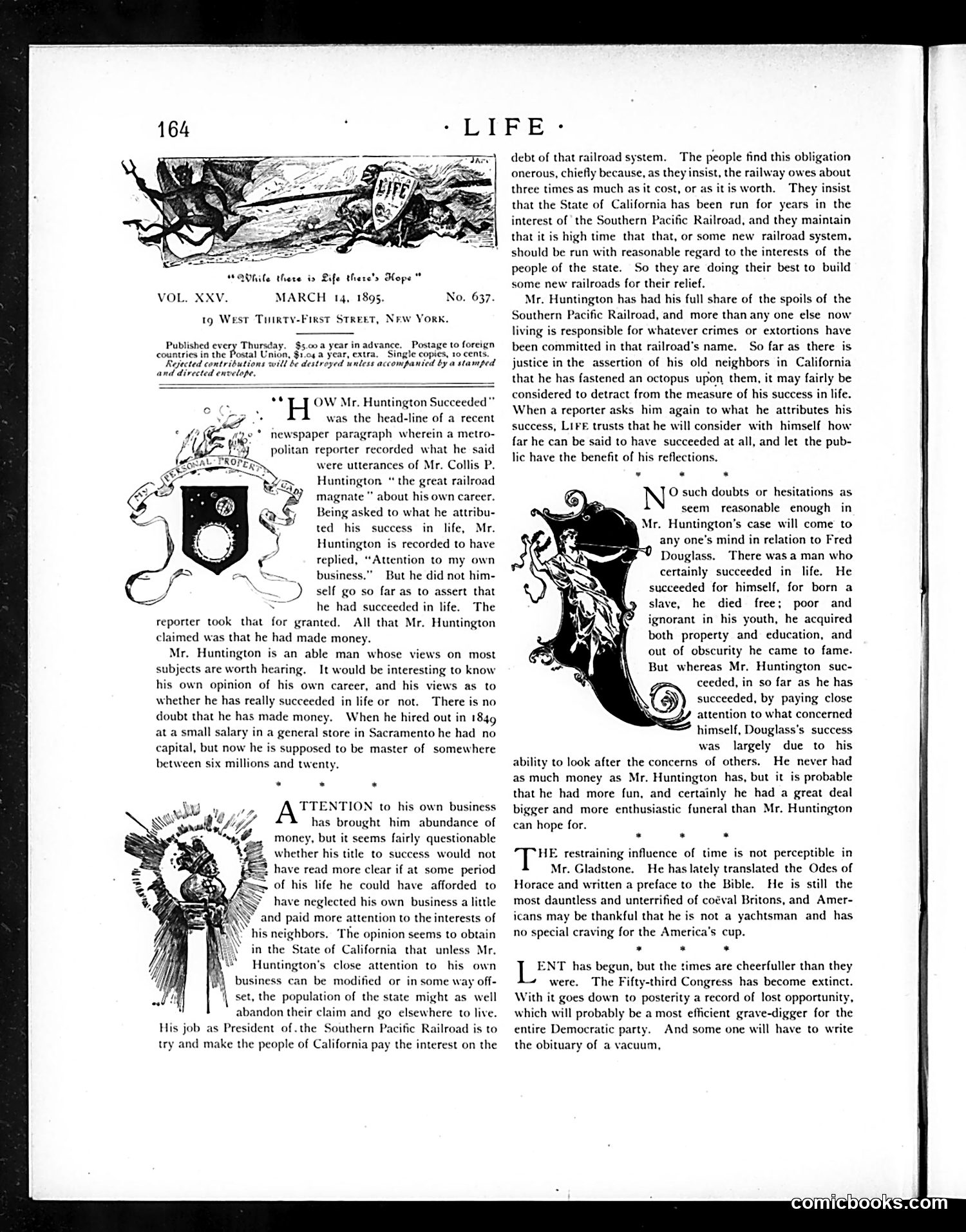
This page critiques **Collis P. Huntington**, the railroad magnate and president of the Southern Pacific Railroad. The article questions whether Huntington truly "succeeded in life," despite his enormous wealth accumulated from railroad operations. The satire's point: Huntington claims his success stems from "attention to his own business," yet the text argues he's actually neglected California's broader interests while building his fortune. The piece contrasts Huntington with **Fred Douglass** (the formerly enslaved man who became famous), suggesting Douglass's rise from poverty through self-improvement is more genuinely admirable than Huntington's wealth, which the magazine implies came partly at public expense. The cartoon's grotesque imagery reinforces this moral critique of unchecked capitalist accumulation.
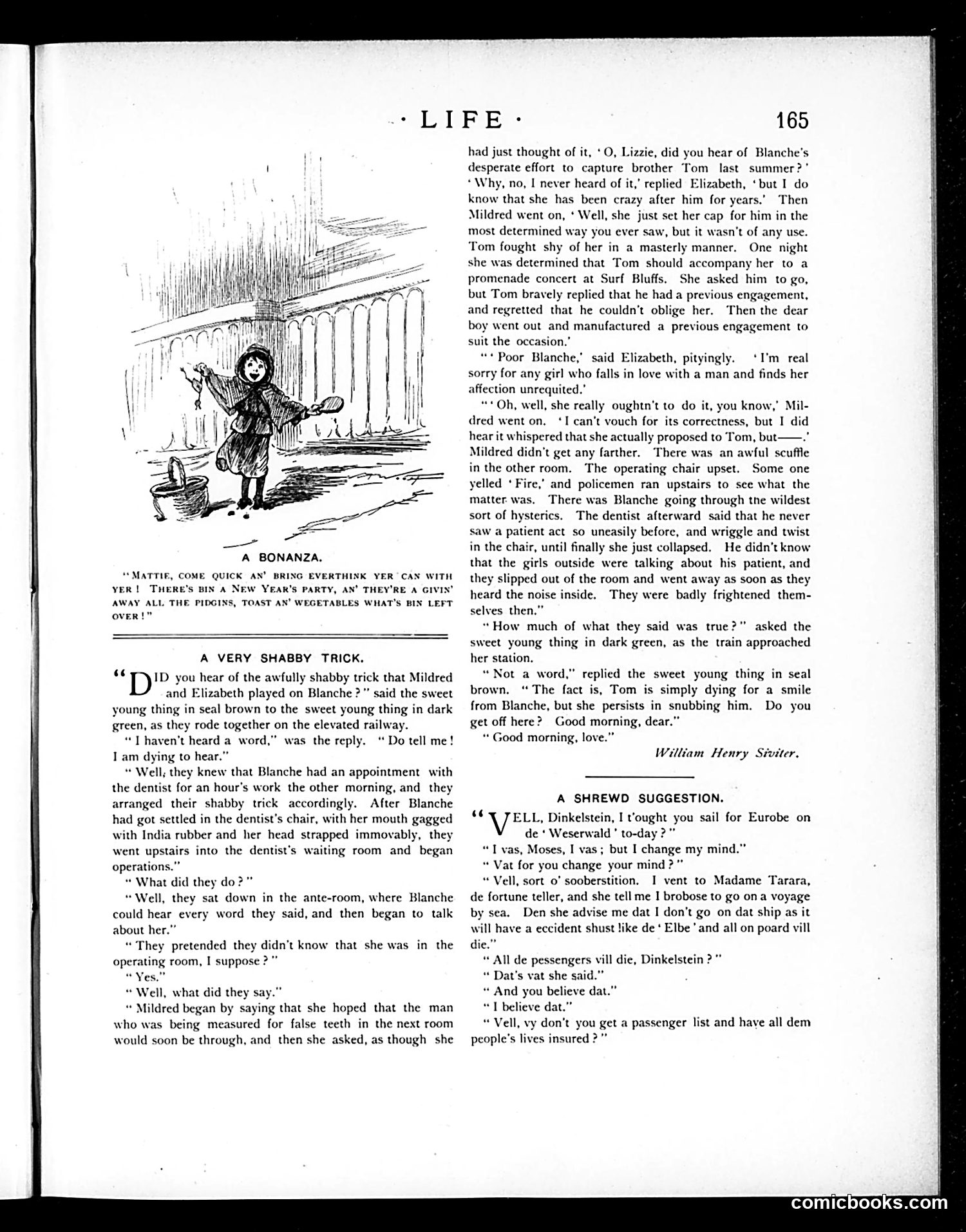
This page contains three separate humorous anecdotes with one illustration titled "A Bonanza." The cartoon shows a child near what appears to be a fence, depicting a scene referenced in the accompanying caption about inviting someone to a New Year's party with "fingers, toast an' vegetables what's his left over." The three stories—"A Bonanza," "A Very Shabby Trick," and "A Shrewd Suggestion"—are satirical social commentary pieces typical of Life magazine's humor format. They mock middle-class social conventions and relationship dynamics: a woman's desperate romantic pursuit, a couple's dental appointment ruse to spend time together, and insurance-related cynicism about sea travel. These are character-driven jokes reflecting early 20th-century courtship customs and anxieties rather than specific political satire.
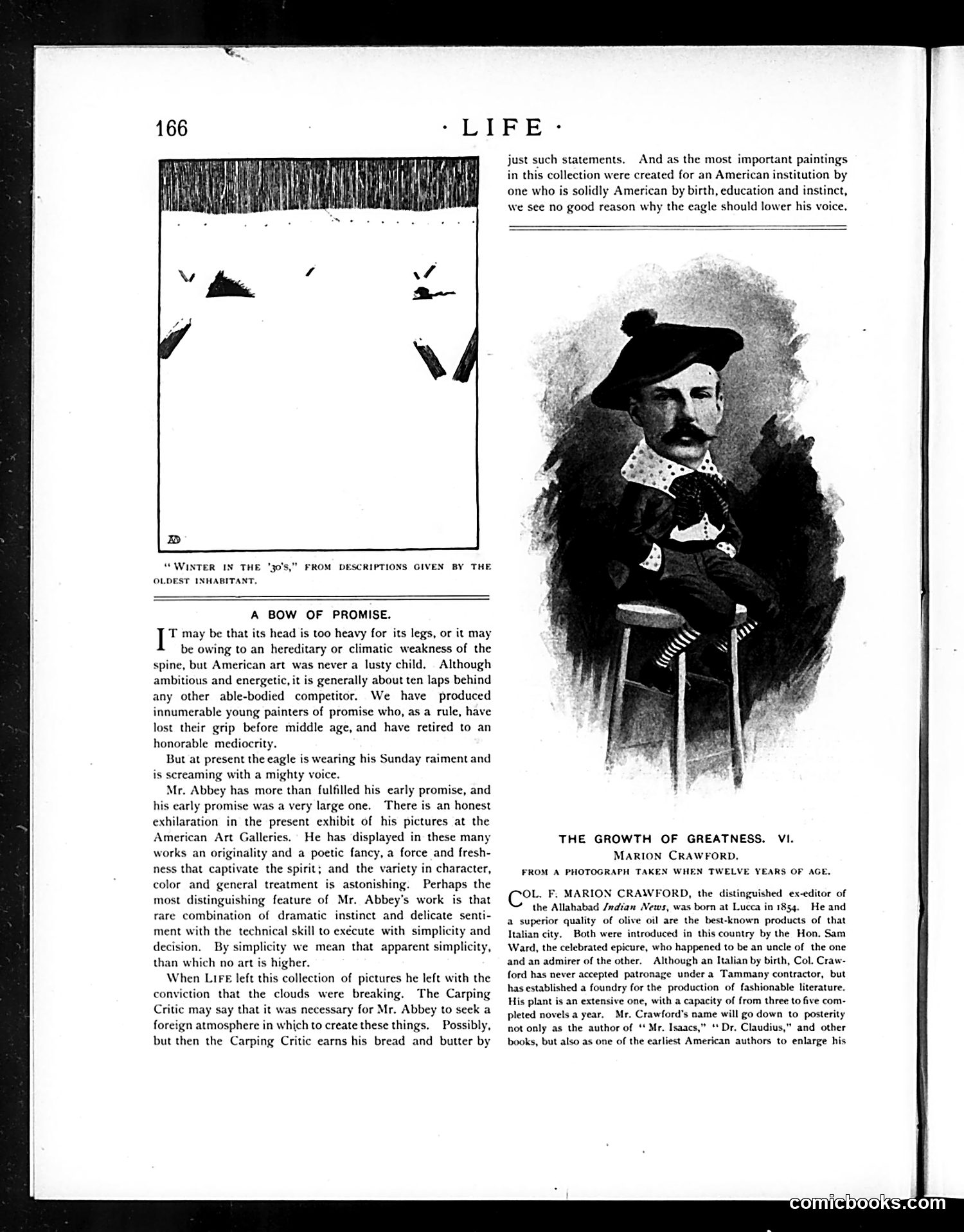
The page contains two distinct elements: **Left side:** A minimalist cartoon titled "Winter in the '90s" depicts a sparse interior with a fireplace and minimal furnishings—likely satirizing economic hardship or poverty during the 1890s depression era. **Right side:** A portrait and article about Marion Crawford titled "The Growth of Greatness. VI." Crawford was apparently an American author and playwright of Italian-American heritage. The text praises his artistic development and mentions his works including "Mr. Isaacs" and "Dr. Claudius." The article emphasizes his dual cultural identity and literary contributions to American letters, suggesting *Life* magazine was promoting contemporary American cultural achievement. The juxtaposition suggests contrasting 1890s social conditions—economic struggle versus artistic success.
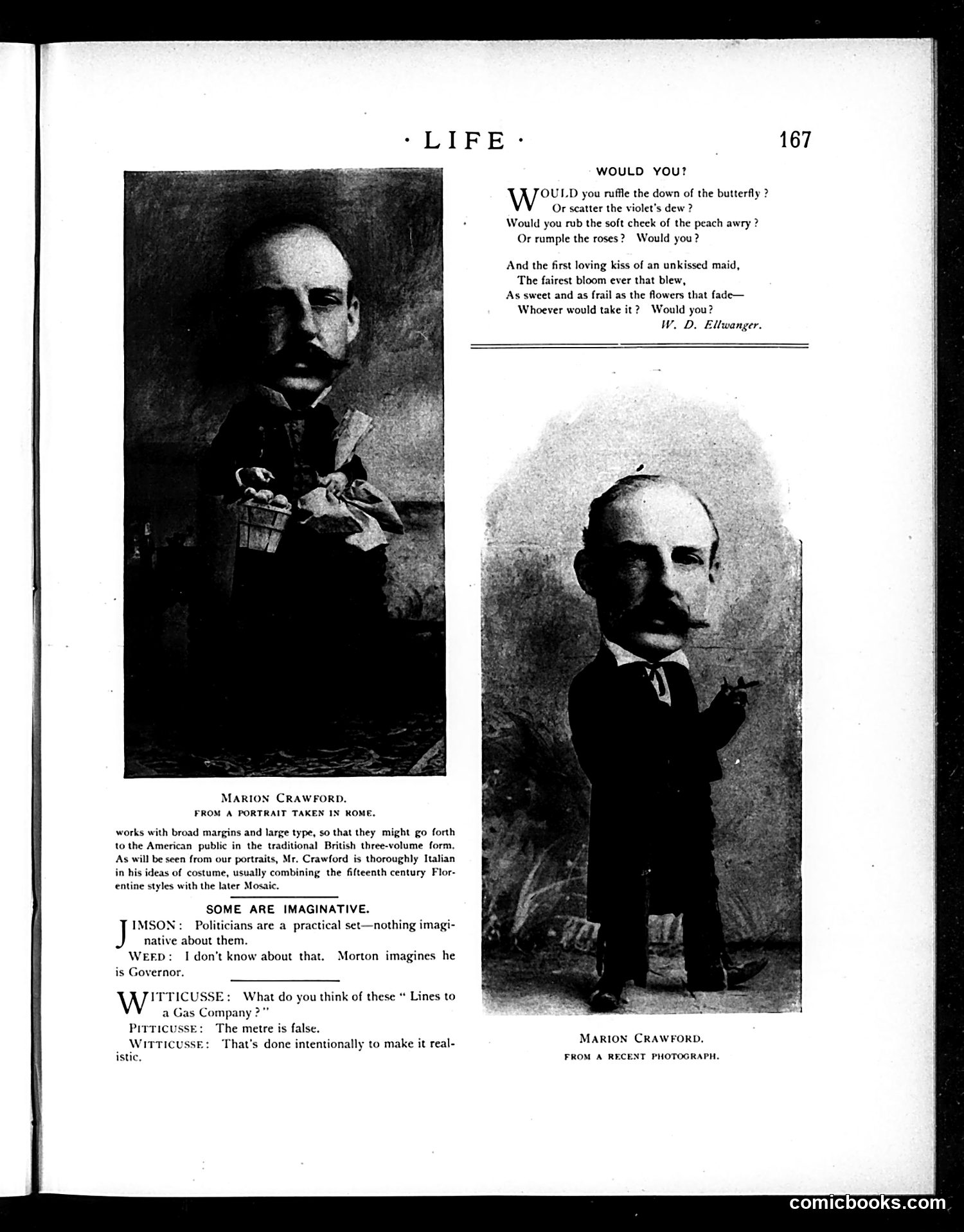
This page features two photographs of **Marion Crawford**, labeled as "from a portrait taken in Rome" and "from a recent photograph." The accompanying text describes Crawford's work as using "broad margins and large type" for American publication in "traditional British three-volume form," noting his "thoroughly Italian" costume ideas combining fifteenth-century Florentine with later Mosaic styles. Below the photographs is a dialogue section titled "SOME ARE IMAGINATIVE," featuring characters named Jimson, Weed, and Witticusse discussing politicians' lack of imagination. Witticusse critiques false advertising copy ("Lines to a Gas Company"), suggesting intentional deception to appear realistic. The page appears to satirize both artistic affectation and commercial dishonesty.
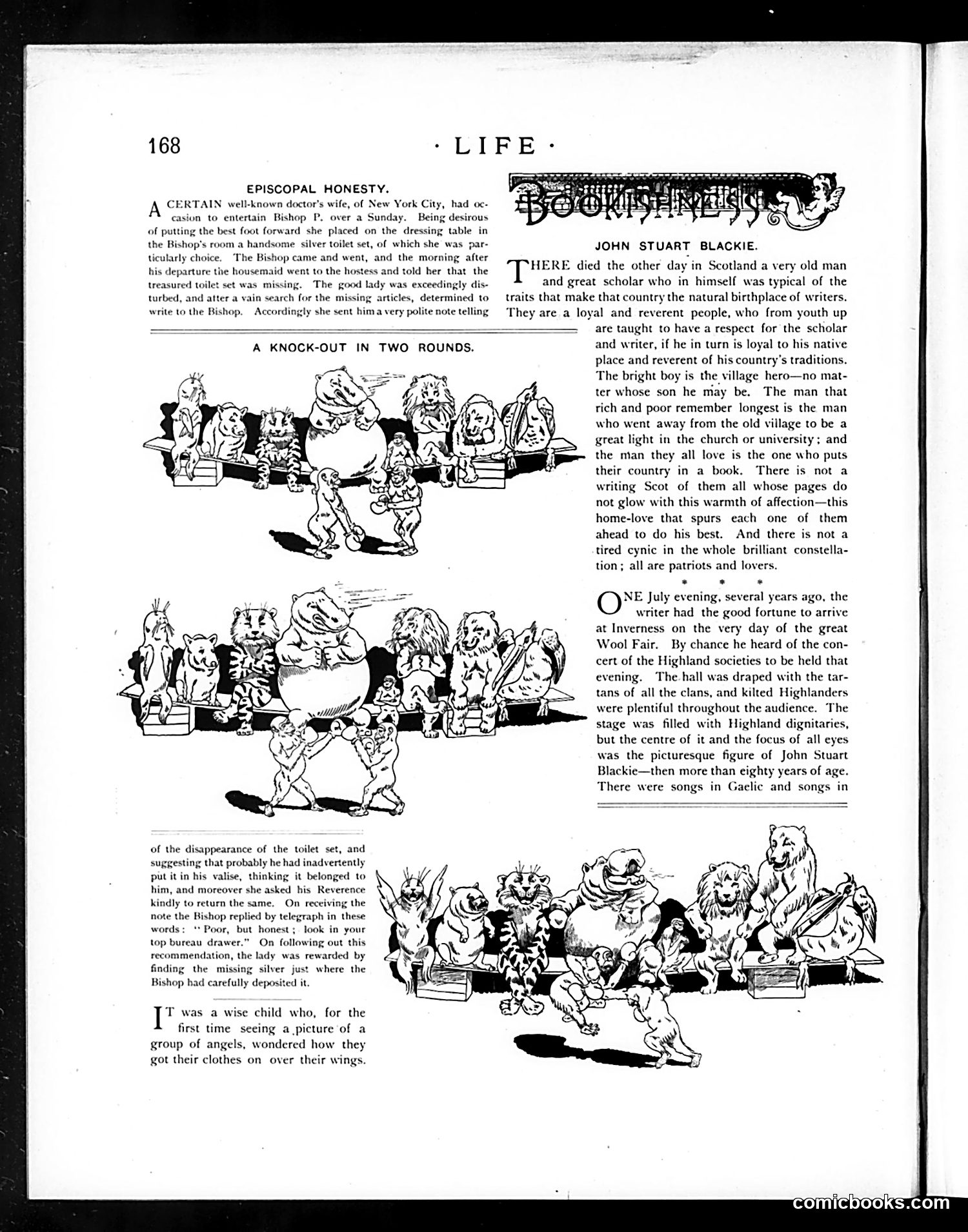
This page contains three separate humor pieces: **"Episcopal Honesty"** mocks a bishop's hypocrisy. A doctor's wife reports a missing toilet set to the bishop, who initially denies knowledge. When she threatens to write him about it, he suddenly "remembers" it was his all along—revealing his dishonesty when faced with public embarrassment. **"A Knock-Out in Two Rounds"** shows cartoon illustrations of what appears to be a boxing match or confrontation, though the specific reference is unclear from the visible content. **"John Stuart Blackie"** is an obituary celebrating a Scottish scholar known for patriotic writings and devotion to his homeland. The piece emphasizes how Scottish writers inspire national pride. The page satirizes institutional hypocrisy (the church) while celebrating genuine patriotism.
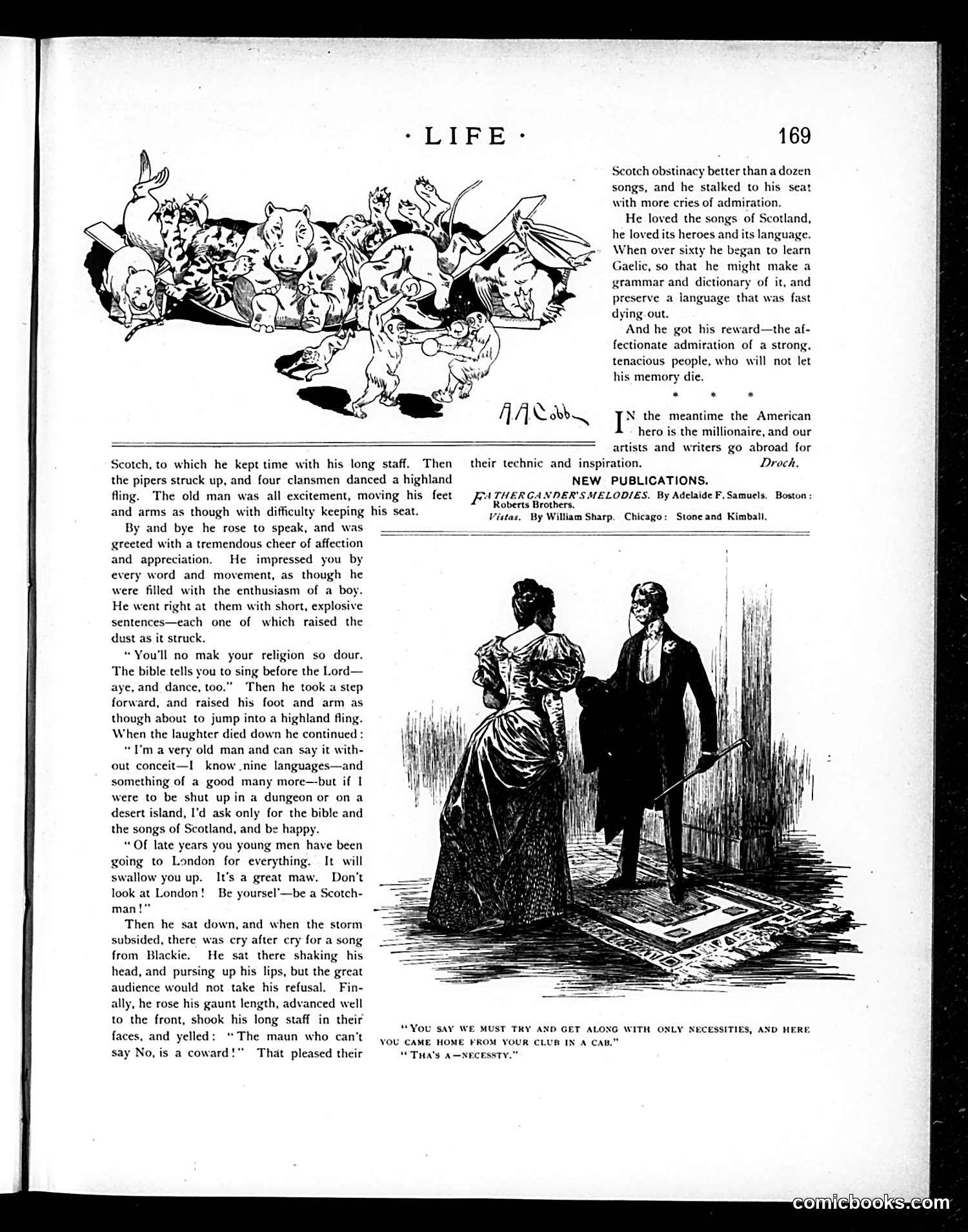
This page contains a narrative about an old Scottish man and his love for Scottish culture, language, and heritage. The top illustration shows various Scottish animals and objects in a whimsical arrangement. The main text describes how the man learned Gaelic, impressed audiences with passionate speeches about Scotland, and refused to compromise his Scottish identity despite pressure to adopt London ways. When challenged, he famously declares: "The maun who can't say No, is a coward!" The bottom illustration depicts a well-dressed couple in conversation, with dialogue about "necessities" and someone arriving home "from your club in a car." The satire appears to criticize materialism and the abandonment of cultural identity in favor of modern conveniences and urban sophistication—championing authentic Scottish pride over cosmopolitan assimilation.
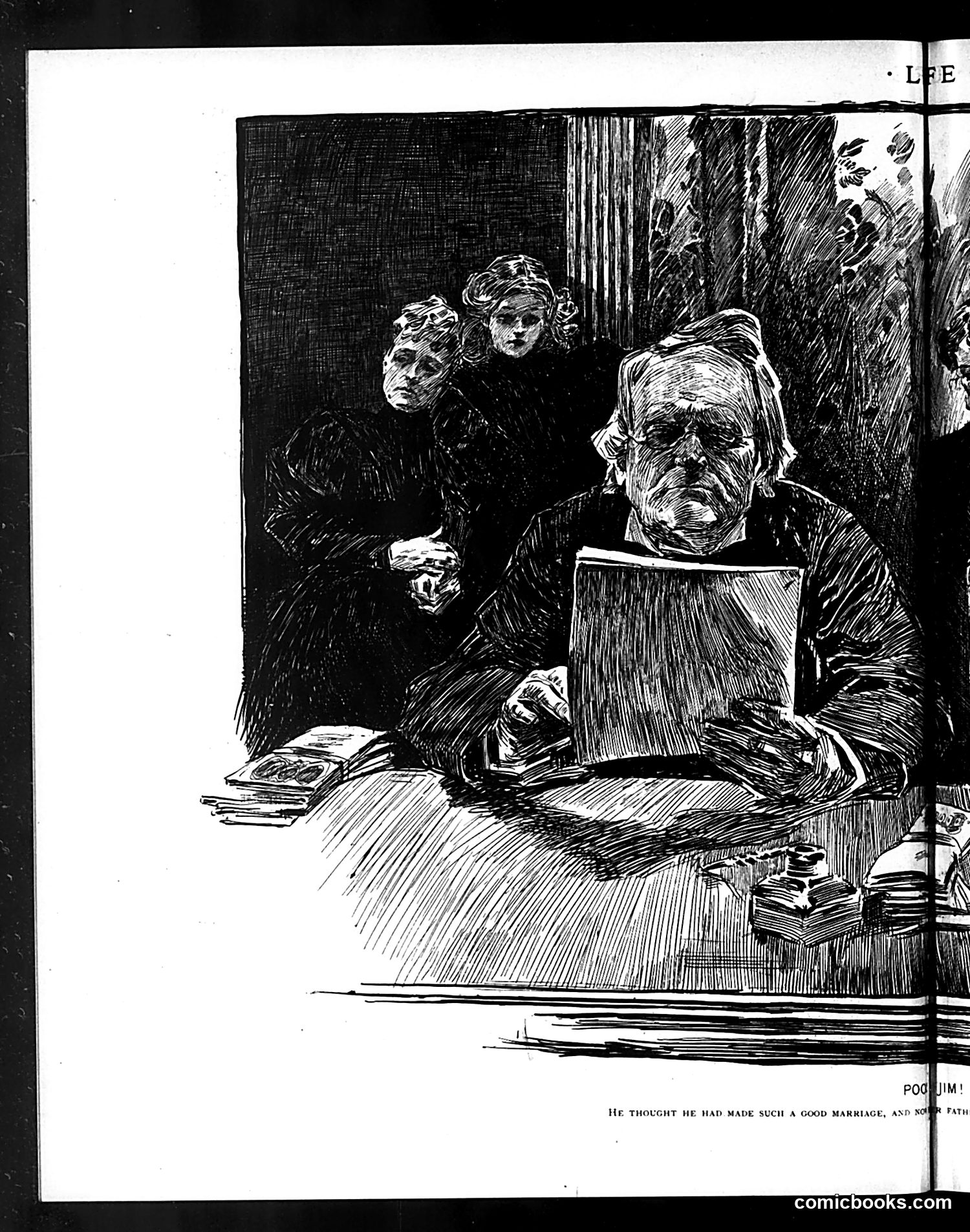
This is a satirical illustration showing an older man at a desk reading or reviewing documents, while two women stand behind him observing. The caption reads: "HE THOUGHT HE HAD MADE SUCH A GOOD MARRIAGE, AND SO A PATH..." The caption appears incomplete due to OCR or image cropping, making the full satirical point unclear. However, the scene suggests commentary on marriage or domestic relations. The man's absorbed focus on his paperwork while the women watch suggests either marital discord, financial concerns, or perhaps commentary on a public figure's personal life. Without the complete caption or clearer identification of the figures, the specific target and satirical message remain uncertain. The illustration's style and composition suggest this is social or domestic satire typical of *Life* magazine's approach to contemporary issues.
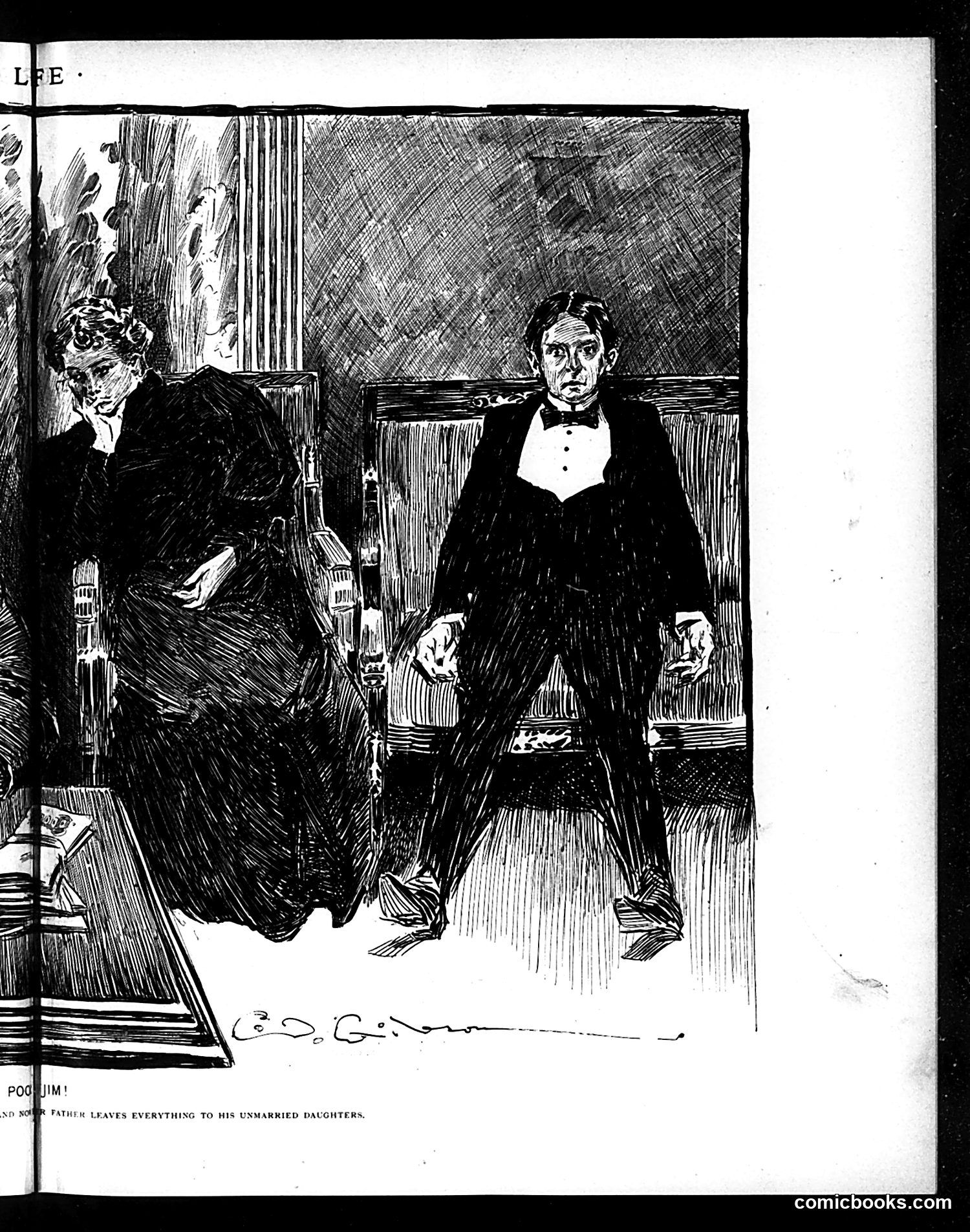
This is a satirical illustration from *Life* magazine showing two men in formal evening wear seated together. The caption reads: "A SON LEAVES EVERYTHING TO HIS UNMARRIED DAUGHTERS." The cartoon satirizes inheritance and family wealth dynamics of the era. The two formally-dressed men appear to be representatives of wealth or social standing, positioned awkwardly close together in what seems an uncomfortable social situation. The humor likely stems from the unconventional act of a father leaving his entire estate to unmarried daughters rather than following traditional patriarchal inheritance patterns—a socially notable choice that the magazine's readers would have found remarkable or worthy of mockery. The specific identities of the figures remain unclear from the image alone.
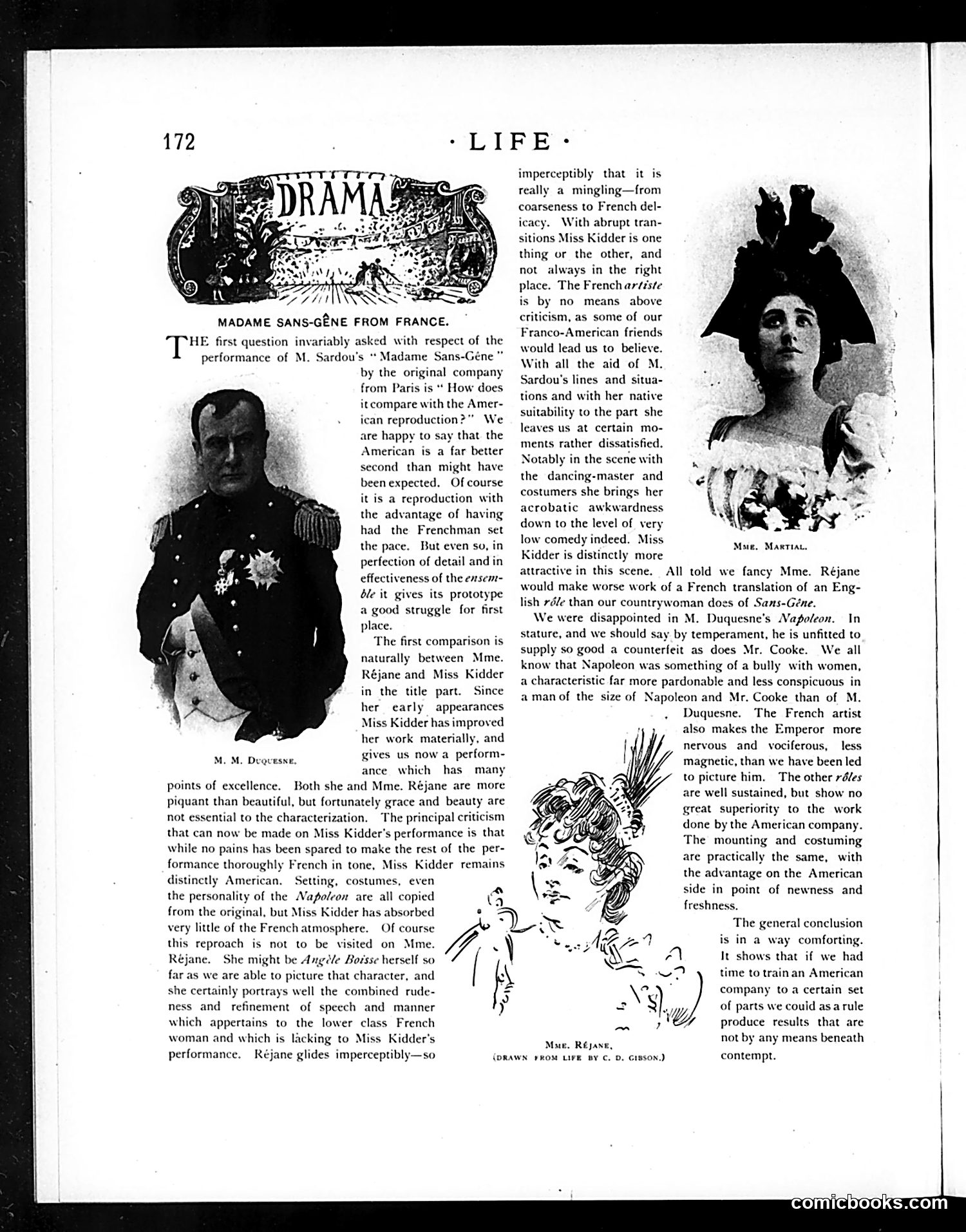
This theater review compares a French production of Sardou's play with its American adaptation. The illustrated figures are the actresses and actors in the cast: **Mme. Réjane** (original French star), **Miss Kidder** (American lead), and **M. Duquesne** (French actor playing Napoleon). The satire critiques both performances while highlighting a broader cultural point: the American version, though competent, lacks authentic French refinement. **Miss Kidder** remains "distinctly American" despite elaborate French sets and costumes—she lurches between coarseness and delicacy rather than gliding between them as Réjane does. Similarly, **Duquesne's Napoleon** is too nervous and vociferous compared to American actor Cooke's magnetic interpretation. The article's conclusion is backhanded: Americans *could* eventually match French artistry with proper training—faint praise suggesting American theater, while improving, still lags European sophistication in capturing authentic national character.
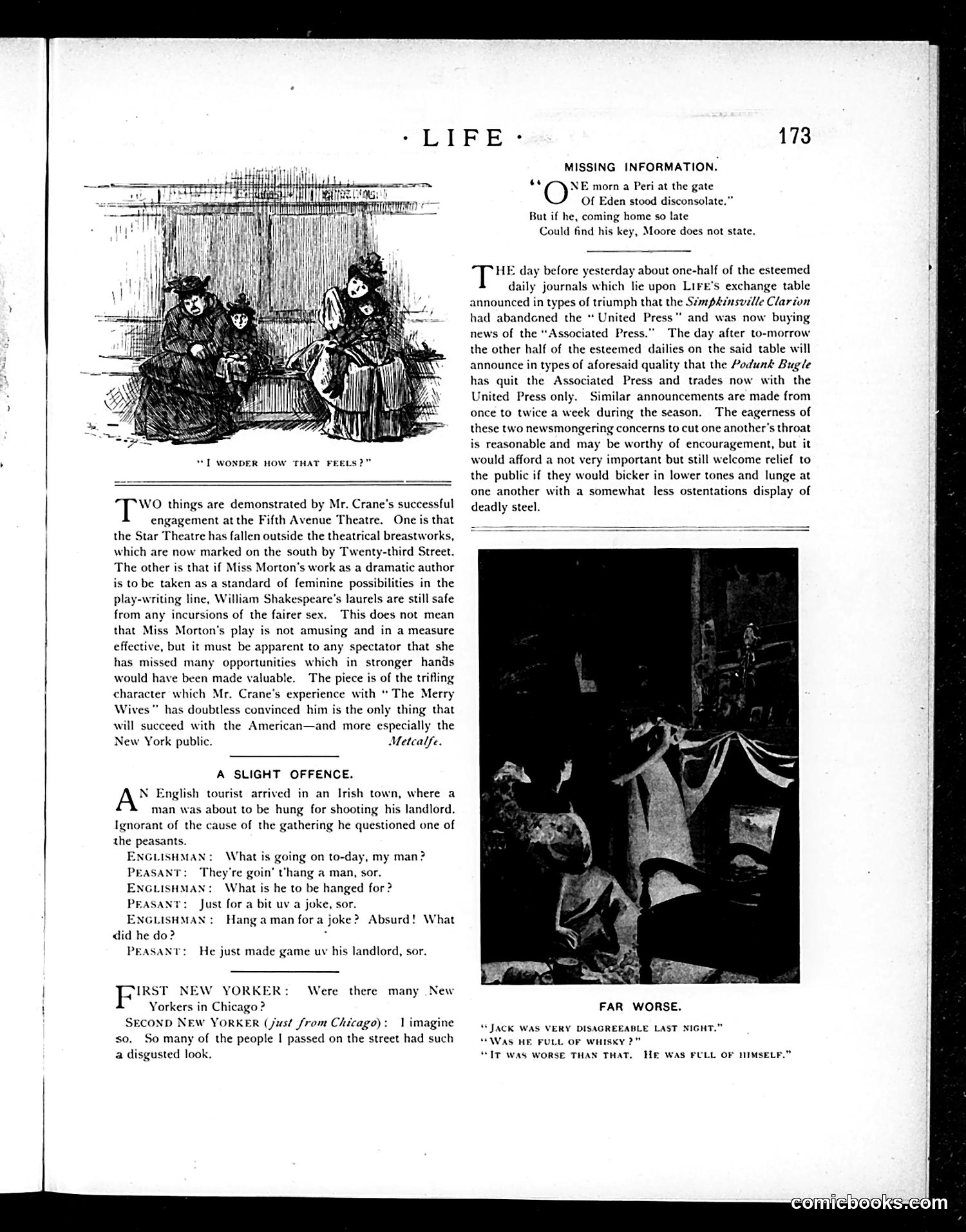
This page contains three distinct satirical pieces targeting American society and culture circa the 1880s-90s: **Theater Critique**: The main text reviews Mr. Crane's Fifth Avenue Theatre production and Miss Morton's play, suggesting that American audiences (particularly New York's) prefer trivial entertainment over quality drama. The author dismissively compares Morton unfavorably to Shakespeare. **"A Slight Offence"**: A joke mocking Irish peasants' casual violence. An Englishman discovers a man is being hanged for "making game" (joking) about his landlord—satirizing Irish-English tensions and portraying rural Irish as prone to brutal overreaction. **"First New Yorker" Joke**: Mocks Chicago by suggesting its residents look perpetually disgusted—a regional jab at Midwestern cities versus New York sophistication. **Bottom Section**: A brief commentary on competing news agencies (United Press vs. Associated Press) constantly switching allegiances, and a final quip about vanity being worse than drunkenness. The illustrated cartoons support these satirical themes with period engravings.
This page from *Life* magazine contains **anecdotal humor** rather than political cartoons. It's a collection of brief satirical stories meant to amuse educated readers through wit and social observation. The anecdotes mock: 1. **Musical pretension**: A correspondent absurdly overpaises Wagner, only to be undercut by a clever response suggesting Wagner is merely "a finer musician than Schiller"—deflating his enthusiasm. 2. **Social awkwardness**: A military officer, accustomed to restaurant etiquette, repeatedly wipes his silverware at a dinner party, misunderstanding polite society customs. 3. **Class economics**: Historical figures (Jonas Hanway, James Whitcomb Riley) are portrayed as stingy or contradictory—paying for simple items while complaining about costs, or a "tradesman" becoming a poet. The humor relies on **incongruity and class observations**—situations where characters reveal ignorance of social conventions or expose hypocrisy. The page also features period **product advertisements** (Ivory Soap, Williams Shaving Soap), typical of *Life*'s commercial model.
This page from *Life* magazine is primarily **advertisements and promotional content** rather than political satire. The visible content includes: **Advertisements:** For Armour beef extract, Reed & Barton silverware ("La Marquise" design), and Redfern court dressmaker. **Business news:** An article about Herbert Booth King & Brother's advertising and publishing agency relocating their offices to Madison Square, highlighting their modern facilities and services. **Magazine promotion:** A "Monthly Calendar for March" featuring a contest tied to the novel *Trilby* (a popular book of the era), offering cash prizes for readers who answer trivia questions about the story. **Satirical anecdote:** A brief humorous story about an authoress giving tedious readings at a salon, during which a guest (Mr. Bore) escapes and finds the footman asleep at his post—a gentle joke about enduring bad literature. The page reflects turn-of-the-century American magazine culture: commercial advertising mixed with literary content and reader engagement contests.
This page contains three anecdotal stories illustrating American character and wit, presented as moral tales for the magazine's genteel audience. **The Hawthorne story** depicts the famous novelist as a humanitarian who identifies a genuine American through intimate local knowledge—asking about "Skim-milk Folsom," an apple-seller from the boy's hometown. The joke: real nationality cannot be faked; authentic belonging is proved through shared memory. **The Aberdeen Professor story** mocks old-fashioned academic pomposity—a stiff Scottish professor responds to a social invitation card with equally stiff formality, unable to grasp its purpose. **The Culberson anecdote** satirizes a Texas lawyer's pragmatic superiority over a Maryland rival. When the Marylander relies on Boston-printed legal authorities, Culberson dismisses them as inapplicable to Texas, suggesting local knowledge and common sense trump Eastern legal formalism. All three stories celebrate American shrewdness and practical wisdom over pretense and imported formality.
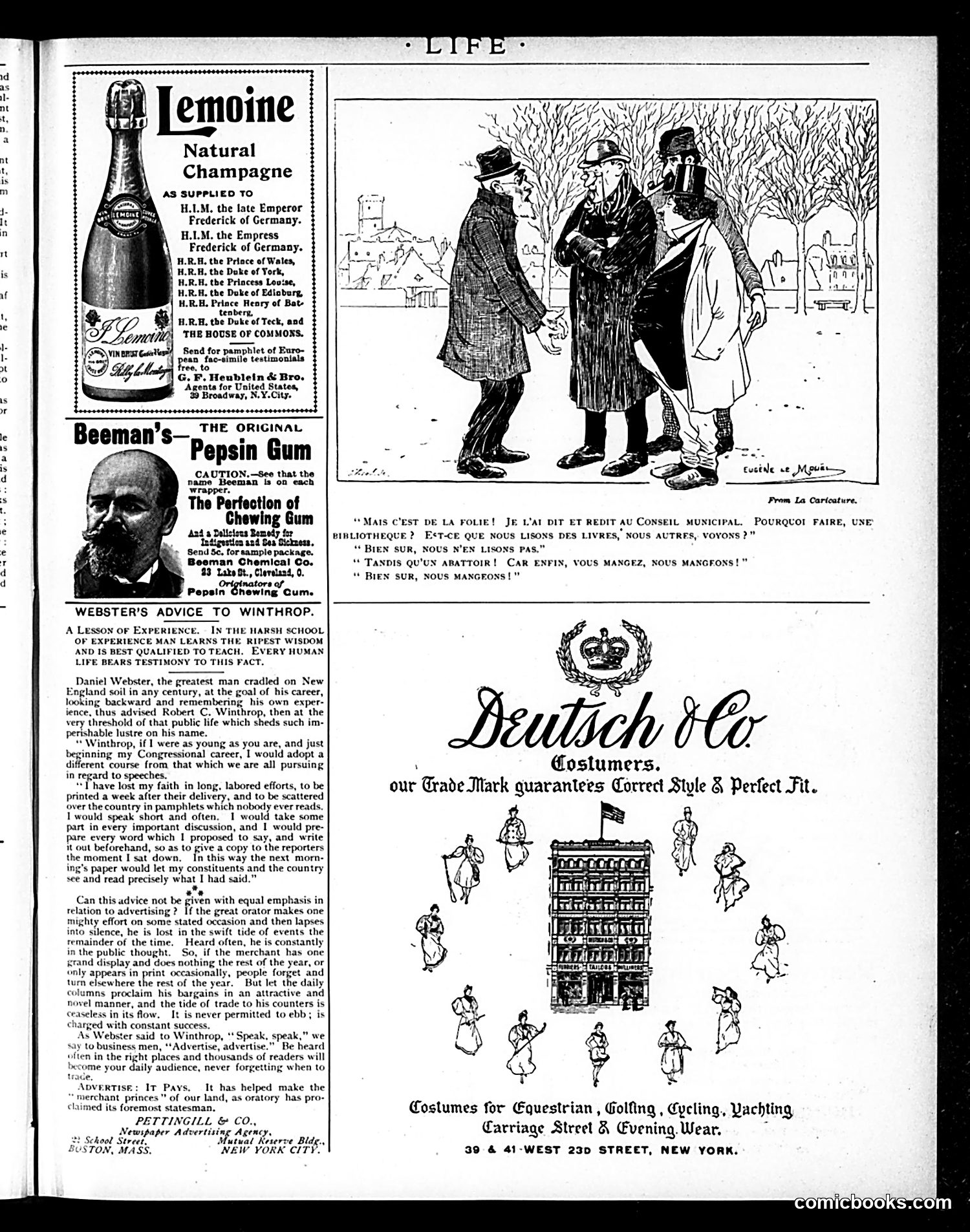
The main cartoon (credited "From La Caricature," a French publication) satirizes municipal politics, likely depicting a debate over public spending priorities. Three well-dressed officials discuss whether to build a library. The dialogue reveals the satire's point: one asks "Why build a library?" and another responds "Because we read books"—but a third counters that an abattoir (slaughterhouse) is better since "we eat, we others eat!" The joke mocks politicians' prioritization of practical, self-interested concerns (food/business) over civic improvements like libraries and education. It suggests that elected officials care more about butchers' profits than public enlightenment. The page is otherwise filled with advertisements (Lemoine Champagne, Beeman's Pepsin Gum, Deutsch & Co. costumes) and an essay praising frequent advertising, making this a typical Life magazine page mixing satire with commercial content.
This page contains two humorous anecdotes from late 19th-century American life, plus period advertisements. **"General Slocum" story**: Two Civil War generals attempt to con a stranger in Philadelphia by pretending to recognize him as an old acquaintance ("Bradford"). The man, suspicious of their "confidence operator" scheme, nearly has them arrested before they escape on their train. The satire mocks how easily con artists operated then and the generals' audacity. **"Davis-Thompson wedding" story**: Secretary of the Treasury Carlisle pranks wedding guests by secretly advancing a decorative cuckoo clock to strike noon early. When the ceremony actually begins at noon, the clock repeatedly cuckoos at an awkward moment—right as he enters—embarrassing him publicly. The joke satirizes a powerful government official being humbled by his own failed practical joke. Both stories exemplify *Life* magazine's satire of prominent public figures and social pretense. The advertisements below (dressmakers, cameras, wine) are typical period marketing.