
Life, 1895-03-14 · page 6 of 18
Life — March 14, 1895 — page 6: what you’re looking at
What you’re looking at
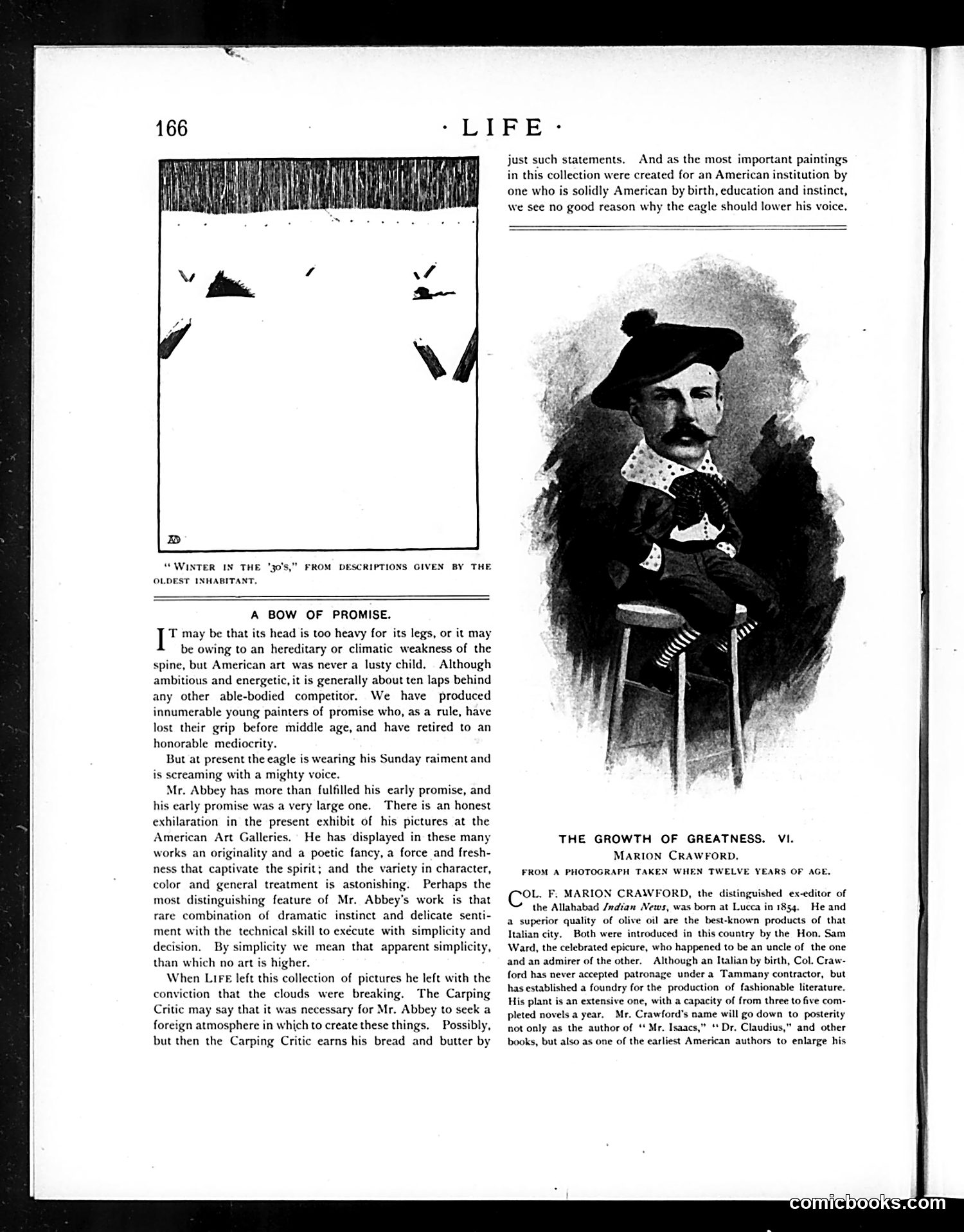
The page contains two distinct elements: **Left side:** A minimalist cartoon titled "Winter in the '90s" depicts a sparse interior with a fireplace and minimal furnishings—likely satirizing economic hardship or poverty during the 1890s depression era. **Right side:** A portrait and article about Marion Crawford titled "The Growth of Greatness. VI." Crawford was apparently an American author and playwright of Italian-American heritage. The text praises his artistic development and mentions his works including "Mr. Isaacs" and "Dr. Claudius." The article emphasizes his dual cultural identity and literary contributions to American letters, suggesting *Life* magazine was promoting contemporary American cultural achievement. The juxtaposition suggests contrasting 1890s social conditions—economic struggle versus artistic success.
📄 Transcribed text from this page (OCR, searchable)
Machine-transcribed from the original scan — historical spelling and the odd misread are preserved.
- LIFE: “WINTER IN THE ‘30's, FROM DESCRIPTIONS GIVEN BY THE OLDEST INHABITANT. A BOW OF PROMISE. I" may be that its head is too heavy for its legs, or it may be owing to an hereditary or climatic weakness of the spine, but American art was never a lusty child. Although ambitious and energetic, it is generally about ten laps behind any other able-bodied competitor. We have produced innumerable young painters of promise who, as a rule, have lost their grip before middle age, and have retired to an honorable mediocrity. But at present the eagle is wearing his Sunday raiment and is screaming with a mighty voice. Mr. Abbey has more than fulfilled his early promise, and his carly promise was a very large one. There is an honest exhilaration in the present exhibit of his pictures at the American Art Galleries. He has displayed in these many works an originality and a poetic fancy, a force and fresh- ness that captivate the spirit; and the variety in character, color and general treatment is astonishing. Perhaps the most distinguishing feature of Mr. Abbey’s work is that rare combination of dramatic instinct and delicate senti- ment with the technical skill to exécute with simplicity and decision. By simplicity we mean that apparent simplicity, than which no art is higher. When LiFe left this collection of pictures he left with the conviction that the clouds were breaking. The Carping Critic may say that it was necessary for Mr. Abbey to seek a foreign atmosphere in which to create these things. Possibly, but then the Carping Critic earns his bread and butter by just such statements. And as the most important paintings in this collection were created for an American institution by one who is solidly American by birth, education and instinct, we see no good reason why the eagle should lower his voice. THE GROWTH OF GREATNESS. VI. MARION CRAWFORD, FROM A PHOTOGRAPH TAKEN WHEN TWELVE YEARS OF AGE. OL. F. MARION CRAWFORD, the distinguished ex-editor of the Allahabad /ndian News, was born at Lucca in 1854. He and a superior quality of olive oil are the best-known products of that Italian city. Both were introduced in this country by the Hon, Sam Ward, the celebrated epicure, who happened to be an uncle of the one and an admirer of the other. Although an Italian by birth, Col. Craw- ford has never accepted patronage under a Tammany contractor, but has established a foundry for the production of fashionable literature. His plant is an extensive one, with a capacity of from three to five com- pleted novels a year. Mr. Crawford’s name will go down to posterity not only as the author of * Mr. Isaacs,” ‘Dr. Claudius,” and other books, but also as one of the earliest American authors to enlarge his