
Life, 1895-03-14 · page 12 of 18
Life — March 14, 1895 — page 12: what you’re looking at
What you’re looking at
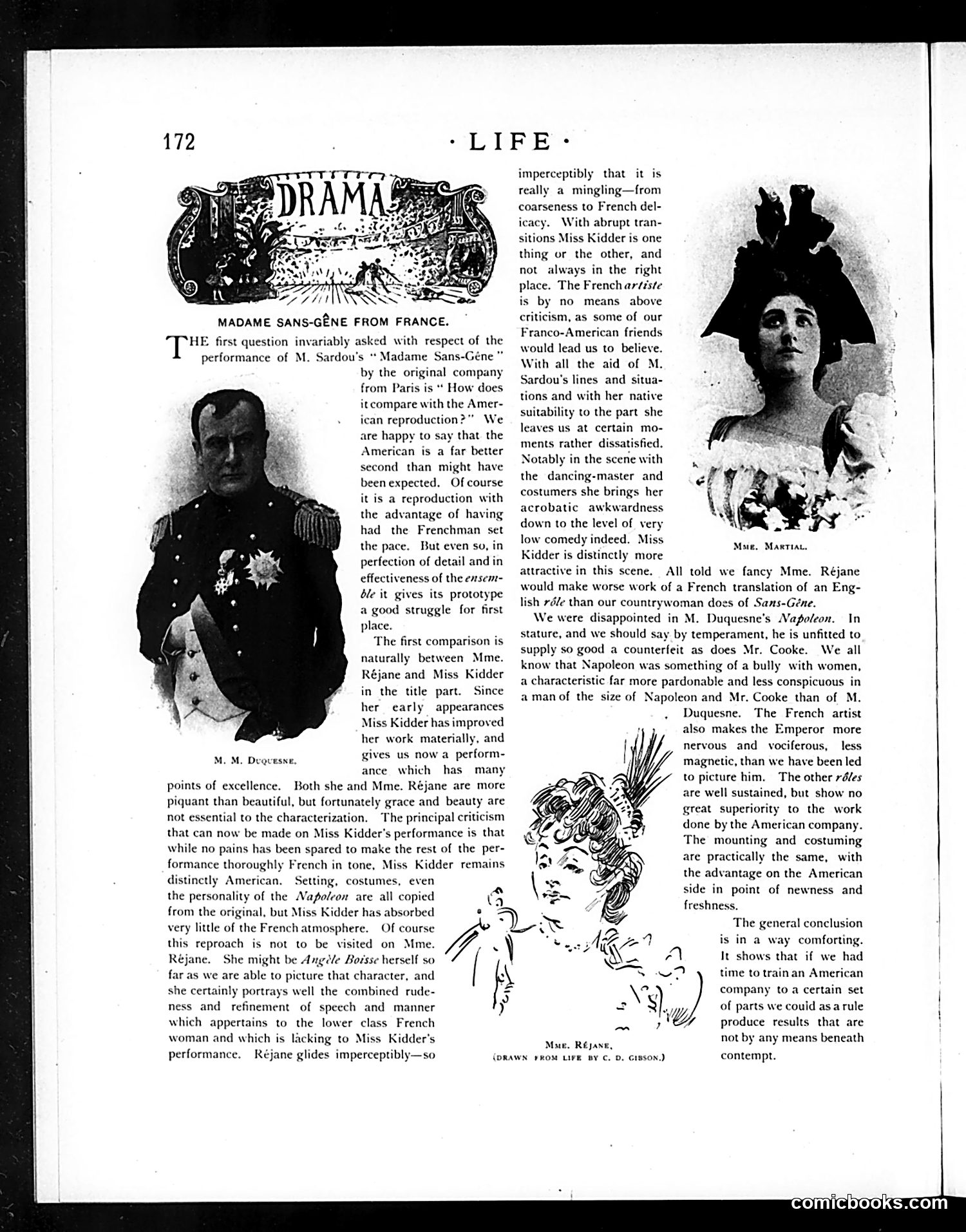
This theater review compares a French production of Sardou's play with its American adaptation. The illustrated figures are the actresses and actors in the cast: **Mme. Réjane** (original French star), **Miss Kidder** (American lead), and **M. Duquesne** (French actor playing Napoleon). The satire critiques both performances while highlighting a broader cultural point: the American version, though competent, lacks authentic French refinement. **Miss Kidder** remains "distinctly American" despite elaborate French sets and costumes—she lurches between coarseness and delicacy rather than gliding between them as Réjane does. Similarly, **Duquesne's Napoleon** is too nervous and vociferous compared to American actor Cooke's magnetic interpretation. The article's conclusion is backhanded: Americans *could* eventually match French artistry with proper training—faint praise suggesting American theater, while improving, still lags European sophistication in capturing authentic national character.
📄 Transcribed text from this page (OCR, searchable)
Machine-transcribed from the original scan — historical spelling and the odd misread are preserved.
MADAME SANS-GENE FROM FRANCE. HE first question invariably asked with respect of the performance of M. Sardou’s “ Madame Sans-Géne " by the original company from Paris is * How does itcompare with the Amer- ican reproduction?” We are happy to say that the American is a far better second than might ve beenexpected. Of course it is a reproduction with the advantage of having had the Frenchman set the pace. But even so, in perfection of detail and in effectiveness of the ensem- ble it gives its prototype a good struggle for first place. The fi naturally between Mme. Réjane and Miss Kidder in the title part. Since her early appearances Miss Kidder has improved her work materially, and gives us now a perform- ance which has points of excellence. Both she and Mme. Réjane are more piquant than beautiful, but fortunately grace and beauty are not essential to the characterization. The principal criticism that can now be made on Miss Kidder’s performance is that while no pains has been spared to make the rest of the per- formance thoroughly French in tone, Miss Kidder remains distinctly American. Setting, costumes, even the personality of the Napoleon are all copied from the original, but Miss Kidder has absorbed very little of the French atmosphere. Of course this reproach is not to be visited on Mme. Réjane. She might be Angéle Borsse herself so far as we are able to picture that character, and she certainly portrays well the combined rude- ness and refinement of speech and manner which appertains to the lower class French woman and which is lacking to Miss Kidder's performance. Réjane glides imperceptibly—so ‘st comparison is M. Dequesse. - LIFE: imperceptibly that it is really a mingling—from coarseness to French del- icacy. With abrupt tran- sitions Miss Kidder is one thing or the other, and not always in the right place. The French artiste is by no means above m, as some of our Franco-American friends would lead us to believe. With all the aid of M. Sardou's lines and situa- tions and with her native suitability to the part she leaves us at certain mo- ments rather dissatisfied. Notably in the scene with the dancing-master and costumers she brings her acrobatic awkwardness down to the level of very low comedy indeed. Miss Kidder is distinctly more attractive in this scene. All told we fancy Mme. Réjane would make worse work of a French translation of an Eng- lish ré/e than our countrywoman does of Sams-Géne. We were disappointed in M. Duquesne's Napoleon. In stature, and we should say by temperament, he is unfitted to supply so good a counterfeit as does Mr. Cooke. We all know that Napoleon was something of a bully with women, a characteristic far more pardonable and less conspicuous in aman of the size of Napoleon and Mr. Cooke than of M. Duquesne. The French artist also makes the Emperor more nervous and vociferous, less magnetic, than we have been led to picture him. The other rd/es are well sustained, but show no great superiority to the work done by the American company. The mounting and costuming are practically the same, with the advantage on the American side in point of newness and freshness. Mate, Magtiat. The general conclusion in a way comforting. It shows that if we had time to trainan American company to a certain set of parts we couid asa rule produce results that are not by any means beneath Mae. Réyane, (DRAWN FROM LIFE BY C.D. GIBSON.) contempt.