
Life, 1895-03-14 · page 4 of 18
Life — March 14, 1895 — page 4: what you’re looking at
What you’re looking at
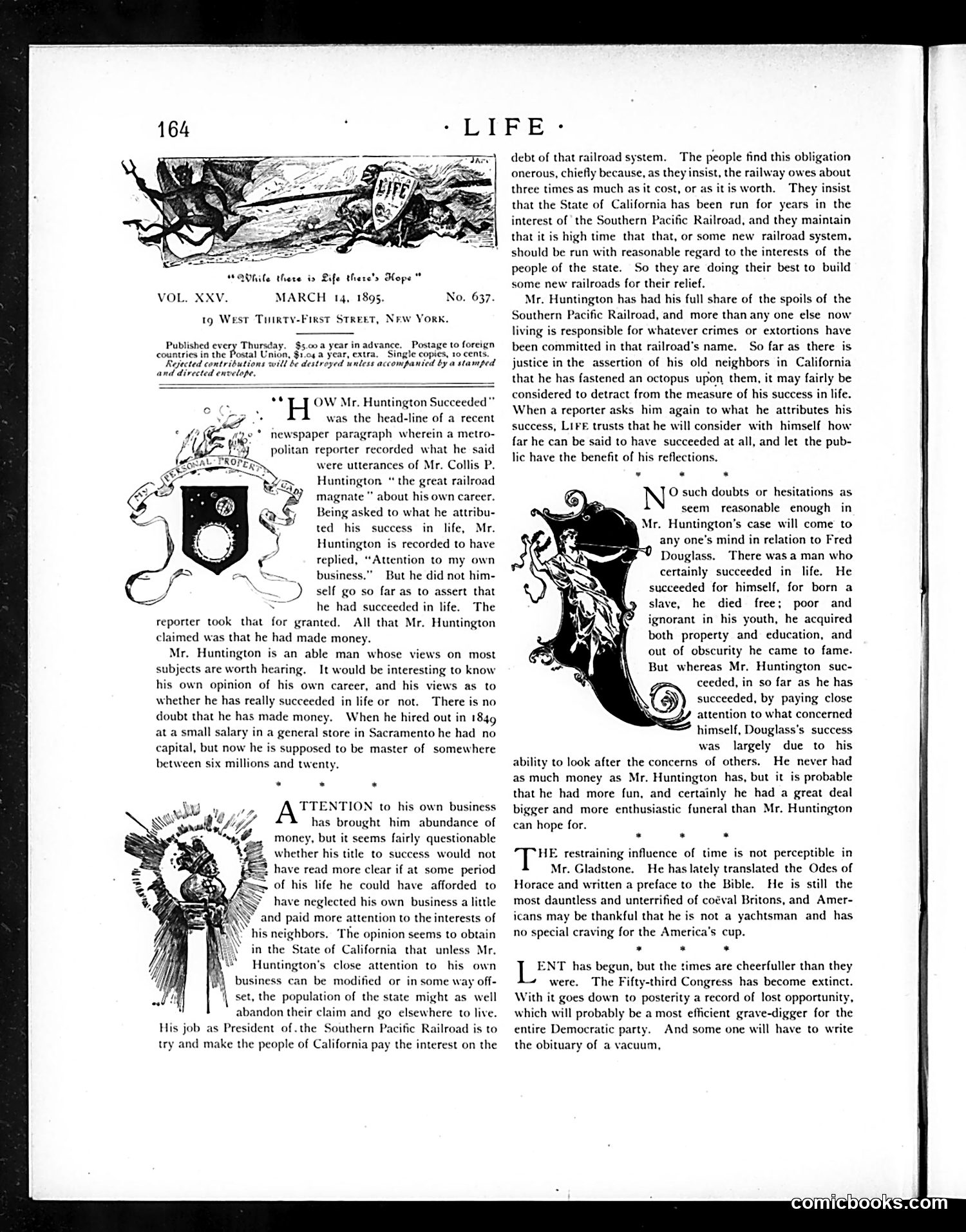
This page critiques **Collis P. Huntington**, the railroad magnate and president of the Southern Pacific Railroad. The article questions whether Huntington truly "succeeded in life," despite his enormous wealth accumulated from railroad operations. The satire's point: Huntington claims his success stems from "attention to his own business," yet the text argues he's actually neglected California's broader interests while building his fortune. The piece contrasts Huntington with **Fred Douglass** (the formerly enslaved man who became famous), suggesting Douglass's rise from poverty through self-improvement is more genuinely admirable than Huntington's wealth, which the magazine implies came partly at public expense. The cartoon's grotesque imagery reinforces this moral critique of unchecked capitalist accumulation.
📄 Transcribed text from this page (OCR, searchable)
Machine-transcribed from the original scan — historical spelling and the odd misread are preserved.
LIFE HOMIE there is Life there's Hope" MARCH 14, 1895. tg West Tuirty-First STREET, No. 637. New York. Published every Thursday. $5.00a year in advance. Postage to foreign countries in the Postal Union, $1.04 a year, extra, Single copies, 10 cents. U be destroyed unless accompanied by a stamped Rejected contribution: and directed envelope, OW Mr. Huntington Succeeded” was the head-line of a recent paper paragraph wherein a metro- reporter recorded what he said were utterances of Mr. Collis P. Huntington “ the great railroad magnate” about his own career. Being asked to what he attribu- ted his success in life, Mr. Huntington is recorded to have replied, “Attention to my own busines: But he did not him- self go so far as to assert that he had succeeded in life. The reporter took that for granted, All that Mr. Huntington claimed was that he had made money. Mr. Huntington is an able man whose views on most subjects are worth hearing. It would be interesting to know his own opinion of his own career, and his views as to whether he has really succeeded in life or not. There is no doubt that he has made money. When he hired out in 1849 at a small salary in a general store in Sacramento he had no capital, but now he is supposed to be master of somewhere between six millions and twenty. . * . ATTENTION to his own business has brought him abundance of money, but it seems fairly questionable whether his title to success would not ig "fy iy have read more clear if at some period of his life he could have afforded to have neglected his own business a little \) and paid more attention to the interests of his neighbors. The opinion seems to obtain in the State of California that unless Mr. Huntington's close attention to his own business can be modified or in some way off- || set, the population of the state might as well abandon their claim and go elsewhere to live. puthern Pacific Railroad is to ke the people of California pay the interest on the His job as Pr try and ma debt of that railroad system. The people find this obligation onerous, chiefly because, as they insist, the railway owes about three times as much as it cost, or as it is worth. They insist that the State of California has been run for years in the interest of the Southern Pacific Railroad, and they maintain that itis high time that that, or some new railroad system, should be run with reasonable regard to the interests of the people of the state. So they are doing their best to build some new railroads for their relief. Mr. Huntington has had his full share of the spoils of the Southern Pacific Railroad, and more than any one else now living is responsible for whatever crimes or extortions have been committed in that railroad’s name. So far as there is justice in the assertion of his old neighbors in California that he has fastened an octopus upon them, it may fairly be considered to detract from the measure of his success in life. When a reporter asks him again to what he attributes his success, LIFE trusts that he will consider with himself how far he can be said to have succeeded at all, and let the pub- lic have the benefit of his reflections. O such doubts or hesitations as seem reasonable enough in Mr. Huntington's case will come to any one’s mind in relation to Fred Douglass. There was a man who certainly succeeded in life. He succeeded for himself, for born a slave, he died free; poor and ignorant in his youth, he acquired both property and education, and out of obscurity he came to fame. But whereas Mr. Huntington suc- ceeded, in so far as he has succeeded, by paying close attention to what concerned —= himself, Douglass's success was largely due to his ability to look after the concerns of others. He never had as much money as Mr. Huntington has, but it is probable that he had more fun, and certainly he had a great deal bigger and more enthusiastic funeral than Mr. Huntington can hope for. HE restraining influence of time is not perceptible in Mr. Gladstone. He has lately translated the Odes of Horace and written a preface to the Bible. He is still the most dauntless and unterrified of coéval Britons, and Amer- icans may be thankful that he is not a yachtsman and has no special craving for the America’s cup. * * . L T has begun, but the times are cheerfuller than they were. The Fifty-third Congress has become extinct. With it goes down to posterity a record of lost opportunity, which will probably be a most efficient grave-digger for the entire Democr: party. And some one will have to write the obituary of a vacuum,