
Life, 1895-03-14 · page 16 of 18
Life — March 14, 1895 — page 16: what you’re looking at
What you’re looking at
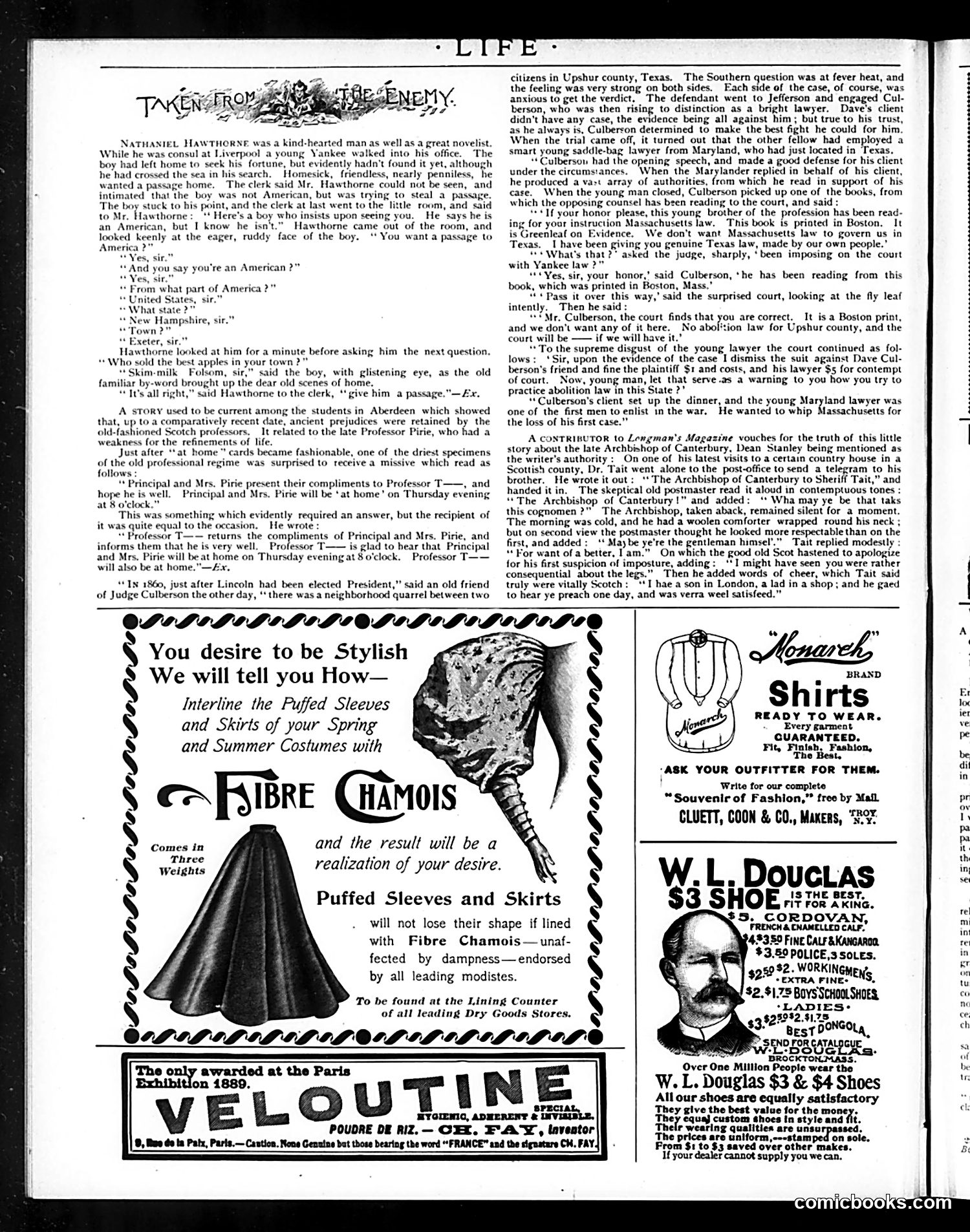
This page contains three anecdotal stories illustrating American character and wit, presented as moral tales for the magazine's genteel audience. **The Hawthorne story** depicts the famous novelist as a humanitarian who identifies a genuine American through intimate local knowledge—asking about "Skim-milk Folsom," an apple-seller from the boy's hometown. The joke: real nationality cannot be faked; authentic belonging is proved through shared memory. **The Aberdeen Professor story** mocks old-fashioned academic pomposity—a stiff Scottish professor responds to a social invitation card with equally stiff formality, unable to grasp its purpose. **The Culberson anecdote** satirizes a Texas lawyer's pragmatic superiority over a Maryland rival. When the Marylander relies on Boston-printed legal authorities, Culberson dismisses them as inapplicable to Texas, suggesting local knowledge and common sense trump Eastern legal formalism. All three stories celebrate American shrewdness and practical wisdom over pretense and imported formality.
📄 Transcribed text from this page (OCR, searchable)
Machine-transcribed from the original scan — historical spelling and the odd misread are preserved.
NATHANIEL HAWTHORNE was a kind-hearted man as well as a great novelist. consul at Liverpool a young Yankee walked into his office. The boy had left home to seek his fortune, but evidently hadn't found it yet, although he had crossed the sea in his search. mesick, friendless, nearly penniless, he wanted a passage home, The clerk said Mr. Hawthorne could not be seen, ‘and intimated that the boy was not American, but was trying to steal a passage. The boy stuck to his point, and the clerk at last went to the little room, and said to Mr. Hawthorne: ** Here's a boy who insists upon seeing you. He ‘says he is an American, but I know he isn't.” Hawthorne came out of the room, and looked keenly at the eager, ruddy face of the boy. ‘ You want a passage to America ?” Yes, sir.” ‘And you say you're an American ?” merica ?" New Hampshire, sir.” wn?" Exeter, sir.” Hawthorne looked at him for a minute before asking him the next question, ** Who sold the best apples in your town ?” “Skim-milk Folsom, sir,” said the boy, with glistening eye, as the old familiar by-word brought up the dear old scenes of home. “It's all right,” stid Hawthorne to the clerk, give him a passage."—Zx. A STORY used to be current among the students in Aberdeen which showed that, up to a comparatively recent date, ancient prejudices were retained by the old-fashioned Scotch professors. . It related to the late Professor Pirie, who had a weakness for the refinements of life Just after “at home” cards became fashionable, one of the driest specimens of the old professional regime was surprised to receive a missive which read as cipal and Mrs, Pirie present their compliments to Professor T—, and hope he is well, Principal and Mrs. Pirie will be ‘at home’ on Thursday evening at 8 o'clock.” This was something which evidently required an answer, but the recipient of it was quite equal to the occasion. He wrote : “* Professor T—— returns the compliments of Principal and Mrs. Pirie, and informs them that he is very well. Professor T—— is glad to hear that Principal and Mrs. Pirie will beat home on Thursday evening at o'clock. Professor T—— will also be at home." —£x, id been elected President,” said an old friend “LN 1860, just after Lincoln h. here was a neighborhood quarrel between two of Judge Culberson the other day, citizens in Upshur county, Texas. The Southern question was at fever heat, and the feeling was very strong on both sides. Each side of the case, of course, was anxious to get the verdict.” The defendant went to Jefferson and engaged Cul- berson, who was then rising to distinction as a bright lawyer. Dave's client didn’t have any case, the evidence being all against him; but true to his trust, as he always is, Culberson determined to make the best fight he could for him: When the trial came off, it turned out that the other fellow had employed a smart young saddle-bag lawyer from Maryland, who had just located in Texas. “Culberson had the opening speech, and made a good defense for his client under the circumstances. When the Marylander replied in behalf of his client, he produced a vast array of authorities, fram which he read in support of his case. When the young man closed, Culberson picked up one of the books, from which the opposing counsel has been reading to the court, and said : “+ “If your honor please, this young brother of the profession has been read- ing for yoor instruction Massachusetts law. This book is priated in Boston, It is Greenleaf on Evidence. We don’t want Massachusetts law to govern us in Texas. [have been giving you genuine Texas law, made by our own people.’ “<\ What's that?” asked the judge, sharply, ‘been imposing on the court with Yankee law “Yes, sir, your honor,’ said Culberson, ‘he has been reading from this book, which was printed in Boston, Mass.” “<Pass it over this way,’ said the surprised court, looking at the fly leaf intently. Then he said : + Mr. Culberson, the court finds that you are correct. It is a Boston print, and we don't want any of it bere. No abolition law for Upshur county, and the court w if we will have it.’ “To the supreme disgust of the young lawyer the court continued as fol- lows: ‘Sir, upon the evidence of the case I dismiss the suit against Dave Cul- berson's friend and fine the plaintiff $1 and costs, and his lawyer $5 for contempt of court. Now, young man, let that serve.as a’ warning to you how you try to practice abolition law in this State ?* “ Culberson's client set up the dinner, and the young Maryland lawyer was one of the first men to enlist in the war. He wanted to whip Massachusetts for the loss of his first case." A CONTRIBUTOR to Lengman's Magazine vouches for the truth of this little story about the late Archbishop of Canterbury, Dean Stanley being mentioned as the writer's authority : On one of his latest visits to a certain country house in a Scottish county, Dr. Tait went alone to the post-office to send a telegram to his brother. He wrote it out: ‘The Archbishop of Canterbury to Sheriff Tait,” and handed it in. ‘The skeptical old postmaster read it aloud in contemptuous tones : “The Archbishop of Canterbury!” and added: ‘* Wha may ye be that taks this cognomen ?” The Archbishop, taken aback, remained silent for a moment. ‘The morning was cold, and he hada woolen comforter wrapped round his neck ; but on second view the postmaster thought he looked more respectable than on the first, and added: ** Maybe ye're the gentleman himsel’.” Tait replied modestly : “For want of a better, Lam.” On which the good old Scot hastened to apologize for his first suspicion of imposture, adding: "*1 might have seen you were rather consequential about the legs.” ‘Then he added words of cheer, which Tait said truly were vitally Scotch: “I hae a son in London, a lad in a shop ; and he gaed to hear ye preach one day, and was verra weel satisfeed.” OLIItIIIDIIODIG*Is*I7ItI7 JI 7® You desire to be Stylish We will tell you How— Interline the Puffed Sleeves and Skirts of your Spring and Summer Costumes with IBRE (HAMOIS and the result will be a CAN Comes in Three Weights Puffed Sleeves and : ) realization of your desire. will not lose their shape if lined with Fibre Chamois— unaf- fected by dampness— endorsed by all leading modistes. To be found at the Lining Counter of all leading Dry Goods Stores. ID ID ID ID ID IDOL ID ID ID IG IH BRAND Shirts READY TO WEAR. Every garment GUARANTEED. Fit, Finfah, Fashion, ‘The Best, ‘ASK YOUR OUTFITTER FOR THEM. Write for our complete “Souvenir of Fashion,” free by Mail CLUETT, COON & CO., Mixers, “S:3% N.Y. SHOE 1S THE BEST, FIT FOR AKING. $5. COR DOVAN, |A CNAMELLED CALF. 48359 Fine CALF &KANGAROO. $3.59 er ,3SOLES. $2 Kil $250 Toca rine, J $2.$175 Boys ScHoot SHOES, ones $2! 72 $3. Cs DONGO; A Skirts 9D ILD ID ID OD ID OD IG 0. The only awarded at the Paris “VELOU INE SYOIEWIG, ADHERENT & INVIAISLE. POUDRE DE RIZ.— CHX. FAY, laventor ©, Rue do ta Patz, Parts.— Caution. None Genuine bat those bearing the word “FRANCE” and the signatare CH. FAY. Over One Mittion People wear th ‘wear the. W. L. Douglas $3 & $4 Shoes All our shoes are equally satisfactory They give the best value for the money. Thele weaving guatitice are unssrpes ‘The prices are uniform,---stamped on sole, From $1 to $3 saved over other makes. If your dealer cannot supply you we can.