
A complete issue · 20 pages · 1895
Life — February 28, 1895
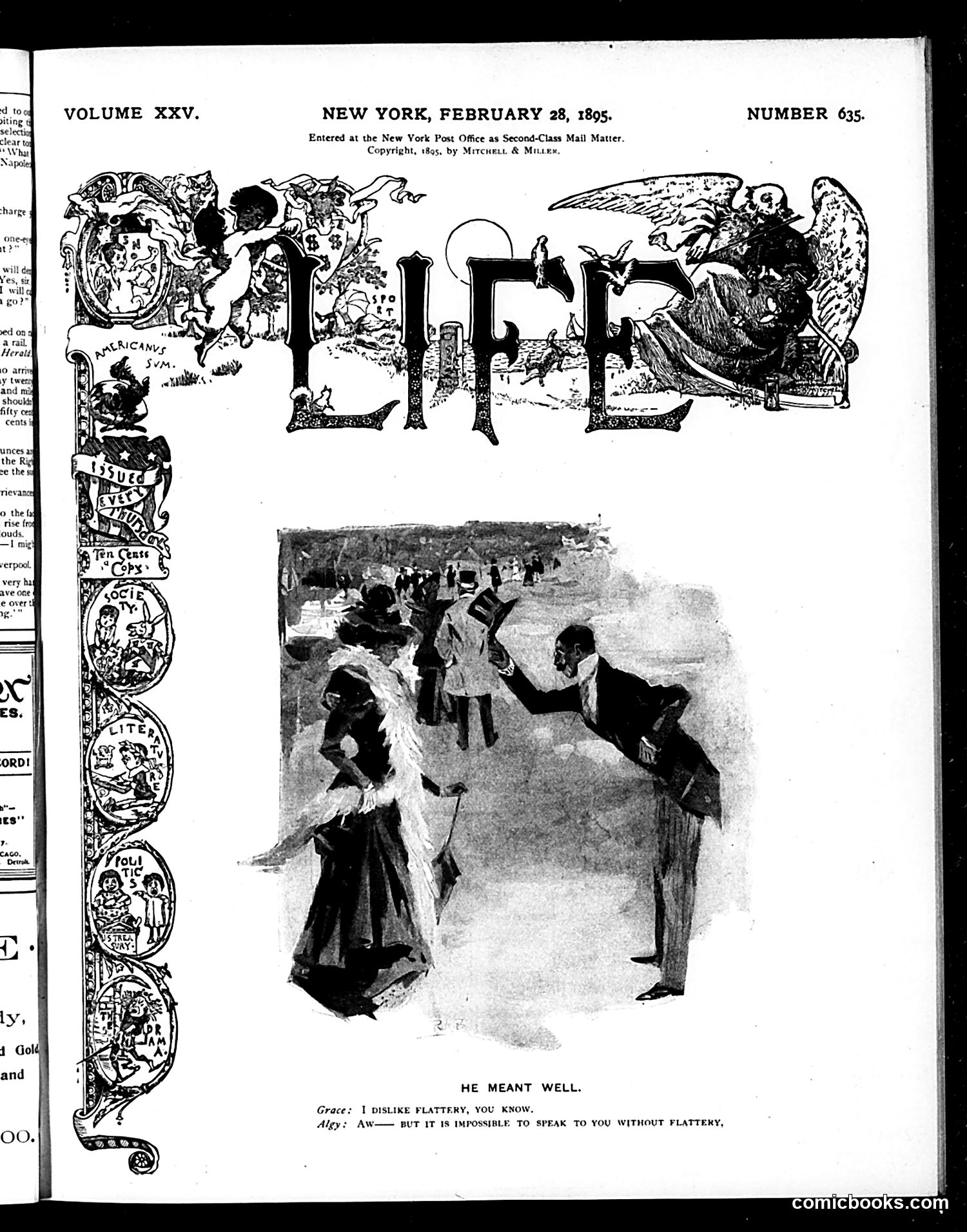
**The Main Cartoon: "He Meant Well"** This cartoon depicts a social interaction between two figures—a woman and a man—in what appears to be a public outdoor setting. The dialogue indicates the man has attempted to compliment the woman ("flattery"), but she rejects his approach, stating she "dislikes flattery" and finds it "impossible to speak to you without flattery." The satire targets Victorian-era courtship conventions and male behavior. The joke suggests that complimenting a woman necessarily involves insincere flattery—that genuine conversation between genders is constrained by social expectations of flowery praise. The man's well-intentioned gesture is undermined by the artificiality of the social performance required in polite society. This reflects late-19th-century anxieties about gender relations and social propriety.
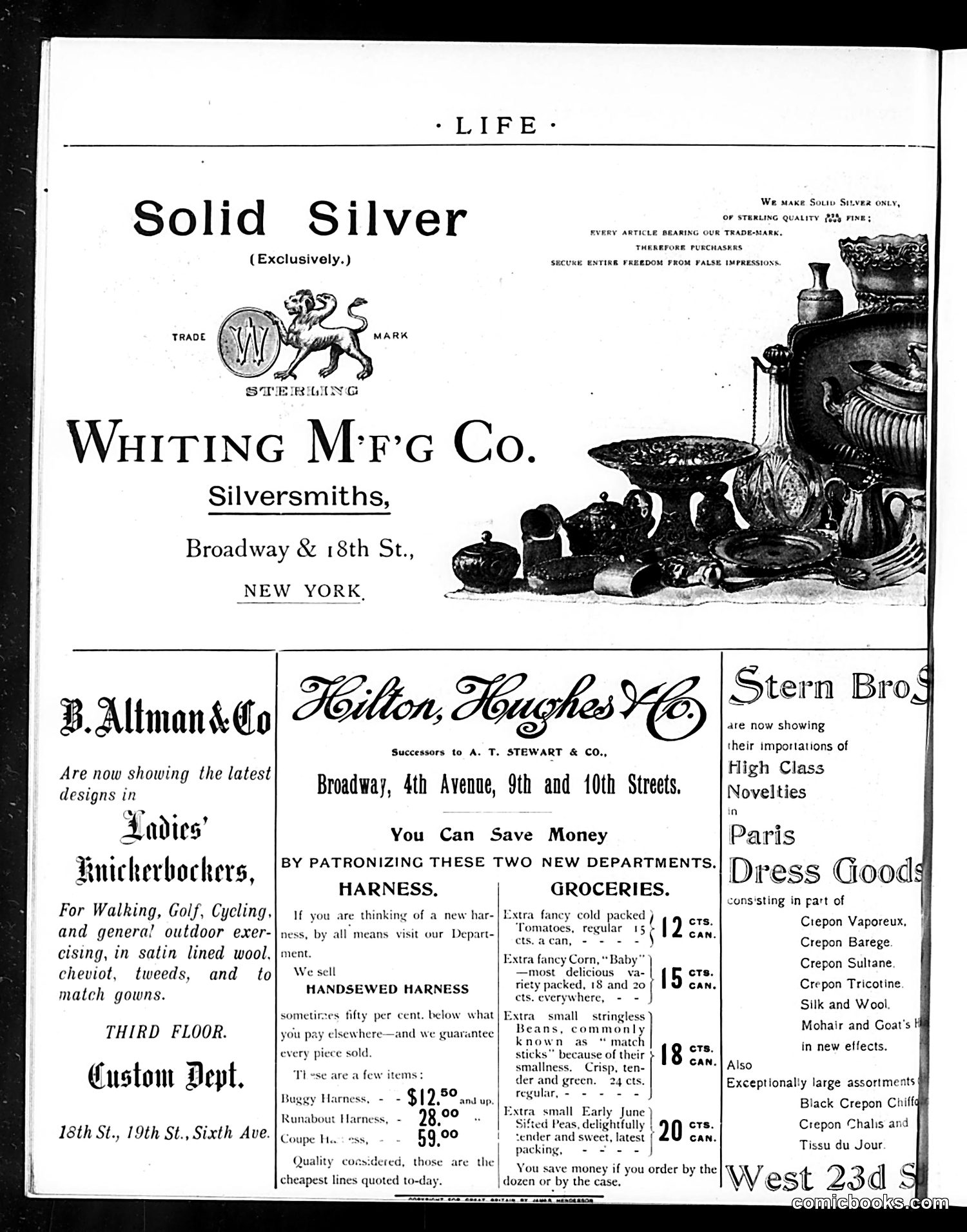
This page is primarily **advertising**, not political satire. It contains multiple commercial advertisements from late 19th or early 20th-century New York businesses: - **Whiting MFG Co.**: Sterling silver tableware manufacturer (Broadway & 18th St.) - **B. Altman & Co.**: Department store advertising women's knickerbockers for outdoor activities - **Hilton, Hughes & Co.**: Grocery and harness departments with price lists - **Stern Bros.**: Showing imported Paris dress goods including crepe fabrics The page represents typical *Life* magazine content of its era—a mix of satirical editorial matter alongside commercial advertisements. No political cartoon or satire is visible here; instead, it documents consumer goods and retail establishments available to affluent New York residents of the period.
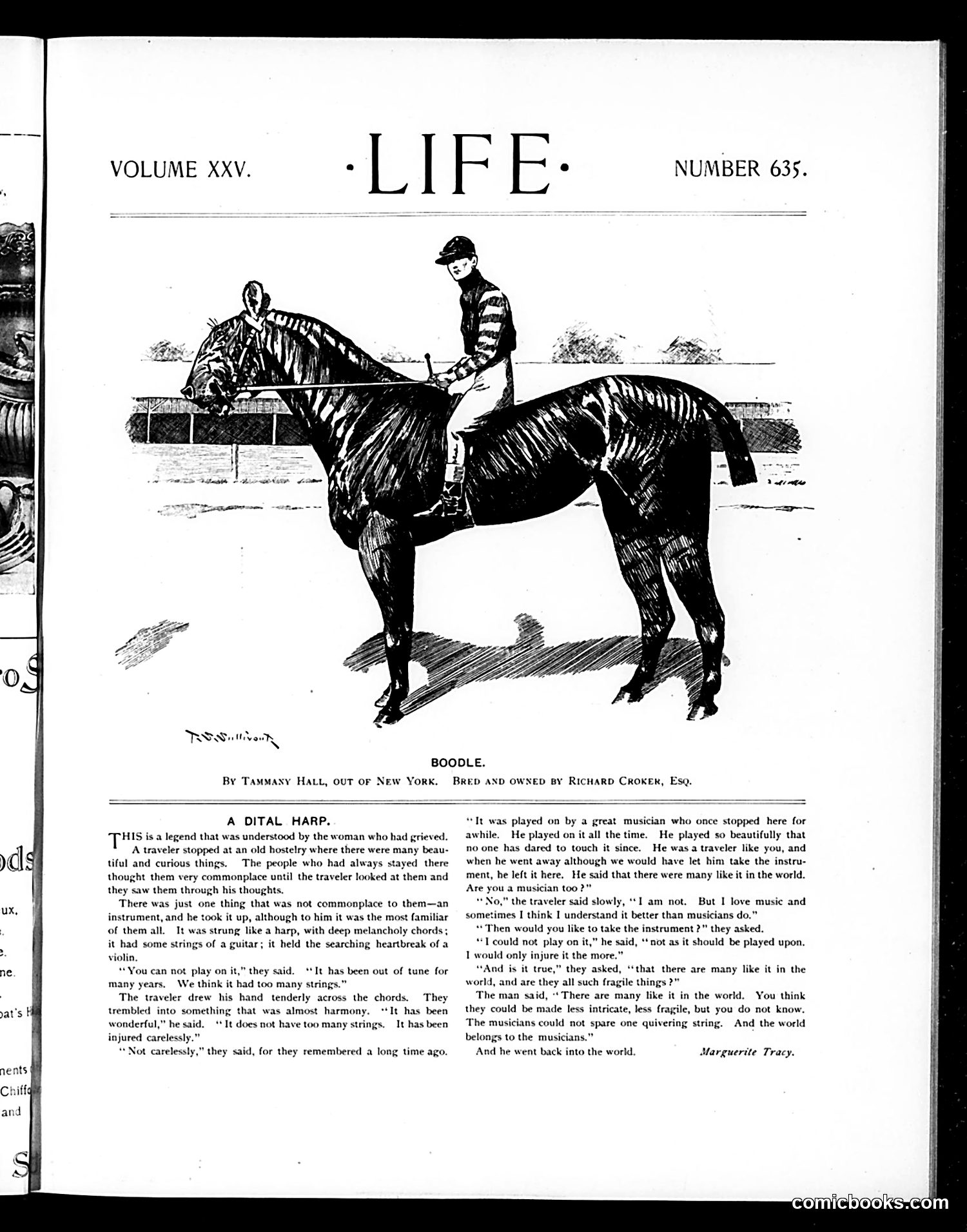
This page features an illustration of a thoroughbred racehorse named "Boodle," owned by Richard Croker, Esq., and bred by Tammany Hall out of New York. The accompanying story, "A Dital Harp," is unrelated to the horse—it's a sentimental tale about a traveler who discovers a neglected harp and learns its musical value from locals. The horse illustration appears to be satirical commentary: the phrase "Tammany Hall, out of New York" is a political jab. Tammany Hall was New York's notorious Democratic political machine, associated with corruption. By naming the horse's pedigree after Tammany Hall, Life magazine sarcastically suggests the horse—and by extension, anything associated with Tammany Hall leadership—is a product of corrupt political breeding. The satire critiques Croker's connection to Tammany Hall's questionable practices.
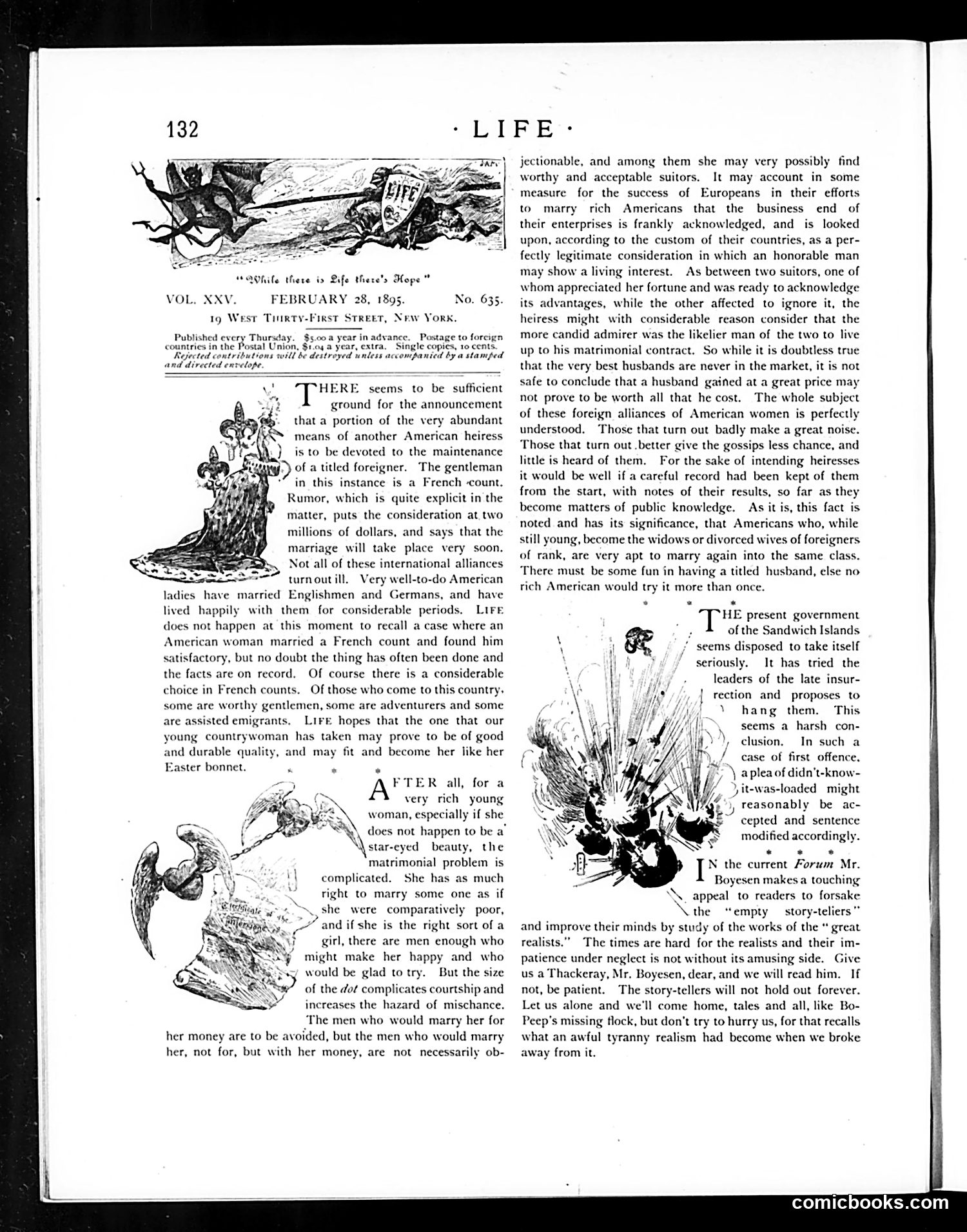
This page satirizes **wealthy American heiresses marrying foreign nobility**—a common phenomenon in the Gilded Age. The article argues that while some Europeans marry Americans for money, American women themselves deserve scrutiny for choosing husbands poorly. The cartoons appear to depict **Cupid or romantic figures** entangled in complications, reinforcing the article's theme about the "hazard of mischance" in such marriages. The piece criticizes both parties: foreign fortune-hunters and American women who prioritize titles over character. It notes that failed marriages between American heiresses and foreign counts/noblemen generate public gossip while cautioning against hasty conclusions about their motives or outcomes. The tone is satirical but moralistic—warning against marrying for status rather than genuine compatibility.
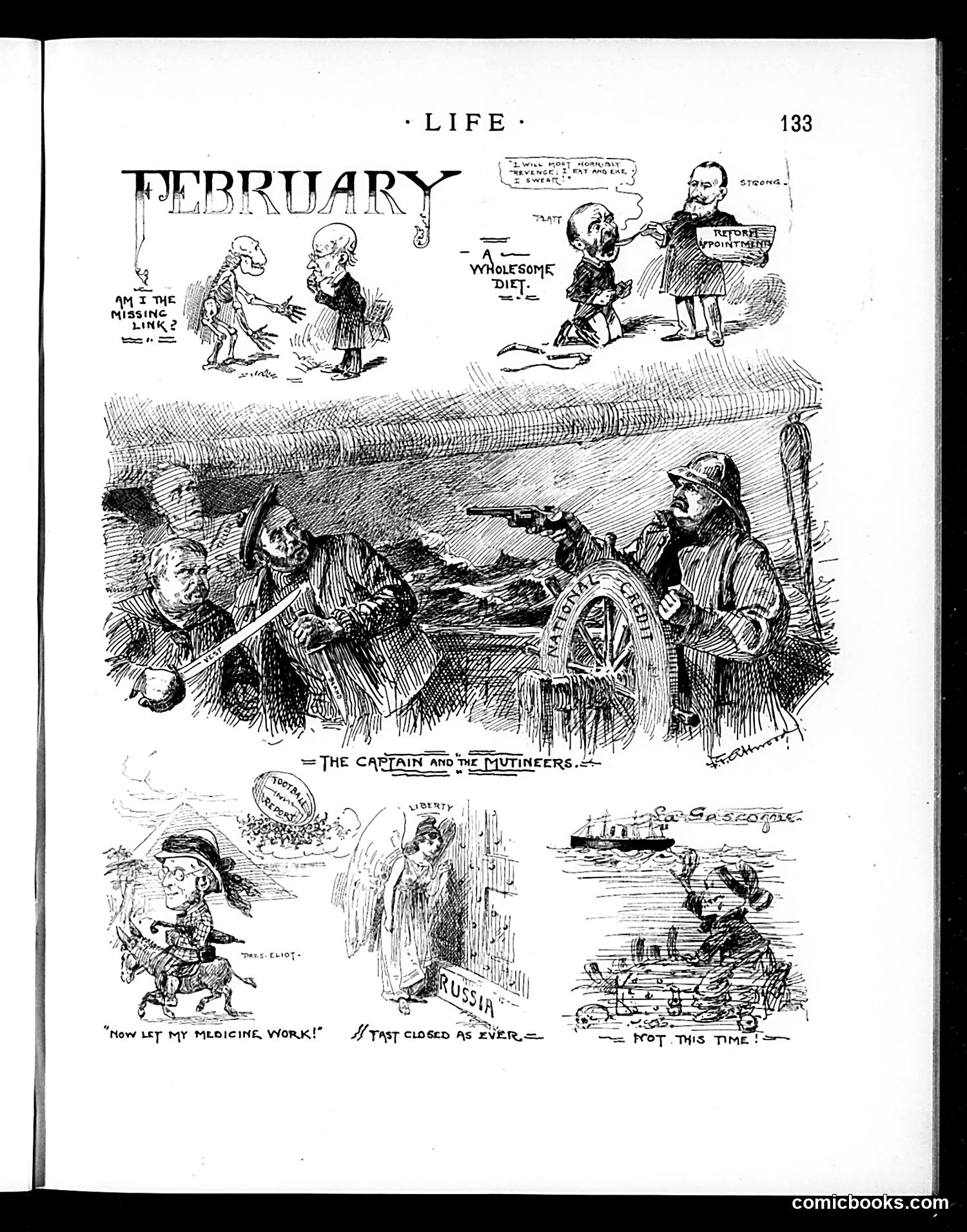
This page contains several satirical cartoons addressing early 20th-century political and social issues: **Top panels**: "A Wholesome Diet" and "Reform Appointment" appear to critique political figures' dietary/moral choices and appointment decisions—likely contemporary political scandals. **Central panel**: "The Captain and the Mutineers" depicts armed conflict, possibly referencing labor disputes or industrial unrest, with workers confronting authority figures. **Bottom panels**: Include Russian references ("Russia"), maritime imagery ("Gascoyne," "Not This Time!"), and "Now Let My Medicine Work!"—suggesting commentary on international relations, possibly WWI-era conflicts or Russian Revolution references, combined with domestic political/medical metaphors for governmental "treatment" of national problems. The overall tone satirizes political leadership and reform efforts.
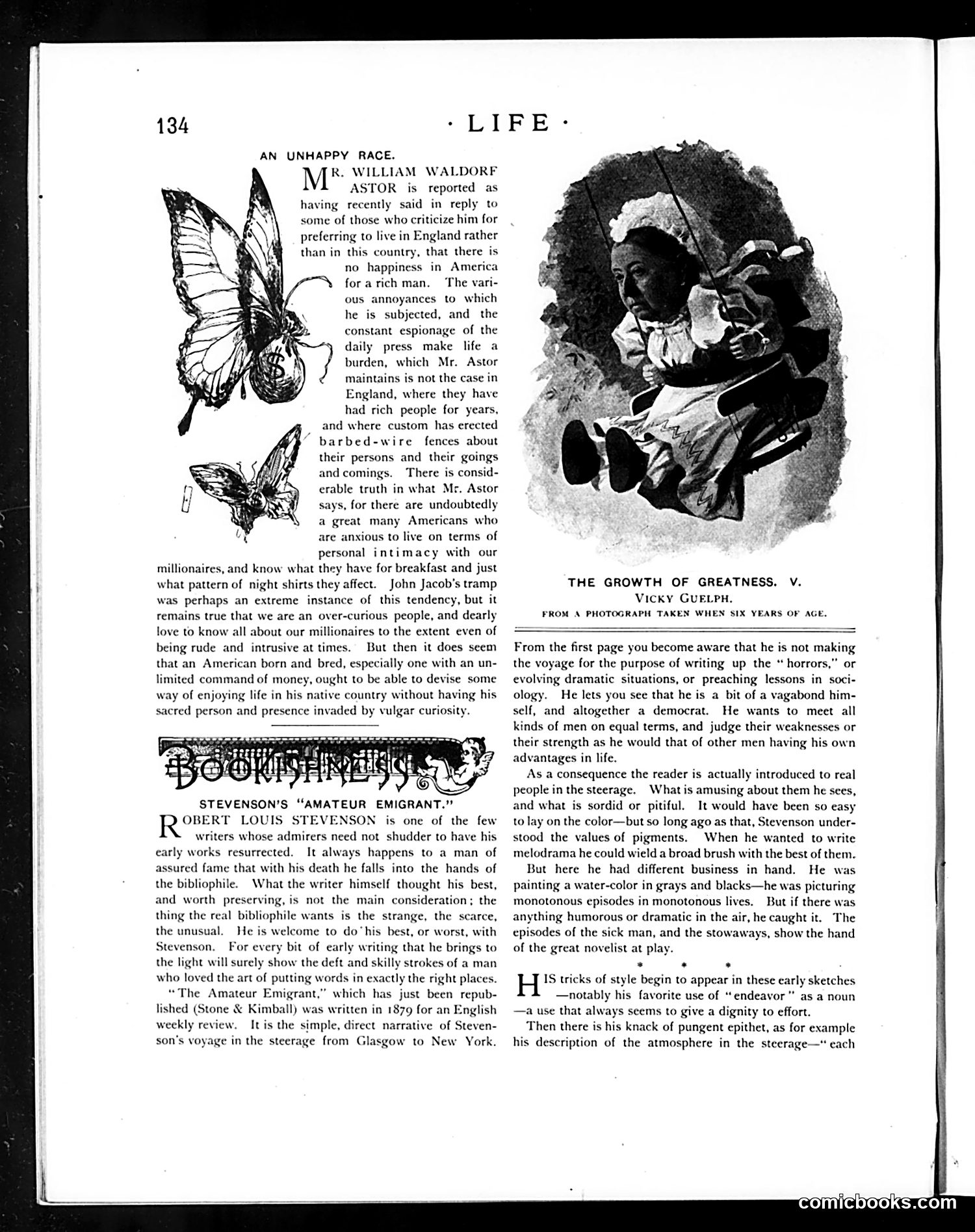
**"An Unhappy Race"** satirizes William Waldorf Astor's reported complaint that wealthy Americans cannot enjoy privacy in their own country, unlike in England where "custom has erected barbed-wire fences" around the rich. The article mocks Astor's complaint as evidence of American curiosity about the wealthy—suggesting this democratic intrusion is preferable to aristocratic exclusivity. **"The Growth of Greatness. V."** discusses Robert Louis Stevenson's early work "The Amateur Emigrant," praising his realistic depiction of ordinary steerage passengers rather than dramatic narratives. The accompanying photograph shows a child at age six, illustrating Stevenson's observational approach to character. The decorative butterfly illustrations appear purely ornamental rather than satirical.
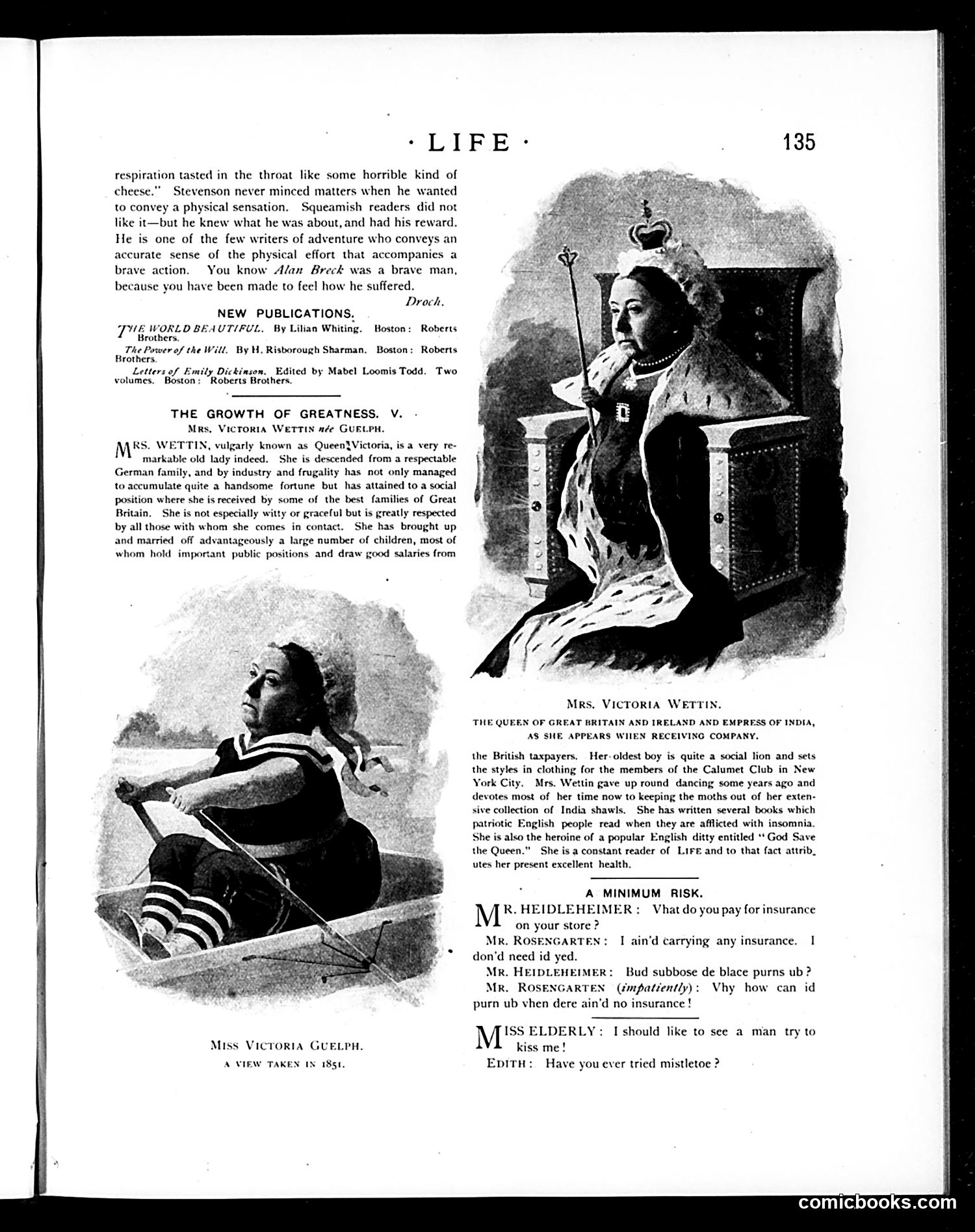
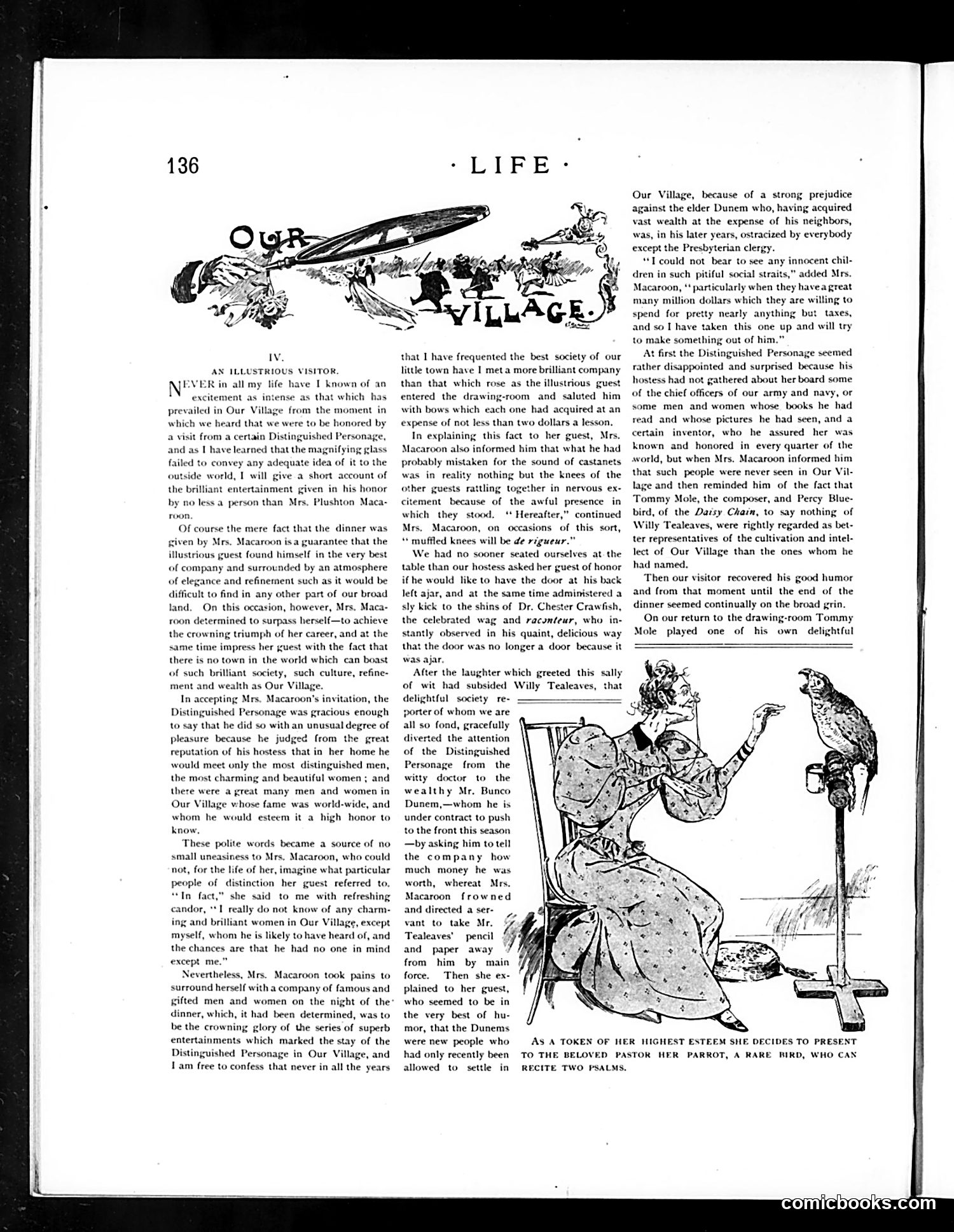
This page contains a narrative essay titled "An Illustrious Visitor" (Section IV) describing a distinguished guest's visit to a small town. The text satirizes social pretension and small-town snobbery—Mrs. Macaroon, the town's leading hostess, treats the visit as a major cultural event, emphasizing her guest's wealth and prominence while name-dropping expensive society details (two-dollar lessons, imported animals). The accompanying illustration shows a woman presenting a parrot to a clergyman, captioned as "a token of her highest esteem." The satire targets upper-class affectation: the hostess's ostentatious gift-giving and the townspeople's desperate social climbing. The parrot reciting psalms is absurdist humor mocking both pretentiousness and the absurdity of village society's attempts at cultural sophistication.
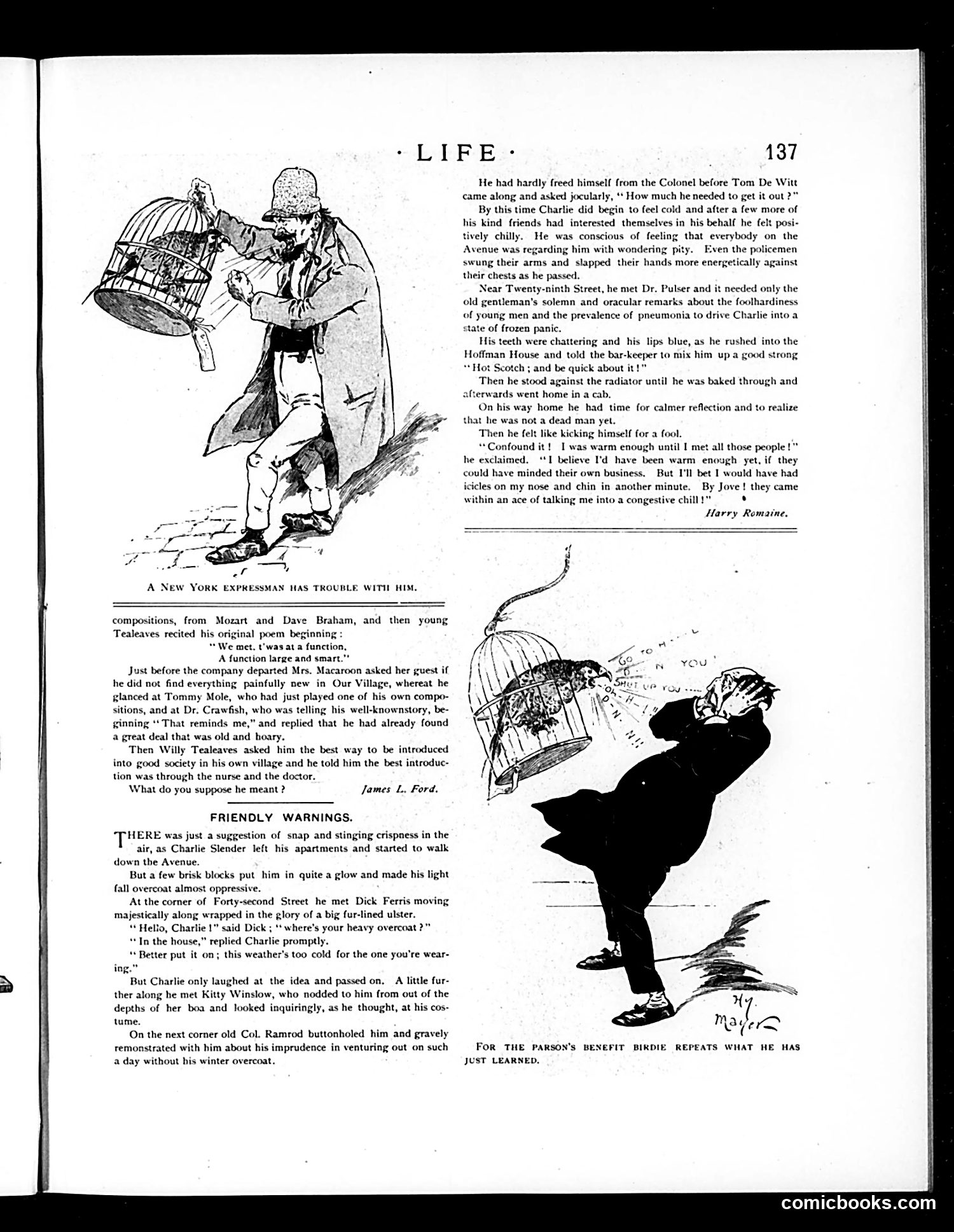
This page contains two satirical illustrations about winter hardship in New York City. The top cartoon, titled "A New York Expressman Has Trouble With Him," depicts a delivery worker struggling with a large birdcage in harsh cold weather—satirizing the impracticality of winter work. The bottom illustration, captioned "For the Parson's Benefit Birdie Repeats What He Has Just Learned," shows a man slipping on ice while holding an umbrella, presumably about to fall. The joke suggests he's learned profanity from the parson (clergyman), implying even religious figures curse in winter's dangerous conditions. Both cartoons mock New York winter's severity and its effects on city residents' dignity and composure.
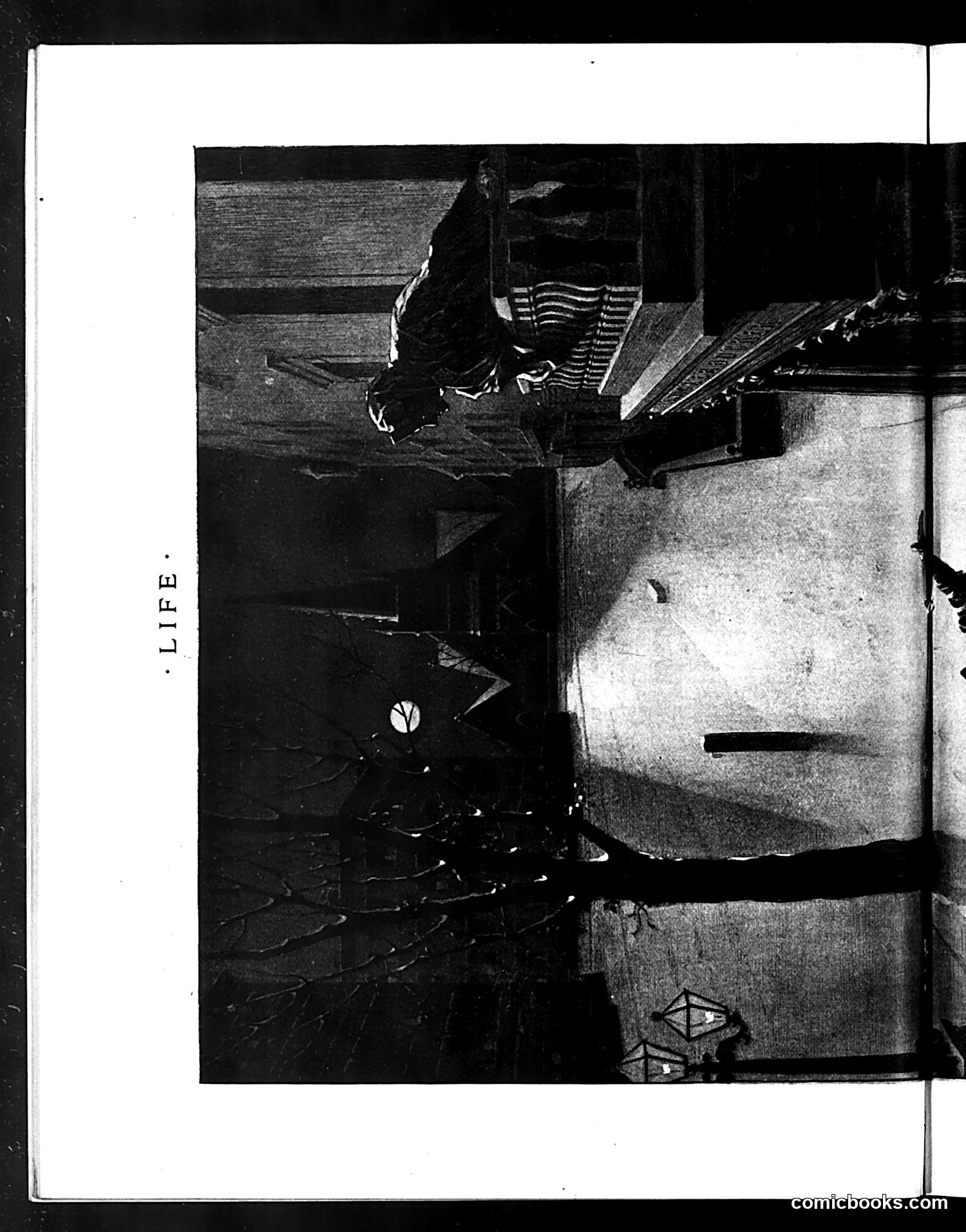
The image is rotated 90 degrees, making it difficult to read text clearly or identify specific figures with confidence. The page appears to show an interior scene photographed from above, with furniture, walls, and what may be a person, but the orientation and image quality prevent certain identification of any caricatures or political figures. The OCR text provided contains only the word "LIFE," which is the magazine's masthead but offers no substantive content to analyze. Without legible text or clearly identifiable figures, I cannot reliably explain the cartoon's meaning, references, or satirical intent to a modern reader. A properly oriented image with clearer detail would be needed for accurate historical analysis.
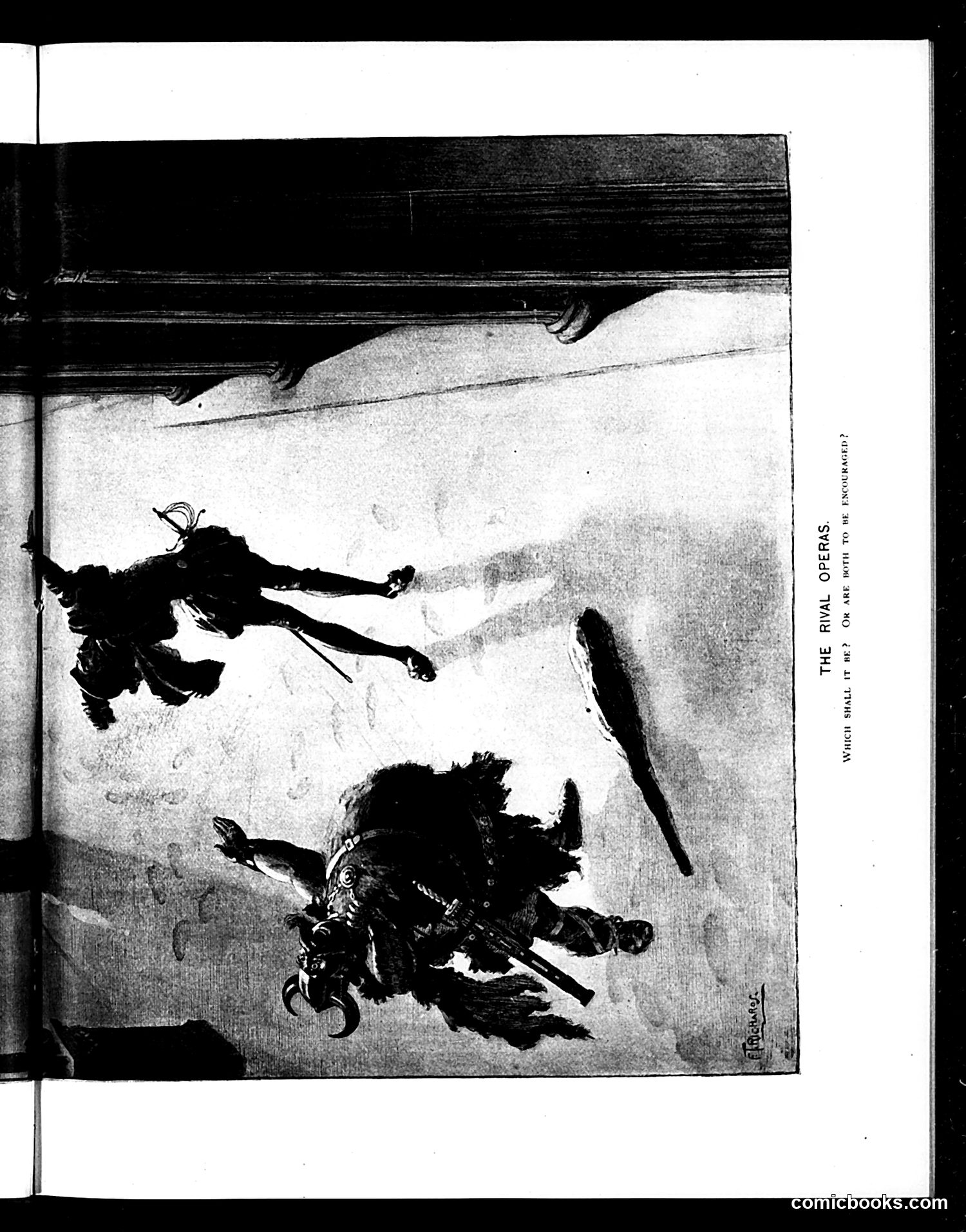
This appears to be a satirical illustration depicting a dramatic confrontation scene. The image shows silhouetted figures in what looks like a theatrical or operatic setting, with what appears to be a grotesque demon or devil-like creature in the lower portion and a human figure above in an acrobatic or falling pose. The caption "The Rival Operas" suggests this references competing opera productions or operatic traditions, likely mocking the rivalry between different opera companies or styles popular in early 20th-century America. The exaggerated, dramatic poses and theatrical composition satirize the grandiose nature of operatic performance itself—suggesting opera's tendency toward melodrama and overwrought emotion. Without additional context from Life magazine's date and other articles, the specific operas or companies referenced remain unclear.
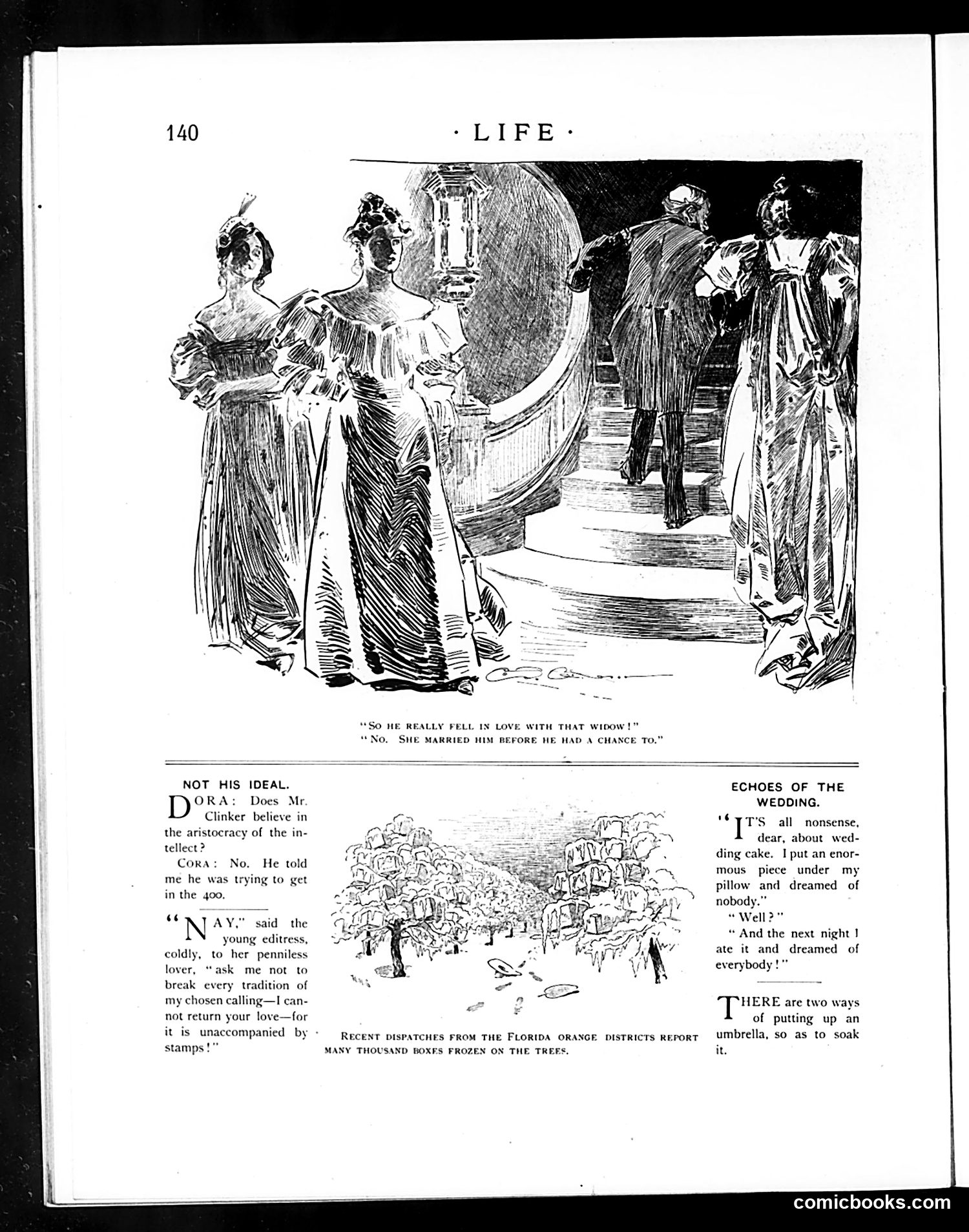
This page contains three satirical pieces mocking early 1900s social conventions: **"Not His Ideal"** jokes about Mr. Clinker's hypocrisy: he claims to believe in intellectual aristocracy but actually pursues membership in the "400"—the exclusive social register of New York's wealthiest families. The satire targets pretentious climbers who contradict their stated principles. **The Editress joke** ridicules a young female editor who refuses her lover's proposal because his poverty means he cannot afford postage stamps—mocking both her mercenary values and the era's obsession with superficial markers of wealth. **The widow cartoon** (top illustration) suggests a woman deliberately married a man before he could change his mind, inverting romantic expectations and implying cynical calculation in marriage. The remaining items—wedding cake folklore, umbrella jokes, and a Florida orange frost report—are brief humor snippets typical of Life's miscellaneous content sections.
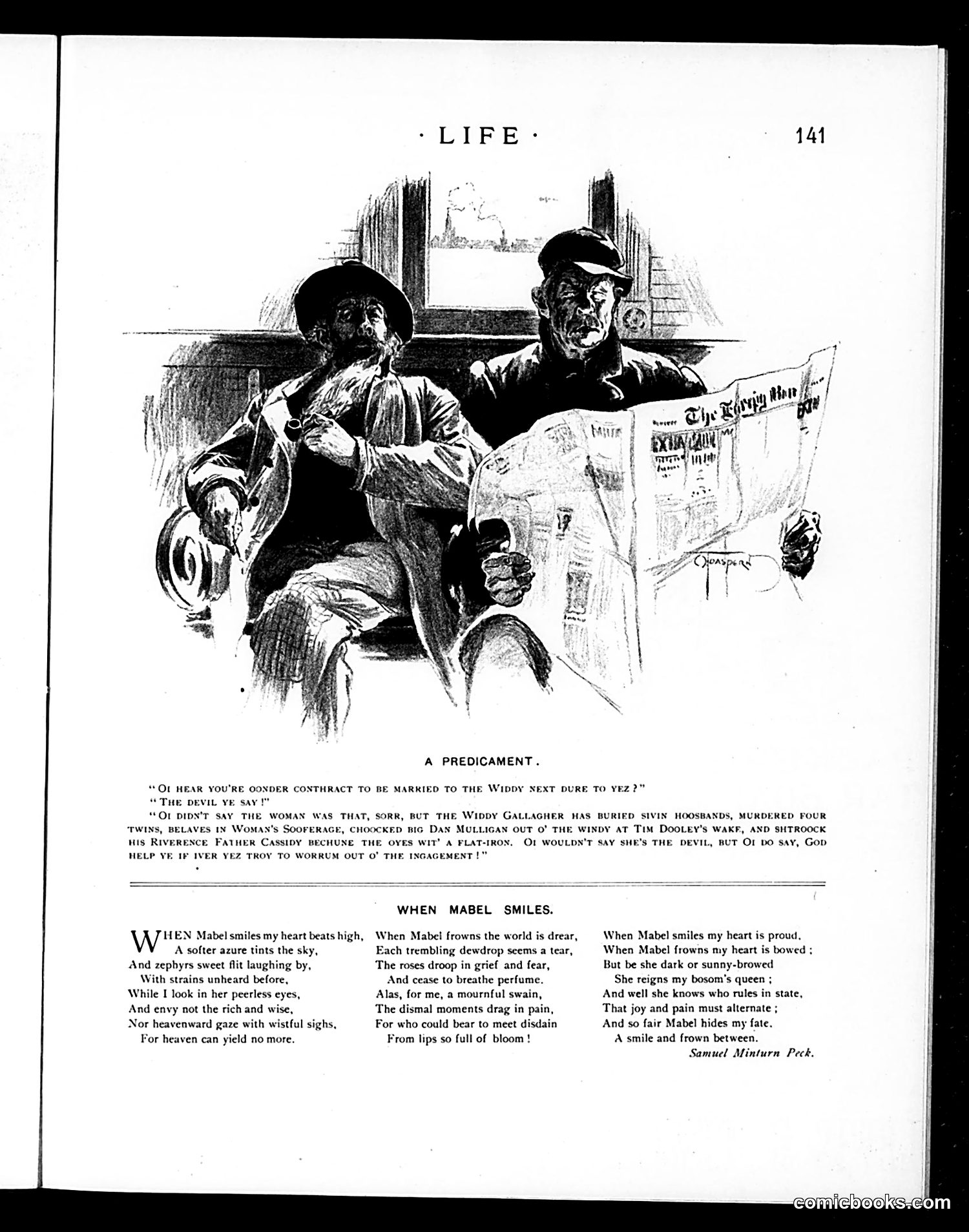
The top cartoon satirizes Irish-American culture through two working-class men discussing an engagement. Using heavy Irish dialect and stereotypes, one warns his friend against marrying "Widow Gallagher," recounting her violent history: she's buried seven husbands, murdered four twins, killed a man by throwing him from a window, and attacked a priest with a flat-iron. The joke plays on Irish stereotypes of both violence and superstition—the woman is portrayed as literally dangerous, yet the man apparently can't escape the engagement. The bottom section, "When Mabel Smiles," is romantic poetry celebrating a woman named Mabel, attributed to Samuel Minturn Peck. It contrasts sharply with the crude humor above, idealizing feminine beauty and emotional power over the male narrator. Together, the page juxtaposes lowbrow ethnic humor with genteel sentimental verse—reflecting early 20th-century *Life* magazine's mixed audience and editorial voice, where crude jokes and refined literature coexisted.
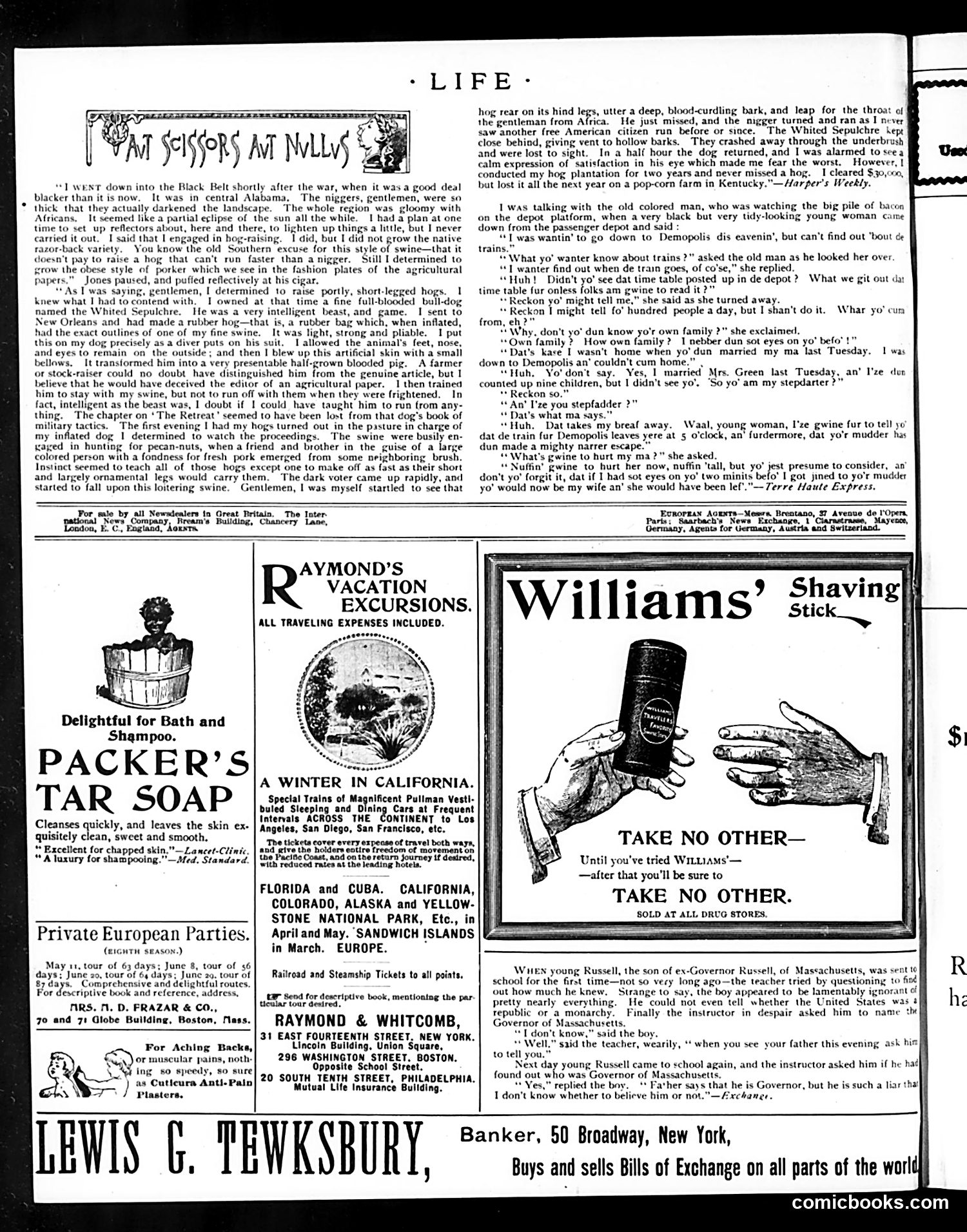
This page primarily contains **narrative fiction rather than political cartoons**. The main story, titled "I Am Scissors Am Nulls" (possibly a corrupted title), is a tall tale in the tradition of American humor literature. ## The Story's Content The narrative is a racist anecdote set in post-Civil War Alabama. A speaker recounts creating a rubber pig-suit for his bulldog to protect his hogs from theft by Black people. The story relies on dehumanizing racial stereotypes common to 19th-century American humor: depicting Black people as primitive, threatening, and subject to mockery. ## Historical Context This reflects **Life magazine's satirical style of the era**, which frequently employed offensive racial caricatures and dialect as comedic devices—material that would be immediately recognized as abhorrent today. The page also contains period advertisements (Raymond's Vacation Excursions, Williams' Shaving Stick, Packer's Tar Soap) typical of such publications. **Note**: This content exemplifies how casual racism was embedded in American popular literature and advertising of this period.
This page is primarily **advertising and promotional content** rather than political satire. It contains: **Main Elements:** - Railroad advertisement (New York Central Line) promoting trains to Chicago, St. Louis, and Cincinnati - Armour & Co. beef extract advertisement - Fibre Chamois fabric advertisement (clothing material) - Multiple brief humorous anecdotes/jokes about domestic situations **The Humor:** The small comedic pieces—about a husband hiding newspaper clippings to keep his wife curious, a young man relieved to avoid a marriage proposal, keeping a cook by hiding the kerosene can—represent *gentle, domestic satire* typical of early 20th-century Life magazine. They mock marital dynamics and household management rather than political issues. **Historical Context:** This reflects the magazine's primary function as entertainment for middle-class readers, mixing humor with advertising for consumer goods (trains, food products, fabrics). The page contains **no clear political cartoons or caricatures** requiring identification—it's a typical commercial/entertainment page from an era when magazines heavily integrated advertisements with content.
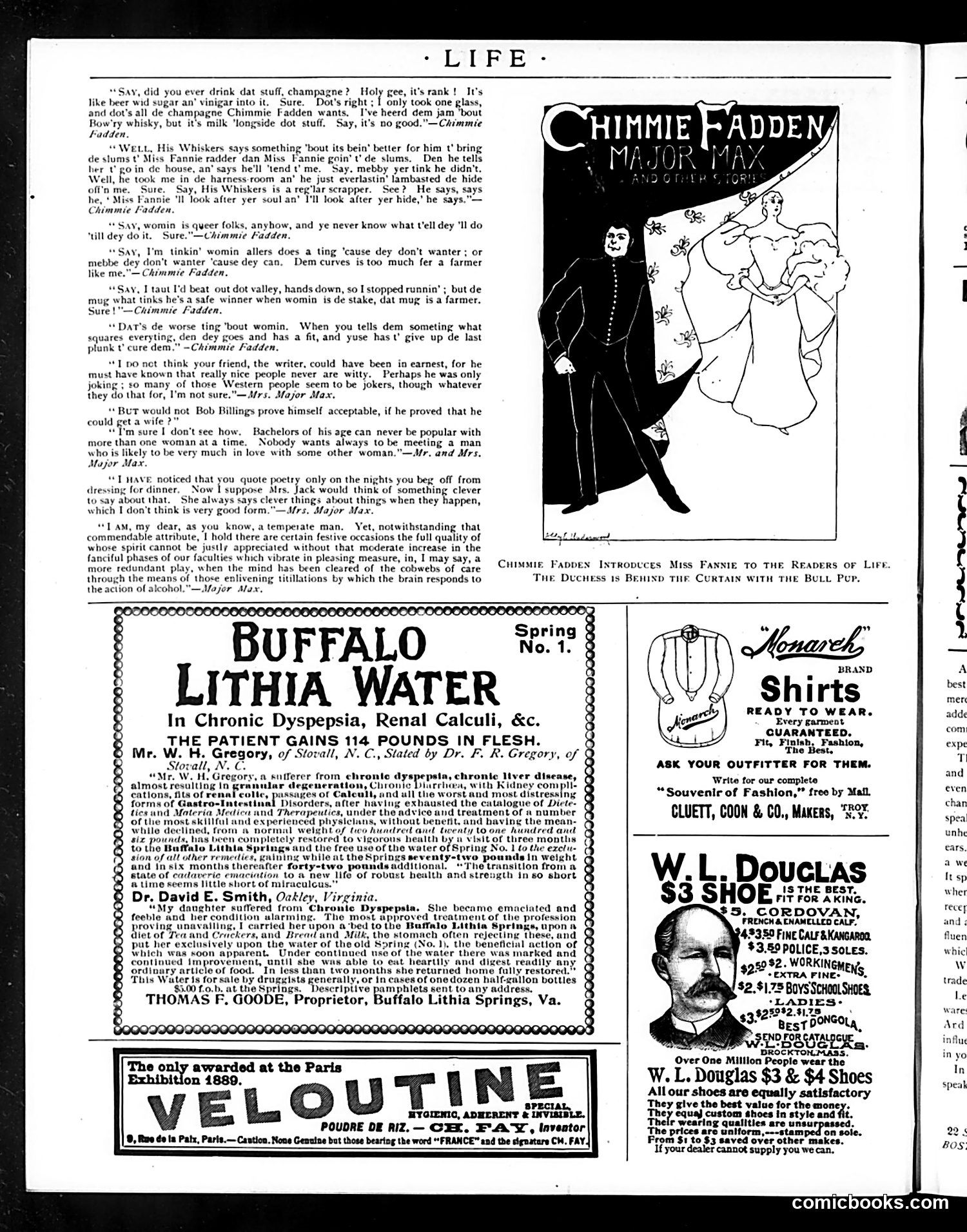
This page features **Chimmie Fadden**, a working-class immigrant character created by Edward Townsend for Life magazine's satirical humor section. The illustrated cartoon shows Fadden introducing "Miss Fannie" to readers—a romantic subplot involving a Bowery character and an upper-class woman. The quoted dialogue captures Fadden's distinctive dialect and perspective: his dismissal of champagne compared to Bowery whisky, his account of being beaten by "His Whiskers" (an authority figure), and his humorous, cynical observations about women's unpredictability. The satire targets both the immigrant working class (through Fadden's malapropisms and naïveté) and the upper classes (through the class-crossing romance and patronizing attitudes of the "Major Max" characters quoted below). The remaining page content is primarily **advertising**—Buffalo Lithia Water, Monarch shirts, W.L. Douglas shoes, and Veloute powder—typical of Life's revenue model.
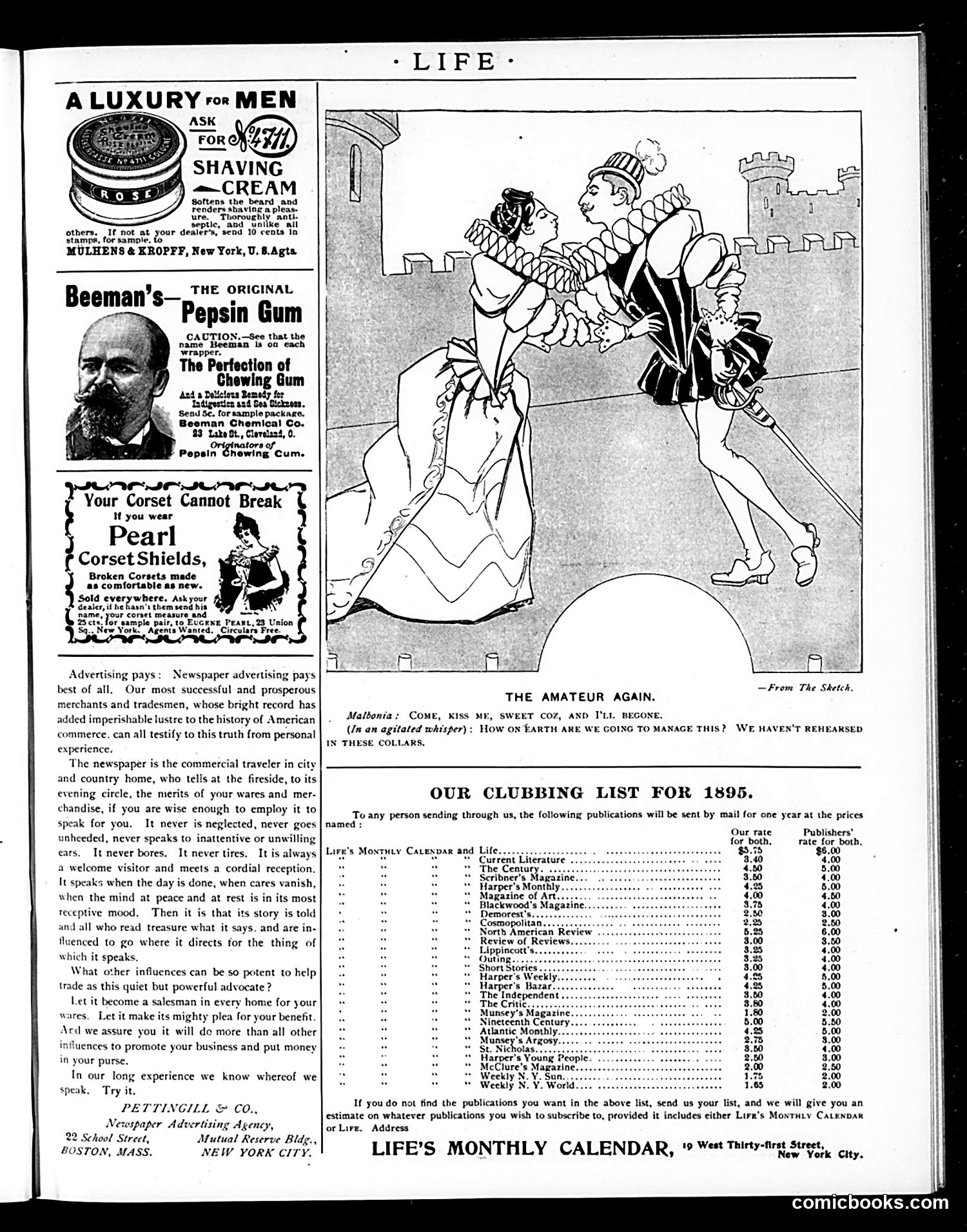
This page is primarily **advertising and subscription material**, not political satire. The main cartoon, titled "The Amateur Again," depicts two figures in elaborate Elizabethan-style costumes in what appears to be a theatrical scene. One character (labeled "Malbonia") whispers to the other that they haven't rehearsed their lines while wearing stiff collars—a joke about amateur theatrical performers struggling with costume constraints and stage fright. The rest of the page contains advertisements for men's grooming products (shaving cream, chewing gum, corset shields) and an extended essay promoting newspaper advertising as a sales tool. The bottom section lists subscription rates for Life Magazine bundled with other publications for 1895. The humor is light and domestic rather than political. No identifiable public figures or current events are referenced.
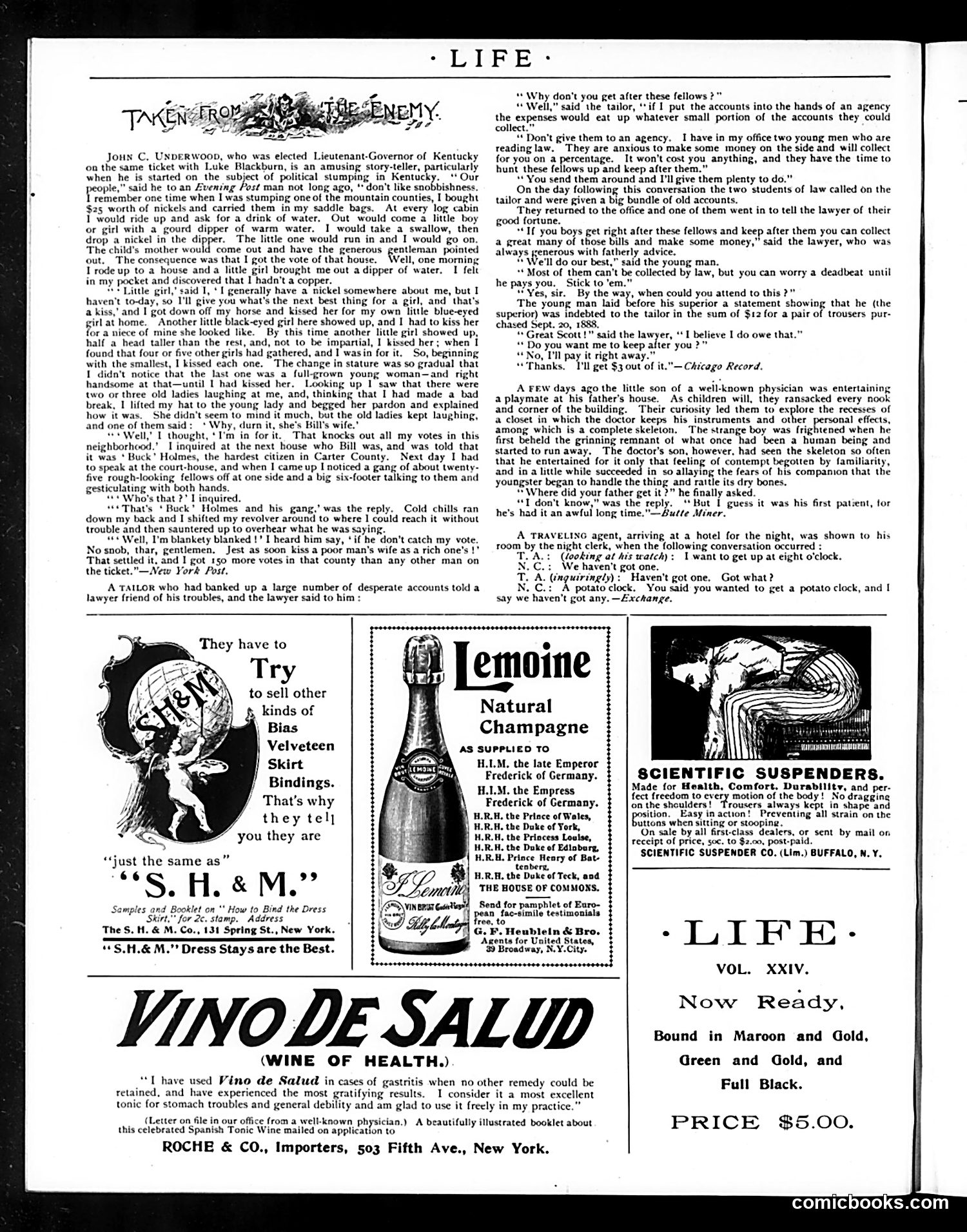
This page features a humorous anecdotal article about John C. Underwood, Lieutenant-Governor of Kentucky, recounting his political campaigning tactics in rural Kentucky mountain counties. The story illustrates Underwood's strategy of winning votes through charm and relatability—kissing young girls at log cabins (offering nickels as customary) to ingratiate himself with families. The humor culminates when he unknowingly kisses a grown woman (the wife of "Buck" Holmes, a rough local), which accidentally impresses Holmes so much that he and his gang become supporters, securing Underwood 150 additional votes. The page is primarily text-based narrative humor rather than political satire; it mocks frontier campaign methods and rural courtship customs while celebrating Underwood's ability to connect with working-class voters through informality rather than aristocratic pretension. The surrounding advertisements are typical period marketing.
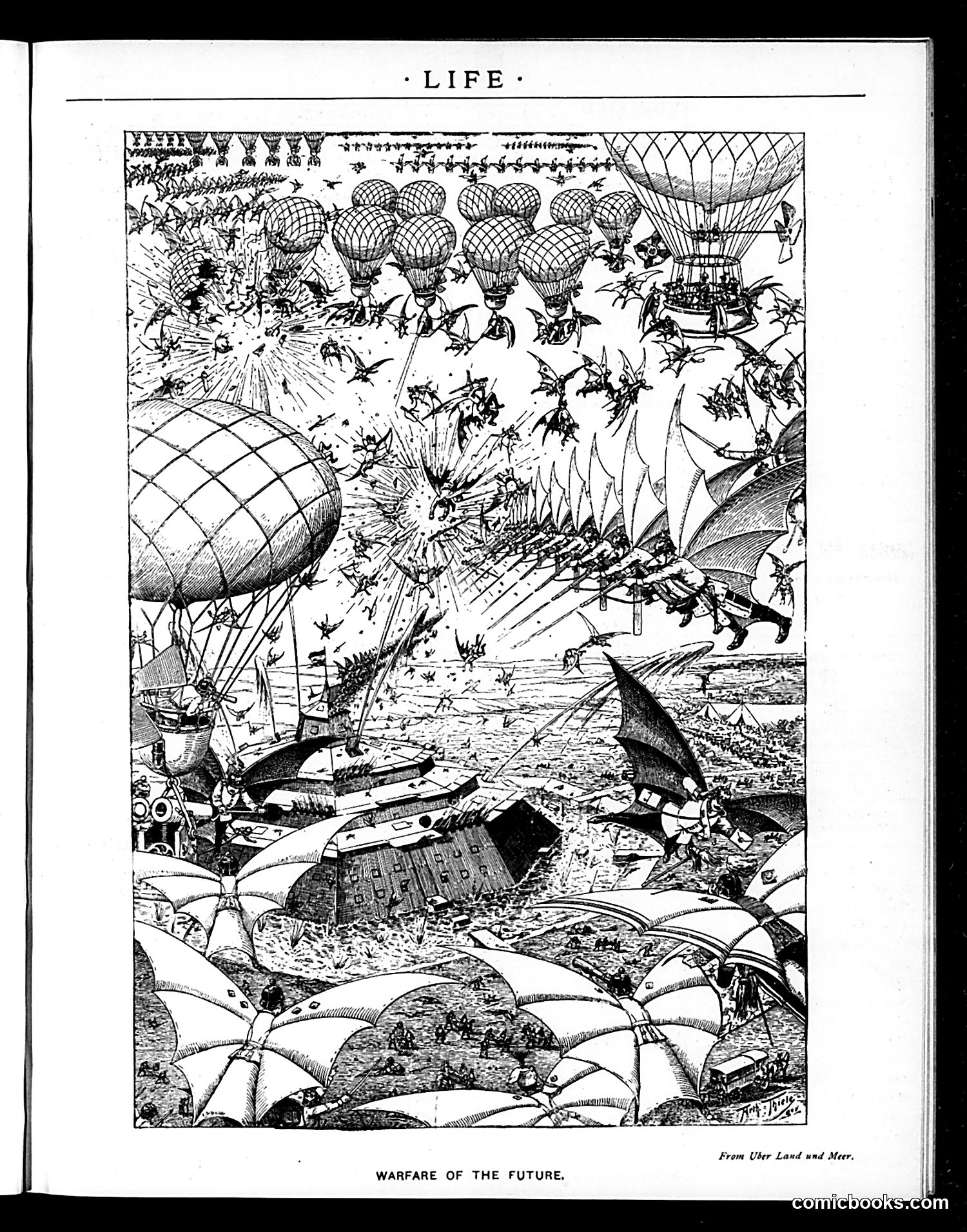
This satirical illustration depicts an imagined future aerial combat scenario, likely from the early 20th century based on the artistic style. The image shows multiple hot air balloons and airships engaged in battle above a landscape dotted with parachuting soldiers or devices. Flying creatures (possibly mechanical or fantastical) populate the sky amid explosions and weapons fire. The satire mocks contemporary anxieties about technological warfare and aviation's military potential. By exaggerating the chaotic aerial scene with numerous balloons, falling figures, and fantastical elements, the cartoonist humorously presents fears about how future conflicts might be fought in the skies rather than on traditional battlefields—a genuinely novel concern as aviation technology was rapidly developing.
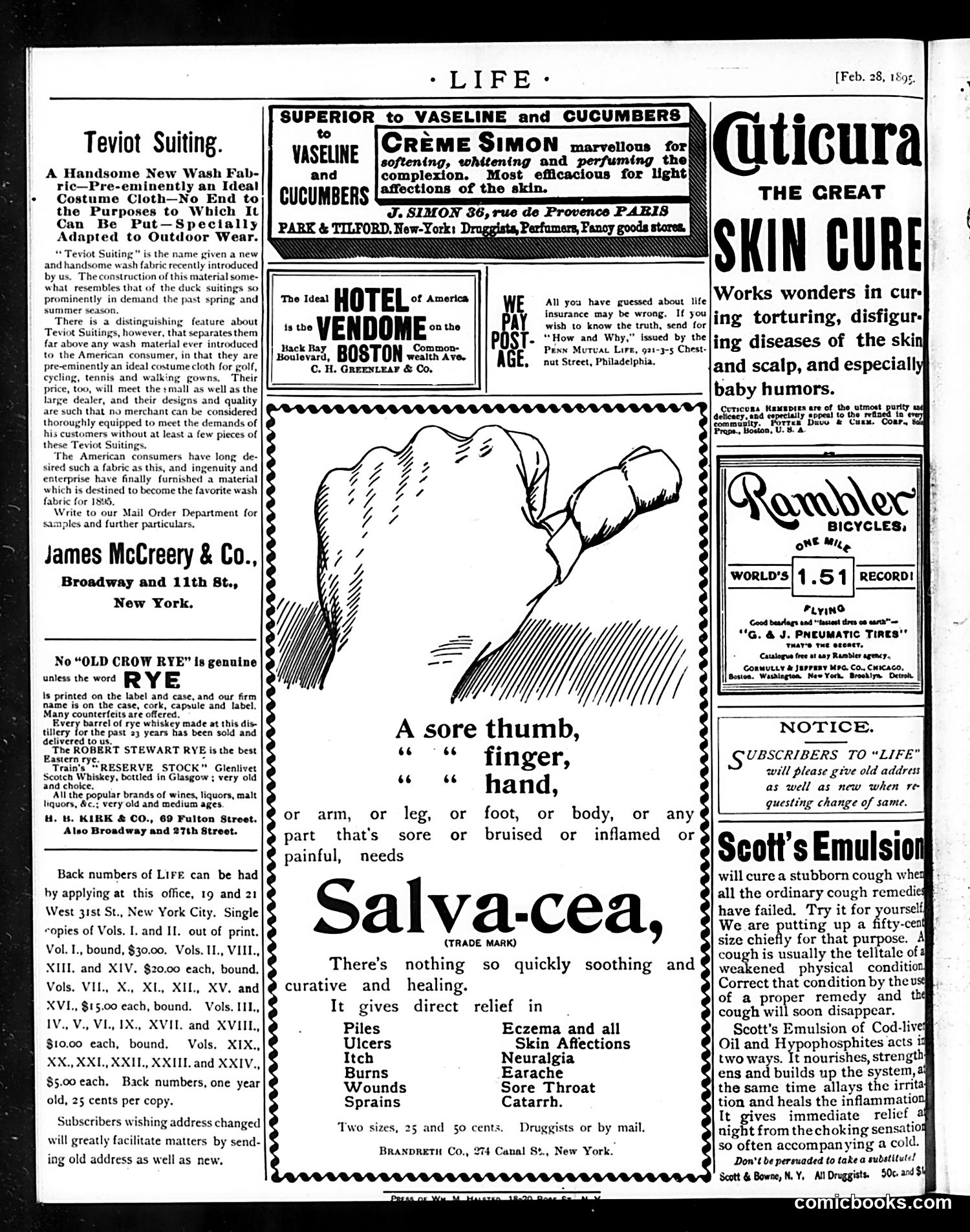
This is primarily an **advertising page** with no political cartoons or satire. The central image shows a simple line drawing of a hand/arm, used to illustrate the product being advertised below it. The main content is a large advertisement for **Salva-cea**, a patent medicine salve claiming to cure various ailments—sores, burns, eczema, ulcers, and other skin conditions. This reflects the period's common use of dubious medicinal products with broad, unproven claims. Surrounding this are typical late-19th-century advertisements for consumer goods: fabric (Teviot Suiting), hotels (The Vendôme in Boston), whiskey (Old Crow Rye), skin cream (Crème Simon), a bicycle (Rambler), Scott's Emulsion cough remedy, and the Cuticura skin cure—all making exaggerated health or quality promises. The page reflects how 1890s magazines relied heavily on advertising revenue and were filled with patent medicine claims that would later face FDA regulation.