
Life, 1895-02-28 · page 6 of 20
Life — February 28, 1895 — page 6: what you’re looking at
What you’re looking at
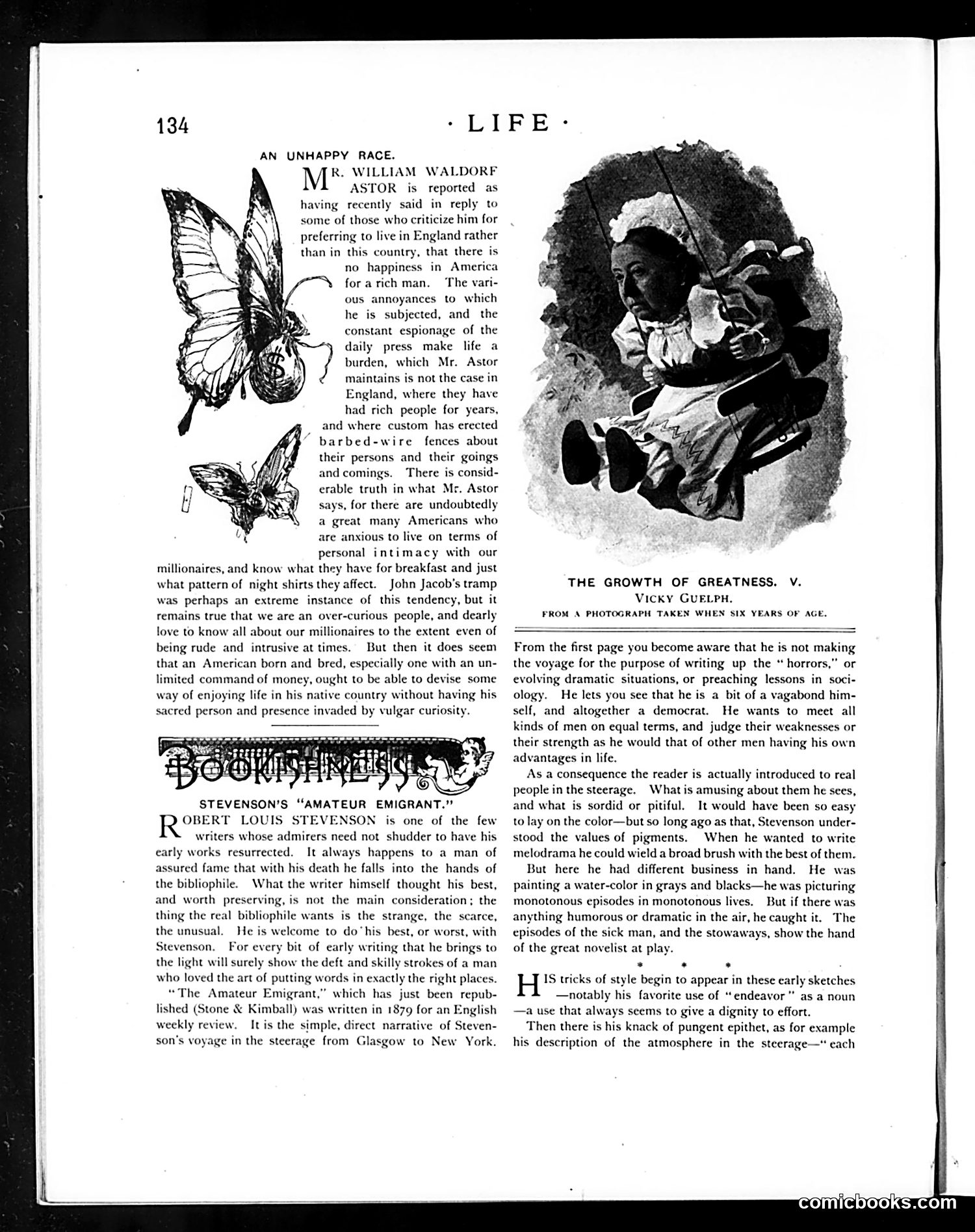
**"An Unhappy Race"** satirizes William Waldorf Astor's reported complaint that wealthy Americans cannot enjoy privacy in their own country, unlike in England where "custom has erected barbed-wire fences" around the rich. The article mocks Astor's complaint as evidence of American curiosity about the wealthy—suggesting this democratic intrusion is preferable to aristocratic exclusivity. **"The Growth of Greatness. V."** discusses Robert Louis Stevenson's early work "The Amateur Emigrant," praising his realistic depiction of ordinary steerage passengers rather than dramatic narratives. The accompanying photograph shows a child at age six, illustrating Stevenson's observational approach to character. The decorative butterfly illustrations appear purely ornamental rather than satirical.
📄 Transcribed text from this page (OCR, searchable)
Machine-transcribed from the original scan — historical spelling and the odd misread are preserved.
* LIFE: AN UNHAPPY RACE. M* WILLIAM WALDORF ASTOR is reported as having recently said in reply to some of those who criticize him for preferring to live in England rather than in this country, that there i no happiness in America forarich man. The vari- ous annoyances to. which he is subjected, and the constant espionage of the daily press make life a burden, which Mr. Astor maintains is not the case in England, where they have had rich people for years. and where custom has erected barbed-wire fences about their persons and their goings and comings. There is consid- erable truth in what Mr. Astor for there are undoubtedly a great many Americans who are anxious to live on terms of personal intimacy with our millionaires, and know what they have for breakfast and just what pattern of night shirts they affect. John Jacob’s tramp was perhaps an extreme instance of this tendency, but it remains true that we are an over-curious people, and dearly love to know all about our millionaires to the extent even of being rude and intrusive at times. But then it does seem that an American born and bred, especially one with an un- limited command of money, ought to be able to devise some way of enjoying life in his native country without having his sacred person and presence invaded by vulgar curiosity. STEVENSON’S “AMATEUR EMIGRANT.” OBERT LOUIS STEVENSON is one of the few writers whose admirers need not shudder to have his early works resurrected, It always happens to a man of assured fame that with his death he falls into the hands of the bibliophile. What the writer himself thought his best, and worth preserving, is not the main consideration; the thing the real bibliophile wants is the strange, the scarce, the unusual. He is welcome to do‘ his best, or worst, with Stevenson. For every bit of early writing that he brings to the light will surely show the deft and skilly strokes of a man who loved the art of putting words in exactly the right places “The Amateur Emigrant,” which has just been repub- lished (Stone & Kimball) was written in 1879 for an English weekly review. It is the simple, direct narrative of Steven- son's voyage in the steerage from Glasgow to New York. THE GROWTH OF GREATNESS. V. Vicky GUELPH. FROM A PHOTOGRAPH TAKEN WHEN SIX YEARS OF AGE, From the first page you become aware that he is not making the voyage for the purpose of writing up the * horrot evolving dramatic situations, or preaching lessons in soci- ology. He lets you see that he is a bit of a vagabond him- self, and altogether a democrat. He wants to meet all kinds of men on equal terms, and judge their weakn sor their strength as he would that of other men having his own advantages in life. As a consequence the reader is actually introduced to real people in the steerage. What is amusing about them he sce: and what is sordid or pitiful. It would have been so easy to lay on the color—but so long ago as that, Stevenson under- stood the values of pigments. When he wanted to write melodrama he could wield a broad brush with the best of them. But here he had different business in hand. He was painting a water-color in grays and blacks—he was picturing monotonous episodes in monotonous liv But if there was anything humorous or dramatic in the air, he caught it. The episodes of the sick man, and the stowaways, show the hand of the great novelist at play. . . . . IS tricks of style begin to appear in these early sketches —notably his favorite use of “endeavor” as a noun se that always seems to give a dignity to effort. Then there is his knack of pungent epithet, as for example his description of the atmosphere in the steerage—* each