
Life, 1895-02-28 · page 4 of 20
Life — February 28, 1895 — page 4: what you’re looking at
What you’re looking at
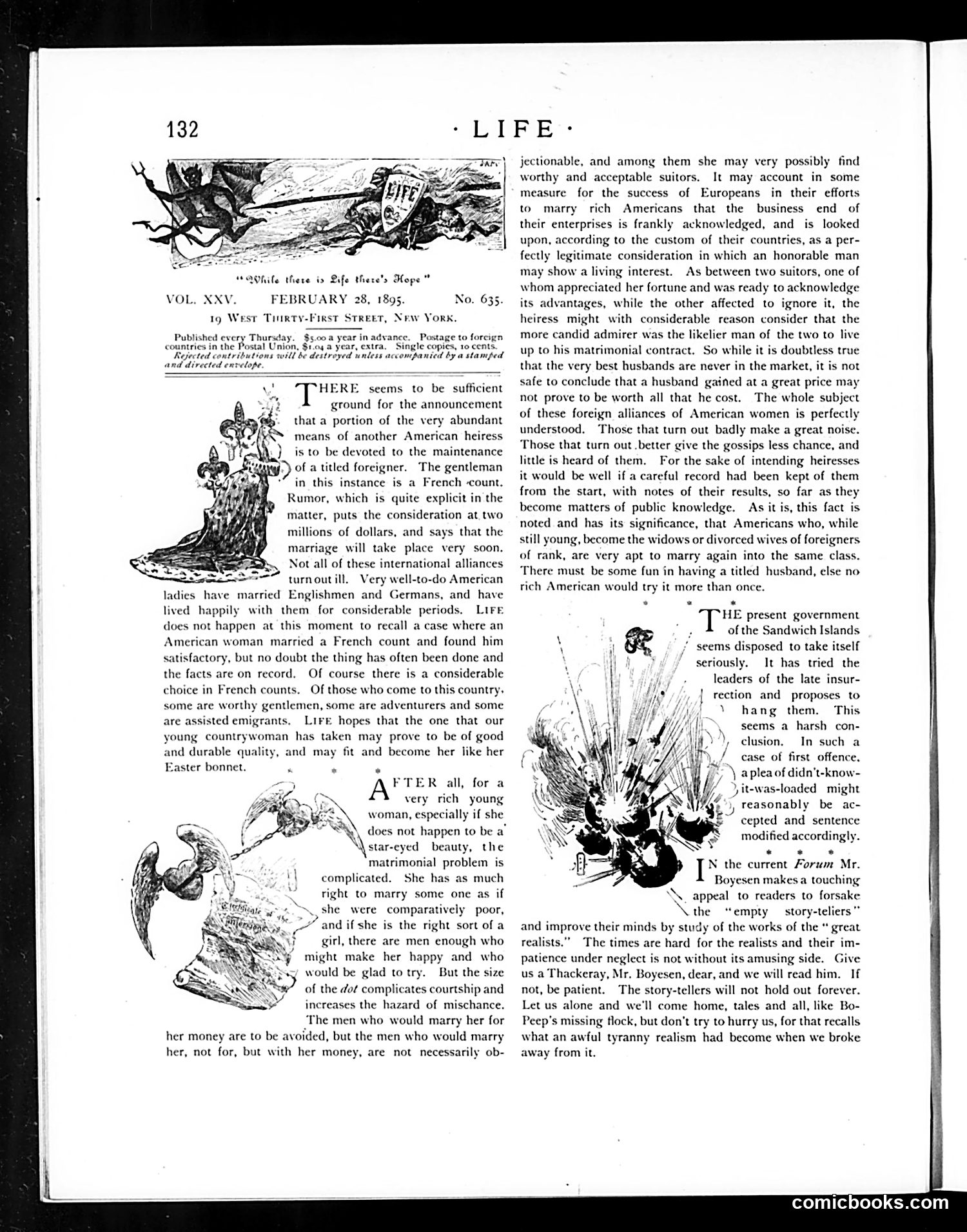
This page satirizes **wealthy American heiresses marrying foreign nobility**—a common phenomenon in the Gilded Age. The article argues that while some Europeans marry Americans for money, American women themselves deserve scrutiny for choosing husbands poorly. The cartoons appear to depict **Cupid or romantic figures** entangled in complications, reinforcing the article's theme about the "hazard of mischance" in such marriages. The piece criticizes both parties: foreign fortune-hunters and American women who prioritize titles over character. It notes that failed marriages between American heiresses and foreign counts/noblemen generate public gossip while cautioning against hasty conclusions about their motives or outcomes. The tone is satirical but moralistic—warning against marrying for status rather than genuine compatibility.
📄 Transcribed text from this page (OCR, searchable)
Machine-transcribed from the original scan — historical spelling and the odd misread are preserved.
‘LIFE™: hile there is Life there's Hope” VOL. XXV. FEBRUARY 28, 1g West THirt 1895. IRST STREET, New York, Published every Thursday. $5.00 a year in advance. countries in the Postal Union, $104 a year, extr Rejected contributions will be destroyed untes Postage to foreign ngle copies, 10 cents. companied by a stamped and directed envelope HERE seems to be sufficient ground for the announcement that a portion of the very abundant means of another American heiress is to be devoted to the maintenance of a titled foreigner. The gentleman in this instance is a French count, Rumor, which is quite explicit in the matter, puts the consideration at two millions of dollar: s that the marriage will ta very and turnoutill. Very well-to-do American adies have married Englishmen and Germans, and have lived happily with them for considerable periods, LIFE does not happen at this moment to recall a case where an American woman married a French count and found him satisfactory, but no doubt the thing has often been done and the facts are on record. Of course there is a considerable choice in French counts. Of those who come to this country: some are worthy gentlemen, some are adventurers and some are assisted emigrants. Lire hopes that the one that our young countrywoman has taken may prove to be of good nd durable quality, and may fit and become her like her very rich young ster bonnet. 7 woman, especially if she NS Y does not happen to be a \\ star-eyed beauty, the matrimonial problem is complicated. She has as much right to marry some one as if she were comparatively poor, * (/ and if she is the right sort of a 2R all, for a girl, there are men enough who might make her happy and who would be glad to try. But the size of the dot complicates courtship and increases the hazard of mischance. he men who would marry her for her money are to be avoided, but the men who would marry her, not for, but with her money, are not necessarily ob- jectionable, and among them she may very possibly find worthy and acceptable suitors. It may account in some measure for the success of Europeans in their efforts to marry rich Americans that the business end of their enterprises is frankly acknowledged, and is looked upon, according to the custom of their countries, as a per- fectly legitimate consideration in which an honorable man may show a living interest. As between two suitors, one of whom appreciated her fortune and was ready to acknowledge its advantages, while the other affected to ignore it, the heiress might with considerable reason consider that the more candid admirer was the likelier man of the two to live up to his matrimonial contract. So while it is doubtless true that the very best husbands are never in the market, it is not safe to conclude that a husband gained at a great price may not prove to be worth all that he cost. The whole subject of these foreign alliances of American women is perfectly understood. Those that turn out badly make a great noise. Those that turn out better give the gossips less chance, and little is heard of them, For the sake of intending heiresses it would be well if a careful record had been kept of them from the start, with notes of their results, so far as they become matters of public knowledge. As it is, this fact is noted and has its significance, that Americans who, while still young, become the widows or divorced wives of foreigners of rank, are very apt to marry again into the same class. There must be some fun in having a titled husband, else no rich American would try it more than once. . . * HE present government of the Sandwich Islands seems disposed to take itself It has tried the leaders of the late insur- rection and proposes to \ hang them. This seems a harsh con- clusion, In such a case of first offence. 7, \ apleaof didn't-know- ) it-was-loaded might reasonably be ac- cepted and sentence modified accordingly. « 2 6 N the current Forum Mr. Boyesen makes a touching ‘\. appeal to readers to forsake the “empty — story-teliers” and improve their minds by study of the works of the “ great realists.” The times are hard for the realists and their im- patience under neglect is not without its amusing side. Give us a Thackeray, Mr. Boyesen, dear, and we will read him. If not, be patient. The story-tellers will not hold out forever. Let us alone and we'll come home, tales and all, like Bo- Peep’s missing flock, but don’t try to hurry us, for that recalls what an awful tyranny realism had become when we broke away from it. seriously. comicbooks.com