
Life, 1895-02-28 · page 3 of 20
Life — February 28, 1895 — page 3: what you’re looking at
What you’re looking at
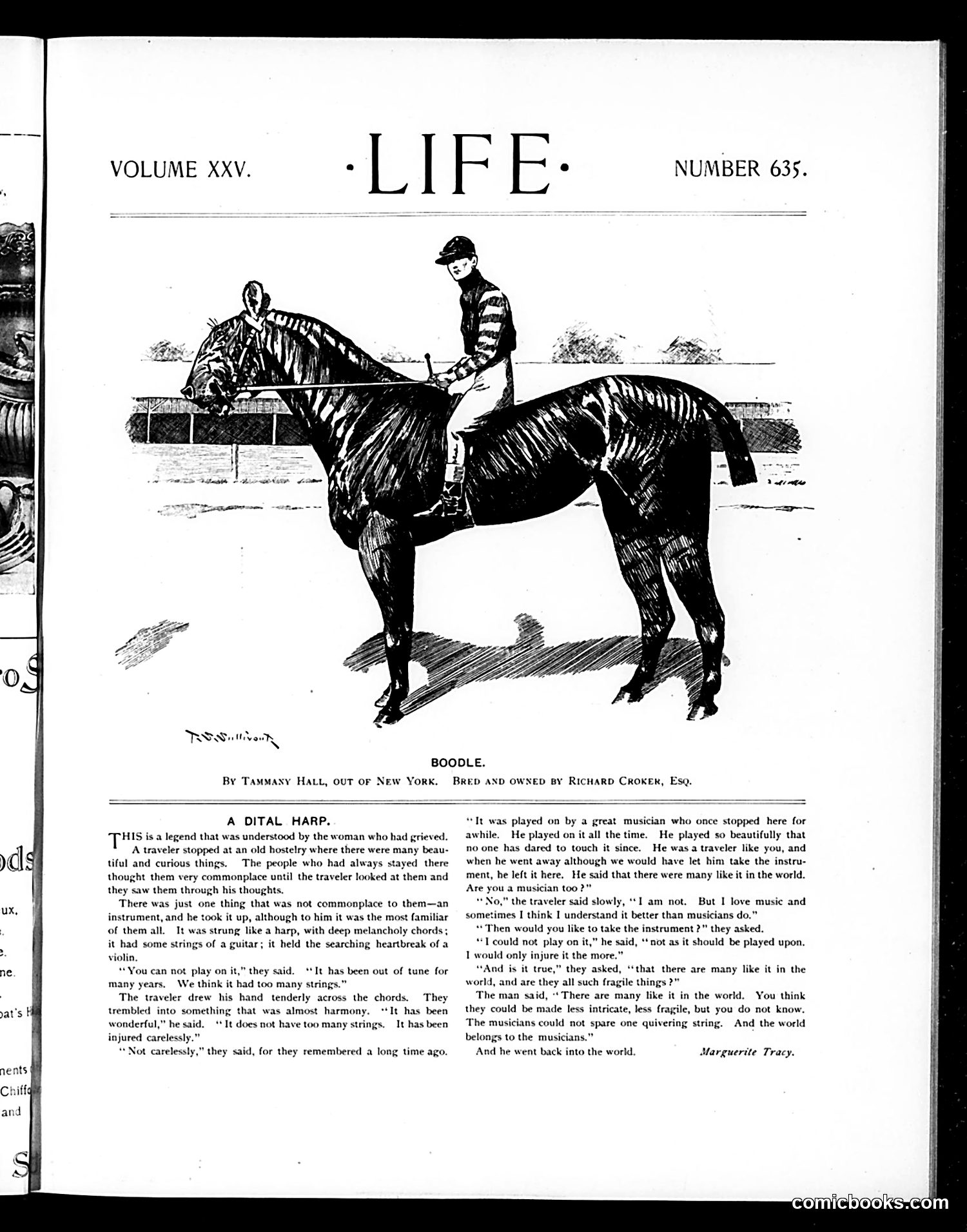
This page features an illustration of a thoroughbred racehorse named "Boodle," owned by Richard Croker, Esq., and bred by Tammany Hall out of New York. The accompanying story, "A Dital Harp," is unrelated to the horse—it's a sentimental tale about a traveler who discovers a neglected harp and learns its musical value from locals. The horse illustration appears to be satirical commentary: the phrase "Tammany Hall, out of New York" is a political jab. Tammany Hall was New York's notorious Democratic political machine, associated with corruption. By naming the horse's pedigree after Tammany Hall, Life magazine sarcastically suggests the horse—and by extension, anything associated with Tammany Hall leadership—is a product of corrupt political breeding. The satire critiques Croker's connection to Tammany Hall's questionable practices.
📄 Transcribed text from this page (OCR, searchable)
Machine-transcribed from the original scan — historical spelling and the odd misread are preserved.
PO oa BOODLE. By TamMaxy HALL, OUT OF New YorK. BRED AND OWNED BY RICHARD CROKEK, Eso. A DITAL HARP. IS isa legend that was understood by the woman who had grieved. A traveler stopped at an old hostelry where there were many beau- tiful and curious things. The people who had always stayed there thought them very commonplace until the traveler looked at them and they saw them through his thoughts. There was just one thing that was not commonplace to them—an instrument, and he took it up, although to him it was the most familiar of them all. It was strung like a harp, with deep melancholy chords; it had some strings of a guitar; it held the searching heartbreak of a violin. “You can not play on it,” they said. “It has been out of tune for many years. We think it had too many strings.” The traveler drew his hand tenderly across the chords. They trembled into something that was almost harmony. ‘It has been wonderful,” he said. ‘It does not have too many strings, It has been injured carelessly.” “* Not carelessly,” they said, for they remembered a long time ago. TH “It was played on by a great musician who once stopped here for awhile, He played on it all the time. He played so beautifully that no one has dared to touch it since. He wasa traveler like you, and when he went away although we would have let him take the instru- ment, he left it here. He said that there were many like it in the world. Are you a musician too?” “No,” the traveler said slowly, “1 am not, But I love music and sometimes I think I understand it better than musicians do.” “Then would you like to take the instrument ?" they asked. “TL could not play on it,” he said, ‘not as it should be played upon. I would only injure it the more.” “And is it true,” they asked, ‘that there are many like it in the world, and are they all such fragile things ?” The man said, “There are many like it in the world. You think they could be made less intricate, less fragile, but you do not know. The musicians could not spare one quivering string. And the world belongs to the musicians.” And he went back into the world, Marguerite Tracy.