
A complete issue · 18 pages · 1895
Life — January 3, 1895
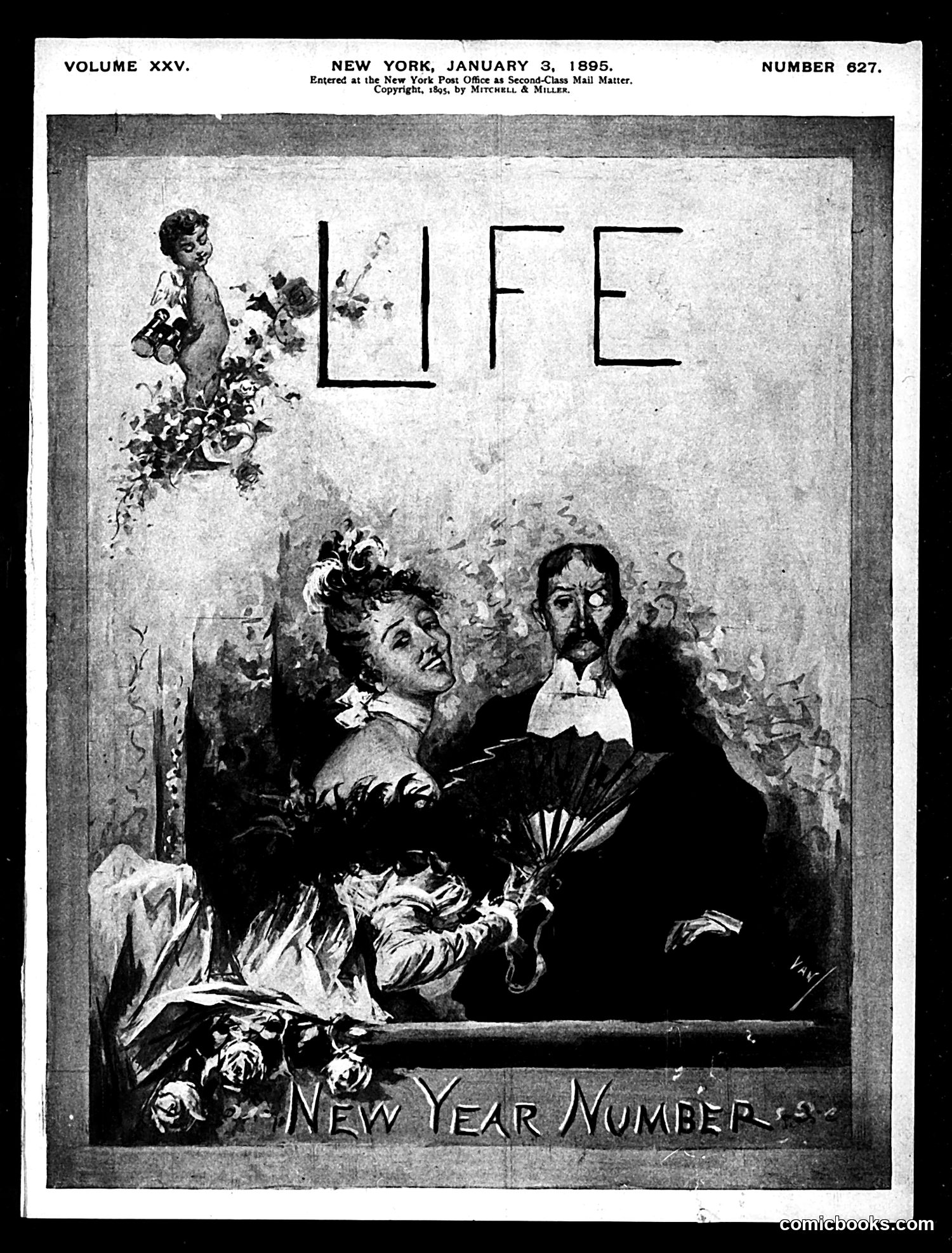
This is the cover of Life's "New Year Number." The illustration depicts a romantic scene of a well-dressed couple gazing upward at a cherub or cupid figure emerging from flowers at the top of the composition, with the word "LIFE" integrated into the design. The "New Year Number" designation and the romantic imagery suggest this is celebratory seasonal content rather than political satire. The couple's elegant Victorian dress, the cherub symbolizing love and renewal, and the floral decorations are typical of fin-de-siècle greeting imagery meant to welcome 1895. Without additional OCR text or captions identifying specific figures, the satire's target—if any—remains unclear from the image alone.
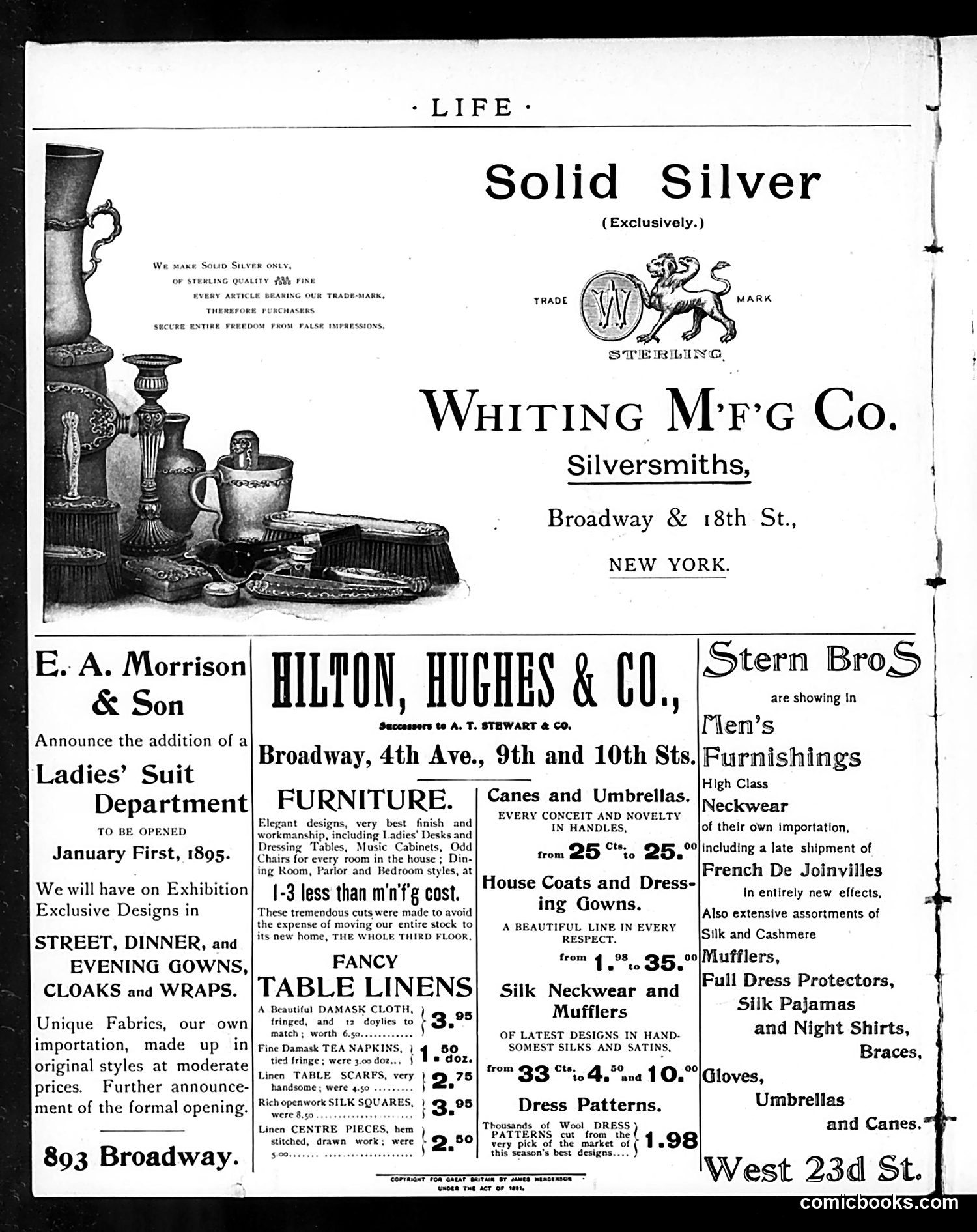
This page is **primarily advertising**, not satirical content. It contains five separate late-19th-century advertisements: 1. **Whiting Mfg Co.** (top): Promotes solid sterling silver goods, displaying ornamental vessels 2. **E.A. Morrison & Son** (left): Announces a new Ladies' Suit Department opening January 1, 1895, featuring exclusive gown designs 3. **Hilton, Hughes & Co.** (center): Advertises furniture, table linens, and accessories at discounted prices 4. **Stern Bros** (right): Showcases men's furnishings, including imported French neckwear and evening wear 5. Various smaller ads for canes, umbrellas, and dress patterns The page reflects 1890s consumer culture and department store commerce rather than political satire. No cartoon or satirical commentary is present—this is a straightforward advertising section from *Life* magazine.
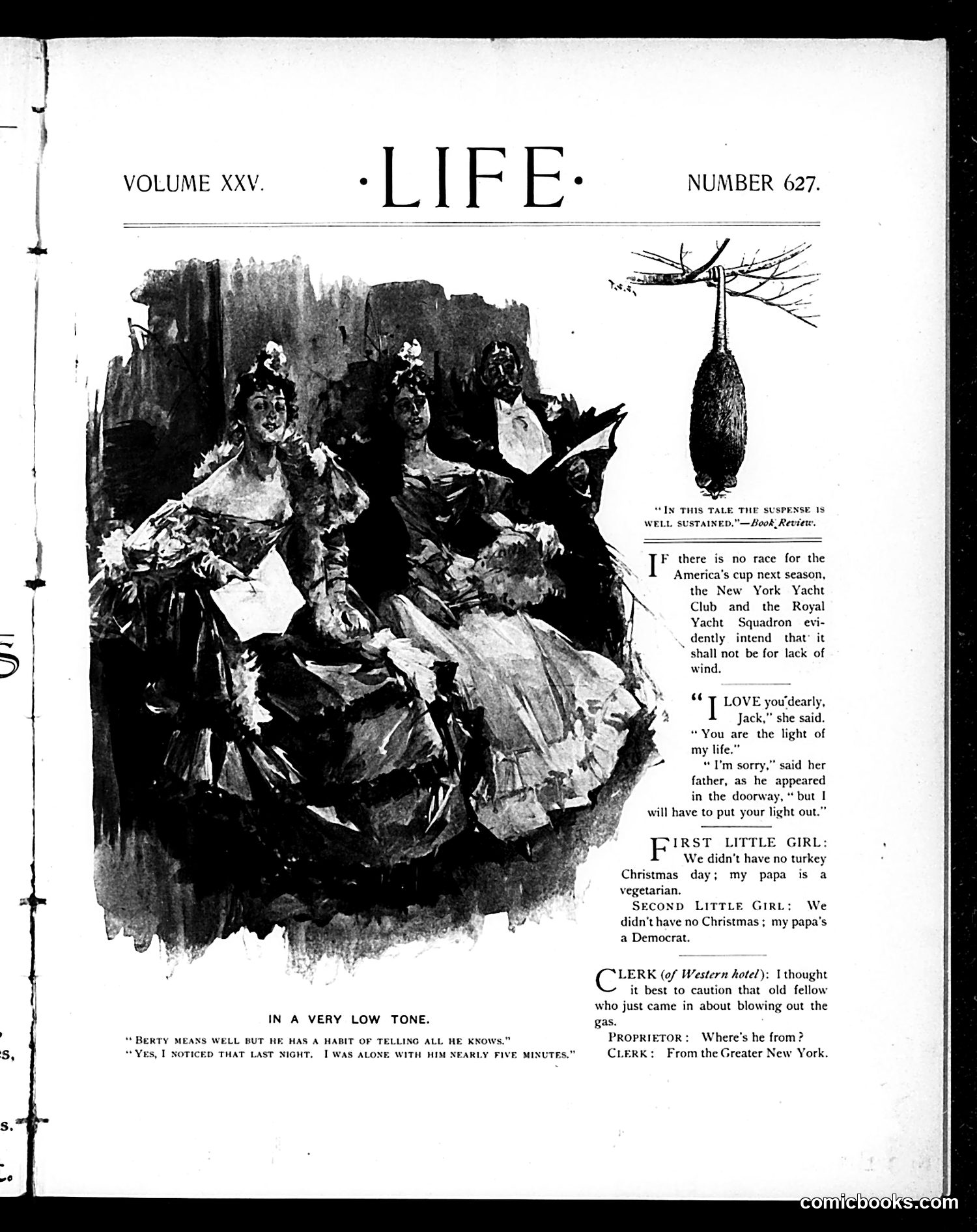
The main illustration depicts a social gathering with elegantly dressed women in what appears to be early 20th-century attire. The caption "In a Very Low Tone" suggests gossip or scandal being discussed discreetly. The accompanying text jokes reference: - **Berty** (likely a character known for indiscretion), caught alone with someone for "nearly five minutes" - **America's Cup yacht racing** between the New York Yacht Club and Royal Yacht Squadron, satirizing wealthy society's concerns - Domestic humor about Christmas without turkey (vegetarian father) and without celebration (Democratic father) - A **Western hotel clerk** cautioning about gas safety The satire mocks upper-class preoccupations with propriety, gossip, wealth displays, and trivial domestic politics, typical of Life's satirical approach to Gilded Age/Progressive Era society.
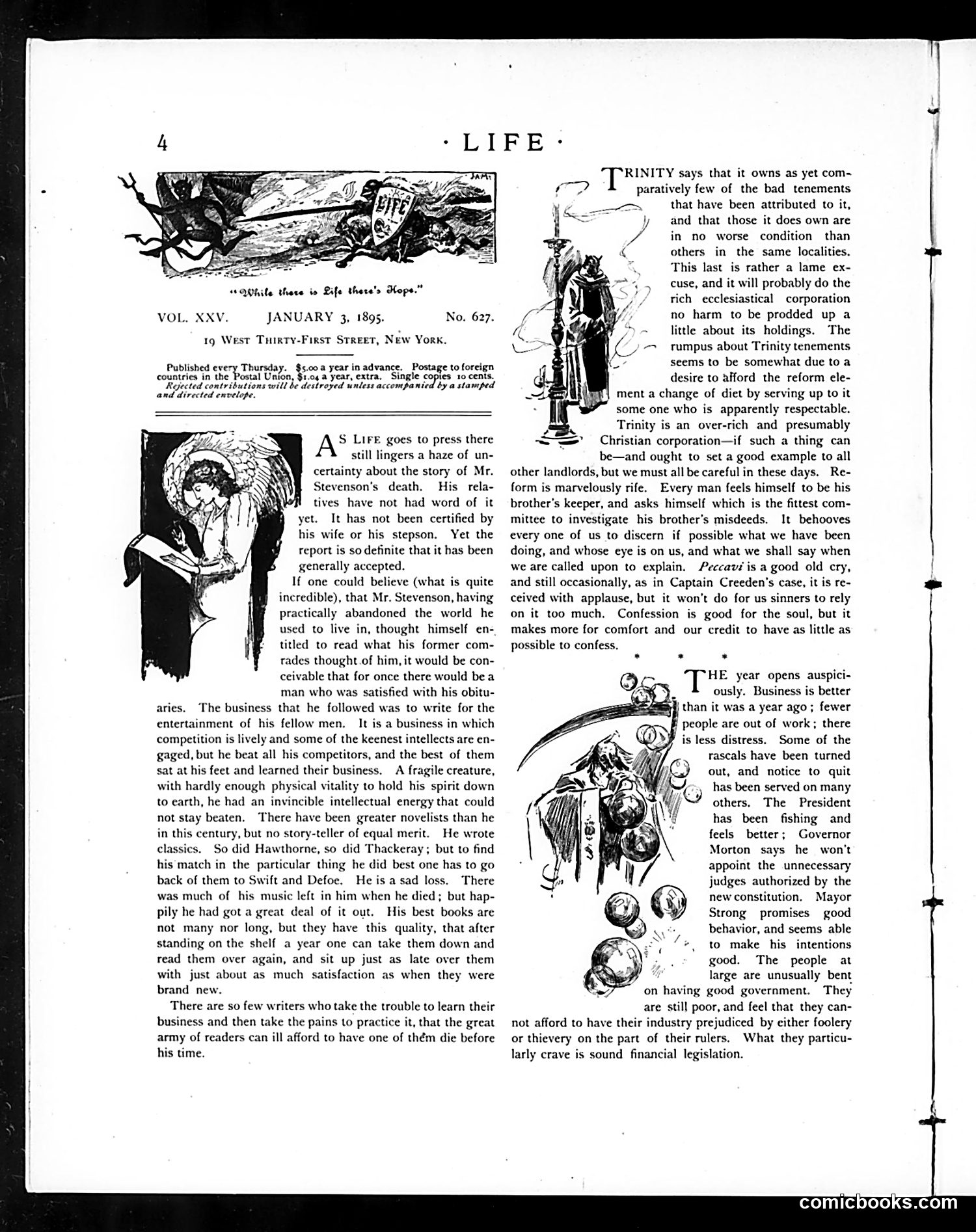
This page contains editorial commentary on current events rather than political cartoons. The main article discusses Mr. Stevenson's death—likely Robert Louis Stevenson, the celebrated Scottish author who died in December 1894. The text praises Stevenson's literary accomplishments, comparing him favorably to Hawthorne and Thackeray, while lamenting his loss to literature. The decorative illustrations appear to be thematic rather than satirical—depicting figures in period dress that complement the nostalgic tone discussing a writer's legacy. The right column shifts to contemporary 1895 American politics, mentioning President Cleveland's fishing, Governor Morton, and Mayor Strong, suggesting optimism about good governance and financial reform, though specifics remain general commentary rather than sharp satire.
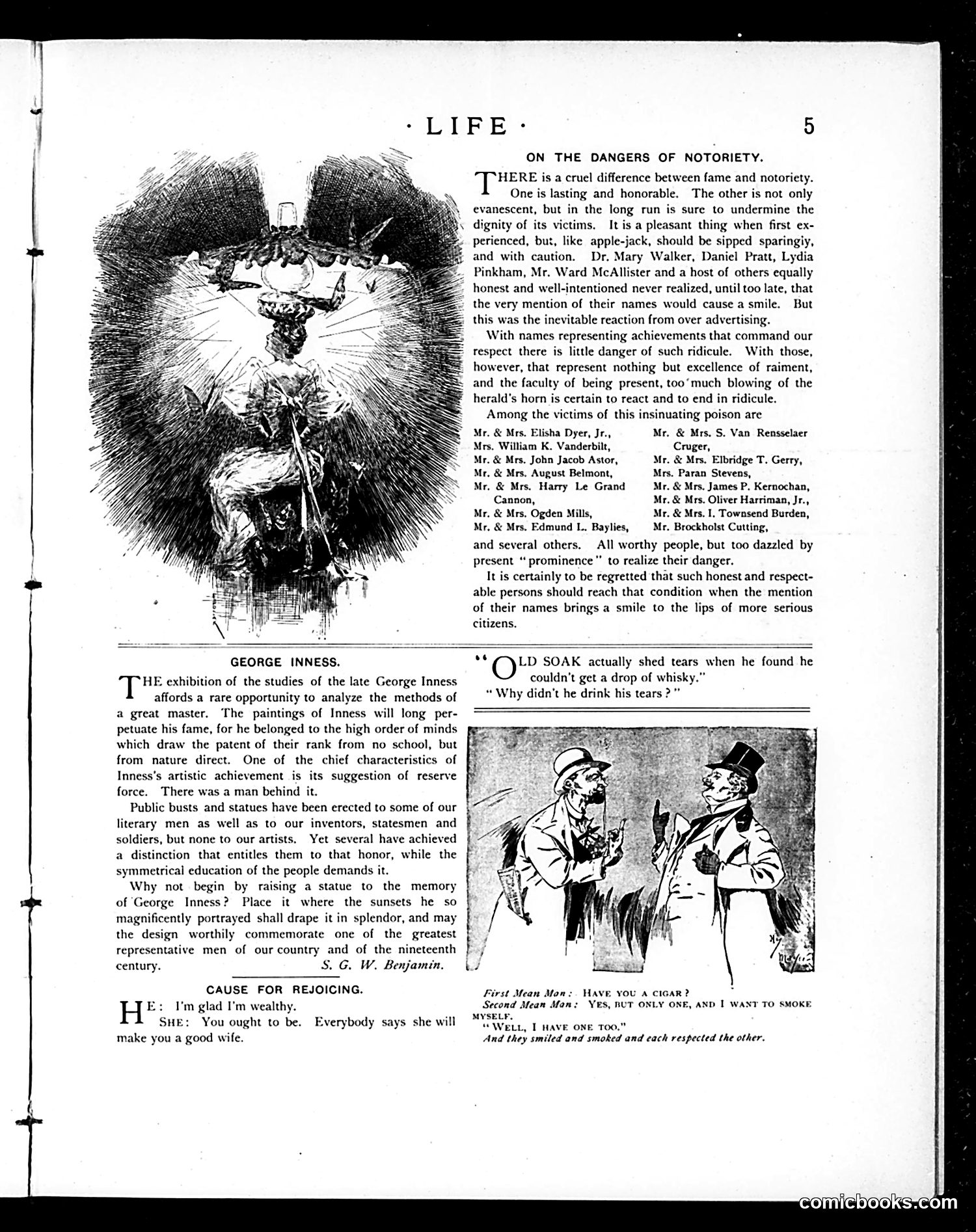
**Top Section - "On the Dangers of Notoriety":** This article warns against confusing fame with notoriety. It argues that while legitimate achievement (citing Dr. Mary Walker, Daniel Pratt, and others) deserves respect, excessive publicity can damage one's dignity. The piece cautions that even well-intentioned people can suffer from over-advertisement, listing several names of individuals whose prominence became problematic. **Bottom Cartoon - "Cause for Rejoicing":** A brief joke about marriage: a man declares he's glad he's wealthy because "Everybody says she will make you a good wife." The humor satirizes how financial status influences marital prospects rather than genuine affection or character. **George Inness Section:** A tribute to the late landscape painter, celebrating his artistic methods and suggesting a statue be erected in his honor.
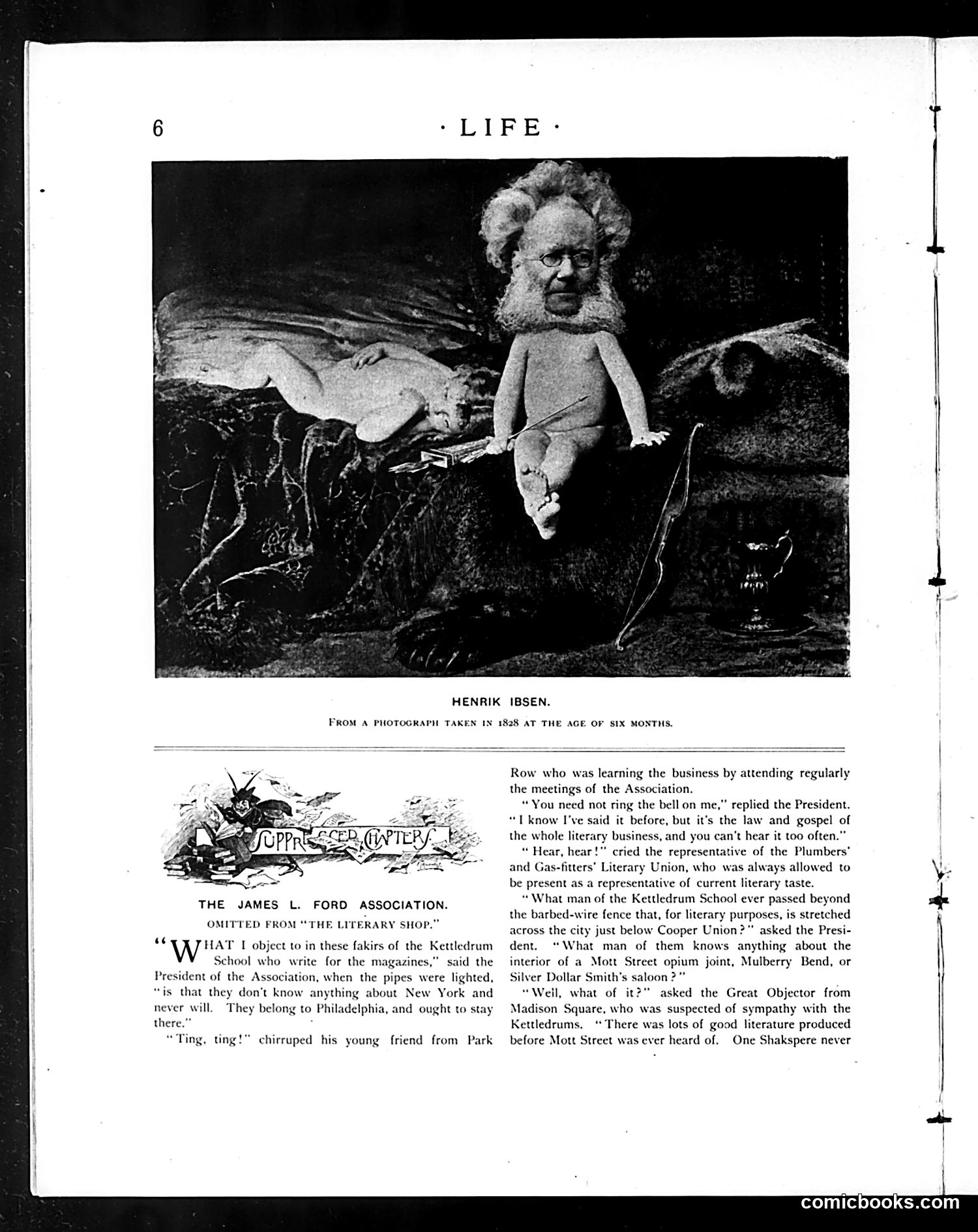
The top image shows Henrik Ibsen as an infant (captioned "from a photograph taken in 1828 at the age of six months"), humorously depicting the famous Norwegian playwright in baby form with an adult's bearded face—a visual joke about his enduring cultural significance. Below, "The James L. Ford Association" section satirizes New York's literary scene. The dialogue mocks pretentious writers and intellectuals who claim authority over "literary business" while remaining ignorant of actual New York geography and culture. References to locations like "Mott Street opium joints" and "Mulberry Blend" suggest criticism of writers who pontificate about urban life without genuine knowledge. The satire targets literary gatekeepers and their shallow expertise.
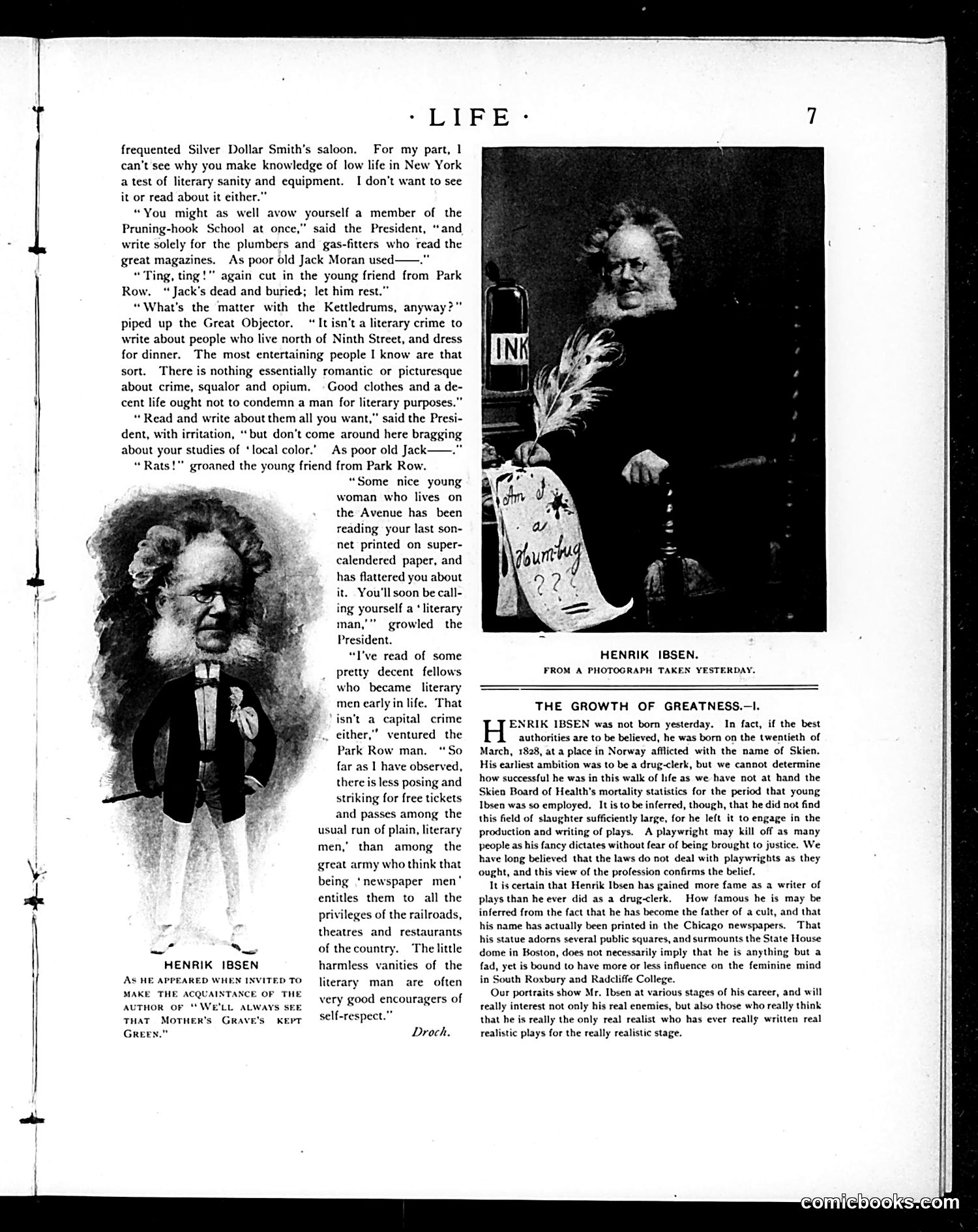
This page features two portraits of **Henrik Ibsen**, the Norwegian playwright. The left image shows Ibsen as he appeared when invited to meet the author of "We'll Always See That Mother's Grave's Kept Green"; the right shows a recent photograph. The accompanying article, "The Growth of Greatness," establishes Ibsen's literary significance while deflating pretension. The satirical dialogue above mocks American literary poseurs—particularly those from "Park Row" (newspaper district) and aspiring "local color" writers who affect sophistication about urban poverty. The President character dismisses such affectations as unoriginal posing. The satire targets Americans attempting cosmopolitan literary credentials by studying "low life," contrasting their phoniness with Ibsen's genuine artistic achievement.
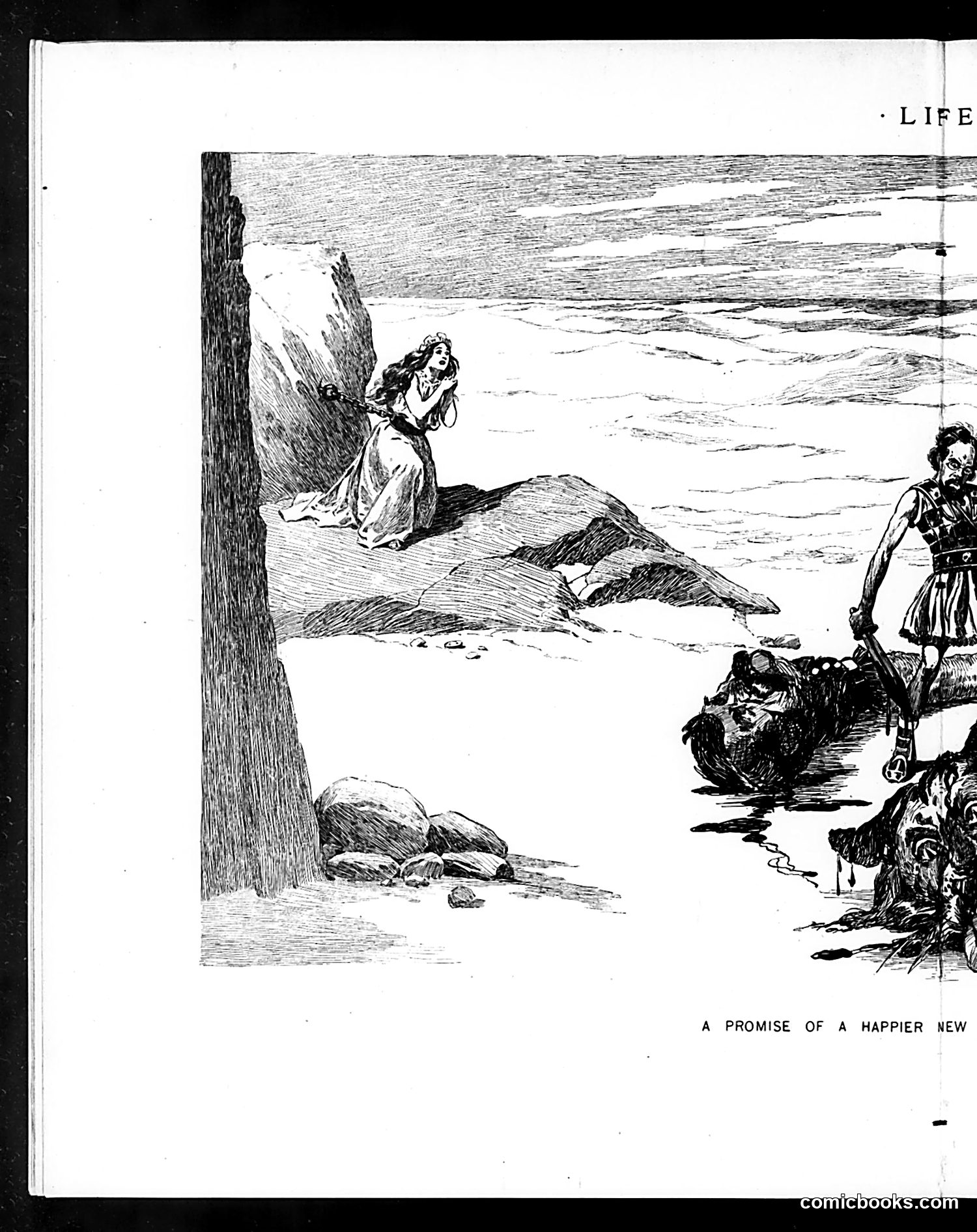
This illustration from *Life* magazine depicts a beach scene with the caption "A PROMISE OF A HAPPIER NEW" (likely referring to New Year). The engraving shows several figures in what appears to be a somewhat chaotic seaside setting. The image presents a satirical comment on leisure and social behavior at the beach. The figures' poses and positioning—including someone reclining dramatically near rocks—suggest commentary on vacationing habits or possibly social class distinctions in recreational activities. The detailed cross-hatching technique creates dramatic shadows and emphasizes the scene's theatrical quality. Without additional context or visible date information, the precise political reference remains unclear, though the composition suggests satire about contemporary (to the publication) attitudes toward leisure, possibly relating to New Year's resolutions or aspirations for improvement.
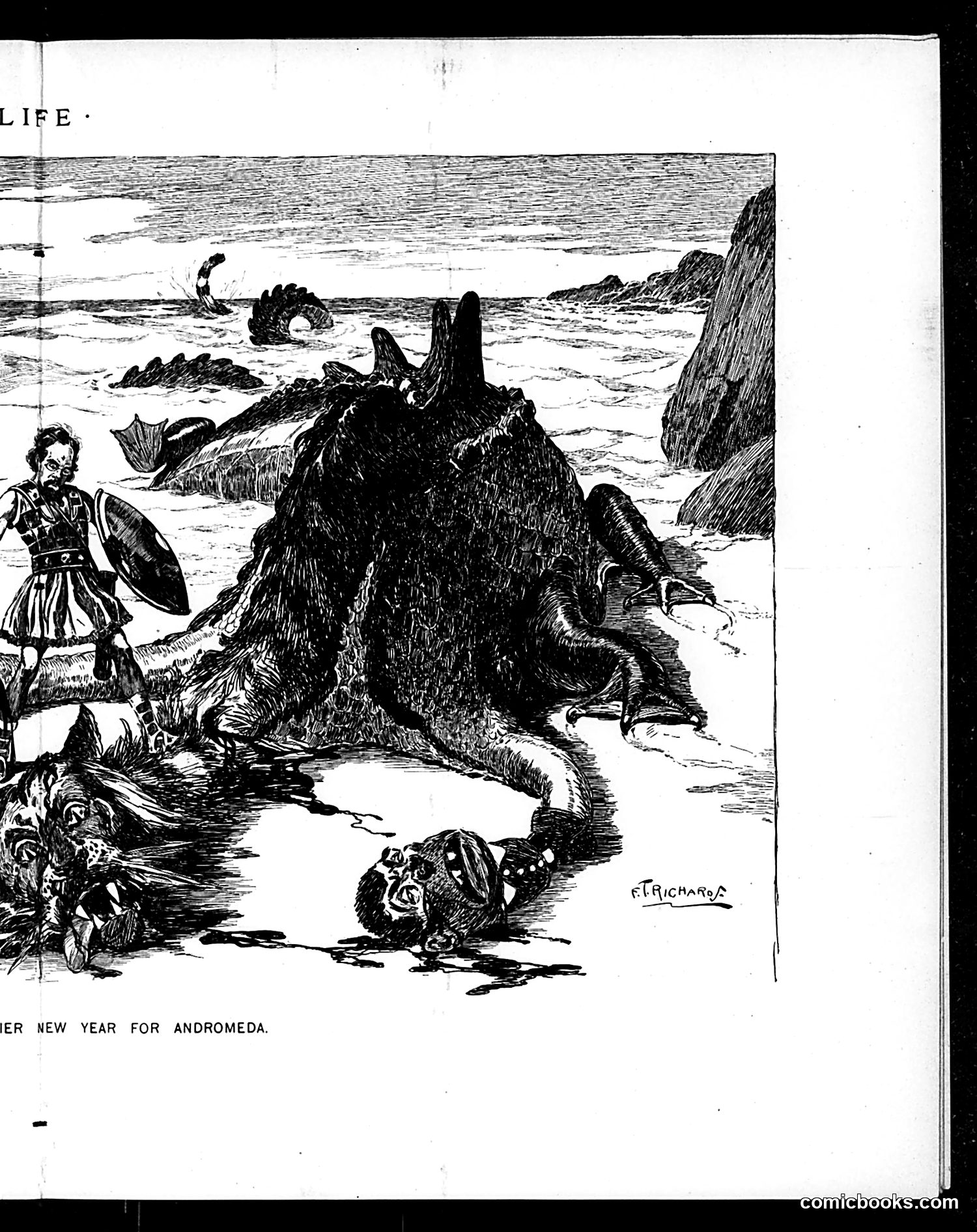
This is a science fiction satire illustrated by F.L. Richards. The cartoon depicts a warrior woman in classical dress confronting a massive, hairy monster on a rocky beach, with other creatures and rock formations visible in the background. The title references Andromeda from Greek mythology—the princess chained to a rock as sacrifice to a sea monster, later rescued by Perseus. This illustration appears to reimagine that classical narrative, possibly satirizing contemporary anxieties about space exploration, alien life, or the "clash of civilizations" trope popular in early 20th-century science fiction. The warrior woman's armed stance suggests a subversive twist on the traditional damsel-in-distress narrative. Without additional context about Life magazine's publication date or surrounding articles, the specific satirical target remains unclear.
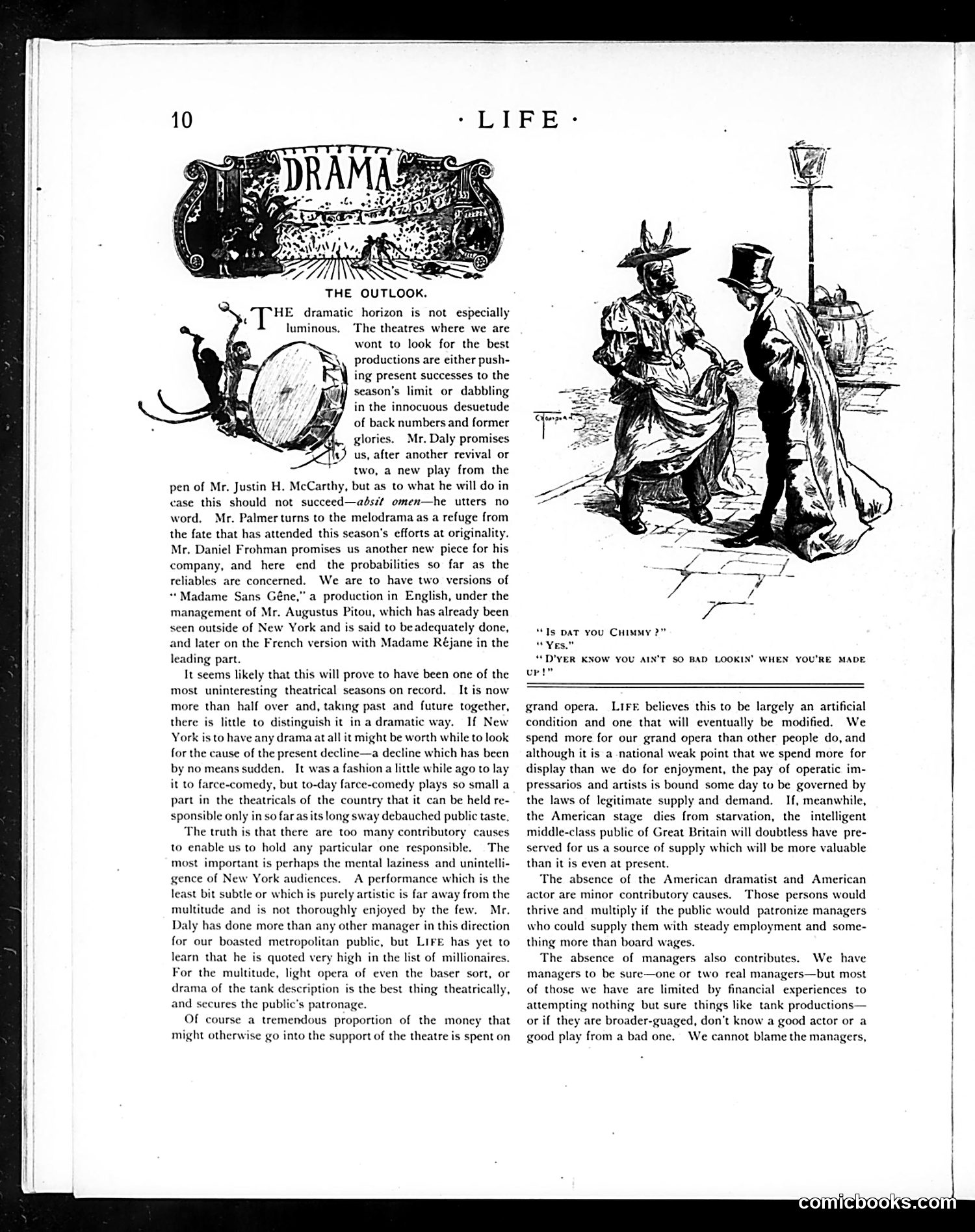
This page from Life's "Drama" section discusses the theatrical season's outlook. The text criticizes the current state of American theater, noting that theaters aren't producing particularly original work—instead reviving previous successes or dabbling with inferior plays. The main illustration shows two figures in period costume (appearing to be from a classical or historical play) with the caption "'IS DAT YOU CHIMMY?' 'YES.' 'DYER KNOW YOU AIN'T SO BAD LOOKIN' WHEN YOU'RE MADE UP!'" This joke satirizes theatrical acting and costumes, suggesting that performers only look acceptable when heavily made up and dressed in costume—implying their natural appearance is unremarkable. The dialect suggests working-class characters, adding a layer of satire about popular theater's audience and performers.
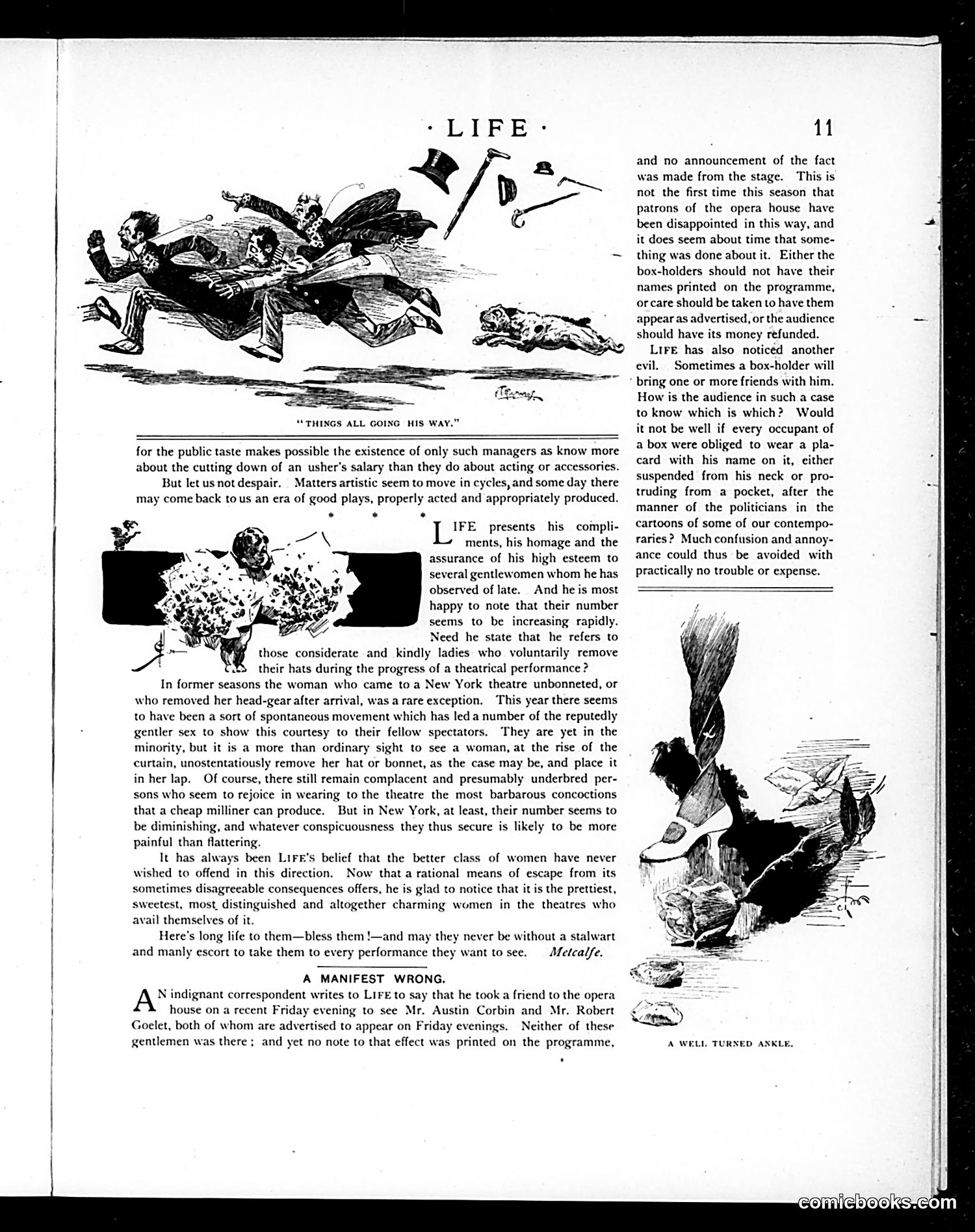
This page satirizes theater etiquette and management failures. The top cartoon ("Things All Going His Way") depicts a chaotic opera scene with figures in disarray—likely mocking incompetent theater direction or management. The main article, "A Manifest Wrong," complains that advertised performers (Austin Corbin and Robert Goclet) failed to appear on an advertised Friday evening, yet the opera house made no announcement. The satire argues this is a fraud on paying patrons who deserve either refunds or notification. A secondary complaint addresses women wearing ostentatious, cheap hats that obstruct other audience members' views—a recurring irritation in theaters of this era. The text advocates for courtesy and proper dress codes among theatergoers. The cartoon "A Well Turned Ankle" (bottom right) appears to celebrate appropriate feminine fashion.
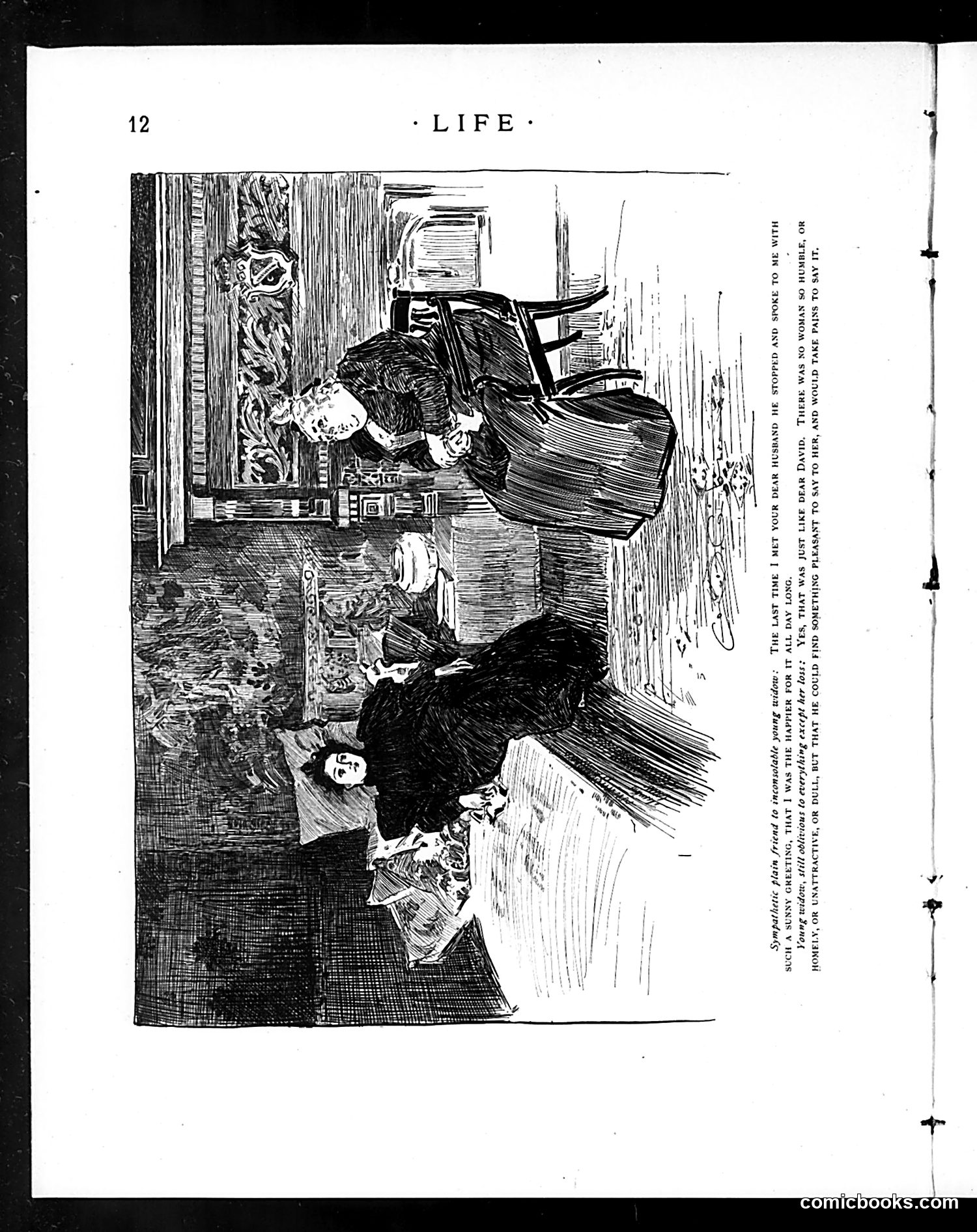
I cannot reliably read the OCR'd text on this page—it appears corrupted or reversed. The illustration itself shows an interior scene with two figures: a man in dark clothing reclining or lying down, and a woman in Victorian-era dress standing. The setting appears to be a domestic interior with detailed furnishings and architectural elements rendered in pen-and-ink style. Without legible text accompanying the image, I cannot identify the specific figures, determine what social or political situation is being satirized, or explain the cartoon's intended meaning to a modern reader. The artistic style is consistent with late 19th or early 20th-century American magazine illustration, but the satire's target remains unclear.
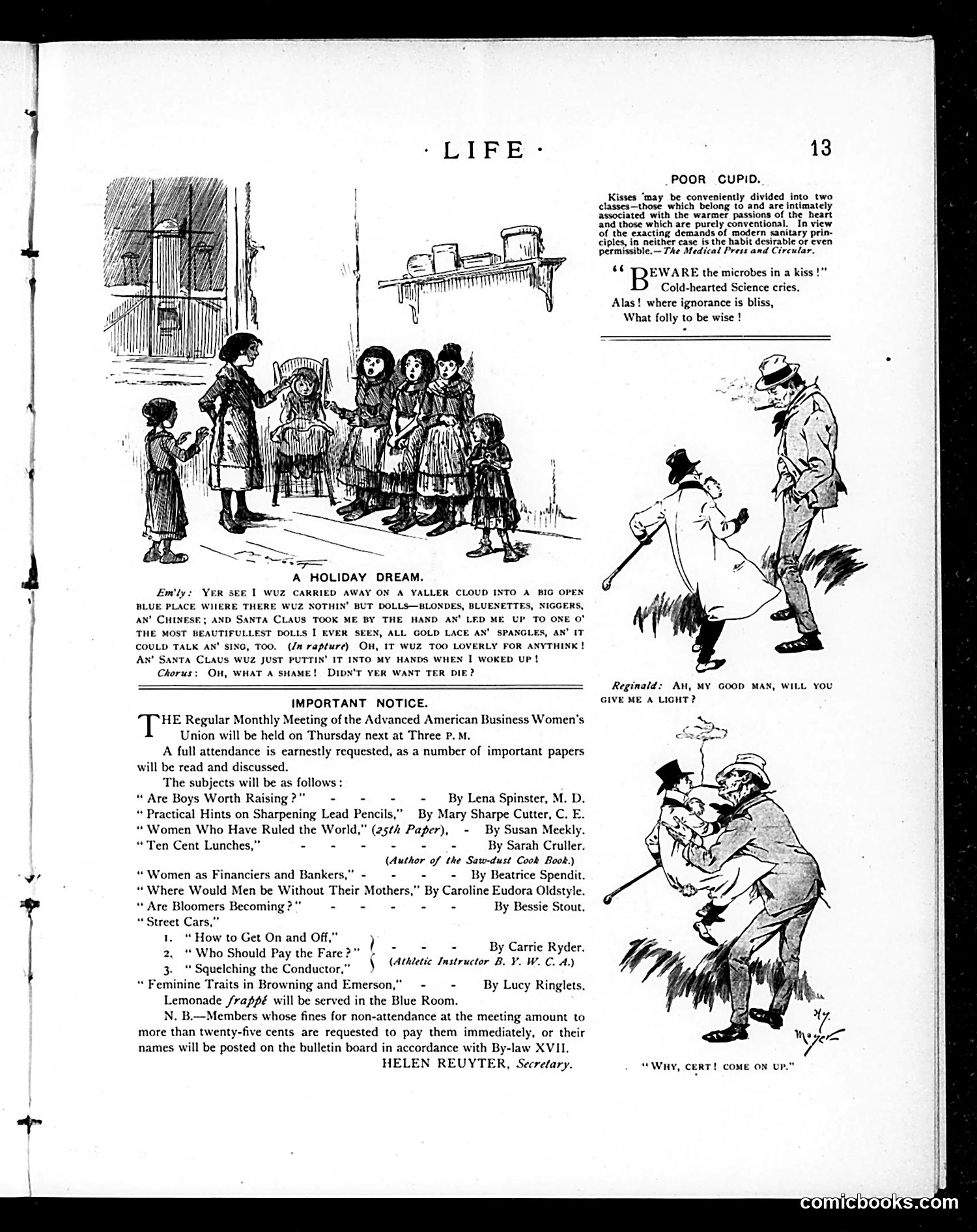
This page contains two distinct satirical pieces: **"Poor Cupid"** mocks the era's growing medical obsession with hygiene. A medical journal warns against kissing due to microbe transmission. The cartoon shows an upper-class man (Reginald) asking a working-class person for a light, with the punchline suggesting romantic/physical contact across class lines. The satire targets both overzealous sanitary warnings and social anxieties about class interaction. **"A Holiday Dream"** depicts a child recounting a fantastical Christmas dream featuring dolls and Santa Claus. The crude dialect and racial language reflect period stereotypes; the joke hinges on the child's disappointment upon waking—a sentimental Victorian trope about lost innocence. The **"Important Notice"** parodies the nascent women's suffrage/professional women's movement through absurdist lecture titles ("Are Boys Worth Raising?"), satirizing early feminist organizations as simultaneously trivial and threatening to traditional gender roles.
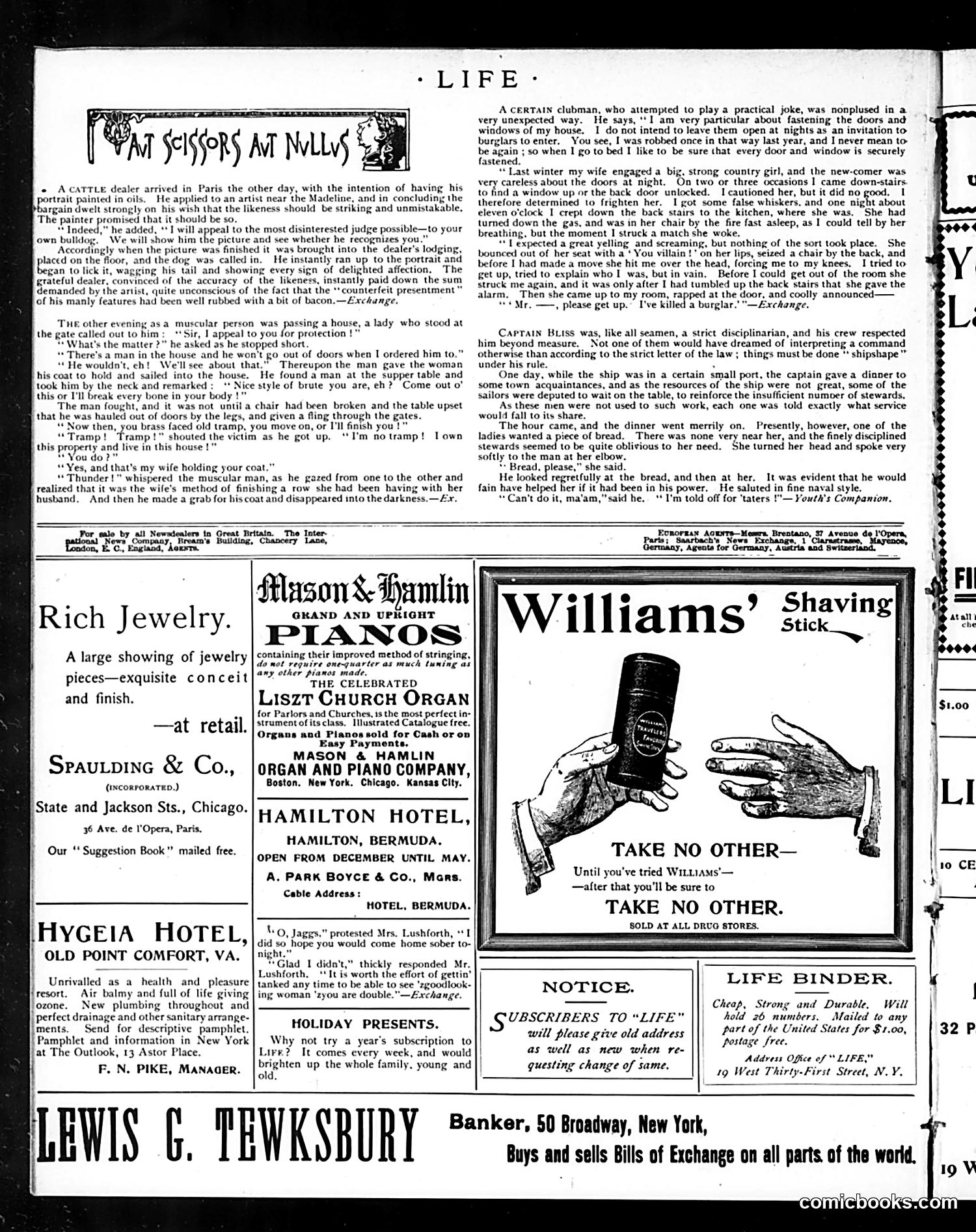
This page contains three humorous anecdotes typical of *Life* magazine's satirical humor: 1. **The Bulldog Portrait**: A cattle dealer commissions a Paris artist to paint a recognizable portrait. The artist's "test"—having the dealer's bulldog identify the painting—succeeds only because the artist rubbed bacon on the canvas, not because the portrait resembles him. The joke: the dealer pays handsomely for a worthless portrait, fooled by a dog's appetite rather than artistic skill. 2. **The Muscular Man and Aggressive Woman**: A strong man stops a woman from evicting a vagrant, only to discover she's the vagrant's wife, attempting to force *him* out. The humor comes from the reversal—the "tough guy" becomes an unwitting pawn in domestic dispute. 3. **The Burglary Prank (partial)**: A clubman dons false whiskers to frighten his careless servant into securing doors better. Instead of cowering, she attacks him with a chair, foiling his practical joke. All three rely on ironic reversals and the humiliation of men attempting to appear clever or authoritative.
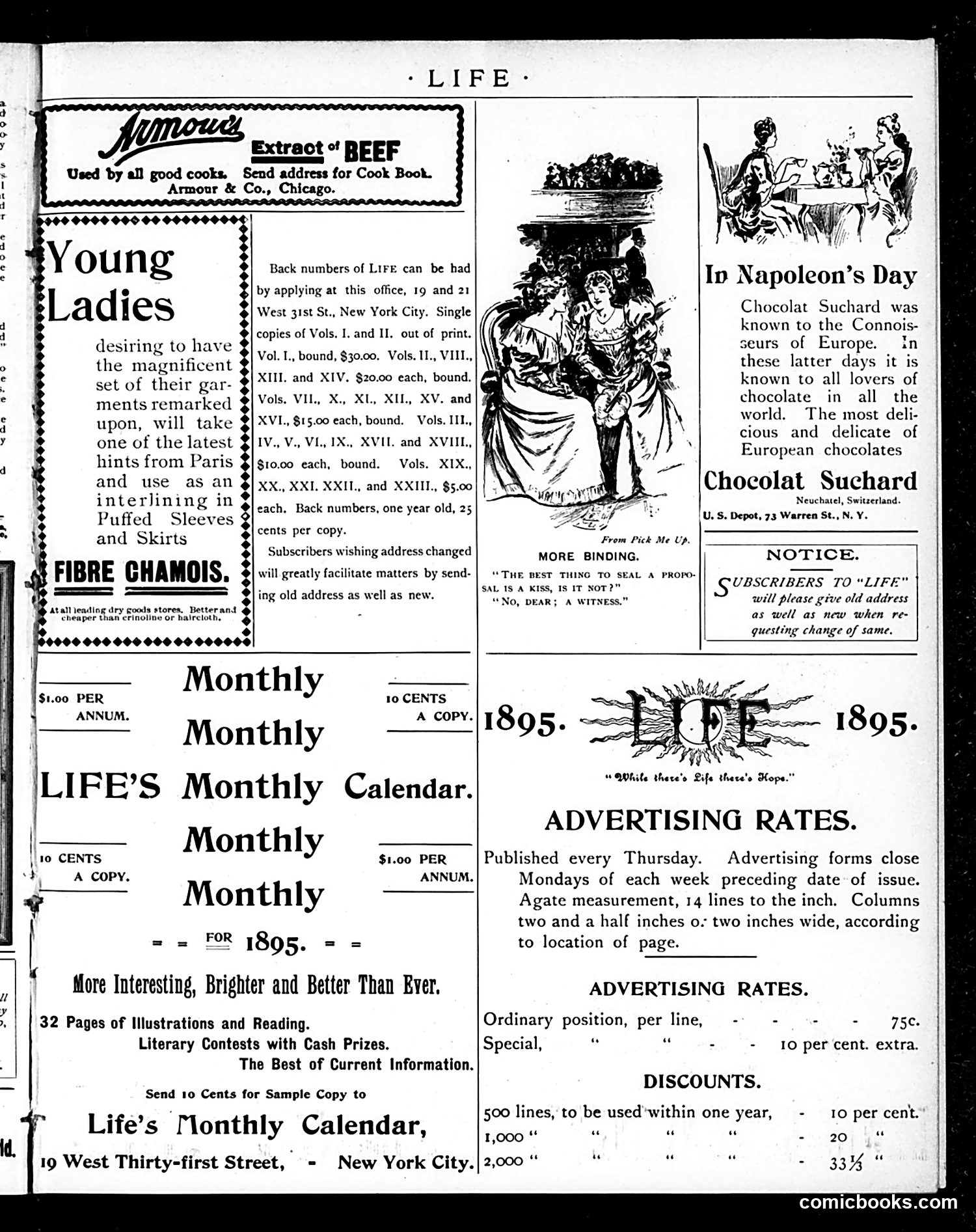
This is primarily an **advertising and administrative page** rather than a satirical cartoon page. The page contains: **Main Content:** - A small cartoon titled "More Binding" showing a man and woman discussing sealing a proposal—the joke being that a legal witness is needed rather than a romantic kiss - Multiple advertisements for period products (Armour beef extract, Fibre Chamois fabric stiffener, Chocolat Suchard) - Subscription and back-issue information for Life magazine itself - A promotional page for Life's Monthly Calendar (a separate publication) - Advertising rate information **Historical Context for Modern Readers:** The "More Binding" cartoon plays on double meaning: "binding" refers both to securing a romantic proposal and to legal/contractual obligations. The humor reflects late-Victorian attitudes about proper courtship requiring witnesses and formality rather than sentiment alone. This page demonstrates how 19th-century magazines financed operations through advertising and subscription sales—a significant portion of each issue was devoted to such administrative and commercial content.
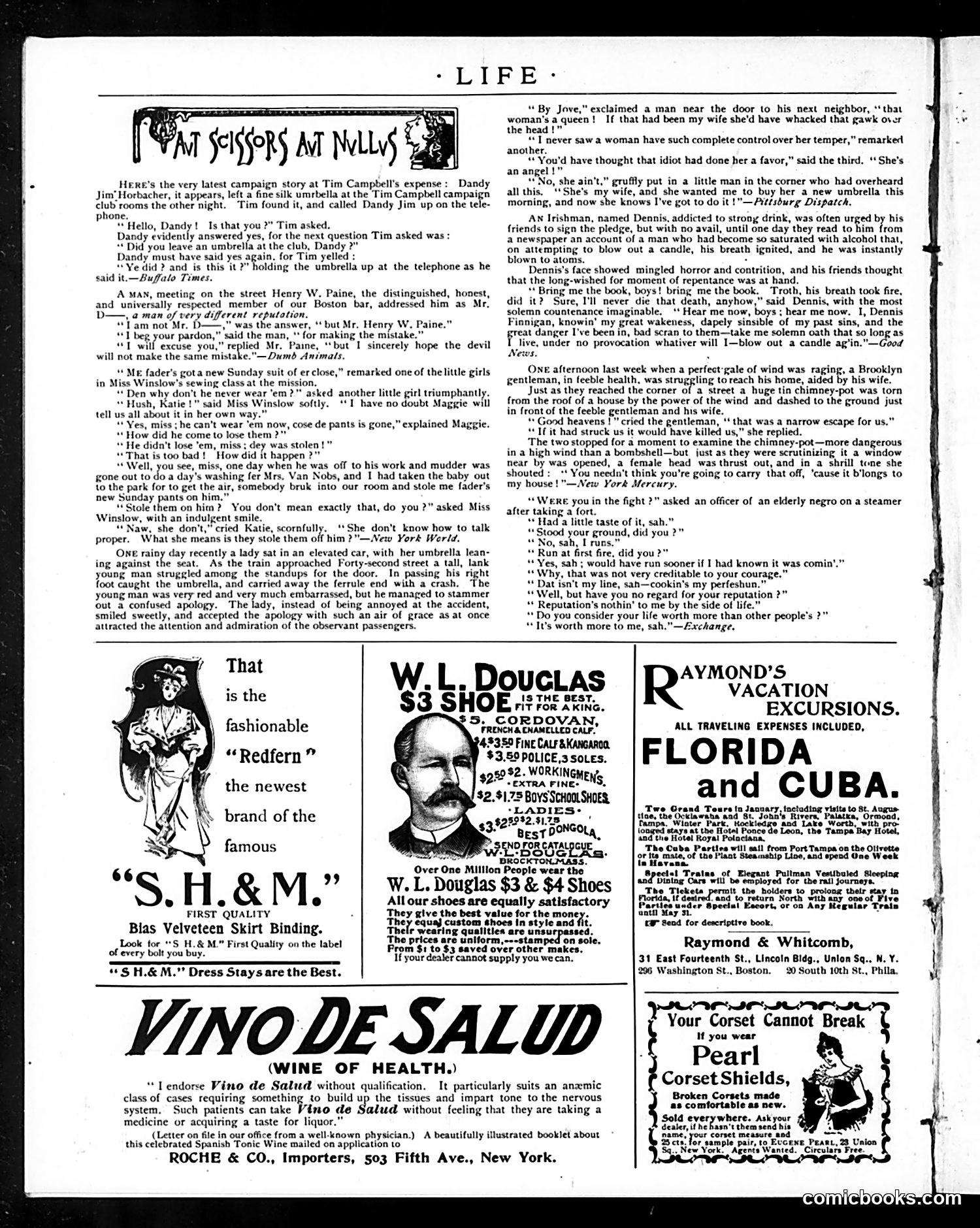
This is a humor/joke page from Life magazine (a satirical publication, not a news source). The cartoons and anecdotes mock various social situations: **Main jokes include:** - A telephone prank where Tim Campbell holds up an umbrella to a caller who can't see it - A case of mistaken identity involving a Boston lawyer - A child's malapropism about stolen "Sunday pants" - An anecdote praising a woman's grace after a man breaks her umbrella on a train—until a cynical Irish voice reveals she was actually pleased because now her husband must buy her a new one - An Irish drunk supposedly frightened into sobriety by learning alcohol can ignite The humor relies on wordplay, class commentary (servants, working poor), and ethnic stereotypes (Irish drunkenness). The page illustrates typical turn-of-century American magazine humor targeting urban working and middle-class readers.
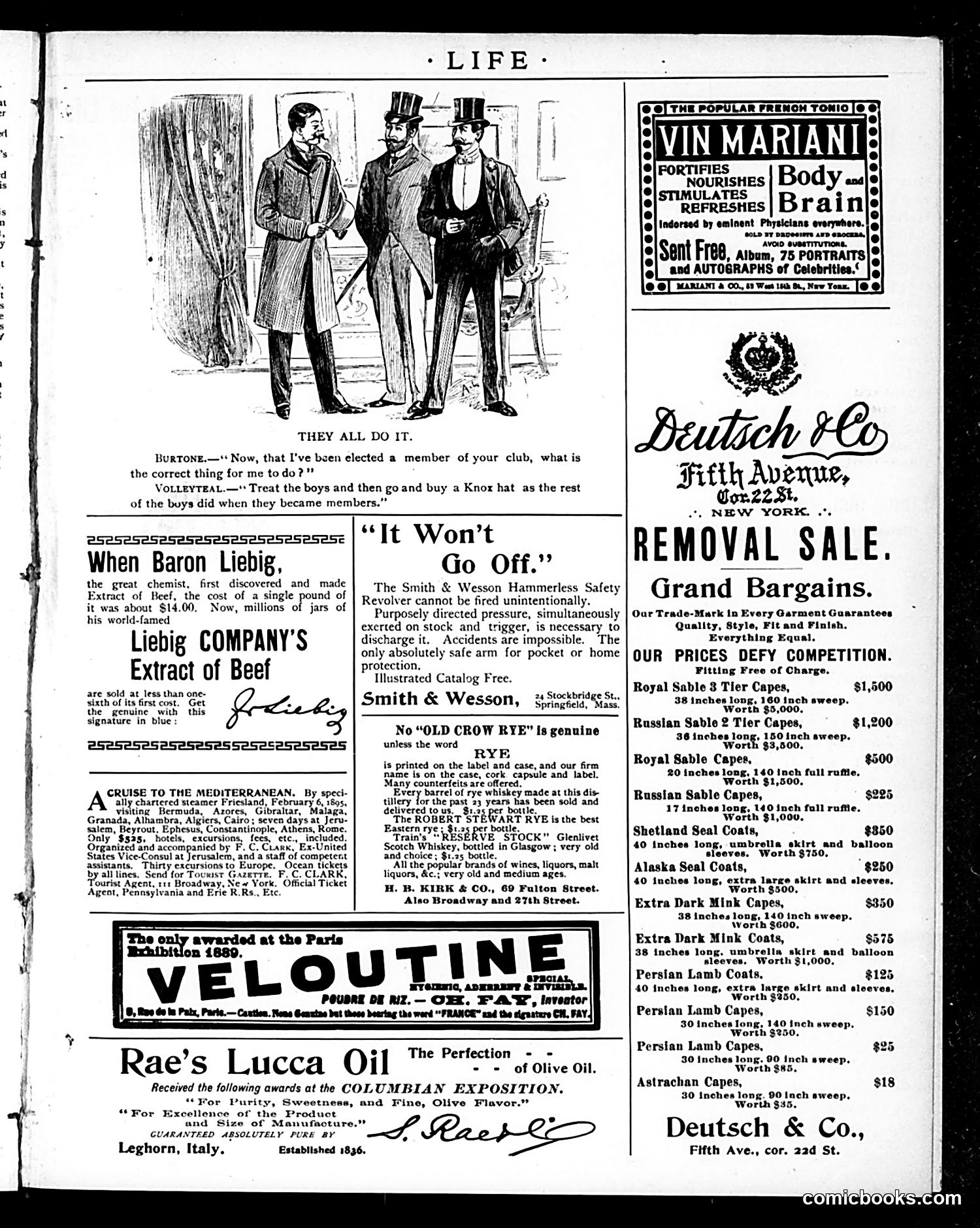
The cartoon depicts a club initiation scene. A newly elected member (Burtone) asks the established member (Volleyteal) what he should do as a new initiate. The response satirizes conformist peer pressure: treat the other members to drinks, then buy a Knox hat—because that's what all the previous new members did. The joke targets ritualistic club behavior and mindless conformity. The title "They All Do It" suggests this is universal male club practice: initiates are pressured into identical social performances (buying drinks, purchasing the same brand of hat) as proof of membership. This reflects late 19th-century concerns about how exclusive clubs enforced social conformity and consumption patterns among affluent men. The satire mocks the assumption that joining requires abandoning individual choice in favor of prescribed ritualistic behavior.
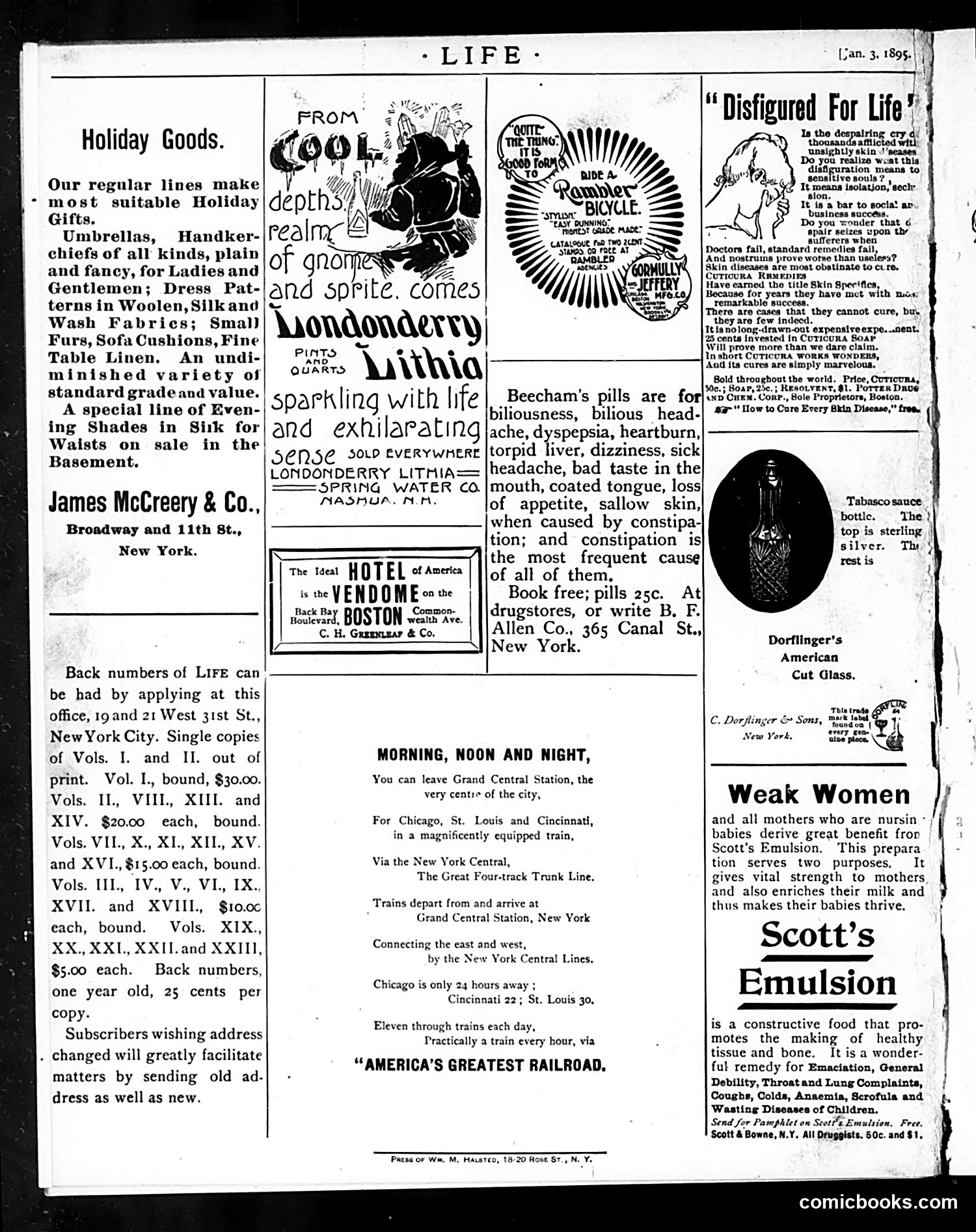
This page is primarily **advertisements and back-matter**, not satirical content. It contains: **Ads for consumer goods** (James McCreery department store, hotels, railroads) typical of 1890s commercial magazines. **Patent medicine advertisements** dominating the right side—Beecham's Pills, Cuticura remedies for skin diseases, and Scott's Emulsion for weak women and nursing mothers. These reflect the era's widespread medical quackery; products made sweeping health claims without regulation. **One illustrated advertisement** for Londonderry Lithia sparkling water, featuring whimsical sprite-like figures and claims about mental vitality—typical pseudo-scientific marketing of the period. The **"Disfigured for Life" Cuticura ad** plays on anxieties about appearance and desperation when conventional medicine failed, exploiting readers' vulnerabilities to sell unproven treatments. This page demonstrates how Life's business model relied on lucrative patent medicine advertising, which was common and largely unregulated in the 1890s.